
Moon Picke independently researches products. If you buy through our links, we may earn a commission at no extra cost to you. Read our affiliate disclosure.
REP PR-1100 review: this guide covers REP’s PR-1100 Power Rack, a four-post home cage with a manufacturer-rated 700 lb rackable capacity, pin-pipe safeties, plastic-lined J-cups, and a multi-grip pull-up arch. It is for barbell trainees building a long-term home gym who want documented 1000-series attachments without a 3×3 custom builder. The strongest documented advantage is that full-cage layout plus numbered 2×2 uprights in a compact listed footprint. The biggest limitation is official: you cannot bolt this rack down, banded work is not recommended at 130 lb product weight, and the listed working depth is 24 inches. Moon Picke has not assembled or loaded this rack. See how Moon Picke evaluates products.
As an Amazon Associate I earn from qualifying purchases.
See the REP PR-1100 on Amazon →
REP PR-1100 Review: Quick Verdict
Is the REP PR-1100 worth buying? Consider it if you want a full power cage for squats, bench work, and pull-ups, a 700 lb manufacturer-rated rackable capacity, included safeties and J-cups, and a path into 1000-series attachments. The trade-off is geometry and setup: a 24-inch official working depth, 3-inch hole spacing, no floor-bolt option, and official advice against muscle-ups and banded movements. Skip it if you need a bolt-down 3×3 system, kipping work, or a deeper in-rack workspace. Buy it as a documented compact cage, not as a PR-4000 substitute.
REP PR-1100
Is the REP PR-1100 worth buying? Consider it if you want a full power cage for squats, bench work, and pull-ups, a 700 lb…
- Full four-post cage with included pin-pipe safeties, plastic-lined J-cups, and a multi-grip pull-up arch.
- Manufacturer-rated 700 lb rackable capacity on documented 2×2, 14-gauge uprights.
- 1000-series attachment path (lat/row, dip, landmine, storage) without buying a 4000-series builder.
Affiliate link. Moon Picke may earn a commission from qualifying purchases.
What Is the REP PR-1100?
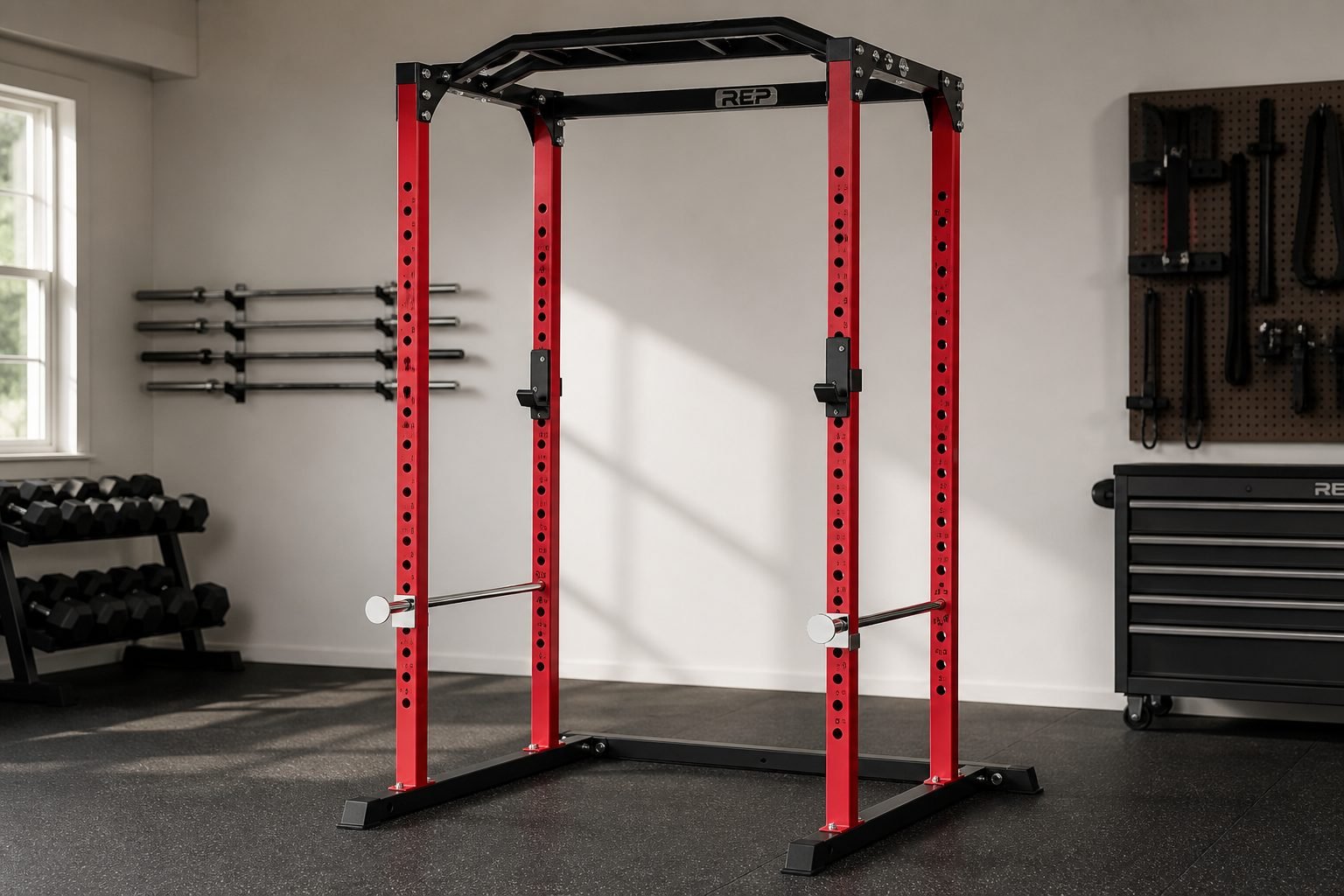
This REP PR-1100 review covers a full four-post power rack, not a folding wall unit and not a two-post squat stand. REP’s product page lists 2×2-inch 14-gauge steel, 3-inch hole spacing, 1-inch holes, 3/8-inch hardware, a 700 lb rackable capacity, and a 130 lb rack weight. Included hardware is pin-pipe safeties and J-cups. The pull-up system is a multi-grip arch with traditional, neutral, close, and wide positions, plus a 1.25-inch bar in front and a 2-inch bar in back. Official add-ons in the 1000 series include dip, lat and low row, weight storage, landmine, weight horns, cannonball grips, extra pin-pipe safeties, and standard J-cups.
Official colors are metallic black, red, blue, and matte black. The Amazon path verified here is Red, no bench, ASIN B07KX7FQRJ, sold by Rep Fitness with Add to Cart. Some Amazon copy still describes black powdercoat on this Red SKU; follow the selected color.
Key Specifications
Figures come from REP’s current PR-1100 product page and official dimension diagram unless noted as Amazon listing figures. Amazon dimensions on this SKU do not match official tech specs; both are listed.
| Spec | Official / listing figure |
|---|---|
| Product | REP PR-1100 Power Rack; Amazon Red, no bench, ASIN B07KX7FQRJ |
| Height / width / depth | Official: 85 × 58.1 × 48.5 in. Amazon: 80.5 × 48 × 47.5 in |
| Working area | Official: 44 in W × 24 in D × 79 in H. Amazon inside: 44 in W × 45.5 in D |
| Product weight | Official: 130 lb |
| Uprights | 2×2 in, 14-gauge steel |
| Hole size / spacing / hardware | 1 in holes; 3 in spacing; 3/8 in hardware |
| Rackable capacity | Manufacturer-rated 700 lb |
| J-cup / safety capacities | Not listed separately on the official spec block |
| Pull-up bar | Multi-grip arch; 1.25 in front, 2 in rear. Amazon lists 400 lb for the arch; not on official tech specs |
| Safeties / J-cups | Included pin-pipe / extended chrome safeties and plastic-lined J-cups (pair) |
| Anchoring | Official FAQ: cannot bolt down |
| Warranty | REP table: rack and functional trainer frames, lifetime* (original purchaser) |
Check the current Amazon Red listing →
Dimensions and Required Training Space
Official overall size is 85 inches high, 58.1 inches wide, and 48.5 inches deep, with a listed working area of 44 × 24 × 79 inches. The 58.1-inch width is the base, wider than the 44-inch rackable width between uprights. Product height is not required room height: pull-ups still need body clearance above the arch, and inverted mounting is the official low-ceiling option.
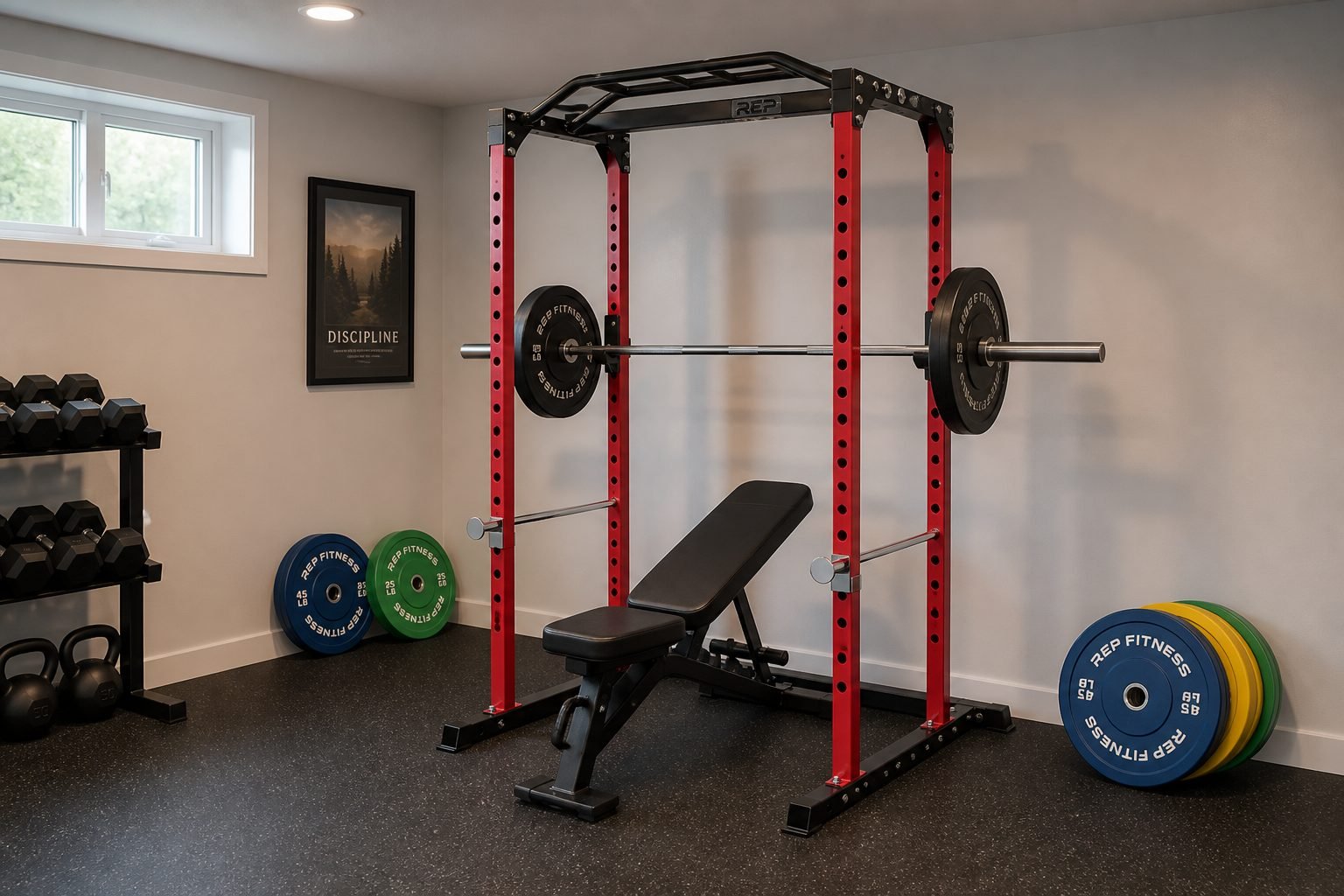
Rack footprint alone is not enough. You still need room for the bar (typically longer than 44 inches of inside width once plates are on), plate loading beside the uprights, a bench, the lifter, and a walk path. A 24-inch official working depth is shallow for in-cage travel. The REP AB-3100 adjustable bench is officially 50.5 inches long—longer than that working depth—so in-rack bench geometry is a measurement job, not a given. Amazon’s 45.5-inch inside depth does not match the official 24-inch working depth. Moon Picke will not invent a reconciliation. Use the official diagram for planning, then tape your floor.
Upright Size, Hole Spacing and Why They Matter
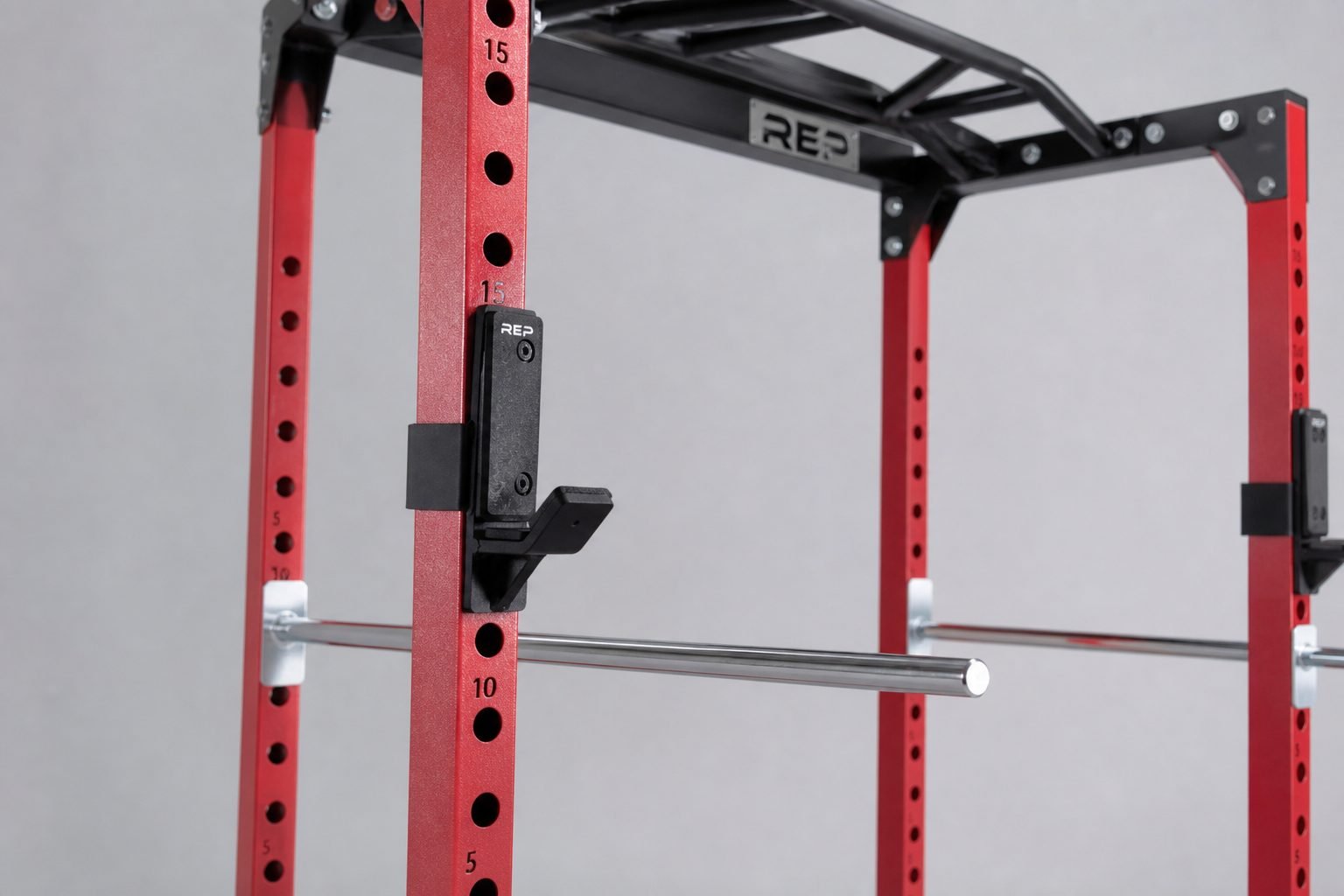
Official uprights are 2×2-inch, 14-gauge steel with 1-inch holes on 3-inch centers and 3/8-inch hardware. Numbered uprights (laser-engraved) are for matching J-cup and safety heights. Three-inch spacing is coarser than 1-inch Westside bench-zone spacing on REP’s 4000 series. That affects how closely you can set rack height and safeties; it is not automatically worse, but it is less granular.
Same hole diameter does not mean universal attachments. Fit depends on upright size, hole size, spacing, and series. Official compatibility language for this cage is the 1000 series, not 4000/5000 hardware. Do not assume a 3×3 sandwich J-cup or Ares cable will mount.
J-Cups and Safety System
The Amazon Red listing includes one rack, an integrated pull-up bar, two J-cups, and two full-length safety bars. Official copy describes plastic-lined J-cups and chrome-plated extended / pin-pipe safeties that can hold an extra barbell, with the note that J-cups are gentler on the bar. Moon Picke has not loaded either part. Safeties help only when they are fully installed at a height that matches the lift and the manufacturer’s hardware. Do not lift on damaged cups or pins, do not modify holes, and do not treat a 700 lb rackable rating as a separate, unpublished J-cup or drop rating.
Using the Rack for Squats and Bench Press
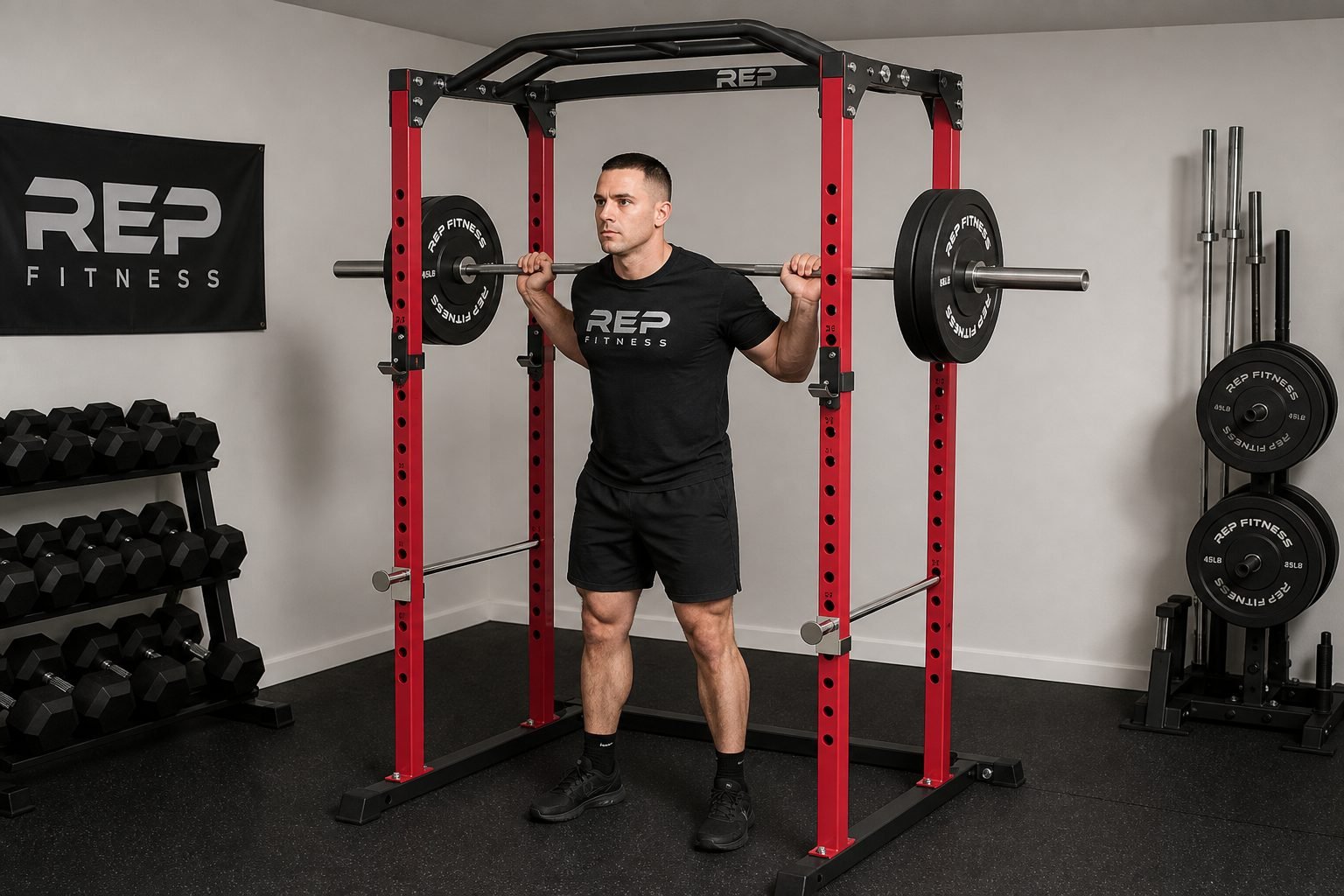
For squats, the cage supplies adjustable J-cup heights, a 79-inch listed working height, and pin-pipe safeties between the front and rear uprights. Set safeties for the lift; this article will not prescribe hole numbers. For bench press, compare bench length, pad height, rear base rails, and the 24-inch official working depth. A rack and a bench can each match their own spec sheets and still conflict. The AB-3100’s 23-inch rear width and 50.5-inch length must be checked against this cage’s 44-inch inside width and shallow listed depth before you assume a centered in-rack press.
Pull-Up Bar and Overhead Clearance
The official arch supports traditional, neutral, close, and wide grips, with 1.25-inch and 2-inch bar diameters. Attachment points for pull-up bands are documented. Invert the arch to lower overall height for shorter ceilings or shorter athletes; REP does not publish a single inverted-height number on the tech spec block, so this review will not invent one. Amazon lists 400 lb for the pull-up arch; that figure is not on the official spec table. Do not treat either number as a kipping or muscle-up rating: official FAQ says muscle-ups are not recommended and points kipping-style work to PR-4000 or PR-5000. Overhead body clearance can require much more than 85 inches of product height once arms, head, and light fixtures are in the path.
Does the Rack Need to Be Bolted Down?
Does the REP PR-1100 need to be bolted down? Official FAQ: no—you cannot bolt it down. That is a constraint, not a promise that every setup is stable. Stability still depends on loading, attachments, exercise, floor, and whether you add rear weight storage. Official copy says banded movements are not recommended because of the 130 lb mass and tipping risk; band-peg holes are omitted for that reason. TRX-style straps are allowed only if you properly weigh the rack down. Adding a lat tower or plate storage can change how the cage behaves; follow each attachment’s instructions instead of assuming the base cage’s free-standing FAQ covers every add-on.
Attachments and Upgrade Potential
Documented 1000-series options include dip, plate-loaded lat/low row, selectorized lat/low row, weight storage, landmine, horns, and extra J-cups. Match 1000-series parts; do not treat 4000/5000 attachments as guaranteed fit. Amazon’s 250 lb lat figure is an add-on listing number, not the cage’s 700 lb rackable rating.
Power Rack vs Squat Stand
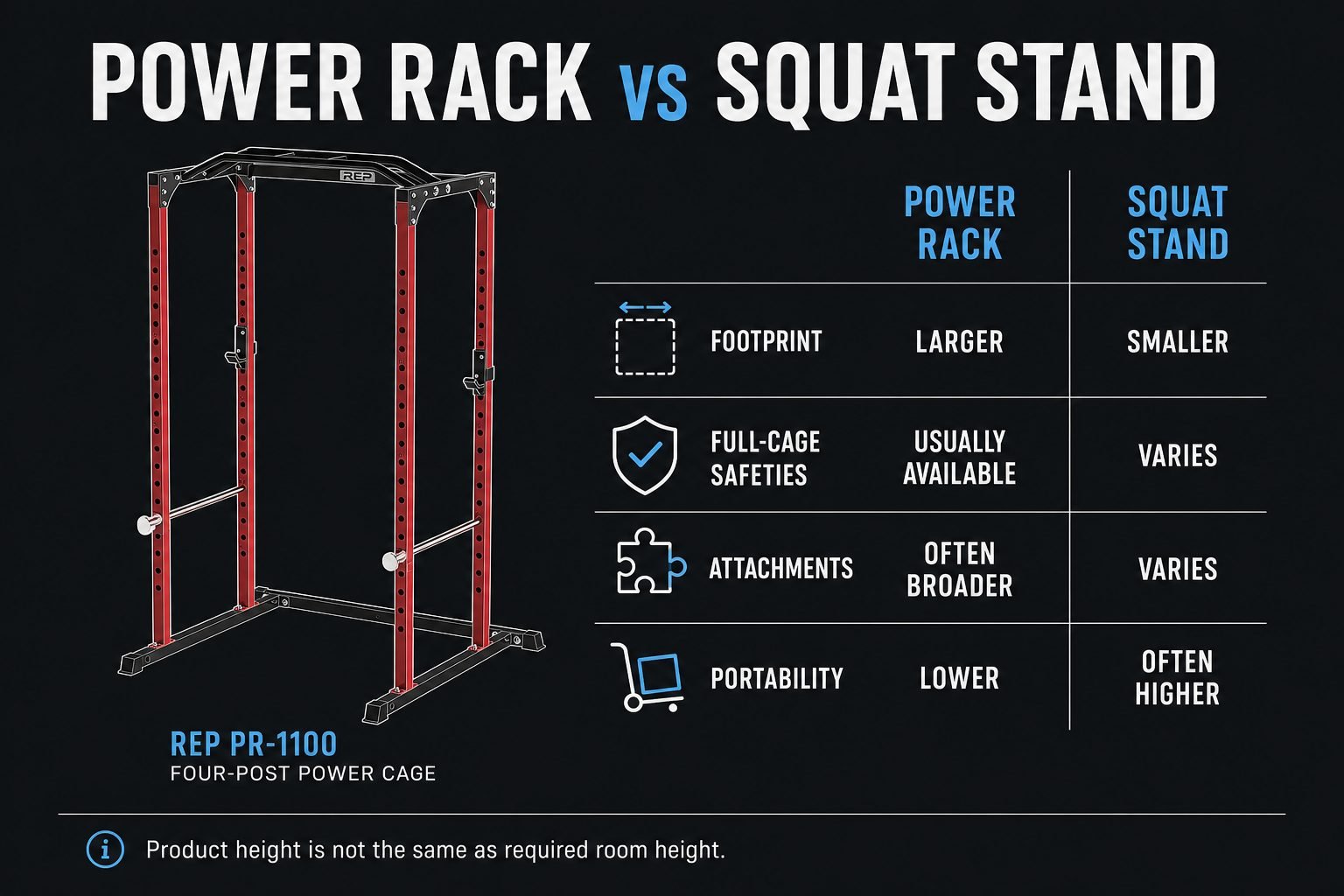
| Factor | Power rack (this PR-1100 class) | Squat stand |
|---|---|---|
| Footprint | larger (48.5 × 58.1 in official) | smaller |
| Full-cage safeties | usually available (pin-pipe included here) | varies |
| Attachments | often broader (1000 series here) | varies |
| Stability | design-dependent; this model cannot be bolted | design-dependent |
| Portability | lower (130 lb official) | often higher |
| Space efficiency | lower | higher |
| Best fit | dedicated home gym | smaller/flexible setup |
Power racks are not universally better. They win when you want an enclosed working area and in-cage safeties. A squat stand wins when floor space and moving the unit matter more.
Power rack vs half rack
A full rack encloses the lifter on four posts and typically offers front-to-rear safety bars. A half rack is more open and often shallower. The PR-1100 is a four-post cage with a shallow official working depth, so it is not a half rack, but its 24-inch listed interior is tighter than many deeper 30- or 41-inch four-posts.
Flooring, Ceiling Height and Room Planning
Use a level, suitable lifting floor. Moon Picke will not claim ordinary residential slabs support every rack-and-load combination. Account for flooring thickness, lights, and fans when comparing the 85-inch official height plus pull-up travel. Place the cage so plates can be loaded without hitting walls. Rear base width (58.1 inches) can interact with nearby benches or dumbbell trays, including a pair of adjustable dumbbells.
What It Does Well — and Its Main Limitations
What It Does Well
- Full four-post cage with included pin-pipe safeties, plastic-lined J-cups, and a multi-grip pull-up arch.
- Manufacturer-rated 700 lb rackable capacity on documented 2×2, 14-gauge uprights.
- 1000-series attachment path (lat/row, dip, landmine, storage) without buying a 4000-series builder.
- Compact listed footprint (48.5 × 58.1 in) and an invert-the-arch option for lower ceilings.
- Cannot-bolt FAQ is explicit, so buyers are not left guessing about floor anchors that do not exist.
Important Limitations
- Cannot be bolted down. Official. Banded work is not recommended; muscle-ups are not recommended.
- 24-inch official working depth versus a 48.5-inch overall depth—tight for in-cage benching with a long bench.
- 3-inch hole spacing is less precise than 1-inch bench-zone racks.
- Amazon vs official dimensions disagree (80.5×48×47.5 vs 85×58.1×48.5; 45.5 vs 24 in inside depth).
- No included weight horns (those are a PR-1000 difference / optional 1000-series storage).
- Optional attachments add cost and can change stability rules.
See Amazon availability for the Red PR-1100 →
Who Is the REP PR-1100 Best For?
Best for serious home-gym owners who train squat and bench with a barbell, want cage safeties and a pull-up bar, have dedicated floor for roughly 4×5 feet plus loading space, and may add 1000-series attachments later. It fits buyers who accept a 700 lb manufacturer-rated rackable limit and a compact, non-bolted 2×2 cage.
Who should skip it? Very small apartments; dumbbell-only trainees; anyone who must bolt a rack; kipping or muscle-up users; low ceilings that still fail after inverting the arch; buyers who need 1-inch hole spacing or 3×3 4000-series attachments; people who need a highly portable stand.
Is the REP PR-1100 Worth Buying?
This REP PR-1100 review’s answer is conditional. Worth considering if 85 × 58.1 × 48.5 inches plus barbell and bench clearance fit, ceiling height works with or without an inverted arch, barbell work is central, included safeties matter, 1000-series upgrades match your plan, and 700 lb rackable is enough under REP’s instructions. Skip if space is tight, the 24-inch working depth conflicts with your bench, dumbbells are enough, you need floor bolts, or you were shopping for a PR-4000-class 3×3 ecosystem.
Final Verdict
This REP PR-1100 review lands on a compact four-post home cage, not a bolt-down 3×3 platform. REP’s PR-1100 puts a 700 lb manufacturer-rated rackable capacity, pin-pipe safeties, plastic-lined J-cups, and a multi-grip arch on 2×2, 14-gauge uprights. The strongest advantage is that documented starter-cage package plus 1000-series expansion. The biggest limitation is official and geometric: no bolting, no recommended banded or muscle-up use, and a 24-inch listed working depth. If that is your home gym, the current Amazon Red no-bench listing (ASIN B07KX7FQRJ) is the purchase path Moon Picke verified as in stock with checkout.
See the REP PR-1100 Red rack on Amazon →
Frequently Asked Questions
Is the REP PR-1100 worth buying? Yes if you want a compact four-post cage with included safeties and a 700 lb manufacturer-rated rackable capacity. No if you need bolting, deeper in-rack space, or 4000-series attachments.
What is its maximum load rating? Official rackable capacity is 700 lb. J-cup and included-safety capacities are not listed separately on the spec block. Do not exceed documented limits.
Does it need to be bolted down? No. Official FAQ: you cannot bolt the PR-1100 down. Weigh it down if using straps as instructed; do not assume that covers every attachment.
What size are the uprights? Official: 2×2-inch, 14-gauge steel, 1-inch holes, 3-inch spacing.
What attachments fit it? Official 1000-series options such as dip, lat/low row, weight storage, landmine, and horns. Not universal 4000/5000 fit.
Can it be used for bench press? As a cage with J-cups and safeties, yes in category terms. Compare your bench to the 24-inch official working depth and 44-inch inside width first.
How much ceiling height does it need? Official product height is 85 inches, plus pull-up clearance. Invert the arch for lower rooms; REP does not list one inverted number on the spec table.