
Moon Picke independently researches products. If you buy through our links, we may earn a commission at no extra cost to you. Read our affiliate disclosure.
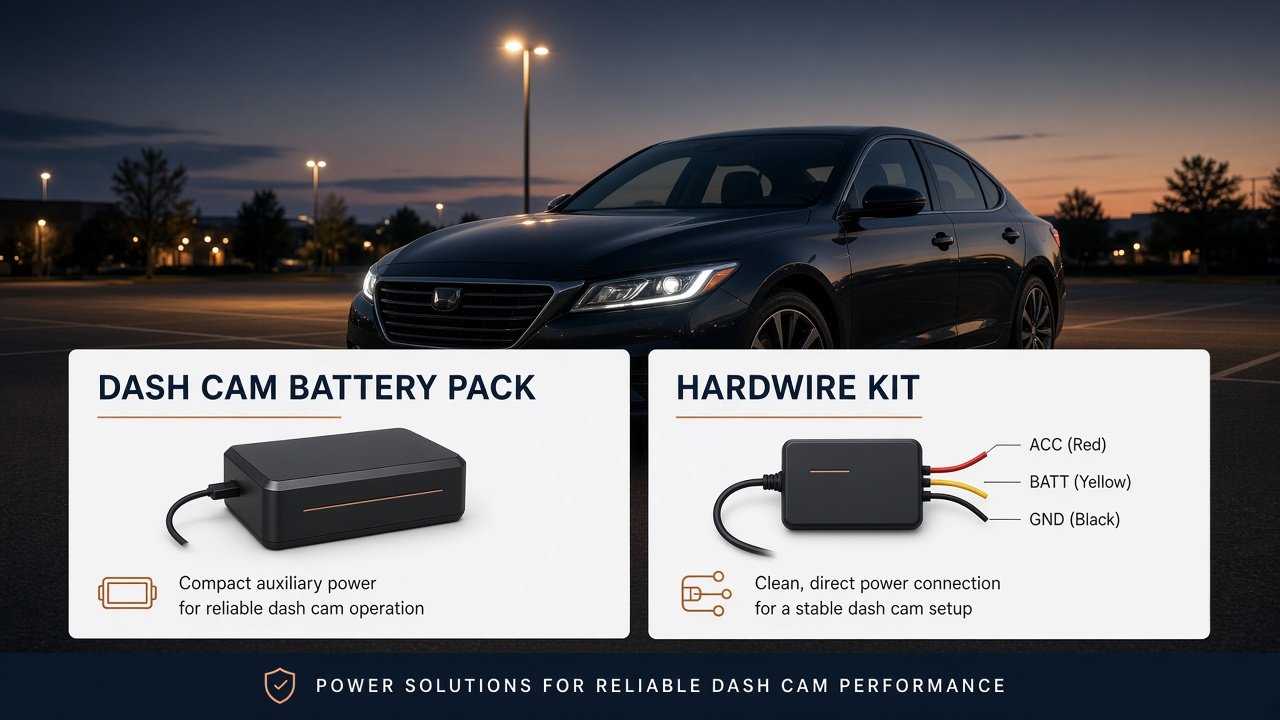
Choosing a dash cam battery pack vs hardwire kit for parking mode is an energy-system decision, not a camera-quality decision. A hardwire kit feeds the dash cam from the vehicle electrical system—typically constant power, an ACC/ignition signal, and ground. A dedicated dash cam battery pack charges while you drive and powers the camera while parked. There is no universal winner. Parking duration, starter-battery use, daily driving, cutoff settings, pack capacity, and camera load all change the result.
Moon Picke has not installed these accessory kits. Facts follow manufacturer documentation for Thinkware and BlackVue accessories used around cameras already reviewed here. This is not a fuse-tap tutorial, not hardwire versus OBD, and not a pack roundup.
Dash Cam Battery Pack vs Hardwire Kit: Quick Answer
Choose a hardwire kit when overnight parking is the goal, lower cost matters, vehicle-battery use with a cutoff is acceptable, and you want fewer cabin boxes. Choose a parking mode battery pack when long parked sessions are common, starter-battery independence is a priority, LTE or cloud may stay active, and extra cost and hardware are acceptable.
A pack does not automatically mean longer parking recording. A hardwire kit does not automatically mean unsafe drain. Results depend on camera draw, parking mode, vehicle use, cutoff, capacity, charge rate, temperature, and configuration.
Is a dash cam battery pack better than hardwiring?
Only if parked hours, camera load, and daily drive time match what the pack can store and replenish. For many overnight parkers, hardwire plus a working cutoff is the more practical setup.
Does a hardwired dash cam drain the car battery?
It can draw from the vehicle battery while parked. Low-voltage cutoff is meant to stop the camera below a selected voltage. It does not guarantee the car will start or that the battery will not wear.
How long does a dash cam battery pack last?
Only as an estimate for a specific pack, camera, and test assumption. BlackVue rates the Power Magic Ultra Battery B-130X at about 30 hours (1-channel) and about 19 hours (2-channel) based on an assumed ~3 W dash cam. Thinkware rates the iVolt Mini (BAB-50) at about 20 hours (1CH) and 16 hours (2CH). Those are manufacturer conditions, not a universal clock.
Does a battery pack eliminate the need to hardwire?
No. Some packs charge from a cigarette socket. Thinkware’s iVolt Mini is designed to hardwire to the fuse box to charge. Faster charging often still means an electrical connection.
How a Dash Cam Hardwire Kit Works
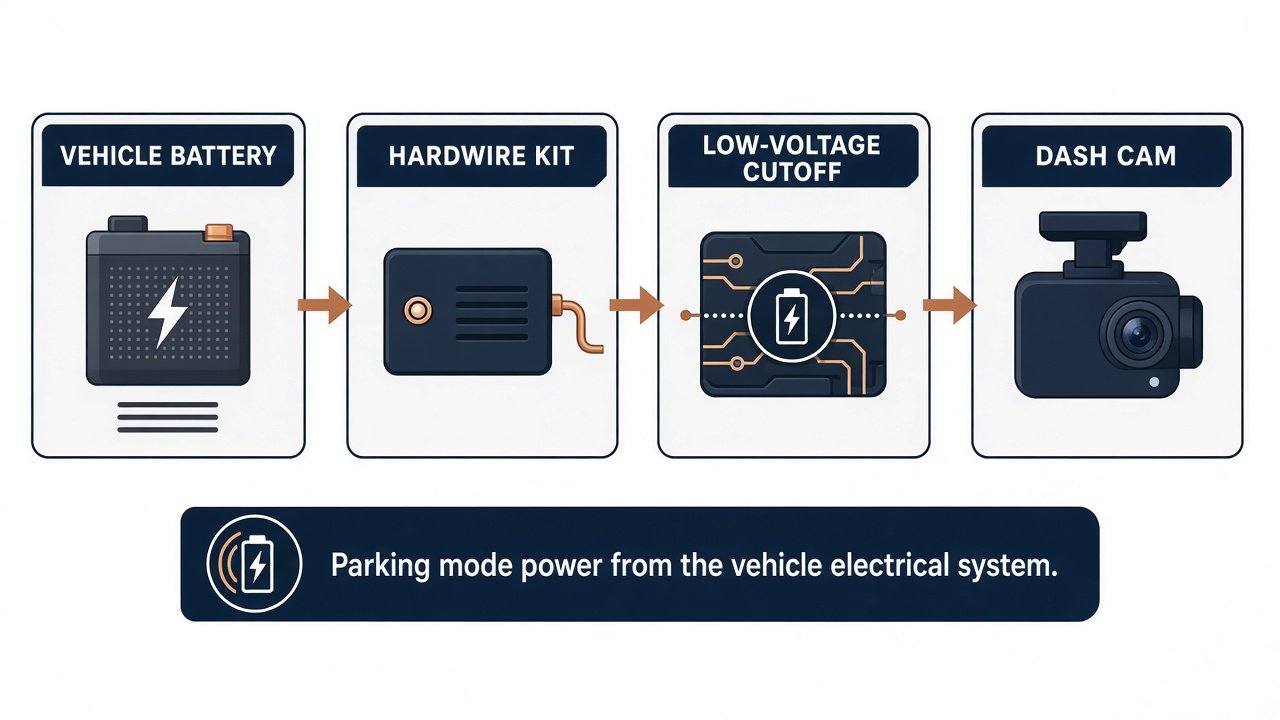
While driving, the vehicle electrical system powers the camera. When you park, a hardwire kit may keep supplying power from the vehicle battery so parking mode can continue. Many kits pass an ACC/ignition signal so the camera can switch modes automatically.
Low-voltage cutoff—when the camera or kit supports it—stops recording if voltage falls below a configured threshold. Power source is not battery protection. A hardwire dash cam parking mode install includes cutoff only if that system implements it and you set it.
Thinkware’s TWA-SH cable is a typical example: it connects a Thinkware camera to the fuse panel so parking surveillance can run with ignition off, and Thinkware documents that the camera voltage meter can shut the unit down at a configurable cutoff. That is camera-side protection on a vehicle-powered install, not identical behavior on every car.
If you already want vehicle-powered parking and only need to choose how to tap the car, see Dash Cam Hardwire Kit vs OBD Cable. This page stays on dash cam battery vs hardwire as the energy source.
As an Amazon Associate I earn from qualifying purchases.
See the Thinkware TWA-SH hardwiring cable on Amazon →
How a Dash Cam Battery Pack Works
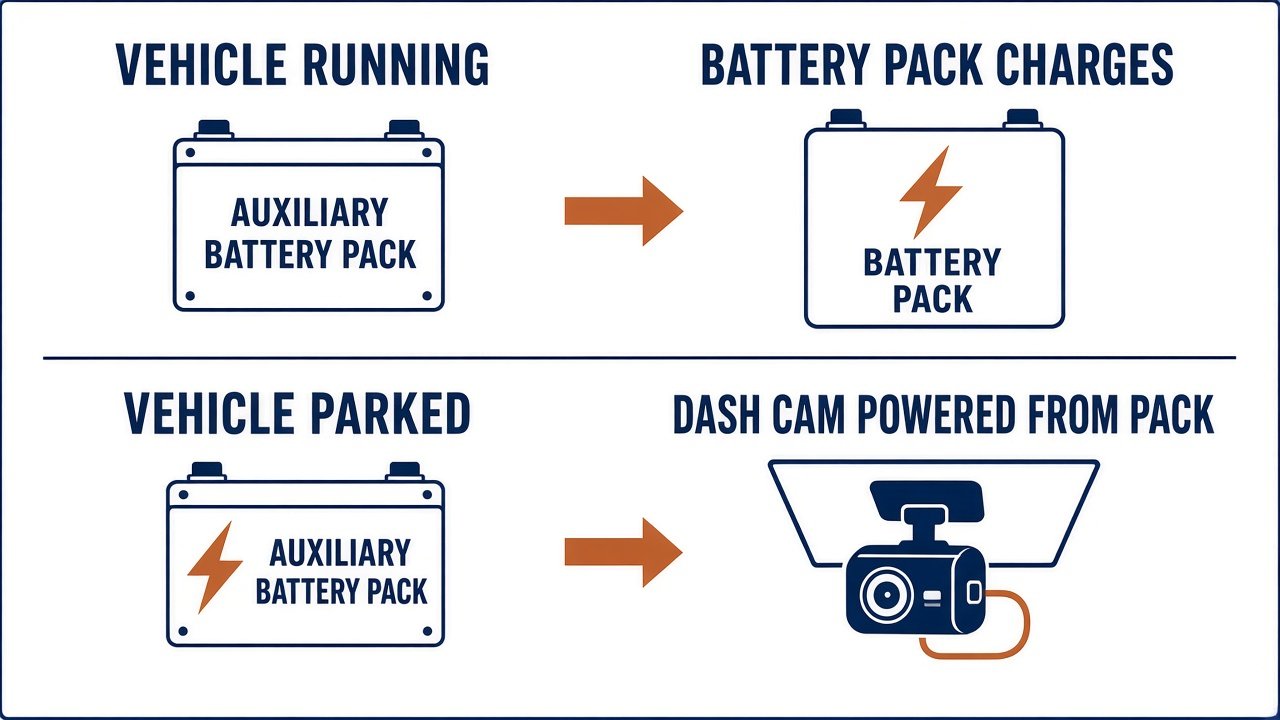
A dash cam external battery is a dedicated auxiliary pack for a dash cam. It is not a USB power bank, jump starter, EV traction battery, or the 12V starter battery. When vehicle power is available, the pack charges. When parked, the pack powers the camera so recording does not rely primarily on draining the starter battery.
That holds only if the pack has enough charge. Short driving may not refill it. Runtime depends on capacity and the driving/charging pattern—not on owning a pack alone.
BlackVue’s B-130X is a LiFePO4 pack listed at 12.8 V / 7,500 mAh / 96 Wh, with cigarette charging around 90 minutes at 5 A and hardwired charging around 50 minutes at 9 A. Thinkware’s iVolt Mini is LiFePO4 at 12.8 V / 4,500 mAh / 57.6 Wh, with an approximate 45-minute hardwire charge, and Thinkware states it requires fuse-box hardwiring (cable sold separately unless bundled). Prefer watt-hours here (96 Wh vs 57.6 Wh); do not compare mAh across different voltages without that context.
See the BlackVue B-130X Power Magic Ultra Battery on Amazon →
Battery Pack vs Hardwire Kit: Key Differences
Use the table as a map. Exact kits, cameras, vehicles, and settings override any row.
| Factor | Hardwire Kit | Battery Pack |
|---|---|---|
| Parking energy source | vehicle battery | dedicated auxiliary battery |
| Upfront cost | generally lower | generally higher |
| Extra hardware | minimal | battery unit required |
| Vehicle-battery dependence | yes, while parked | reduced while parked |
| Runtime | vehicle and cutoff dependent | capacity and load dependent |
| Recharge requirement | no dedicated pack | yes |
| Long parking use | limited by cutoff and battery state | potentially stronger if charged |
| Installation | electrical connection | pack plus charging connection |
| LTE use | possible | potentially useful as dedicated energy |
| Best fit | mainstream parking mode | extended or connected parking |
A poorly set cutoff can still leave a vehicle battery low. A large pack with a short commute can still be empty by midweek.
Which Setup Gives Longer Parking Mode?
It depends. The question is which energy store can support your camera’s draw for your parked hours, then recover before the next park.
Processor, sensors, Wi-Fi or LTE, and parking mode all affect draw. Channel count can raise demand without a clean multiplier: a 4-channel system does not automatically use four times 1-channel power. Vehicle battery condition, cutoff, and parked time constrain hardwire. Pack capacity, charge rate, and drive time constrain packs. Temperature and battery age affect both.
Thinkware has described hardwired parking without an auxiliary pack as on the order of about eight hours depending on the vehicle battery—a vendor estimate, not a Moon Picke test. Pack hours assume stated loads. Cloud Live View or heat moves the clock. Camera-mode shopping stays on Best Dash Cam for Parking Mode; this page owns parking mode power.
Does Hardwiring Drain Your Car Battery?
A hardwired parking camera can draw from the vehicle battery while the car sits. That battery is designed primarily to start the engine and support vehicle electronics. It is not fragile by default, and a dash cam does not automatically damage it. A weak or heavily loaded battery is a different case from a healthy overnight park.
Low-voltage cutoff is meant to stop the camera before voltage falls below a selected threshold. It does not guarantee a start, no wear, complete prevention of discharge, or identical results across vehicles. Condition, temperature, other electronics, the cutoff you chose, and parking duration all matter.
Does a Battery Pack Protect the Starter Battery?
It can reduce reliance on the starter battery while parked, because the parking load is meant to come from the auxiliary pack. That is why people buy a dash cam battery pack parking mode setup. It is not complete electrical isolation unless the exact architecture documents that parked operation never draws the starter battery—and charging hardware still connects when you drive.
Thinkware tells iVolt users to disable the camera’s voltage cut-off, off-timer, and similar protections so the camera does not shut down while the pack still has energy. Follow the pack maker’s pairing notes.
See the Thinkware iVolt Mini external battery on Amazon →
The Hidden Issue: Battery Pack Recharge Time
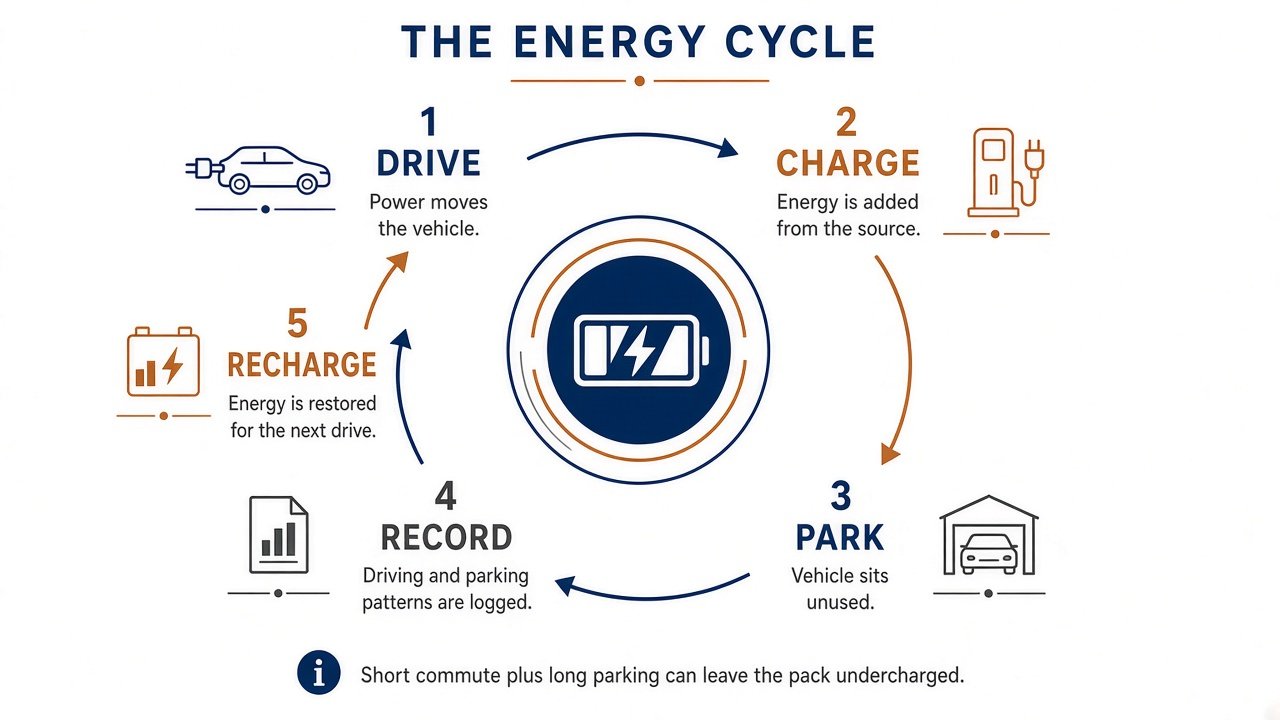
This is the highest-value part of a dash cam battery pack vs hardwire kit decision. A pack stores finite energy. Parking spends it. Driving is supposed to put it back. If parking uses more than daily driving replenishes, charge declines even when the hardware works.
B-130X charge times (~90 minutes at 5 A from a cigarette socket, ~50 minutes hardwired at 9 A) and the iVolt Mini ~45-minute hardwire charge are full-charge estimates under manufacturer conditions—not “one commute always fills it.” A 15-minute trip does not become a 45-minute charge because a spec sheet says 45 minutes. Input current, vehicle state, temperature, and remaining capacity change the clock.
Do you drive long enough each day to replenish parked energy? Short commute plus long parking is the failure pattern. Longer daily driving makes pack ownership more realistic. Hardwire needs no auxiliary recharge cycle, but it draws the vehicle battery while parked, subject to cutoff. No universal winner—only drive, charge, park, record, repeat.
How Parking Mode and Camera Channels Affect Runtime
Motion detection, impact-triggered recording, time-lapse, low-bitrate parking files, and buffered events are different jobs. This page does not rank wattage without manufacturer data. Continuous parked recording is generally a heavier energy job than sparse events—verify the mode your camera actually uses.
1CH through 4CH systems can differ because extra cameras and processing are extra hardware. They do not scale as channel-count times one. Processor, sensors, radios, firmware, and resolution share the budget. See 1-Channel vs 2-Channel vs 3-Channel Dash Cam.
LTE, cloud, notifications, and Live View can add draw; this page does not invent a watt penalty. If you want long parking runtime and remote connectivity, evaluate the whole power system. Pair that with LTE Dash Cam vs Wi-Fi Dash Cam. A BlackVue DR970X LTE install that stays reachable while parked is a different energy problem from a Wi-Fi camera that sleeps until you walk up.
Installation: Which Is Simpler?
No universal winner. Hardwire usually means fewer boxes: fuse-area connection, ACC and constant power, ground, routing, and cutoff settings. A pack adds a unit, charging connection, camera output, routing, and placement. It does not necessarily eliminate hardwiring. BlackVue documents cigarette and hardwire charging for the B-130X, with hardwire specified as faster. Thinkware documents the iVolt Mini as hardwired charging. This is not a vehicle-specific wiring guide.
Heat and Battery Placement
Packs have charging and operating limits that matter in a hot parked cabin. BlackVue documents B-130X charging around 0–45°C and discharging around −10–60°C, with high-temperature cut-off behavior around 80°C. Thinkware lists iVolt Mini charging 0–45°C and discharging −10–60°C, with cell skin not exceeding 80°C. Those are envelopes—not a claim that every pack is safe in extreme heat, or that a pack is inherently dangerous, or that a supercapacitor camera erases pack heat concerns.
Keep the pack away from airbags, pedals, water, loose-object paths, and unsupported enclosed hot spots. Follow the maker’s mounting notes. Treat pack temperature as a parking-power constraint; a later hot-weather camera guide can cover glass-mounted heat separately.
What Does Each Setup Cost Over Time?
Hardwire is usually the kit plus install, including possible professional labor. A pack adds the pack, charging hardware, install, optional expansion in some ecosystems, and eventual replacement. This page does not invent average prices. A pack buys energy independence from the starter battery while parked—not better video.
Some older BlackVue Power Magic Ultra kits documented an expansion-battery port. Extra capacity can extend runtime and adds cost, space, weight, and more energy to put back. Do not treat expansion as infinite daisy-chaining. The Thinkware U3000 PRO review stays on the camera; buy power for how long the car sits and moves.
Battery Pack vs Hardwire for Different Drivers
Daily commuter, overnight parking: hardwire is sufficient in many cases if cutoff is set and the vehicle battery is sound. Airport-length parking: a charged pack is often more useful. LTE/cloud user: a pack can dedicate energy to radios that do not fully sleep. Short commute plus long parking: the pack may not refill; hardwire still uses the vehicle battery but has no second tank to fill. Budget buyer: hardwire is usually the simpler bill.
EV and hybrid architectures vary. Do not assume the traction battery powers the dash cam, or that parking drain matches an ICE 12V system. Check the vehicle maker, camera maker, and a qualified installer.
Which Should You Buy?
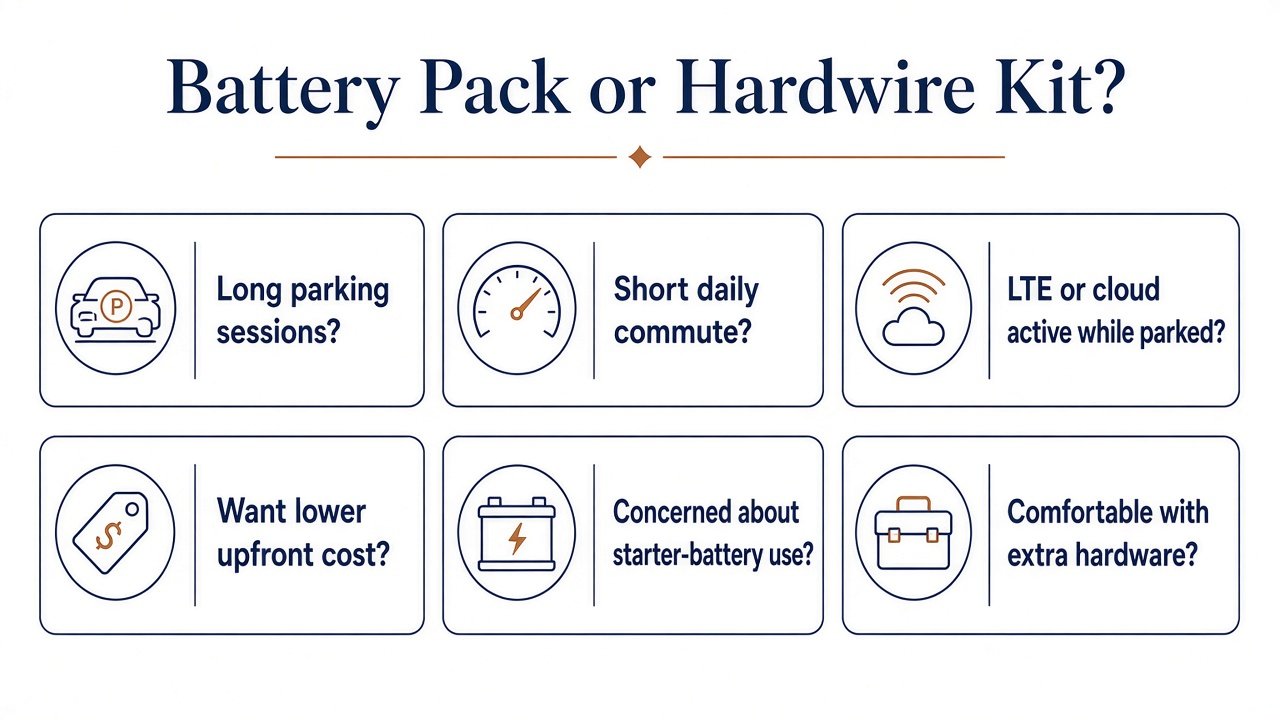
Ask: How long is the car parked? How long is it driven each day? Is LTE or cloud active while parked? How many channels, and which parking mode? Is vehicle-battery use acceptable? Is pack cost and space acceptable?
Ordinary parked hours, regular driving, and a cutoff you will set: start with a dash cam hardwire kit. Long parked hours, starter battery left out of that job, and enough driving to refill: a dedicated pack is the more coherent system. That is the real dash cam battery pack vs hardwire kit framework.
Final Verdict
On dash cam battery pack vs hardwire kit, there is no fake winner. Hardwire is the practical default for mainstream parking mode: lower hardware cost, automatic switching on many kits, and no second battery to refill. A dedicated pack is the upgrade when long or connected parking would otherwise spend starter-battery energy you do not want to spend—and only if the drive/charge loop can keep up. Choose the energy cycle. Do not choose a slogan.
FAQ
Is a dash cam battery pack better than a hardwire kit?
Not automatically. It is better when you need dedicated parked energy and you recharge enough. Hardwire is often better for cost and simplicity on typical overnight parking.
Does a hardwired dash cam drain the car battery?
It can, until cutoff or a timer stops the camera. Cutoff reduces risk; it does not erase it.
How long can a dash cam battery pack power parking mode?
Only under stated conditions. Use the maker’s hours as estimates, then adjust for channels, LTE, mode, heat, and age.
Does a battery pack need to be hardwired?
Some charge from an accessory socket; some hardwire to charge. The iVolt Mini is documented as hardwired charging. Faster charge often still means a wired install.
Can a dash cam battery pack charge while driving?
Yes—that is the intended cycle. Short trips may not complete a full charge.
Is a battery pack worth it for LTE dash cams?
It can be if capacity and driving refill the extra connected load.
Can I use a normal USB power bank?
No. USB banks, jump starters, and EV traction batteries are not dedicated 12V dash cam packs.
Sources: Thinkware iVolt Mini specifications; Thinkware TWA-SH parking/cutoff documentation; BlackVue B-130X capacity and charge-path documentation as cited above.