
This SimPure review is a brand-level buying guide, not a lab report. SimPure sells several water-treatment formats — countertop reverse osmosis, under-sink tankless RO, and whole-house sediment/carbon filtration — and those systems do different jobs. Moon Picke did not independently lab-test SimPure products and did not install them. Start with your water source and the problem you can document, then pick a treatment point and technology. Specs below are from SimPure’s U.S. site, manuals, and listed support pages as of September 11, 2026.
Read How We Evaluate, our editorial standards, and the Affiliate Disclosure. Related reading lives in Guides and Home & Living.
SimPure Review: Quick Verdict
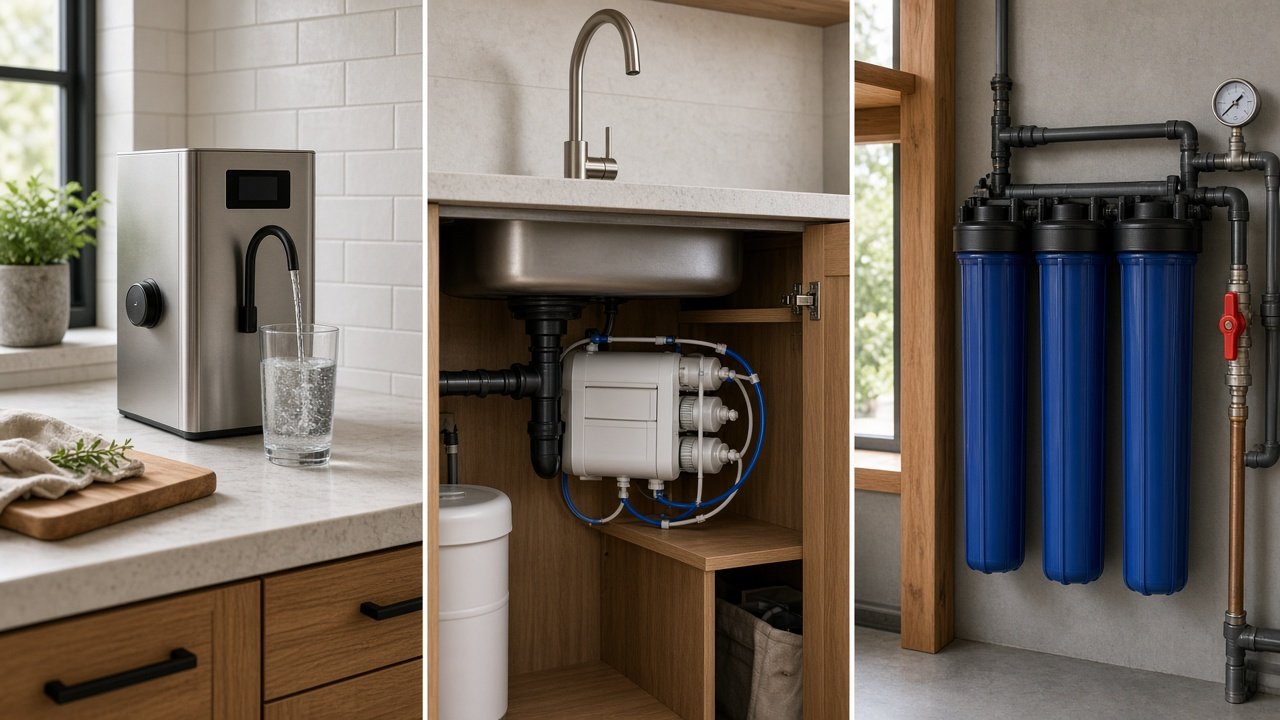
SimPure is worth considering if you already know whether you need point-of-use drinking-water RO or point-of-entry whole-house filtration, and you accept replacement filters plus (for RO) wastewater and electricity. It is a weaker fit if you have not read a utility Consumer Confidence Report or a certified well test, or if you expect one box to treat every contaminant. Main strength: a documented U.S. catalog that covers countertop RO, under-sink tankless RO, and 20-inch whole-house housings, with manuals, replacement filters, and a published warranty path. Main limitation: model names look similar while technologies do not, and “NSF/ANSI 58” on SimPure product pages is not the same as an NSF International system listing. This SimPure review does not name a single best model.
What Kind of Water-Filtration Brand Is SimPure?
SimPureLife.com is a functioning U.S. storefront with product pages, manuals, live chat and phone (1-866-528-4572, 7 a.m.–7 p.m. PDT), and email at service@simpurelife.com. The site lists a Bellevue, Washington business office (Membrane Solutions Corp) and a Dallas, Texas SimPure Water LLC address. Support is verified as published contact channels — not as a Moon Picke service test. The catalog spans countertop RO dispensers, under-sink tankless RO, and whole-house Big Blue-style housings. That range is a real buyer convenience. It is not proof that every SKU performs the same, or that RO is required in every kitchen.
The official warranty page describes a 1-year warranty from the date of purchase on eligible items from simpurelife.com and authorized resellers, with an extra year after registration (the “1+1” offer). Claims from Amazon, Walmart, and eBay purchases are described as handled by SimPure. Terms, exclusions, and replacement rules should be read on that page; they are not identical for every defect scenario. Do not treat a blog’s stale warranty copy as current.
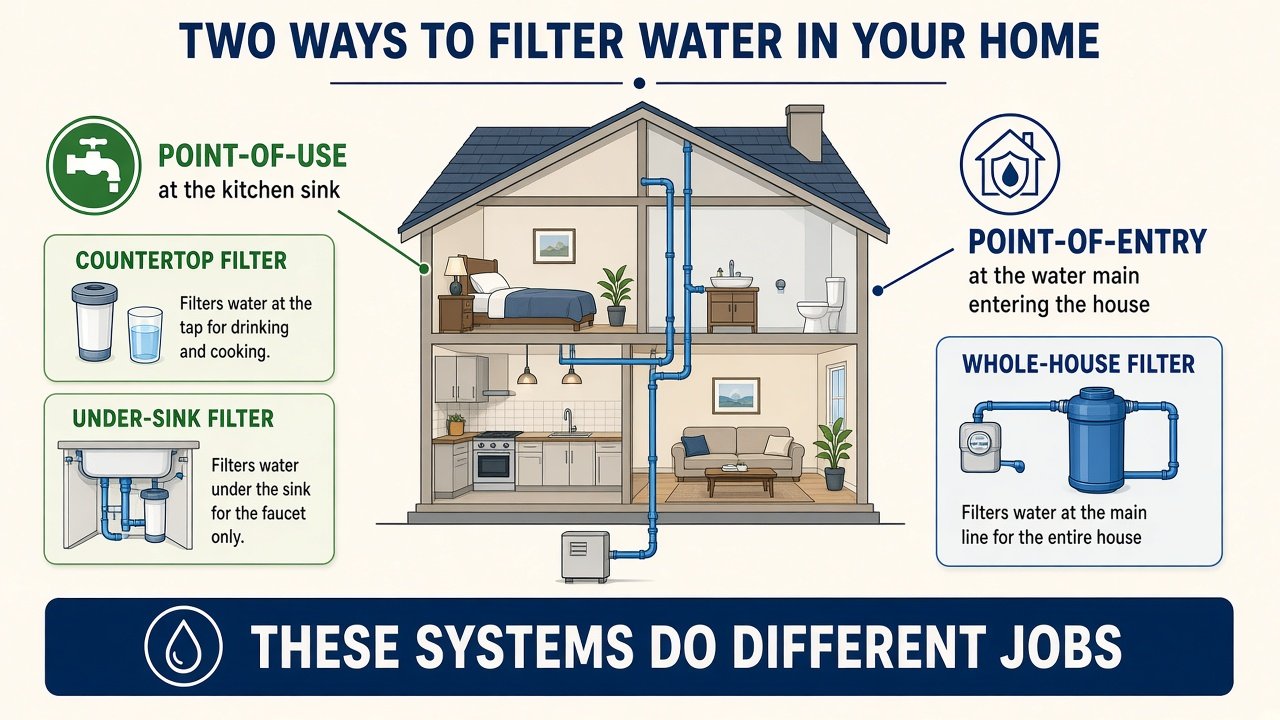
SimPure Product Types at a Glance
As an Amazon Associate I earn from qualifying purchases.
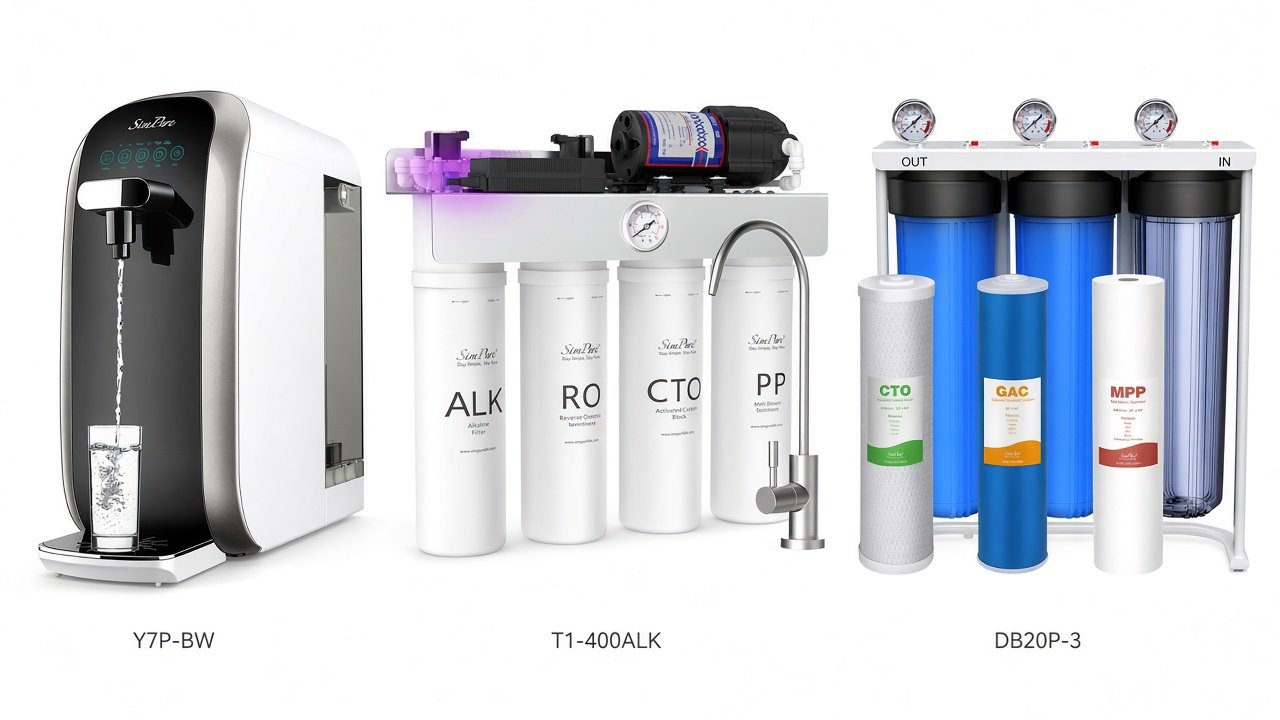
| SimPure System | Format | Treatment Point | Main Technology | Best Fit | Main Trade-Off |
|---|---|---|---|---|---|
| Y7P-BW | Countertop dispenser | Point-of-use | 5-stage RO (+ UV on this SKU) | Drinking/cooking water without under-sink plumbing | Counter space, refill tank, 4:1 drain, electricity |
| T1-400ALK | Under-sink tankless | Point-of-use | 8-stage RO + alkaline remineralization | Dedicated kitchen faucet, higher daily volume | Plumbing, drain, power, filter access |
| DB20P-3 | 20-inch 3-housing | Point-of-entry | PP sediment + GAC + CTO carbon | Whole-home particulate and chlorine/taste/odor use cases the media support | Not RO; will not reduce TDS the way RO does |
| If You Need… | Start With… |
|---|---|
| Drinking water without plumbing | Countertop point-of-use (example: Y7P-BW) |
| Dedicated kitchen drinking water | Under-sink RO (example: T1-400ALK) |
| Treatment at the main household entry | Whole-house filtration (example: DB20P-3) |
These rows are starting categories, not contaminant prescriptions. Confirm the exact Amazon carton is the complete system, New, not a replacement-filter kit.
SimPure Countertop Reverse Osmosis
The current Y7P-BW is SimPure’s countertop point-of-use example: a 5-stage RO dispenser SimPure lists with UV, no plumbing hookup, a 1.3-gallon feed tank, and a 0.45-gallon internal pure-water tank. Official spec table: about 18 × 8 × 16.1 inches, 14.8 lb, AC 110 V / 60 Hz, 30 W, feed TDS below 500 ppm, production up to 8.8 fl oz/min (listed as 100 GPD), 4:1 pure-to-drain. SimPure lists CF and RO filters at a 6-month replacement interval (also 528 gallons of purified water on related Y7P documentation) and twist-in CF/RO cartridges pre-installed. Auto dispense: 6 / 12 / 15 oz. Compatible replacements are the Y7 / Y7P-BW / Y7P-W kit — not a T1 cartridge. On September 11, 2026, simpurelife.com showed a $369.99 regular price and a $269.99 checkout price; pricing changes. Amazon listing B0BHZSJHWG is the complete Y7P-BW unit path we checked, not a filter-only ASIN. Moon Picke did not time a “30-second” setup. The architecture still treats one tap location, needs a refillable feed tank, electricity, and a drain path for concentrate. See SimPure Y7P-BW (ASIN B0BHZSJHWG) →
SimPure Under-Sink Reverse Osmosis
The T1-400ALK is the under-sink tankless example — a different T1 SKU from the T1-400 “nearly 0 TDS” variant. SimPure states the ALK model’s fourth/alkaline stage restores minerals (calcium, magnesium, potassium in marketing copy) and that TDS will not read near zero the way the non-ALK T1-400 is promoted. Official table: 8-stage, 400 GPD, 0.28 gallons/min, 1.5:1 pure-to-drain, 15.6 × 5.3 × 15.7 inches, 17.64 lb, feed TDS below 500 ppm, electricity required. The T1 series manual lists 110 V / 60 Hz, 62 W, feed 15–60 PSI (install a regulator if pressure exceeds the spec), 41–100°F feed, and hardness below 10 grains/gallon with no iron as an optimal note — not a Moon Picke water test. SimPure’s kit description includes faucet, tubing, and drain saddle. Fridge/ice-maker use may need an extra tank SimPure says is not in the box. Filter changes: manufacturer FAQ cites about 6–12 months or roughly 1,057 gallons per cartridge set, depending on water and use; a pressure-gauge reminder is documented (replace RO if above 130 PSI; PP/CTO/ALK if below 75 PSI per the product page). simpurelife.com listed $349.99 regular / $269.99 sale on this date. Amazon ASIN B0C9ZB7WRS — complete T1-400ALK system. See SimPure T1-400ALK (ASIN B0C9ZB7WRS) →
SimPure Whole-House Water Filtration
The DB20P-3 is not reverse osmosis. It is a point-of-entry 3-stage 20-inch × 4.5-inch housing train: PP sediment, granular activated carbon, and CTO carbon, pre-installed, 1-inch female NPT ports, maximum 15 gallons per minute (also listed as 0.25 gallons per second), feed 25–90 PSI, 41–100°F, pH 6–11. Dimensions listed: 22.84 × 7.82 × 25.98 inches. SimPure’s own product copy says this whole-house filter will not reduce TDS and keeps minerals that RO would strip — the correct category split. Cartridge life is listed as 6–12 months (and a 100,000-gallon housing/service-life claim on the same page); both depend on load. Compatible with standard 20 × 4.5-inch cartridges. It may help sediment and chlorine/taste/odor where that media is appropriate. It is not a water softener, not drinking-water RO, and not a well-disinfection plan. Professional plumbing at the main may be appropriate; SimPure markets DIY language, which Moon Picke did not verify as easy. simpurelife.com listed $299.99. Amazon ASIN B0C9ZY2FDG — complete DB20P-3 system. See SimPure DB20P-3 (ASIN B0C9ZY2FDG) →
What SimPure Can and Cannot Tell You About Your Water
Municipal customers can start with the annual Consumer Confidence Report (EPA requires community systems to provide it). Private wells are not covered by that rule. EPA and CDC advise well owners to test at least yearly for total coliform, nitrate, TDS, and pH through a state-certified lab, and to ask the local health department about regional chemicals. Taste, odor, cloudiness, or a TDS meter is not a contaminant identification method. High TDS is not automatically unsafe water. Low TDS is not automatically safe water. TDS does not, by itself, report lead, bacteria, PFAS, or arsenic. If an RO page shows TDS reduction, that is a dissolved-solids claim — not complete performance proof. SimPure RO manuals specify municipal potable/tap water or well water already meeting government drinking-water standards, and feed TDS below 500 ppm on these SKUs. Untreated microbiological well risk is not solved by buying RO because it is “stronger.” Hardness ions are a softener problem; sediment/carbon is not a softener unless the cartridge actually contains verified softening media (the stock DB20P-3 pack is sediment/GAC/CTO).
Certifications and Contaminant Claims: What to Verify
Keep the verbs exact. “Tested to NSF/ANSI 58,” “meets NSF/ANSI 58,” “SGS test report,” and “NSF certified” are not interchangeable. SimPure’s own explainer states the brand is not NSF certified and instead uses SGS testing against NSF standards. NSF’s drinking-water treatment listings for the SimPure trade name that we checked show membrane elements (component listings such as ROULP-series), not the complete Y7P-BW, T1-400ALK, or DB20P-3 systems as NSF-certified systems. Marketplace titles that say “NSF/ANSI 58 Certified” overstate that distinction. NSF/ANSI 58 is a reverse-osmosis drinking-water standard; NSF/ANSI 42 and 53 cover different scopes. The numbers are not a ranking score. One model’s SGS report does not certify the whole catalog. SimPure publishes SGS-linked reduction percentages for named substances on Y7P-BW and broad “1,000+ contaminants” language on T1 pages. Those are manufacturer-attributed figures. Moon Picke did not reproduce the lab work and will not infer a chemical that is not on the cited report. RO can reduce many dissolved substances depending on membrane, system, contaminant, and operating conditions. It does not “remove everything.” No SimPure system is described here as making water medically safe, detoxifying anyone, or preventing disease.
Installation and Maintenance
Countertop (Y7P-BW): fill the feed tank, plug in 110 V, no under-sink drain saddle. You still manage concentrate, filter twists, and counter footprint. Under-sink (T1-400ALK): cold-water feed, drain connection, dedicated faucet, power outlet, cabinet space; fridge tee is extra hardware. Whole-house (DB20P-3): cut into the main, 1-inch NPT, pressure gauges, wrench, bypass planning — closer to a plumbing project. Filter life is usage- and water-dependent even when SimPure prints “6 months” or “6–12 months.” UV, carbon, sediment, RO membranes, and alkaline cartridges are not interchangeable technologies. Replacement SKUs differ by series. Current firmware/app is less central than current manuals and filter part numbers; check the product support page before you order.
What SimPure Really Costs Over Time
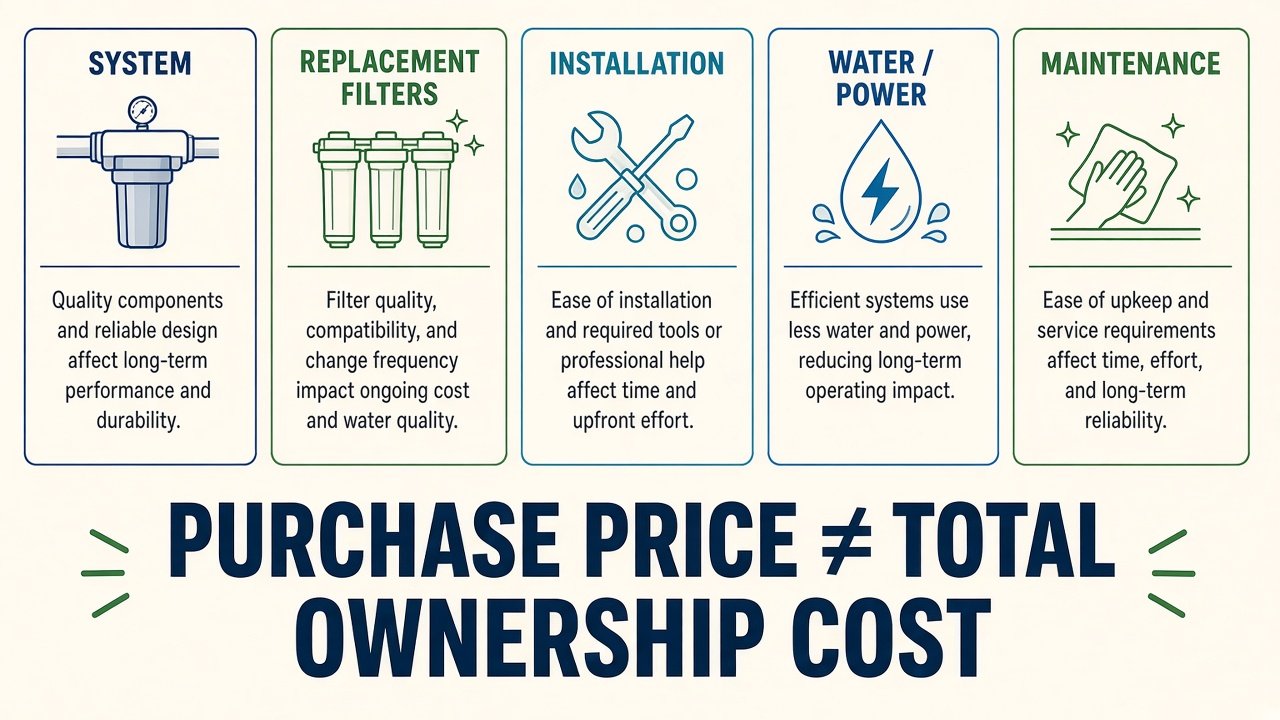
Unit price is not ownership cost. Add replacement CF/RO or T1 twist sets, 20-inch whole-house cartridges, possible plumber time, electricity for powered RO, and RO concentrate to the drain. SimPure’s Y-series comparison table lists an “average annual cost” of $99.99 for Y7P-BW filter upkeep — that is the manufacturer’s table figure, not a Moon Picke household bill. We will not convert 4:1 or 1.5:1 drain ratios into dollar wastewater costs. Sale prices on the RO units on this date do not define value next month. Normalize Amazon bundles: full system versus a 6-month filter kit.
Who Should Consider SimPure?
Buyers who want documented countertop RO without cabinet plumbing. Homeowners planning tankless under-sink RO with a dedicated faucet who accept the ALK mineral stage (or the non-ALK T1-400). Households whose report supports sediment and chlorine/taste/odor at the main via a 20-inch carbon/sediment train. Anyone willing to buy the correct replacement filters. This SimPure review is a category map, not a promise every household should buy the brand. See also About Moon Picke for how brand pages are scoped.
Who Should Consider Another Option?
If testing shows a problem these three architectures do not address (for example, whole-home softening, or a contaminant with no matching documented claim). If you require an NSF International system listing and will not accept SGS-to-standard reports. If you need a local dealer to own installation for life. If you want zero filter maintenance. If you expected the DB20P-3 to behave like kitchen RO.
How to Choose the Right SimPure System
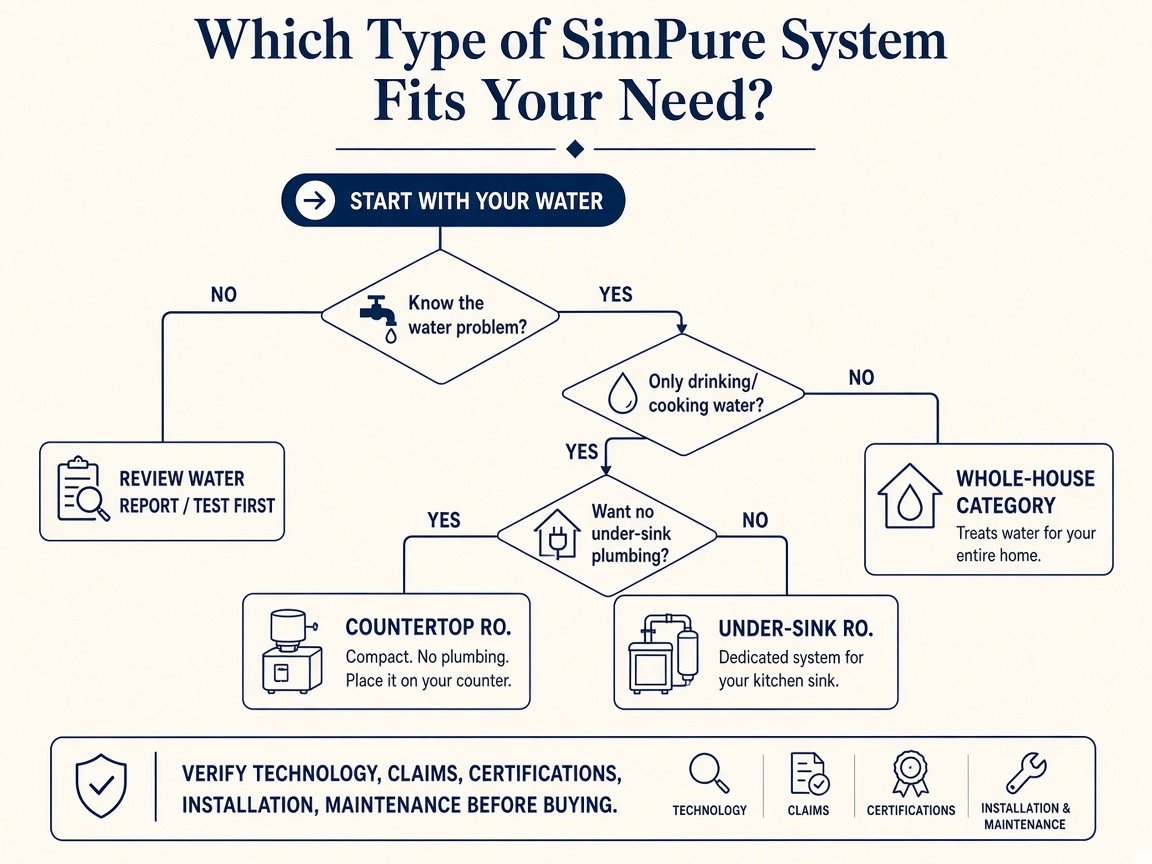
Use this SimPure review sequence, not a model-name shortcut: water source → problem → treatment point → technology → installation → maintenance → exact SKU. What are you trying to treat? Only drinking and cooking water: if you do not want under-sink plumbing, consider countertop point-of-use (Y7P-BW as the example). If you want a dedicated kitchen faucet, consider under-sink (T1-400ALK as the example). Whole house: if testing or the water report supports sediment/carbon use, consider whole-house filtration (DB20P-3 as the example). Dissolved or specialty contaminants may need different or additional technology — including not buying SimPure. Verify claims, certifications, and the Amazon generation before checkout.
Final Verdict: Is SimPure Worth It?
This SimPure review ends where shopping should start. SimPure may be worth buying when the category matches a documented water problem, replacement filters are acceptable, installation fits the home, and you have read the exact SGS/NSF language for that SKU. It is a poor fit when the water problem is unknown, one filter is expected to solve every contaminant, maintenance is unacceptable, or another technology is the better match. SimPure is a portfolio, not one generic filter.
FAQ
Is SimPure a good water-filter brand?
It is a real U.S. catalog with manuals, support contacts, and distinct product types. “Good” depends on matching the system to tested water — not on the brand name.
Is SimPure worth it?
Conditionally, when the treatment point and technology fit. There is no universal yes.
Does SimPure use reverse osmosis?
Some products do (Y7P-BW, T1-400ALK). The DB20P-3 does not.
Which SimPure system is best for drinking water?
Point-of-use RO examples are Y7P-BW (countertop) and T1-400ALK (under-sink). Whole-house carbon/sediment is a different job.
Are SimPure water filters NSF certified?
SimPure states it is not NSF certified as a brand and uses SGS testing against NSF/ANSI 58 for these RO pages. NSF listings we checked are membrane components, not these complete systems. Do not treat Amazon “NSF certified” titles as the full story.
Does SimPure remove TDS?
RO models are marketed for TDS reduction; the ALK under-sink unit will not drive TDS to zero by design. The DB20P-3 is documented as not reducing TDS.
Is SimPure suitable for well water?
Only where the well already meets drinking-water standards and feed limits (including TDS < 500 ppm on these RO units). Test first. RO is not a complete well-treatment plan.
How often do SimPure filters need replacing?
Manufacturer intervals are typically about 6 months on Y7P CF/RO and 6–12 months on T1 and DB20P-3 cartridges, depending on water and use — not a guaranteed calendar.