
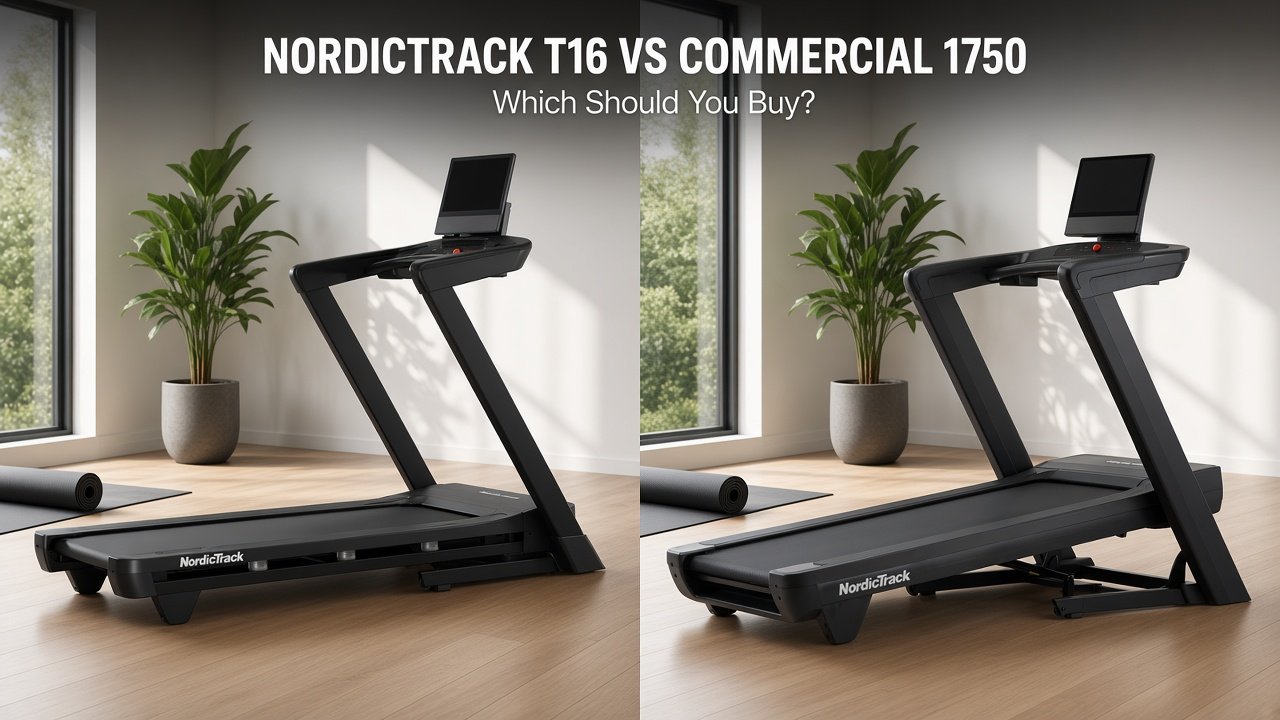
NordicTrack T16 vs Commercial 1750 is not a prestige contest. On current U.S. specs, both are 16-inch iFIT home treadmills with 0–12 MPH and SpaceSaver folding. The 1750’s documented extras are a 22″ × 60″ belt versus the T16’s 20″ × 60″, 12% to −3% decline versus no official T16 decline, a 400 lb versus 325 lb rating, a larger chassis, a pivoting screen, and a lifetime motor warranty versus two years. Whether those extras are worth paying for depends on the workout, the room, and whether you will use decline and the extra two inches of belt. Moon Picke did not test either machine. See the best treadmills for home use roundup for the broader cluster, plus how we evaluate and editorial standards.
NordicTrack T16 vs Commercial 1750: Quick Verdict
Choose T16 if you want a documented 20×60, 12 MPH, 0–12% incline trainer screen and a slightly smaller unfolded footprint.
Choose 1750 if you will use a 22″ belt, decline, a higher weight rating, a pivoting 16″ screen, and the current lifetime motor warranty card.
Choose neither if you want no iFIT ecosystem, a published folded cube, or a compact walking deck.
As an Amazon Associate I earn from qualifying purchases. Read the affiliate disclosure. NordicTrack.com trials and white-glove delivery are not Amazon’s terms.
| Category | NordicTrack T16 | Commercial 1750 | Better Fit For |
|---|---|---|---|
| Current generation | T Series 16 / T16, NTL16426 | Commercial 1750, NTL17125 | Confirm the model number, not just the name |
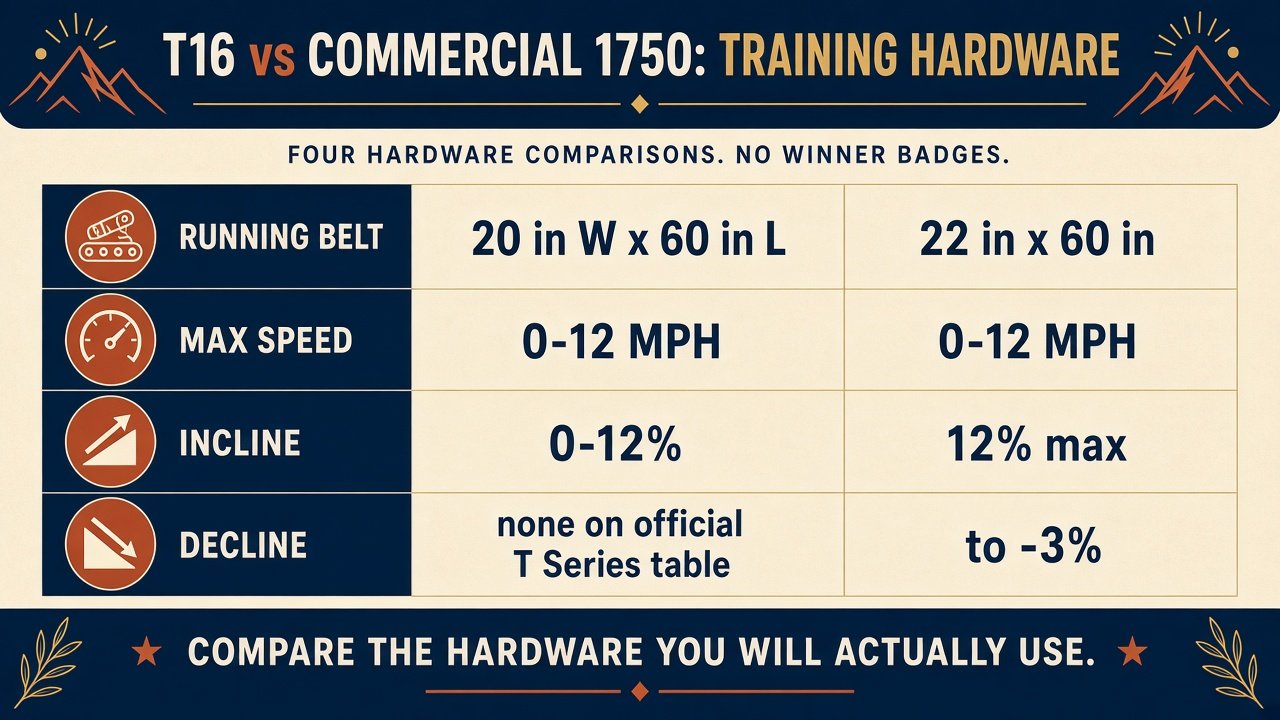
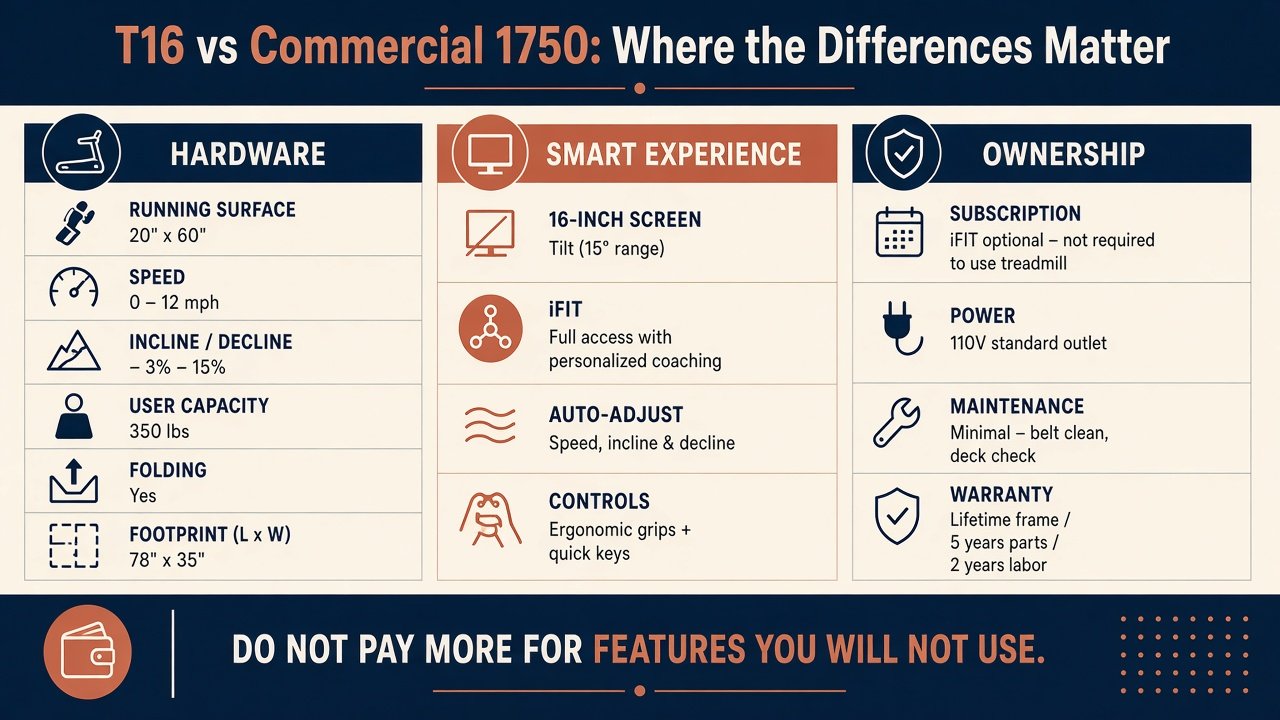
| Running surface | 20″ W × 60″ L | 22″ × 60″ | 1750 if you want extra width |
| Max speed | 0–12 MPH | 0–12 MPH | Tie on documented speed |
| Incline | 0–12% | Up to 12% | Tie on max incline |
| Decline | None on official T Series table | To −3% | 1750 if you will use downhill |
| Motor terminology | 3.60 CHP | 4.25 CHP | Not a durability ranking (CHP ≠ household HP) |
| User capacity | 325 lb | 400 lb | Rating only; not fit or stability |
| Dimensions | 75.1″ L × 34.3″ W × 58.4″ H | 77.3″ L × 37″ W × 59.5″ H | T16 smaller unfolded box |
| Folding | SpaceSaver; folded size not published | SpaceSaver; folded size not published | Neither is a proven closet winner |
| Display | 16″ tilting HD touchscreen | 16″ pivoting touchscreen | 1750 if you want off-deck viewing |
| iFIT | Yes; paid Pro for full content | Same ecosystem | Software is not the hardware gap |
| Without subscription | FAQ manual Start | FAQ manual Start | Tie on documented basic mode |
| Safety | Follow NTL16426 manual | Follow NTL17125 manual | No documented safety winner |
| Power | Not clearly published on T16 marketing pages | Not clearly published on 1750 marketing pages | Use each unit’s manual |
| Warranty | 10-yr frame, 2-yr motor, 2-yr parts, 1-yr tablet, 1-yr labor | 10-yr frame, lifetime motor, 2-yr parts, 1-yr labor | 1750 on motor term; confirm cards |
| Amazon availability | B0GZJ6LGCT In Stock 15 Sep 2026 | B0GSH23JFC In Stock 15 Sep 2026 | Stock is not quality |
| Main strength | Full-size 20×60 + 12% + 16″ tilt in a smaller chassis | Wider belt, decline, 400 lb rating, pivot, lifetime motor term | Depends what you will use |
| Main limitation | No official decline; unpublished folded cube | Larger/taller machine; “Commercial” ≠ gym cert | — |
Check current NordicTrack T16 price on Amazon · Check current Commercial 1750 price on Amazon
T16 vs Commercial 1750: Current Model and Generation Check
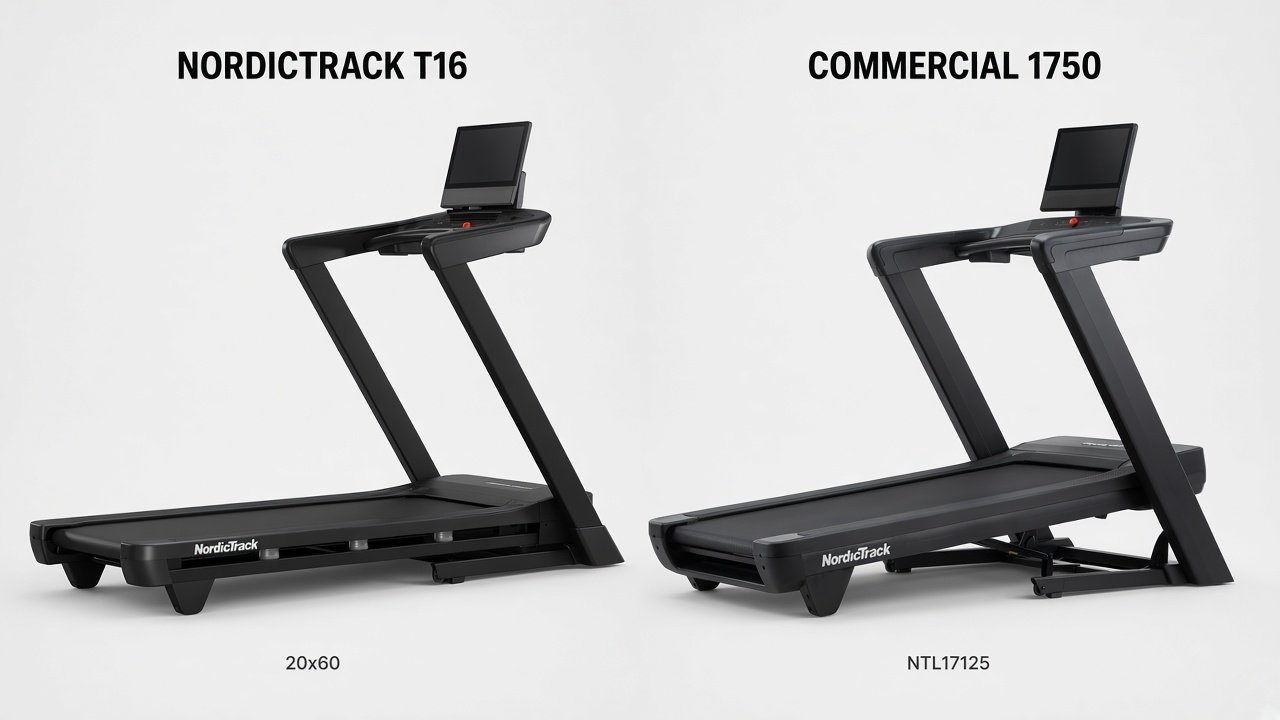
This NordicTrack T16 vs Commercial 1750 matchup is generation-specific. NordicTrack currently sells the T16 as the T Series 16 Treadmill and also labels the 16-inch picker “T16 Treadmill.” Official media uses NTL16426. The Commercial 1750 name has existed across revisions; the current U.S. checkout spec is NTL17125. Do not mix T 6.5 S, T Series 10, older 1750 consoles, or Commercial 2450 into this page. “Commercial” is a product name, not a gym-certification or 24/7 facility warranty.
Running Surface and User Fit
Belt width × length is the usable running surface. T16: 20″ × 60″ (series table prints 60″ W × 20″ L with 152 × 51 cm). 1750: 22″ × 60″ (55 × 152 cm). Length is the same; width is not. Extra width can matter for stance, but we did not test comfort. Walking can use either rectangle. Running generally benefits from more room; the 1750 is the documented wider deck. User-weight ratings are 325 lb versus 400 lb. Those numbers are not stability, lifespan, or proof that every lighter user fits the rails. Fit also depends on belt, console, handrails, and the 8.3″ versus 10.01″ step-up. Chassis size is separate: T16 75.1″ × 34.3″ × 58.4″; 1750 77.3″ × 37″ × 59.5″. A bigger machine is not automatically a bigger belt—here the 1750 is both wider and a larger box.
Speed, Incline, Decline and Motor Labels
Maximum speed is 0–12 MPH on both. Equal speed is not equal running quality; belt width and user fit still differ. Incline max is 12% on both. Decline is the hardware split: T Series table lists no decline for T16; 1750 documents 12% to −3%. iFIT can auto-follow speed and incline (and, on 1750, decline) with paid Pro. Higher range is not better for a walker who stays near 0%. Cushioning names differ—SelectFlex on T16, RunFlex on 1750—as design claims, not medical joint protection.
Motors: T16 3.60 CHP, 1750 4.25 CHP. NordicTrack’s CHP footnote: dynamometer comparison term, not household operating horsepower. Do not read “stronger,” “commercial-grade,” or longer life from the larger number. 1750 checkout marketing says “our strongest motor” in the 12 MPH context; that is brand copy, not a Moon Picke durability test.
Which Is Better for Walking and Running?
Walking: both cover walking speeds and 12% hills. T16 is enough if 20″ width and no decline match the plan. Running: same 12 MPH; 1750’s 22″ belt is the verified surface upgrade. Jogging sits in the middle. This page does not replace dedicated walking or running guides. We will not say either “feels more stable.” If your household mixes easy walks with occasional faster miles, start from belt width and decline use, not from the Commercial name.
Screen, Controls and iFIT
Both use a 16″ HD touchscreen and iFIT Pro for the full library, Follow Trainer, SmartAdjust, ActivePulse (compatible HR monitor sold separately), AI Coach, and on-screen streaming (third-party apps may need their own fees). U.S. iFIT Pro was $39/month or $396/year on official pages 15 September 2026. Same ecosystem does not mean identical experience: T16 tilts; 1750 pivots for off-treadmill classes. 1750 lists two bottle holders versus T16’s bottle holder on the series table. AutoBreeze, 2″ speakers, USB-C, and Bluetooth headphone/HR appear on both current spec sets. A bigger “Commercial” name does not make iFIT run better; we did not test UI speed. Calories and HR are fitness metrics, not clinical readings. Screen size is equal; do not pay for a larger display that does not exist here—pay, if at all, for pivot plus hardware under the deck.
Can You Use Them Without an iFIT Subscription?
NordicTrack’s FAQ applies to the equipment family: if you do not renew, press Start for manual mode, adjust settings yourself, see a racetrack-style graphic, and keep a limited number of leftover iFIT workouts. Paid Pro is required for the advertised coach-controlled library and auto-follow, not (per that FAQ) to purchase the treadmill. iFIT footnotes also say a free account, terms, and Wi‑Fi are required to operate equipment. Treat activation as possibly required on both, and paid Pro as required for full connected features on both. Amazon listings for T16 and 1750 each include one month of iFIT Pro in the title; that is an Amazon-channel promo, not a permanent hardware feature, and not automatically a NordicTrack.com bundle. Direct qualifying purchases may include a 30-day in-home trial with a stated return-shipping charge—confirm at NordicTrack checkout. Amazon returns are Amazon’s.
Folding, Dimensions and Home Space
Both use SpaceSaver fold-and-roll. Official folded dimensions are not clearly published for either, so neither wins a small-room contest on a cube measurement. Unfolded, T16 is shorter, narrower, and slightly lower (75.1 × 34.3 × 58.4 versus 77.3 × 37 × 59.5). Add user access, fold arc, cord, and service space. Step-up is 8.3″ versus 10.01″—relevant at incline and for getting on, not a fake ceiling formula. In-box weights (250 lb vs 311.5 lb) are shipping figures, not assembled product weights. Folding is not automatically compact; apartments and noise belong on later pages. We do not rank quietness.
Safety, Power, Maintenance and Warranty
Follow each generation’s owner’s manual. Do not copy T Series 10 electrical notes onto either machine. Marketing pages we opened do not clearly publish outlet/amp rules for T16 or NTL17125; use the booklet in the box. No documented safety-feature winner—do not score keys. Keep children and pets away per manufacturer warnings. Maintenance: belt, deck, and software updates per that unit’s manual, not “same brand, same lube schedule.” Do not call either machine maintenance-free.
Warranty is model-specific. T Series 16 series page: 10-year frame, 2-year motor, 2-year parts, 1-year tablet, 1-year labor. 1750 checkout: 10-year frame, lifetime motor, 2-year parts, 1-year labor. Same brand, different motor term. Confirm the card that ships. Amazon protection plans are not factory coverage.
T16 vs Commercial 1750: Price and Value
1750 direct checkout showed $2,499 on 15 September 2026. T16 official MSRP was not clearly published on the product page. Amazon prices move—check live listings rather than locking a gap in dollars. The extra 1750 money, when it exists, buys verified hardware: 2″ more belt width, −3% decline, 400 lb rating, larger footprint, pivoting 16″ screen, RunFlex naming, two bottle holders, and a lifetime motor warranty term. It does not buy a higher max speed, a larger iFIT library unique to 1750, or gym certification. If you will not use decline or extra width, T16 can be the better purchase even when 1750 has more rows on the spec sheet. Direct white-glove assembly, if offered on NordicTrack.com, still does not apply to Amazon unless that listing says so. See current T16 availability on Amazon · See current 1750 availability on Amazon.
Who Should Buy the T16?
Mixed walking and running on a 20×60 deck. Incline up to 12% without downhill. Households that want the 16″ iFIT tilt screen and a slightly smaller unfolded machine. Buyers who will not pay for decline or two extra inches of belt. People comparing NordicTrack T16 vs Commercial 1750 who mainly walk. View the NordicTrack T16 on Amazon if that is the listing you need, then confirm T Series 16 / 16″.
Who Should Buy the Commercial 1750?
Runners who want the current 22×60 surface. Training that uses documented decline. Shoppers who want the 400 lb rating as a specification (still not a fit test). Off-deck iFIT classes using a pivoting screen. Buyers who value the lifetime motor warranty language on NTL17125. Skip both if you refuse accounts/Wi‑Fi/iFIT, need a published folded size, or only need a short walking pad. View the Commercial 1750 on Amazon and confirm NTL17125 / Amazon Exclusive bundle.
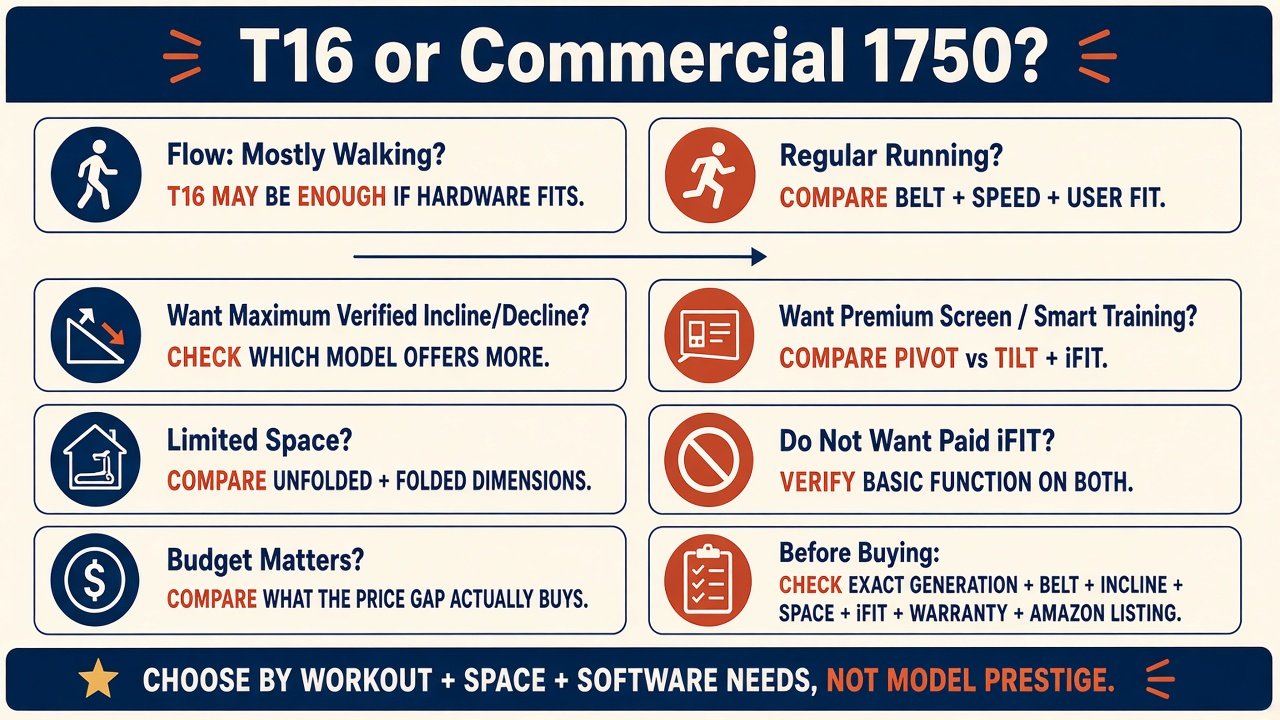
Final Verdict
The decision in NordicTrack T16 vs Commercial 1750 is depends. Hardware that both share: 12 MPH, 12% max incline, 16″ iFIT touchscreen, SpaceSaver fold, FAQ manual mode. Hardware the 1750 adds: wider belt, decline, higher weight rating, larger box, pivot, lifetime motor term. Choose T16 when those extras would sit unused. Choose 1750 when you will actually run on 22″ and use downhill. Do not ask which name sounds more expensive. Ask what the 1750 adds, and whether you will use it enough to justify space and ownership. Assembly time is not documented here for either unit—use the included instructions. About · guides · Home & Living · contact.
FAQ
What is the difference between NordicTrack T16 and Commercial 1750?
Current T16 (NTL16426) is 20×60, 0–12%, tilting 16″ screen, 325 lb. Current 1750 (NTL17125) is 22×60, 12% to −3%, pivoting 16″ screen, 400 lb, larger footprint, lifetime motor warranty term. Speed is 12 MPH on both.
Which is better for running?
1750 if you want the wider belt. T16 still documents 20×60 and 12 MPH. No feel ranking.
Which is better for walking?
Either on speed/incline. T16 is enough for many walkers; 1750’s extras are optional.
Which has more incline?
Same 12% max. Only 1750 documents decline.
Does either treadmill require iFIT?
Paid Pro for full connected features on both. FAQ manual Start without paid membership. Footnotes mention free account and Wi‑Fi to operate.
Can you use both without a subscription?
Yes for documented manual workouts. Auto-follow and the full library need Pro on both.
Which treadmill folds smaller?
Unknown. Official folded dimensions are not clearly published for either. T16 is smaller unfolded.
Is the Commercial 1750 worth the extra money?
Only if you will use width, decline, rating, pivot, or the motor warranty term. T16 MSRP was not clearly listed; check live Amazon prices. Prestige is not a spec.