
Moon Picke independently researches products. If you buy through our links, we may earn a commission at no extra cost to you. Read our affiliate disclosure.
Osprey Farpoint Trek 55 review: this guide covers Osprey’s current men’s Farpoint Trek 55 Travel Backpack in Black, one-size, a 55-liter hybrid Osprey positions for trips with trail time built in. Official hardware is AirSpeed mesh suspension, a padded load-supporting hipbelt, torso-length adjustability, front-panel packing, and a stowable AirCover that protects checked packs and doubles as a raincover. The strongest documented advantage is a real hiking harness on a travel-opening bag. The biggest compromise is size: Osprey lists 29.1 × 14.2 × 15 inches, which is check-in geometry, not a typical overhead-bin carry-on. Moon Picke has not hiked or flown with this pack. See how Moon Picke evaluates products.
As an Amazon Associate I earn from qualifying purchases.
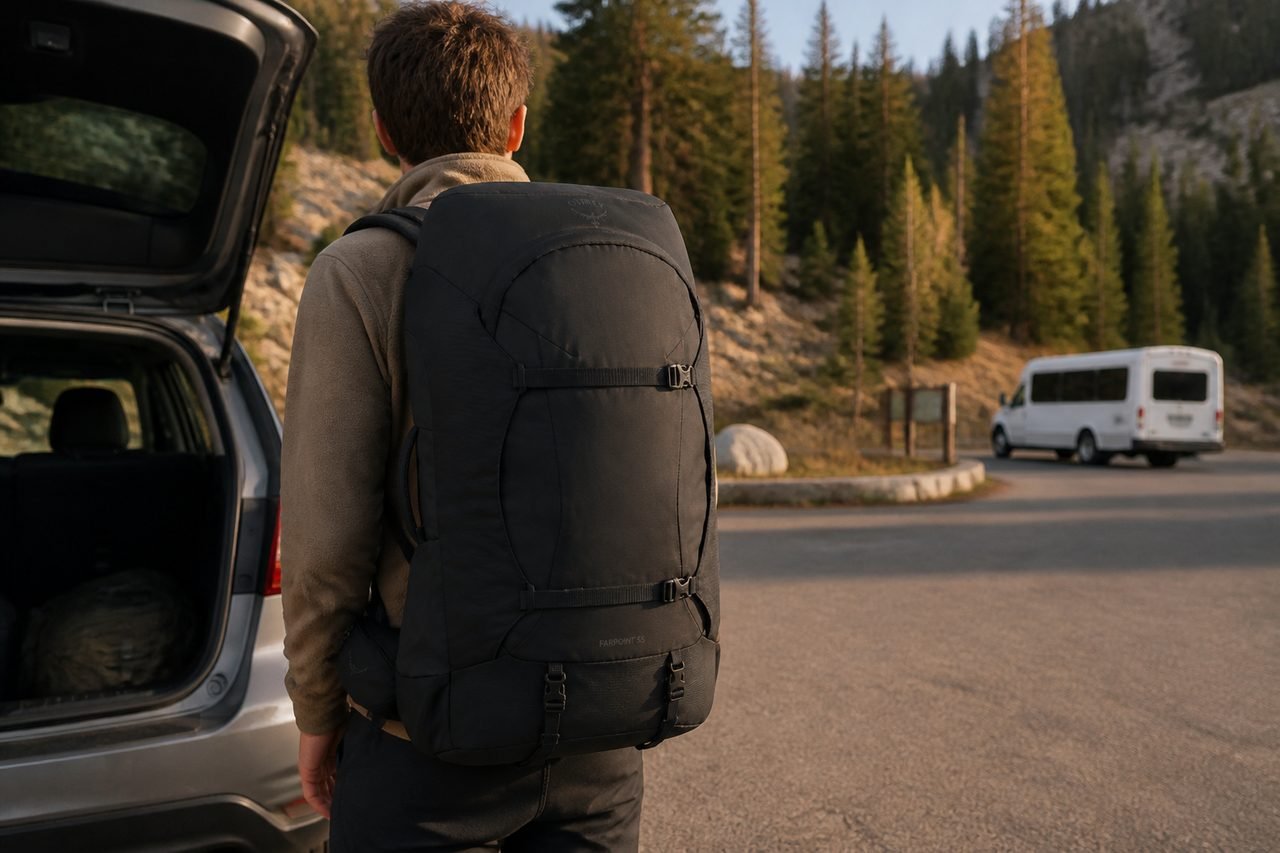
See the Osprey Farpoint Trek 55 on Amazon →
Osprey Farpoint Trek 55 Review: Quick Verdict
Is the Osprey Farpoint Trek 55 worth buying? It is worth considering if you want one premium hiking travel backpack for city-plus-trail trips and will check a bag when airlines require it. AirSpeed suspension plus a padded hipbelt is the hiking side. Front-panel access plus grab handles is the travel side. Skip it if you need a carry on hiking backpack for overhead bins, a padded 16-inch travel laptop pocket, or an ultralight trail pack. The verdict is conditional: buy the hybrid if both uses are real; do not buy it as a substitute for a 40-liter cabin bag.
Osprey Farpoint Trek 55
Is the Osprey Farpoint Trek 55 worth buying? It is worth considering if you want one premium hiking travel backpack for city-plus-trail trips and…
- Documented hiking suspension on a travel opening: AirSpeed mesh, LightWire frame, padded hipbelt, front-panel packing.
- Checked-bag thinking: AirCover for transit and rain, padded grab handles, daypack attachment points.
- 55 L for mixed clothing and trail kit with internal compression straps, not a 20 L commuter shell.
Affiliate link. Moon Picke may earn a commission from qualifying purchases.
What Is the Osprey Farpoint Trek 55?
This is Osprey’s men’s Farpoint Trek 55 Travel Backpack, Black, O/S. Amazon ASIN B0FGXYLC75 matches the current official page: 55 liters, AirSpeed trampoline backpanel, LightWire frame, included AirCover, and a multi-functional interior sleeve for a hydration reservoir or a tablet/laptop. Osprey describes this Osprey Farpoint Trek 55 travel backpack as an adventure pack for trips with trail time built in, with men’s sizing aimed at longer torsos and broader shoulders.
It is a hybrid travel backpack, not a mountaineering pack and not the Farpoint 40 cabin bag. The Trek 55 spends volume and frame on hiking carry and checked-bag protection. A compatible Farpoint/Fairview Travel Daypack or Daylite attaches on the front and is sold separately.
Key Specifications
Figures below come from Osprey’s current Farpoint Trek 55 specifications and feature list unless noted.
| Spec | Official listing |
|---|---|
| Configuration | Farpoint Trek 55 Travel Backpack, men’s, Black, O/S; ASIN B0FGXYLC75 |
| Capacity | 55 L (3,356 in³) |
| Dimensions | 29.1 H × 14.2 W × 15 D in (74 × 36 × 38 cm) |
| Empty weight | 3.94 lb (1.79 kg) |
| Torso | Adjustable torso length (Osprey does not publish an inch range on this page) |
| Hipbelt | Padded, edgeless mesh; crossbody hipbelt system; two zippered hipbelt pockets |
| Sternum strap | Adjustable; magnetic bite-valve attachment and safety whistle |
| Backpanel / frame | AirSpeed tensioned mesh trampoline; LightWire perimeter frame |
| Laptop / hydration | One multi-functional interior sleeve for a reservoir or tablet/laptop |
| Rain cover | Stowable AirCover included; also protects checked packs |
| Opening | Large front-panel access to the main compartment |
| Materials | 210D recycled nylon main; 200D recycled polyester lining; 420D recycled nylon bottom; PFAS-free DWR; bluesign PRODUCT |
| Warranty | Osprey All Mighty Guarantee (repair or replace) |
Check the current Amazon listing for Black O/S →
Travel Design vs Hiking Design
Hybrid backpacks usually trade specialization for versatility. The Trek 55 makes that trade explicit.
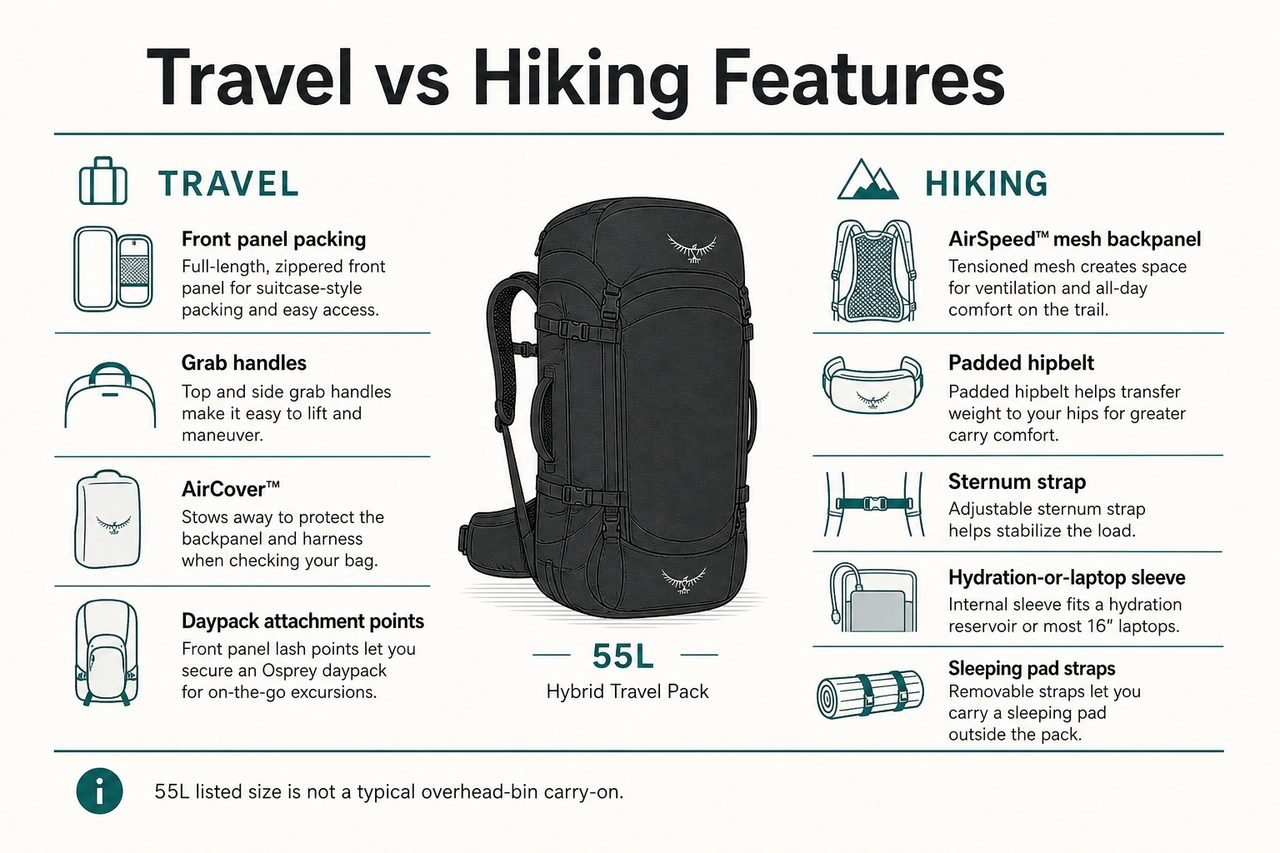
Travel features on the official list: large front-panel access; dual internal compression straps; zippered top pocket; large vertical-zip front pocket; padded top and side grab handles; AirCover for checked transit; daypack attachment webbing. That is suitcase-style packing and airport handling, not a top-loader you dump on a hostel floor only from the lid.
Hiking features: AirSpeed mesh backpanel, LightWire frame, padded mesh harness, padded hipbelt with pockets, sternum strap with bite-valve clip, dual front compression, removable sleeping-pad straps, and a sleeve that can take a hydration reservoir. Osprey is borrowing backpacking suspension, not a thin waist strap from a city pack.
What you give up either way: a cabin-sized travel backpack for hiking, such as the published NOMATIC Navigator Travel Backpack 32L review, will usually be easier in a sizer and weaker on trail ventilation. A dedicated backpacking pack will usually be worse at clamshell packing and worse as checked luggage without a cover. This bag sits between those jobs. It is not automatically best at both.
Harness, Hip Belt and Carry Support
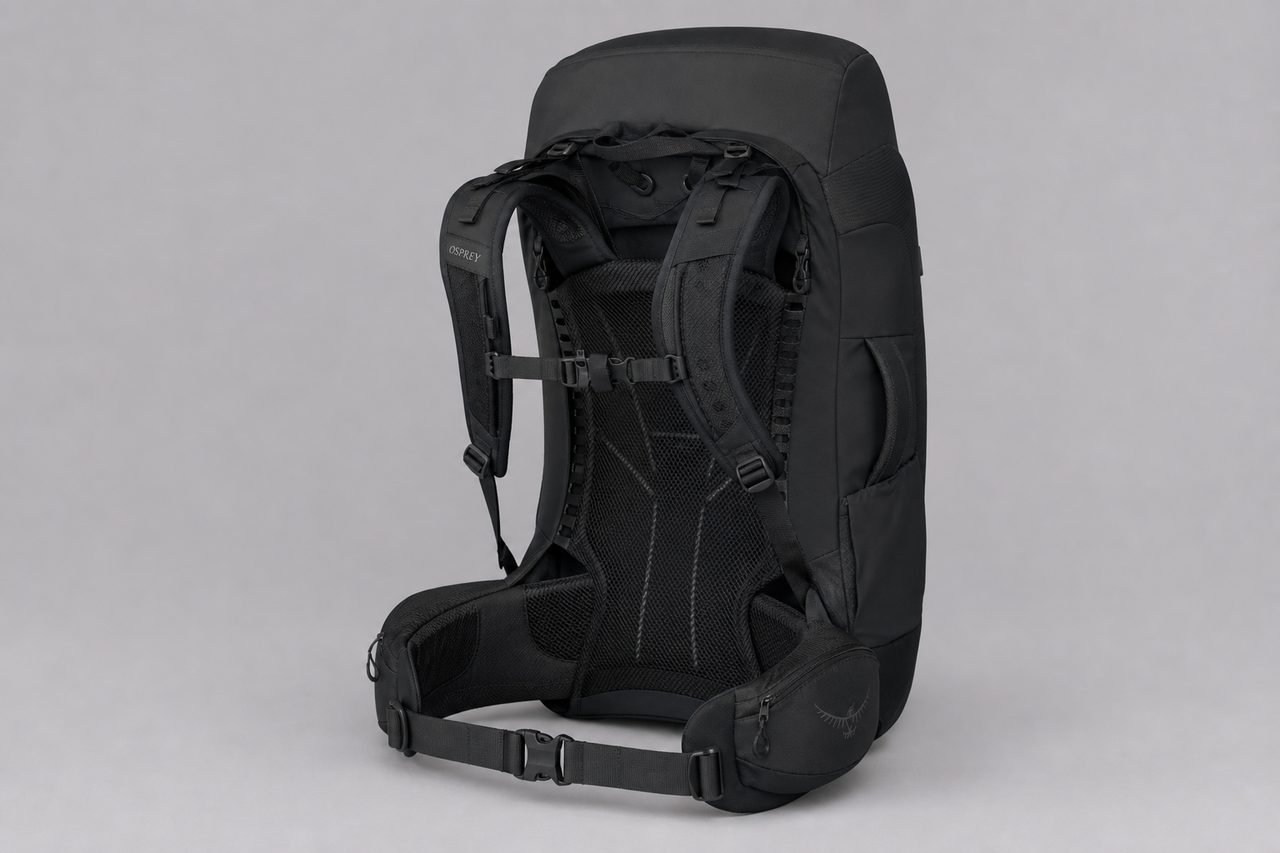
Osprey documents a padded, edgeless mesh harness, an adjustable sternum strap, and a padded, edgeless hipbelt with a crossbody hipbelt system for load support. The AirSpeed backpanel is a tensioned mesh trampoline. LightWire is the perimeter frame that tensions that mesh and creates the load-support structure. That is a hiking-oriented harness, not a dress-code backpack strap.
A hip belt matters most when it can sit on the iliac crest and actually take weight. Osprey’s language here is load support and a snug crossbody fit, plus two zippered hipbelt pockets. That is not the same thing as a 20-millimeter webbing waist strap on a laptop bag. Moon Picke has not worn this hipbelt and will not claim all-day comfort. Fit still depends on torso length, hip shape, total load, and terrain. Osprey lists torso-length adjustability but does not publish a numeric torso range on this product page. Maximum product volume is not a comfortable carry weight.
Capacity and Packing Layout
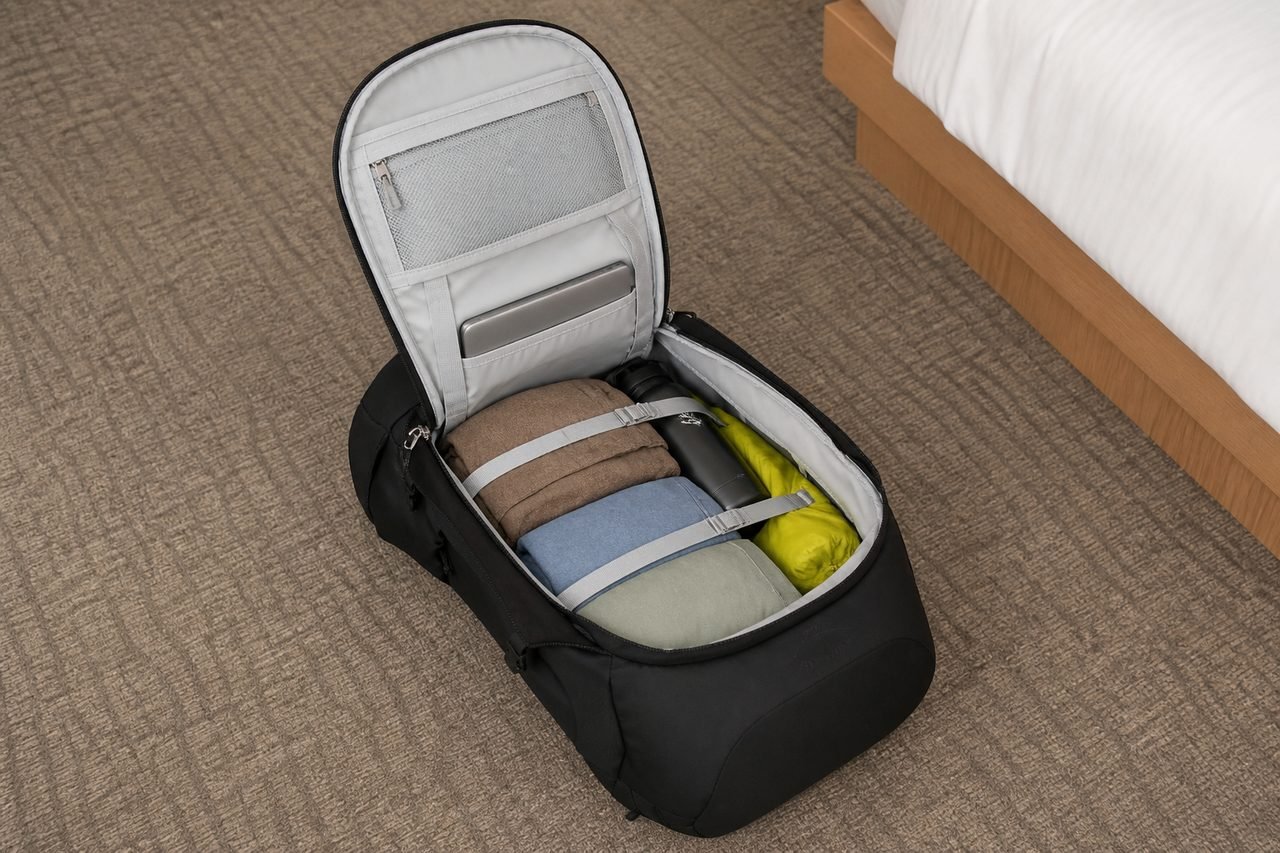
Fifty-five liters is clothing, trail layers, and some bulky kit in one main bay with internal compression straps and a mesh pocket on the front flap. Osprey does not publish a packing-cube count or a sleeping-bag size chart. Travel organization here is a panel opening plus straps, not a wall of admin pockets. Cubes still help. Hiking equipment that is long or odd-shaped—pads, poles if lashed, a bulky midlayer—competes with those cubes. Removable sleeping-pad straps are the documented external lash, not a full daisy chain.
The information-gain point: front-panel packing makes hotels easy and can make a stuffed hiking load harder to stabilize than a top-loading backpacking bag with a dedicated sleeping-bag compartment. Osprey lists dual internal straps. It does not list a separate lower sleeping-bag zipper on the current Trek 55 feature list.
Is It Actually Good for Hiking?
Is the Osprey Farpoint Trek 55 good for hiking? In this Osprey Farpoint Trek 55 review, it can be for travel hikes, hut-to-hut days, and light multi-day use where you want backpacking ventilation and a hipbelt. Evidence is the AirSpeed trampoline, LightWire frame, padded hipbelt, compression straps, sleeping-pad straps, hipbelt pockets, and a hydration-capable sleeve. Osprey does not call this a mountaineering pack or an ultralight trail bag.
Good for: day hikes from a city base and mixed itineraries where the same bag stays on your back. Not documented as technical climbing or glacier travel. Bottle pockets are not listed on the current feature list; do not invent them. Moon Picke has not walked a loaded trail with it.
Is It Practical for Flights?
Is it carry-on friendly? Not as a typical cabin bag. Osprey lists 29.1 × 14.2 × 15 inches and writes AirCover for checked packs. A common US template is about 22 × 14 × 9 inches. Height and depth here are the problem even before sleeping-pad straps and a daypack add bulk. Compare the fully packed bag, including AirCover and straps, with the operating carrier’s current size and weight chart. It is not universally airline approved, not TSA approved as a product, and not a personal item.
Hiking features make airports more awkward: a padded hipbelt, mesh backpanel, and external straps catch belts and carousels. AirCover is Osprey’s answer for check-in protection and also a raincover. Grab handles help when the pack is off your back. There is no listed luggage pass-through or stowable-harness tuck like some travel-first packs. Weight empty is 3.94 lb before water, laptop, and clothes; many international carriers weigh checked bags. Packed weight is on you to measure.
Laptop, Tech and City-Travel Use
Osprey lists one multi-functional interior sleeve for a hydration reservoir or a tablet/laptop. That is not a dedicated rear-zip 16-inch travel sleeve like many city packs. You choose water or computer real estate, and the sleeve is not described as a padded 16-inch spec on the current page. For coworking-heavy trips, a travel-first bag such as the published NOMATIC 20L Travel Pack review is the opposite layout: denser tech access, far less hiking suspension.
A hiking-first Osprey Farpoint Trek 55 hiking backpack often carries outdoor loads better and offers weaker laptop choreography than a travel-first pack.
See current Amazon availability for the Farpoint Trek 55 →
Materials and Weather Protection
Main fabric is bluesign APPROVED, 100% recycled 210D high-tenacity nylon with DWR made without PFAS. Lining is 200D recycled polyester with the same DWR family. Bottom is 420D recycled high-tenacity nylon. Mesh on the backpanel, harness, and hipbelt is recycled polyester. That is weather-oriented DWR plus a raincover, not a waterproof dry-bag.
Keep the words separate. DWR and a raincover are documented. Osprey does not publish an IP rating or call the Trek 55 waterproof. AirCover as a raincover is not a waterproof backpack. Moon Picke has not rain-tested it.
Airport-to-Trail Practicality
This is the job the Trek 55 is actually for: check the bag when sizers demand it, walk a city, then hike without swapping to a second large pack. AirCover on and handles out in transit. AirCover off, hipbelt on, reservoir in the sleeve on trail. Daypack webbing is for a separately purchased Daylite or Farpoint/Fairview daypack.
One-bag travel is attractive because you own one premium shell. The cost is compromise: heavier and bulkier than a travel-only cabin pack, less trail-specialized than a dedicated 50–65 L backpacking bag, weaker laptop workflow than a 20 L admin pack. Two specialized bags can still win if you fly carry-on-only and then rent or stash a trail pack. This hybrid wins if you will repeatedly do airport, train, hotel, city, trailhead, hike in the same week and will check luggage when the chart says so.
What It Does Well — and Its Main Limitations
What It Does Well
- Documented hiking suspension on a travel opening: AirSpeed mesh, LightWire frame, padded hipbelt, front-panel packing.
- Checked-bag thinking: AirCover for transit and rain, padded grab handles, daypack attachment points.
- 55 L for mixed clothing and trail kit with internal compression straps, not a 20 L commuter shell.
- Hydration-capable sleeve with sternum-strap bite-valve hardware for trail days.
- All Mighty Guarantee and bluesign recycled fabrics with PFAS-free DWR.
Important Limitations
- Not a typical carry-on: 29.1 × 14.2 × 15 in; AirCover is for checked packs.
- Premium cost for a compromise bag rather than two optimized bags.
- Laptop is a shared sleeve, not a travel-first 16-inch compartment.
- Hipbelt and straps add airport bulk versus a stowable-harness cabin pack.
- Heavier and larger than travel-only 32–40 L packs; less specialized than a backpacking-specific 55 L.
- Weather is DWR plus raincover, not waterproof. Men’s O/S fit is not a universal torso.
Travel/Hiking Hybrid vs Separate Travel and Hiking Backpacks
| Factor | Hybrid backpack | Separate bags |
|---|---|---|
| Versatility | High | Specialized |
| One-bag travel | Strong if you will check 55 L | Requires choosing which bag flies |
| Hiking support | AirSpeed-level on this model | Hiking bag optimized |
| Travel organization | Panel access; fewer admin pockets | Travel bag optimized |
| Cost | One premium bag | Potentially two purchases |
| Storage at home | Simpler | More gear |
| Compromise | Higher | Lower per task |
Neither is universally better. The Trek 55 is the one-bag bet. Two bags win when cabin rules are strict and trail days are serious.
Who Is the Osprey Farpoint Trek 55 Best For?
Best for travelers who hike during trips and people who want one backpack for city and trail travel. It fits adventure weeks when the 55 L stays on your back after a flight you are willing to check. Digital nomads doing outdoor excursions can use it if a shared laptop/hydration sleeve is enough tech.
Who should skip it? Serious backpackers who want a trekking-specific 50–70 L. Ultralight hikers. Travelers who need maximum business organization. Personal-item-only flyers. Anyone who needs a guaranteed overhead-bin bag. Buyers who want highly specialized alpine features Osprey does not list here.
Is the Osprey Farpoint Trek 55 Worth Buying?
This Osprey Farpoint Trek 55 review’s answer is conditional. Worth considering if both travel and hiking use are genuine, the harness matches your torso and load, you accept checked-bag dimensions, one-bag versatility matters, and a shared laptop/hydration sleeve is acceptable. Skip if hiking is highly technical, business organization dominates, ultra-low weight matters, or two specialized bags would fit the itinerary better.
Final Verdict
This Osprey Farpoint Trek 55 review lands on a hybrid buy, not a cabin-bag buy. Osprey put AirSpeed suspension, a padded hipbelt, front-panel packing, and an AirCover on a 55-liter men’s pack for airport-to-trail weeks. The strongest advantage is that hiking carry system on a travel opening. The biggest compromise is 29.1 × 14.2 × 15 inches and a sleeve that splits laptop and water. If that is your trip, the current Amazon Black O/S listing is the purchase path. If you need overhead bins or a 16-inch travel office, this is the wrong Farpoint.
See the Osprey Farpoint Trek 55 Black on Amazon →
Frequently Asked Questions
Is the Osprey Farpoint Trek 55 worth buying? Yes if you will hike and travel with one 55 L pack and will check it when airlines require. No if you need a carry-on-only bag or an ultralight trail pack.
Is it good for hiking? It can be for travel hikes and light multi-day walking. AirSpeed, hipbelt, and hydration sleeve are documented. It is not listed as expedition or mountaineering gear.
Is it carry-on size? Osprey lists 29.1 × 14.2 × 15 inches and AirCover for checked packs. Treat cabin acceptance as unlikely on typical 22 × 14 × 9 templates unless a specific airline allows it.
Does it have a hip belt? Yes. Osprey lists a padded, edgeless hipbelt with a crossbody system and two zippered pockets.
Does it fit a laptop? There is a multi-functional interior sleeve for a tablet/laptop or a hydration reservoir. It is not specified as a padded 16-inch travel compartment.
Is it hydration compatible? The same interior sleeve is listed for a hydration reservoir. A reservoir is not listed as included.
Is it waterproof? No. Official protection is PFAS-free DWR plus AirCover as a raincover. That is not a waterproof backpack rating.