
The best dash cams for night driving are not the boxes that shout “STARVIS,” “4K,” or “night vision” the loudest. After-dark video is a system: sensor, lens, exposure, processing, mount, glass, and the actual road. HDR can help with headlights against dark pavement; it does not guarantee a readable plate. Specs below come from manufacturer U.S. pages and current listings as of September 11, 2026. Moon Picke did not drive these cameras at night or grade footage.
Read How We Evaluate, our editorial standards, and the Affiliate Disclosure. This is a low-light buying page, not a parking-mode roundup, not a no-subscription ranking, and not a 2K-versus-4K essay.
Best Dash Cams for Night Driving: Quick Picks
| Dash Cam | Best For | Front Sensor | Front Resolution | HDR | Rear Night Hardware | Main Limitation |
|---|---|---|---|---|---|---|
| VIOFO A329S 2CH | Overall night system | STARVIS 2 IMX678 | 4K60 HDR-off / 4K30 HDR | Front+rear, mode-dependent | IMX675 2K30 HDR F1.8 | 4K60 disables HDR |
| VIOFO A229 Ultra 2CH | Front/rear night spec | STARVIS 2 IMX678 | 4K30 HDR | Front+rear | IMX678 4K30 HDR F1.8 | Dual-4K storage |
| Thinkware U3000 PRO 2CH | City high-contrast features | STARVIS 2 IMX678 | 4K30 or 2K60 | Driving; front 4K + rear | IMX675 2K30; Super Night Vision 4.0 | Aperture unpublished |
| Vantrue E1 Pro | Value front-only | STARVIS 2 IMX678 | 4K30 HDR | Front listed | Front-only | No rear channel |
| BlackVue DR970X-2CH LTE Plus II | Premium f/1.7 front | STARVIS 2 IMX678 | 4K30 HDR front | Front; rear not claimed | STARVIS 1080p30 | Weaker rear |
Confirm New condition, exact channel count, and whether a card, CPL, or hardwire kit is in the carton.
As an Amazon Associate I earn from qualifying purchases.
How We Chose These Night Dash Cams
Every model needed a defensible low-light hardware case: current Sony STARVIS or STARVIS 2, published aperture where available, HDR or named night processing, and U.S. availability in September 2026. We checked front and rear sensors separately, support language, max microSD, temperature spec, and kit cost. We did not rank on parking, subscriptions, or dual-channel coverage as the primary axis. We did not test night image quality, glare, plates, apps, or weather. Independent comparative night footage was not used to break ties. Roles are specification-based, not lab scores.
VIOFO A329S 2CH — Best Overall for Night Driving
The A329S 2CH is the overall pick because the night hardware is a balanced system, not a slogan. Front: Sony STARVIS 2 IMX678, F1.8, 140° FOV, HDR. Rear: STARVIS 2 IMX675, F1.8, 160° FOV, 2K 30 with HDR. That is a stronger rear night package than 1080p STARVIS 1, without forcing dual-4K file sizes. VIOFO documents 4K60+2K30 with HDR off on the 4K60 path, and 4K30+2K30 with HDR available — so 60 fps is not automatically the night setting. A front CPL-200 is included; a rear CPL is optional. Polarizers can cut some reflections, but they also reduce light, so do not treat CPL as a nighttime upgrade. See the VIOFO A329S review for the model walkthrough. Current VIOFO support and firmware pages remain the place to confirm updates before you buy.
Wi-Fi 6, built-in GPS, supercapacitor, −20–65°C, max 512 GB microSD plus optional SSD. Parking modes exist when you add HK4/HK6; that is a separate shopping problem. VIOFO.com lists 2CH at $459.99. Amazon ASIN B0FFT3YBH7 is 2CH with charger — no card, no hardwire. Buy if you want current STARVIS 2 on both ends plus documented HDR without paying dual-4K storage. Skip if you need native 4K rear or a front-only compact. See VIOFO A329S 2CH (ASIN B0FFT3YBH7; card/hardwire extra) →
VIOFO A229 Ultra 2CH — Best Front/Rear Night Option
This is the night-oriented 2CH kit with the strongest published rear imaging stack: dual STARVIS 2 IMX678 8MP sensors, F1.8, 140° FOV on both, and HDR listed on front and rear at simultaneous 4K 30. Front-night performance still is not rear-night performance once tint, dirt, and mount enter the picture — but you are at least evaluating matching sensor generation instead of a leftover 1080p module. VIOFO.com lists the 2CH camera kit at $409.99. Dual 4K writes more data; follow the maker’s card list, not invented hours (dash cam SD card size). Max 512 GB.
Standard rear cable is 6 m. GPS, 5 GHz Wi-Fi, VIOFO app (documented connectivity only — we did not test download speed). Supercapacitor; −20–65°C. Amazon ASIN B0FXWV3MY1 is a 2CH bundle with 128 GB + HK4 — disclose that versus camera-only, and do not buy 3CH Ultra cabin ASINs such as B0FNR5JS4P. Parking with HK4 is relevant if you also want overnight files; it is not why this camera is here. Buy if rear STARVIS 2 + HDR is the reason you opened this page. Skip if 2K rear on the A329S is enough and you would rather keep 4K60 as an option. See A229 Ultra 2CH bundle (ASIN B0FXWV3MY1; confirm 2CH not 3CH) →
Thinkware U3000 PRO 2CH — Best Feature Set for High-Contrast City Night
Thinkware documents Super Night Vision 4.0 on front and rear plus HDR in driving: front HDR in 4K mode, and rear HDR. That combination is the city-night feature set — headlights, signs, and dark surroundings — not Moon Picke street testing and not a glare-elimination claim. Front: STARVIS 2 IMX678, 4K@30 or 2K@60. Rear: STARVIS 2 IMX675, 2K@30. Diagonal FOV 147° / 156°. Aperture is not published on the pages we checked; we will not invent F-stops. 2K@60 is an available front mode, not a universal night recommendation. Confirm current Thinkware firmware on the official support site. Do not treat Thinkware marketing about plates as our claim. A dash cam is not a plate scanner.
GPS, Wi-Fi, Bluetooth, supercapacitor; 14–140°F (−10–60°C); microSD to 512 GB. Rear cable 7.5 m / 24.5 ft. CONNECTED/LTE is optional. Amazon ASIN B0FP137YT4 includes 64 GB + OBD cable — confirm versus hardwire SKU B0FZW91Y7G. Parking surveillance needs power hardware; that architecture belongs on a parking-mode page. Buy if you want named dual-channel night processing plus driving HDR on both cameras. Skip if you need a published aperture number or 4K rear. See Thinkware U3000 PRO 2CH (ASIN B0FP137YT4; confirm OBD vs hardwire) →
Vantrue E1 Pro — Best Value Night Dash Cam (Front-Only)
The E1 Pro is the value night pick because it puts a STARVIS 2 IMX678, F1.8 lens, 158° FOV, and 4K@30 HDR into a compact front-only body without forcing a rear cable. Vantrue also lists 2K 30 HDR. A CPL is included; useful for some daytime/interior reflections, not an automatic night add-on. Max microSD 1 TB; card not in the typical box. Supercapacitor; −20–60°C. GPS/Wi-Fi and the Vantrue app are documented features, not tested ease-of-use. Optional LTE exists on some Vantrue stacks; it is not the ranking reason here, and a plan is not required for local files. Complete-system cost still includes a high-endurance card and, if you want parking files, a hardwire kit.
PlatePix and similar marketing language stay on the vendor page. We will not repeat speed-at-night plate claims. Parking needs an optional hardwire kit. Amazon ASIN B0DSKXJV3H — confirm E1 Pro, New, front-only. Buy if most of your night risk is forward and you want current low-light hardware without a 2CH install. Skip if rear coverage matters; then shop A329S or A229 Ultra instead of stretching this 1CH into a dual kit. See Vantrue E1 Pro (ASIN B0DSKXJV3H; front-only, card extra) →
BlackVue DR970X-2CH LTE Plus II — Best Premium Low-Light Front System
BlackVue’s North America DR970X-2CH LTE Plus II is the premium front night package: STARVIS 2 IMX678 (~8.4 MP), 4K@30, documented HDR on the front, and a 7-element f/1.7 lens (wider than the F1.8 VIOFO fronts). Wider aperture can admit more light; it is not automatically a better night image. Rear: STARVIS ~2.1 MP, 1080p@30. HDR is not claimed for the rear on the pages we used — the clearest teaching example that front night hardware is not rear night hardware. Typical kits include hardwire + 64 GB. microSD 64–512 GB. Operating −20–70°C; supercapacitor. Built-in LTE (SIM extra) plus Cloud are paid layers; local recording still works without them, so a plan is secondary here. Confirm current BlackVue firmware on the support site. See LTE vs Wi-Fi dash cams.
BVNA-class pricing near $540.99. Amazon ASIN B0FHJTNN3M — confirm Plus II 2CH. Buy if you want the f/1.7 + front HDR stack and may add remote alerts later. Skip if rear low-light files are why you are shopping — A229 Ultra is the more honest rear-spec kit. See BlackVue DR970X-2CH LTE Plus II (ASIN B0FHJTNN3M; SIM extra) →
What Actually Makes a Dash Cam Better at Night?
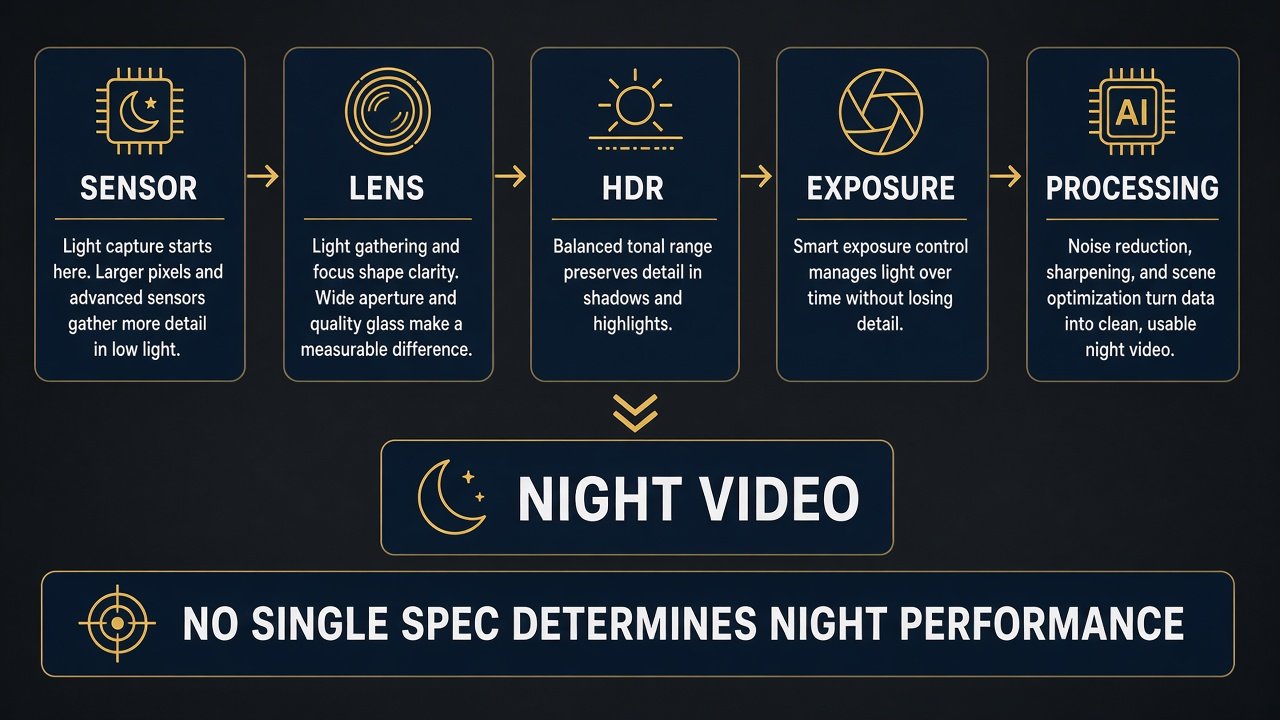
Night video is not one checkbox. A larger or newer sensor can gather more photons in principle; size still does not determine the file alone. Aperture (F1.7 vs F1.8) may pass more light, with flare trade-offs. HDR — including dual-exposure of brighter and darker frames — can hold headlights and dark shoulders; it is not guaranteed plate capture. WDR is not automatically multi-exposure HDR — use the maker’s word. Named night modes may be automatic, driving-only, or parking-specific. 60 fps is not always better after dark. 4K is not an automatic night winner. A CPL cuts reflections and light; it is not a default night accessory. Mounting, dirty glass, dash reflections, and windshield coatings change what the lens sees.
| Feature | Why It Matters at Night | Limitation |
|---|---|---|
| STARVIS 2 | Current Sony low-light branding | Name ≠ best footage |
| HDR | Helps headlights vs dark pavement | ≠ readable plates |
| Aperture | Wider may admit more light | ≠ automatic winner |
| CPL | May cut some reflections | Also cuts light |
| 4K | More pixels if the image is clean | Does not fix exposure |
| 60 fps | More temporal samples | May shorten exposure; HDR-off on some modes |
STARVIS vs STARVIS 2: Does the Sensor Name Matter?
Sony STARVIS and STARVIS 2 are real product families used in current dash cams. Generation can matter for advertised low-light capability. STARVIS 2 is not automatically the best night camera, and two IMX678 units can still look different after lenses and firmware. The BlackVue rear STARVIS 1080p module is not the same night hardware as a STARVIS 2 IMX675 or IMX678 rear. Buy the imaging system, not the badge.
Can a Dash Cam Read License Plates at Night?
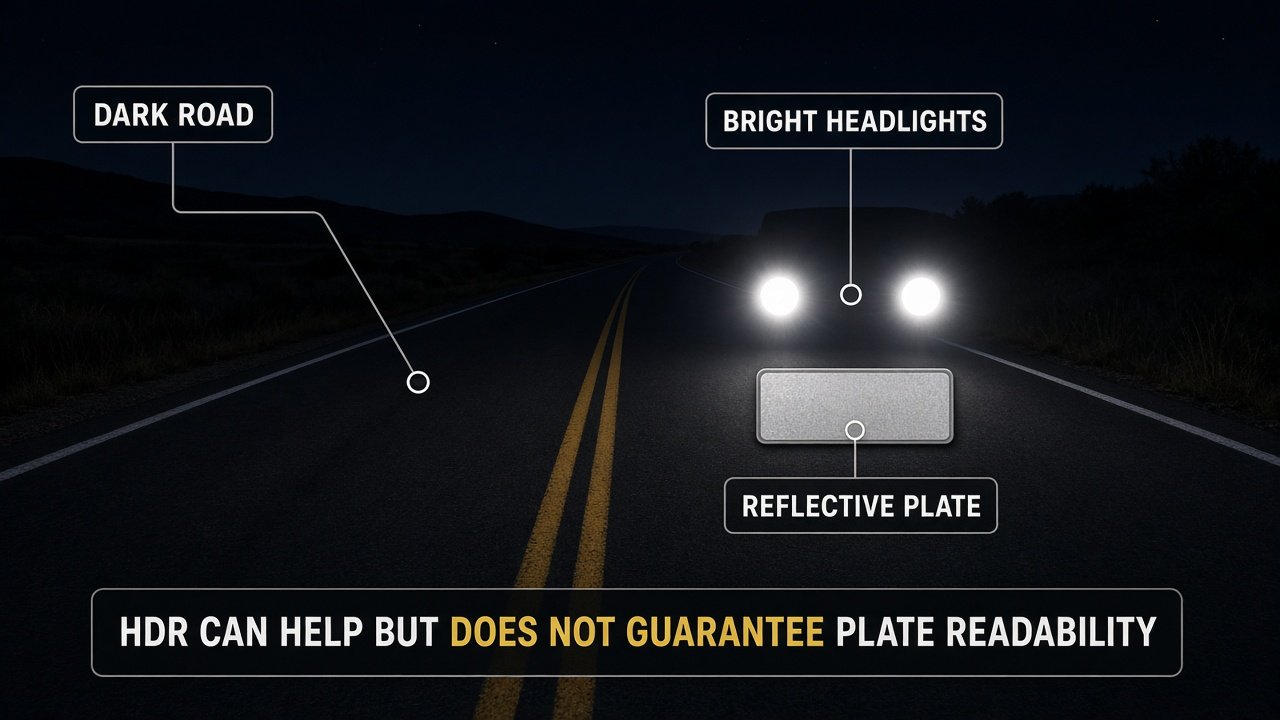
A dash cam records a scene. It is not an automatic license-plate scanner. Readability depends on relative speed, angle, distance, weather, reflective coatings, headlights, shutter, and processing. Opposing traffic at night is especially hard. No product here is declared able to capture every plate. HDR can help manage high-contrast exposure; it does not guarantee characters on a reflective plate. Rain, fog, and snow can overwhelm any camera; we did not weather-test these units.
Front vs Rear Night Performance (City Streets vs Dark Rural Roads)
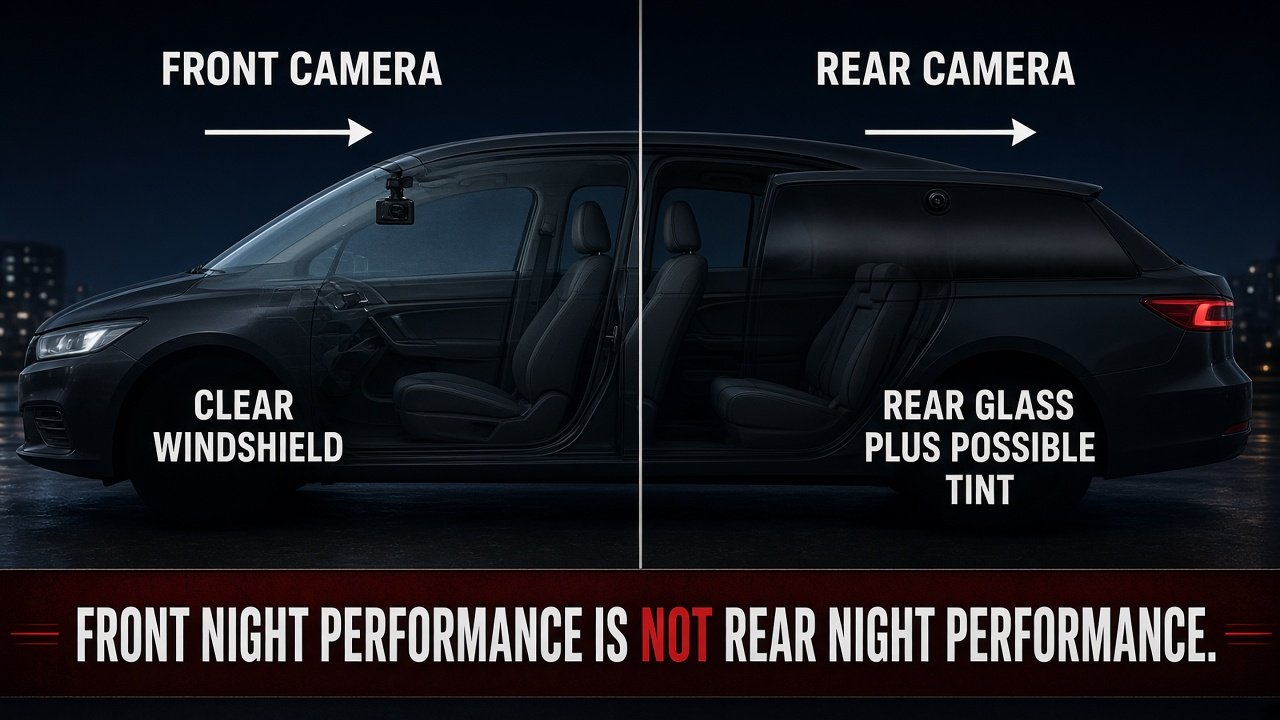
The front camera usually looks through clearer windshield glass at oncoming lights. The rear camera often looks through factory or privacy tint, defroster lines, and a different exposure scene. Tint can materially reduce light; we will not invent stop-loss numbers. Dirty glass increases glare and haze at night — clean it; that is not a product defect. Dash reflections depend on mount and angle; no camera eliminates them. City night has more ambient light and high-contrast signs, so HDR language is more relevant. Rural night has lower ambient light and headlights dominate; a sensitive sensor and lens matter, but no dash cam invents detail where almost no useful light exists.
What to Check Before Buying
1) Front sensor? 2) Rear sensor? 3) Front resolution in your mode? 4) Rear resolution? 5) Aperture if published? 6) HDR front? 7) HDR rear? 8) 30 or 60 fps, and does HDR stay on? 9) CPL included — do you even want one at night? 10) Tint and glass? 11) Max storage? 12) Current firmware? 13) Exact bundle? 14) Hardwire only if you also want parking files? If you mostly drive daylight or short, well-lit trips, the most expensive low-light stack may not pay for itself.
Which Night Dash Cam Should You Buy?
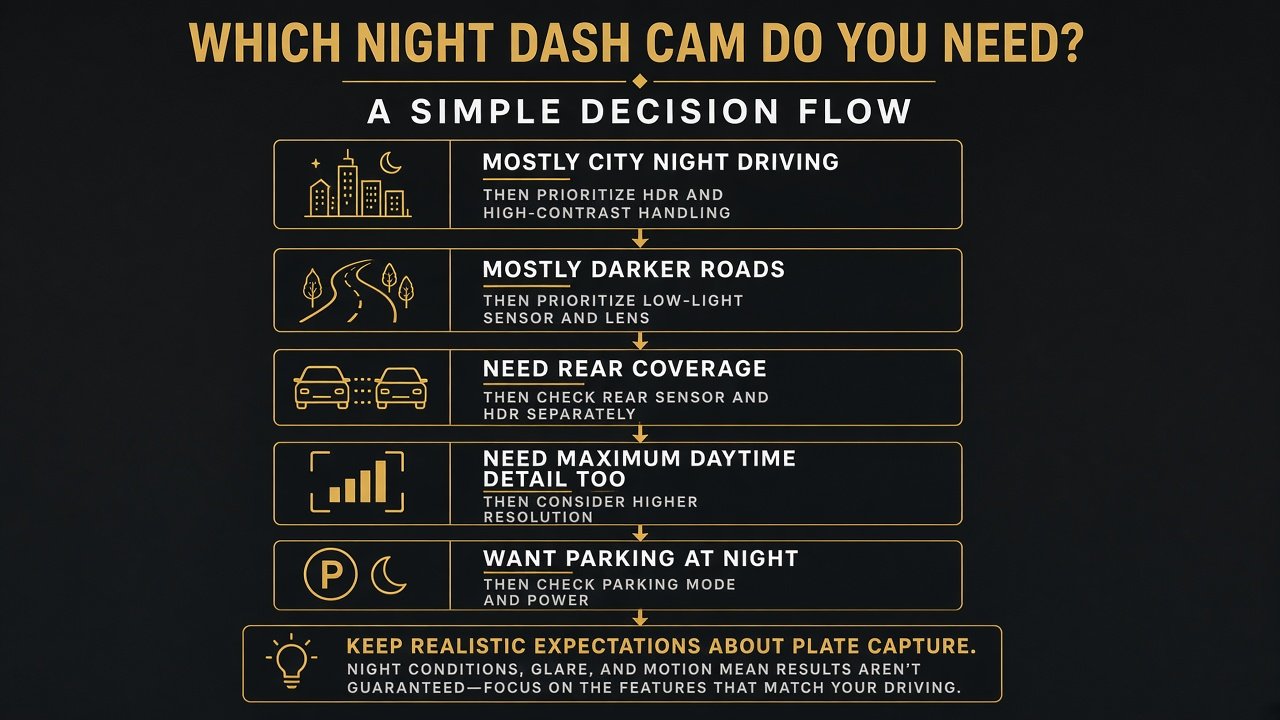
City night and documented high-contrast tools → Thinkware U3000 PRO 2CH (manufacturer HDR + Super Night Vision 4.0, not a street test). Darker roads and a 2CH stack without dual-4K storage → A329S 2CH. Strongest published rear night hardware → A229 Ultra 2CH. Front-only value STARVIS 2 + HDR → Vantrue E1 Pro. Premium f/1.7 front + optional LTE → BlackVue Plus II, knowing the rear is 1080p. Want parking at night too → use a dedicated parking-mode guide. These best dash cams for night driving are a 2026 hardware shortlist — not a claim that any camera “sees in the dark.”
Shop the best dash cams for night driving as an imaging system: sensor + lens + HDR + exposure + scene + mounting. Do not buy on the words 4K, STARVIS, or HDR alone. The A329S 2CH is the overall night-driving choice. A229 Ultra 2CH is the front/rear night spec kit. U3000 PRO is the high-contrast city feature set. E1 Pro is value front-only. BlackVue Plus II is the premium front package with a weaker rear. Keep realistic plate expectations, clean the glass, and verify the exact Amazon variant before you order.
FAQ
What is the best dash cam for night driving?
Moon Picke’s overall pick is the VIOFO A329S 2CH. Other kits win on 4K rear spec, city processing, front-only price, or a wider front aperture. No universal night winner.
Is STARVIS 2 better at night?
STARVIS 2 is current Sony low-light branding. It is not an automatic win, and two STARVIS 2 models can still differ by lens and processing.
Does 4K help at night?
4K can preserve more detail when the image is already usable. It does not fix glare, noise, or exposure.
Is HDR important for dash cams?
HDR can help headlights versus a dark road. It does not guarantee plate capture. Check front versus rear and the recording mode.
Can a dash cam read license plates at night?
Sometimes, under favorable angle, distance, and light. Often not. Do not buy expecting a scanner.
Is 60fps better than 30fps at night?
Not always. On the A329S, 4K60 is documented with HDR off. Follow the manual for your mode.
Does tint affect rear footage, and should I use a CPL at night?
Tint can materially affect rear night footage. A CPL may cut reflections and light; it is not a default nighttime upgrade.