
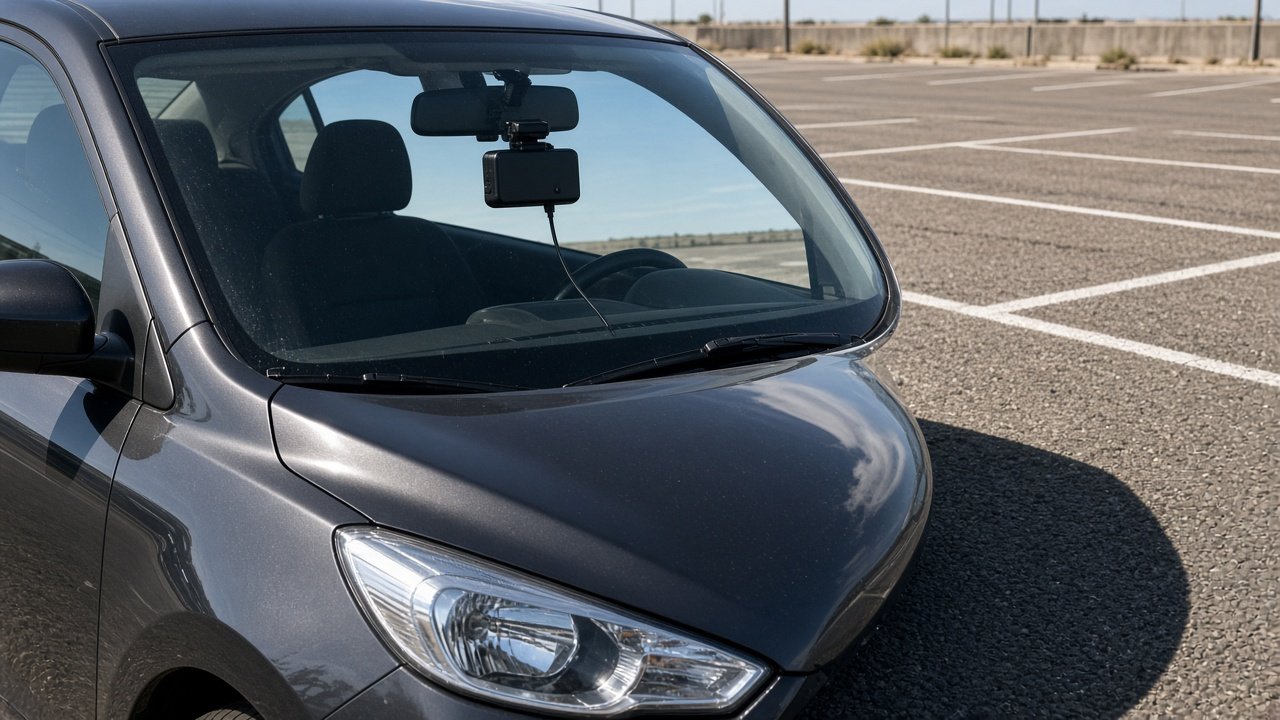
The best dash cams for hot weather are not the boxes that only say “supercapacitor.” Heat tolerance is an operating range, a storage range, power architecture, parking use, the memory card, and where you mount the camera. A parked cabin in sun can get substantially hotter than outside air, and the camera on the glass is not at ambient temperature. Specs below are from manufacturer U.S. pages and manuals as of September 11, 2026. Moon Picke did not run heat-chamber or parked-car tests.
Read How We Evaluate, our editorial standards, and the Affiliate Disclosure. This is a thermal-spec buying page, not a parking-mode ranking, not a 2K-versus-4K essay, and not a night-driving roundup.
Best Dash Cams for Hot Weather: Quick Picks
| Dash Cam | Best For | Operating Temp | Storage Temp | Supercapacitor | Parking Mode | Main Limitation |
|---|---|---|---|---|---|---|
| VIOFO A329S 2CH | Overall hot-weather system | −20–65°C (−4–149°F) | −20–70°C (−4–158°F) | Yes (no internal battery) | With HK4/HK6; manual advises caution above 60°C cabin | Highest temp spec is not the BlackVue envelope |
| BlackVue DR970X-2CH LTE Plus II | Highest published operating spec | −20–70°C (−4–158°F) | −20–80°C (−4–176°F) | Yes | Hardwire in typical kits; cutoff ~75°C (167°F) | SIM/Cloud extra; 1080p rear |
| VIOFO A229 Plus 2CH | Value 2CH heat spec | −20–65°C (−4–149°F) | −20–70°C (−4–158°F) | Yes | HK4 extra | 2K+2K, not 4K front |
| VIOFO A229 Ultra 2CH | Front/rear kit, same VIOFO envelope | −20–65°C (−4–149°F) | −20–70°C (−4–158°F) | Yes | HK4/HK6 extra | Dual-4K storage load; 4K ≠ hotter automatically |
| Thinkware U3000 PRO 2CH | Documented parking thermal protection | −10–60°C (14–140°F) | −20–70°C (−4–158°F) | Yes | OBD/hardwire; Smart Parking thermal path | Lower max operating temp than VIOFO/BlackVue |
As an Amazon Associate I earn from qualifying purchases.
How We Chose These Hot-Weather Dash Cams
Every pick needed a published operating range, a supercapacitor (not a small lithium backup cell), current U.S. support, and a defensible automotive-heat case. We also checked storage temperature when published, parking-power path, max microSD, and kit cost. Highest °C is not automatic overall. We did not test cabins, adhesives, card failures, or shutdown behavior. Independent heat videos were not used. Roles are specification assignments.
| Feature | Why It Matters | What It Does NOT Prove |
|---|---|---|
| Supercapacitor | Better suited to automotive heat than a tiny backup lithium cell | Unlimited heat tolerance or parking power |
| High operating temp | Wider published operating envelope | Indefinite reliability at the max |
| High-endurance SD | Better suited to repeated writes in a hot car | The camera itself is heat-proof |
| Thermal shutdown | Can protect hardware | Continuous recording while hot |
VIOFO A329S 2CH — Best Overall for Hot Weather
The A329S 2CH is overall because the heat case is complete enough: supercapacitor, operating −20–65°C (−4–149°F), storage −20–70°C (−4–158°F), current firmware/support, 4K+2K local recording, and max 512 GB microSD (optional SSD). That is not the widest operating envelope here. It is the better balance of thermal spec, support, and system features. VIOFO’s A329S manual is unusually direct on parking in hot weather: if cabin temperature goes above 60°C (140°F), it advises turning the dash cam off to avoid recording errors or damage, and it prefers time-lapse when parked outside in summer. That is manufacturer caution, not Moon Picke testing, and not an automatic thermal-cutoff table like BlackVue’s. See the VIOFO A329S review.
Supercapacitor saves files on power loss; it does not run parking hours. HK4/HK6 (and HK6 voltage cutoff) are extra. Optional SSD: VIOFO says keep the drive out of a high-temperature spot (glove box guidance) and recommends 0–60°C for SSD use — do not leave a portable SSD on the dash. Electrostatic film plus adhesive mount; we will not claim it never drops. GPS, Wi-Fi 6, no required cloud. VIOFO.com 2CH $459.99. Amazon ASIN B0FFT3YBH7 is 2CH + charger, no card or hardwire. Buy for a current 65°C-class 2CH kit with honest summer-parking language. Skip if you need the 70°C operating spec. See VIOFO A329S 2CH (ASIN B0FFT3YBH7; card/hardwire extra) →
BlackVue DR970X-2CH LTE Plus II — Best High-Temperature Spec
BlackVue’s Plus II manual lists the widest envelope on this page: operating −20–70°C (−4–158°F), storage −20–80°C (−4–176°F), supercapacitor, and high-temperature cut-off approx. 75°C (167°F). Highest published max is still not a parked-car forever guarantee, and cutoff means recording stops until the unit is back in a safe range. Typical North America LTE Plus II kits include hardwire + 64 GB. Front 4K@30 STARVIS 2; rear 1080p STARVIS — heat ranking is not a dual-channel contest. microSD 64–512 GB on the Plus II spec table (some LTE listings mention larger cards; confirm the carton). GPS, Wi-Fi, LTE (SIM extra), Cloud extra. Confirm current BlackVue firmware on the official support site. Mount is the BlackVue windshield adhesive/bracket kit; we will not claim it never fails in sun.
Amazon ASIN B0FHJTNN3M — confirm Plus II 2CH. Street examples near $540.99. Buy if the 70°C / 80°C storage numbers and documented cutoff are why you are shopping. Skip if you refuse a SIM/Cloud stack or need a 2K/4K rear. A dedicated battery pack is not automatically cooler; packs have their own limits — see battery pack vs hardwire. See BlackVue DR970X-2CH LTE Plus II (ASIN B0FHJTNN3M; SIM extra) →
VIOFO A229 Plus 2CH — Best Value Hot-Weather Dash Cam
Same VIOFO thermal pair as the A329S and Ultra: operating −20–65°C (−4–149°F), storage −20–70°C (−4–158°F), built-in supercapacitor, no internal lithium backup. You are not paying 4K-front money for a weaker heat rating. Dual STARVIS 2 IMX675, 2K+2K, HDR both channels, 2K60+2K30 listed, F1.8/F1.9, max 512 GB, GPS, dual-band Wi-Fi. Parking needs HK4. VIOFO.com $229.99. Confirm current Plus firmware on VIOFO support. The summer parking note in the A329S/A229 Ultra family manuals — time-lapse outside, consider powering down if the cabin exceeds 60°C — is the kind of caution to apply to any powered VIOFO 2CH in sun; we are not inventing a unique Plus-only cutoff. Electrostatic film plus adhesive in typical kits is for glass mounting, not a published heat-proof pad. Amazon ASIN B0CKX14L34 — confirm 2CH, New, not 3CH. Card usually extra. Buy for a current 2CH supercap kit on the 65/70°C pair at a lower camera price. Skip if you need 4K front or Thinkware’s parking thermal modes. Complete cost still includes a high-endurance card and hardwire if you park powered. See VIOFO A229 Plus 2CH (ASIN B0CKX14L34; confirm 2K+2K) →
VIOFO A229 Ultra 2CH — Best Front/Rear Option on the Same Heat Envelope
The Ultra 2CH is here as a complete 4K+4K 2CH package that still publishes the same −20–65°C operate / −20–70°C store supercap envelope as other current VIOFO 2CH kits. 4K does not automatically overheat more; thermal design varies, and we did not measure processors. Dual IMX678, HDR both, max 512 GB, HK4/HK6 extra, GPS, 5 GHz Wi-Fi. Amazon ASIN B0FXWV3MY1 is 2CH + 128 GB + HK4 — disclose versus camera-only, and skip 3CH ASINs such as B0FNR5JS4P. VIOFO.com camera kit $409.99. Dual-4K writes more data, which stresses cards in any climate — follow VIOFO’s endurance list (dash cam SD card size). Confirm current Ultra firmware on VIOFO support. Apply the same family summer caution as other VIOFO 2CH kits: time-lapse when parked outside in heat, and the manual’s 60°C cabin note is not a promise the camera will keep recording. Electrostatic/adhesive mount, not a suction-cup heat claim. Buy if you want 4K rear on the same documented VIOFO heat pair. Skip if 2K rear on the A329S already covers you. See A229 Ultra 2CH bundle (ASIN B0FXWV3MY1; confirm 2CH) →
Thinkware U3000 PRO 2CH — Best Documented Parking Thermal Protection
Thinkware publishes a lower operating max than VIOFO or BlackVue: −10–60°C (14–140°F), storage −20–70°C (−4–158°F), supercapacitor, integrated thermal protection. Thinkware support describes parking thermal protection: above about 65°C in parking mode the camera can switch to impact-only recording, then resume motion/time-lapse around 55°C. That is manufacturer behavior, not a “safe all day in sun” claim. Shutdown or reduced parking recording protects hardware and also means you may miss non-impact events while hot. Radar parking and OBD/hardwire are a parking-architecture topic; here they only matter because a powered camera in a hot cabin is the harder case.
4K@30 or 2K@60 front, 2K rear, max 512 GB, 64 GB + OBD on Amazon ASIN B0FP137YT4 (confirm versus hardwire B0FZW91Y7G). CONNECTED/LTE optional. Thinkware’s overheating support page restates the −10–60°C operate / −20–70°C store pair for the family. Buy if you want named thermal-protection parking logic and accept the 60°C operating ceiling. Skip if the 65–70°C operating specs on VIOFO/BlackVue are the reason you opened this page. See Thinkware U3000 PRO 2CH (ASIN B0FP137YT4; confirm OBD vs hardwire) →
Operating Temperature vs Storage Temperature
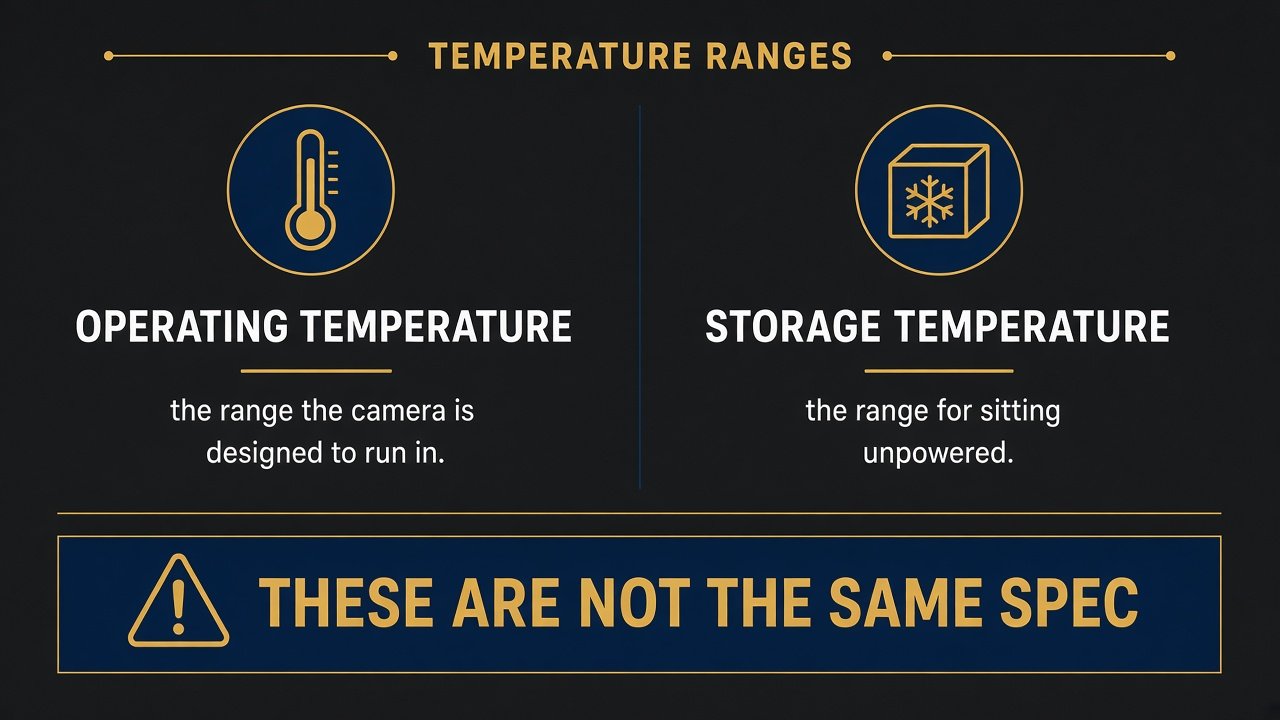
Operating temperature is the range the maker says the camera is designed to run in. Storage temperature is the range for sitting unpowered. They are not the same spec. A camera powered off in a parked car is still in storage conditions; a camera in parking mode is operating and adding its own heat. Published max is not “guaranteed to survive forever at that number,” not a cabin-temperature promise, and not a five-year Arizona lifespan. Warranty length is not a heat-proof certificate. Outside air is not dash-cam temperature: glass, sun, a dark dash, and electronics all sit in the path. We will not invent a degree delta. Hot, sunny parking happens outside desert states too. Humidity is a different stress; we will not invent IP waterproofing for interior cams.
Why supercapacitors matter — and what they do not do
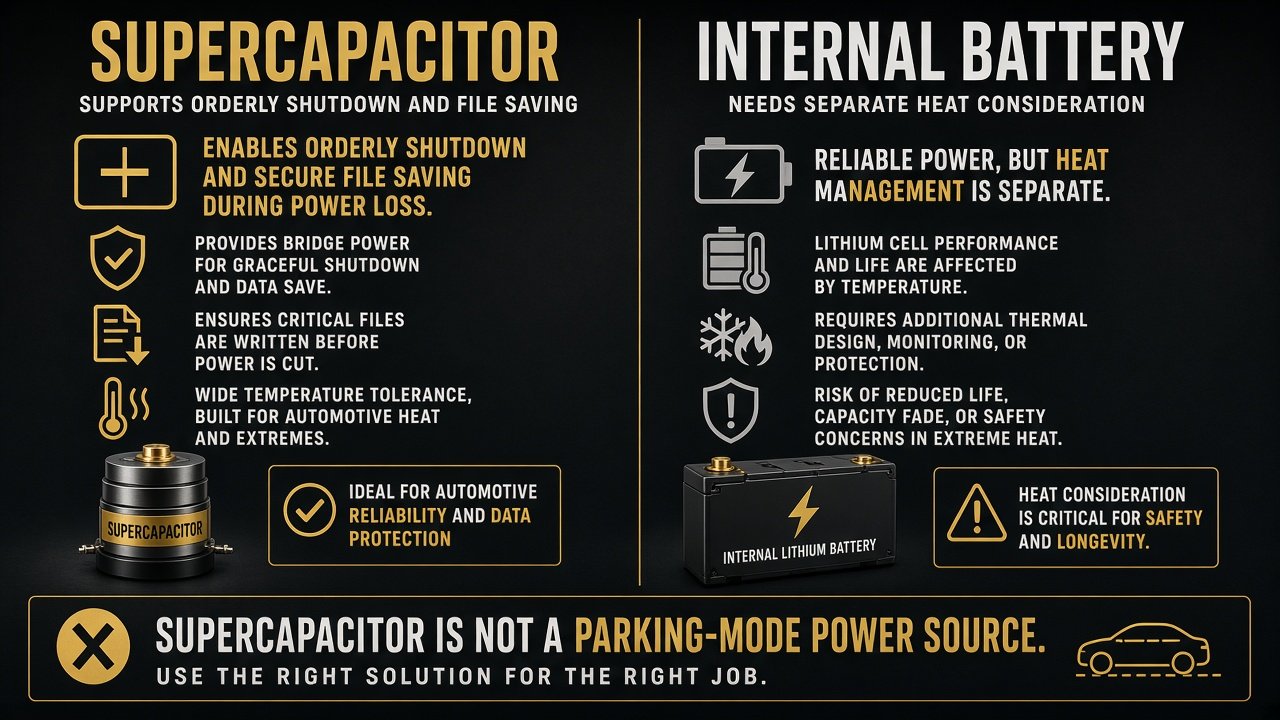
These five cameras use supercapacitors instead of a small internal lithium backup pack. That architecture is commonly chosen for automotive heat and for orderly file saving when power drops. It is not the 12 V source, not hours of parking recording, and not unlimited heat tolerance. Processor, enclosure, firmware, card, and mount still matter. We did not select an internal-lithium model; if you shop one, read its own temperature limits. Do not block vents or modify housings. Do not infer cooling from plastic versus metal.
Parking Mode Is Harder on a Dash Cam in Hot Weather
Parked plus powered is a different scenario from driving with the A/C on. The cabin can already be hot; the camera still dissipates energy. Hardwire keeps the unit on — it is not a heat solution. A battery pack has its own temperature limits; do not stash lithium packs against glass. Thermal shutdown (BlackVue cutoff ~75°C; Thinkware parking thermal path) can protect the unit and stop or reduce recording. VIOFO’s summer note to power down above 60°C cabin is the opposite of “leave it recording no matter what.” Full parking-mode types belong on a dedicated parking page. 4K is not an automatic overheat label; compare thermal specs, not resolution nicknames.
Why the memory card matters in high heat
Continuous writes plus a hot windshield is two stresses. Use the maker’s capacity cap and high-endurance / surveillance-class guidance — not a random phone card. Card temperature ratings vary; we will not pretend every microSD is equal. A failed recording can be card wear, an unsupported card, corruption, power, or heat. It is not automatically “the camera overheated.” Format on the schedule the manual gives.
What to Check Before Buying
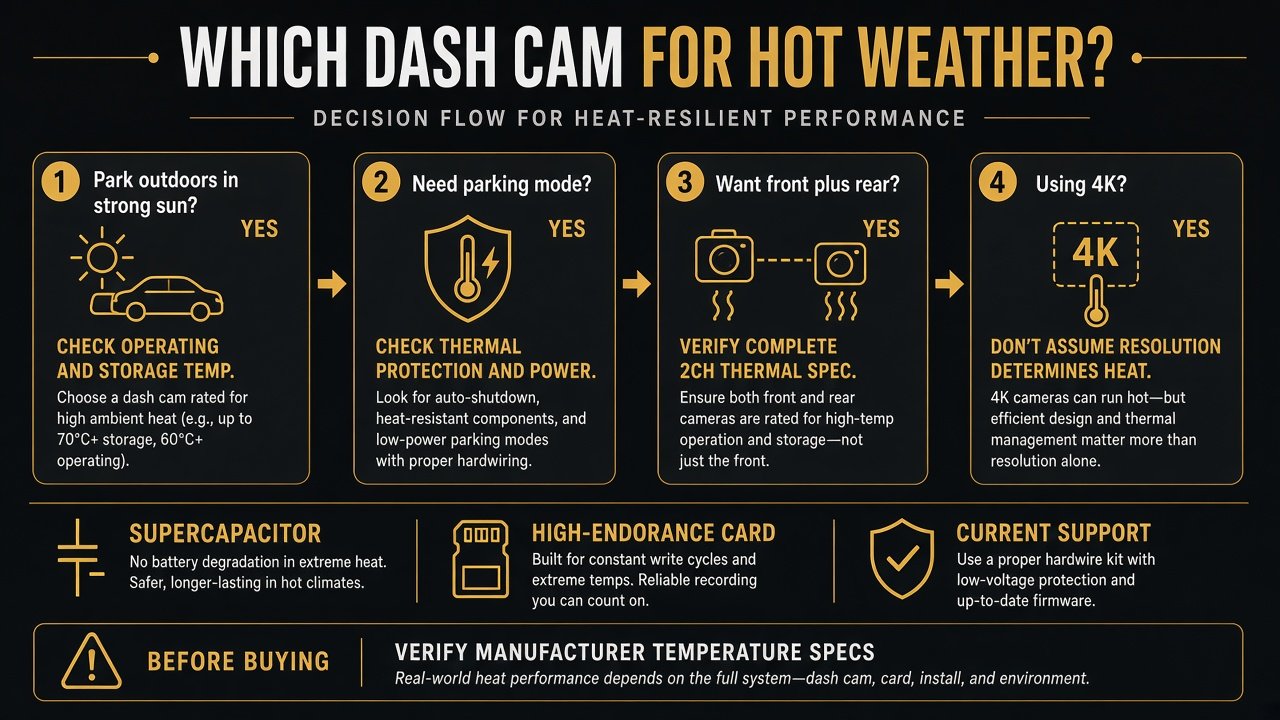
1) Operating temperature? 2) Storage temperature? 3) Supercapacitor or battery? 4) Documented thermal shutdown or parking thermal mode? 5) Parking mode at all? 6) Hardwire and low-voltage cutoff? 7) Battery-pack limits if you use a pack? 8) Max microSD? 9) Endurance card list? 10) Card temperature rating if you pick a specific card? 11) Mount type (adhesive / electrostatic — not “never falls”)? 12) Current support? 13) Exact bundle? 14) Warranty terms without assuming heat coverage? Keep a clear road view and legal placement; do not hide the lens in shade that ruins the file. A sunshade can lower cabin heat but can conflict with a windshield cam — do not cover a powered camera. If you park in a garage and rarely use parking mode, you may not need the premium heat-first stack.
Which Hot-Weather Dash Cam Should You Buy?
Outdoor sun parking and you want the balanced best dash cams for hot weather shortlist pick → A329S 2CH. You want the highest published operate/store numbers plus a cutoff spec → BlackVue Plus II. You want the same VIOFO 65/70°C pair for less → A229 Plus 2CH. You want 4K+4K on that same pair → A229 Ultra 2CH. You want documented parking thermal-protection behavior and accept 60°C operating → U3000 PRO 2CH. Need parking hardware details → treat power kits as extras, not heat magic.
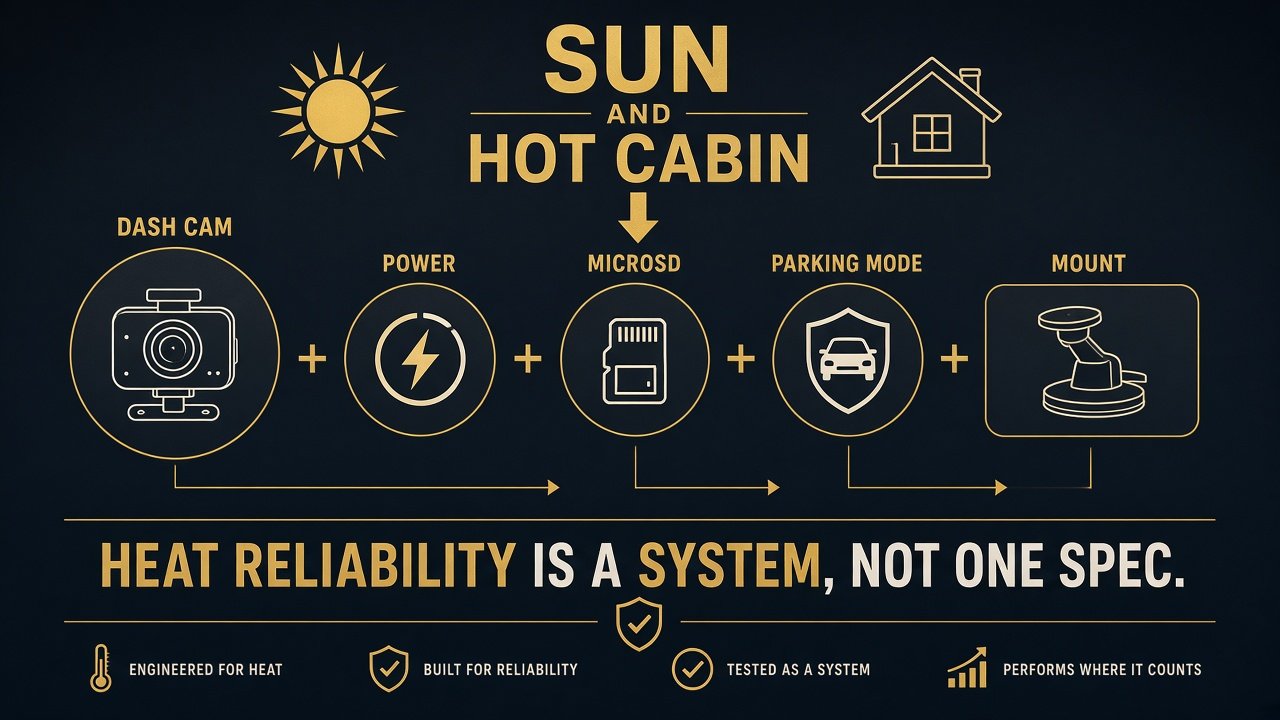
Shop the best dash cams for hot weather as a system: operating range + storage range + power design + parking use + memory card + installation. Do not buy the word supercapacitor alone. None of these cameras is heat-proof.
FAQ
What is the best dash cam for hot weather?
Moon Picke’s overall pick is the VIOFO A329S 2CH on a published −20–65°C operate / −20–70°C store supercap kit. BlackVue Plus II publishes a higher operating max. No heat-proof winner.
Is a supercapacitor better than a battery in heat?
It is often chosen for automotive heat and shutdown saving. It is not parking-mode power and not unlimited heat tolerance.
Can dash cams overheat in parked cars?
Cabin and glass temperatures can exceed comfortable ambient air. Some models document cutoffs or advise powering down. We did not measure your car.
What does operating temperature mean? Is storage temperature different?
Operating is the running envelope. Storage is unpowered. They can differ. Max spec is not a lifetime guarantee.
Does parking mode make overheating more likely?
Parked plus powered is more demanding than sitting off. Hardwire is not a cooling kit.
Do 4K dash cams run hotter?
Not automatically. Thermal design matters more than the 4K label.
Does the microSD card need to handle heat? Should I remove the camera in the sun?
Use a maker-approved high-endurance card. Removing a cam is a personal choice, not a requirement we tested. If you leave it, verify specs and parking behavior.