
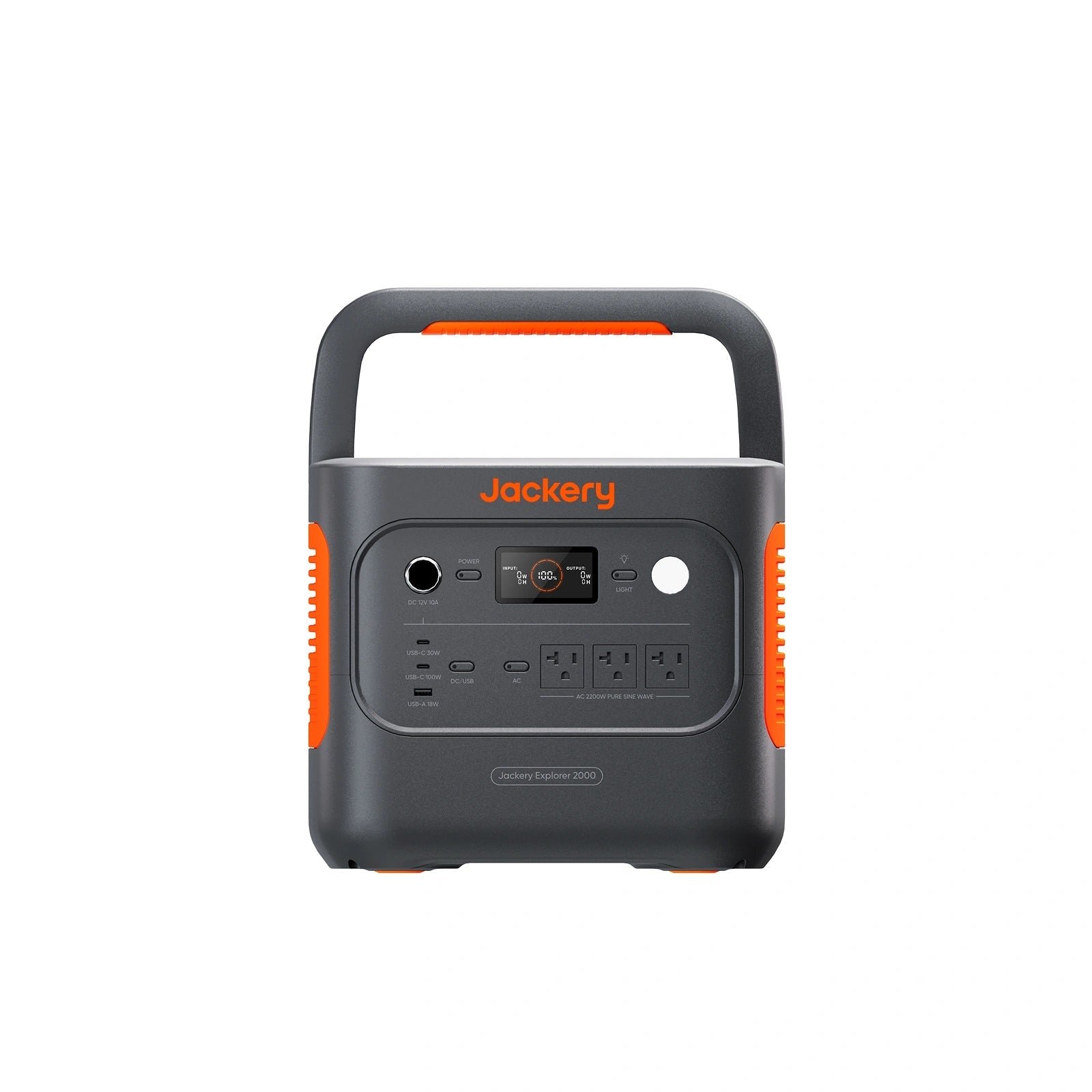
Jackery Explorer 2000 v2 review: The Jackery Explorer 2000 v2 (model JE-2000D) is a 2,042Wh LiFePO4 portable power station with 2,200W rated AC output, built for camping, road trips, and short home backup rather than whole-house generation. The strongest documented feature is that mix of 2 kWh-class capacity and 2,200W / 4,400W surge AC in a roughly 39.5 lb chassis with a carry handle. The biggest limitation is that the Explorer 2000 v2 is not expandable — extra battery packs are not part of this SKU — and solar input tops out at 400W.
Moon Picke compared Jackery’s official Explorer 2000 v2 specifications with the current Amazon listing (ASIN B0DFG2WDQH). We have not timed charging sessions, measured inverter output, or run a refrigerator on this unit. See how Moon Picke evaluates products.
As an Amazon Associate I earn from qualifying purchases.
Jackery Explorer 2000 v2 Review: Quick Verdict
This Jackery Explorer 2000 v2 review is most useful if you need about 2 kWh of LiFePO4 capacity and 2,200W AC for a campsite, RV stop, or a few household essentials during an outage. The strongest reason to consider it is documented 2,042Wh capacity, 4,400W surge, USB-C up to 100W, and wall charging Jackery lists at about 1.75 hours. The largest trade-off is no battery expansion and a 400W solar ceiling. It is worth buying if those loads fit and you can carry about 40 lb; skip it if you need modular kWh growth or a much lighter pack.
Check current availability on Amazon →
Jackery Explorer 2000 v2
This Jackery Explorer 2000 v2 review is most useful if you need about 2 kWh of LiFePO4 capacity and 2,200W AC for a campsite,…
- 2,042Wh LiFePO4 with a 4,000-cycle claim: chemistry and cycle language are on Jackery’s spec sheet, not a vague “long life” slogan.
- 2,200W AC / 4,400W surge and three outlets: enough headroom for many mixed camp and outage loads if you stay inside the rating.
- Fast wall recharge: Jackery’s ~1.75-hour AC claim (and ~1.7-hour Emergency Super Charge) is the practical home-use advantage.
Affiliate link. Moon Picke may earn a commission from qualifying purchases.
What Is the Jackery Explorer 2000 v2?
Jackery sells this unit as the Explorer 2000 v2 portable power station. Amazon lists the same configuration as a 2,042Wh LiFePO4 solar generator with optional panels. It is a floor-standing battery with an AC inverter, USB ports, a 12V car outlet, and two DC 8 mm inputs. It is not a gasoline generator, not a 240V whole-home system, and not a medical UPS. If you run a portable fridge on trips, size the station against the fridge’s documented draw — see our Dometic CFX5 75DZ review for a dual-zone cooler’s power path, not as a bundled kit.
Key Specifications
| Specification | Detail |
|---|---|
| Brand / model | Jackery Explorer 2000 v2 (JE-2000D) |
| ASIN (listing reviewed) | B0DFG2WDQH |
| Battery capacity | 2,042Wh (45.6Ah / 44.8V DC) |
| Battery chemistry | LiFePO4 (LFP) |
| Cycle-life claim | 4,000 cycles to 70%+ capacity (Jackery) |
| AC output | 2,200W rated; 4,400W surge peak; 3× 120V outlets |
| USB-C | 1× 100W max; 1× 30W max |
| USB-A | 18W max |
| Car port | 12V⟥10A max |
| Solar / DC input | 2× DC 8 mm; 16–60V up to 21A / 400W max combined |
| AC charging | 100–120V, 15A max; Jackery lists ~1.75 hours (Emergency Super Charge ~1.7 hours) |
| Weight / dimensions | About 39.5 lb (17.9 kg); 13.2 × 10.4 × 11.5 in |
| Expansion | Not expandable |
| UPS | Switchover under 20 ms (Jackery) |
| Warranty | 3+2 years on Jackery’s documented authorized-purchase path |
See the exact Explorer 2000 v2 configuration on Amazon →
Battery Capacity and Chemistry
Product → feature → use case → limitation: 2,042Wh is the rated pack, not the AC energy you will actually extract. Inverter losses, temperature, and the battery management system all reduce usable output. Jackery specifies LiFePO4 cells and 4,000 cycles to 70%+ capacity. Its “11+ year” figure is a cycle-math claim, not a Moon Picke field result. Two kilowatt-hours can cover lights, phones, a laptop, a router, and a cycling fridge for a limited window — not multi-day whole-home backup.
AC Output: What Can It Power?
Jackery rates continuous AC at 2,200W and surge at 4,400W across three 120V pure sine outlets. Running watts under 2,200W may be compatible; anything higher will not, even with a full battery. Surge helps motors start only inside that 4,400W peak.
Conditional examples, not guarantees: laptops, TVs, routers, and many CPAP machines are usually inverter-easy and runtime-limited. A refrigerator often fits on running watts, then depends on compressor surge and cycling. A coffee maker or microwave can exceed 1,000W while on, so they fit the inverter better than they fit a long session. Check nameplate watts on tools and cookers before you plug them in.
Ports and Device Charging
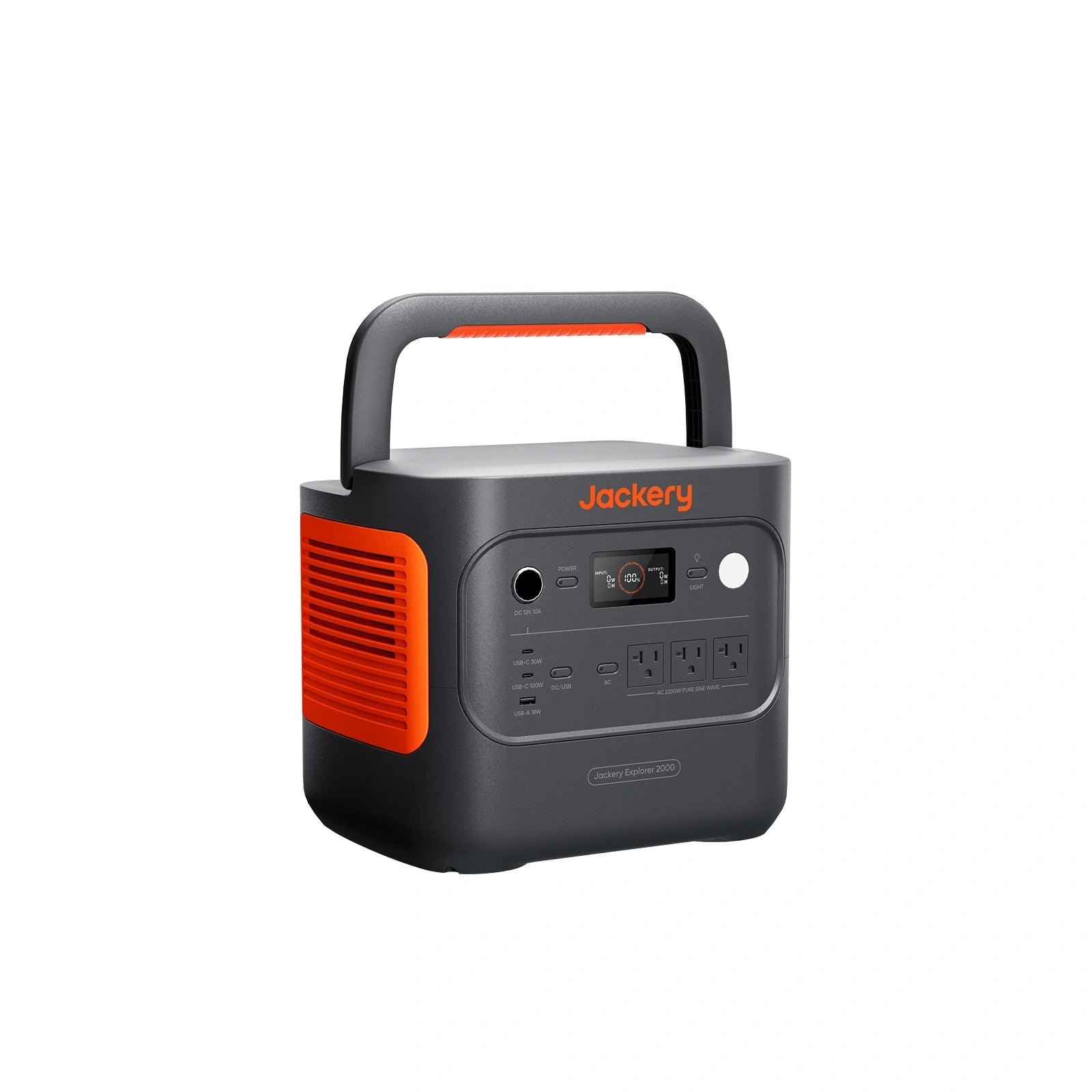
Three AC outlets share the 2,200W budget. USB-C is split — 100W and 30W — which is the difference between a USB-C laptop and a phone top-up. USB-A is 18W. The car socket is 12V at 10A max for cigarette-lighter accessories, not a second inverter. Separate DC/USB and AC buttons let you skip the inverter when you only need USB. A front LED on Jackery’s product photos is convenience lighting, not extra watt-hours.
Charging Speed and Options
Jackery documents wall AC, solar, 12V car charging, and app-controlled Emergency Super Charge. Official AC time is 1.75 hours; Emergency Super Charge is about 1.7 hours, with a faster-blinking charge light. Car charging is listed at 24 hours from 12V — a drive top-up, not a 2 kWh fill. Jackery’s FAQ supports pass-through charging but cautions against using it constantly. Those times are Jackery claims, not Moon Picke measurements.
Solar Charging
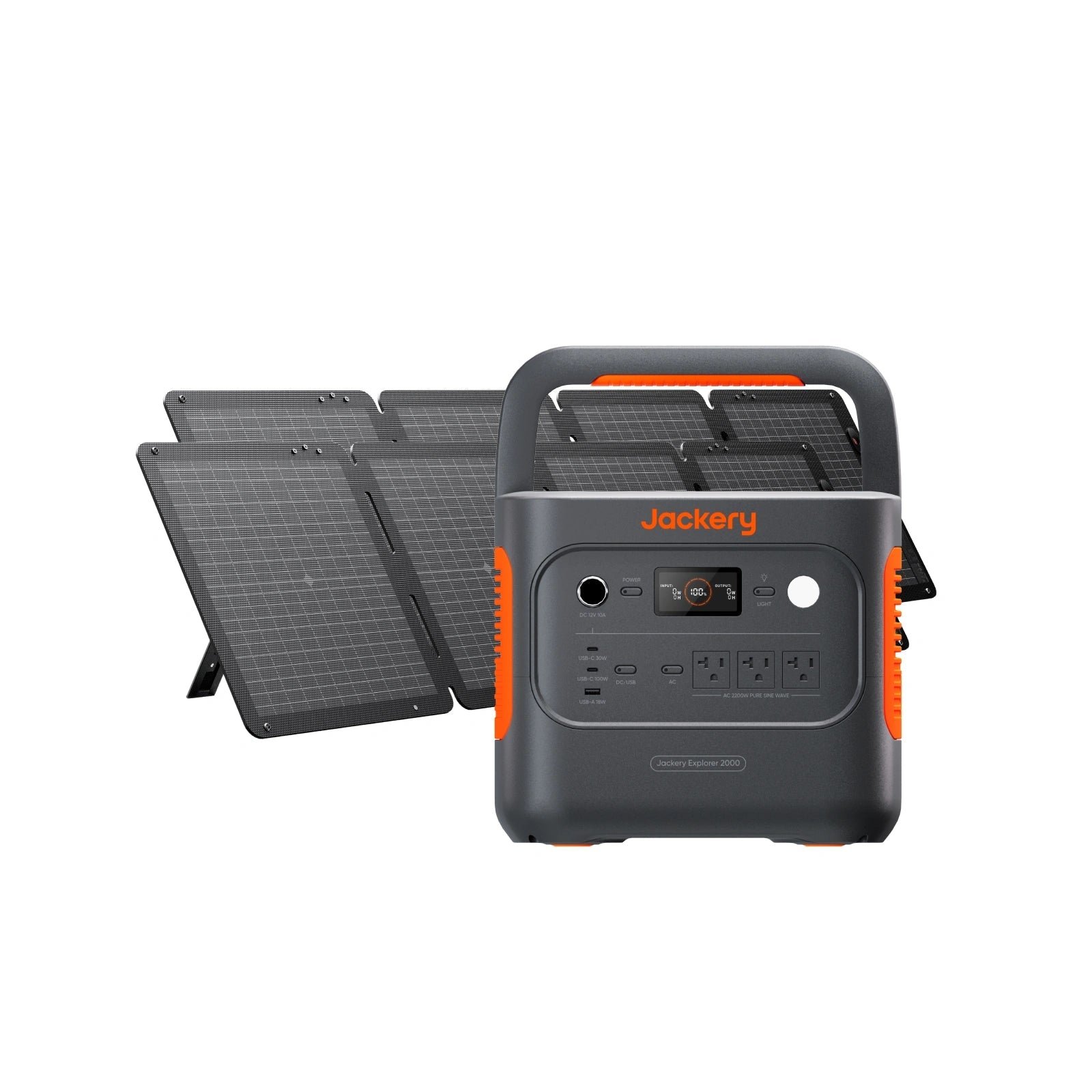
Maximum solar input is 400W on two DC 8 mm ports (16–60V up to 21A / 400W max combined; a lower 11–16V range is also listed). SolarSaga panels are sold separately. Jackery’s spec table lists 7.5 hours for solar charging — an ideal-sunlight claim. Real results vary with weather, angle, shade, cables, and temperature. The station has no IP waterproof rating on this spec sheet; keep it dry even if a panel lists IP68.
How Portable Is It?
Jackery lists about 39.5 lb (17.9 kg) and 13.2 × 10.4 × 11.5 inches, with a top handle and no wheels. That is trunk-portable, not backpack-portable. Jackery calls it smaller and lighter than the previous 2 kWh generation. Moon Picke’s judgment: compact for this capacity, still a two-hand lift.
Can It Run a Refrigerator?
Direct answer: many refrigerators can be compatible if running watts stay under 2,200W and surge stays under 4,400W. Runtime still depends on average draw, compressor cycling, inverter losses, temperature, and other loads.
Rough estimate only — not a tested runtime: at a 100W cycling average, 2,042Wh × 0.85 ÷ 100W ≈ 17 hours. At 150W, about 11 hours. A 12V compressor fridge averaging 40–60W can last longer, including on the car port if the fridge is designed for 12V. Confirm running and starting watts before an outage.
Is It Good for Camping?
Direct answer: yes for car camping if you accept the weight and 400W solar limit. Capacity covers lights, phones, laptops, a fan, and often a portable fridge. Jackery lists Quiet Mode at 30 dB and 45 dB at full load (1 meter) — quieter than gasoline, still a fan. Camp charging needs shore power, a vehicle, or enough sun. Discharge is listed at 14–113°F and charge at 32–113°F; keep the unit dry. Skip it for ultralight backpacking.
Home Backup Use
Jackery positions this for outage essentials within 2,200W: fridge, Wi-Fi, lights. That is plug-in backup, not a transfer-switch whole-home generator. It will not run central air, an electric range, or a pump above the inverter rating. For a larger expandable station already on Moon Picke, see the EcoFlow DELTA 2 Max review — a different SKU, not a spec swap.
UPS / EPS Function
Jackery documents UPS switchover under 20 ms for a router, PC, or NAS. Product → feature → use case → limitation: the station sits on AC bypass (12A max listed) and jumps to battery when the wall dies. That is convenience UPS behavior, not a medical-grade UPS. Do not use it for life support. Switchover time is Jackery’s spec, not a Moon Picke measurement.
App and Controls
The front display plus AC, DC/USB, light, and power buttons cover daily use. Energy Saving Mode: long-press AC and main power until the icon lights. Emergency Super Charge is a Jackery app setting. Charge-limit sliders are not on the spec table we used, so they are omitted.
Expansion Batteries
Jackery’s FAQ is explicit: the Explorer 2000 v2 is not expandable. Extra kWh means a different product, such as Jackery’s 2000 Plus family. Solar panels, a bag, and a 12V cable are accessories, not expansion batteries.
Noise and Cooling
Jackery publishes 30 dB in Quiet Mode and 45 dB at full load, measured 1 meter from the unit. Fans can still run while charging or under heavier AC loads. Those dB figures are Jackery’s, not independent measurements. Place the station where intake and orange side vents are unobstructed, and do not cover it with bedding or a sealed bin.
What Comes in the Box?
Included (Jackery, power-station configuration): Explorer 2000 v2 body and AC charging cable. Amazon’s listing is the station with solar panels optional — confirm the selected offer is not a panel bundle if you only want the battery.
Sold separately: SolarSaga panels and solar cables, Extreme Guard carrying bag, 12V car charging cable, extra DC extension leads. Jackery’s Extreme Kit adds the bag; solar generator kits add panels. None of those extras are required to use AC wall charging.
Check the current Explorer 2000 v2 kit on Amazon →
What It Does Well
The useful split is not “more watts on the box.” It is rated watt-hours versus usable AC energy, 2,200W continuous versus 4,400W surge, and a 400W solar lid that makes off-grid refill slower than wall charging. Those are the ownership facts this SKU actually competes on.
- 2,042Wh LiFePO4 with a 4,000-cycle claim: chemistry and cycle language are on Jackery’s spec sheet, not a vague “long life” slogan.
- 2,200W AC / 4,400W surge and three outlets: enough headroom for many mixed camp and outage loads if you stay inside the rating.
- Fast wall recharge: Jackery’s ~1.75-hour AC claim (and ~1.7-hour Emergency Super Charge) is the practical home-use advantage.
- USB-C 100W plus a 12V car port: covers laptops and 12V accessories without extra inverters.
- Documented UPS under 20 ms: useful for a network closet or PC that is already plugged through the station.
Important Limitations and Trade-Offs
- Not expandable: capacity is fixed at 2,042Wh.
- 400W solar cap: slower off-grid refill than 800W–1,200W-class stations.
- About 39.5 lb and no wheels: portable in a car, awkward as luggage.
- Car recharge is slow: 24 hours on 12V per Jackery.
- Solar and bag are extra: ownership cost is more than the station.
- No published IP waterproof rating for the station.
- UPS is not medical-certified.
- Amazon lists the item as non-returnable hazardous materials in the current buy box: read checkout terms before you buy.
What Does It Really Cost to Own?
Budget the station first, then extras you will actually use: solar panels, a 12V cable, a bag, and spare cables. Wall electricity to refill 2 kWh is small next to the hardware. Growing capacity means another station. Checkout prices change, so they are omitted. Confirm Amazon warranty terms against Jackery’s authorized-dealer language.
Who Is the Jackery Explorer 2000 v2 Best For?
- Car campers and road-trip users who can lift about 40 lb into a trunk
- RV users who need 120V and USB-C without a 240V house panel
- Homeowners who want plug-in backup for a fridge, lights, and internet — not whole-home power
- Laptop users who want USB-C 100W without a second brick
Who Should Skip It?
- Ultralight campers and anyone who cannot manage ~40 lb
- Buyers who need expandable battery modules
- Households expecting whole-home or 240V backup
- Users whose appliances exceed 2,200W continuous or 4,400W surge
- Shoppers who only need a small power bank or high-watt daily solar refill
What to Check Before Buying
- Rated 2,042Wh and LiFePO4 chemistry
- 2,200W continuous / 4,400W surge
- Three AC outlets; USB-C 100W + 30W; USB-A 18W; 12V 10A
- 400W solar input, 16–60V range, dual DC 8 mm connectors
- AC charge path and whether you need a 12V cable
- Weight about 39.5 lb and 13.2 × 10.4 × 11.5 in
- No expansion batteries
- UPS under 20 ms — not medical grade
- Jackery app Emergency Super Charge; Energy Saving Mode on the unit
- Warranty terms for the exact seller
- Amazon configuration B0DFG2WDQH, station-only vs solar bundle
Is the Jackery Explorer 2000 v2 Worth Buying?
Direct answer: it is worth considering if your loads fit 2,200W, 2,042Wh matches a weekend or a short outage, ~40 lb is acceptable, wall or modest solar charging matches how you travel, and you do not need add-on batteries. Skip it if you need much less capacity, much more output, backpack weight, or a cheaper mini station. Moon Picke’s judgment: the value is a complete 2 kWh LFP inverter in one handle-equipped box — not unlimited backup and not guaranteed fridge hours.
Final Verdict
This Jackery Explorer 2000 v2 review lands on a conditional yes for supervised camping, road-trip, and essential-circuit backup. The ideal buyer already knows the wattage of a fridge or a few AC tools and can carry the unit. The strongest feature is 2,042Wh LiFePO4 with 2,200W AC and fast wall charging on Jackery’s published times. The biggest limitation is the fixed pack plus 400W solar. Confirm ASIN B0DFG2WDQH and the station-only kit, then buy from load math, not from “solar generator” marketing copy.
Check current availability on Amazon →
Frequently Asked Questions
Is the Jackery Explorer 2000 v2 worth buying?
Yes if you need about 2 kWh and 2,200W AC and can lift ~40 lb. No if you need expansion batteries, whole-home power, or a lightweight pack.
How many watt-hours does the Jackery Explorer 2000 v2 have?
Jackery rates the pack at 2,042Wh (45.6Ah / 44.8V). Usable AC energy will be lower after inverter losses.
Can the Jackery Explorer 2000 v2 run a refrigerator?
Often, if running and surge watts fit 2,200W / 4,400W. Runtime depends on the fridge’s average draw. See the labeled estimate above; it is not a tested result.
Can it charge with solar panels?
Yes. Maximum documented solar input is 400W on two DC 8 mm ports. Panels are sold separately. Jackery’s 7.5-hour solar time is an official ideal-condition claim.
How long does it take to charge?
Jackery lists about 1.75 hours on AC, about 1.7 hours in Emergency Super Charge, 24 hours on 12V car charging, and 7.5 hours for the solar figure on the spec table.
Is the Jackery Explorer 2000 v2 good for camping?
It is a strong car-camping station: enough energy for mixed devices, but too heavy for backpacking and limited to 400W solar refill.
Can it be used for home backup?
For selected 120V essentials within 2,200W, yes. It is not a whole-home generator and the UPS function is not medical-grade.
Sources: Jackery official Explorer 2000 v2 product page, Jackery Solar Generator 2000 v2 specifications, Amazon listing B0DFG2WDQH. Methodology: How We Evaluate Products. Affiliate Disclosure.