
Moon Picke independently researches products. If you buy through our links, we may earn a commission at no extra cost to you. Read our affiliate disclosure.
This Kenwood DMX958XR review asks whether Kenwood’s Excelon Reference DMX958XR is still a sensible 2026 buy. As of September 2026, Kenwood USA still lists the model, and Kenwood’s multimedia firmware page still hosts a DMX958XR update dated 20 October 2025. The unit offers wired and wireless Apple CarPlay, wireless and wired Android Auto, Bluetooth 5.0, Wi-Fi, USB-C, 5.0 V preouts, 13-band EQ, and four camera inputs. The ideal buyer is building aftermarket audio around a traditional integrated screen. The biggest limitation is that a mature chassis still needs vehicle-specific integration hardware, and Amazon/marketplace stock can be inconsistent. Moon Picke has not installed this receiver.
As an Amazon Associate I earn from qualifying purchases.
See the Kenwood DMX958XR (ASIN B0B4WZTQLT) on Amazon →
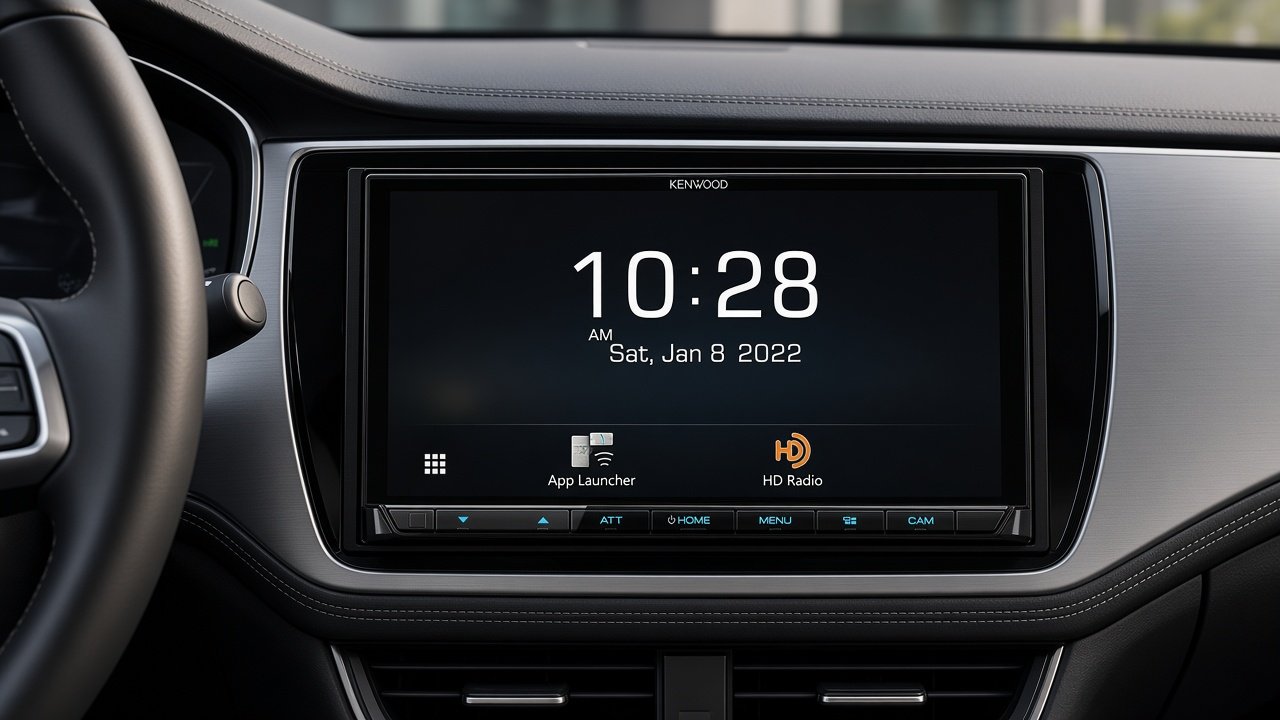
Kenwood DMX958XR Review: Quick Verdict
It remains relevant if Kenwood’s listed features still match the car and the listing is clearly new from an authorized path. Strongest reason: high-voltage preouts plus DSP tools for amplifiers, not the built-in 50W×4 maximum rating. Biggest trade-off: a 6.75-inch integrated screen and extra adapters versus simpler CarPlay-only radios or large floating displays. Conditional verdict: still worth considering for system builders when firmware, warranty, and fitment check out—not an automatic buy because the spec sheet is premium.
Is the Kenwood DMX958XR still worth buying in 2026?
Yes, when support documentation is still live, the unit is new from an authorized seller, wireless phone features cover daily use, and you actually need the audio/camera expansion. Skip unclear marketplace copies.
Does the DMX958XR have wireless Apple CarPlay and Android Auto?
Kenwood lists wired and wireless Apple CarPlay, and Android Auto plus Android Auto Wireless. A compatible phone is required. Moon Picke has not timed connections or lag.
Does it support iDatalink Maestro?
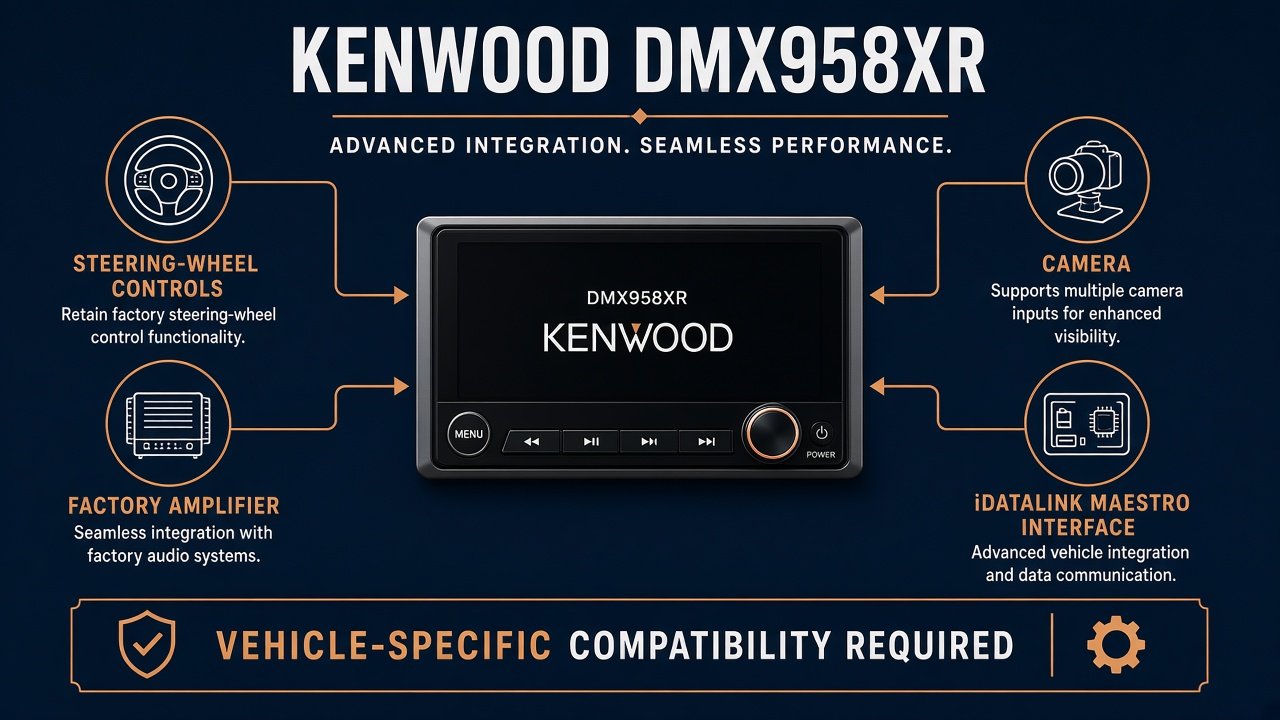
Kenwood documents optional Maestro RR/RR2 for steering-wheel audio controls, factory amplifier retention, secondary displays, and some vehicle data on compatible vehicles. It does not keep “all” factory features on every car.
Is it good for aftermarket audio?
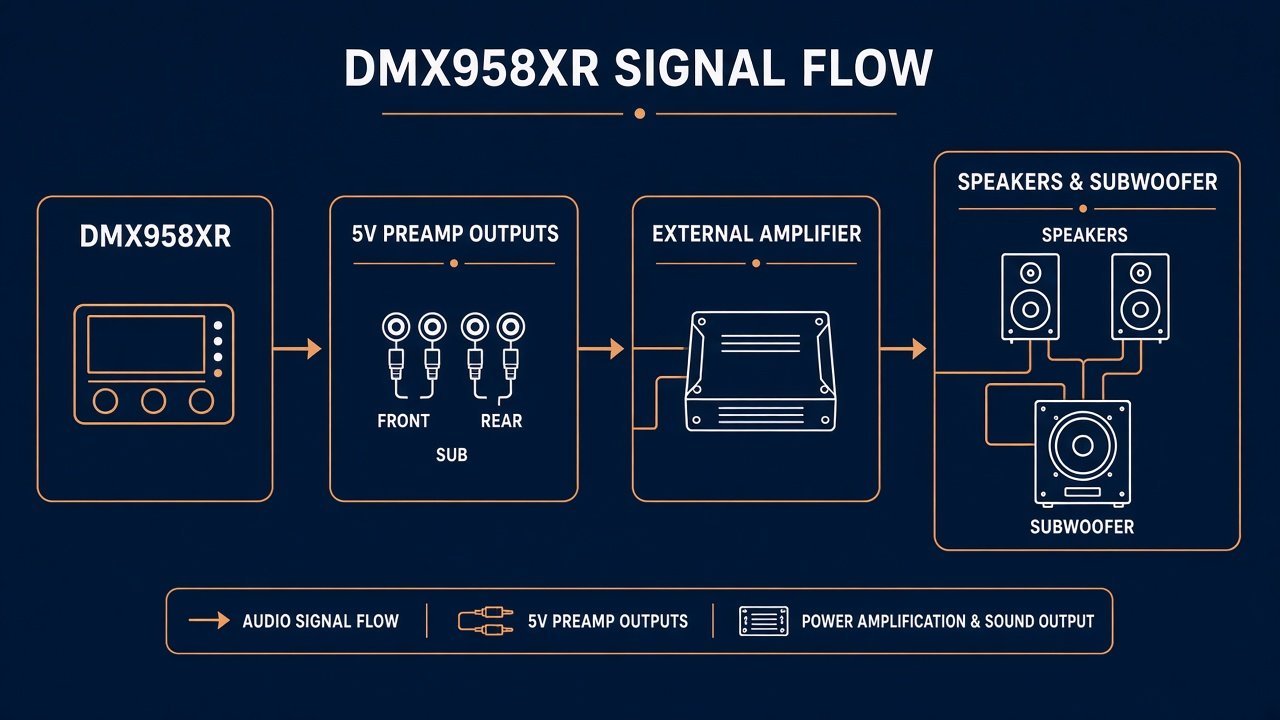
That is its strongest documented role: three 5.0 V preouts, 13-band EQ, 2-way/3-way crossovers, digital time alignment, and subwoofer level. The head unit is a control hub, not a substitute for a measured amplifier.
What Is the Kenwood DMX958XR?
Official Kenwood USA naming: DMX958XR, Excelon Reference, “6.8" Digital Multimedia Receiver.” The spec table calls the picture size 6.75 inches diagonal. It is a monitor-with-receiver (DMX), not a Kenwood DNX navigation receiver. Do not confuse it with DMX957XR, DMX9708S, DMX1057XR, DNR1007XR, or DMX809S.
Kenwood positions Excelon Reference around selected audio parts, gold-plated 5 V preouts, capacitive HD touch, wireless phone projection, HD Radio, SiriusXM readiness, four camera inputs, and short-chassis installation. This page is one product’s 2026 ownership case, not a Kenwood lineup or a best-head-unit roundup.
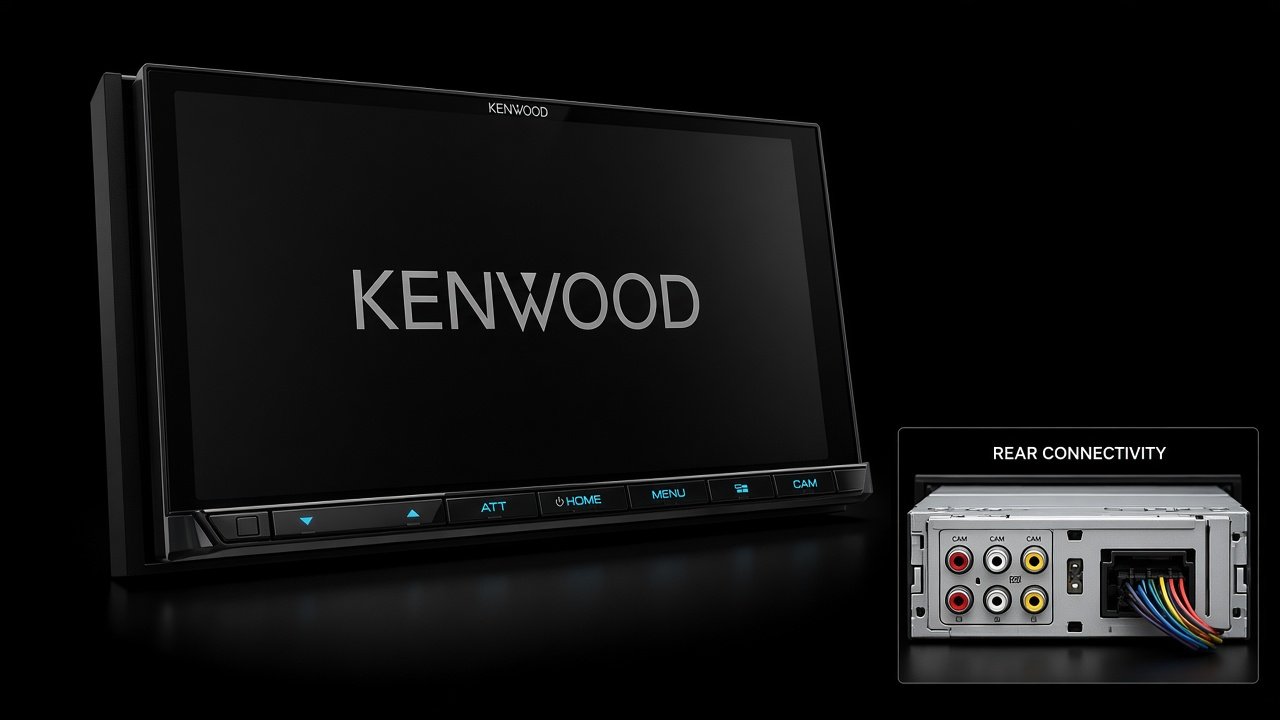
Kenwood DMX958XR Key Specifications
Facts below follow Kenwood USA’s DMX958XR specification table and feature copy unless noted. Maximum power is not continuous power.
| Spec | Kenwood listing |
|---|---|
| Display size | 6.75 in diagonal (Kenwood also markets 6.8") |
| Display resolution | 1280H × 720V × RGB (2,764,800 pixels), AAS LCD, capacitive touch |
| Wireless Apple CarPlay | Wired and wireless (compatible iPhone) |
| Wireless Android Auto | Android Auto and Android Auto Wireless (Android 6.0+ per Kenwood) |
| Bluetooth / Wi-Fi / USB | BT 5.0 (SBC/AAC/LDAC); Wi-Fi dual-band; USB-C 5 V 3.0 A |
| HD Radio | Built-in AM/FM HD Radio tuner |
| SiriusXM | Ready; optional tuner sold separately; subscription required for service |
| Built-in amplifier | Maximum 50 W × 4; typical full-bandwidth 22 W × 4 at less than 1% THD |
| Preamp outputs / voltage | 3 preouts, 5.0 V / 10 kΩ |
| EQ / DSP | 13-band EQ; 2-way/3-way crossovers; time alignment; sub level −50 to +10 dB |
| Camera inputs | 4 inputs; HD rear-camera ready (Kenwood CMOS-740HD example) |
| iDatalink Maestro | RR/RR2 sold separately; vehicle-specific |
| Chassis | Main unit 178 × 100 × 85 mm (7 × 3-15/16 × 3-3/8 in); Kenwood “short chassis,” less than 3.5" depth |
| Warranty | Unauthorized dealers: no Kenwood limited warranty. Authorized Excelon often 2 years—confirm seller. |
Is the DMX958XR Still Supported in 2026?
As of September 2026, Kenwood USA’s Excelon Reference product page for the DMX958XR is live, with specifications, manuals path, and authorized-retailer language. Kenwood’s global multimedia firmware index still lists DMX958XR under 2021 models. The 20 October 2025 package (S_V1_4_0005_4600.zip) notes improved stability and improved software security. That is current published support—not a prediction of how long updates will continue.
Amazon listing ASIN B0B4WZTQLT matches the US Excelon Reference DMX958XR. Stock can appear as new, remaining inventory, or marketplace. Do not assume every offer is factory-new authorized product. Kenwood states it does not offer the manufacturer’s limited warranty on car audio bought from unauthorized dealers. A mature head unit can still work well and become a weaker purchase if warranty is unclear or the seller is not authorized. This review does not call the radio discontinued, obsolete, or current-generation flagship.
Check current DMX958XR listing condition and seller on Amazon →
Wireless CarPlay and Android Auto
Kenwood documents wired and wireless Apple CarPlay, and Android Auto plus wireless Android Auto. Wireless needs a compatible phone; Kenwood cites iOS 12.0 and higher for certain CarPlay navigation-app notes, and Android 6.0 or higher plus the Android Auto app. Wired USB-C remains part of the architecture (Type-C cable and Type-A adapter included per Kenwood). Wi-Fi is dual-band 802.11 a/b/g/n/ac. Bluetooth 5.0 handles calls and audio (including LDAC for Kenwood’s Hi-Res Audio Wireless claim).
Daily value is phone projection without a permanent cable, with a wired fallback. Moon Picke has not tested connection time, dropouts, or “faster than Sony/Alpine.” Reliability still depends on phone OS, region, and install quality.
Display and Everyday Interface
Kenwood specifies a 6.75-inch diagonal AAS LCD at 1280×720 RGB, LED backlight, and an electrostatic capacitive touch panel. Physical keys along the face include volume, ATT, HOME, MENU, and CAM on Kenwood’s product photography. Widgets can include clock, album art, compass, photo frame, and visualizer depending on configuration. A GPS antenna is in the instruction-manual accessory list for time/position functions—not a built-in navigation map suite like Kenwood DNX models.
A ~6.8-inch integrated display can suit buyers who want a conventional dash footprint instead of an oversized floating panel. This page does not claim it is brighter, glare-free, or more responsive than other screens.
Why the DMX958XR Appeals to Aftermarket Audio Buyers
This is the core audio case in a Kenwood DMX958XR review aimed at system builders. Kenwood lists three 5.0 V preouts, 13-band EQ (62.5 Hz–16 kHz bands, ±9 dB), high-pass and low-pass filters with selectable slopes, 3-way crossover options, front/rear/sub delay 0–20.01 ft, and subwoofer level −50 to +10 dB. FLAC and WAV playback are listed up to 192 kHz / 24-bit. Bluetooth LDAC is the wireless Hi-Res path Kenwood markets.
Higher preamp voltage can send a stronger line-level signal to compatible external amplifiers. It does not automatically mean better sound, more bass, or lower distortion in every install. Setup still matters. Kenwood’s built-in amplifier is specified as 50 W × 4 maximum and 22 W × 4 typical full-bandwidth power at less than 1% THD. Do not treat 50 W × 4 as continuous RMS. For an aftermarket system, the receiver often matters more as signal source plus DSP/control hub than as the main power amp.
HD Radio, SiriusXM and Media Features
HD Radio is built in: digital FM/AM on Kenwood’s tuner tables, no Kenwood monthly fee for HD Radio itself. That is over-the-air digital broadcast, not satellite and not phone streaming. SiriusXM is hardware-ready only: optional tuner sold separately, subscription required. USB uses Type-C (FAT16/32, exFAT, NTFS). HDMI is Type-D; Kenwood lists optional KCA-HD200. Music Mix can connect up to five Bluetooth devices. No fake reception claims.
Camera Inputs and Expansion
Kenwood specifies four camera inputs and HD rear-camera ready. Examples include front, Kenwood DRV-N520 dash cam (sold separately), rear, and side cameras. Switching is on-screen; automatic side cameras can use Maestro RR on supported vehicles. Parking guidelines need a compatible backup camera. HD viewing is documented for CMOS-740HD on the rear input. Four inputs are not factory 360° surround. Factory cameras need adapters.
iDatalink Maestro and Factory Feature Retention
Kenwood: optional iDatalink Maestro RR/RR2 can retain factory steering-wheel audio controls, factory amplifier, and secondary displays, and can show vehicle information such as performance data, climate, and battery voltage on compatible vehicles. Radar-detector display is a separate K40/Escort path. Availability varies by vehicle, year, trim, module, and firmware. Do not read that as “Maestro keeps all factory features.”
Replacing OEM infotainment can affect steering controls, factory amp, backup camera, premium audio, USB, microphone, chimes, climate screens, and telematics. Receiver features and vehicle integration are separate purchases. SWC without Maestro may still need another interface on some cars—this page does not inventory every adapter.
Will the Kenwood DMX958XR Fit Your Car?
Do not assume it fits any double-DIN opening. Kenwood’s main-unit size is 178 × 100 × 85 mm; with sleeve 182 × 112 × 85 mm. Short depth helps some dashes and does not replace a dash kit, harness, antenna adapter, or factory-amp interface. Check opening, depth, trim, harness, factory electronics, steering controls, factory camera, antenna, and USB location. A future Moon Picke Single-DIN vs Double-DIN guide can own the format question; this review only records this chassis.
What You May Need Beyond the Head Unit
- Dash kit — vehicle-dependent
- Wiring harness / antenna adapter — vehicle-dependent
- iDatalink Maestro RR/RR2 — optional, vehicle-specific
- Steering-wheel-control interface if not using Maestro — vehicle-dependent
- Factory-amplifier interface — vehicle-dependent
- Camera adapter or Kenwood camera — optional
- SiriusXM Connect tuner — optional; not in the receiver box
- HDMI cable (KCA-HD200) — optional
- Professional installation — often the honest labor cost
The receiver’s sale price is not the cost of a complete installation. Moon Picke does not invent average shop rates.
How the DMX958XR Fits Beside Sony and Alpine
Keep this to architecture, not a four-way shootout. The DMX958XR is a traditional integrated-display premium receiver aimed at DSP, 5 V preouts, cameras, and Maestro-class integration. Sony’s XAV-AX8500 is Moon Picke’s large floating-screen Sony example; the Sony XAV-AX8500 review owns that chassis. The XAV-AX8500 vs XAV-AX6000 page owns Sony’s integrated-versus-floating choice, including the AX6000 as Sony’s integrated option. Alpine’s Halo11 is the large floating Alpine path on the Alpine iLX-F511 review. If you mainly want a giant screen, those articles are the better starting points. If you want Kenwood’s documented audio-expansion stack in a ~6.8-inch integrated body, stay here. Screen size is a dashboard architecture decision, not a quality score. This is not Kenwood vs Sony as a ranking keyword.
What the Kenwood DMX958XR Does Well
- Wireless and wired Apple CarPlay plus wireless/wired Android Auto, as Kenwood lists them
- 5.0 V / three preouts with 13-band EQ, crossovers, and time alignment for system builders
- Four camera inputs and HD rear-camera readiness, with Kenwood camera examples
- Built-in HD Radio plus SiriusXM-ready hardware (tuner extra)
- Documented Maestro RR/RR2 path and a still-published 2025 firmware file
Kenwood DMX958XR Limitations
- Mature 2021-class firmware family—supported, not “newest platform”
- Retail availability can be leftover or marketplace; warranty follows authorized-seller rules
- Integrated 6.75-inch screen is smaller than floating 9–11 inch designs
- No built-in navigation suite (DMX, not DNX); GPS antenna is for unit functions
- SiriusXM tuner and most cameras/Maestro are extra
- Factory feature retention is never the receiver alone
- 50 W × 4 is maximum power, not a high-current amp replacement
Who Should Buy the Kenwood DMX958XR?
Buyers building aftermarket amps who want wireless CarPlay/Android Auto on an integrated screen, multiple camera inputs, and a real Maestro path. Skip if you only need basic CarPlay, want a floating jumbo display, OEM integration looks expensive, or the listing’s seller/warranty is muddy.
Is the Kenwood DMX958XR Worth Buying in 2026?
A 2026 Kenwood DMX958XR review should not start with “is it old?” Consider it if official support is still usable (product page + October 2025 firmware), the price is right for a mature Excelon Reference, wireless phone features match the phones you own, audio expansion is the reason you are spending, and the vehicle’s kit/Maestro/cameras are quoted before you click buy. Skip if support/warranty is unclear, you wanted a newer Kenwood family, the install stack is too complex, or a simpler receiver already does CarPlay. Older is not automatically bad. Premium specs are not automatically the best choice for every vehicle.
Final Verdict
On this Kenwood DMX958XR review, the strongest fit is the aftermarket-audio buyer who still wants wireless phone projection in a short, integrated chassis. Biggest advantage: documented 5 V preouts and DSP, plus four camera inputs. Biggest limitation: vehicle integration and total installed cost sit outside the radio. Current-support caveat: Kenwood still publishes the USA page and a 20 October 2025 firmware file; buy authorized and confirm the listing. Conditional recommendation: yes for that system-builder brief; no as a generic “best stereo.”
FAQ
Is the Kenwood DMX958XR still worth buying in 2026?
If docs/firmware are current enough, the unit is new/authorized, and you need its audio/camera stack. Otherwise no.
Does the DMX958XR have wireless Apple CarPlay?
Yes. Kenwood lists wired and wireless Apple CarPlay.
Does it support wireless Android Auto?
Yes. Kenwood lists Android Auto Wireless and wired Android Auto.
Does the DMX958XR have HD Radio?
Yes. Built-in HD Radio is not SiriusXM.
Does SiriusXM require an extra tuner?
Yes. Tuner sold separately; subscription is separate.
Does it support iDatalink Maestro?
Kenwood documents Maestro RR/RR2 as optional and vehicle-specific.
How many camera inputs, and will it fit any double-DIN vehicle?
Four inputs per Kenwood. It will not fit every double-DIN car without a kit and electronics check.
Sources: Kenwood USA DMX958XR; Kenwood 2021 multimedia firmware (20 Oct 2025); DMX958XR instruction manual (B5K-0858-00); Amazon B0B4WZTQLT.