
Moon Picke independently researches products. If you buy through our links, we may earn a commission at no extra cost to you. Read our affiliate disclosure.
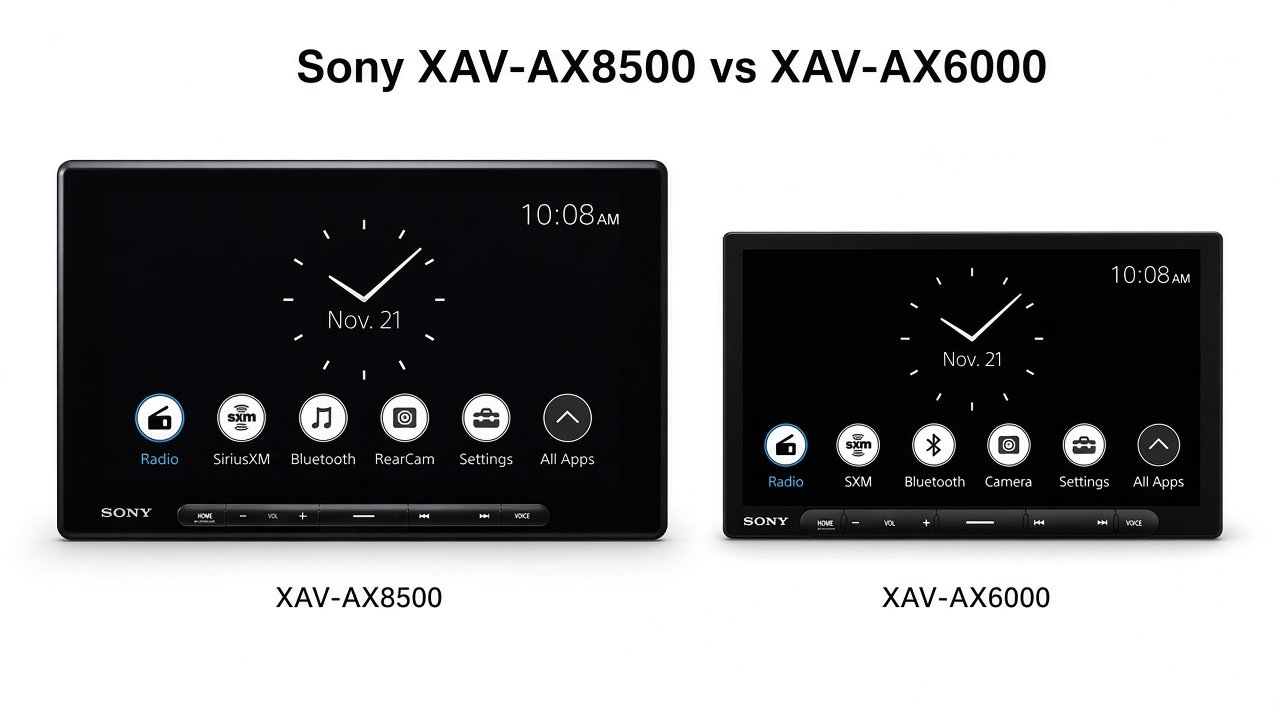
The Sony XAV-AX8500 vs XAV-AX6000 choice is a dashboard-architecture decision, not a smartphone-feature shootout. Sony documents wireless and wired Apple CarPlay and Android Auto on both. Choose the XAV-AX8500 if you want its 10.1-inch floating HD screen, documented tilt/swivel, and three camera inputs—and your dash can clear that panel. Choose the XAV-AX6000 if a 6.95-inch integrated, bezel-less layout is enough and you do not want to pay for display size or extra camera inputs you will not use. Moon Picke has not installed either unit.
As an Amazon Associate I earn from qualifying purchases.
See the Sony XAV-AX8500 on Amazon →
See the Sony XAV-AX6000 on Amazon →
Sony XAV-AX8500 vs XAV-AX6000: Quick Verdict
Which is better, Sony XAV-AX8500 or XAV-AX6000? Neither is universally better. Buy the AX8500 when a large floating 10.1-inch HD display (1280×720) and three triggered camera inputs are the reason you are shopping. Buy the AX6000 when you want Sony’s wireless CarPlay/Android Auto stack in a more compact 6.95-inch (800×480) integrated face, with one rear-camera input. Audio expansion is largely the same on paper: CTA-2006 20 W RMS × 4, 55 W × 4 maximum, and 5 V three-way preouts. Fitment, not the logo, is the real filter.
Key Differences at a Glance
This Sony XAV-AX8500 vs XAV-AX6000 table is from Sony’s U.S. product pages, Help Guide specifications, and current Sony USA support downloads (checked September 2026). Amazon listings used for availability: AX8500 ASIN B0CXF7H2Z4; AX6000 ASIN B0B52FJ3ZG.
| Feature | Sony XAV-AX8500 | Sony XAV-AX6000 |
|---|---|---|
| Display size | 10.1 in / 25.7 cm | 6.95 in / 17.6 cm |
| Display style | Oversized floating HD panel; tool-free tilt/swivel ±15° H/V after install | Bezel-less capacitive panel designed to sit in the dash opening |
| Display resolution | 1280 × 720 (HD) | 800 × 480 |
| Touch | Capacitive | Capacitive |
| Wireless CarPlay | Yes (also wired) | Yes (also wired) |
| Wireless Android Auto | Yes (also wired) | Yes (also wired) |
| Preamp outputs | 5 V, 3 (front / rear / sub) | 5 V, 3 (front / rear / sub) |
| Built-in amp | 20 W RMS × 4 (CTA-2006); 55 W × 4 max | 20 W RMS × 4 (CTA-2006); 55 W × 4 max |
| Camera inputs | Rear + Input 1 + Input 2 (individual triggers) | Rear view camera in |
| Chassis (documented) | Mounting ~178 × 50 × 158 mm (single-DIN-height opening) | Mounting ~182 × 111 × 115 mm; compact rear chassis behind a double-DIN-class face |
| Screen adjustment | Tilt/swivel ±15°; install height/depth per Sony manual | Fixed panel (no documented post-install tilt/swivel) |
| Steering-wheel controls | Adapter-dependent (iDatalink Maestro RR/RR2 optional) | Adapter-dependent (Maestro RR/RR2 optional) |
| Warranty (Sony-listed) | 3-year limited when bought from Sony | 3-year limited when bought from Sony |
| Sony USA firmware (as of check) | v3.02.00 (27 May 2025) | v3.04.00 (16 July 2026) |
Sony still lists both models on electronics.sony.com with firmware download pages. The AX6000 product page can show out of stock even while the Amazon listing is offered. That is a channel-availability fact, not a verified “discontinued” label.
Display Size: The Biggest Difference
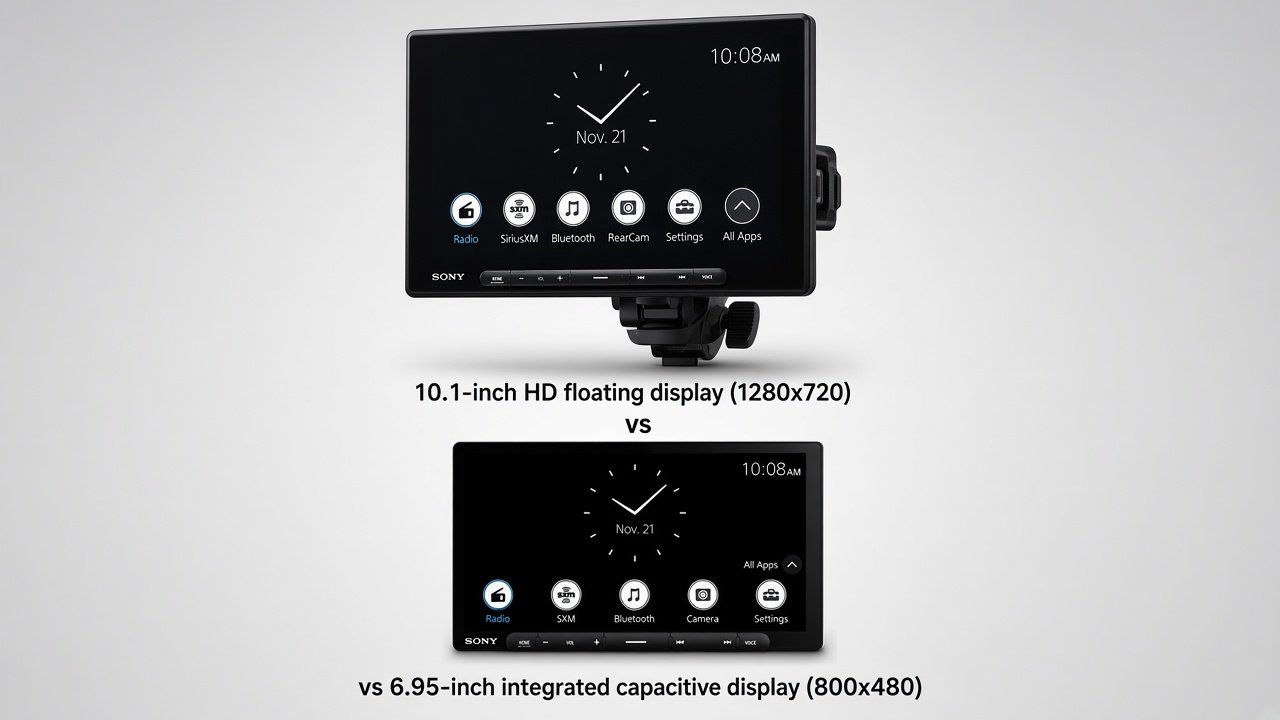
What is the biggest difference between AX8500 and AX6000? The screen. Sony specifies a 10.1-inch optically gapless HD LCD at 1280×720 on the AX8500, versus a 6.95-inch anti-glare capacitive LCD at 800×480 on the AX6000. The AX8500 is also a different physical object: an oversized panel on a display joint. Sony documents a screw-less tilt and swivel of ±15 degrees horizontally and vertically, adjustable without tools after installation. The AX6000 is documented as a bezel-less face meant to integrate with the dashboard opening.
Larger screen improves display area. It does not, by itself, improve amplifier power, CarPlay reliability, or whether the radio will physically miss your vents. The AX6000’s smaller panel is not a defect; it is a lower visual footprint. Buyers who mainly want maps and media tiles at phone-like size may be over-served by 10.1 inches. Buyers who want a tablet-like center stack will under-use 6.95 inches. That preference is the XAV-AX8500 vs AX6000 differences that actually change daily driving—if the dash cooperates.
Which Fits Better in a Real Dashboard?
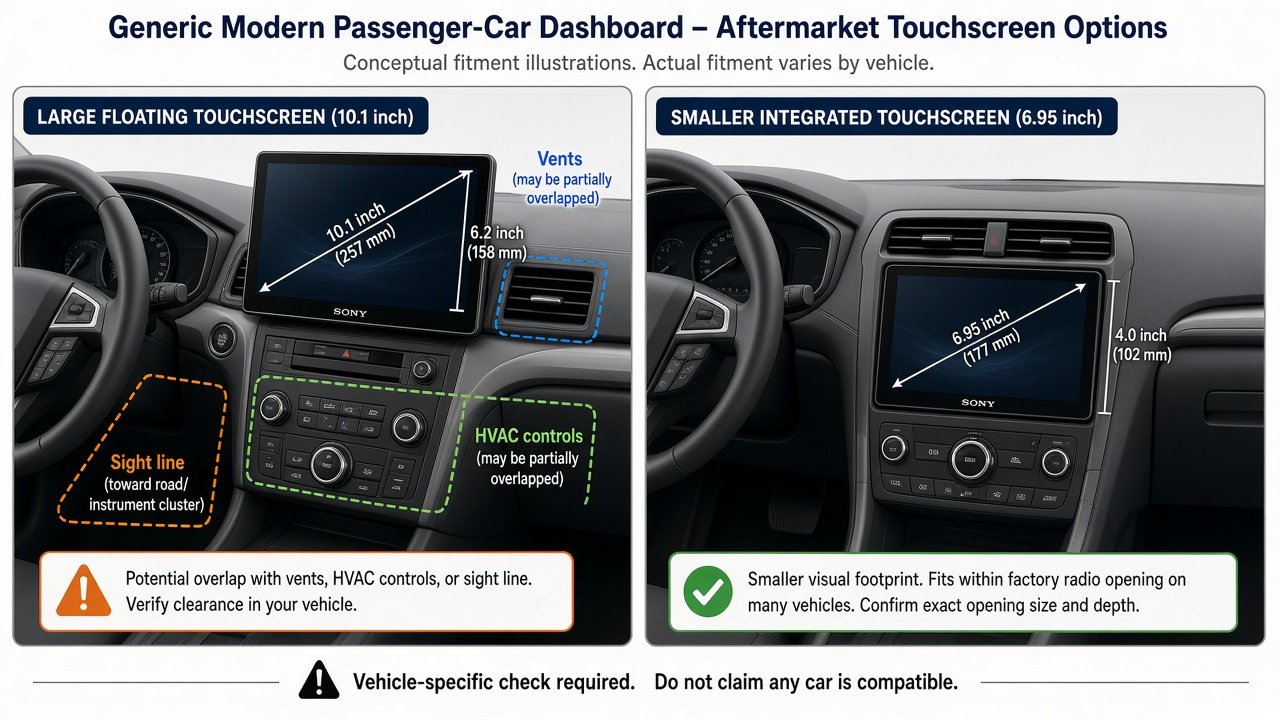
Head unit size is not vehicle fitment. Sony’s AX8500 Help Guide sets mounting dimensions at about 178 × 50 × 158 mm and warns that the distance from the mounted unit’s front reference surface to the center-cluster surface must stay within 22 mm (7/8 in) or the unit cannot be installed properly. The same manual tells installers to keep the display from interfering with driving controls such as switches or the shift lever, and it publishes display-position ranges that change with installed angle. Installer-facing notes commonly describe a ~2-inch single-DIN-height chassis with the 10.1-inch monitor attached in front; some of those openings still cannot clear the panel.
The AX6000’s Help Guide lists overall dimensions of about 178 × 100 × 132 mm and mounting dimensions of about 182 × 111 × 115 mm. Sony’s marketing copy for the AX6000 says that despite a double-DIN-class display, the rear chassis is smaller than conventional double-DIN boxes, which can leave more room for cables. That is architecture, not a promise it drops into every 2-DIN dash without a kit.
Moon Picke’s assessment: the AX6000 may be physically easier where a flush, shorter panel avoids HVAC knobs, hazard switches, and windshield sight lines. The AX8500’s floating panel may work better where you want the glass to sit proud and you have measured clearance to vents and the steering wheel. Neither “fits any car.” Confirm make, model, year, dash kit, harness, factory amplifier, cameras, USB, antenna, and vehicle data before you buy. This is not a single-DIN versus double-DIN buying guide.
Wireless CarPlay and Android Auto
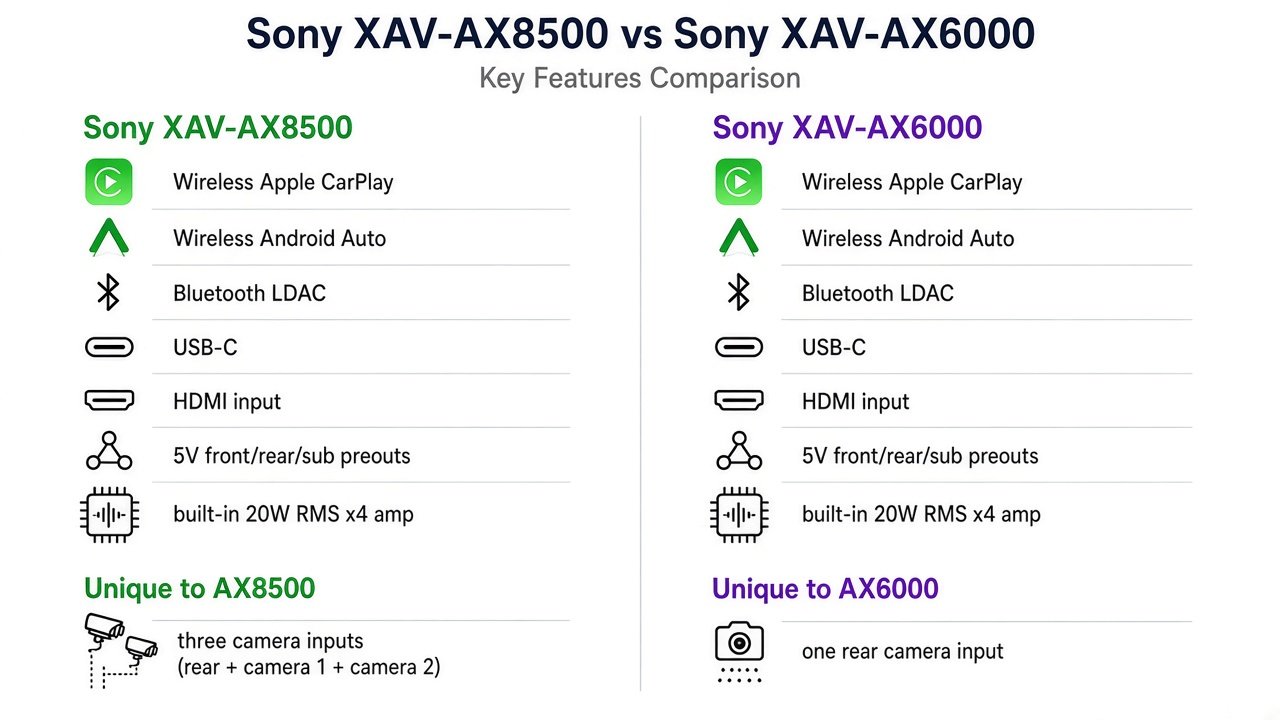
Do both support wireless CarPlay? Yes. Sony’s U.S. pages state wireless and wired Apple CarPlay and Android Auto on both the XAV-AX8500 and XAV-AX6000, using Wi-Fi plus the supplied GPS antenna for wireless phone projection. Both list Bluetooth 5.0 with SBC, AAC, and LDAC, USB Type-C (Hi-speed, 3.0 A), and a micro-HDMI input (480p/576p/720p; HDMI output is not available). Wi-Fi is documented for CarPlay/Android Auto, not as general hotspot browsing.
Because the core smartphone stack is the same on paper, this is usually not the deciding factor in a Sony head unit comparison. Wireless behavior still depends on the phone, OS version, vehicle noise, and installation (Sony still publishes an Android 14 wireless Android Auto note on XAV support pages). Moon Picke has not tested pairing, dropouts, or boot time on either unit, so there is no “AX8500 felt faster” claim here.
Audio Features: Is One Actually Better?
Sony lists the same headline amplifier and preout architecture on both: 20 W RMS × 4 under CTA-2006 at 4 Ω and ≤1% THD+N, 55 W × 4 maximum, and 5 V preouts for front, rear, and sub. Do not confuse 55 W maximum with continuous RMS. Both document a 14-band equalizer, time alignment, USB hi-res codecs (including FLAC/ALAC/DSD-family files as listed), and LDAC over Bluetooth. CTA signal-to-noise figures differ slightly in the Help Guides (AX8500 85 dBA vs AX6000 80 dBA, different reference wording). That is not evidence that the AX8500 “sounds better,” has a better DAC, or hits harder bass.
Sony’s AX6000 feature copy also calls out a 3-zone crossover with the DSP. The AX8500 spec sheets Moon Picke used emphasize EQ and time alignment without the same 3-zone sentence. Treat that as a documentation difference, not a listening test. If your plan is “external amps + sub,” both radios expose the same 5 V three-preout map. Buyers should not pay the AX8500 premium solely for imagined audio superiority.
Camera Inputs and Expansion
Sony specifies three camera inputs/triggers on the AX8500 (rear plus Camera 1 and Camera 2). The Help Guide describes reverse-lamp triggering for the rear camera and EXT IN 1 / EXT IN 2 interruption signals for the extra cameras, with priority: REVERSE IN first, then EXT IN 1 over EXT IN 2. Cameras are not supplied. The AX6000 spec lists rear-view camera in only, with parking-line adjustment and marker settings.
A camera input is not factory-camera plug-and-play. Adapters may be required, and OEM cameras can use proprietary signals. If you are adding aftermarket rear, front, or side cameras, the AX8500’s extra triggered inputs are the documented expansion advantage. If you only need a backup camera, the AX6000’s single rear input can be enough. See factory vs aftermarket dash cam for the broader camera-integration idea—not a Sony accessory list.
Installation and Factory Feature Retention
Replacing factory infotainment can affect steering-wheel controls, factory amplifiers, backup cameras, premium DSP, vehicle settings screens, USB, microphones, warning chimes, and telematics. Sony lists optional iDatalink Maestro RR / RR2 on both U.S. models; features vary by vehicle and the module is sold separately. Both kits include a GPS antenna (needed for wireless CarPlay location) and an external microphone. A remote is optional on U.S. (UC) packs.
The installation ecosystem can matter more than the receiver. A cheaper radio that retains the factory amp and camera with one harness can beat a “better spec” unit that needs a custom interface, a new backup camera, and extra labor. Confirm kits before you click Buy. The car’s electronics—not the Amazon title—decide what still works after the swap.
XAV-AX8500 vs XAV-AX6000 for Aftermarket Audio
For amplifier and subwoofer builds, Sony documents the same 5 V front/rear/sub preouts and DSP tuning (14-band EQ, time alignment) on both. Built-in speaker power is the same CTA-2006 20 W × 4. If you will high-level the factory speakers only, neither radio is a high-power amp. If you will run external amplification, the radios are near-identical on the spec sheet; spend the difference on speakers, a sub, or professional tuning—not on a screen you do not need.
Which One Is Easier to Live With?
Moon Picke has not lived with either dash. From documented design only: the AX8500 offers a larger interface, post-install viewing-angle adjustment, and more physical presence. The AX6000 offers a smaller, more factory-like face and fewer documented screen-clearance variables. Daily ease is conditional on your dash.
Price and Total Installation Value
Sony’s U.S. store recently priced the AX8500 above the AX6000 (the AX6000 page can show out of stock even when Amazon still lists it). Checkout prices move by seller and day. Relatively, the AX8500 is the more expensive hardware, and its floating screen can add installer time.
Product price is not total installed cost. Add dash kit, wiring harness, steering-wheel adapter, factory-amp interface, camera adapter, antenna adapter, and labor. Paying more for the AX8500 only makes sense if its larger display or extra camera inputs solve a need you will actually use. Methodology for how Moon Picke separates spec from anecdote is on how we evaluate.
Choose the Sony XAV-AX8500 If…
- A 10.1-inch floating HD display is the point of the upgrade.
- You have measured vent, HVAC, switch, and sight-line clearance for that panel.
- You need Sony’s documented three camera inputs with separate triggers.
- Post-install tilt/swivel (±15°) is worth the extra hardware.
- You accept a higher unit price plus possibly more installer time.
- You still want the same wireless CarPlay/Android Auto and 5 V preouts as the AX6000.
Check the current Sony XAV-AX8500 listing →
Product-level detail lives in the Sony XAV-AX8500 review; this page is only the decision layer against the AX6000.
Choose the Sony XAV-AX6000 If…
- You want a more compact, integrated 6.95-inch face rather than a floating tablet.
- Wireless CarPlay/Android Auto is the main feature, and one rear camera input is enough.
- Your dash (or kit) favors a shorter panel and compact rear chassis.
- You do not want to pay for unused screen area or extra camera jacks.
- Current lower hardware cost plus a simpler visual footprint is the better value.
- You still want 5 V preouts, 14-band EQ, time alignment, HDMI in, and USB-C.
Check the current Sony XAV-AX6000 listing →
Sony XAV-AX8500 vs XAV-AX6000: Which Should You Buy?
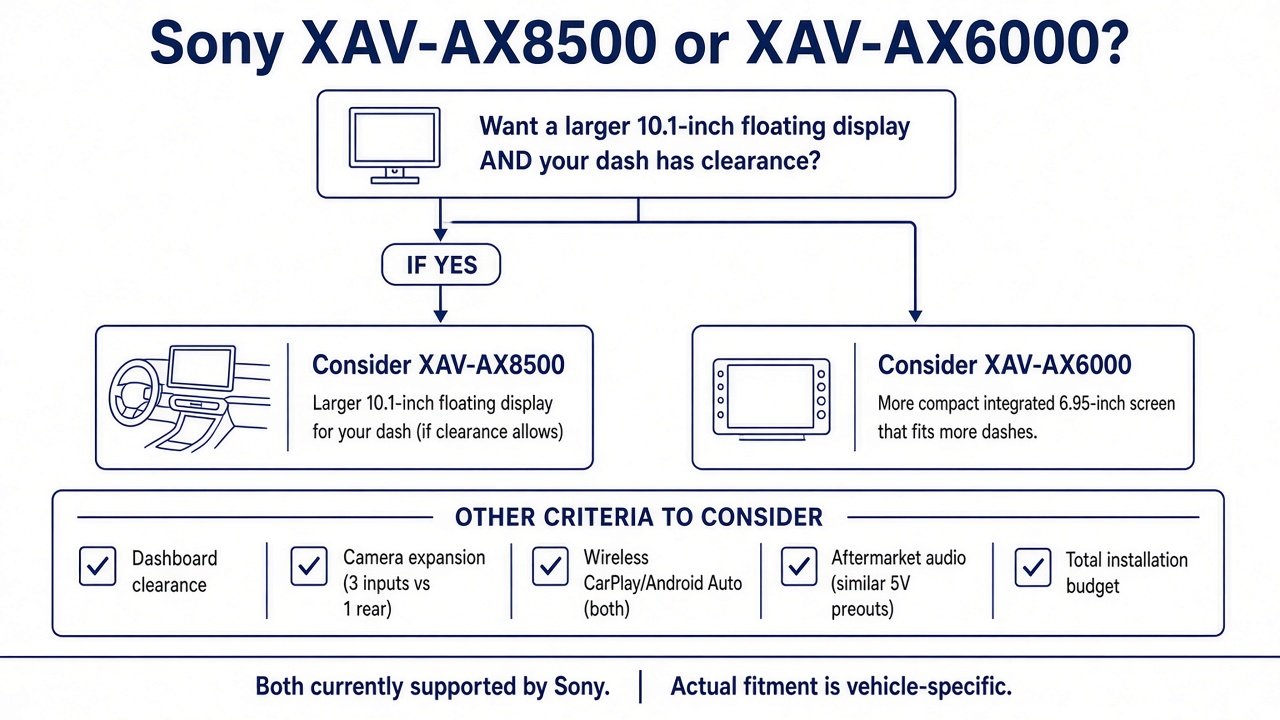
Which Sony head unit should I buy? Best for large display: XAV-AX8500. Best for compact/integrated install: XAV-AX6000. Best overall: whichever matches your dash and the features you will use. Reverse the names if you only remember Sony XAV-AX6000 vs XAV-AX8500—the logic is identical. An XAV-AX8500 or XAV-AX6000 pick that ignores kits and clearance is the expensive mistake. Related coverage: Moon Picke’s Auto Tech hub.
Final Verdict
This Sony XAV-AX8500 vs XAV-AX6000 guide is a fit-and-expansion filter. The AX8500 buyer wants the floating 10.1-inch HD panel and extra camera inputs and has a dash that can take them. The AX6000 buyer wants Sony wireless smartphone projection in a smaller integrated package, usually at lower hardware cost. The strongest distinguishing factor is display architecture, not CarPlay. The biggest mistake is buying the more expensive, larger radio because it looks premium—or the cheaper radio because it looks cheaper—without checking clearance, harnesses, and which camera inputs you will actually wire.
FAQ
Which is better, Sony XAV-AX8500 or XAV-AX6000?
The AX8500 if you need the 10.1-inch floating screen and three camera inputs. The AX6000 if a 6.95-inch integrated design covers your needs. There is no universal winner.
What is the biggest difference between AX8500 and AX6000?
Display size and mounting architecture (floating HD 10.1-inch with tilt/swivel versus 6.95-inch integrated), plus three camera inputs versus one rear camera input.
Do both have wireless Apple CarPlay?
Yes. Sony documents wireless and wired Apple CarPlay on both.
Do both support wireless Android Auto?
Yes. Sony documents wireless and wired Android Auto on both. Phone OS and install still affect real-world wireless behavior.
Which model has the larger screen?
The XAV-AX8500 (10.1-inch HD). The AX6000 is 6.95 inches at 800×480.
Will the Sony XAV-AX8500 fit my car?
Unknown until you check the vehicle, dash kit, and Sony’s clearance notes. A single-DIN-height chassis does not mean the 10.1-inch panel will clear your vents and switches.
Is the AX8500 worth more than the AX6000?
Only if you will use the larger adjustable display and/or extra camera inputs. Shared CarPlay and similar audio I/O are not, by themselves, a reason to pay up.