
Moon Picke independently researches products. If you buy through our links, we may earn a commission at no extra cost to you. Affiliate disclosure.
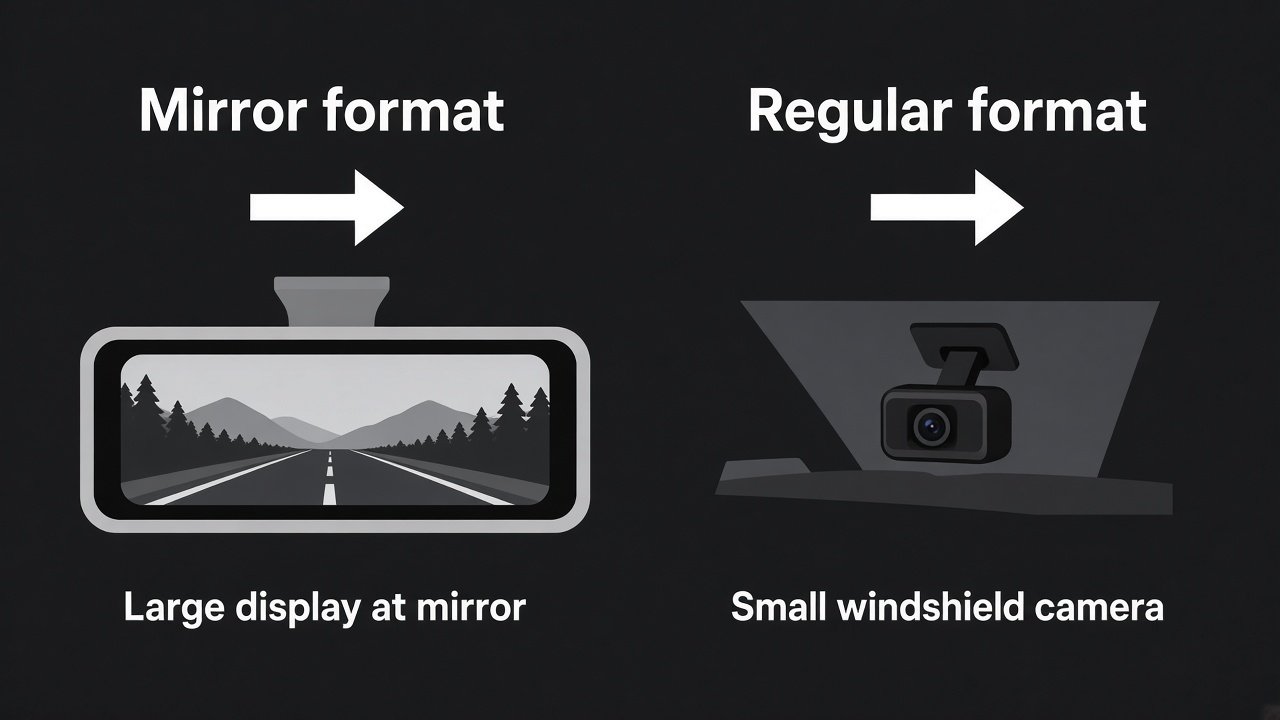
A mirror dash cam vs regular dash cam choice is a design decision, not a simple “which one records better” contest. A mirror dash cam typically mounts over or around the rear-view mirror and uses a large display; a regular dash cam is a dedicated windshield camera body, often smaller, with a small screen or none. Choose a mirror format if a large digital rear view is the point. Choose a regular format if you want smaller hardware, the factory mirror left alone, and a recording-first setup. Neither format is universally better.
As an Amazon Associate I earn from qualifying purchases.
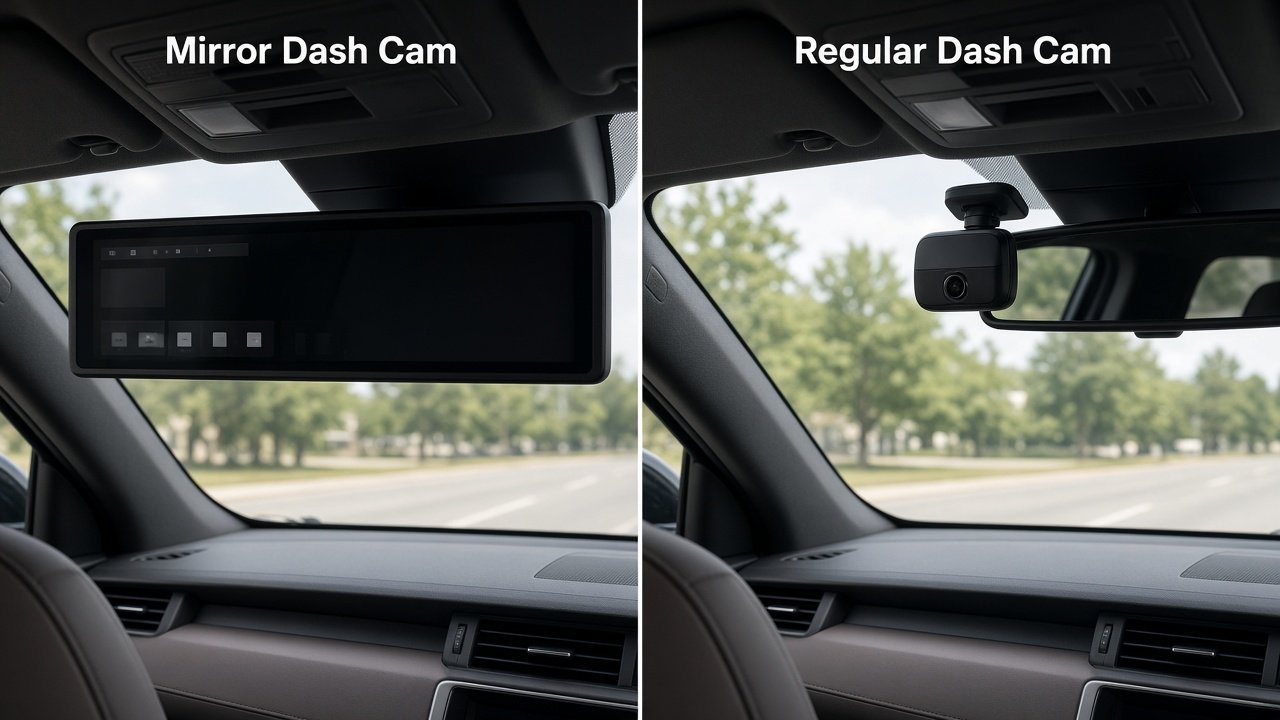
Mirror Dash Cam vs Regular Dash Cam: Quick Answer
Choose a mirror dash cam if a large rear-view display matters, digital rear view has real value in your vehicle, you will install the rear camera properly, and factory-mirror compatibility is confirmed.
Choose a regular dash cam if smaller hardware matters, the factory mirror should stay untouched, you prefer a recording-focused body, or you want broader windshield placement and 1CH-to-multi-channel options.
Do not treat mirror as premium and regular as basic. A Thinkware U3000 PRO or VIOFO A329S can out-spec a cheap mirror unit on sensors. A 12-inch screen does not upgrade the file.
Is a mirror dash cam better than a regular dash cam?
No format wins by default. A mirror unit can be better when you want the mirror area to be the interface. A regular unit can be better when you want the camera separate from normal mirror use.
What is the main advantage of a mirror dash cam?
On many models, the rear camera can feed a live image to a large display, so rearward viewing is camera-based rather than only an optical reflection.
What is the biggest disadvantage of a mirror dash cam?
It interacts with the factory mirror. Fit, OEM buttons, auto-dimming, sensors, and the extra visual footprint are real constraints. The rear camera also becomes central to daily use, not optional garnish.
Can a mirror dash cam replace a rear-view mirror?
It can overlay or occupy the mirror area, but it does not automatically replace an optical mirror, eliminate blind spots, or satisfy every legal/OEM reversing requirement. Treat it as a camera display, not a safety guarantee.
What Is a Mirror Dash Cam?
A mirror dash cam typically combines camera hardware, mirror-area mounting, a large display, and a rear-camera feed—depending on the model. Some units strap over the existing interior mirror. Others use different brackets. They do not all work identically.
The WOLFBOX G900 Pro is Moon Picke’s concrete example: a 12-inch IPS touchscreen that straps over the factory mirror, a 4K (3840×2160) @30fps front camera on the unit, and a separate 2.5K (2560×1440) @30fps USB-C rear camera. WOLFBOX documents front, rear, and split-screen views, plus an optional reversing-line overlay. That is one architecture—not every mirror cam.
What Is a Regular Dash Cam?
A regular dash cam typically uses a dedicated windshield-mounted camera body, a small display or no display, a separate rear camera if it is 2-channel, and a camera-first layout. Regular does not mean basic. Thinkware’s U3000 PRO is a premium conventional front/rear windshield system. VIOFO’s A329S is a local-first high-resolution conventional design that can run 2CH or 3CH. Nextbase’s Piqo is a compact screenless example: Nextbase markets it with no display screen and app-led viewing via the Nextbase app and a ClickMount windshield mount.
1CH, 2CH, and 3CH are all possible in this format. Architecture lives on 1-channel vs 2-channel vs 3-channel dash cam. This page only asks whether the body sits at the mirror or on the glass as a separate camera.
Mirror vs Regular Dash Cam: Key Differences
This mirror dash cam vs regular dash cam table is about interface location. Use commonly, often, and model-dependent.
| Factor | Mirror Dash Cam | Regular Dash Cam |
|---|---|---|
| Primary location | Rear-view mirror area | Windshield camera body |
| Display | Commonly large | Small or none |
| Rear live view | Common on many models | Less central |
| Factory mirror interaction | High | Low |
| Mounting flexibility | Mirror-dependent | Usually broader on the glass |
| Rear camera importance | Often very high | Configuration-dependent |
| Installation | Rear camera often integral to the benefit | Depends on channel count |
| OEM mirror conflicts | Possible | Less direct |
| Best fit | Digital rear-view buyer | Recording-first buyer |
Use commonly, often, and model-dependent. A regular 3CH kit can be visually busier than a tidy mirror overlay. A mirror kit with a dim screen and a dirty rear lens can be worse to live with than a small puck you ignore.
The Biggest Mirror Dash Cam Advantage: Digital Rear View
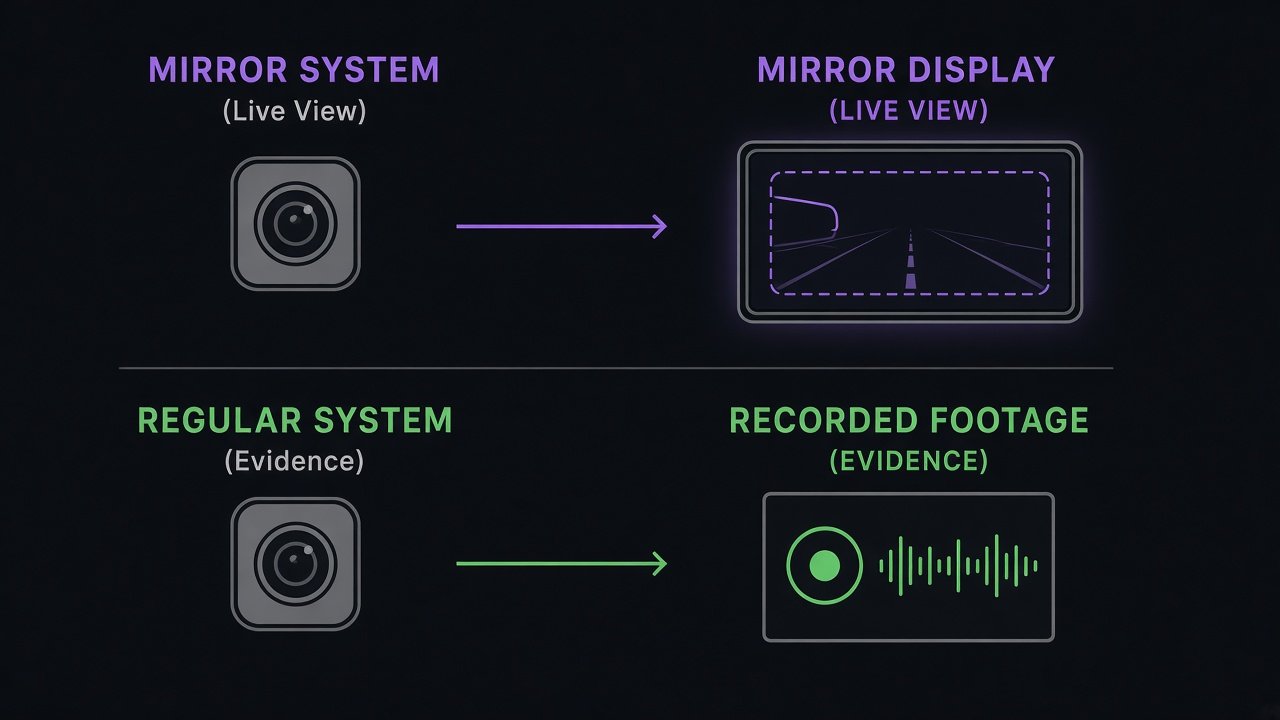
On supported systems the path is rear camera → live image → mirror display. That can help when passengers, a headrest, or cargo block the optical line through the cabin glass. You are looking at a processed camera picture: sensor, processor, exposure, brightness, and power. An optical mirror is a direct reflection with a physical line of sight. They fail differently. Dirt, rain, or a dead display can blank a digital view while an optical mirror still works. A blocked cabin view can blank an optical mirror while a rear-window camera still sees traffic—if it is aimed and powered.
This is a visibility preference, not a claim that digital rear view eliminates blind spots, replaces mirrors legally everywhere, always improves rear visibility, or is safer in all conditions. Headlights can bloom on a camera display; they can also glare on glass. No universal winner. Keep the rear lens clean: on a mirror dash cam that lens is both your daily rear view and your evidence file.
The Biggest Regular Dash Cam Advantage: Flexible Placement
A smaller body can often sit high near the windshield top, depending on local placement rules and a safe view of the road. The factory mirror stays an optical mirror. You are not betting fit on strap width. Screenless options such as Piqo reduce on-dash interaction: settings and playback go through an app. Trade-off: no large live rear picture in the mirror area. Regular is not always more discreet—some windshield cameras are obvious—but placement is usually less hostage to OEM mirror shape.
Which Design Is Better for Front and Rear Recording?
Neither, by format alone. Evaluate front resolution, rear resolution, frame rate, HDR, and sensors. Display size and recording quality are separate. The G900 Pro records 4K front and 2.5K rear at 30fps; that is hardware, not a 12-inch bonus. A conventional 2CH kit can match or beat those numbers. Shortlist evidence kits on best front and rear dash cam. Do not assume a mirror cam records better because the screen is larger. Reverse/parking guidelines on some mirror units (the G900 Pro has a reversing-line setting) are not the same as an OEM backup-camera system with reverse trigger, dedicated placement, and vehicle guidelines. Do not treat a dash-cam rear module as a replacement for factory reversing equipment.
See the WOLFBOX G900 Pro mirror kit (ASIN B0DD78Y3L5) on Amazon →
Mirror Compatibility and Factory Features
Do not assume any mirror dash cam fits any rear-view mirror. Check width, shape, thickness, stem angle, and whether the front lens can see past the OEM arm. Also check:
- Auto-dimming glass and whether covering it still matters to you
- HomeLink or other integrated buttons
- Compass, microphones, and mirror-mounted controls
- Factory camera displays or a factory digital mirror
- Sensor housings and ADAS camera pods near the mirror
Modern cars may pack rain sensors, driver-assistance cameras, and microphones near the mirror. Do not claim mirror dash cams interfere. Verify mounting clearance and do not obstruct factory cameras or sensors. The same clearance rule applies to regular windshield placement. Fit details for the G900 Pro strap kit belong in the WOLFBOX G900 Pro review, not in a “best mirror dash cam” list.
Which Is Easier to Install?
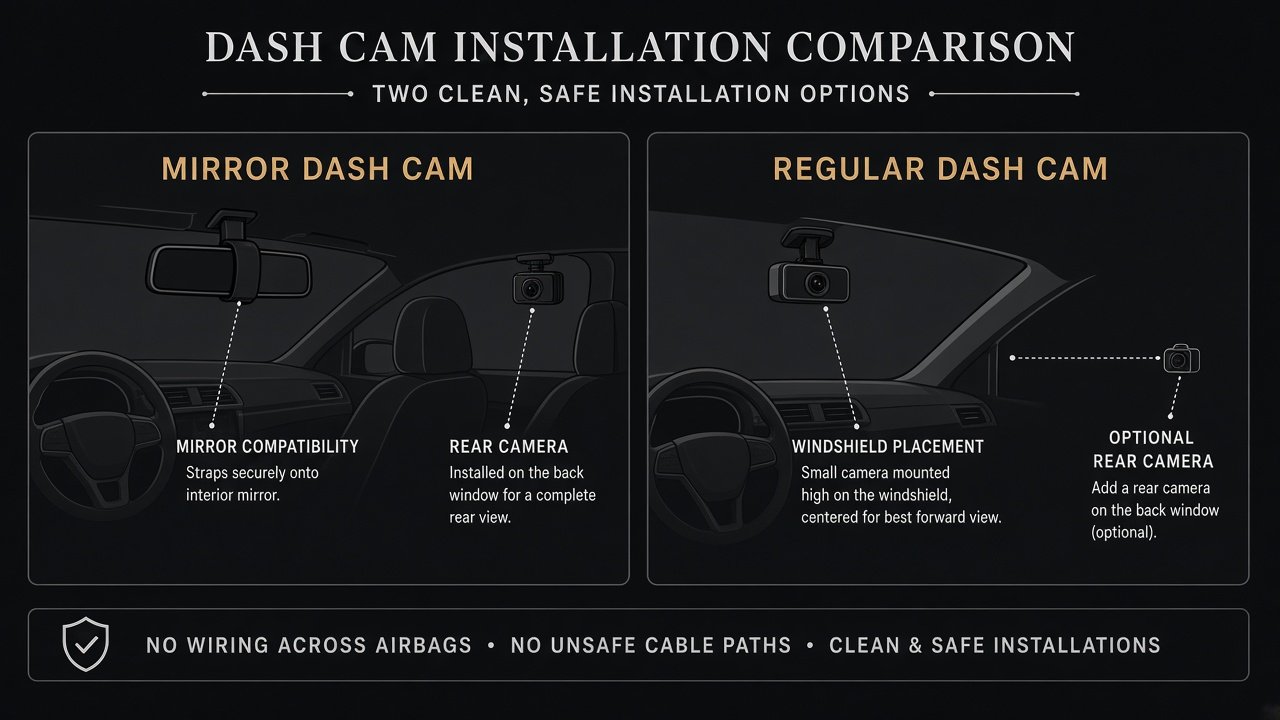
It depends on channel architecture, not the word mirror. Mirror systems often need the rear camera to deliver the core live-view benefit: straps or a bracket, front power, a long rear cable, a rear mount, and sometimes a GPS puck and hardwire kit. Integrated looks are not the same as an easy install. A regular 1CH kit can be one camera and power. A regular 2CH or 3CH kit still runs a long rear cable and extra mounts—complexity tracks how many physically separate cameras you add. See channel planning on the channel comparison.
Night, Parking Mode, and Storage
Night recording quality is a sensor, HDR, and exposure problem. Night digital rear-view quality is that plus display brightness. Mirror format is not inherently better at night. For night recording hardware, start with best dash cam for night driving. This page does not invent anti-glare scores.
Parking mode is not won by a large mirror panel. Capability depends on firmware, hardwire or battery-pack power, and the exact parking modes. Displays may turn off while parked. A big screen is not better parking surveillance. See best dash cam for parking mode.
Format does not set storage. Storage follows channels, resolution, bitrate, codec, and parking. A 2CH 4K/2K mirror kit may need a larger card than a simple regular 1CH camera because of workload, not because it is a mirror. Plan capacity with the dash cam SD card size guide.
Apps and LTE are product features, not format features. Some mirror cams use local Wi-Fi (G900 Pro). Some regular cams are local-only, app-led, or LTE/cloud. Do not call one format more connected. Premium LTE ecosystems on some conventional brands are product choices, not proof that “regular dash cams have better cloud.”
Total ownership cost is also not predicted by format. Mirror kits still need the main unit, rear camera, power, install, and a card. Regular kits still need cameras, cables, optional hardwire or battery pack, optional LTE/data, and a card. Feature set drives cost more than the silhouette.
See a conventional high-resolution example, the VIOFO A329S (ASIN B0FFT3YBH7), on Amazon →
See a screenless regular example, Nextbase Piqo (ASIN B0DD7Z338X), on Amazon →
WOLFBOX G900 Pro vs a Conventional Dash Cam
Use this only as a format snapshot. The G900 Pro puts a 12-inch touch interface over the factory mirror, records 4K front / 2.5K rear, and treats the rear camera as live view plus evidence. Parking monitoring on that model needs a G900 Pro-compatible hardwire kit. Wi-Fi is local to the WOLFBOX app, not cellular remote access.
A conventional counterpart such as the Thinkware U3000 PRO keeps a separate windshield camera and leaves the optical mirror in place. The VIOFO A329S likewise stays a glass-mounted recorder, with 2CH or 3CH options and no requirement that you drive by a 12-inch panel. Piqo goes further toward “camera you forget,” with no display and app setup. If you wanted a hidden or high-glass recorder, those regular designs match the job. If you wanted the rear-view area to be the dash-cam screen, the G900 Pro is built for that job. This is not a product ranking and not a Wolfbox vs Nextbase brand shootout.
Mirror vs Regular: Pros and Cons
Mirror dash cam pros and cons (tendencies): large display; digital rear view where supported; one mirror-area interface; front/rear kits on many models. Trade-offs: mirror compatibility; rear-camera dependence for the main benefit; more visual interface; a long rear run; possible OEM-feature conflicts.
Regular dash cam pros and cons (tendencies): mounting flexibility; small or no screen; factory mirror unchanged; a wide 1CH–multi-channel range. Trade-offs: separate camera hardware on the glass; rear-view display is not the center of the product; multi-channel installs can still be complex. Regular is not automatically less distracting; it is usually less tied to the mirror.
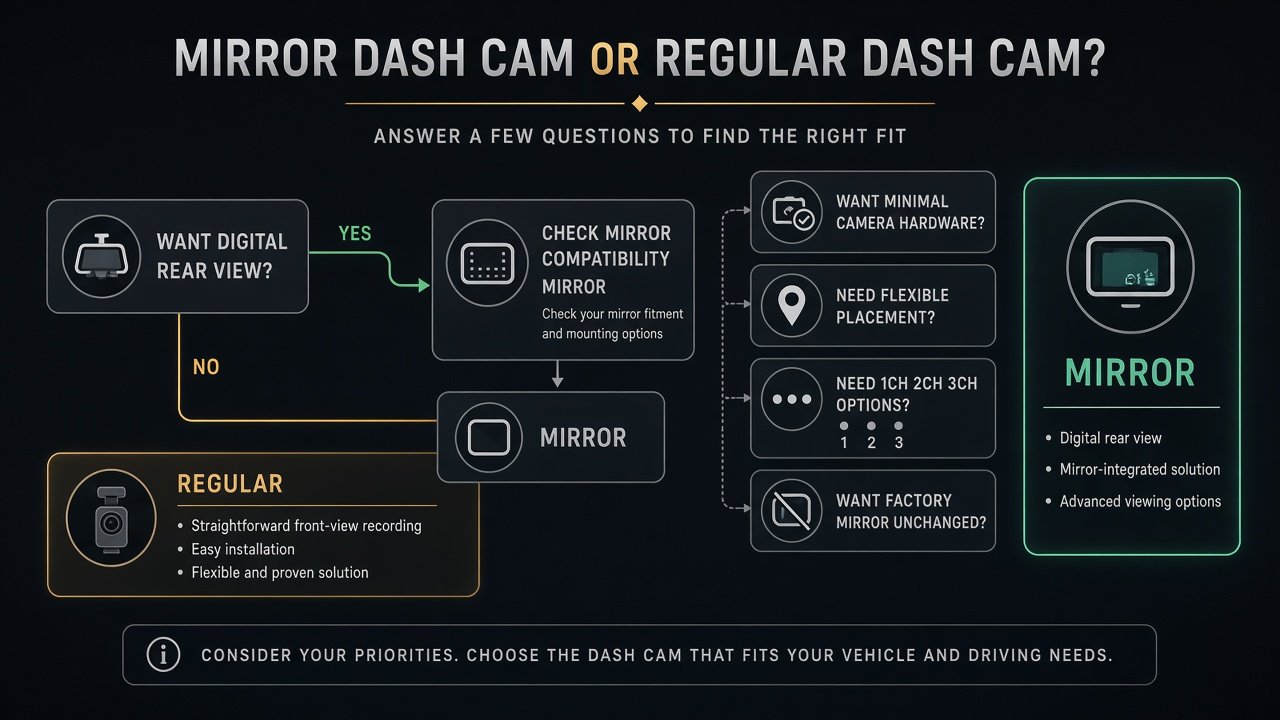
Which Design Should You Buy?
Ask whether you actually want the rear-view mirror area to become part of the dash-cam interface.
Buy mirror if digital rear view is a real priority, compatibility is confirmed, the rear camera will be installed and kept clean, and you want the large display.
Buy regular if the primary goal is recording, mirror functions should stay unchanged, you prefer smaller hardware, or you need flexible 1CH/2CH/3CH placement.
A mirror dash cam vs regular dash cam decision that starts with “which 4K number is higher” is the wrong first question. Start with interface location, then confirm cameras, power, and fit.
Final Verdict
On mirror dash cam vs regular dash cam, mirror units are not inherently better dash cams. They are a different interface and installation architecture. Regular units are not inherently more honest or more premium. They keep recording hardware off the factory mirror. Choose the format that solves a real use case: digital rear view and a large display, or a recording-first camera that leaves the optical mirror alone. No format score. Confirm fit before you buy the silhouette.
FAQ
Is a mirror dash cam better than a regular dash cam?
Only if you want that interface. Recording quality still depends on the cameras, not the housing shape.
What is the main advantage of a mirror dash cam?
A large display and, on many models, a live rear-camera view in the mirror area.
What are the downsides of a mirror dash cam?
Fit against the OEM mirror, a more present screen, and a rear camera that must work for daily viewing—not only for files.
Do mirror dash cams record front and rear?
Many 2CH mirror kits do. Check the exact model. A large screen does not create a rear file by itself.
Are mirror dash cams harder to install?
Often they still need a rear-camera cable to deliver the main benefit. A regular 1CH install can be simpler. A regular 3CH install can be harder than a 2CH mirror kit.
Do mirror dash cams work with auto-dimming mirrors?
Sometimes physically, sometimes you cover functions you still wanted. Measure the mirror and the controls. There is no universal yes.
Which type is better for parking mode?
Neither by design. Power, firmware, and parking modes decide. The display may be off while parked.
Sources: WOLFBOX G900 Pro product page; G900 Pro specifications / manual PDF; Nextbase Piqo (screenless / app / ClickMount); VIOFO A329S product documentation; Thinkware U3000 PRO windshield front/rear documentation.