
This Roborock Saros 10R vs Saros 10 guide is for buyers who already know both are premium U.S. vacuum-and-mop systems. Moon Picke did not test either robot in a home. The ownership split is navigation (always-flat StarSight 2.0 versus RetractSense LiDAR), mopping (dual spinning pads versus VibraRise 4.0), and dock details. On September 12, 2026, Roborock US priced both complete kits at $1,299.99 versus $1,599.99 MSRP, so the official gap is $0 unless Amazon’s live New price diverges. Entity specs for the 10R live in our Saros 10R review; this page only chooses between the two.
As an Amazon Associate I earn from qualifying purchases. See Affiliate Disclosure, How We Evaluate, and editorial standards. Also: Guides and Home & Living.
Roborock Saros 10R vs Saros 10: Quick Verdict
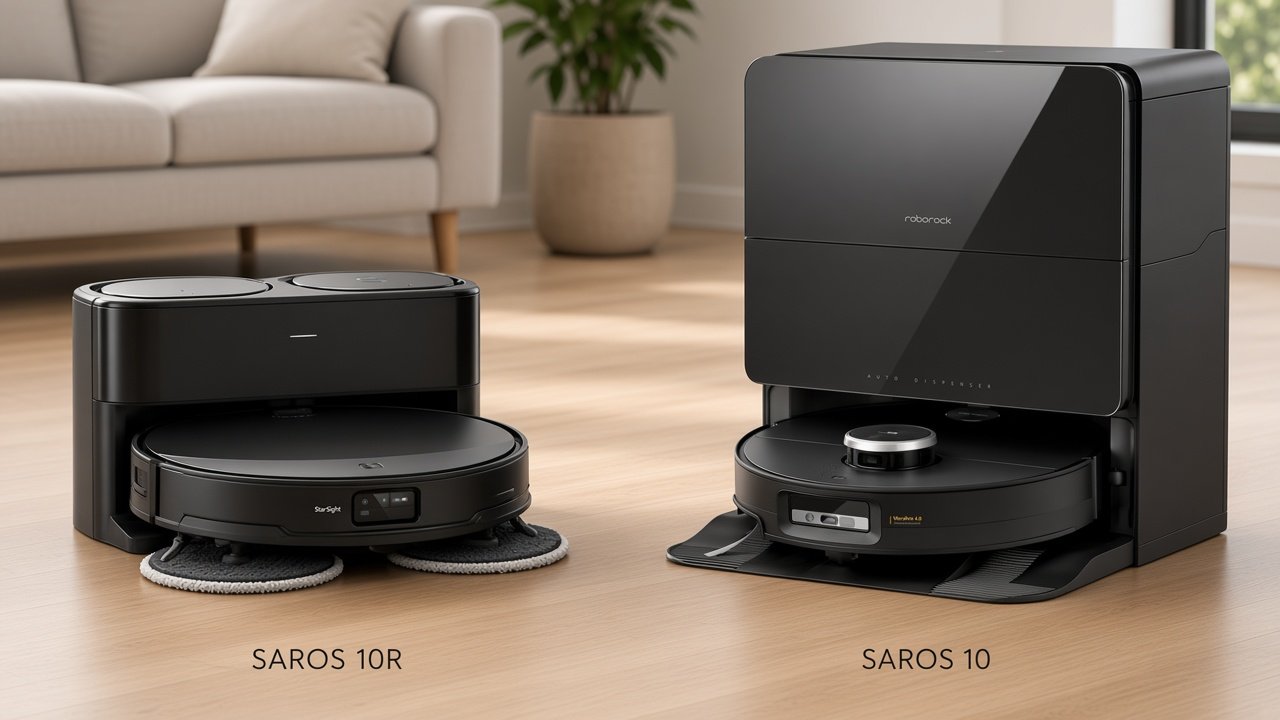
No automatic winner. Take the 10R for a turret-free 3.14-inch body all the time, dual spinning mops with a FlexiArm mop, and Multifunctional Dock 4.0. Take the Saros 10 for retractable spinning LiDAR, a published 22,000 Pa HyperForce figure, VibraRise sonic mopping plus an independent edge mop, and RockDock Ultra 2.0’s 140°F dry cycle. Shared, so not the decision: DuoDivide brushes, FlexiArm side brushes, AdaptiLift claims, 6,400 mAh packs, auto mop detach, 176°F mop washing. Independent outlets such as The Ambient mainly confirm that architecture fork; Moon Picke is not importing their scores.
| Feature | Roborock Saros 10R | Roborock Saros 10 | Why It Matters |
|---|---|---|---|
| Navigation | StarSight 2.0 (3D ToF, no turret) | RetractSense LDS + wide-angle module | Open-room mapping versus low furniture |
| Height | Always 3.14 in / 79.8 mm | 3.14 in retracted; 3.68 in elevated | Lower is not automatically better |
| Obstacles | ToF + RGB + VertiBeam; 108 types listed | ReactiveAI 3.0 triple structured light + RGB + VertiBeam | Recognition ≠ guaranteed avoidance |
| Suction claim | HyperForce; U.S. page omits Pa | 22,000 Pa (internal-test footnote) | Pa is not a pickup score |
| Brushes | DuoDivide + FlexiArm riser | Same family | Tie on documented vacuum hardware |
| Mop | Dual spinning pads + FlexiArm mop | VibraRise 4.0 + lifting edge mop | Different stain/edge trade-offs |
| Carpet | Lift + app auto mop removal | Lift + auto detach; app chassis lift on pile | Mop lift ≠ dry-carpet guarantee |
| Threshold | AdaptiLift up to 1.57 in / 4 cm | Same claim and geometry footnotes | Tie; threshold shape still matters |
| Dock | Dock 4.0; 131°F dry | RockDock Ultra 2.0; 140°F dry | Hotter wash ≠ home sterilization |
| Battery | 6,400 mAh; ~2.5 h charge claim | Same pack; 150-minute charge claim | Not a whole-home guarantee |
| Smart home | Alexa, Siri Shortcuts, Google, Matter marketed | Alexa, Google; Matter described as OTA | Matter ≠ full app |
| Official price | $1,299.99 (MSRP $1,599.99) | $1,299.99 (MSRP $1,599.99) | Confirm live Amazon New prices |
| Choose Saros 10R if… | Choose Saros 10 if… |
|---|---|
| You need zero turret height all day | You want spinning LDS, retracted only when needed |
| You prefer dual spinning mops and a FlexiArm mop | You prefer a vibrating pad and a dedicated edge mop |
| You want Dock 4.0’s 10-in-1 labeling | You want 140°F drying and dynamic wash temperatures |
| You accept HyperForce without a U.S. Pa number | You want the published 22,000 Pa spec (still not a score) |
| New 10R B0DHCJ571Z is the in-stock full dock | You confirm New, non-RDS Saros 10 stock, not Used |
Check current Amazon price for the Saros 10R (ASIN B0DHCJ571Z, New robot + Dock 4.0) and the Saros 10 (ASIN B0DLH247PS — confirm New, complete RockDock, not refill-and-drain).
The Biggest Differences at a Glance
Ignore the shared list. Verified deltas: StarSight versus RetractSense; always 3.14 in versus 3.14/3.68 in; spinning FlexiArm mops versus VibraRise plus edge mop; Dock 4.0 at 381×475×488 mm and 131°F dry versus RockDock Ultra 2.0 at 440×409×470 mm and 140°F dry; 10R omits Pa on the U.S. page while Saros 10 publishes 22,000 Pa; 10R obstacle stack leans on 3D ToF, Saros 10 on front triple structured light; Roborock’s FAQ notes Bluetooth-assisted setup on the Saros 10. Those change ownership more than the letter R. A Roborock Saros 10R vs Saros 10 buyer who only compares suction numbers or “flagship” labels will miss the fork that actually shows up under furniture and on hard floors.
Navigation and Robot Height
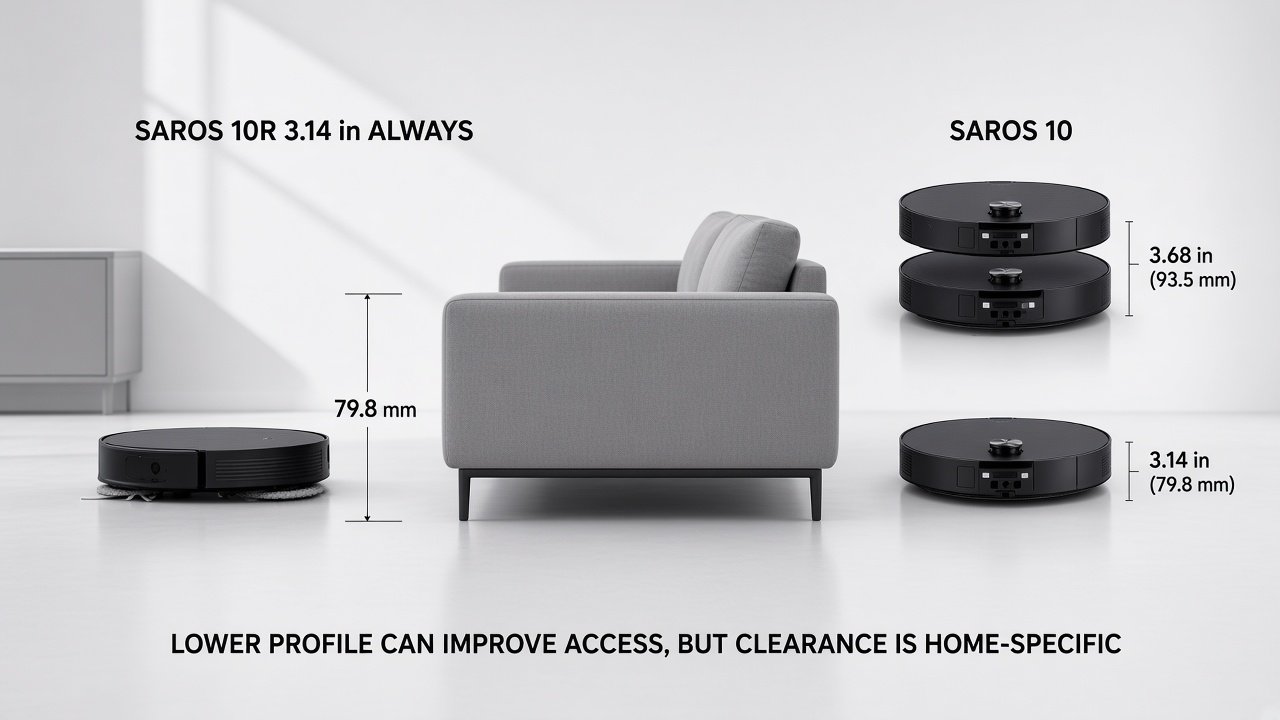
10R StarSight 2.0 uses dual-transmitter solid-state 3D ToF (QVGA, 21,600 points in Roborock notes) so the lid never grows a turret. Saros 10 RetractSense drops spinning LDS under furniture, keeps a wide-angle module while lowered, uses an upward range finder to time the drop, and a top contact sensor meant to avoid forcing under sloped frames. Open rooms: 10 is 3.68 in (93.5 mm); retracted it matches 10R at 3.14 in (79.8 mm). Both robots: 350 × 353 mm.
Moon Picke’s editorial read: long sofa runs that never clear a turret favor the 10R’s always-low lid. Buyers who want conventional 360° LiDAR in the middle of a room and will accept a moving turret match the 10. Equal clearance is not a fit — leave extra for pile, ramps, and the dock. Neither climbs stairs.
Obstacle Avoidance
10R: ToF + RGB + VertiBeam; 108 object types listed; internal tests of ~0.79 in objects, accuracy varies. Saros 10: ReactiveAI 3.0 with front triple structured light, RGB, and VertiBeam. Both market cables, toys, and pet-related objects. That is not “avoids every cable” and not guaranteed pet-waste avoidance — pick up accidents. Cliff sensors do not make stair falls impossible. Optional video calling / pet snaps are consent-gated on both; RGB obstacle cameras are not security NVRs by default.
Vacuuming and Anti-Tangle Design
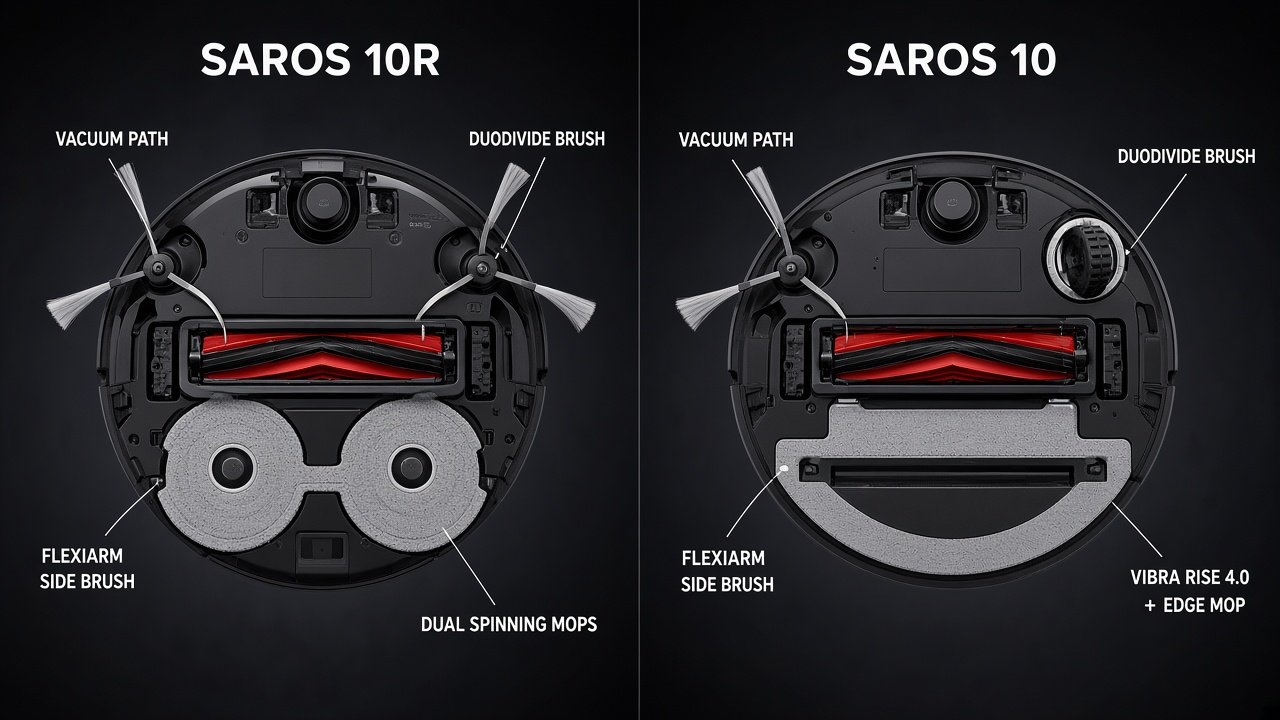
Saros 10: 22,000 Pa HyperForce from internal testing. 10R U.S. page: HyperForce, no Pa; Amazon titles sometimes paste 22,000 Pa onto the 10R — we will not treat that as this SKU’s official rating. Pa still would not equal pickup. Both use DuoDivide dual rollers (SGS-cited 0% tangle / hair-removal lab numbers with caveats) and a FlexiArm riser side brush. Official accessory copy sells the same main-brush family for both — a vacuum-hardware tie. Dirt detection can raise suction or shift toward mop-only on liquids (manufacturer behavior). Pet-hair relevance is that anti-tangle architecture; it is not a category winner. Edge reach is a design, not a percentage we measured.
Mopping: Which System Makes More Sense?
10R: two spinning pads plus a FlexiArm mop; hot-water mop path up to 70°C is not floor sterilization. Saros 10: VibraRise 4.0 dual sonic zones at 4,000 times/min each, up to 8 N in a documented deep-clean app mode, 26% larger vibration area versus S8 MaxV Ultra in Roborock’s footnote, plus a side mop up to 220 RPM (no-load Max) that lifts independently (TÜV-cited 0.002 in edge-close claim). Auto detach exists on both; a Saros 10 footnote says mid-job the pad may lift rather than fully unclip. Roborock’s FAQ names VibraRise versus dual rotating modules as the mop fork — not a stain-percentage crown. Robot mops remain maintenance tools. Hardwood suitability follows water control and pad type, not a finish-safety guarantee we did not test. If you care more about agitating a wide pad than spinning two disks into corners, the Saros 10’s mop is the matching tool; the reverse favors the 10R. Do not convert 8 N or 4,000 vibrations into “cleans X% better.”
Carpet Handling
Both lift assemblies and can leave mops at the dock. 10R: mop lift up to 0.87 in with chassis lift; chassis up to 0.39 in (internal tests). Saros 10: 0.39 in chassis lift on high pile, app-enabled per footnote. Shared FAQ lists ultrasonic / carpet-aware behavior. Lift is not automatic dry-carpet insurance on thick rugs. This is not a carpet roundup.
Dock Automation, Battery and Large Homes
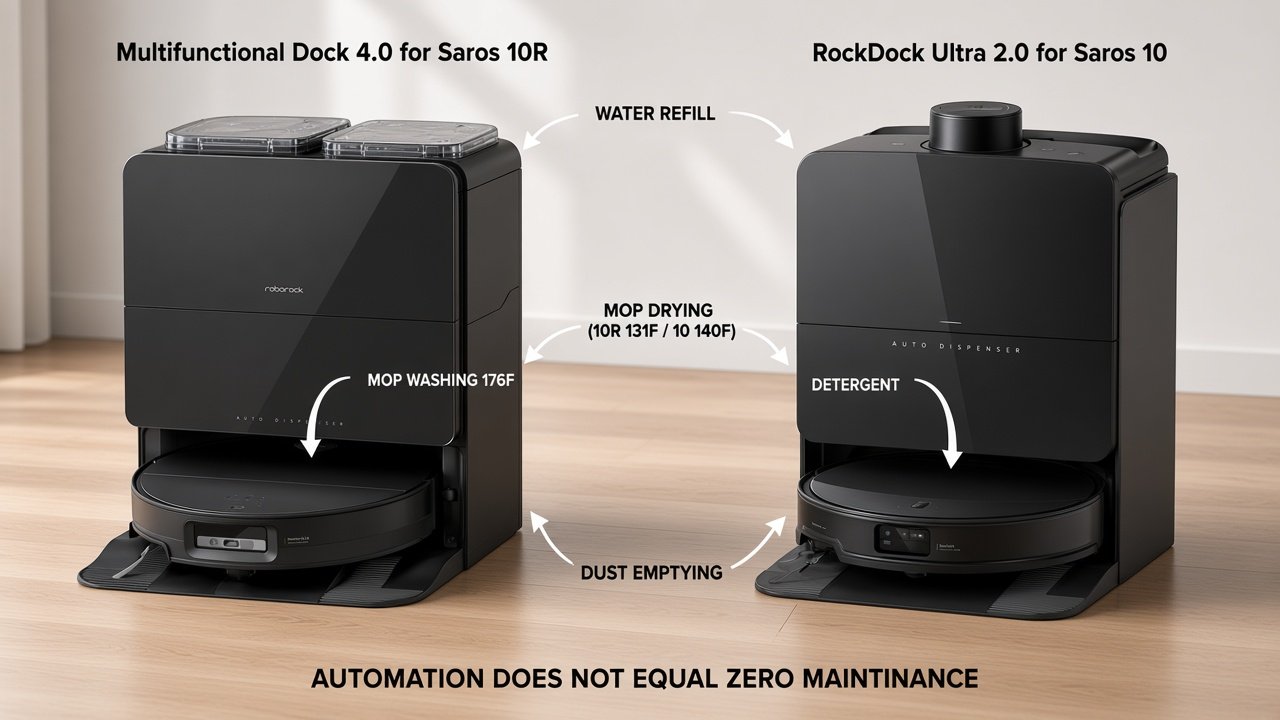
Both empty dust, wash, dry, refill the robot tank, dose detergent, and self-clean with 176°F dispenser water. Self-cleaning ≠ no chores. TÜV 99.99% bacteria figures apply to specified mop tests after dock self-clean, not your floor. Drying is meant to cut leftover moisture, not to guarantee zero odor.
10R Dock 4.0: 381 × 475 × 488 mm, 131°F / 55°C dry. Saros 10 RockDock Ultra 2.0: 440 × 409 × 470 mm, 140°F / 60°C air, press-to-open glass, dynamic wash setpoints 122 / 140 / 176°F. Those temperature deltas are manufacturer outlet figures, not a disinfection ranking. Plumbing refill-and-drain SKUs are regional extras — not default Amazon (skip B0FBGQVGZJ here). Place on hard flat floor against a wall with 2.4 GHz coverage; Roborock still publishes extra clearances for plumbing variants. Both: 6,400 mAh, ~2.5 h / 150 min charge with remaining-area logic. Runtime is not guaranteed square footage and depends on suction, mop, carpet, and floor plan. Recharge-and-resume is expected in this class; we will not invent a resume timer. Saros 10 documents up to 30 room partitions. Quiet-mop lab footnotes (10R ≤55 dB; 10 as low as 52 dB(A)) are not whole-home vacuum numbers. Large-home ranking is a later article; apartments should measure dock volume before robot diameter.
App, Smart Home and Privacy
Same app brand, different hardware sliders (VibraRise pressure, RetractSense, mop-removal). Intended use wants the app and 2.4 GHz Wi-Fi. Saros 10 documents Bluetooth as setup help, not a control radio. Hello Rocky onboard voice is listed without network for simple commands; Alexa and Google Home on both; 10R lists Siri Shortcuts. Matter is marketed on 10R; Saros 10’s U.S. page still called Matter / Apple Home an upcoming OTA — check the live app. Matter will not clone every Roborock control. Both cite TÜV / ETSI EN 303 645 and default-off cloud photos; optional video is not always-on surveillance.
Maintenance, Price and Value
Similar chores: bag, tanks, detergent, architecture-specific mop cloths, DuoDivide, side brush, filters, tray. Do not assume spinning disks and VibraRise pads interchange. Dust bags are grouped as Saros-series on Roborock stores — match your dock. No mandatory subscription was identified for core empty/wash/map functions on either; you still need an account and Wi-Fi. U.S. new-unit limited warranty is typically one year.
September 12, 2026: official complete-system prices both $1,299.99 versus $1,599.99 MSRP — $0 (0%) official gap. Amazon New 10R B0DHCJ571Z showed $1,299.99. Black Saros 10 B0DLH247PS showed Used/Like New in our check; white B0DLH45139 showed unavailable. Do not mix Used 10 with New 10R. Total ownership still adds bags, filters, brushes, mop parts, and detergent on both — purchase price is not lifetime cost, and we will not fabricate an annual dollar figure. If Amazon later opens a few-hundred-dollar New gap, that gap — not the nickname — should decide value. Unused spinning mops waste 10R dollars; unused VibraRise wastes Saros 10 dollars. Cheaper is not automatically better value; unused premium features are.
See current Amazon availability (confirm New, full dock) →
Who Should Buy Which — or Neither
Saros 10R: always-low sofas; dual spinning + FlexiArm mop; 3D ToF without a moving LDS; New 10R in stock when 10 is not. Pros versus 10: flat lid, FlexiArm mop, Dock 4.0. Cons: no U.S. Pa number; 131°F dry; spinning-pad cloths.
Saros 10: spinning LiDAR in open space; VibraRise plus edge mop; published 22,000 Pa as a documented number; 140°F dry and dynamic wash; Bluetooth setup. Pros: RetractSense, Pa figure, sonic mop, hotter dry. Cons: 3.68 in with LDS up; confirm New stock. Neither is clutter-proof.
Neither: basic vacuuming only, no mopping, no dock space, no bags/detergent, discomfort with RGB cameras even with default-off cloud photo claims, or a cheaper robot plus a stick vacuum for stairs, upholstery, and spot stains. Premium automation is a poor fit if you will not run schedules. Qrevo Curv, Dreame X50 Ultra, and Ecovacs X9 Pro Omni wait for later articles — mention them only as context, not as a third bake-off.
Check current Amazon price for Saros 10R B0DHCJ571Z and Saros 10 B0DLH247PS →
Final Verdict: Roborock Saros 10R vs Saros 10
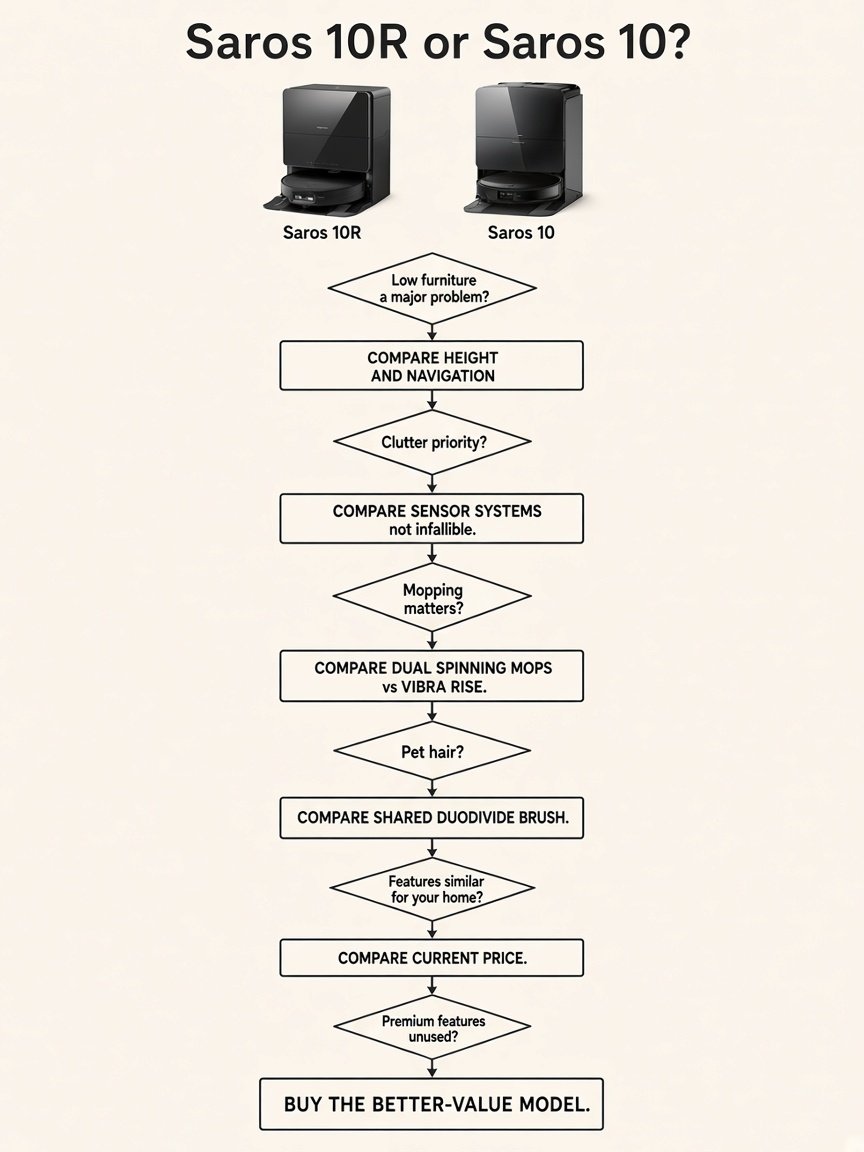
This Roborock Saros 10R vs Saros 10 verdict stays conditional. Do not choose from suction marketing, the letter R, or flagship talk. Choose navigation + height behavior + obstacle stack + mop architecture + carpet strategy + dock + live New price. At a $0 official gap, unused differences are wasted money. The 10R fits when always-low StarSight and spinning mops solve real problems. The Saros 10 fits when RetractSense LiDAR and VibraRise are the features you will run.
FAQs
What is the main difference between Saros 10R and Saros 10?
StarSight 2.0 and dual spinning mops versus RetractSense LiDAR and VibraRise 4.0, plus different docks and drying temperatures. Brushes, battery class, and AdaptiLift overlap.
Which model is lower?
Both can be 3.14 in. The 10R never raises a turret; the 10 is 3.68 in with LDS up. Measure extra clearance.
Which has better obstacle avoidance?
Different stacks (ToF versus structured light), both with RGB and VertiBeam. No Moon Picke success rate. Not a cable or pet-waste guarantee.
Which is better for pet hair or carpet?
Shared DuoDivide hardware; mop-removal details differ. No category-wide winner here.
Do they use the same mop or dock?
No. Dual spinning pads versus VibraRise. Dock 4.0 versus RockDock Ultra 2.0.
Does either need a subscription?
No mandatory subscription was identified for core empty/wash/map functions reviewed. App and 2.4 GHz Wi-Fi still required for intended use.
Is the Saros 10R worth paying more for?
Official prices matched at check. Pay a live Amazon premium only if New stock and architecture you will use justify it. This Roborock Saros 10R vs Saros 10 page does not rank other brands.