
A robot vacuum vs traditional vacuum choice is not new tech versus old tech. They are usually built for different jobs. A robot is an autonomous floor machine for frequent scheduled or on-demand maintenance. A traditional vacuum—upright, canister, corded stick, or cordless stick—is a manually aimed tool for targeted passes, stairs, upholstery, and other surfaces robots do not treat as a floor path. Neither universally wins. Frequency is not the same as depth. Active labor is not the same as elapsed run time. Many homes should own both, without buying two flagships. See the Saros 10R review as one current robot example, plus How We Evaluate and editorial standards.
Robot Vacuum vs Traditional Vacuum: Quick Verdict
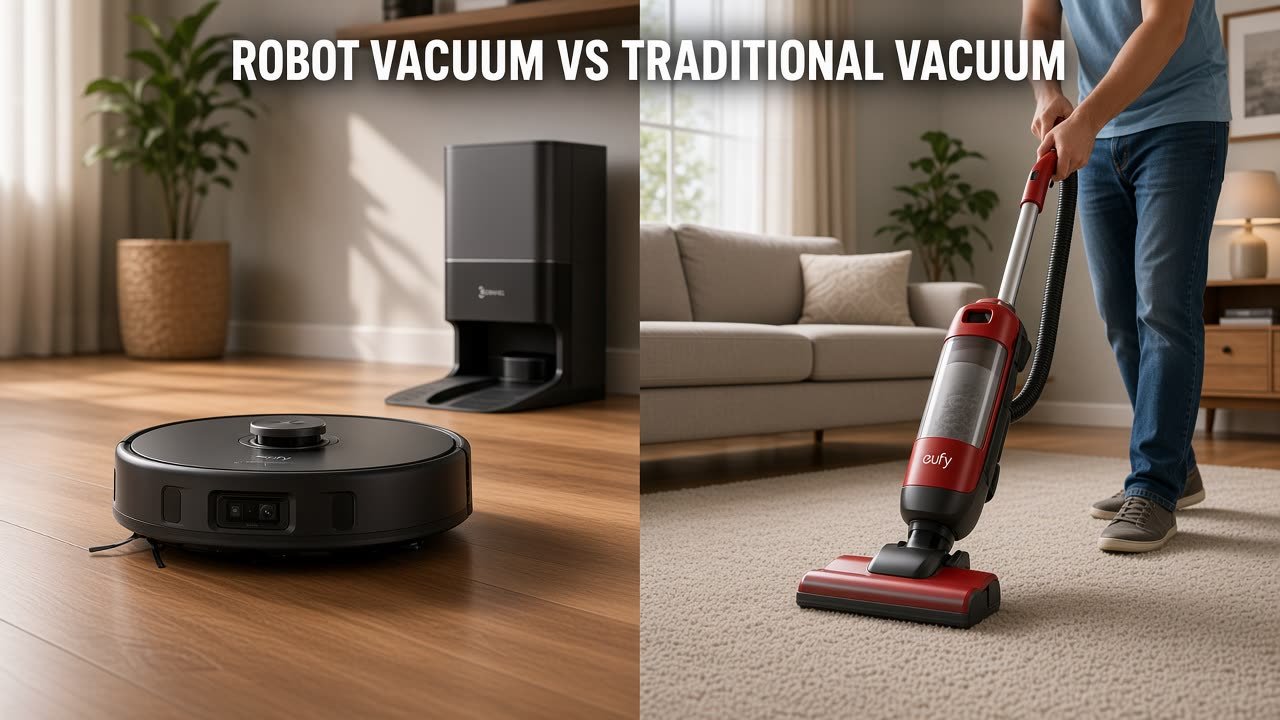
Is a robot vacuum better than a traditional vacuum? No single winner. For frequent autonomous floor maintenance, the robot often has the edge. For deliberate deep or targeted work, stairs, and above-floor surfaces, a manual vacuum often has the edge. Cordless sticks are not the same machine as corded uprights. Dry robots and dry uprights are not carpet extractors. A robot mop is not a full replacement for washing a floor by hand. Moon Picke did not run pickup labs. Also: Guides and Home & Living.
| Cleaning Need | Robot Vacuum | Traditional Vacuum | Better Fit |
|---|---|---|---|
| Daily floor maintenance | Strong (schedules, rooms) | Conditional (you must run it) | Robot for frequency |
| Carpet deep/targeted passes | Limited as “deep”; good as upkeep | Strong with a carpet-capable head | Traditional for depth; both for upkeep |
| Hard-floor crumbs/dust | Strong if it can reach the floor | Strong for immediate spots | Conditional |
| Stairs | Limited (no climbing) | Strong with a suitable design | Traditional |
| Upholstery | Limited (floor tool) | Strong with attachments | Traditional |
| Under furniture | Strong if height/width clear | Conditional (wand or moving furniture) | Robot when clearance exists |
| Pet hair | Strong on floors, often | Strong on stairs/sofas | Both |
| Automation | Strong | Limited | Robot |
| Spot cleaning | Conditional (app zone/spot) | Strong (you aim it) | Traditional for mess-in-view |
| Mopping | Conditional (combo models) | Limited (most dry vacs) | Robot for light auto mop; manual still for stains |
| Active user time | Often lower | Higher during the session | Robot for labor; not elapsed time |
| Storage / dock | Needs floor-level dock space | Closet, wall mount, or corner | Depends on the home |
| Maintenance | Brushes, dock, bags/tanks possible | Bin/bag, filter, roll, maybe belt/battery | Conditional; robot ≠ simpler |
| Household Type | Better Starting Point | Why |
|---|---|---|
| Apartment, mostly hard floors | Robot, if a dock fits | Frequency; watch dock depth |
| Pets + carpet + stairs | Both | Daily floors plus sofas/stairs |
| Mostly carpet, deep-clean priority | Traditional first | Deliberate passes; robot as helper |
| Mostly hardwood, single level | Robot first | Crumbs/dust on a schedule |
| Multi-story | Traditional required for stairs; robot optional per floor | Maps ≠ climbing |
| Busy household | Both, midrange | Automation plus a manual tool you already trust |
What Each Type of Vacuum Is Actually Best At
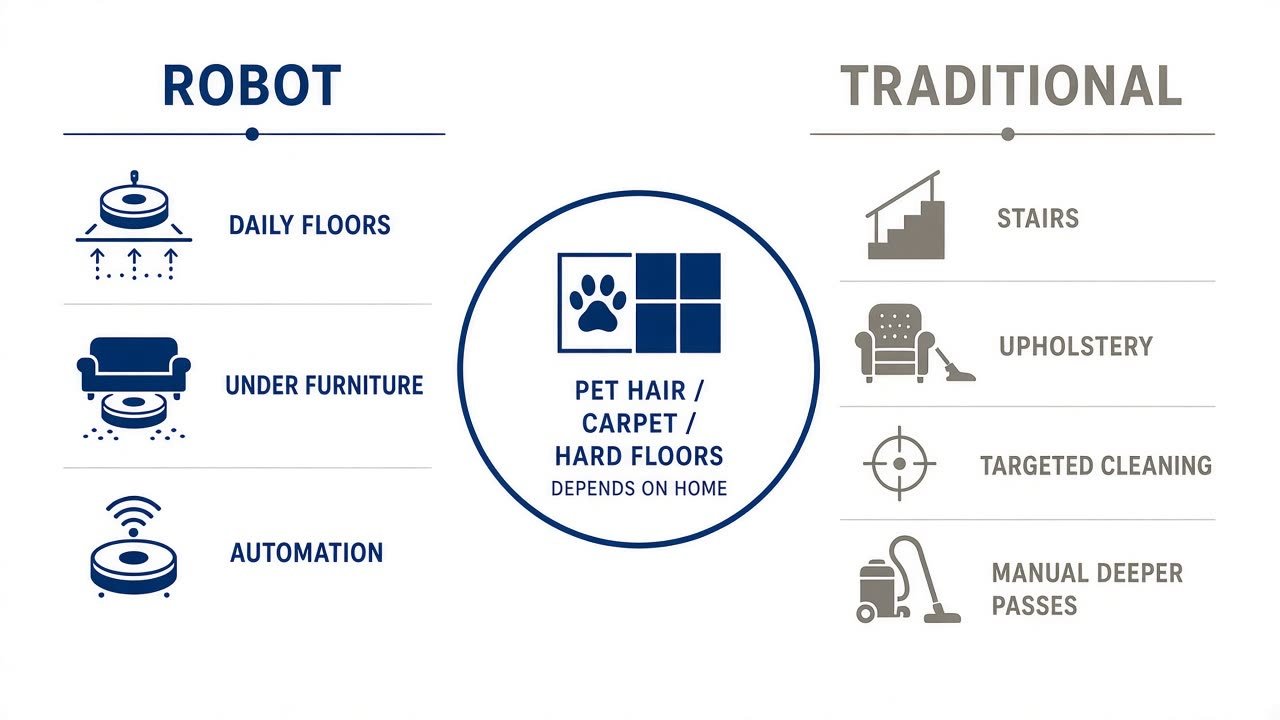
Job one: keep floors from accumulating dust, crumbs, and hair. Job two: hit a problem area hard—a stair, a sofa, a spill zone, a high-traffic carpet lane. Robots are built around job one: maps, rooms, no-go zones, docks, and optional empty/mop modules. Traditional machines are built around job two: you choose the head, the number of passes, and the attachment. Uprights often emphasize carpet contact. Canisters can be easier on stairs because the body stays below while the hose moves. Corded sticks skip battery limits on a long session. Cordless sticks trade runtime for grab-and-go, then they need a charger the same way a robot needs a dock—except you are still the driver. Do not collapse those into one “regular vacuum” personality. Navigation software is not the same as a human choosing the next stroke.
Daily Cleaning and Automation
The robot’s main advantage is automated frequency—daily, several times a week, or selected rooms while you work or leave. That can slow debris buildup. It does not automatically mean deeper carpet, better stairs, or better spot work. Automation is not zero work: you still clear cords, empty bins or bags, wash filters and brushes, and service a dock if you bought one. Self-emptying reduces how often you dump a tiny onboard box; it does not erase filters, chutes, or mop tanks. A traditional vacuum needs your hands on every session, which is more labor in the moment and can be mechanically simpler if there is no wash station. Neither schedule is a tested hours-saved claim. See how we talk about methods on the editorial standards page rather than invented weekly minutes.
Carpet and Deep Cleaning
Which is better for carpet? Conditional—this is where a robot vacuum vs traditional vacuum debate often over-claims. Frequent robot runs can keep surface grit from sitting. They are not extractors, and a typical dry upright is not an extractor either. “Deep” here means embedded debris and extra manual passes—not a score. A full-size carpet head you steer can put more deliberate contact on a soiled lane. A robot may boost suction or lift a mop when it detects carpet; that is maintenance architecture, not a lab ranking. If carpet is the whole house and you care about periodic thorough passes, keep a capable traditional machine in the stack. A robot can still do the in-between days. Brush type, contact, and how many times you go over the same patch matter more than a Pa headline on either side.
Hard Floors and Mopping
Which is better for hardwood floors? Robots are convenient for crumbs and dust if they can enter the rooms. You still get better immediate control with a stick or canister on a dropped bowl of cereal. Some robots add mopping: useful as light maintenance on sealed floors, not a substitute for sticky spills, corners, or finish-specific care. Most traditional dry vacuums do not mop. Do not pour random cleaners into robot tanks. Unsealed wood can rule out robot water entirely—follow the floor maker, not marketing. Hard-floor grit still scratches if a dirty pad or a packed brush is dragged; both categories can grind debris if you skip brush care.
Pet Hair
Which is better for pet hair? Often both. The robot’s job is frequent floor hair, including under furniture when the lid fits, plus anti-tangle brushes and optional auto-empty on premium docks. The traditional vacuum’s job is stairs, sofas, pet beds, and extra carpet passes you decide to make. Small homes can still shed a lot of hair. Recognition of pet waste is not a cleanup plan; do not vacuum biological accidents with a household robot or a dry upright unless the product is explicitly designed for that use. This page stays category-level, not a pet-hair product ranking. Hair that never reaches a floor tool—on fabric, in a crate, on a landing—stays a manual job no matter how many maps you save.
Stairs, Upholstery and Above-Floor Cleaning
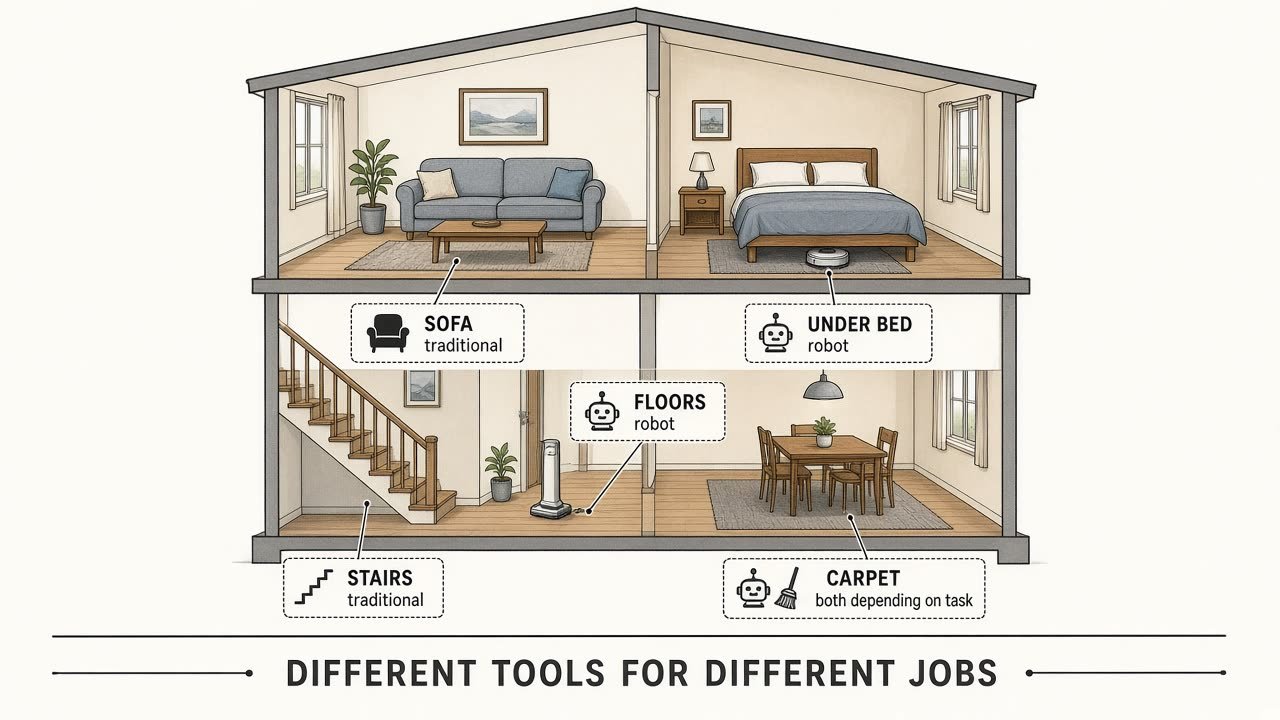
Which is better for stairs? Traditional, clearly. Typical robots do not climb stairs. Cliff sensors reduce fall risk; they do not guarantee never falling. Multi-floor maps are stored layouts, not a stair-climbing feature; you carry the robot if you want another floor cleaned, and the dock stays put. Upholstery, mattresses, curtains, and many pet beds are outside the robot’s floor contract. A hose, handheld, or motorized tool on a manual vacuum is how those surfaces get done—when that specific machine actually includes them. Shelves, vents, and some baseboards are the same story: attachments versus a disc that lives on the floor.
Under Furniture, Edges and Tight Spaces
Robots can be the better daily tool under beds and sofas if height, width, and a path exist. A 3.14-inch robot still needs extra clearance; height is not the opening. Traditional machines may need a low head, a wand, or moved furniture. Edges: robots use side brushes or extending hardware along straight walls; 90-degree corners are a different geometry. A crevice tool lets you aim. Cables: a robot can miss thin cords; a person can move them. Cluttered rooms reduce convenience, not usefulness—you prep the floor more often. Tight chair forests can stall a disc that would have been easy for a slim wand.
Which Saves More Time?
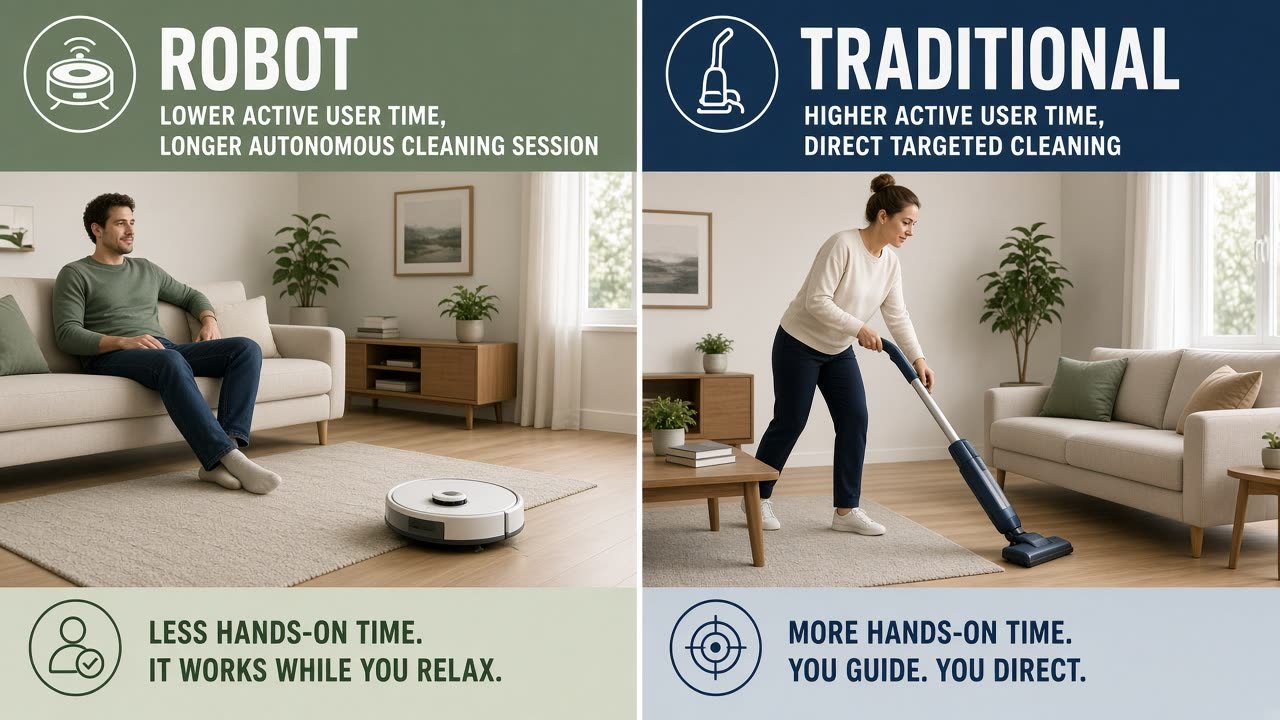
Do robot vacuums save time? They can reduce active user time while using more elapsed wall-clock time to finish a mapped run, including dock returns. A stick or upright can finish a targeted room quickly because you are the navigation system. Cordless sticks then need a charge; corded uprights do not. Recharge-and-resume on a robot stretches elapsed time further; we will not invent mission durations. Any numbers on a diagram here are labels, not a Moon Picke stopwatch. A robot vacuum vs cordless vacuum comparison still splits those two clocks.
Maintenance and Ownership Cost
Robots can add docks, bags, mop pads or rollers, detergent, and water trays. Traditional machines add bags or bins, filters, brushrolls, sometimes belts, and batteries on cordless models. Robot ≠ automatically lower maintenance. Traditional ≠ automatically simple. Purchase price spans cheap to premium in both categories; a robot is not always the expensive one. Total cost is purchase plus consumables plus parts plus, where applicable, a replacement battery. No invented annual dollars. Premium robot money buys navigation, empty, and mop docks you should only pay for if you will use them—whether a high price is “worth it” is a later article, not this comparison. A closet full of unused attachments is the same waste as a dock you never fill with water.
Robot Vacuum vs Traditional Vacuum for Different Homes
Apartment: a robot can handle daily dust if the dock fits; a stick may store vertically. Large single-story: robot frequency plus recharge/resume helps maintenance; stairs still need a person. Multi-story: keep a traditional vacuum for the staircase; one robot does not patrol both levels alone. Pets: complementary pair. Mostly carpet: traditional remains important; robot is the between-days helper. Mostly hard floors: robot may cover more of the daily need, with a stick for spots. Busy household: midrange robot plus the manual vacuum you already own beats two unused premiums. Storage: dock footprint versus closet—neither wins by default. Noise is model-specific; we will not rank dB. Robot empty cycles can be a short loud burst even when cleaning modes sound milder. Schedule around household quiet hours if that matters. A robot vacuum vs traditional vacuum pick in a rental is also a pick about floor space and landlord rules—no drilling a drain kit into a kitchen wall.
When a Robot Vacuum Makes More Sense
Buy robot-first if the pain is frequency on reachable floors: single level or a floor you will dedicate, mostly hard floors or mixed rooms a robot can enter, limited stair and upholstery demand, willingness to empty a dock and pick up cords, and acceptance that sticky messes still need a human. As an Amazon Associate I earn from qualifying purchases. Affiliate Disclosure. If that describes you and you want a current U.S. robot-plus-station example—not a category winner—see the eufy X10 Pro Omni (B0CPFBBHP4, New) as one midrange automation bundle, then recheck the live listing.
When a Traditional Vacuum Makes More Sense
Buy traditional-first if the pain is versatility: many stairs, sofas and mattresses, a cluttered plan you will not prep daily, a tight budget for one device, or a preference for aiming the head yourself. A cordless stick is still a traditional vacuum in this article’s sense, but it is not a corded upright. Do not assume one SKU does cars, stairs, and deep carpet equally well. If the only floor tool you will actually use is a stick in a closet, start there and add a robot later when frequency becomes the bottleneck.
When Owning Both Is the Better Strategy
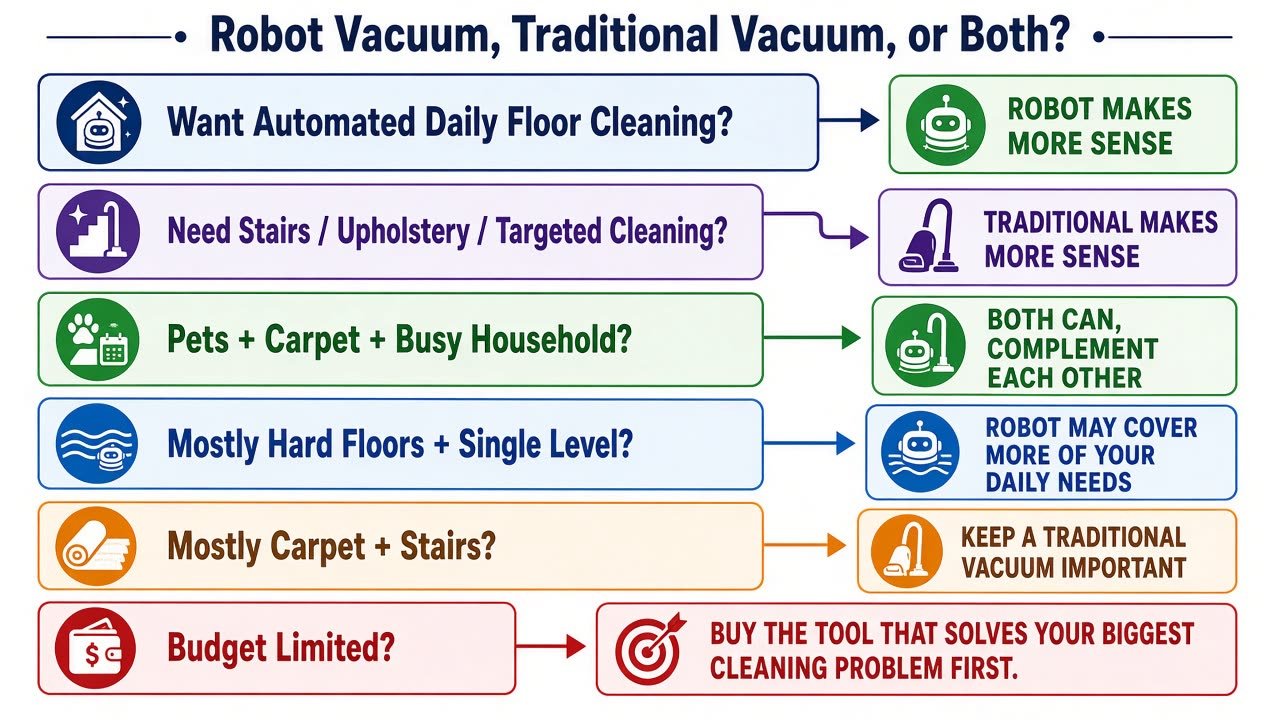
Do you still need a regular vacuum if you have a robot vacuum? If you have stairs, upholstery, or periodic carpet passes, usually yes. Is it worth owning both? For pets, mixed floors, large or busy homes, often yes—as complementary roles, not two trophies. Pair a midrange robot with an existing upright or stick. You do not need a flagship robot plus a flagship manual kit to get daily floors plus a weekend stair run. A robot vacuum vs traditional vacuum hybrid can be last year’s stick plus this year’s midrange robot. Should I buy a robot vacuum is the frequency question; robot vacuum or stick vacuum is the versatility question. Answer those separately, then decide if one purchase leaves a hole. Are robot vacuums better than regular vacuums only after you name the job.
Final Verdict
Treat robot vacuum vs traditional vacuum as a job match. Robot when the problem is frequent floor maintenance. Traditional when the problem is targeted, deep, or above-floor work. Both when you want automated daily floors plus periodic manual cleaning. Higher tech is not better for every job. Lower active labor can mean a more complex dock. Recheck any example listing for New condition before you click.
FAQ
Is a robot vacuum better than a regular vacuum? Not universally. Frequency versus targeting.
Can a robot vacuum replace a traditional vacuum? Sometimes on simple, single-level hard floors. Not for stairs and most upholstery.
Do I still need an upright if I own a robot? If you have carpet lanes you want to work by hand, or you already own one that works, keep it.
Which is better for carpet? Traditional for deliberate deep/targeted passes; robot for frequent surface upkeep. Neither is an extractor.
Which is better for pet hair? Both: robot on floors, traditional on furniture and stairs.
Which is better for hardwood? Robot for scheduled dust; traditional for immediate messes. Mop combos are extra, not a wash bucket.
Which is better for stairs? Traditional. Robots do not climb.
Do robot vacuums save time? They can cut active labor, not always elapsed time.