
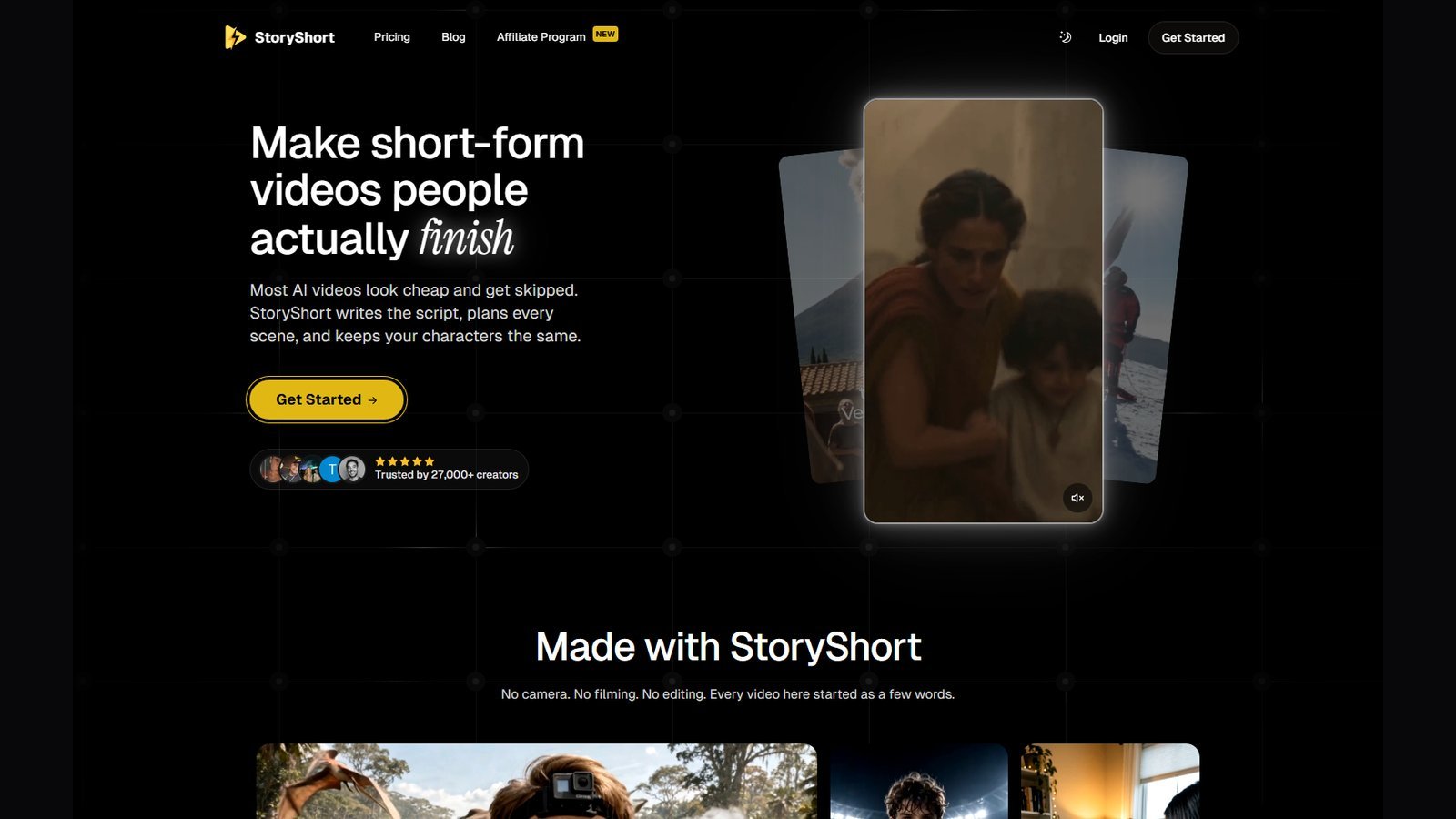
This StoryShort AI review is a buyer decision, not a feature dump. StoryShort is currently sold as a faceless short-form stack: it writes a script, plans scenes, generates images and clips, adds voice and captions, then can auto-post to TikTok, YouTube, and Instagram. Moon Picke has not run hands-on generation tests. The notes below follow StoryShort’s live site, pricing table, FAQ, MCP/API pages, Terms, Privacy, and Refund Policy, checked on 5 October 2026. Pricing and plan limits can change; check StoryShort’s current plan page before purchasing.
Quick verdict
StoryShort is an AI-assisted video assembly and channel-automation product, not a single cinematic text-to-video model. Official copy says it writes the script, plans every scene, makes images and clips, and adds voice. Faceless Stories are described as a voice over AI images with consistent characters. Long-form is listed as 10 to 30 minutes, but the live pricing cards mark long-form and UGC as unavailable on Starter and Growth. Paid plans start at $39/month for Starter (400 credits, 1 Series, auto-post, “no watermark”). Yearly Starter is $23/month equivalent, billed annually at $279. Signing up is free; the homepage FAQ says making a video uses credits, and credits come with a paid plan. Privacy also mentions one-time free signup credits. Biggest advantage: script-to-publish consolidation plus Series auto-post. Biggest limitation: $39 monthly floor, credit math that punishes premium models, and long-form/UGC gated to Influencer and Ultra on the credit table. Buy if you want a faceless Shorts/TikTok/Reels pipeline with publishing. Skip if you need a timeline NLE, a cheap forever-free commercial exporter, or Starter-plan UGC ads.
Disclosure: Moon Picke may earn a commission if you purchase through links on this page, at no additional cost to you. Read the affiliate disclosure.
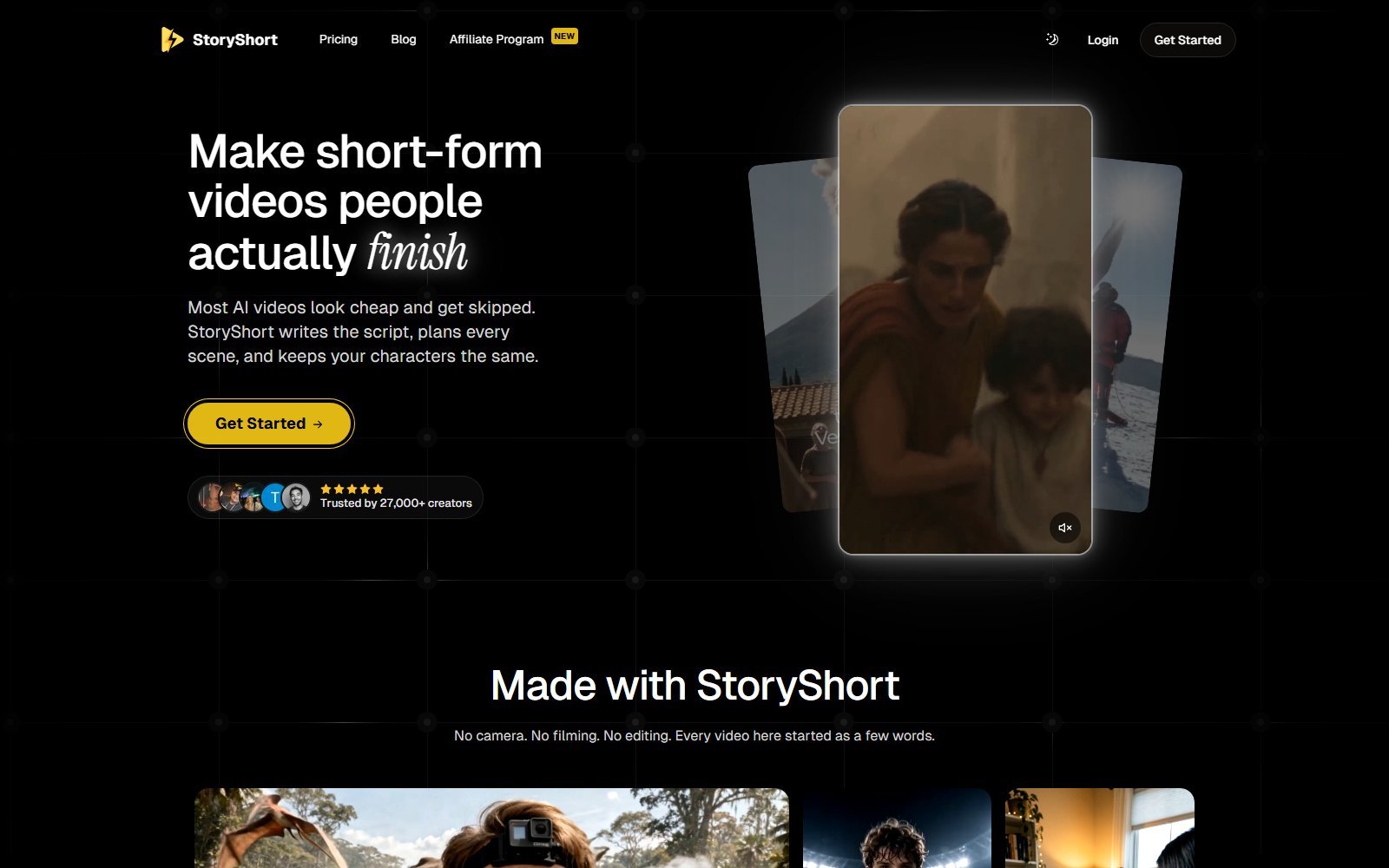
StoryShort at a glance
| Category | StoryShort |
|---|---|
| Best for | Faceless short-form channels that want script-to-post automation |
| Starting paid price | $39/month Starter (monthly). $23/month equivalent billed yearly at $279 |
| Free plan / trial | No forever free video quota. Signup is free. FAQ: credits come with a paid plan. Privacy: one-time signup credits. Refund policy mentions a trial only if one is offered |
| Primary workflow | Faceless / script-to-video assembly + Series auto-post |
| AI video generation | YES (clips/models; not only stills). FAQ names Seedance, Grok, Wan, Veo, p-video. MCP also lists Sora, Kling, Seedance 2.5 |
| AI images | YES. Faceless Stories = voice over AI images. MCP: gpt-image, Flux, Seedream |
| AI voice | YES. FAQ: ElevenLabs, OpenAI, Qwen. Qwen can copy your own voice |
| Captions | YES. Word-timed; MCP lists 33 caption styles |
| Auto-publishing | YES. FAQ: TikTok and YouTube from the app, with a daily schedule. Homepage also names Instagram |
| Export resolution | NOT LISTED as 720p/1080p/4K on pricing. FAQ: paid plans give “better video quality” |
| Watermark | Paid plan cards list “No watermark.” Free full-video watermark rule NOT LISTED beyond paid copy |
| Main limitation | $39 monthly floor; long-form and UGC ads marked not in Starter/Growth on the live cards and credit table |
What is StoryShort?
According to the current homepage, StoryShort is an “AI Faceless Video Generator for TikTok & YouTube Shorts.” The About page says it turns ideas into finished short-form videos and can run faceless channels on a schedule, built by Samuel Rondot. Terms (28 September 2026) are governed by the laws of France.
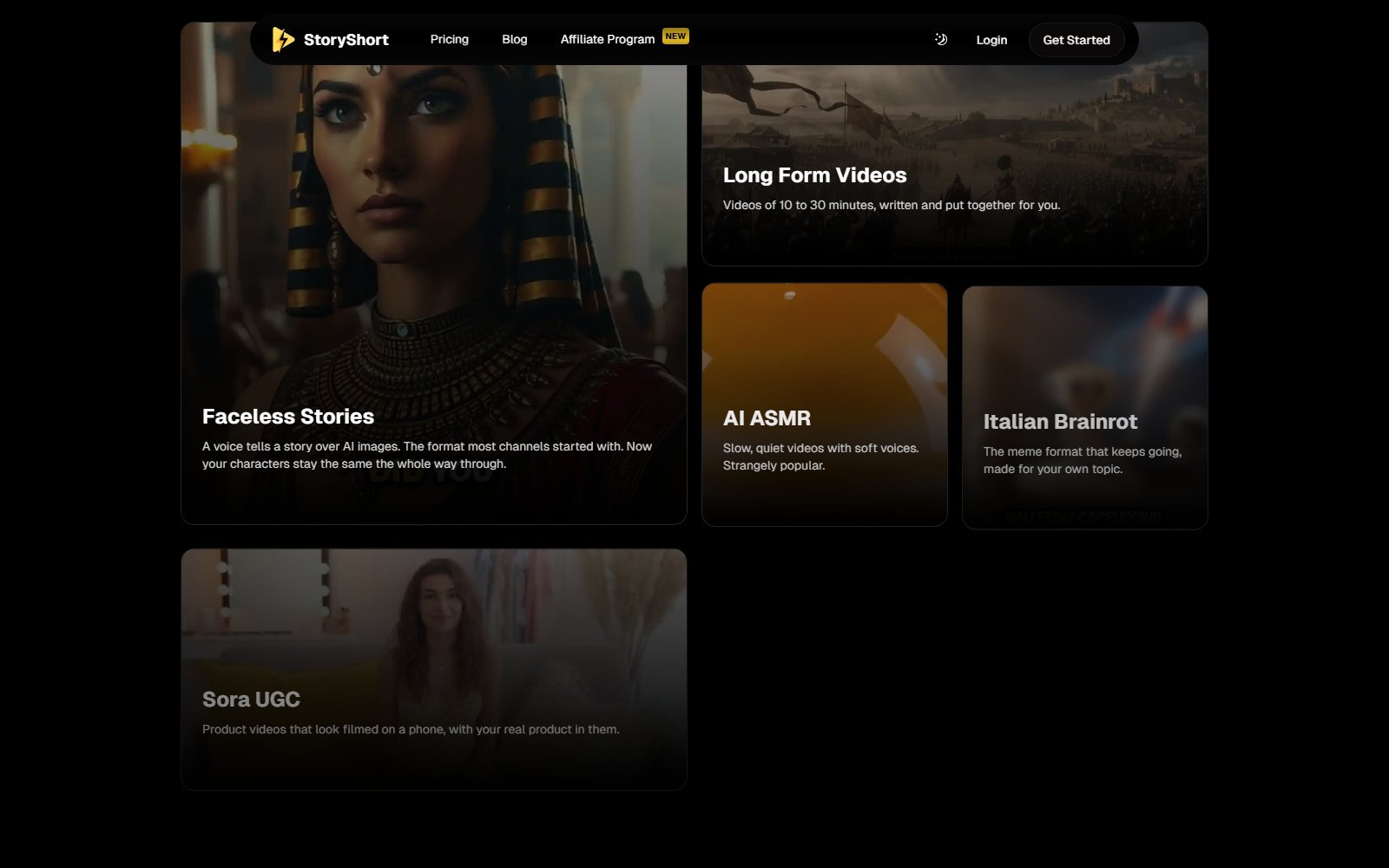
That is not the same job as a prompt-only scene generator. StoryShort’s current workflow is built around AI-assisted video assembly: script, scene plan, stills and/or clips, voice, captions, then optional Series publishing. Sora UGC and talking characters go beyond stills-plus-voiceover. Faceless Stories remain the starting format: a voice over AI images, with character continuity.
How StoryShort works
StoryShort’s current workflow is built around two entry points. “Start from scratch”: type what the video is about; the platform writes the script, plans scenes, and builds the piece. “Repurpose”: paste a video that did well, or pick one from creators you follow; StoryShort keeps the topic and rebuilds it in your style and characters. A follow feed is sold as a daily scan of other creators’ videos that beat their usual performance.
The platform provides an “AI Editor” described as shot-by-shot changes (for example, redo shot 4) without restarting the whole video. Voice selection includes listed voices plus cloning from a short recording. Captions are described as appearing on every word, with a style you pick once. Series copy says you can set a series once; StoryShort picks the next niche topic, writes it, makes it, and posts it.
Moon Picke did not click through a logged-in dashboard for this review. The sequence above is how the public product pages describe the pipeline.
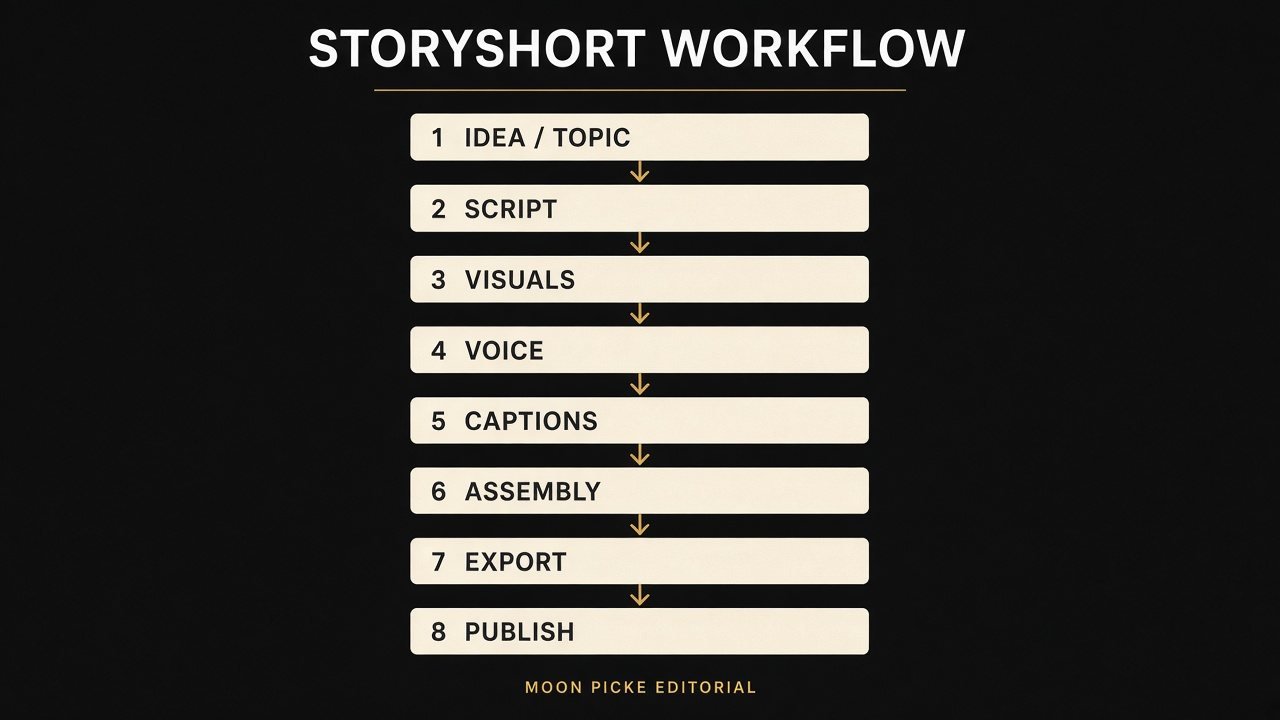
What parts of video creation does StoryShort automate?
| Workflow step | StoryShort support | How it works | Main limitation |
|---|---|---|---|
| Idea / topic | PARTIAL | Follow feed, repurpose, Series topic pick | You still choose niche and which videos to copy |
| Script | AUTOMATED | FAQ: Claude writes scripts. MCP: generate_script | No quality test here; facts still need a human pass |
| Visuals | AUTOMATED | AI images, clips, character lock, product uploads | Model and credit cost vary; estimate shown before generate |
| Voice | AUTOMATED | Listed voices or clone from a short recording | Terms ban using a real person’s voice without consent |
| Captions | AUTOMATED | Word-timed captions; 33 styles on MCP | Style quality NOT VERIFIED in a lab |
| Music | AUTOMATED | Paid cards list background music; MCP list_music | Do not treat as a blanket royalty-free grant |
| Video assembly | AUTOMATED | Homepage: writes, plans, makes images/clips, adds voice | Not the same as one T2V model rendering every frame |
| Editing | PARTIAL | AI Editor shot redo; you can change anything after | Not a professional timeline NLE |
| Export | AUTOMATED | Download listed on paid cards; MCP render_video MP4 | Pixel resolution NOT LISTED on pricing |
| Scheduling | AUTOMATED | FAQ: set a schedule and let it post daily. MCP schedule_publish | REST publish-now vs cron is documented separately on the API page |
| Publishing | AUTOMATED | TikTok, YouTube, Instagram; Zapier named on API | Needs connected accounts. Not a YouTube-policy guarantee |
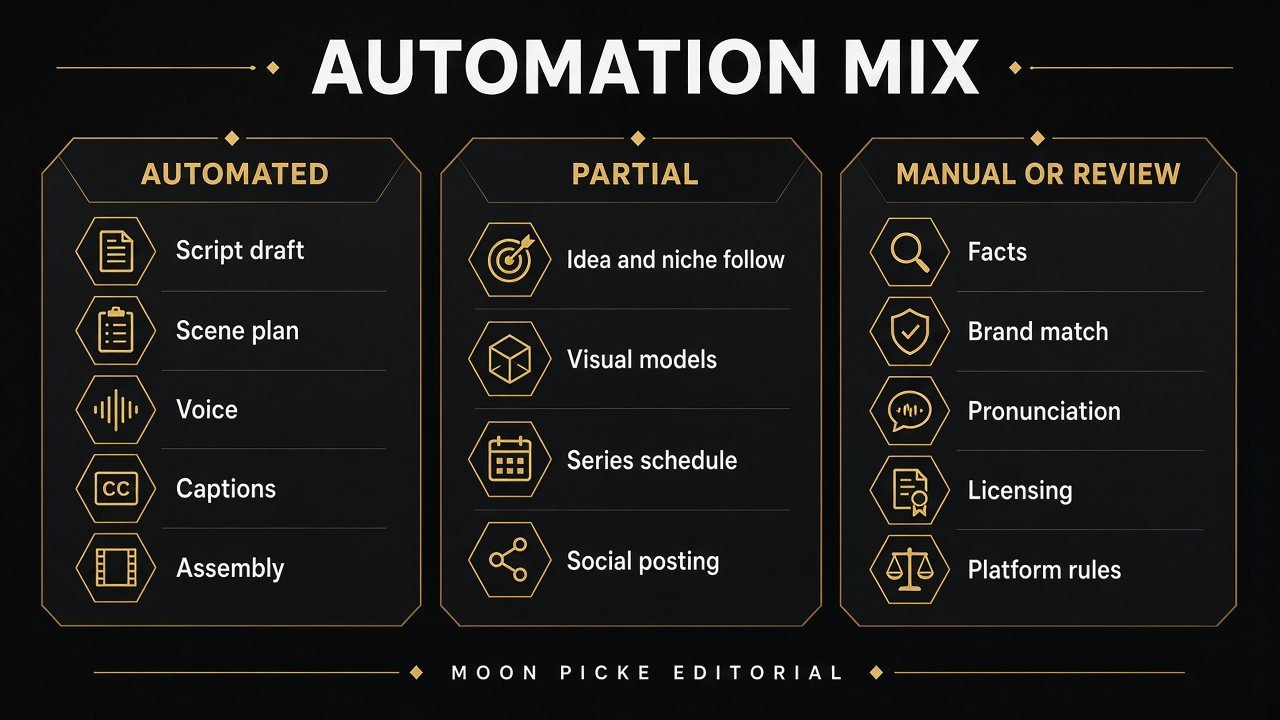
Even with Series auto-post, creators still need to review script accuracy, visual match, pronunciation, captions, branding, factual claims, and licensing before treating a channel as “set and forget.” StoryShort does not document zero-oversight publishing as a compliance feature.
Script generation
According to StoryShort, you can type a topic or start from a repurposed video. The homepage FAQ states that Claude writes the scripts. The MCP page lists a generate_script tool described as StoryShort’s tuned script writer. Custom script editing is implied by “you can change anything after” and the AI Editor line-swap example. This review does not grade writing quality.
Visuals and AI video generation
Faceless Stories are sold as a voice over AI images with the same characters across scenes. The site also sells generated clips and “short films,” talking on-screen characters, product uploads (photos, screenshots, or a short clip used in scenes), and a Sora UGC mode for product videos that “look filmed on a phone.”
The homepage FAQ (5 October 2026) says videos are made with Seedance, Grok, Wan, Veo or p-video, depending on quality, and that StoryShort swaps models when a better one ships. The MCP catalog separately lists Sora, Veo, Kling, Seedance 2.5 under list_video_models, and image models including gpt-image, Flux, and Seedream. StoryShort did not create those third-party models. Per-model credit prices and plan gates are not fully tabulated on the public pricing page; the pricing page says you always see an estimate before generating, and that longer scripts and premium models use more credits.
AI voices
The FAQ names ElevenLabs, OpenAI, and Qwen, and says Qwen can copy your own voice. MCP lists those libraries plus clones. This review does not call the voices human-like or studio quality.
Voice cloning, as documented, is a short recording of your voice. StoryShort’s Terms prohibit deepfakes, face swaps, or content that uses a real person’s likeness or voice without explicit consent. Do not use the feature to impersonate people who did not authorize it.
Captions, music, and editing
Captions: word-timed, reusable style; MCP lists 33 themes. Music: paid cards list background music. This article does not claim royalty-free or monetization-safe audio. Editing is an AI shot redo, not a timeline NLE. Aspect ratios are NOT LISTED as a 9:16/16:9 table on pricing.
Faceless video workflow
Faceless fit is strong because the default Story format is voice plus generated visuals, not a webcam. Script, voice, captions, Series, and auto-post are what make a calendar possible.
It may not suit you if you need documentary footage you shot, a human UGC actor on Starter, or cinematic camera control from a single foundation model. “No camera. No filming. No editing” is homepage marketing; the same site still offers an editor and asks you to change shots. Treat that as automation with review, not a closed loop.
Short-form vs long-form
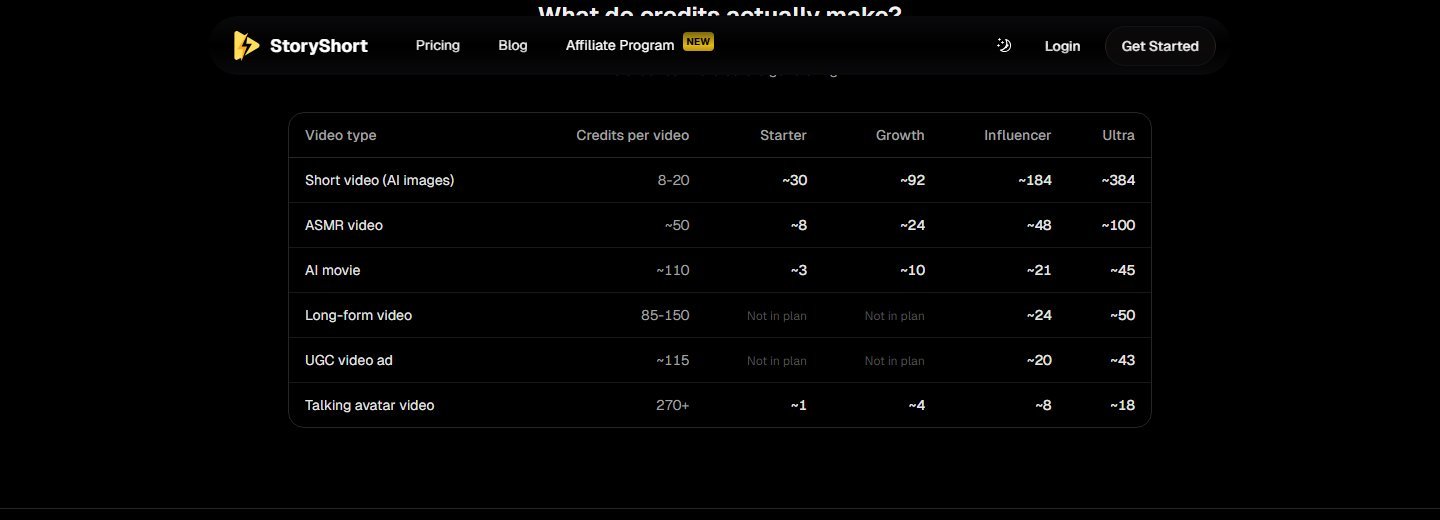
Short-form is the core sell (TikTok, YouTube Shorts, Instagram). Long-form is listed on the homepage as videos of 10 to 30 minutes. On the live pricing cards, long-form and UGC show as unavailable (red X) on Starter and Growth, matching the credit table “Not in plan” for those rows. Influencer (~24 long-form videos on the table) and Ultra (~50) are the plans where long-form credit math is published. Do not buy Starter expecting the 10–30 minute SKU.
Minimum generated-clip length is NOT LISTED. Shorts-specific second caps are NOT LISTED. Talking-avatar rows start at 270+ credits, which is a different product from a cheap faceless stills video.
Automation, scheduling, and publishing
Homepage FAQ: connect accounts and post from the app, including a daily schedule. The homepage also names Instagram. The API can publish immediately (schedule via your own cron) and lists Zapier. MCP lists publish and schedule tools. Series is 1–4 per plan. That is direct publishing after you connect accounts—not a promise every platform will accept or monetize the file.
StoryShort pricing in 2026
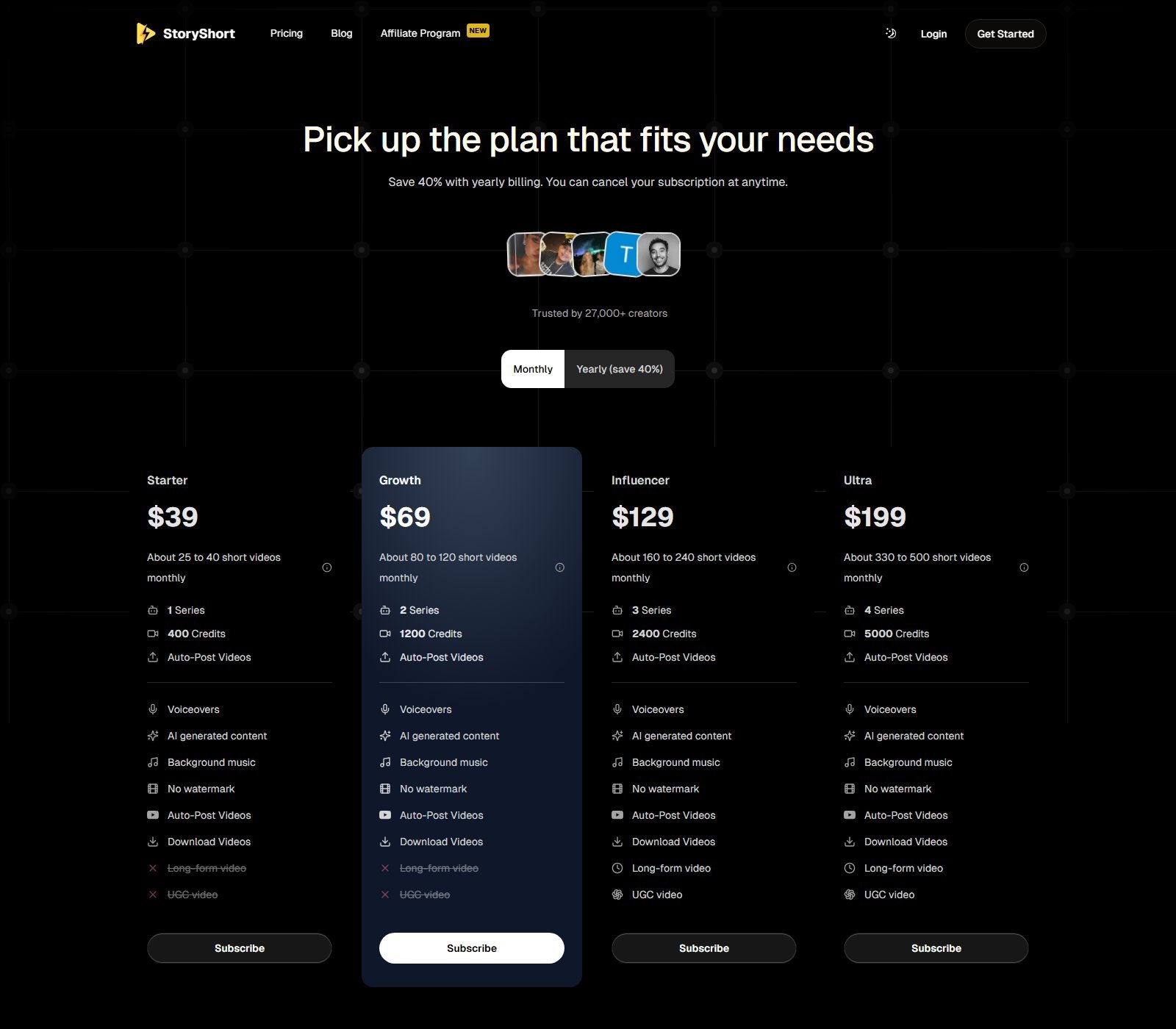
Pricing and plan limits were checked on 5 October 2026 and may change. Check StoryShort’s current plan page before purchasing.
| Plan | Price | Key allowance | Best for | Main limitation |
|---|---|---|---|---|
| Starter | $39/mo monthly. $23/mo equivalent, billed annually at $279 | 400 credits, 1 Series, auto-post, download, no watermark listed. Official: about 25–40 short videos/month | Low-volume faceless Shorts | Long-form and UGC not in plan on the live cards |
| Growth | $69/mo monthly. $42/mo equivalent, billed annually at $499 | 1,200 credits, 2 Series. Official: about 80–120 short videos/month | Regular short-form volume | Same long-form/UGC gate as Starter |
| Influencer | $129/mo monthly. $75/mo equivalent, billed annually at $899 | 2,400 credits, 3 Series. Official: about 160–240 short videos/month | Higher-volume plus long-form/UGC rows | Talking-avatar still ~270+ credits each |
| Ultra | $199/mo monthly. $117/mo equivalent, billed annually at $1,399 | 5,000 credits, 4 Series. Official: about 330–500 short videos/month | Highest published Series/credit bucket | Highest cash outlay; premium models still tax the bucket |
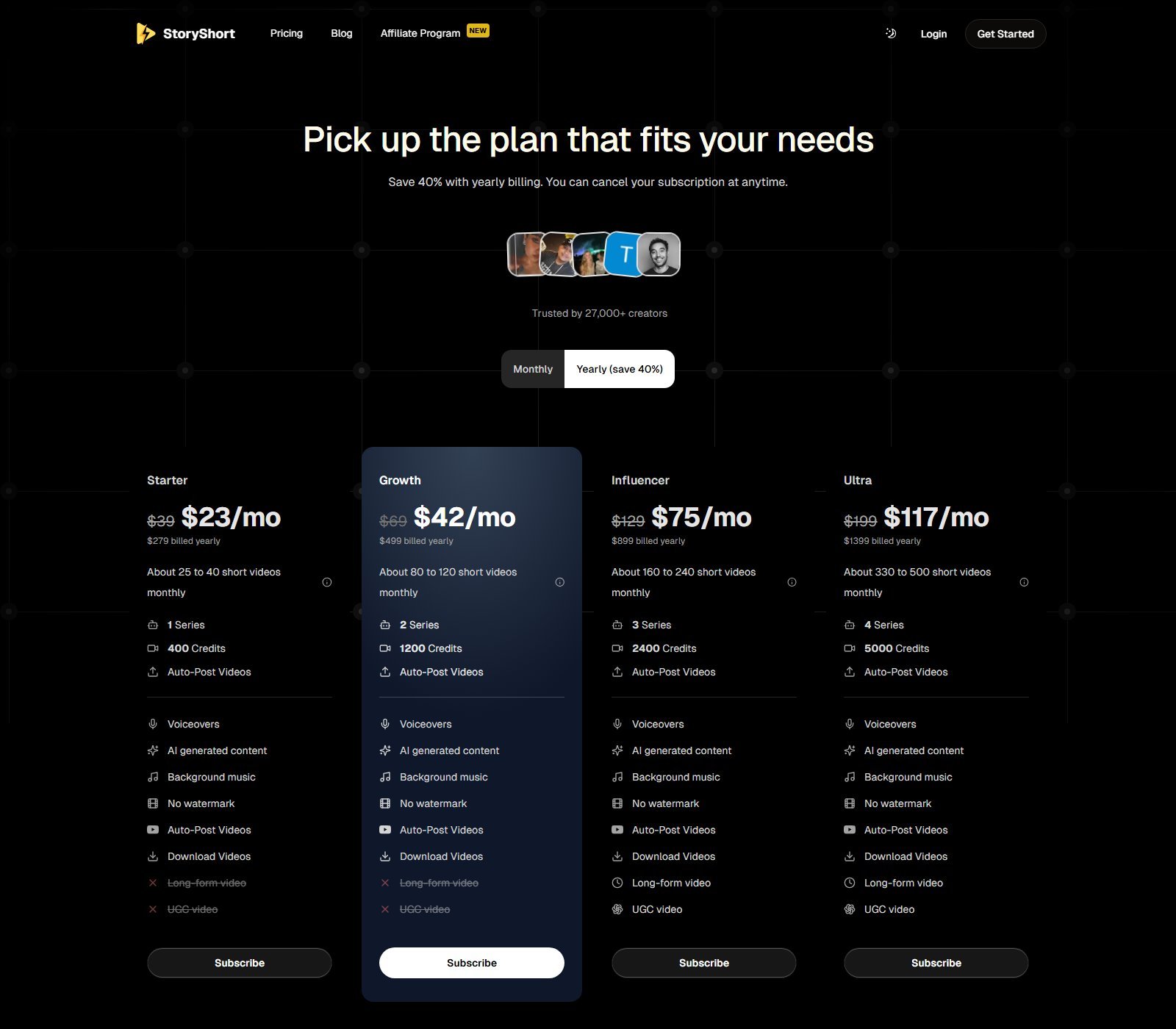
Never read the yearly $23/mo Starter figure as a cancel-anytime monthly price. Monthly Starter remains $39. All four paid cards list voiceovers, AI generated content, background music, no watermark, auto-post, and download. The same cards mark long-form and UGC with an X on Starter and Growth.
Which StoryShort plan makes sense?
Low-volume faceless creator: Starter, if 25–40 short image-led videos is enough and you do not need the long-form or UGC-ad rows. Regular short-form: Growth for 1,200 credits and a second Series. Higher-volume plus long-form or UGC ads: Influencer, because those credit rows are “Not in plan” below it. Ultra is the 5,000-credit / 4 Series ceiling, not an automatic recommendation.
How the credit system works
Credits purchase generation. The public table: short video (AI images) 8–20 credits; ASMR ~50; AI movie ~110; long-form 85–150; UGC ad ~115; talking avatar 270+. Longer scripts and premium models cost more. Unused credits roll over at renewal, up to twice the plan’s monthly credits (Refund Policy, updated 3 October 2026). Unused credits are not refundable. API and MCP use the same credits as the app.
Moon Picke calculation (Starter, short AI-image videos only): if you treat the official 25–40 shorts/month at $39, that is about $0.98–$1.56 per short video before premium-model overage. Using the 8–20 credit row on 400 credits instead implies ~20–50 videos if every job stays in that band. Those two official ranges do not match exactly; use the on-screen estimate. This is not a cost for UGC ads, long-form, or talking avatars.
StoryShort strengths
- Script, visuals, voice, captions, and auto-post sit in one product.
- Faceless Stories match how many Shorts channels actually publish.
- Series + daily schedule is documented, not only “export an MP4.”
- Credit estimates before generate, plus a public typical-cost table.
- Named third-party voice and video stacks, with a statement that models get swapped.
- REST API, MCP, and Zapier for people who already automate.
- Terms say the content you create belongs to you (still read current ToS for third-party media).
StoryShort limitations
- $39/month is a high floor versus some faceless autopilots.
- Long-form and UGC ads are gated off Starter/Growth on the live cards.
- Talking-avatar economics (270+ credits) can empty a Starter bucket fast.
- Export resolution is not printed as 1080p/4K on pricing.
- No current advertised free trial; signup credits are not a forever free plan.
- Refunds: subscriptions and credit purchases are generally non-refundable, with narrow unused-credit / billing-error exceptions.
Pros and cons
| Pros | Cons |
|---|---|
| Faceless script-to-post path is the actual product | Starter monthly is $39, not the yearly $23 equivalent |
| Auto-post to TikTok, YouTube, Instagram | Long-form/UGC not on Starter or Growth |
| Credit table is public; estimate before generate | Premium models and avatars burn credits quickly |
| Voice clone from your own recording is documented | Pixel export size NOT LISTED |
| API + MCP for agents | No forever free commercial exporter |
| Character continuity is a named feature | Not a substitute for a timeline editor |
| Credit rollover up to 2× monthly (refund policy) | ToS: all sales generally final |
StoryShort vs building your own AI video stack
A manual stack (script tool, model playground, TTS, captions, NLE, scheduler) wins on control if you already pay for those seats. StoryShort wins on one credit bucket, Series posting, and API. This review does not invent a DIY-stack dollar total.
Who should use StoryShort?
This StoryShort AI review points the seat at faceless Shorts/TikTok/Reels operators who want script, voice, visuals, and posting in one place—and who will connect social accounts. Stay on image-led shorts on Starter, or pay Influencer+ for long-form or UGC ads.
Who should skip StoryShort
Editors who need fine timeline control. Filmmakers shopping a single cinematic T2V playground as the whole product. UGC advertisers who only have Starter budget (UGC row is not in that plan). Very low-volume users who can live on a forever free commercial tier elsewhere. Anyone expecting YouTube monetization just because the tool can post.
StoryShort alternatives
Fliki — better if you need a documented forever free plan (3 credits/month, 720p, watermark, no commercial on free) and paid Standard at $28/month with listed 1080p and commercial rights. It is a studio you drive, not StoryShort’s Series autopilot. See Fliki plans
AutoShorts — better if you want a cheaper faceless autopilot. Official homepage JSON lists Starter at $19/month (yearly $190) and a Free row with watermark. Homepage “try free” copy can disagree with other live notes; confirm on the site. See AutoShorts
Revid — better if you want Auto-Mode workers plus API/MCP in a credit workspace. Live pricing (5 October 2026) shows a $39/month path (Hobby/Growth promo copy) and signup credits, not a forever free plan. See Revid plans
Short.ai — better if you want a $19/month Basic faceless + auto-caption + social post bucket (1,600 credits) without StoryShort’s $39 floor. It is not the same Series-plus-character-continuity sell. See Short.ai plans
Deeper Fliki coverage: Fliki AI review. Faceless pairing: AutoShorts vs StoryShort. Method: how we evaluate.
FAQ
Is StoryShort AI worth it? It is worth $39/month if you will use Series auto-post for faceless shorts and can live inside the credit table. It is a weak buy if you only needed a free exporter or Starter-plan UGC ads.
What does StoryShort AI do? It assembles AI faceless and related videos from a topic or a repurposed video, then can publish on a schedule.
How much does StoryShort cost? Starter $39/month or $279/year ($23/month equivalent). Growth $69 or $499/year. Influencer $129 or $899/year. Ultra $199 or $1,399/year.
Does StoryShort have a free plan? Signing up is free. The FAQ says credits come with a paid plan. Privacy mentions one-time signup credits. That is not a forever free publishing plan.
Can StoryShort create faceless videos? Yes. Faceless Stories are a named homepage format: voice over AI images with consistent characters.
Can it make YouTube Shorts, TikTok, and Reels? Publishing to TikTok, YouTube, and Instagram is documented. Platform acceptance is not guaranteed.
Can it create long videos? Homepage: 10–30 minutes. Pricing cards: not on Starter/Growth.
Does it generate AI voices? Yes. FAQ lists ElevenLabs, OpenAI, and Qwen, including cloning your own voice via Qwen.
Can it automatically publish videos? Yes, after you connect accounts. Series and schedule are documented. Review outputs before you trust a fully unattended calendar.
Does StoryShort add a watermark? Paid cards list no watermark. A forever-free watermarked exporter is not the current FAQ story.
Can videos be used commercially? Terms: the content you create belongs to you, with a license back to StoryShort to operate the service. Buyers should read current Terms for third-party media, music, and model rules. AI-tool access does not guarantee YouTube monetization.
What are practical alternatives? Fliki (free forever + $28 Standard), AutoShorts ($19 Starter faceless autopilot), Revid ($39 credit/Auto-Mode), Short.ai ($19 Basic).
Final verdict: is StoryShort worth it?
StoryShort makes most sense if you want one paid seat to write faceless shorts, keep characters consistent, and auto-post to TikTok, YouTube, and Instagram. At the current $39/month Starter price, that is a workflow purchase, not a casual toy. It becomes less compelling if you needed long-form or UGC ads on the cheap plans, a printed 1080p/4K spec, or a forever free commercial tier. The strongest reason to choose it is script-to-publish consolidation with a public credit table. The main reason to choose something else is a lower paid floor (AutoShorts, Short.ai) or a real free plan (Fliki). Moon Picke did not generate test videos for this StoryShort AI review. Recheck StoryShort’s live plans before you pay.