
This TOPDON Phoenix Lite 3 vs XTOOL D7 comparison is for advanced DIYers choosing between two current full-system tablet scanners — not a basic code-reader roundup. There is no universal winner. The documented split is wireless CAN-FD tablet plus Phoenix MDCI versus a wired 7-inch D7 with CAN FD and DoIP, plus a very different update bill. Check make, model, year, and the exact function before you pay. This is not a side-by-side shop test.
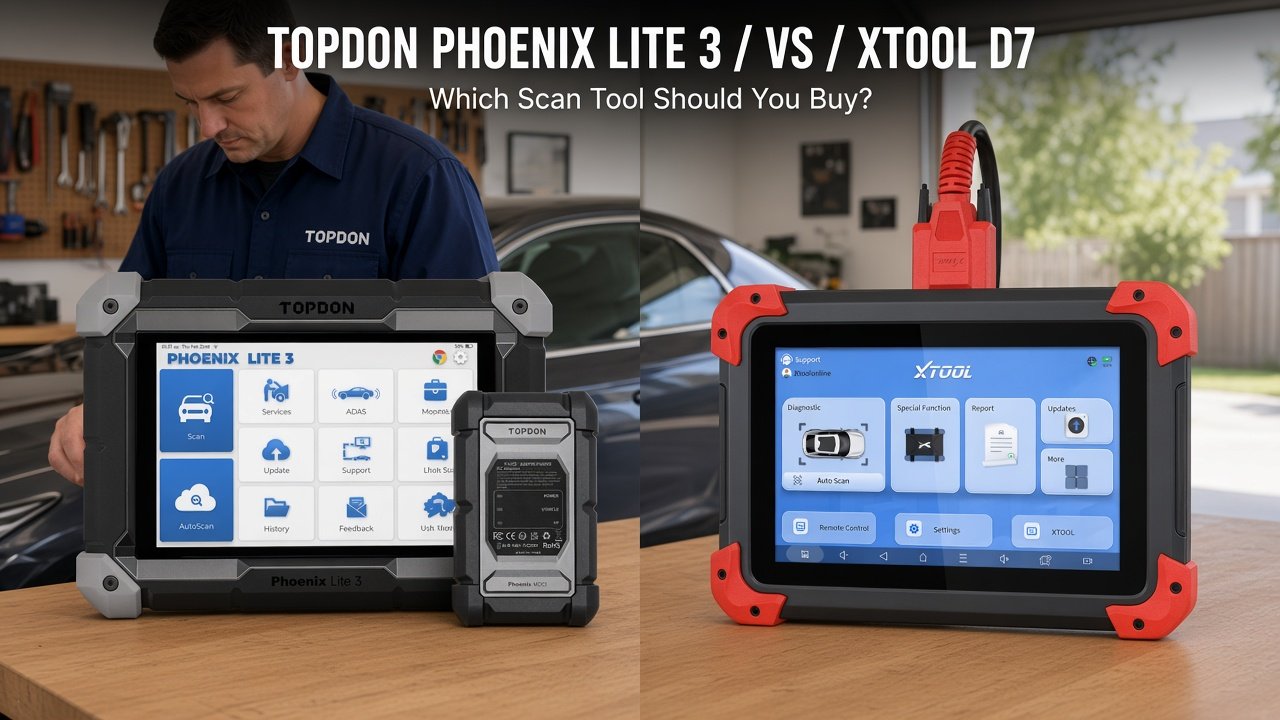
TOPDON Phoenix Lite 3 vs XTOOL D7: Quick Verdict
As an Amazon Associate I earn from qualifying purchases. Verified 16 September 2026: XTOOL D7 Amazon listing B098LF38DS is New and In Stock. TOPDON Phoenix Lite 3 has no verified New standalone tablet + Phoenix MDCI Amazon package; historical B0DFLWDPK2 opened as TOPDON ONE Plus (B0GYP7K1J9). Do not buy ONE Plus, Phoenix Lite 2, D7S, or D7W as substitutes.
| Category | TOPDON Phoenix Lite 3 | XTOOL D7 | Better Fit For |
|---|---|---|---|
| Diagnostic level | Full-system; vehicle-dependent | Full-system; vehicle-dependent | Either, after a coverage check |
| Bidirectional | Actuation tests documented | Action tests documented | The tool that lists your test |
| Service functions | Up to 35 | Official 36+ (Amazon listing currently 39+) | Do not rank by count |
| Coding/adaptation | Online coding documented | Online and offline coding documented | D7 if you need documented offline coding |
| Programming | J2534/cloud programming marked unsupported vs higher Phoenix | Not a J2534 flash package | Neither for OEM flashing |
| CAN FD | Yes, native MDCI | Yes; listing: no extra adapter | Tie on acronym; still vehicle-specific |
| DoIP | Not this SKU (“Only CAN FD Supported”) | Yes, documented with CAN FD | D7 if your car needs DoIP connectivity |
| Security gateway | FCA SGW / AutoAuth path | FCA AutoAuth documented | Neither is “free unlock” |
| Hardware | 8″ 1280×800; 2 GB / 64 GB; Android 10 | 7″ 1024×600; 2 GB / 64 GB; Android 10 | Lite 3 if screen size matters |
| Connection/VCI | Bluetooth Phoenix MDCI | Wired main OBD cable | Lite 3 wireless; D7 cable |
| Update policy | 2 years free; published $495/year | 3 years free; official D7 renewal $99/year | D7 for cheaper published renewal |
| Best buyer | Coverage-checked advanced DIY who wants MDCI + topology | Coverage-checked DIY who wants DoIP + longer cheap updates | Function first |
| Main limitation | No DoIP; Amazon package unverified; costly renewal | Wired 7″ tablet; not D7S PMI class | — |
Choose Phoenix Lite 3 if official coverage lists your jobs, you want Bluetooth MDCI, an 8-inch display, and topology mapping, and you accept CAN-FD without DoIP plus $495/year after year two. Choose XTOOL D7 if you want documented CAN FD + DoIP on a wired tablet, online and offline coding on supported brands, three years of updates then a published $99/year D7 renewal, and a currently verifiable New Amazon kit. Choose neither if the exact active test, reset, or coding job is missing from that brand’s coverage tool — or you only need engine codes.
See current Phoenix Lite 3 availability on Amazon — confirm PXLITE3 + MDCI, not ONE Plus
Check current XTOOL D7 price on Amazon (ASIN B098LF38DS, not D7S)
The Biggest Differences at a Glance
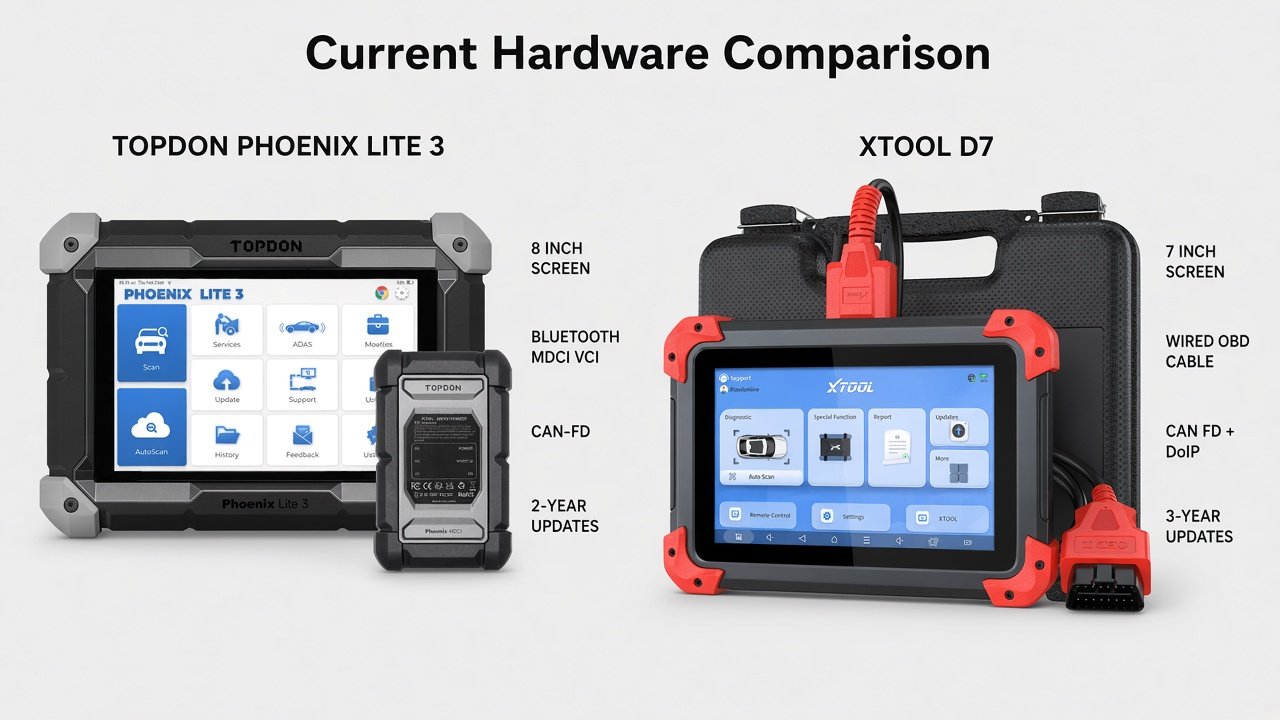
In this TOPDON Phoenix Lite 3 vs XTOOL D7 matchup the hardware split is obvious: Lite 3 is an 8-inch Android 10 tablet talking to a Bluetooth Phoenix MDCI; D7 is a 7-inch Android 10 tablet with a wired OBD main cable (official packing: VGA to OBD-II). Protocol split is equally sharp: Lite 3’s official comparison row is CAN-FD only; D7’s manufacturer spec lists CAN FD and DoIP. Ownership split: two years then $495/year on TOPDON US versus three years then a $99/year D7 software-update renewal on XTOOL’s official renewal guide. Direct-site kits are not automatically the Amazon kit.
Full-System Diagnostics and Vehicle Coverage
Both go beyond generic OBD2 (read/clear engine DTCs, live data, freeze frame) into enhanced OEM-module work when the vehicle package supports it. Full-system is not every module on every car. Coverage varies by make, model, year and function. ABS or SRS codes are not ABS bleed. Transmission communication is not transmission programming.
TOPDON US cites 168+ makes and a Vehicle Coverage Tool (that tool showed no function dump on the verification date). XTOOL publishes a vehicle-coverage page and tells buyers to confirm VIN with support; D7 marketing also cites AutoVIN / Auto Scan. AutoVIN is not universal detection. Do not declare either brand “broader.” A BMW or Ford logo on both sites does not mean the same reset on the same year. European-car shopping and Toyota/Honda/Ford-only shopping are separate jobs; keep this page on these two SKUs. If you only need a simpler reader, use the best OBD2 scanners for home mechanics hub.
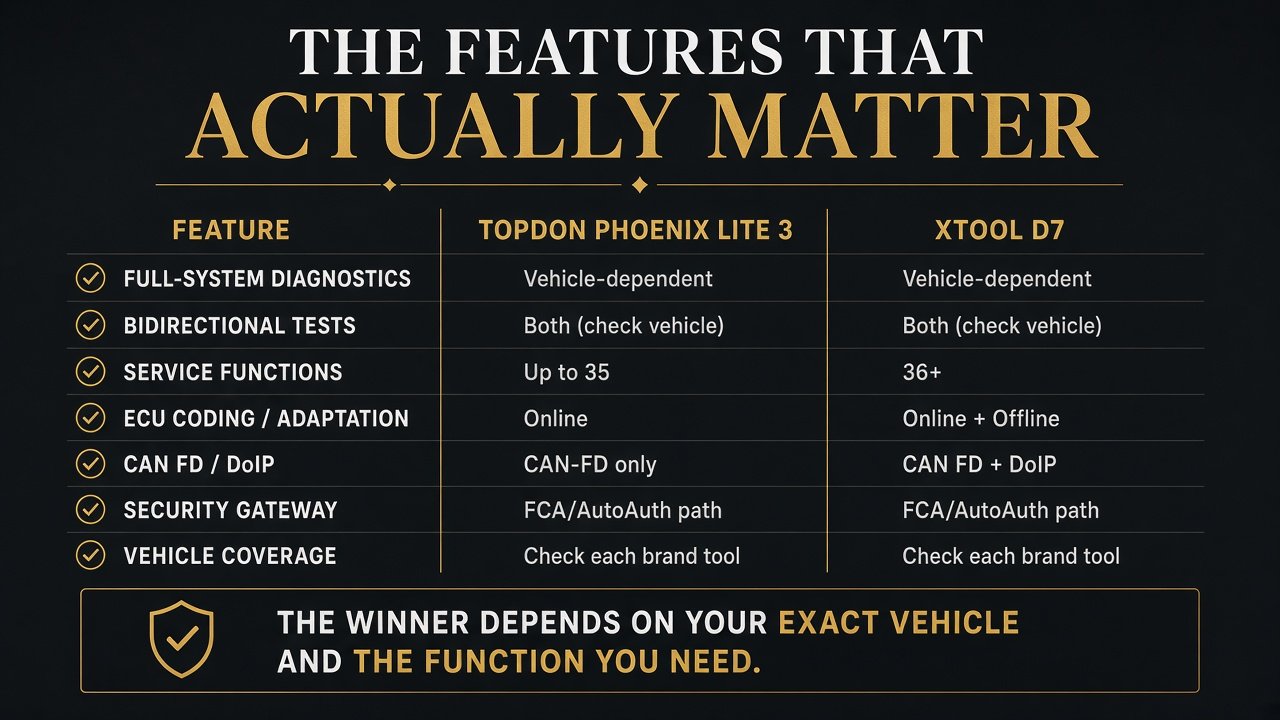
Is TOPDON Phoenix Lite 3 better than XTOOL D7? Only for a specific job. Lite 3 is the better documented fit for wireless MDCI, a larger screen, and topology mapping. D7 is the better documented fit for native DoIP plus a longer, cheaper published update path. Coverage still decides.
Bidirectional Tests: Which Tool Gives You More Useful Control?
Both document bidirectional / actuation tests: command a supported component for diagnosis. TOPDON’s Lite 3 manual says available tests vary by manufacturer, year, and model; marketing art shows examples such as an injector, window, wiper, and brake lamp — illustrations, not a universal list. XTOOL’s D7 page lists active testing of actuators such as EVAP, A/C clutch, fuel injectors, windows, doors, and sunroofs; Amazon copy also names fans and solenoids. Those are official examples, not proof one tool is “more powerful.” Active-test counts such as “4,000+” on a listing are a weak ranking device because availability is vehicle-specific. Check the exact test.
Which has better bidirectional controls? Both are bidirectional. Neither is proven superior on every car. The useful control is the test that actually appears for your VIN.
Service Functions: Count vs Actual Vehicle Support
TOPDON markets up to 35 maintenance functions, with availability varying by vehicle (oil, EPB/EBP, SAS, BMS, DPF, throttle matching, injector coding, ABS bleeding, TPMS learning, and others in the Lite 3 manual). XTOOL’s D7 spec lists 36+ special functions, including ABS bleeding, oil reset, EPB, SAS, injector coding, TPMS reset, and throttle relearn. The current Amazon D7 title says 39+. Count is not depth. Do not pick a winner because 39 is larger than 35. ABS diagnostics ≠ ABS bleed on either tool.
ECU Coding, Adaptation and Programming
Coding/adaptation changes supported configuration. Programming flashes software. Do not mix them. Lite 3 documents online coding; TOPDON’s Lite 3 vs Smart/Max chart marks cloud-based programming and D-PDU/J2534/RP1210 with an X. D7 documents online and offline ECU coding. XTOOL’s own product education currently describes D7 online coding for Mercedes-Benz, BMW, and Volkswagen, and offline coding for Mercedes-Benz, Mitsubishi, Volkswagen, Audi, and Skoda — still not every module. Amazon D7 copy states coding availability varies and “does not include ECU programming.” Neither current package is a J2534 pass-thru programmer. IMMO/key menus exist in marketing (Lite 3 matching after specified replacements; D7 key/IMMO copy about disabling lost keys / replacement fobs) — not universal key programming. Topology mapping is documented on Lite 3 as network visualization, not automatic root-cause. D7’s current spec sheet does not treat topology as a headline D7 feature.
Which has better ECU coding? D7 currently documents both online and offline coding; Lite 3 documents online coding. Brand, year, and module still have to match. Coding is not programming on either scanner.
CAN FD, DoIP and Security Gateway Support
Phoenix Lite 3: CAN-FD native on the included MDCI; official comparison “Only CAN FD Supported” — treat DoIP as not this VCI. D7: CAN FD and DoIP on the official spec; Amazon/store copy says no additional adapters for those protocols, with examples such as GM 2020+ (CAN FD) and BMW/Mercedes/Land Rover-class DoIP mentions on the listing — connectivity is not full-function support.
Both document an FCA / AutoAuth path. AutoAuth is not a free scanner unlock: expect accounts, current software, internet, and AutoAuth/OEM terms. Gateway access ≠ included-for-free diagnostics. Camera power off the OBD port is unrelated: dash cam hardwire kit vs OBD cable and the dash cam buying guide.
Hardware, Screen and VCI
Lite 3: 8″ 1280×800, 4-core 2.0 GHz, 2 GB / 64 GB, 12600 mAh / 3.8 V, rear 8 MP, Bluetooth MDCI (USB Type-C on the VCI also documented). D7: 7″ 1024×600, quad-core 1.5 GHz, 2 GB / 64 GB, 2500 mAh × 7.3 V, Type-C charging, wired vehicle connection. A larger screen helps graph visibility; it does not deepen coverage. Extra RAM or a faster processor is not proof of better vehicle software. Battery figures are capacity only — no invented runtime. Official D7 packing lists a tool case; the Amazon B098LF38DS included-components text lists the D7 scanner, OBD2 cable, and Type-C charging. Confirm photos on the listing you actually buy. A replacement VCI or cable is not the scanner. Do not call either UI “easier” from this desk. Read the Phoenix Lite 3 review for the single-product deep dive, plus How We Evaluate and the affiliate disclosure.
| Spec | Phoenix Lite 3 | XTOOL D7 |
|---|---|---|
| Screen | 8″ 1280×800 | 7″ 1024×600 |
| OS | Android 10.0 | Android 10 |
| RAM | 2 GB | 2 GB |
| Storage | 64 GB | 64 GB (Amazon notes a 32 GB → 64 GB upgrade on current units) |
| Battery | 12600 mAh / 3.8 V | 2500 mAh × 7.3 V |
| Connection | Bluetooth MDCI | Wired OBD main cable |
| Included VCI | Phoenix MDCI | No separate wireless VCI; cable is the vehicle link |
| Free update period | 2 years | 3 years |
| After update expiry | Not clearly published | Previously downloaded software remains accessible (official D7 page) |
| Amazon ASIN | None verified 16 Sep 2026 | B098LF38DS |
Software Updates and Long-Term Ownership
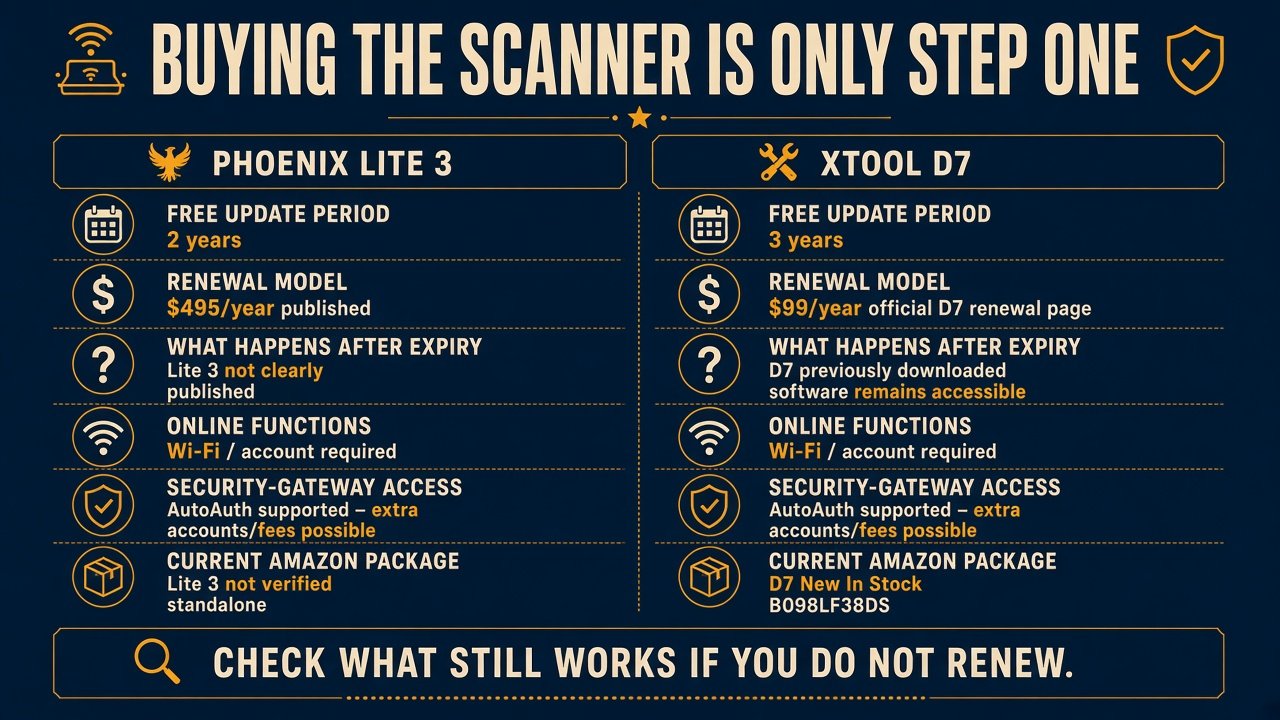
Update renewal is not a generic app subscription and not AutoAuth. Lite 3: two years of free upgrades on TOPDON US, then a published $495/year renewal; activation uses Wi-Fi and email. D7: three years of free Wi-Fi upgrades; XTOOL’s D7 renewal guide currently prices an extra year at $99 via serial-number checkout and a 16-digit activation code. Amazon D7 copy says three-year updates with “no subscription fees” for that included window — that is still an update plan, not lifetime updates. Direct TOPDON/XTOOL warranty channels can differ from Amazon returns. XTOOL also documents a two-year warranty on the D7 store page; do not merge that with software years.
What Happens When the Free Update Period Ends?
XTOOL’s D7 product page: previously downloaded software remains accessible after the update period; new coverage and features are what renewal buys. Lite 3 pages do not clearly state keep-working versus brick; they also do not say the tablet dies. Do not assume either device becomes unusable. Do not assume online coding, coverage downloads, or AutoAuth stay identical if accounts lapse. Confirm current support terms before treating either as a decade tool.
Can you keep using either scanner after updates expire? D7: official copy says previously downloaded software remains accessible. Lite 3: not clearly published. New vehicle packages are the usual reason to renew on both.
Which Is Better for Advanced DIY Mechanics?
Advanced DIY is the core audience for TOPDON Phoenix Lite 3 vs XTOOL D7 if you will actually run module scans, active tests, and service menus. Beginners who only clear a MIL should skip both and stay on the hub. Light shops overlap these feature lists but still need programming-class tools if the job is J2534 flashing. If D7 documents the DoIP car and the $99 renewal matters, D7 is the ownership-leaning pick. If you want wireless MDCI, topology, and the 8-inch panel — and Lite 3 coverage lists the job — Lite 3 can be the workflow pick even at a higher published MSRP ($859 TOPDON US, sold out on the verification date; D7 official store $349 and backordered the same day).
Check current Phoenix Lite 3 search results on Amazon and reject wrong models
See current XTOOL D7 availability on Amazon
Which Is Better for Multiple Vehicles?
A long brand list is not equal function depth. Check every household VIN for the weakest car and the function you actually run. Do not pick a winner from logo walls.
Which Is the Better Value?
Amazon prices move. Prefer “check current Amazon price.” Official list: Lite 3 $859 versus D7 $349. Extra Lite 3 money buys a larger display, wireless MDCI, topology, and a different adapter kit — not automatically deeper coding or DoIP. Extra D7 value, on paper, is DoIP, offline coding documentation, three included update years, and $99 renewal versus $495. Temporary sale price is not diagnostic depth. Infotainment is a different purchase: wireless Apple CarPlay head units and wireless vs wired CarPlay.
Final Verdict: Phoenix Lite 3 or XTOOL D7?
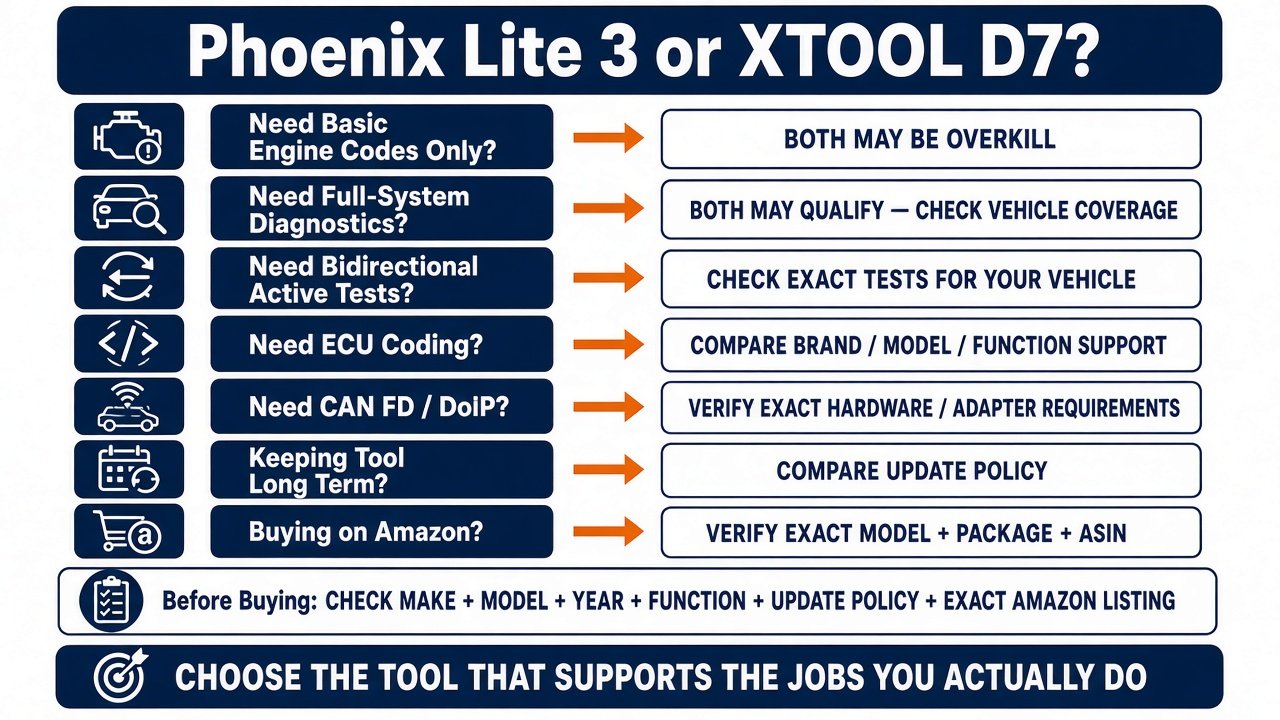
Conditional. For U.S. buyers on 16 September 2026, TOPDON Phoenix Lite 3 vs XTOOL D7 is not a trophy fight. Buy Lite 3 when TOPDON’s coverage tool lists the job and you specifically want MDCI wireless diagnostics without DoIP. Buy D7 when you need documented DoIP/CAN-FD on a wired tablet, want the published cheaper update path, and can confirm ASIN B098LF38DS is the D7 — not D7S. Buy neither when the function is missing or you only needed a $40 code reader. Moon Picke editorial interpretation: if Amazon cannot show a New PXLITE3 kit, do not “make do” with ONE Plus; wait or buy TOPDON US when it is actually in stock.
FAQ
TOPDON Phoenix Lite 3 vs XTOOL D7: which should I buy?
Buy the tool that lists your exact vehicle and function. Use Lite 3 for wireless MDCI/topology/CAN-FD. Use D7 for wired DoIP plus cheaper published updates.
Are both bidirectional?
Yes. Active tests vary by vehicle on both.
Can both read ABS and SRS?
Full-system menus can include ABS and SRS when the package supports them. That is not automatic on every car.
Can both perform ABS bleed?
Both document ABS bleed as a service function. Availability is still vehicle-dependent.
Which supports ECU coding, and is coding programming?
Lite 3: online coding. D7: online and offline coding on documented brands. Coding is not flashing. Neither is the J2534 programming kit.
Do both support CAN FD and DoIP?
CAN FD: both. DoIP: D7 yes; Lite 3 no on the official comparison row.
What happens when software updates expire?
D7: previously downloaded software remains accessible per official copy. Lite 3: not clearly published. Renewal buys new coverage. Neither is documented as a brick.