
This treadmill buying guide is a pre-purchase checklist, not a ranking. Start with how you will actually use the machine, then interpret the spec sheet—do not shop the biggest number. Walking, running, incline work, a tight room, and a no-subscription preference pull different specs to the front. Moon Picke used manufacturer spec pages, placement/electrical notes, warranty tables, and current iFIT membership language, with Amazon.com US listings opened 15 September 2026 only as purchase-channel examples. We did not invent belt minimums, horsepower rules, ceiling formulas, durability, or quietness scores.
Once the framework is set, product shortlists live elsewhere: best treadmills for home use, walking, incline, small spaces, folding, higher user-weight capacity, apartments, and home-office walking pads if a full deck is the wrong category. Method: how we evaluate.
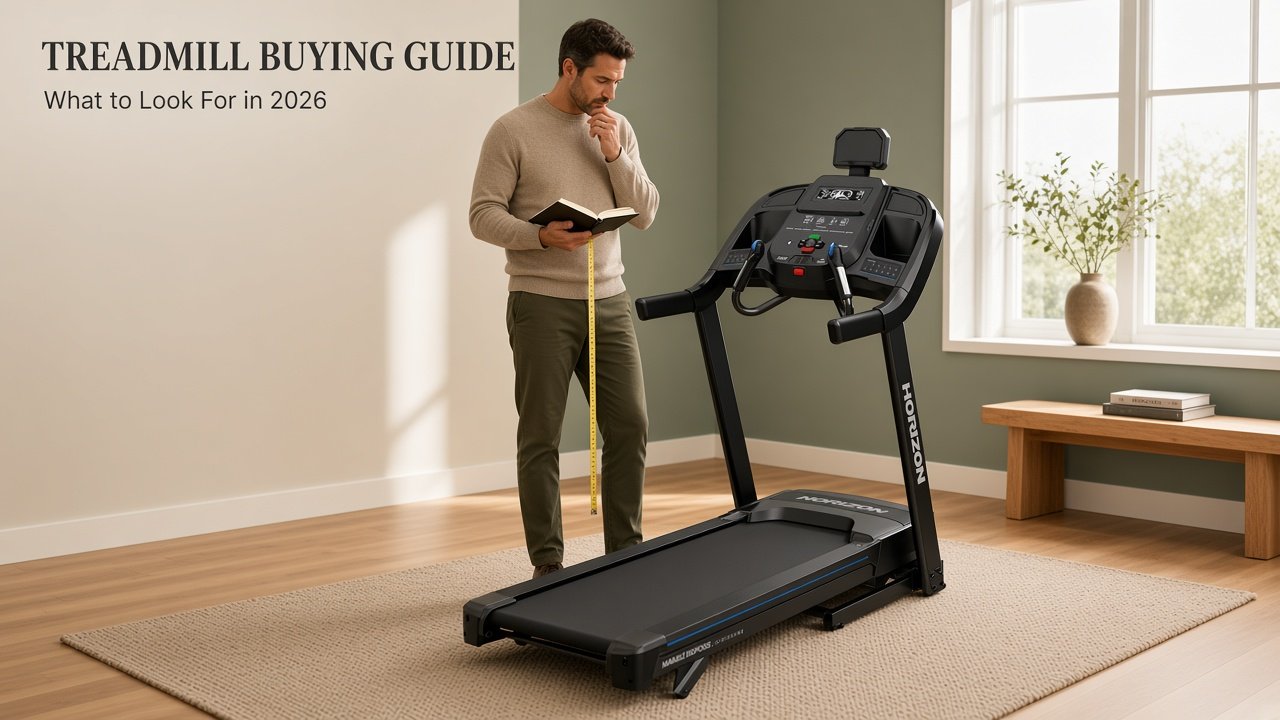
Treadmill Buying Guide: Quick Checklist
Use this treadmill buying guide table as a spec decoder. The second table is a priority map, not a winner list.
| Spec / Feature | Why It Matters | Common Buying Mistake |
|---|---|---|
| Running surface | Belt width × length is the usable walking/running area | Confusing it with overall machine size |
| Max speed | Capability you may or may not use | Treating the highest MPH as quality |
| Incline / decline | Powered grade vs software auto-adjust vs unused range | Buying steepness you will never use; mixing % with degrees |
| Motor terminology | HP, CHP, peak, or no public number—maker-specific | Comparing unlike ratings or treating CHP as lifespan |
| User-weight capacity | Documented limit—do not exceed it | Reading it as stability, durability, or a buffer rule |
| Dimensions | Assembled W × D × H, not the shipping box | Planning the room from carton size |
| Folding | What folds, folded size, approved orientation | Assuming foldable = compact or portable |
| Deck height | Step-up, ceiling at max incline, entry/exit | Treating a low deck as a medical rating |
| Controls | Start/stop, speed, incline, quick keys | Judging the treadmill by screen inches |
| Screen | Trainer/entertainment layer | Equating a large display with better hardware |
| Subscription | What works without a paid plan | Confusing an app with a membership |
| Power | Voltage, outlet, cord, circuit notes on that SKU | Assuming any strip or extension cord is fine |
| Maintenance | Belt, lube, alignment, updates per the manual | Expecting premium to mean maintenance-free |
| Warranty | Frame / motor / parts / labor split | Using headline years as lifespan |
| Buyer Type | Prioritize | Usually Lower Priority |
|---|---|---|
| Walker | Belt fit, access, simple controls, footprint, folding, value | Top-end running speed, giant trainer screen |
| Runner | Surface, usable speed, direct controls, fit, incline, warranty split | Unused software extras |
| Small-space buyer | Assembled + folded size, clearance, storage path | Largest belt if it will not fit the room |
| Apartment buyer | Placement, neighbors, conservative noise expectations | “Quiet motor” as total-system proof |
| Higher-capacity buyer | Published user-weight limit plus belt/rail geometry | Capacity as a strength trophy |
| Incline-focused buyer | Powered % range, decline if needed, controls | Auto-adjust if you train manually |
| No-subscription buyer | Manual mode, physical console, optional apps | Paying for a screen you will not fund |
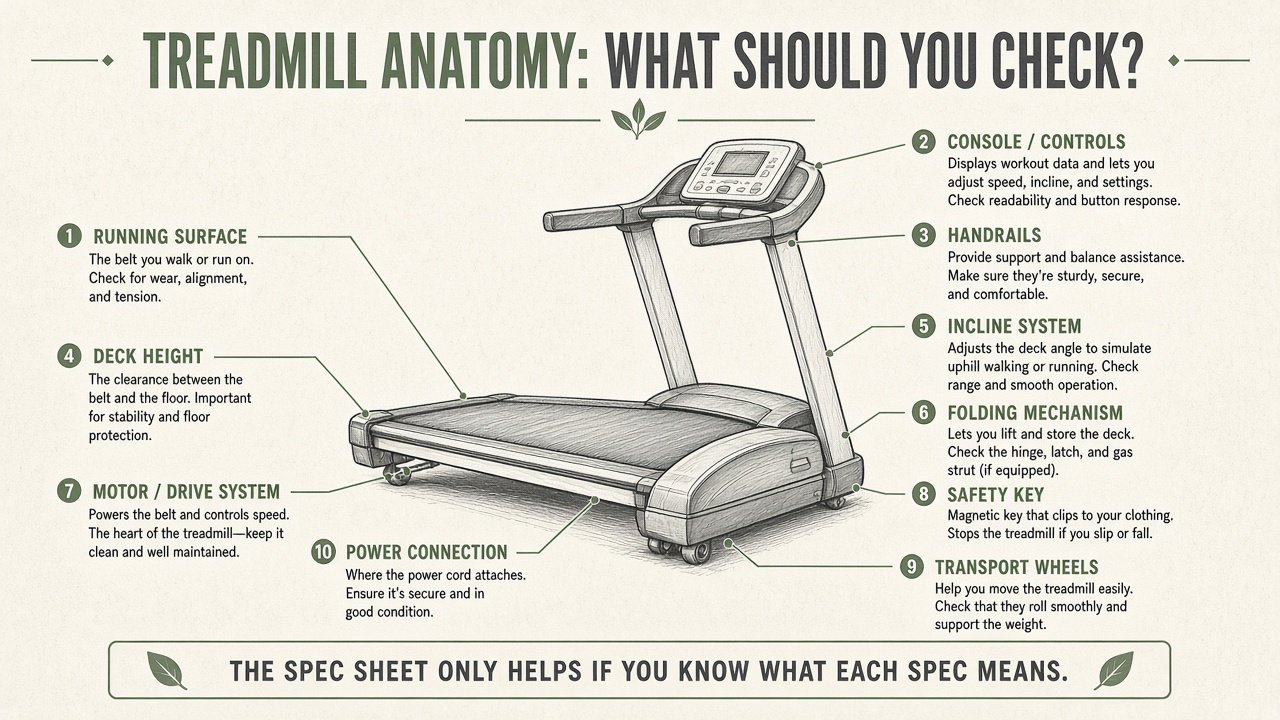
1. Start With How You’ll Use the Treadmill
Define the job: walking, mixed walk/jog, regular running, incline sessions, multi-user household, limited space, apartment, no-subscription ownership, or a higher user-weight requirement. That order beats brand names and is step one of any useful treadmill buying guide. Walkers often care about simple controls, belt fit, access, incline, footprint, folding, and value—see treadmills for walking. Runners often care more about usable surface, speed they will hit, direct controls, fit, incline, and the warranty split. There is still no live Moon Picke running roundup to dump you into; stay on criteria here. Incline-first buyers: incline treadmills. Office walking may belong on a pad: walking pads for home office.
2. Check the Running Surface Before the Screen
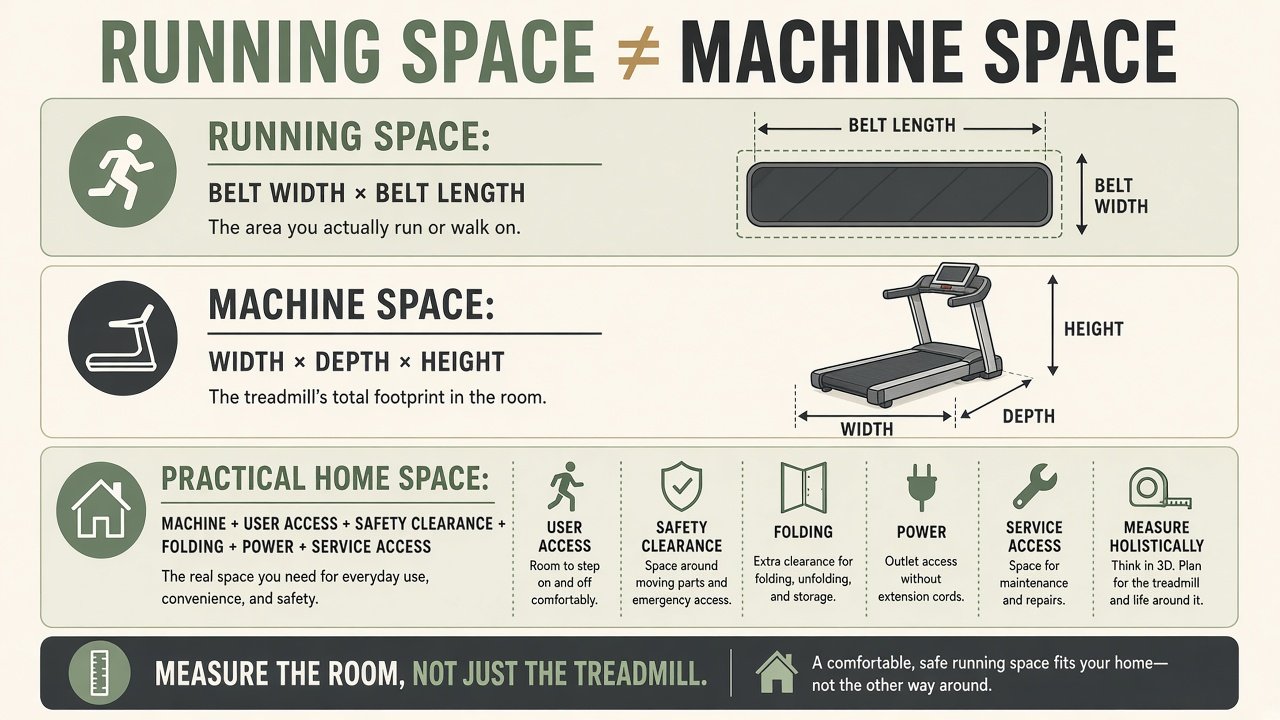
Running surface is belt width × belt length. It is not the treadmill’s outer width × depth × height. A large frame can still offer a modest belt; a compact chassis can use its footprint efficiently. Belt length can matter more as you move from walking to jogging to running—do not invent a height cutoff, and do not write that all runners need exactly 60 inches. Illustrative examples, not recommendations: Horizon 7.0 AT (HTM1457-01) lists 20″ × 60″ on a 76″ × 35″ × 67″ assembled body; NordicTrack Commercial 1750 (NTL17125) lists 22″ × 60″. More width can add lateral room and also grow machine width. Widest is not automatically best. A spec sheet cannot prove comfort, stride, stability, or “feel.”
3. Buy the Speed and Incline You’ll Actually Use
Max speed is capability, not quality. A high MPH treadmill can still have a smaller belt, a worse room fit, or software you will ignore. Buy the range you will use. Incline percentage is not the same measurement as degrees; keep them separate. Powered incline means the machine can change grade from controls. Smart auto-adjust means software can change it for you—they are different. More grade is not better quality and is not a calorie or weight-loss claim. Horizon 7.0 AT lists 0.5–12 MPH and 0–15% with no listed decline; 1750 lists 0–12 MPH and 12% to −3%. Use those only as examples of how tables differ.
4. Read Motor Specs Carefully
Makers may publish HP, CHP, peak horsepower, proprietary wording, or no public number. Do not normalize unlike ratings. Do not teach that higher CHP means a longer-lasting treadmill, better reliability, or better running feel. Do not invent “walkers need X HP” or “runners need Y CHP.” Evaluate the full system: positioning, belt, speed, warranty split, and use case. Example language only: 1750 lists 4.25 CHP; Sunny SF-T723030 lists 2.5 Peak HP—those strings are not a ranking.
5. Check User-Weight Capacity — But Don’t Confuse It With Fit
Manufacturer maximum user-weight capacity is a documented limit. Do not exceed it. It is not user fit: belt, rails, console, and step-up still have to match you. It is not stability or durability. Do not invent a 50–100 lb buffer. Capacity shortlists: treadmills for heavy users. Product weight matters for moving and folding; heavier is not better or more stable. Horizon lists 277 lb machine weight and 325 lb user rating; 1750 notes 400 lb user rating and 311.5 lb in-box—in-box is not quality.
6. Measure Your Room, Not Just the Treadmill
Verify assembled width × depth × height—not shipping dimensions. Horizon’s 7.0 AT table also lists shipping 79.5″ × 30″ × 13.4″; that carton is not the treadmill you live with. Practical footprint is machine + access + manufacturer clearance + folding movement + power + service access. Follow the current manual for clearance; do not copy one SKU’s set onto every treadmill. Smaller is not automatically better. Tight rooms: small-space treadmills. Placement: apartments. Sound is motor + belt/rollers + foot strike + flooring + room. Do not trust “quiet motor” as total quietness. Do not invent dB. A mat may protect a floor; it is not soundproofing.
7. Understand What “Folding” Actually Means
Ask what folds: deck, rails, flat, bifold, or nothing. Folding is not compact until you read folded dimensions (Horizon 7.0 AT folded 44″ × 35″ × 68″). Folding is not portable: weight, wheels, and the storage path still decide. Storage orientation—vertical, horizontal, under-bed, upright—must be manufacturer-approved; do not infer from lifestyle photos. Sunny’s SF-T723030 FAQ on the brand page used here says to store flat and not upright without stability bumpers—that is one SKU’s rule, not a category law. See folding treadmills for product shortlists after you know the mechanism.
8. Check Deck Height and Ceiling Clearance
Published step-on height matters for entry/exit, low ceilings, and incline use. Horizon 7.0 AT lists 8 5/8″; cluster notes for 1750 list 10.01″ and T Series 16 8.3″—examples, not accessibility medical claims. Low deck is not “safer for seniors,” arthritis, or rehab. For ceiling, consider user height + deck height + maximum incline position + actual ceiling. Do not invent height + deck + 12 inches or any other generic formula.
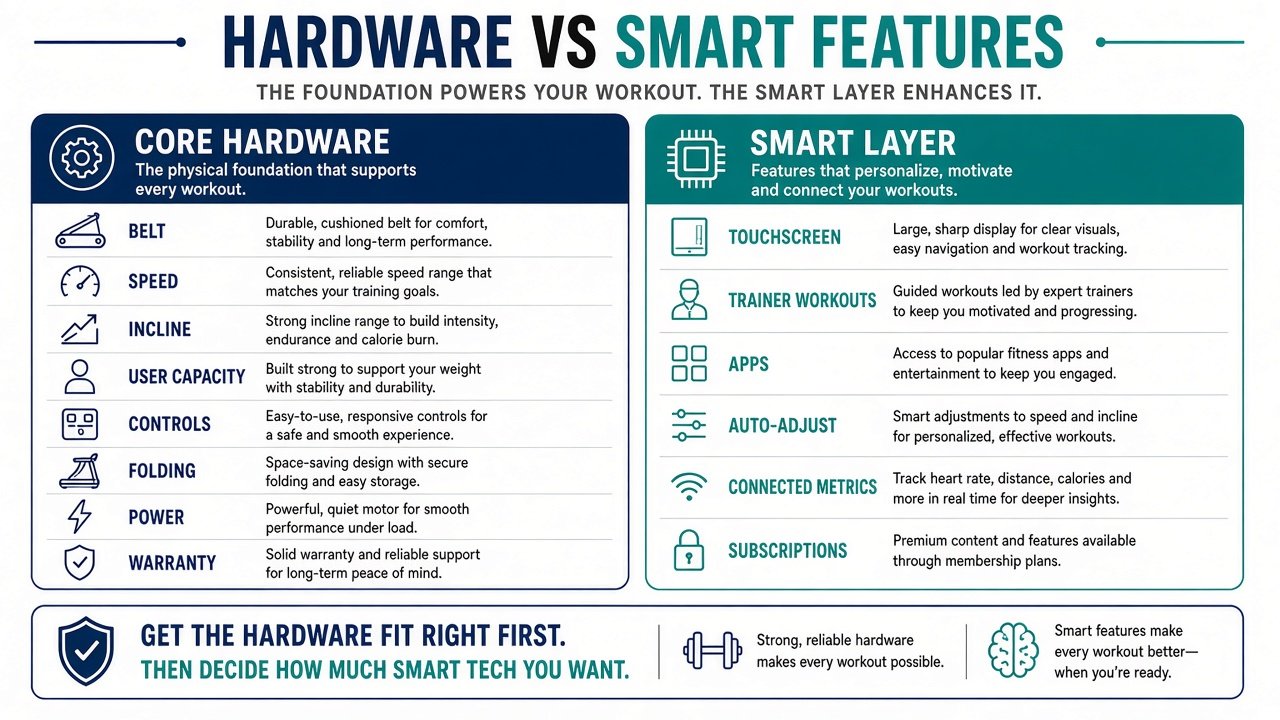
9. Look at Controls Before the Touchscreen—Then Decide How Much Smart Tech You Want
Inspect start/stop, speed, incline, quick keys, and whether those are physical, handle-mounted, or on-glass. Interval users may care about direct keys; we do not invent button “feel.” Screen size is not treadmill quality. A tablet holder versus a built-in display is a preference, not a winner. Get hardware fit right first. Smart auto-adjust of speed/incline is a software layer, not proof of a better deck. If belt, space, or capacity are wrong, apps will not fix them. Some buyers will prefer simple buttons over a large screen.
Ecosystems may include iFIT, JRNY, Echelon, or others. Ask what works without a paid plan. Do not assume paid software is required for basic belt motion. An app can be free, optional, setup-only, or tied to membership. iFIT Pro was listed at $39/month (1-year Pro $396 on NordicTrack’s membership checkout) on 15 September 2026 for touchscreen equipment; NordicTrack states full library and adaptive features need a paid plan while manual mode and some onboard workouts remain. Horizon’s 7.0 AT Studio table marks JRNY as not included. This guide does not own a no-subscription product ranking.
10. Check Power, Safety, Maintenance, and the Warranty Split
Power is model-specific: voltage, outlet notes, dedicated-circuit language if published, cord placement, and extension-cord restrictions. Horizon 7.0 AT lists 60Hz–120V and is marked not compatible with GFCI outlets. Do not generalize that every treadmill can use any strip or cord. A deck can physically fit a wall and still fail if the correct power access is missing.
Check documented safety key, e-stop, pause/stop, child/PIN lock if offered, and folding lock. A key is not zero risk: setup, behavior, the manual, and surrounding space still matter. There is no “safest treadmill” award here. Cushioning uses proprietary names (Horizon 3-Zone Variable Response Cushioning on the 7.0 AT table)—report the term; do not translate it into knee protection. Heart-rate contact grips or Bluetooth HR are not medical-grade by default. Console calories are estimates, not exact physiology.
Maintenance is model-specific: cleaning, deck care, lubrication, alignment, tension, incline calibration, software updates. Treadmills are not maintenance-free; premium is not lower maintenance. Warranty: read frame, motor, parts, and labor. Horizon 7.0 AT home table: lifetime frame and motor, 3 years parts, 1 year labor. 1750 marketing highlights lifetime motor—do not assume every component matches. Coverage is not lifespan. Registration, residential-use limits, and seller terms can differ. Manufacturer-direct delivery, assembly, returns, trials, and iFIT bundles are not Amazon’s terms.
As an Amazon Associate I earn from qualifying purchases. Read the affiliate disclosure. The links below are current-model / channel examples, not picks. Direct-site trials are not Amazon’s. See our current treadmill picks for ranked home-use shortlists after you finish this framework.
Example of verifying a current hardware SKU: Horizon 7.0 AT, Amazon B0DJ3N5SY9 NEW when opened 15 September 2026—confirm HTM1457-01, not a similar Studio name. Check current Amazon availability. Example of a long-running “Commercial” name that is branding, not gym certification: Commercial 1750, Amazon B0GSH23JFC, confirm NTL17125. Compare current treadmill options on that listing after you match generation, screen, and bundle. Amazon titles can be messy; ASIN + model number beat the headline.
11. Verify the Exact Current Model Before Buying
Model names persist across revisions—especially NordicTrack and similar families. An old review can show a different screen, incline, motor term, dimensions, or warranty under a similar name. Confirm generation on the official page, then match Amazon images, configuration, NEW condition, bundle, seller, and ASIN. Shipping-box photos are not assembled dimensions. Price is volatile; MSRP ≠ always paid. Higher price can be hardware, screen, software, brand, or service. “Commercial” in Commercial 1750 is branding, not gym certification. A large discount is not value proof.
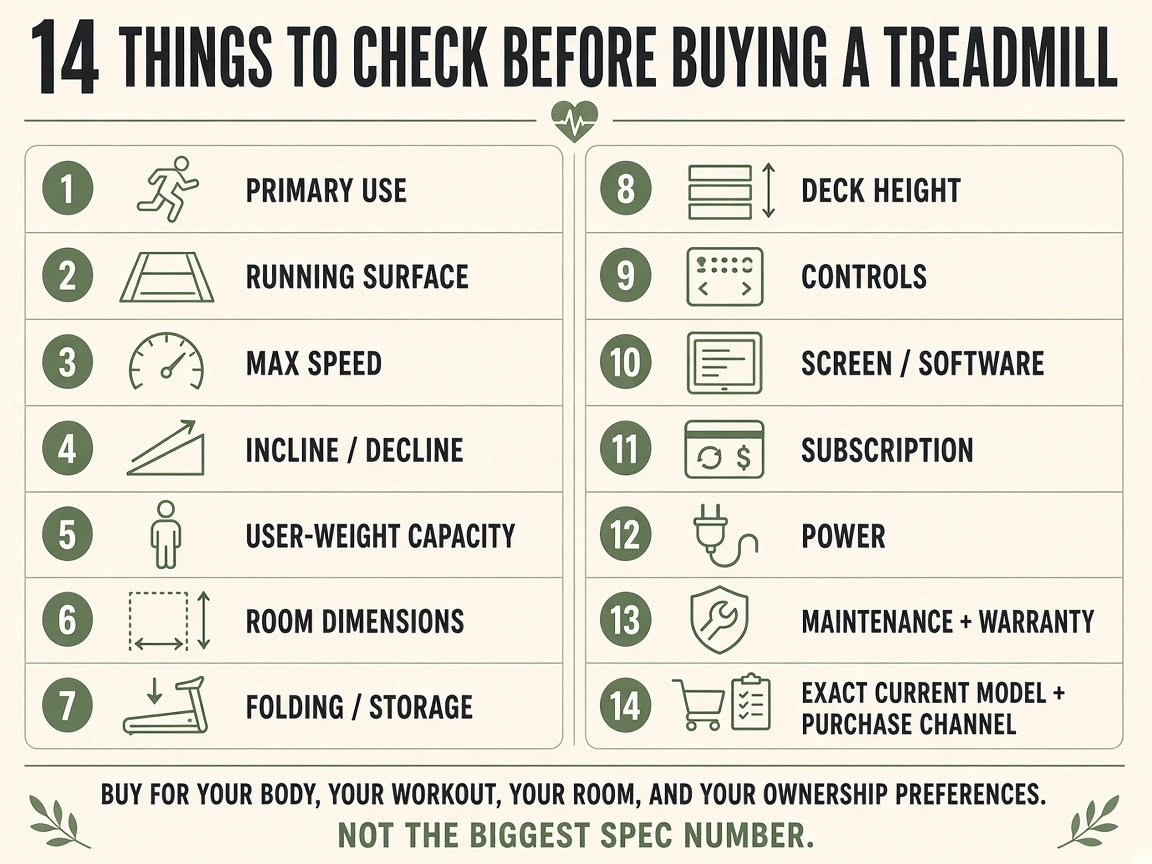
Final Buying Checklist, Common Mistakes, and Verdict
Do not buy just because it has the highest top speed, the largest motor number, the highest weight capacity, the biggest screen, the steepest incline, a fold, “quiet” marketing, “Commercial” in the name, the longest warranty headline, or the largest discount. Each can hide a small belt, unused software, a room that does not fit, or coverage that applies to one part only.
Check: primary use; belt size; max speed; incline/decline; weight capacity; unfolded dimensions; folded dimensions; manufacturer clearance; deck height; ceiling; controls; subscription vs basic mode; power; maintenance; warranty breakdown; exact current generation; purchase-channel terms.
What matters most in this treadmill buying guide is not the biggest spec. Ask what workout you will do, how much room you have, what hardware you need, what software you want, and what ownership looks like after delivery. How to choose a treadmill is that sequence. Moon Picke editorial interpretation: hardware fit first, smart layer second, channel terms last. Buy for body, workout, room, and ownership—not the loudest number on the box.
FAQ
What should I look for before buying a treadmill?
Use case, running surface, usable speed and grade, capacity as a limit, practical footprint, controls, then software and channel. That is this treadmill buying guide in one sentence.
What is the most important treadmill specification?
There is no single winner spec. Wrong belt or wrong room ruins a high MPH console.
How large should a treadmill belt be?
Whatever width × length matches your stride and use. No invented height cutoff.
Does motor horsepower matter?
Only as the maker’s labeled term on that SKU. It is not durability and not a universal minimum.
Is higher weight capacity better?
Only if you need the limit. It is not stability or quality.
Do folding treadmills save much space?
Only if folded dimensions and the storage path work. Folding ≠ portable.
Do treadmills require special electrical outlets?
Follow that model’s manual. Horizon 7.0 AT is an example of 120V / non-GFCI guidance—not a rule for every deck.
Does a longer warranty mean better quality?
No. Read the component split. Years are coverage, not lifespan.