
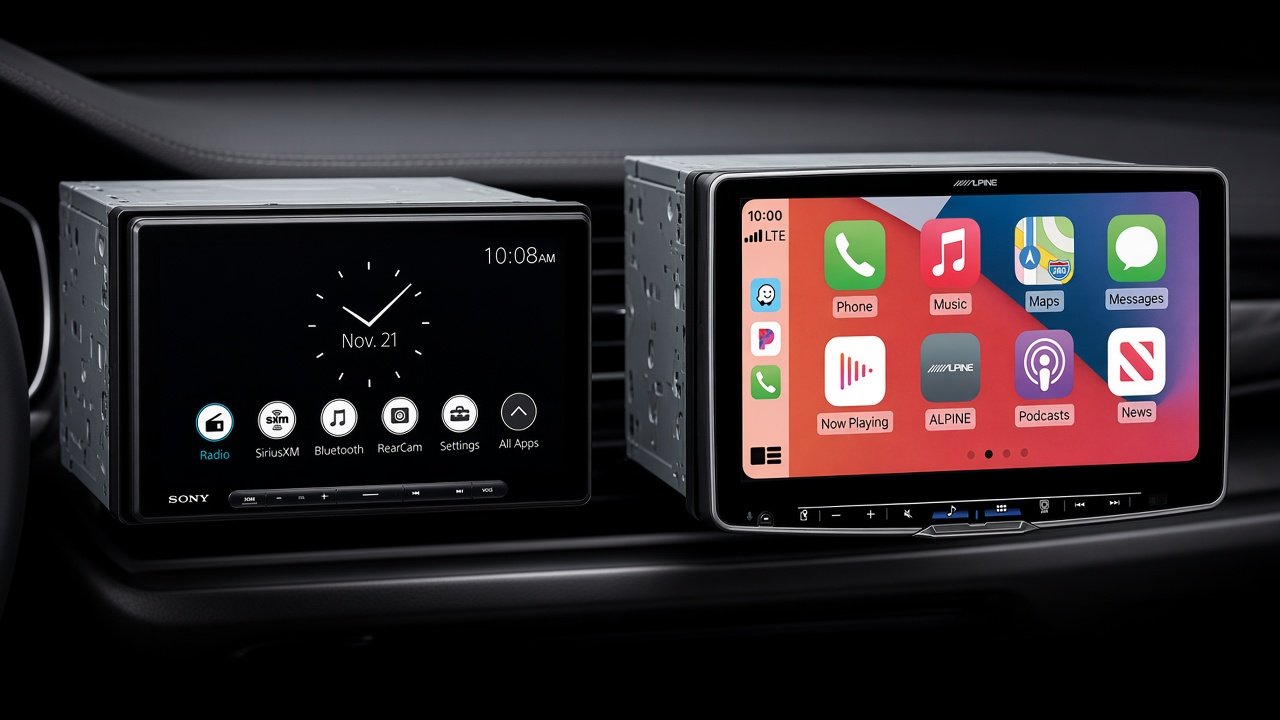
The Sony XAV-AX8500 vs Alpine Halo11 decision is not “11 inches beats 10.1.” Quick verdict: buy the Sony XAV-AX8500 if a 10.1-inch floating HD screen, three camera triggers, and Sony’s current U.S. list price cover your needs. Buy the Alpine Halo11 — official U.S. model iLX-F511 — only if you specifically need that 11-inch panel’s height/depth/tilt architecture, HDMI output, built-in HD Radio, or Alpine’s documented camera/tuning extras, and the glass will clear your vents and HVAC. Vehicle-specific fit must be checked. This is a two-product buyer comparison, not a Sony review (that lives on our Sony XAV-AX8500 review) and not a large-screen roundup.
Moon Picke is independent of Sony and Alpine. Specs: Sony Electronics / Help Guide and Alpine USA iLX-F511 pages as of September 11, 2026. See How We Evaluate, Editorial Standards, and our Affiliate Disclosure.
Sony XAV-AX8500 vs Alpine Halo11: Quick Verdict
BUY SONY IF: you want a 10.1-inch (1280 × 720) floating monitor with documented ±15° tilt/swivel, three camera inputs with individual triggers, USB Type-C (3.0 A), micro-HDMI input, 5 V three-channel preouts, and Sony.com’s current $799.99 sale price — and you have confirmed the panel will not block vents, the hazard switch, or HVAC.
BUY ALPINE IF: you specifically want the iLX-F511’s 11-inch 1280 × 720 floating display with five vertical positions, two lockable depths, and pressure tilt; HDMI input and output; built-in HD Radio; 4 V preouts plus 13-band parametric EQ per channel; or Alpine DVR-C320R dash-cam input — and you accept a much higher head-unit-only price plus the same class of kits, harnesses, and labor.
What is the main difference between Sony XAV-AX8500 and Alpine Halo11?
Display size and adjustment, I/O (cameras, HDMI out, radio), and documented DSP/preout design — not wireless CarPlay. Both are single-DIN-chassis floating screens. CarPlay support alone is not a reason to choose the more expensive unit.
Do both support wireless Apple CarPlay?
Yes. Sony and Alpine both document wired and wireless Apple CarPlay and Android Auto. That is feature support, not a reconnect or dropout test.
Is Alpine Halo11 worth the price premium?
Only if you will use a verified iLX-F511-only need (11-inch glass that actually fits, HDMI out, HD Radio, Alpine camera path, or Alpine’s parametric/time-correction toolkit). Paying extra for CarPlay you already get on the AX8500 is a weak reason.
| Difference | Sony XAV-AX8500 | Alpine Halo11 (iLX-F511) | Who Should Care? |
|---|---|---|---|
| Screen size | 10.1 in (25.7 cm) | 11 in | Maps/UI area vs dash space |
| Resolution | 1280 × 720 | 1280 × 720 (WXGA) | Same pixel grid; Alpine spreads it over more glass |
| Display adjustment | Tilt/swivel ±15° after install | Five heights, two depths, pressure tilt | Clearing vents/HVAC |
| Chassis | Compact single-DIN source + floating monitor | Standard 1-DIN chassis + floating 11-inch panel | Kit choice, not “fits every car” |
| Physical controls | Keys on the monitor (power/home/volume/track/voice) | Face keys including HOME, MUTE, volume, CAM, MAP, seek, mic (owner’s manual) | Tactile vs touch preference |
| Preouts | Three 5 V (front/rear/sub) | Three 4 V “true” preouts | Amp gain structure — not a sound-quality score |
| EQ / time | 14-band EQ, time alignment | 13-band parametric per channel; 6-channel time correction | Tuning flexibility, not a listening test |
| HDMI | Micro-HDMI input (cable not supplied) | HDMI input and HDMI output | Pass-through / parked video paths |
| Cameras | 3 inputs with individual triggers | 2 direct + Alpine DVR-C320R input (camera sold separately) | How many aftermarket views you will wire |
| Radio extras | AM/FM; SiriusXM tuner sold separately | Built-in HD Radio; SiriusXM-Ready (SXV300 + subscription) | HD Radio without a dongle |
| Current U.S. head-unit price (Sep 11, 2026) | $799.99 on Sony.com (MSRP $999.99) | Authorized dealers commonly list ~$1,699.95 head-unit-only; confirm alpine-usa.com / seller carton | Stereo gap before kits |
Sony XAV-AX8500 vs Alpine Halo11 — decision rows only. Sources: Sony Electronics and Help Guide; Alpine USA iLX-F511 product/tech specs; Alpine iLX-F511 owner’s manual.
As an Amazon Associate I earn from qualifying purchases.
See Sony XAV-AX8500 listings (confirm New, model XAV-AX8500, ASIN B0CXF7H2Z4) →
The Differences That Actually Matter
Ignore equal-weight spec sheets. The purchase turns on (1) 10.1-inch versus 11-inch floating glass and how each manufacturer lets you aim it, (2) whether that object clears your dash, (3) camera count and HDMI direction, (4) 5 V / 14-band Sony DSP versus Alpine 4 V / parametric / 6-channel time correction, (5) HD Radio on Alpine versus AM/FM on Sony, and (6) a head-unit gap that is hundreds of dollars before kits. Shared class (not a reason to pay extra): wired/wireless CarPlay and Android Auto; Bluetooth; floating 1280 × 720-class glass on a 1-DIN chassis; three preouts; some camera input; SiriusXM tuner sold separately; Maestro sold separately; documented microphone. Paying more does not buy a second CarPlay.
Display: 10.1 Inches vs Halo11’s Larger Screen
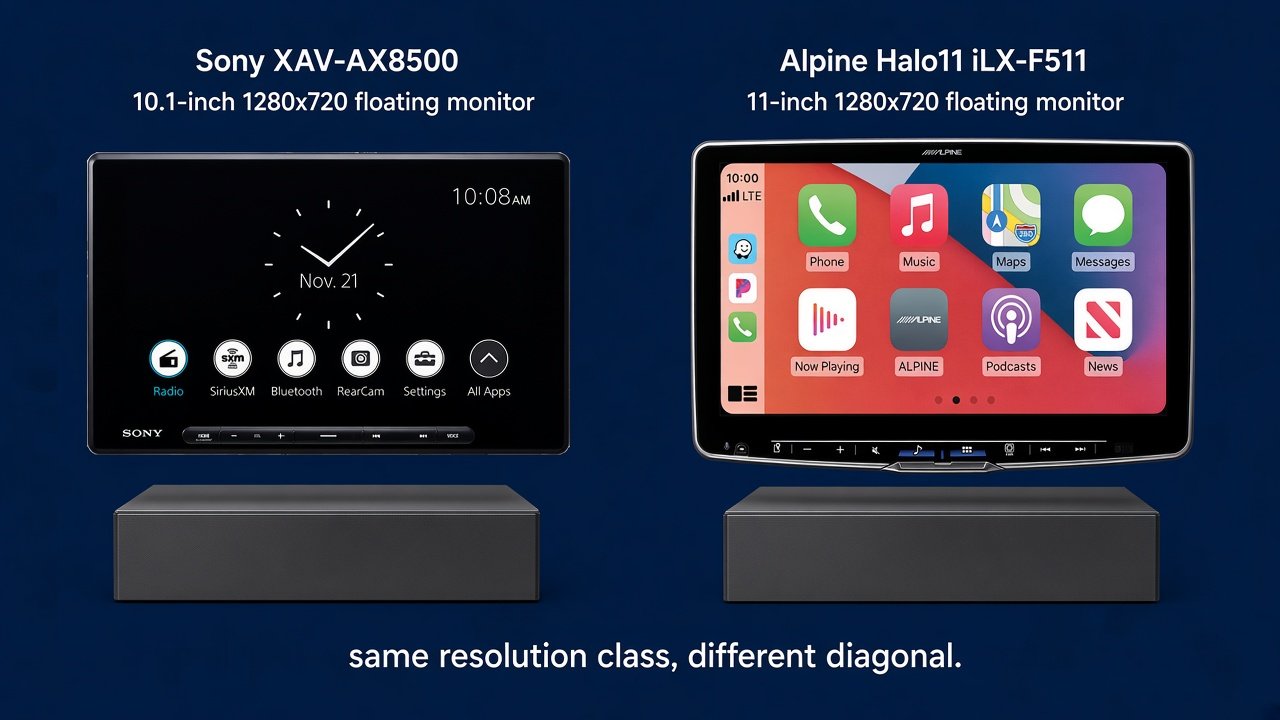
Sony XAV-AX8500 vs Alpine Halo11 on glass: Sony’s 10.1-inch (1280 × 720) optically gapless capacitive panel versus Alpine’s 11-inch WXGA 1280 × 720. Same pixel grid on a larger Alpine diagonal is not an automatic sharpness win. We will not write that either screen “looks dramatically sharper.”
A larger screen can give CarPlay maps and camera images more physical area. CarPlay is still Apple’s interface framework; a bigger head unit does not create different CarPlay software capabilities. An 11-inch panel can also occupy more dash, crowd vents, or sit closer to HVAC and the hazard button. Display size is not display quality, and it is not vehicle compatibility. XAV-AX8500 vs Halo11 is a tape-measure problem before it is a pixel problem.
Which Floating Display Fits a Dashboard Better?
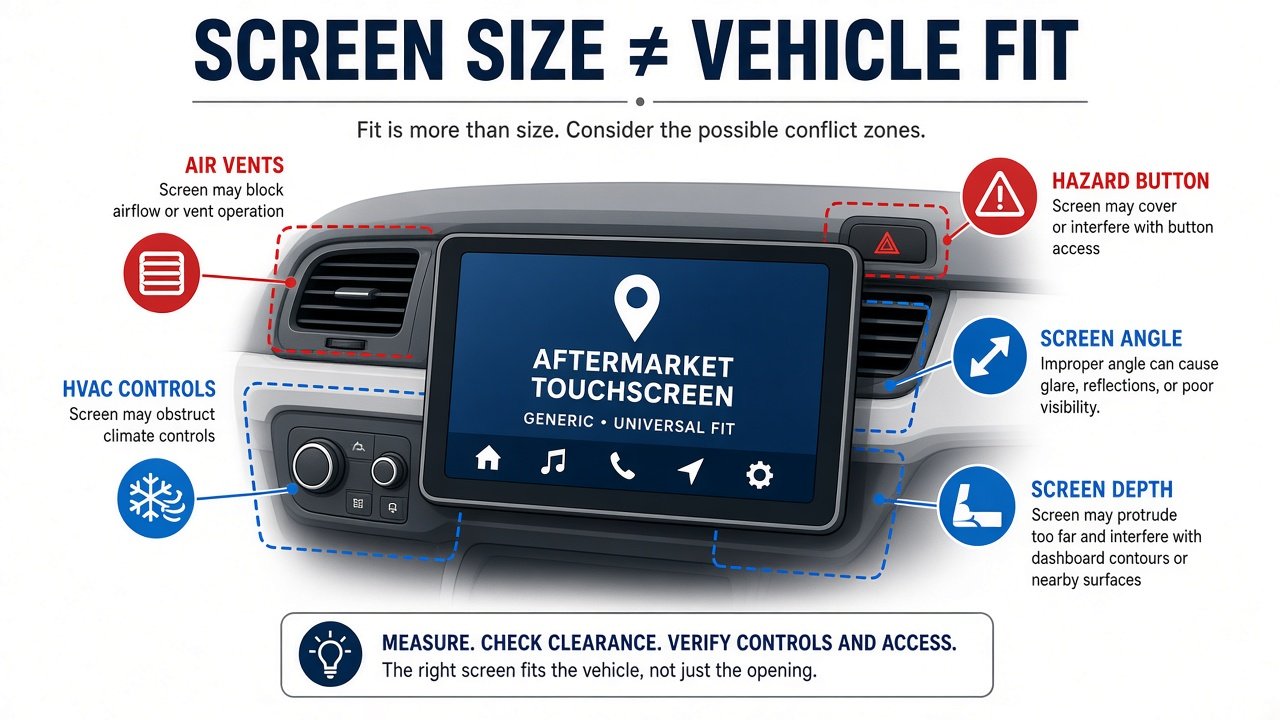
Both use a compact 1-DIN-class chassis so the radio opening can stay small while the monitor floats. That is not a universal fit. Screen position still matters. Do not read “standard 1-DIN” as “fits almost every car.” See single DIN vs double DIN for opening language — then measure the glass, not only the hole.
Sony documents an updated joint: after installation you can tilt and swivel the AX8500 monitor ±15° horizontally and vertically without tools. Alpine documents five vertical adjustments, two separate depths that lock, and a pressure tilt mechanism aimed at viewing angle and HVAC access. Adjustability can matter more than the 0.9-inch diagonal gap. We will not claim either unit blocks or clears controls in a named vehicle. Vehicle-specific fit must be checked: vents, hazard, HVAC, trim, factory screens, and sight lines.
Apple CarPlay and Android Auto
Sony documents wired and wireless Apple CarPlay and Android Auto on the XAV-AX8500. Alpine documents the same modes on the iLX-F511 (U.S. copy notes Android Auto Assistant requirements including USB + Bluetooth). CarPlay support alone is not a reason to choose the more expensive unit. Wireless CarPlay is not wireless charging. We did not measure reconnect speed, latency, GPS, or dropouts. Android Auto is listed on both; this page is not the cluster’s dual-platform roundup.
Audio Features: Sony vs Alpine
Sony lists a 4-channel amp at 20 W RMS × 4 (CTA-2006), three 5 V preouts, 14-band EQ, time alignment, crossovers, LDAC, and hi-res USB (WAV/FLAC/ALAC up to 96 kHz/24-bit on Sony’s FAQ). Alpine’s iLX-F511 page lists 18 W RMS × 4 (some tech sheets print 16 W RMS — do not mix peak vs RMS or invent a wattage winner), three 4 V preouts, 13-band parametric EQ per channel, 6-channel time correction, crossovers, Media Xpander, Hi-Res 96 kHz/24-bit, and LDAC wireless Hi-Res. TIDAL on the unit needs a TIDAL plan and tethering.
Higher preout voltage is not guaranteed better sound. More EQ bands are not automatically better sound. For amp builds, Alpine publishes the more granular parametric/time-correction set; Sony publishes 5 V preouts and a 14-band EQ. We will not declare “best sounding.”
USB, HDMI and Camera Connectivity
USB is not a wash. Sony: rear USB Type-C, 3.0 A, extension supplied — USB-C is not automatically faster than Alpine’s ports. Alpine: two USB inputs (one data, one charge-only); the U.S. spec list does not call them Type-C. HDMI: Sony micro-HDMI input only (cable not supplied). Alpine: HDMI input and output. Do not sell in-motion video as a feature.
Sony documents three camera inputs with individual triggers (cameras sold separately). Alpine documents two direct inputs plus Alpine DVR-C320R (sold separately). Extra inputs matter only if you wire them. This is not a dash-cam roundup.
Vehicle Integration and iDatalink Maestro
Both U.S. pages are Maestro compatible; modules sold separately. Sony footnotes RR/RR2; Alpine lists possible steering-wheel, TPMS, codes, or HVAC data — all vehicle-dependent. The logo is not identical retention. Factory amps and cameras often need extra interfaces. Confirm year/make/trim. Older dashes need kits/harnesses; that broader topic is a later article. Firmware: Sony listed 3.04.00 (16 July 2026) for the AX8500. Alpine USA hosts iLX-F511 updates; that is not a multi-year promise.
Installation and Total System Cost
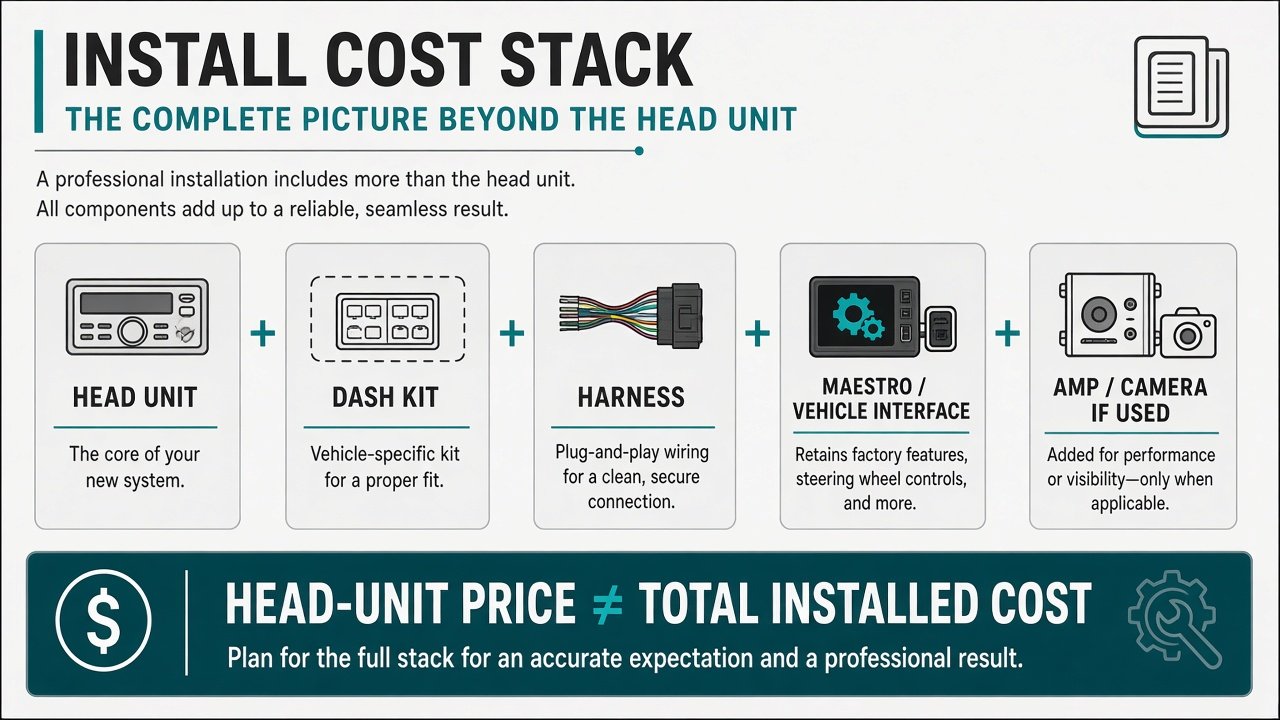
Neither unit is “easy to install.” Budget the head unit plus dash kit, harness, antenna adapter, optional Maestro/CAN interface, factory-amp interface if needed, camera adapters, USB/HDMI routing, microphone, GPS antenna where required, and labor. A $100 product gap is not a $100 install gap; here the stereo gap is far larger, and vehicle hardware can still dwarf or shrink it. We will not invent labor hours or a national average. Screen clearance is part of install: height, depth, and tilt are why both brands sell floating glass. Professional measurement beats brochure language. Sony XAV-AX8500 vs Alpine Halo11 install cost is a project quote, not a sticker delta.
Price: Is the Alpine Premium Worth It?
Sony XAV-AX8500 vs Alpine Halo11 on price, September 11, 2026: Sony Electronics U.S. lists the XAV-AX8500 at $799.99 (MSRP $999.99). Alpine USA presents the iLX-F511 as the current Halo11 SKU; authorized U.S. dealers commonly advertise about $1,699.95 for the receiver alone. Confirm alpine-usa.com and the seller carton — site widgets can differ from dealer MAP. Approximate head-unit-only gap versus Sony’s sale price is on the order of $900, not $100. Normalize bundles: ASIN B09WWSMMNM is the iLX-F511 receiver; B09XR9ZWXC adds nav/camera extras. Launch-era 2022 MAP ($1,199.95) is not today’s street price. Head-unit price is not total installed cost.
Who Should Buy Which Head Unit?
Sony XAV-AX8500
Choose the XAV-AX8500 if you have measured clearance for a 10.1-inch floating HD panel, you want Sony’s documented tilt/swivel and three camera triggers, USB-C is convenient for your install, and you want wireless CarPlay/Android Auto without paying Alpine’s current premium. Sony’s Help Guide lists a microphone among the connection set; we did not test call quality. Factory-integration buyers should still check Maestro for this Sony SKU on iDatalink — the logo is not a rank. Skip Sony if you already know you need HDMI output, built-in HD Radio, or an 11-inch diagonal that you have physically mocked up.
Alpine Halo11 (iLX-F511)
Choose the iLX-F511 if an 11-inch class display is a stated requirement, Alpine’s five-height / two-depth / tilt scheme solves a known obstruction, and you will actually use HDMI out, HD Radio, 4 V preouts with parametric EQ, Media Xpander, or the DVR-C320R input. A bigger brand ecosystem is not a reason to buy features you will not wire. Skip Halo11 if the only attraction is wireless CarPlay or a belief that 11 inches always wins. Sony AX8500 vs Alpine Halo11 is then fit-plus-I/O, not brand loyalty. XAV-AX8500 or Halo11 should be answered with a tape measure and a feature you can name.
Final Verdict
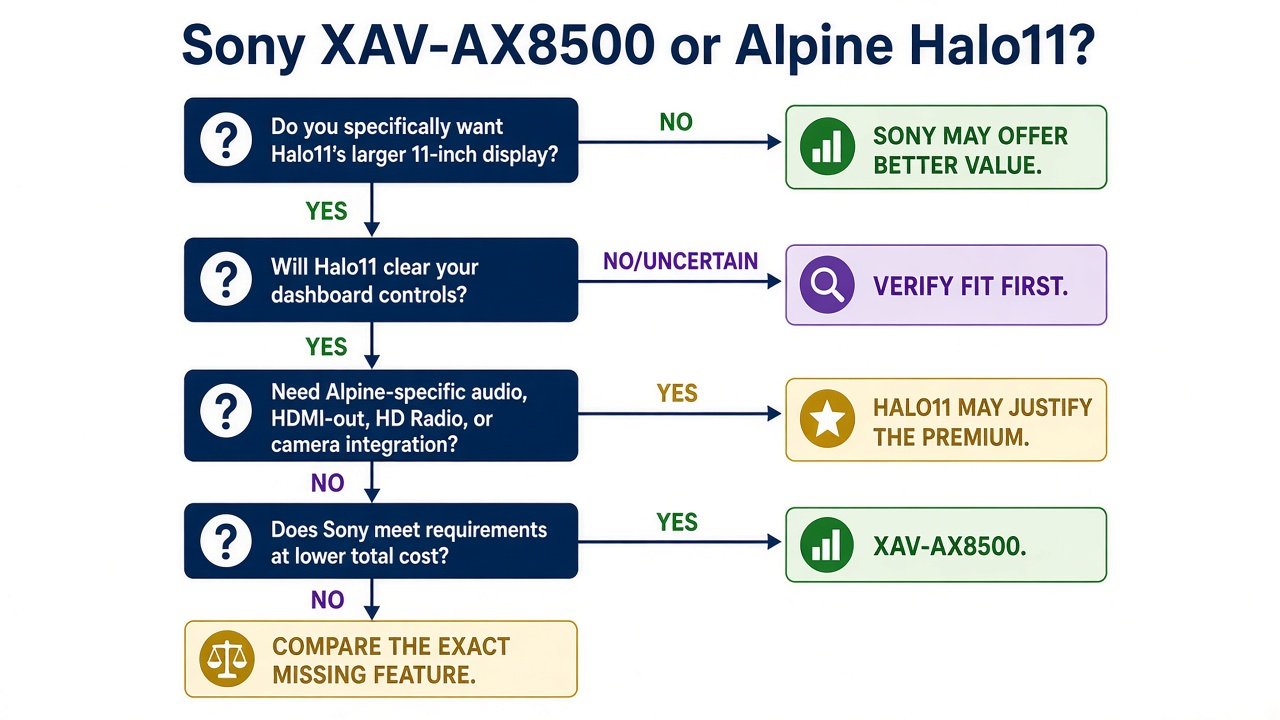
For Sony XAV-AX8500 vs Alpine Halo11, the better purchase is the unit whose unique features solve the actual dash and system — not the larger diagonal. Most comparison shoppers who need wireless CarPlay, Android Auto, Maestro-ready integration, and a floating HD screen should start with the XAV-AX8500 at Sony’s current U.S. sale price, provided 10.1 inches clears the dash. The iLX-F511 should win only when its 11-inch adjustability, HDMI output, HD Radio, Alpine camera path, or parametric tuning toolkit is the job, the screen clears controls, and the total install budget includes that premium. Best spec is not best fit. Compare display + adjustability + audio/I/O you will use + vehicle compatibility + total installed cost.
FAQ
What is the main difference between Sony XAV-AX8500 and Alpine Halo11?
10.1-inch Sony floating HD with ±15° tilt/swivel and three camera triggers versus Alpine iLX-F511 11-inch glass with height/depth/tilt, HDMI in/out, HD Radio, and a different DSP/preout design. Not CarPlay.
Which has the bigger screen?
Alpine Halo11 iLX-F511 is 11 inches; Sony XAV-AX8500 is 10.1 inches. Larger is not automatically better or a guaranteed fit.
Do both support wireless Apple CarPlay?
Yes, wired and wireless on both, plus Android Auto as documented. Support is not a reliability score.
Which is better for an aftermarket amplifier?
Both have three preouts. Sony lists 5 V; Alpine lists 4 V plus per-channel parametric EQ and 6-channel time correction. No listening winner here.
Does either support iDatalink Maestro?
Yes, both, with modules sold separately. Retained features depend on vehicle, interface, and firmware.
Which is easier to fit in a dashboard?
Neither is universally easier. Check screen envelope, vents, HVAC, and kit. Floating display is not universal fit.
Which should I buy?
Default to the XAV-AX8500 unless you have a named iLX-F511 feature requirement and confirmed 11-inch clearance. Alpine Halo11 vs Sony XAV-AX8500 is that test, not a brand trophy.