
Moon Picke independently researches products. If you buy through our links, we may earn a commission at no extra cost to you. Affiliate disclosure.
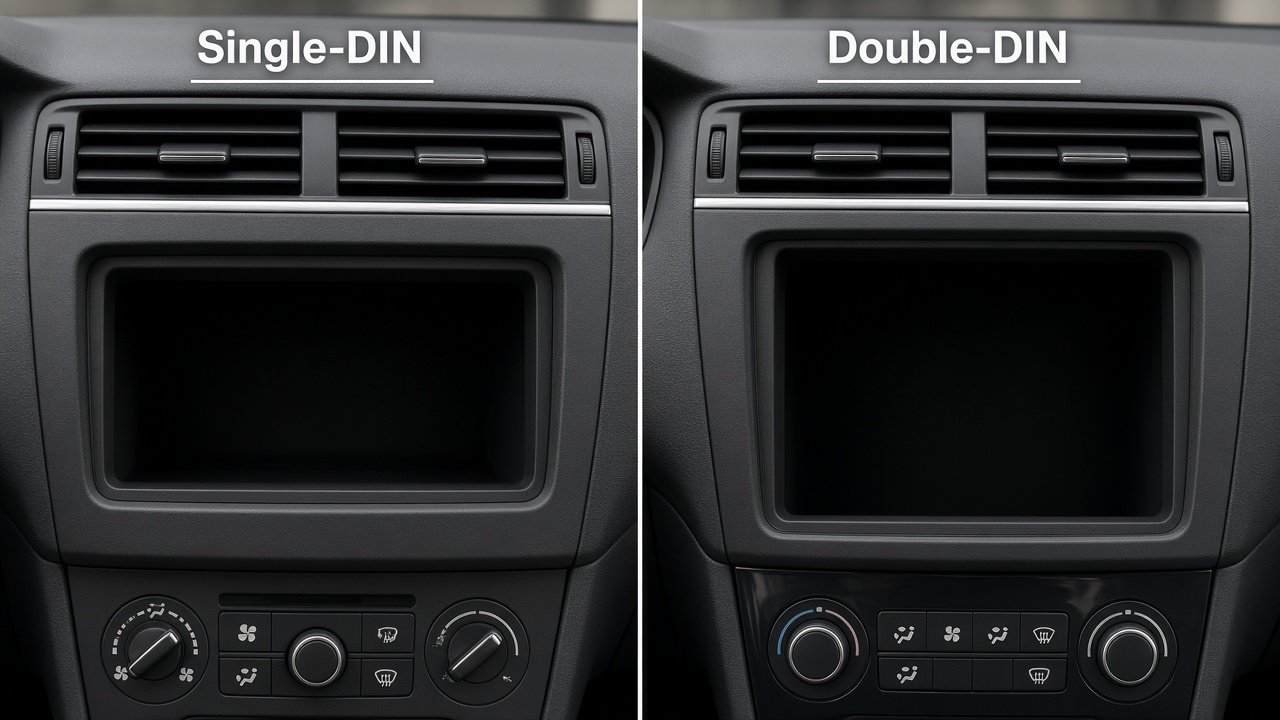
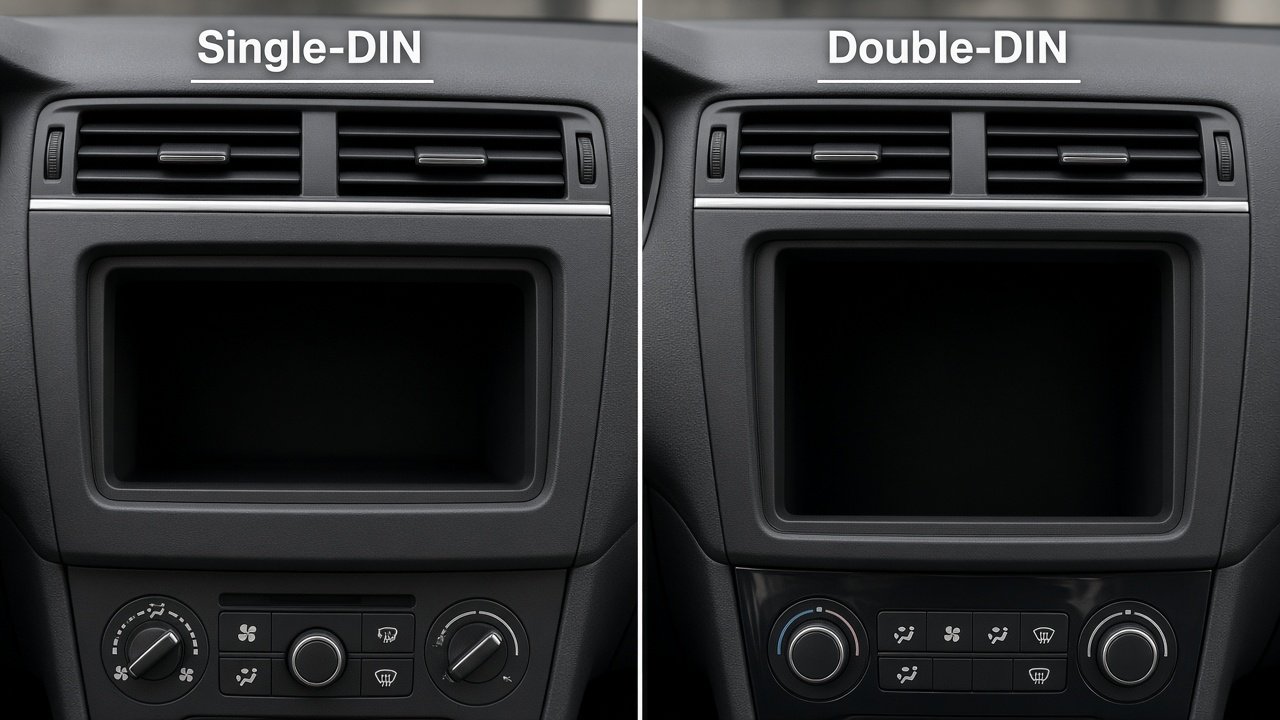
Single DIN vs double DIN is a dash-opening and chassis-format choice, not a quality ranking. Single-DIN is the shorter standard face class; double-DIN is about twice that height. Neither is universally better. Modern floating-screen receivers can put a large display on a compact rear chassis, so screen size no longer maps neatly to DIN size. Fitment is chassis + opening + dash kit + depth + display clearance + vehicle electronics. This is not a best-head-unit list. See Moon Picke Auto Tech for the broader car-tech hub.
As an Amazon Associate I earn from qualifying purchases.
Single DIN vs Double DIN: Quick Answer
Single-DIN: shorter standard dash opening / chassis class. Double-DIN: approximately twice the face height. Buy the format your vehicle and kit actually support. A large floating screen can still use a single-DIN-style rear box. A double-DIN opening still does not guarantee every double-DIN receiver fits—depth, trim, and electronics remain.
Potential single-DIN advantages, all product-specific: it can match certain shorter openings; many older and simpler dashes were built around that class; floating-screen models can still deliver a large interface; some compact chassis are relatively shallow. Potential limitations: a traditional face has less integrated screen area; some taller dashes need a pocket/kit; a huge floater can still fight the dashboard even when the rear box slides in. Single-DIN installs are not always easier.
Potential double-DIN advantages, likewise not guarantees: more integrated face area; a touchscreen can sit in the opening; a more factory-like look in compatible cars. Limitations: you still need an adequate opening; depth can fail independently; factory integration can stay complex; a larger chassis does not make the radio more powerful or better sounding.
What is the difference between single-DIN and double-DIN?
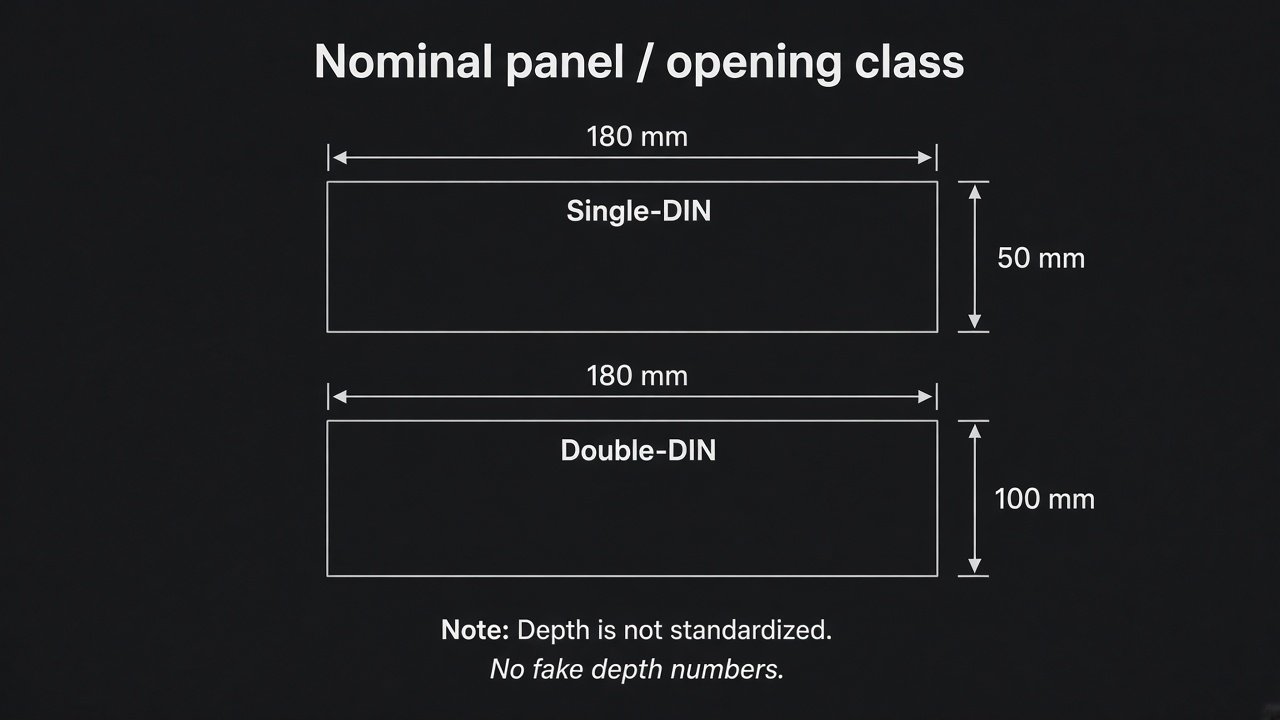
The difference is the standardized face/opening height class. Single-DIN panels are commonly cited at 180 × 50 mm. Double-DIN panels are commonly cited at 180 × 100.3 mm. Depth is not that class.
Is double-DIN better than single-DIN?
No. DIN size does not decide sound quality, CarPlay quality, DSP, cameras, or reliability. Those are product and install features.
Can a single-DIN car fit a double-DIN radio?
Sometimes, only if the dash structure and a vehicle-specific conversion kit allow it. Do not cut a dash because an article said “just convert it.”
Does single-DIN mean a small screen?
No. A single-DIN chassis can carry a large floating display. Alpine’s iLX-F511 and Sony’s XAV-AX8500 are examples of that architecture.
What Does DIN Mean in a Car Stereo?
DIN here is a dashboard radio opening form-factor convention. The size class began as German standard DIN 75490 and was adopted internationally as ISO 7736:1984, “Road vehicles — Car radio for front installation — Installation space including connections.” People say “DIN size” for that opening class. ISO 7736 does not define the ISO 10487 electrical connectors. A DIN-class face does not include a universal mounting depth. Shallow HVAC, modules, or wiring behind the dash can stop a radio that matches the rectangle in front.
Single-DIN and Double-DIN Dimensions
Wikipedia’s ISO 7736 summary—the commonly cited panel sizes used in this guide—lists a single-DIN panel of 180 × 50 mm (about 7.09 × 1.97 in) and a double-DIN panel of 180 × 100.3 mm (about 7.09 × 3.95 in). Industry writing often rounds double-DIN to 180 × 100 mm. Those numbers describe width/height class, not a complete chassis, not a bezel, and not a dash kit.
| Format | Nominal Width | Nominal Height | What It Describes |
|---|---|---|---|
| Single-DIN | 180 mm (≈7.09 in) | 50 mm (≈1.97 in) | Dash/chassis face class |
| Double-DIN | 180 mm (≈7.09 in) | 100.3 mm (≈3.95 in) | Taller dash/chassis face class |
Product chassis often measure a few millimeters under the panel class. Sony lists XAV-AX8500 mounting dimensions at about 178 × 50 × 158 mm. Kenwood lists DMX958XR main-unit size at 178 × 100 × 85 mm. Depth is a product spec, not a DIN guarantee.
Single DIN vs Double DIN: Key Differences
| Factor | Single-DIN | Double-DIN |
|---|---|---|
| Face height | Smaller class | Approximately double |
| Integrated screen space | Typically less on a traditional face | Typically more on an integrated face |
| Floating-screen options | Common on modern compact chassis | Possible, model-dependent |
| Dash opening required | Shorter | Taller |
| Sound quality | Product-dependent | Product-dependent |
| CarPlay / Android Auto | Product-dependent | Product-dependent |
| Installation | Vehicle-dependent | Vehicle-dependent |
| Best fit | Shorter openings / floating-display plans | Compatible larger integrated openings |
A factory radio that “looks double-DIN” is not proof an aftermarket double-DIN unit drops in. OEM dashes use custom trim, climate rows, infotainment, and proprietary plugs.
Does Single-DIN Mean a Small Screen?
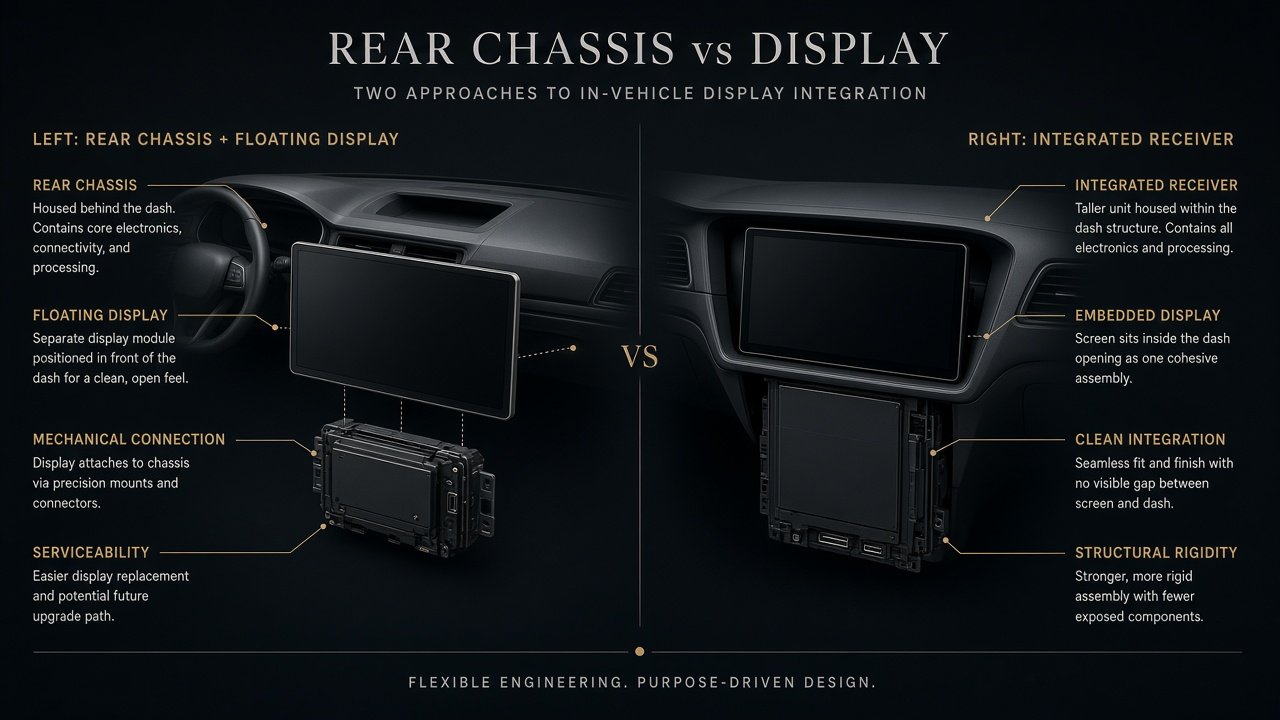
No. Traditional single-DIN faces were radio/CD decks, fold-outs, or compact screens. The modern split is rear chassis versus display. Architecture: rear chassis → mount → large panel in front of the dash. Benefits can include a large CarPlay/Android Auto surface without a full double-DIN chassis height. Risks: vents, HVAC, hazard, shifter, leftover factory-screen hole, and sight lines.
The Alpine iLX-F511 (Halo11) is a verified 11-inch floating display on a standard 1-DIN rear chassis. Alpine’s own fitment language is about the chassis, not a promise that an 11-inch panel clears every HVAC row. The Sony XAV-AX8500 is a 10.1-inch floating HD panel with Sony mounting dimensions of about 178 × 50 × 158 mm—single-DIN height class. Sony’s maximum outer size is much larger because the screen sits in front of the dash. Confirm both chassis fit and screen clearance. Moon Picke has not installed these units.
See the Alpine iLX-F511 Halo11 (ASIN B09WWSMMNM) on Amazon →
See the Sony XAV-AX8500 (ASIN B0CXF7H2Z4) on Amazon →
Why Double-DIN Doesn’t Guarantee Fit
A double-DIN opening is necessary for many integrated ~7-inch faces. It is not sufficient. Depth, HVAC ducts, factory modules, and wiring occupy the hole behind the rectangle. A vehicle-specific dash kit may still be required. A wiring harness, data interface, factory-amp interface, and steering-wheel module are electrical problems. Camera inputs on the receiver are not the same as OEM camera retention. USB, microphone, AM/FM or satellite antenna, and GPS pucks can each need an adapter. Some factory infotainment also owns climate, driver settings, and warnings; replacing it may need a specialized interface or may not be practical. Aftermarket radios do not work in every modern car. That is why “will double DIN fit my car?” is a vehicle question, not a format slogan.
Chassis Fit vs Display Fit
Check two dimensions. First: what must fit inside the dash (width/height class plus this receiver’s depth). Second: what extends outside (floating panel, knobs, camera). Shallow-chassis designs can help some vehicles; they do not guarantee an easy install. Sony documents a compact rear chassis behind the XAV-AX6000’s double-DIN display (maximum about 178 × 100 × 132 mm). Kenwood documents a short double-DIN chassis on the DMX958XR (main unit 178 × 100 × 85 mm). Those depths are product facts, not a DIN rule. If the opening is right and the radio is still too deep, you do not “have DIN wrong”—you have a packaging problem behind the fascia.
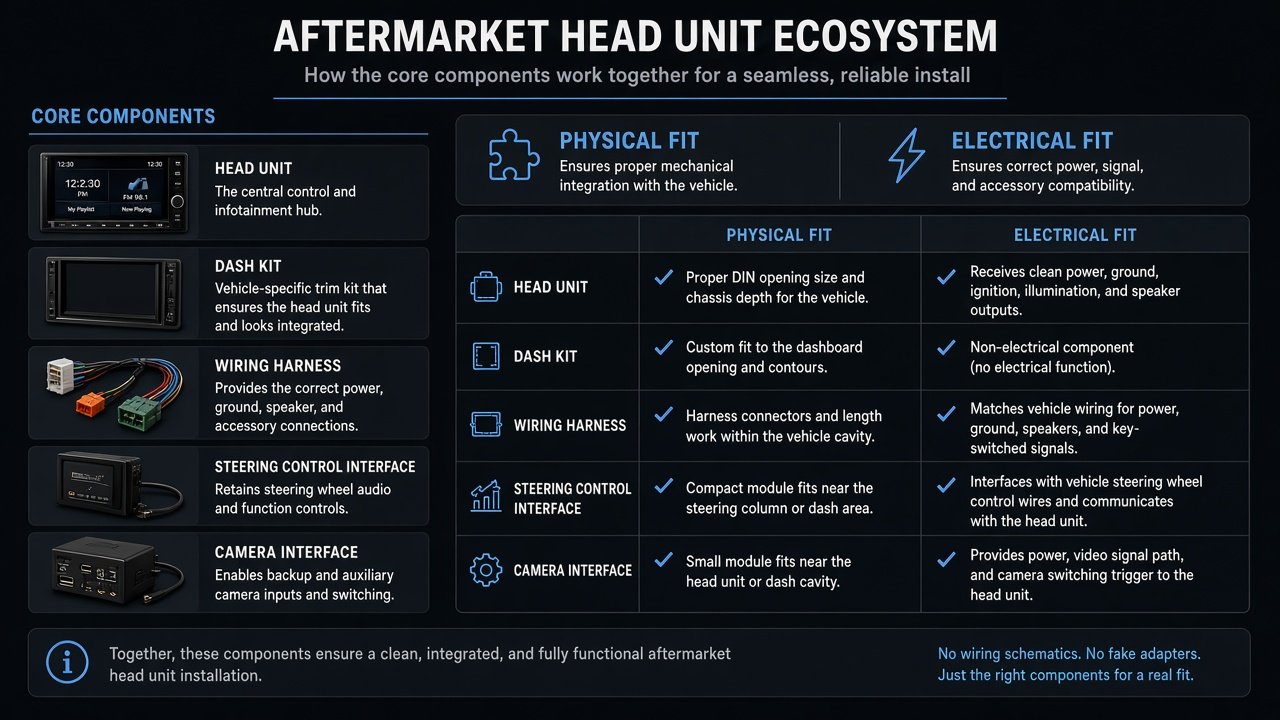
Dash Kits, Wiring, and Factory Features
A dash kit can adapt factory trim to an aftermarket receiver: mounting, fascia, gap fill, sometimes a pocket under a single-DIN radio in a taller opening. Not every vehicle needs one. Never buy a “universal” kit as a substitute for make, model, year, and trim lookup. Physical fit and electrical integration are separate. Steering-wheel audio retention is head-unit feature plus vehicle interface, not a DIN bonus. Premium factory amps and digital speaker systems often need an interface; a standard harness is not a guarantee. Factory backup or 360° cameras, guidelines, USB, mics, antennas, chimes, and climate/vehicle menus are a retention checklist, vehicle by vehicle.
Installed cost follows that stack—kit, harness, data interface, steering module, amp interface, camera retention, labor—not the DIN label. Moon Picke does not publish a fake national stereo-install average. This is not a splice tutorial. Use the product manual, a vehicle-specific kit list, and a professional installer when the dash or airbags are beyond you. Do not cut, grind, or bypass safety systems from this page.
Can You Swap DIN Sizes?
Double-DIN into a single-DIN dash: sometimes, if structure and a compatible conversion kit exist. Some vehicles cannot accept a taller chassis without major modification. That is not a DIY cutting guide. A professional test-fit is the honest next step when the kit chart is ambiguous.
Single-DIN into a double-DIN opening: often possible with the correct vehicle-specific kit, sometimes with a storage pocket. Not universal. A floating 11-inch panel can still fail clearance in a double-DIN car because the screen lives in front of the opening, not inside it.
The old question was only single DIN vs double DIN. The better modern set is: what rear chassis fits, what display clears, which interfaces retain OEM functions, and which features you are willing to lose.
CarPlay, Android Auto, and Audio Quality
CarPlay does not require double-DIN. Wireless CarPlay and Android Auto appear on compact floating chassis and on integrated double-DIN faces, depending on the model. The AX8500, AX6000, iLX-F511, and DMX958XR all document phone projection; that is product documentation, not a format prize.
Audio is not a DIN contest. Preouts, DSP, built-in amplifier ratings, speakers, and tuning decide sound. A single-DIN receiver can have strong preouts. A double-DIN unit can be basic. Do not rank audio by opening height. Aftermarket camera and audio planning is still vehicle-specific; a related aftermarket-hardware discussion lives on Moon Picke’s aftermarket dash cam coverage only as a reminder that “the port exists” is not the same as OEM retention—apply the same logic to radios.
Real-World Examples: Sony, Alpine and Kenwood
These are architecture snapshots, not a ranking. The Sony XAV-AX8500 vs XAV-AX6000 page owns the Sony pair: AX8500 = 10.1-inch floating display on a ~178 × 50 mm mounting chassis; AX6000 = 6.95-inch integrated double-DIN-class face with a compact rear body. Lesson: display architecture and chassis class are separate SKUs, even under one brand. Alpine iLX-F511: 11-inch Halo panel, 1-DIN box; clearance is the real filter. Kenwood DMX958XR: ~6.75-inch integrated short double-DIN chassis (178 × 100 × 85 mm)—factory-like face still needs kit, harness, and depth check. Wireless CarPlay on all four does not make them the same install. Do not treat these as “best single-DIN” or “best double-DIN.”
See the Sony XAV-AX6000 (ASIN B0B52FJ3ZG) on Amazon →
See the Kenwood DMX958XR (ASIN B0B4WZTQLT) on Amazon →
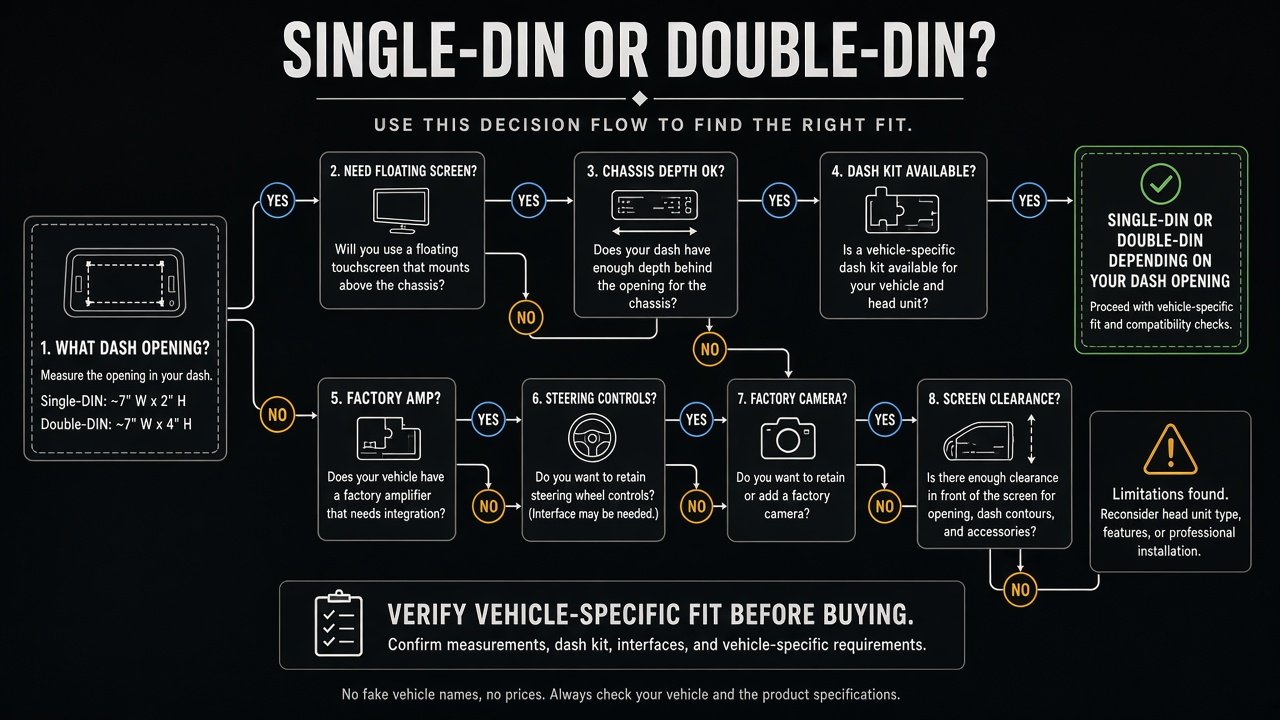
How to Check What Fits Your Car
Do not guess from a photo of a rectangle. Verify make, model, year, trim, factory radio type, dash opening class, this receiver’s depth, whether a dash kit exists, wiring/data interface, steering controls, factory amp, factory camera, and floating-screen clearance (vents, HVAC, hazard, shifter, sight line). Then choose format. If any of those are unknown, you are not ready to click Buy on a chassis class.
Choose a single-DIN-based receiver if the vehicle requires that class, a kit supports it, a smaller rear chassis helps, or a floating screen is how you get display size. Choose double-DIN if the vehicle and kit support a taller integrated face and you want the screen in the opening. Most important: fitment, not label prestige. If you wanted a Sony/Alpine/Kenwood feature shootout, that lives on the product reviews—not on this single DIN vs double DIN fitment page.
Final Verdict
Single DIN vs double DIN tells you only part of the installation story. Before buying, verify chassis, depth, display, dash kit, and electrical integration. A compact chassis can wear a huge screen. A double-DIN hole can still reject a radio on depth or OEM electronics. There is no universal winner—only a vehicle-specific stack. Look up the car first, then the radio, then the kit. That order prevents a pretty screen from becoming a return.
FAQ
What is the difference between single-DIN and double-DIN?
Face/opening height class: about 50 mm versus about 100 mm at the same 180 mm width. Not quality, not CarPlay, not depth.
What size is a single-DIN radio?
The commonly cited panel class is 180 × 50 mm. Actual chassis and depth vary by model.
What size is a double-DIN radio?
The commonly cited panel class is 180 × 100.3 mm (often rounded to 180 × 100 mm). Depth still varies.
Is double-DIN better than single-DIN?
No. Better is whatever fits and retains the features you need.
Can I put a double-DIN radio in a single-DIN car?
Only if structure and a proper kit allow it. Do not cut the dash from a blog instruction.
Can a single-DIN radio fit a double-DIN opening?
Often with the right kit and sometimes a pocket. Check the vehicle. Check floating-screen clearance separately.
How do I know what head unit fits my car?
Year/make/model/trim lookup, this unit’s chassis and depth, kit and interfaces, then screen clearance for floaters. Visual guessing is not a method.
Sources: ISO 7736:1984; ISO 7736 panel-size summary (180 × 50 mm / 180 × 100.3 mm); Sony XAV-AX8500 / XAV-AX6000 specification and mounting dimensions; Alpine iLX-F511 1-DIN chassis documentation; Kenwood DMX958XR chassis table (178 × 100 × 85 mm).