
Are expensive robot vacuums worth it? Only when the extra hardware solves problems you actually have, you will use those features often, and today’s street price—not a launch MSRP—makes the gap reasonable. A premium robot is not automatically better value. A cheaper robot is not automatically better value either. Value is useful capability versus total cost: purchase plus bags, filters, brushes, mop parts, and detergent, plus the extra complexity a full-service dock adds. This is a price-and-feature decision article, not a flagship ranking. For one current premium example’s feature set, see the Saros 10R review, plus How We Evaluate and editorial standards.
Are Expensive Robot Vacuums Worth It? Quick Answer
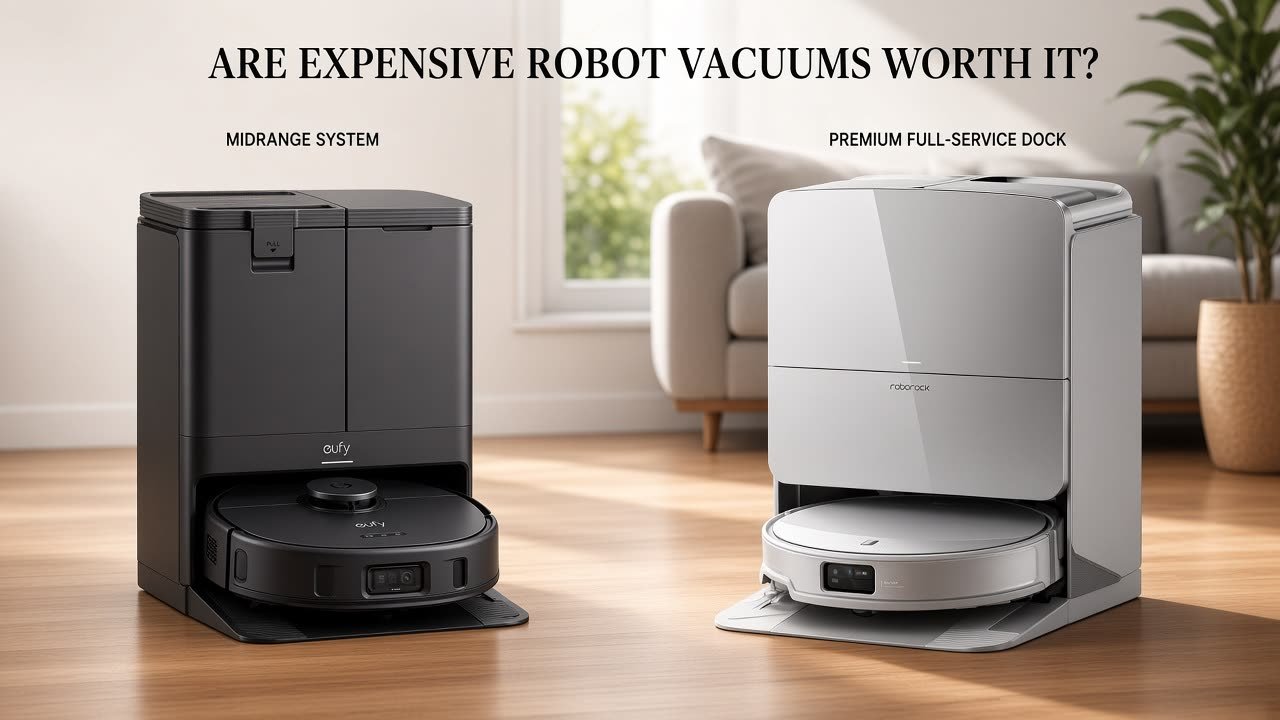
Are expensive robot vacuums worth it? Conditionally. Pay more when several hard jobs stack—hair, mixed floors, clutter, low furniture, or a large mapped home—and the premium modules address those jobs every cycle. Save the money when you need basic scheduled vacuuming in a simple, mostly level space. Current U.S. street prices move with Amazon discounts and brand promotions; a midrange omni on sale can close the gap on a flagship sitting at list.
Approximate U.S. bands as of September 12, 2026—not permanent technical categories: entry/budget often means simpler mapping and little or no mop-wash dock; midrange often means room maps plus self-empty and a usable mop; premium often means larger full-service docks, low-profile navigation, auto mop removal, or chassis/threshold hardware. Those dollar windows shift when a new generation launches.
| Feature You Pay More For | Who Benefits Most | When It May Be Overkill |
|---|---|---|
| Advanced obstacle avoidance | Pets, kids, cords, unsupervised runs | A tidy, open floor plan |
| Low-profile navigation | Beds, sofas, cabinets with tight clearance | Generous furniture height |
| Anti-tangle hardware | Long hair, heavy shedding | Little hair, easy brush access |
| Self-emptying | Pets, frequent cleaning, larger debris load | Small home, light debris, easy bin dump |
| Advanced mopping | Mostly tile, vinyl, sealed hardwood | Mostly carpet; mopping rare |
| Automatic mop removal / lift | Mixed floors, rugs in mopped rooms | No rugs, or vacuum-only use |
| Full-service dock | Owners who hate washing pads and emptying bins | Tight floor space; unused water tanks |
| Threshold / chassis systems | Raised transitions the robot must cross | Level floors |
| Large-home automation | Many rooms, recharge/resume, multi-map control | Studio or one open zone |
| Advanced app / smart-home extras | Room routines and dock controls you will actually tap | Start, schedule, and rooms only |
What Are You Actually Paying More For?
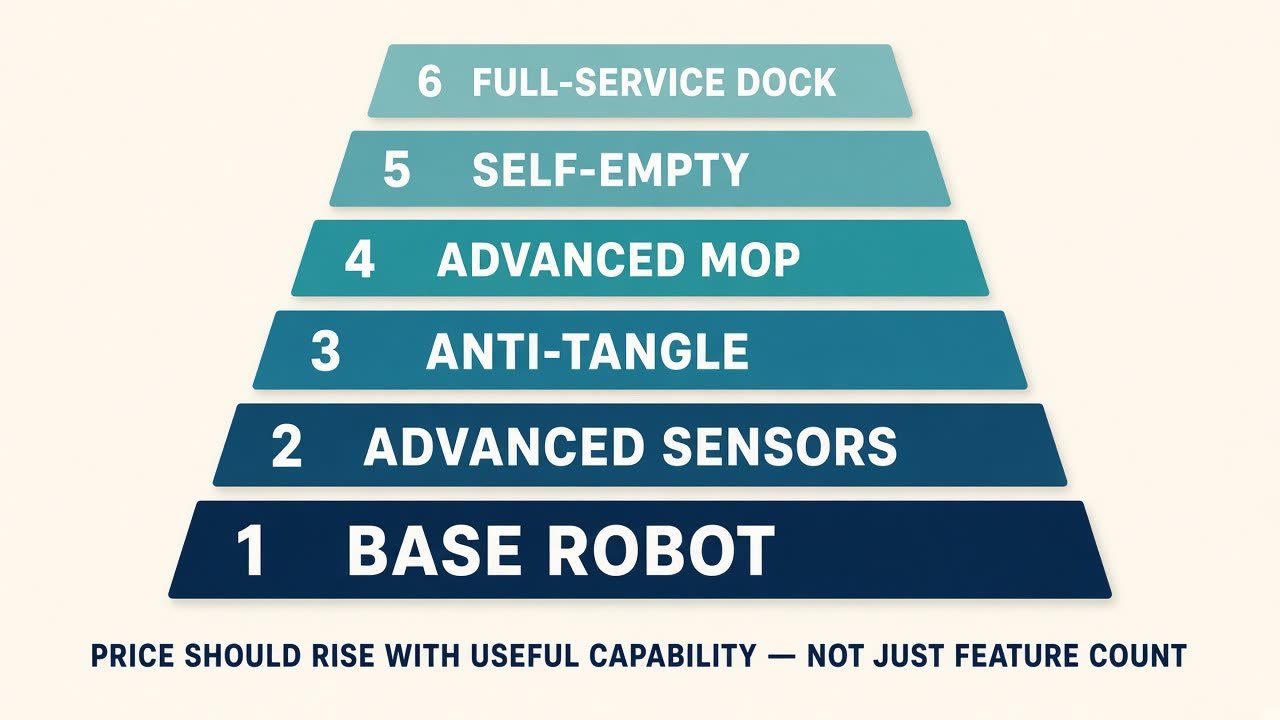
What do you get by paying more for a robot vacuum? Layers, not a magic “better robot” badge. Price usually rises with navigation and obstacle hardware, brush and anti-tangle design, mop architecture (pads, vibrating plates, or rollers; edge extension; lift or auto-removal), dock automation (empty, wash, heat claims, dry, refill, detergent dosing, tray cleaning), chassis/threshold systems, low-profile sensor layouts, and a denser software surface. More layers are not more value unless you use them.
Two current U.S. illustrations—not a ranking. As an Amazon Associate I earn from qualifying purchases. Affiliate Disclosure. On September 12, 2026, the eufy X10 Pro Omni (T2351, robot plus Omni station) listed at $899.99 on eufy’s U.S. store and $479.99 New on Amazon ASIN B0CPFBBHP4. The Roborock Saros 10R with Multifunctional Dock 4.0 listed at $1,299.99 on Roborock US (compare-at $1,599.99) and $1,299.99 New on Amazon ASIN B0DHCJ571Z (a used offer also appeared; ignore used). Absolute premium, 10R versus eufy Amazon street: $820.00 (~171%). Versus eufy’s official $899.99, the 10R premium is $400.00 (~44%). Recheck New, robot plus the correct dock. eufy X10 Pro Omni (B0CPFBBHP4, New) · Saros 10R (B0DHCJ571Z, New).
Roborock documents a 3.14-inch body, StarSight 2.0 (3D ToF, RGB camera, VertiBeam), DuoDivide with an SGS lab hair-entanglement claim, FlexiArm, AdaptiLift (thresholds up to 4 cm), automatic mop-mount detach, and Dock 4.0 with mop wash up to 80°C and mopping up to 70°C. eufy documents dual pads with 12 mm lift, Pro-Detangle Comb, AI.See, iPath LiDAR, empty/wash/dry/refill, 4.47-inch height, and about 33.46 in of recommended station height clearance. Different stacks. Longest spec sheet does not win.
When Better Navigation and Obstacle Avoidance Are Worth Paying For
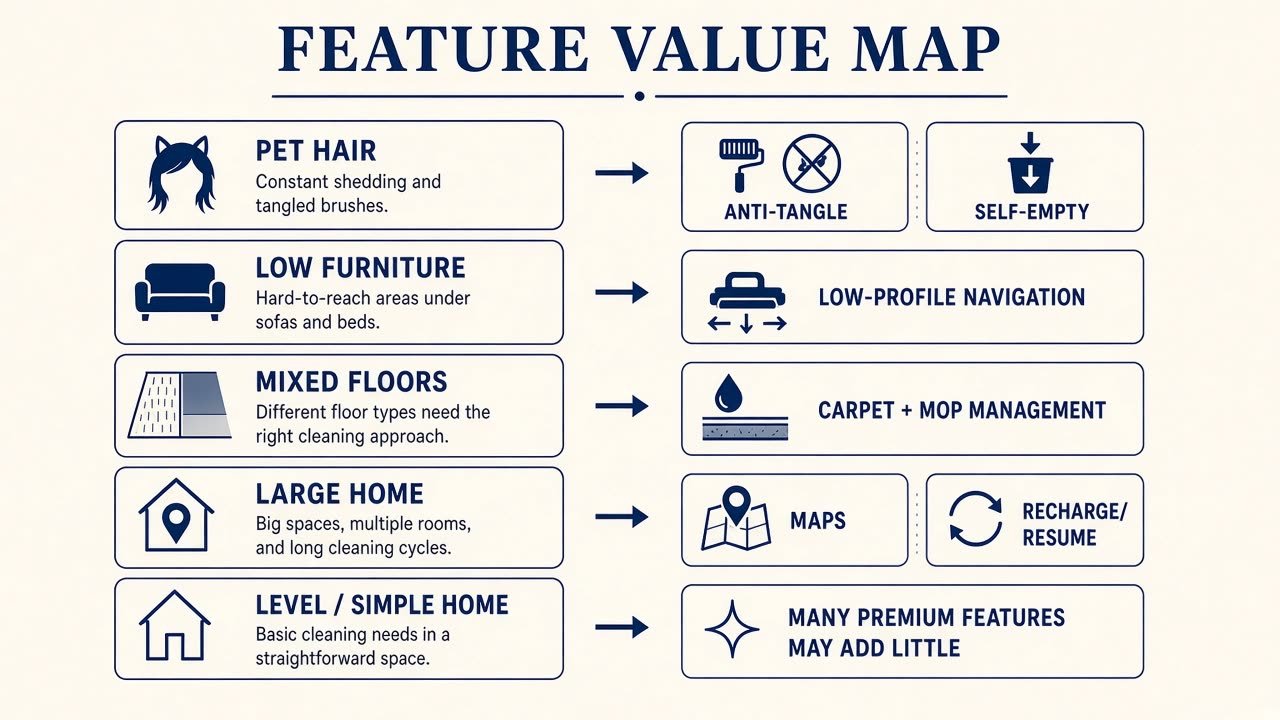
Premium navigation may use LiDAR turrets, cameras, structured light, 3D ToF, retractable masts, or low-profile sensor layouts. More sensors do not prove better navigation. Buyer impact does: fewer stuck missions, better coverage in furniture mazes, and—if the body is actually thinner—access under low beds. Object recognition is not guaranteed avoidance. Cords still win sometimes.
Obstacle hardware is high-value when children, pets, shoes, and cables share the floor and you run the robot unsupervised. It is lower value in a tidy home you already pick up. Cameras add a privacy conversation some buyers care about; others prefer less camera-dependent layouts. Use each brand’s published privacy policy. Do not pay a premium solely for a camera if you will disable visual features. Low-profile architecture is worth money only if furniture clearance requires it; generous sofa height makes a 3.14-inch robot a nice-to-have, not a problem solved.
Does More Suction Make an Expensive Robot Better?
Is more suction worth paying for? Not by itself. Flagships advertise large maximum Pa figures—the 10R listing even leads with 22,000 Pa; eufy lists 8,000 Pa. Higher Pa is not proportionally better cleaning. Pickup also depends on brush architecture, floor contact, hair management, airflow path, and whether the robot actually reaches the dirt. Do not spend hundreds more solely for a bigger Pa number. If two robots already have competent sealed airflow and similar brushes, suction marketing is one of the easiest overpay traps in this category.
When Premium Anti-Tangle Features Are Worth It
Split rollers, dual rollers, combs, and active anti-tangle systems matter when long human hair or heavy shedding would otherwise wrap a brush after almost every run. That is recurring owner work, so hardware that reduces wrapping can justify spend—without turning this page into a pet-hair roundup. Anti-tangle is not zero maintenance: eufy’s own support still discusses hair in ducts; Roborock’s SGS “0% entanglement” language is a lab claim, not a Moon Picke home test. Light-hair apartments may never feel the upgrade. Inspect brushes regardless of tier.
When Premium Mopping Is Worth the Extra Money
Spinning pads, vibrating plates, and roller mops are different architectures. Edge-extension, mop lift, automatic pad removal, and continuous pad washing are additional layers. Most complex is not automatically best. Premium mopping is worth more in hard-floor-heavy homes (tile, vinyl, compatible sealed hardwood). Carpet-heavy buyers easily overpay for hot-water wash, detergent dosing, and large water tanks they rarely use; they usually get more from brushes, anti-tangle, and carpet detection. Mop lift or auto-removal can justify a premium in mixed-floor homes, but lift is not a guaranteed dry-carpet warranty. Hot-water washing is a temperature claim (Roborock cites up to 80°C wash on Dock 4.0; Ecovacs documents temperature-controlled wash on some OMNI stations). Hotter water is not sterilization. Heated drying reduces damp pads; it is not a promise of zero mold or odor.
Is a Premium Self-Emptying or Full-Service Dock Worth It?
Is a premium self-cleaning dock worth it? Self-emptying is one of the clearest labor reducers: you skip dumping a tiny onboard bin after every run. It is high-value with pets, frequent schedules, and larger debris loads. It is low-value in a small, low-debris, no-pet home where emptying the robot bin is trivial. Self-emptying is not maintenance-free. Bags or dock bins still fill; filters still clog; brushes still need attention.
A full-service dock can add mop washing, drying, clean-water refill, detergent dosing, and tray routines. That can cut repetitive handling. It also adds purchase cost, a larger footprint, proprietary consumables, and more failure points—the complexity tax. Owners still empty dirty water, refill clean water, clean tanks, replace bags, wipe trays, maintain brushes, replace filters, and inspect mop pads or rollers. Self-cleaning is not maintenance-free. Apartment buyers may prefer a smaller system over maximum automation.
When Large-Home Features Justify the Price
More rooms, longer missions, more debris, and more hard-floor area can make recharge/resume, maps, auto-empty, and water automation more valuable because they fire every cycle. Battery size is not large-home value by itself. Threshold hardware helps only with raised transitions—not stairs. Robots do not climb; the dock stays put. See Guides for related pieces as they go live. This page is not a full specification checklist.
When Premium Features Are Overkill
Skip the flagship tax in a simple small home: one floor, mostly open, few rugs, no pets, light debris, easy bin emptying. Vacuum-only buyers should not fund hot-water mop stations, detergent automation, mop drying, and extra tanks unless some other premium feature (height, hair, obstacle sensing) is the real reason. Tidy homes gain less from advanced object recognition. Level homes gain little from chassis theater. A dock that does not fit the alcove is negative value. Also: Home & Living.
Why Midrange Robot Vacuums Can Be the Sweet Spot
Is a midrange robot vacuum good enough? Often yes—and that is frequently the practical answer to are expensive robot vacuums worth it. Features that used to sit only on flagships—self-emptying, obstacle sensing, mop washing, anti-tangle combs—have moved into midrange bundles. The eufy Omni example is that pattern: empty, wash, dry, refill, dual pads, and a detangle comb without 10R money, especially at $479.99 New versus $899.99 official. Midrange can still miss low-profile bodies, auto mop-mount removal, hotter documented wash cycles, or a specific chassis. That is a feature match, not a moral failing. Entry-level still has a role: small hard-floor apartments, light debris, simple layouts, buyers who will empty a bin and skip dock automation.
Is an older flagship better value than a new midrange model? No universal winner. Compare live functions and today’s New street price. Last year’s premium can fall when a new generation ships—and can beat a full-ask flagship if parts and app support remain healthy. It is not an automatic bargain: older hardware and a shorter support horizon can erase the discount. A newer midrange may already include last generation’s self-empty or mop wash. Do not call a unit “a $1,599 robot” if it sells for $1,299.99 today. A sale can flip the answer; a flagship at full ask is harder to justify.
Purchase Price vs Total Ownership Cost
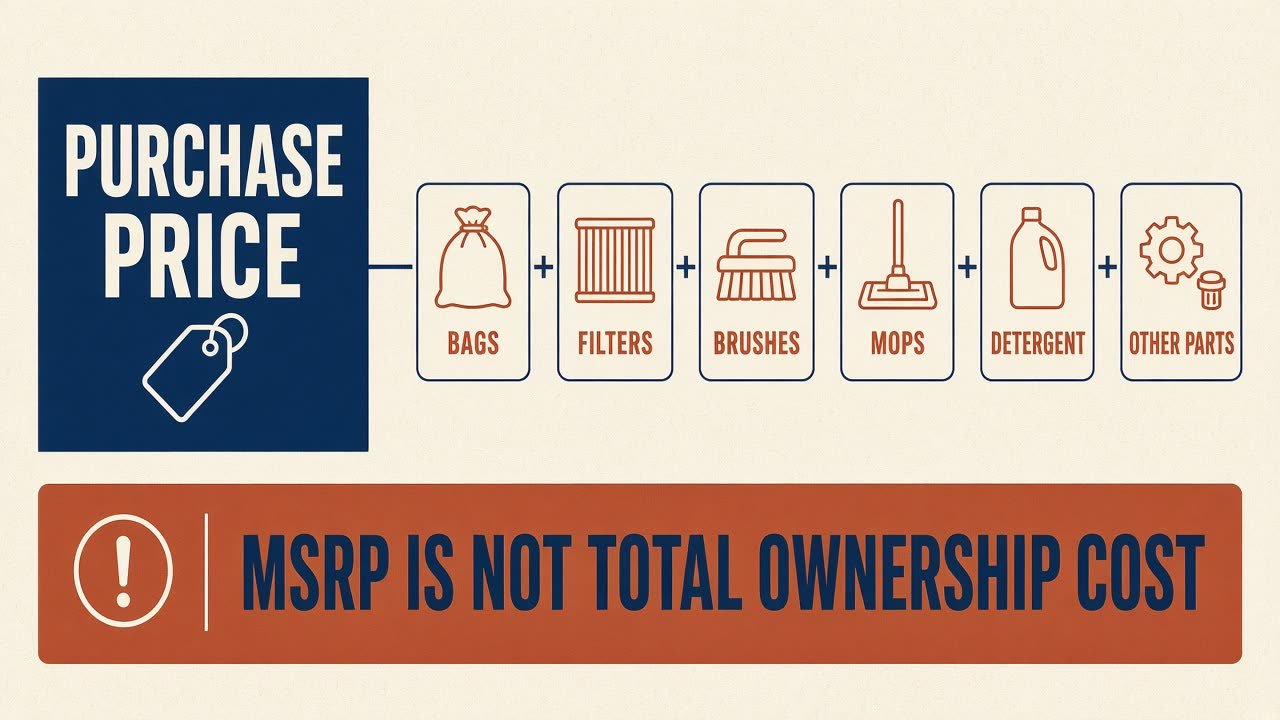
MSRP is not total ownership cost. After purchase you may still buy dust bags, filters, main and side brushes, mop pads or rollers, detergent, dock filters, and other parts. Premium automation can increase dependence on brand bags, detergent cartridges, and specialized mop modules. We will not invent yearly dollar totals or replacement intervals. Core mapping, scheduling, and docking on the two examples above do not, in the manuals we used for this cluster, require a paid subscription to start a clean; do not assume every brand forever. Warranty is model-specific; a higher price does not prove a longer U.S. limited warranty or better support. Price does not prove longer lifespan or higher reliability. More subsystems can mean more parts to service. Official stores sell replacement brushes and filters for these lines; that is availability, not a repairability score.
Who Should Buy a Premium Robot Vacuum — and Who Should Save
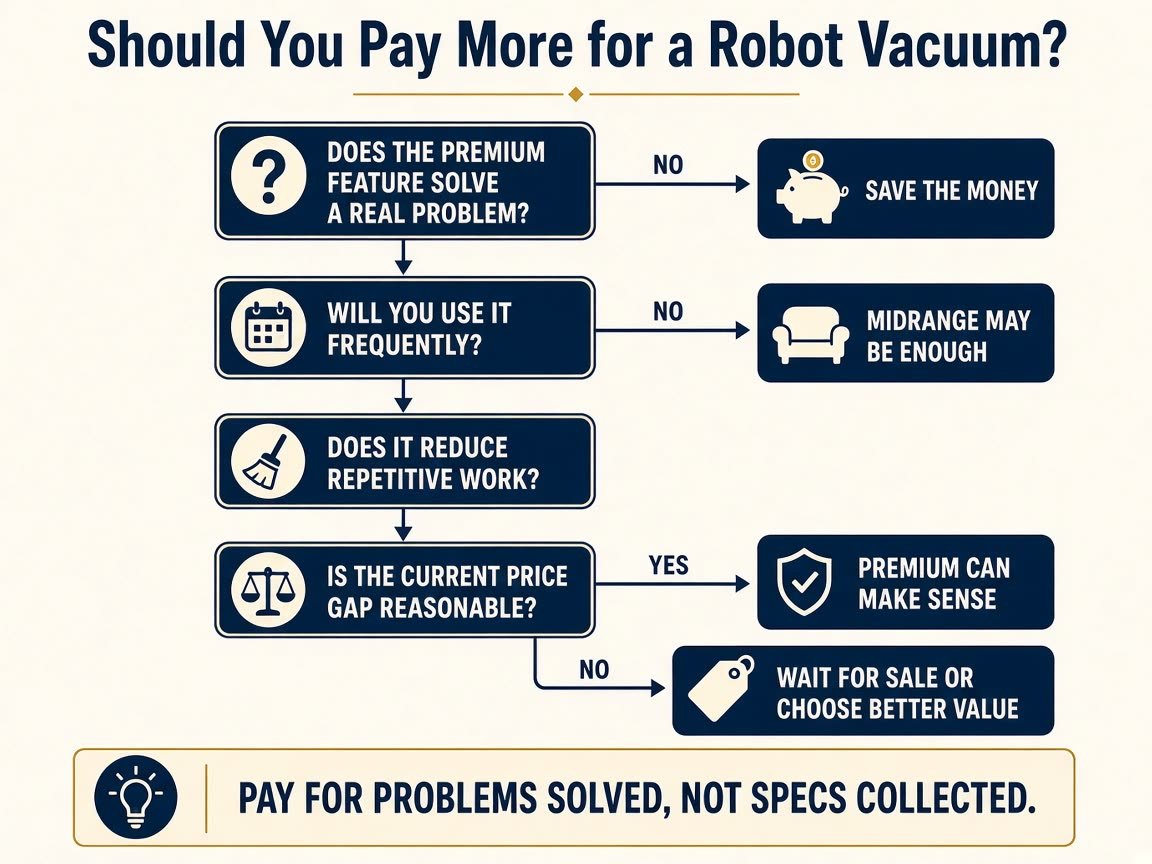
Premium can make sense when several conditions are true together: multiple difficult problems; modules that address them; frequent use; less repetitive work (emptying, detangling, washing pads, refilling); a reasonable current price gap versus a midrange that already does most of the job; and acceptance of consumables. Typical fits: hair-heavy homes that want anti-tangle plus self-empty; mixed floors that will mop and need lift or pad removal; large mapped homes that need resume and water automation; cluttered rooms; low furniture that needs a documented thin body. Editorial frame—not a formula: useful extras × frequency × work reduced, versus price premium + ongoing cost + complexity.
Save the premium for basic vacuuming, a simple level home, rare mopping, easy bin emptying, a dock that will not fit, unused technology, or a huge price gap. How much should you spend on a robot vacuum? Enough for modules you will use at today’s New street price—not a universal cutoff. Cheap vs expensive robot vacuum arguments fail when they ignore sale tags. Recheck Amazon New condition and the exact robot-plus-dock SKU.
Final Verdict
So, are expensive robot vacuums worth it? Yes when the premium feature solves a real problem, you use it frequently, it reduces recurring work, and the current price gap makes sense. No when the feature looks impressive but does not change your routine. Expensive is not better value by default. Cheapest is not better value by default. Higher Pa alone rarely justifies a large premium. Self-cleaning is not maintenance-free. Hot-water wash is not sterilization. Higher price is not proven longer life. The best-value robot is the one where the extras you pay for solve problems you actually have. This is not a shopping-spec encyclopedia; keep the next buying-guide article for checklists. Recheck live U.S. prices on the execution date you buy.
FAQ
Are expensive robot vacuums worth it? Only if premium features match your home, get used often, cut repetitive work, and the current street premium is reasonable.
How much should you spend on a robot vacuum? There is no universal threshold. Match modules to problems at today’s New price, then add consumables.
Are premium robot vacuums better at cleaning? Not automatically. Brushes, contact, navigation, and whether the robot reaches the dirt matter as much as a flagship badge.
Is more suction worth paying for? Rarely as the sole reason. Pa is not proportional cleaning.
Is a self-emptying dock worth the extra money? Often in pet, large, or high-frequency homes; often not in small, low-debris homes. Still not maintenance-free.
Is a premium robot vacuum worth it for pet hair? Anti-tangle plus self-empty can be, if hair is a daily problem. It is not a substitute for brush inspection.
Are expensive robot vacuums more reliable? Price does not prove reliability. Complexity can add maintenance points.
Is an older flagship better than a new midrange model? Compare live features, support outlook, and today’s New street prices. Discounted MSRP is not a bargain by itself.