
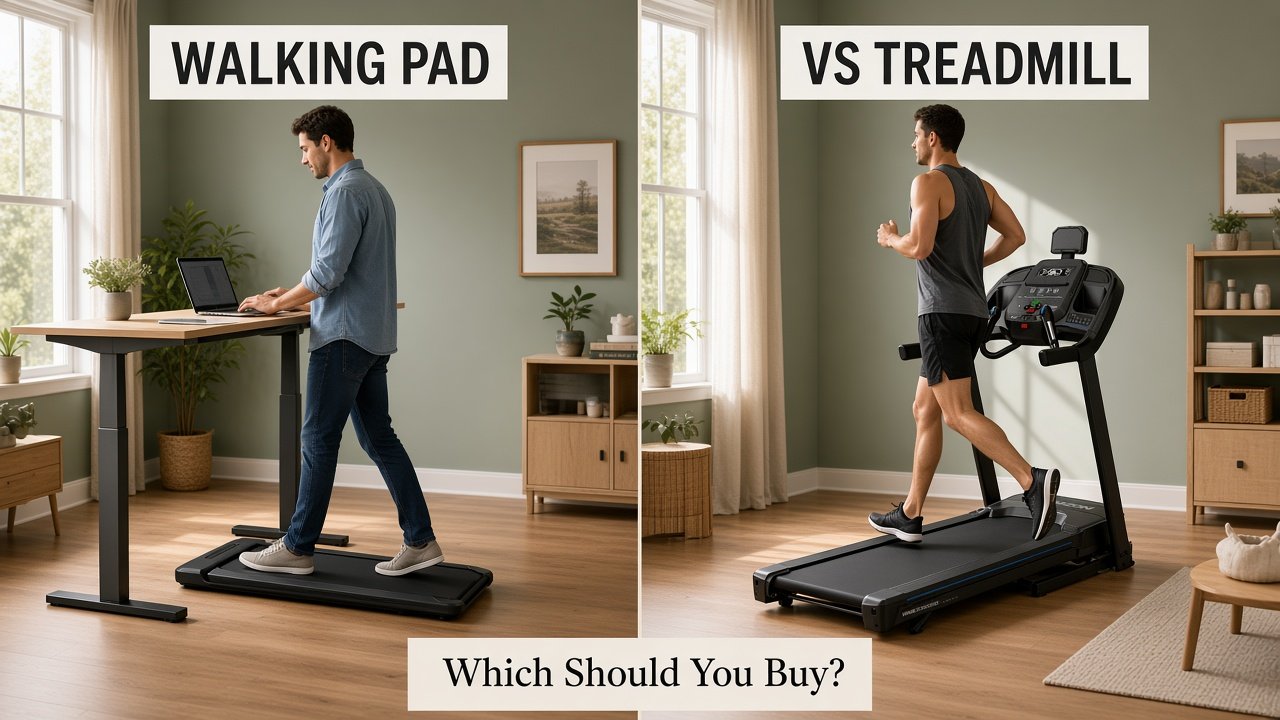
The walking pad vs treadmill decision is a use-case match, not a category trophy. A walking pad is often a low-profile, walking-first deck for under-desk work and compact storage. A full treadmill is often a taller console-and-rail machine for dedicated sessions that may include walking, jogging, running, and—on many models—powered incline. Specs come from manufacturer pages, manuals/FAQs, and Amazon.com US listings opened 15 September 2026. We did not lab-test sound, vibration, calories, or productivity.
If you already want a full deck, start with best treadmills for home use. Walking on a full machine: best treadmills for walking. Tight rooms: small spaces and folding treadmills. Method: how we evaluate and editorial standards.
Walking Pad vs Treadmill: Quick Answer
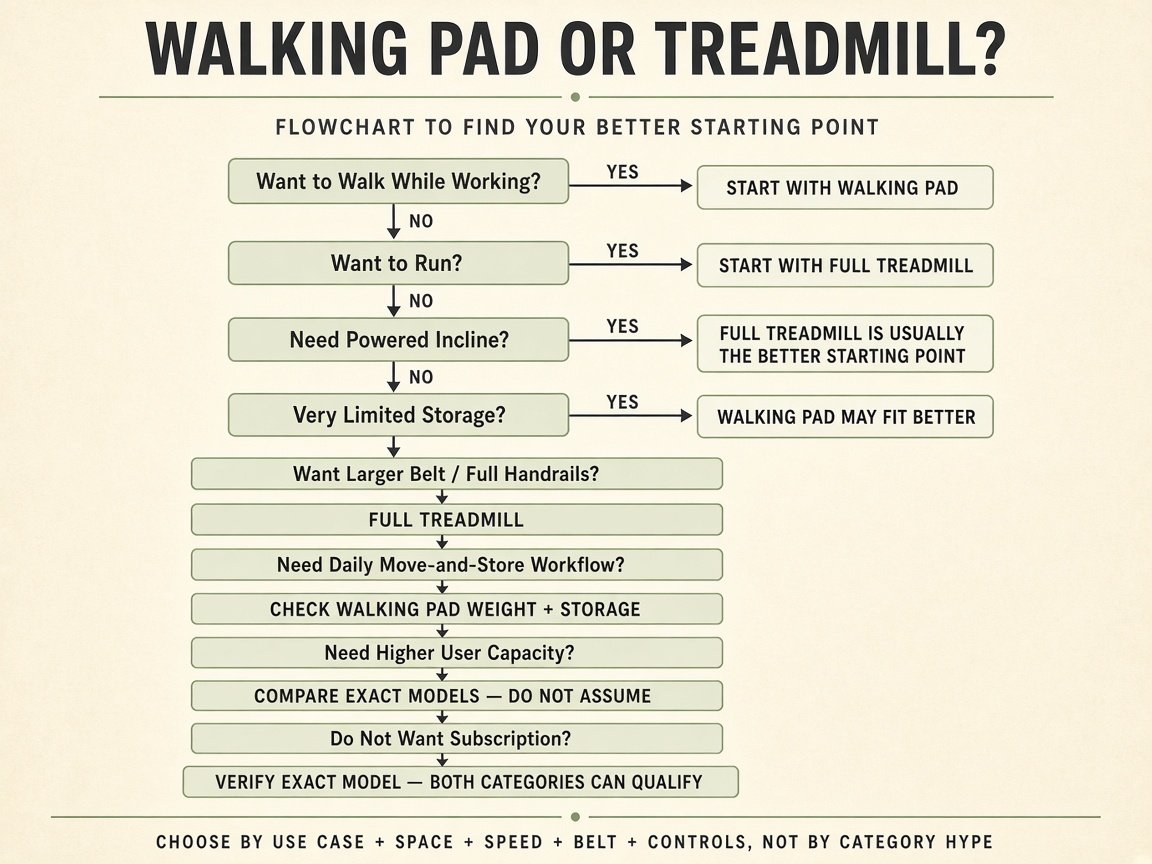
Choose a walking pad if you want under-desk walking, a low-profile deck, simple remote or app controls, frequent compact storage, and you primarily walk. Choose a full treadmill if you want running range, a larger belt, fixed handrails, a full console, and (often) powered incline in a dedicated space. Consider a hybrid pad with a folding rail if you want rail-down desk walking plus a documented rail-up speed that is still not a full running treadmill. No universal winner for walking pad vs treadmill.
| Category | Walking Pad | Full Treadmill | Better Fit When… |
|---|---|---|---|
| Primary use | Often walking-first, low-profile | Often dedicated walk/jog/run | Match the room you will use |
| Under-desk use | Usually the start (height still buyer-specific) | Usually blocked by console/rails; hybrids may differ | Walking at a standing desk |
| Walking | Often designed for it | Often on a larger deck | Walking alone does not pick a category |
| Running | Often walking-speed; some hybrids allow higher speed rail-up per the maker | Usually the stronger start | You need jogging/running |
| Speed range | Model-specific, often walking-first | Model-specific, often broader | Higher max speed is not automatically better |
| Walking/running surface | Often smaller belt | Often more belt area and more floor | Desk walking can use a smaller belt if it fits |
| Handrails | None, folding, or removable—model-dependent | Typically fixed front/side structure | Rails are not a medical safety guarantee |
| Incline | None, fixed, manual, or limited powered—model-dependent | Powered incline more common; not universal | Varied dedicated workouts |
| Controls | Often remote, app, deck display, and/or rail buttons | Often physical console speed/incline/stop | Workflow, not feature count |
| Storage | Often compact; orientation model-specific | Often deck-fold / upright-fold—model-specific | Never assume under-bed or vertical storage |
| Product weight | Often lighter here; not always | Often heavier here; not always | Folding ≠ easy to move |
| User capacity | Substantial on some pads; model-specific | Often higher on full decks; model-specific | Capacity ≠ fit or durability |
| Subscription | Often optional app, not a paid membership | May integrate iFIT; basic belt use can still work—verify | App ≠ paid subscription |
| Maintenance | Belt, lube, cleaning, inspection per manual | Same class of moving parts | Smaller ≠ maintenance-free |
| Home-office fit | Usually stronger start | Usually a poor desk fit | Confirm desk height and structure |
| Dedicated workout fit | Limited range on many pads | Usually the stronger start | Training machine, not a desk accessory |
| If You Care Most About… | Better Starting Point | Why |
|---|---|---|
| Under-desk work | Walking pad | Low profile; rail-down/no-rail common |
| Running | Full treadmill | Broader speed and larger belts more common |
| Compact storage | Walking pad / depends | Pads often smaller; verify orientation |
| Incline | Full treadmill | Powered incline more common; pads may have fixed/limited incline |
| Larger belt | Full treadmill | More belt usually costs more floor |
| Simple walking | Depends | Either can walk; pick belt, rails, controls |
| No subscription | Depends | Verify the exact SKU in both categories |
| Higher capacity | Depends | Compare published ratings; do not assume |
| Low profile | Walking pad | Lower decks help desk clearance and some storage |
| Dedicated workouts | Full treadmill | Console, rails, speed, incline range |
What Is a Walking Pad? What Counts as a Full Treadmill?
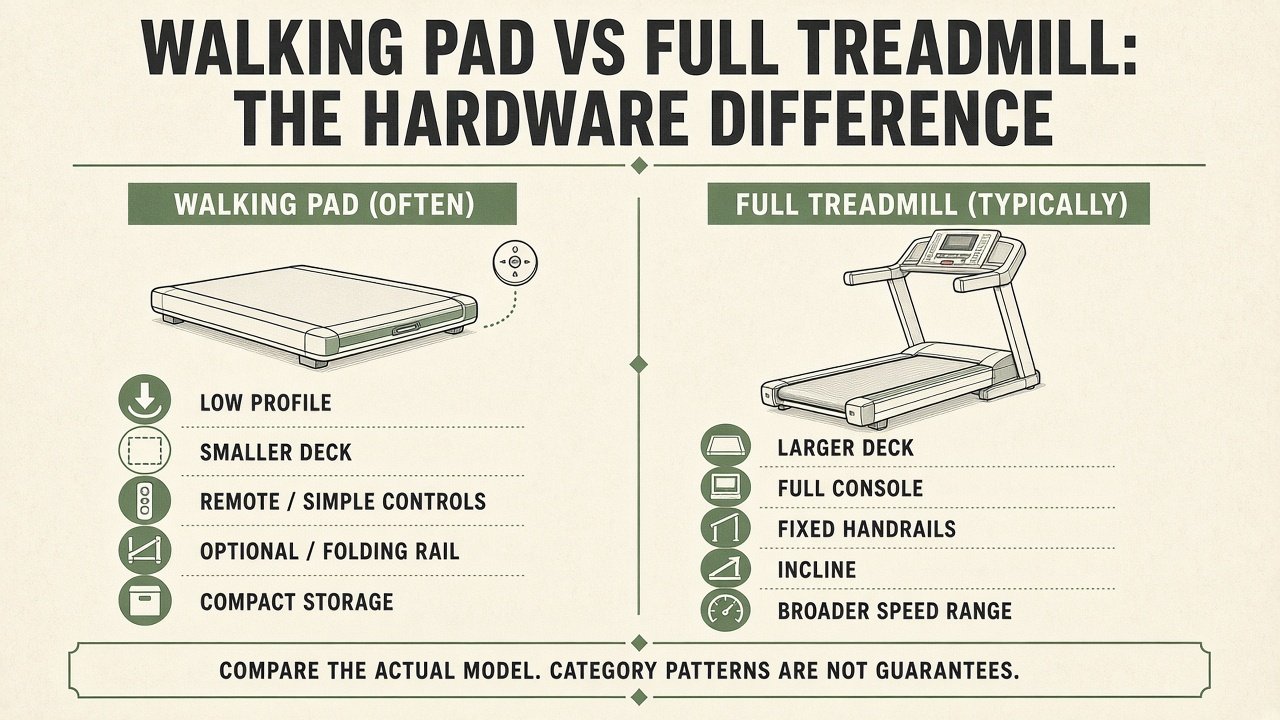
A walking pad is not simply a small treadmill. It is usually a low-profile motorized deck with reduced console and rail hardware, a walking-first speed set, and a compact storage story. Labeled manufacturer examples (not a ranking): WalkingPad C2 (WPS1F) 47.2″ × 15.7″, 1–4 MPH, 4.9″/5.4″ height, 55 lb, 220 lb, no rail, remote/optional KS Fit/FootSense™. WalkingPad P1 (WPP1F) 47″ × 16.5″, 0.3–3.75 MPH, 5″, 62 lb, no rail. Egofit Walker Pro-M1 16.54″ × 34.25″, 0.62–3.11 MPH, 6.89″, 48.5 lb, 220 lb, no rail, fixed 5% incline. UREVO Strol 2E (URTM030) hybrid: 40.2″ × 15″, 0.6–4 MPH rail down, 0.6–6.2 MPH rail up, 47.2 lb official, 265 lb.
A full treadmill is not automatically running-only. Many people walk on full decks for belt size, rails, incline, and a console. Horizon 7.0 AT (HTM1457-01): 20″ × 60″, 0.5–12 MPH, 0–15% incline, about 76″ × 35″ × 67″, 277 lb, 325 lb user rating. NordicTrack Commercial 1750 (NTL17125): 22″ × 60″, 12% to −3%, iFIT. NordicTrack T Series 16 (NTL16426): 20″ × 60″, 0–12%. Powered-grade shopping: best incline treadmills for home.
Walking Pad vs Treadmill: Key Differences at a Glance
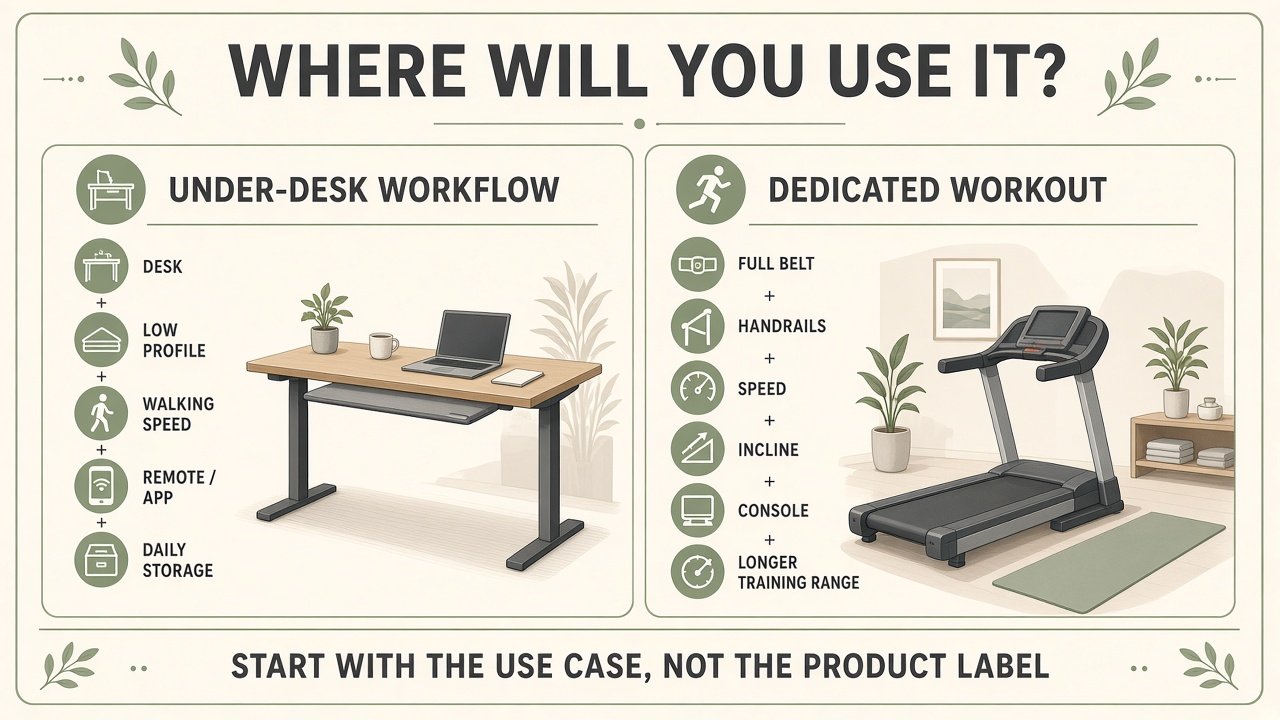
The useful walking pad vs treadmill split is design purpose, not “small versus large.” Pads trade belt area and training range for under-desk height and simpler controls. Full treadmills trade floor, height, and often weight for a larger surface, rails, console, and a broader speed/incline set. Inches alone miss whether the machine can sit under a desk. Moon Picke editorial interpretation: buy the workflow first, then confirm the SKU.
Which Is Better for Walking?
Both categories can support walking, so “I only walk” does not automatically mean walking pad. Want a 20″ × 60″ class belt, fixed rails, powered incline, and console keys? You may still want a full treadmill for walking—see treadmills for walking. Want a standing-desk 4.9″–6.89″ class deck and a remote? Start with a pad. Smaller belt is not bad if stride and desk fit. Larger belt is not required for every walker. Do not pick by hypothetical calorie burn.
Which Is Better for Running?
This is one of the clearer patterns. Many pads are walking-first: lower published max speeds, smaller belts, no fixed running rails. Full treadmills more commonly publish jogging/running speeds and larger belts (Horizon 7.0 AT 0.5–12 MPH on 20″ × 60″). Do not call all walking pads unsafe for running. Strol 2E documents 0.6–6.2 MPH only with the handlebar up—still a 40.2″ belt, not a 60″ running deck. Hybrid ≠ both categories without compromise.
Which Takes Up Less Space—and Which Fits Under a Standing Desk?
Pad bodies are often smaller (C2 unfolded 56.9″ × 20.4″ × 4.9″; M1 38.39″ × 21.85″ × 6.89″). Full frames are often larger (Horizon 7.0 AT about 76″ × 35″ × 67″). Product footprint ≠ practical footprint: add stride space, cable, clearance, and storage path. Folding ≠ portability. C2’s 180° fold still leaves a 55 lb cube; Horizon’s 277 lb frame with wheels is a different move. Wheels ≠ easy movement. Low profile is not a medical accessibility claim.
Pads generally have the under-desk advantage: low profile, rail-down or no-rail decks. That is not “all pads fit all desks.” Fit depends on published height, desk structure, height, crossbars, trays, stance, and shoes. Most conventional full treadmills are not designed to sit under desks because of console, rails, and frame height. Unusual hybrids may differ—measure. We do not claim Zoom-safe sound.
Speed, Belt Size and Handrails
Do not invent a universal pad cap or treadmill floor. Verified examples: C2 1–4 MPH; P1 0.3–3.75 MPH; M1 0.62–3.11 MPH; Strol 2E 4 MPH rail down / 6.2 MPH rail up; Horizon 7.0 AT 0.5–12 MPH. Higher max speed is not a better buy for an under-desk walker; for a runner it may be essential. Belt width × length: this pad set runs from M1’s 16.54″ × 34.25″ to C2/P1 near 47″ long; full examples use 20″×60″ or 22″×60″. Handrails: none on C2/P1/M1; folding on Strol 2E; typically fixed on full decks. Rails are not proof treadmills are safer. Safety depends on use, speed, the manual, behavior, and the product. No-rail is not unsafe by definition; railed is not safe for every user.
Incline, Controls and Workout Range
Do not say pads never have incline. M1 publishes fixed 5%. Strol 2E lists none. C2/P1 tables used here do not sell powered home incline the way Article #10 machines do. Full decks more commonly offer powered incline (Horizon 0–15%; T16 0–12%; 1750 12% to −3%). Incline is not necessary for every buyer. Pad controls may be remote, app, deck LED, or rail buttons—not automatically better or worse. Full consoles may put speed, incline, and stop under the hands. We do not invent button feel. iFIT is not required to prove a 1750 belt exists; a pad app is not automatically a paid subscription. Grade shopping: incline treadmills.
Noise, Power and Apartment Use
Do not write that walking pads are quieter than treadmills as a fact. Sound depends on motor, belt, rollers, foot strike, speed, flooring, and the room. Slower speed is not automatically silent, meeting-safe, or neighbor-proof. Egofit’s “under 70 dB even at max speed” line is model-specific. We do not rank vibration. Both need product-specific electrical guidance (C2 110V; P1 110V U.S. / 746 W). Do not assume a pad uses less energy. Full-machine apartment context: treadmills for apartments.
Storage, Moving and Maintenance
Pads may support flat storage, under-furniture marketing, or folding—only as the current manual allows. Do not call them “under-bed treadmills” as a class. C2/P1 market sofa/bed/desk placement; furniture gap is yours. Strol 2E FAQ: under suitable furniture or against a wall at 4.6″ folded height. M1’s page used here does not publish a vertical-storage procedure. Full decks may fold upright—model-specific. Both can need belt alignment, lubrication, cleaning, and inspection. Compactness does not remove moving parts. Do not claim pads need less maintenance. Some pads use simpler 1-year whole-product language (WalkingPad brand pages used); some full decks segment frame/motor/parts/labor. Warranty length is not reliability.
As an Amazon Associate I earn from qualifying purchases. Read the affiliate disclosure. Links below are representative examples, not a roundup. Check current Amazon availability.
Walking-pad example: WalkingPad C2 (WPS1F), Amazon B0F48MZV54 NEW when opened 15 September 2026. See our current walking pad picks after you confirm WPS1F / C2, not an accessory. Hybrid: UREVO Strol 2E, Amazon B0FS7ZH2M3. Compare current options for documented rail-down versus rail-up speeds. Full-treadmill example: Horizon 7.0 AT, Amazon B0DJ3N5SY9. See our current treadmill picks for a 20″ × 60″ belt and 0–15% powered incline—not a category winner.
Price and Subscription Differences
Observation dated 15 September 2026: a walking pad is not automatically cheaper, and a full treadmill is not automatically more expensive. Premium pads can overlap entry-level full decks. Total ownership is purchase price plus any subscription you actually use, plus space, storage, maintenance supplies, and required accessories. We do not invent an annual cost. Pad examples document optional apps without a required paid membership on the pages used. Full machines may integrate iFIT; basic hardware can still run without a coach plan on many consoles—verify the SKU. App ≠ subscription.
Who Should Buy a Walking Pad or a Full Treadmill?
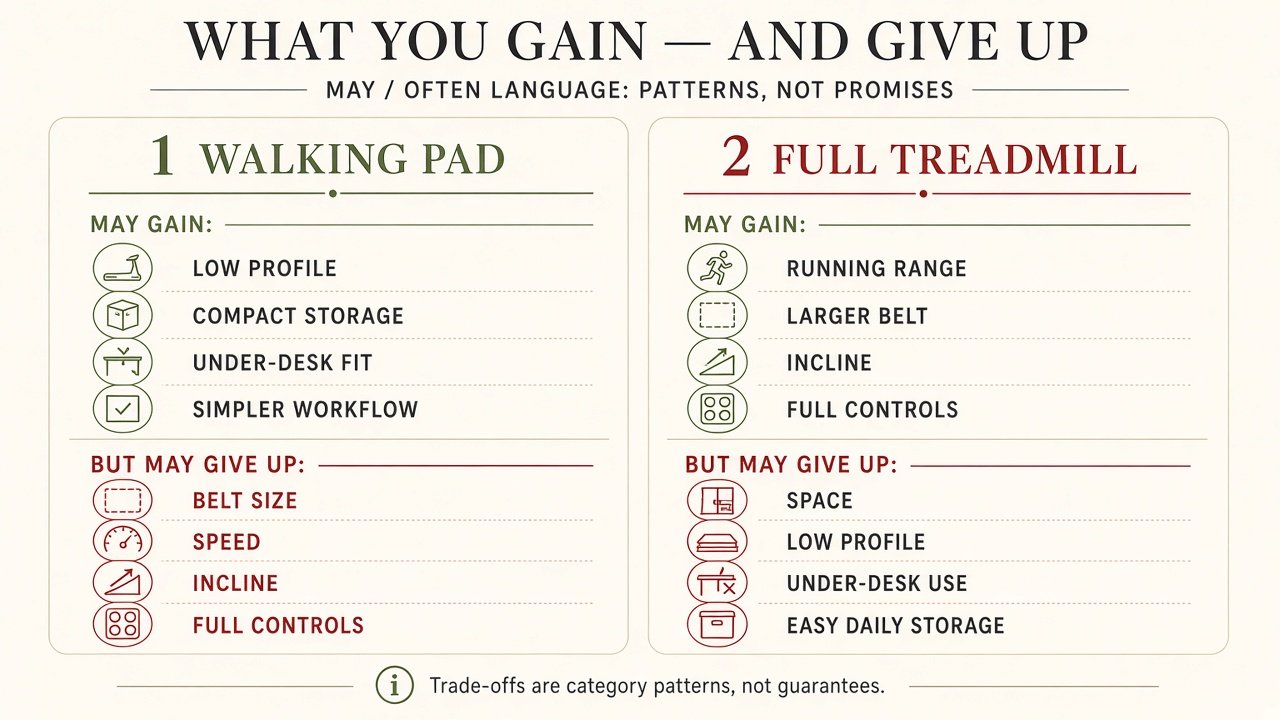
A walking pad may fit if you want under-desk walking, limited floor space, frequent storage, primarily walking, simple controls, and you do not need running or powered incline. Confirm desk height, belt versus stride, capacity (C2/P1/M1 220 lb; Strol 2E 265 lb—ratings are not durability), and approved storage. Capacity is not fit.
A full treadmill may fit if you want running, a larger belt, powered incline, dedicated-workout controls, a broader speed range, and you do not need an under-desk setup. After the category is decided, pick a deck from home-use treadmills. Consider a hybrid pad only if you accept a smaller belt and a rail-up speed that is still not a 60″ running deck.
Final Verdict: Walking Pad or Treadmill?
Do not ask which category is better. Ask whether you want to walk while working or you want a dedicated workout machine—and whether you need running, incline, a larger belt, and full controls, or you value low profile, under-desk use, and easier daily storage more. The walking pad vs treadmill answer stays conditional. Desk-first: start with a walking pad and verify height. Run-and-incline-first: start with a full treadmill and verify belt and speed. Walk-only but want rails and a 60″ class surface: start with a full walking treadmill.
FAQ
What is the main difference between a walking pad and treadmill?
In a walking pad vs treadmill match, the difference is design purpose. Pads are often low-profile, walking-first, desk-oriented. Full treadmills are often taller, railed, console machines with a broader training range. Not merely size.
Is a walking pad enough for daily walking?
It can be if belt, speed, room or desk, and capacity match you. Daily walking on a full treadmill is also common. Model-specific.
Can you run on a walking pad?
Only when the manufacturer documents that speed and rail position. Many pads are walking-only. Hybrids still trade belt size versus a full deck.
Do walking pads have handrails?
Some have none, some fold, some are a different SKU with a bar. Full treadmills typically have a fixed structure. Rails ≠ safety guarantee.
Do walking pads have incline?
Sometimes none, sometimes fixed (M1 5%), sometimes other limited designs. Powered incline is more common on full treadmills, not universal.
Are walking pads quieter than treadmills?
Not as a category fact. Sound is system- and room-specific.
Which is easier to store?
Pads often have a smaller body; approved orientation is model-specific. Full decks may fold upright. Folding ≠ easy to move.
Do either require subscriptions?
Not as a category rule. Pads in our examples use optional apps. Some full treadmills offer paid coaching. Verify the SKU. App ≠ subscription.