
Moon Picke independently researches products. If you buy through our links, we may earn a commission at no extra cost to you. Read our affiliate disclosure.
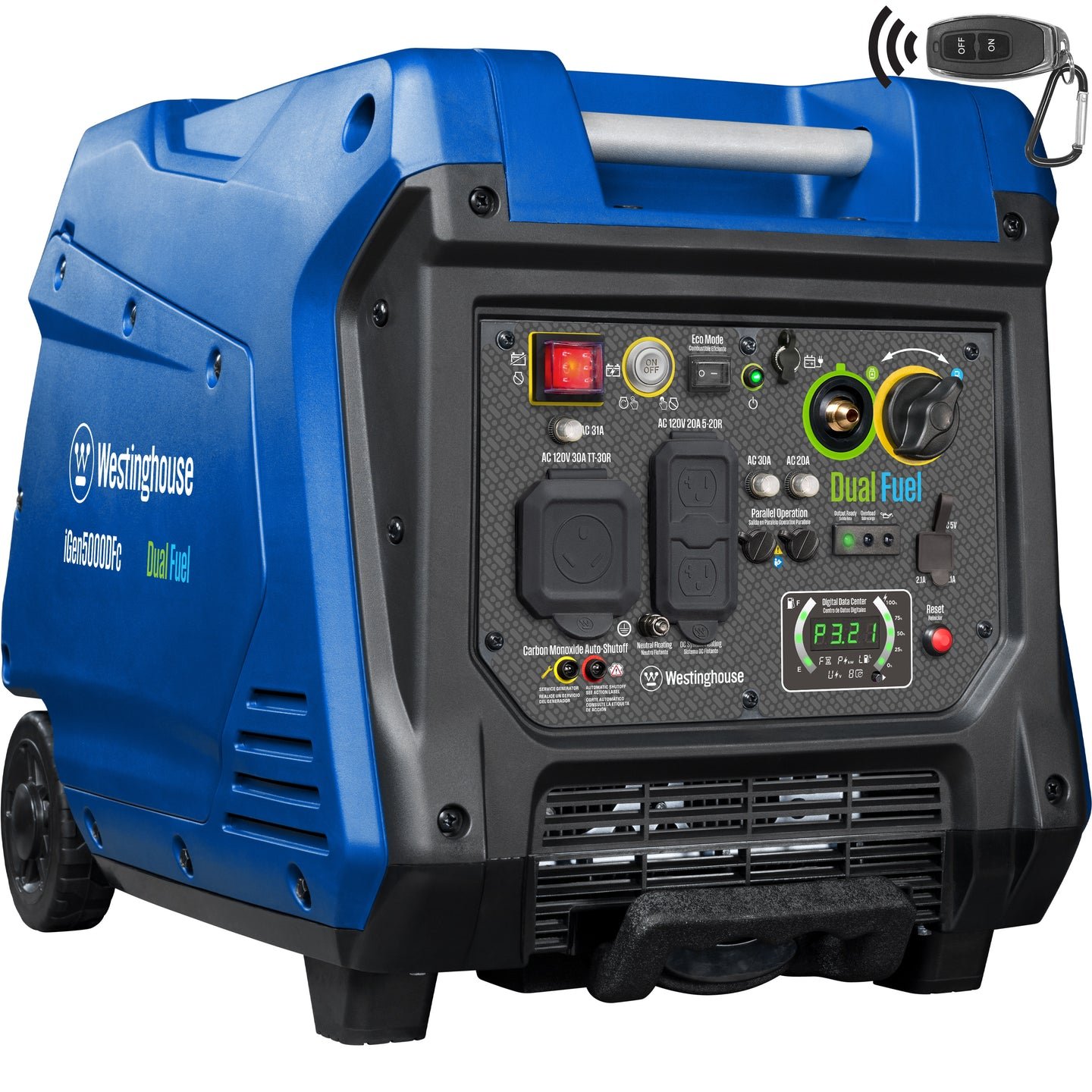
The Westinghouse iGen5000DFc is a compelling premium dual-fuel inverter generator for RV owners, campers and households that want portable 120-volt backup power. It combines 3,900 running watts on gasoline, a 30-amp RV outlet, remote electric start and gasoline-or-propane flexibility in a fully enclosed inverter design. Its main compromise is physical: at 105.8 pounds dry, it rolls well but is not a casual one-person lift.
This Westinghouse iGen5000DFc review is based on the manufacturer’s current specifications, owner’s manual and commercial listing—not hands-on testing. The evidence suggests it is best for buyers who need more capability than a small suitcase generator but do not need 240-volt output or whole-home capacity.
Moon Picke verdict
The iGen5000DFc earns its premium through usable RV power, two fuel choices, long manufacturer-rated runtime and unusually convenient starting options. Buy it when a 30-amp RV connection and flexible fuel storage matter more than low weight.
Westinghouse iGen5000DFc review: the quick answer
Is the Westinghouse iGen5000DFc worth buying? Yes, for an RV or outdoor backup setup that can use roughly 3.5–3.9 kilowatts of continuous 120-volt power and has room to operate a fuel-burning generator safely outdoors. It supplies 5,000 peak and 3,900 running watts on gasoline, or 4,500 peak and 3,500 running watts on propane. Those ratings give it enough headroom for many 30-amp RV scenarios when loads are managed carefully.
The value is not simply a large watt number. A TT-30R RV receptacle avoids an unnecessary household-outlet adapter, while remote, push-button electric and recoil starting provide useful redundancy. The enclosed inverter platform is rated at no more than 3% total harmonic distortion, and economy mode can vary engine speed with demand. Westinghouse also includes wheels and a telescoping handle, which are essential at this weight.
This is not the right generator for every campsite. Some campgrounds prohibit generators or limit operating hours. Anyone seeking silent overnight power, an indoor solution, 120/240-volt output or easy hand-carry portability should choose a different power system.
Westinghouse iGen5000DFc
Is the Westinghouse iGen5000DFc worth buying? Yes, for an RV or outdoor backup setup that can use roughly 3.5–3.9 kilowatts of continuous 120-volt power…
- Product details documented in the article
- Use-case fit discussed in the review
- Trade-offs covered before the final verdict
Affiliate link. Moon Picke may earn a commission from qualifying purchases.
What you get for the premium price
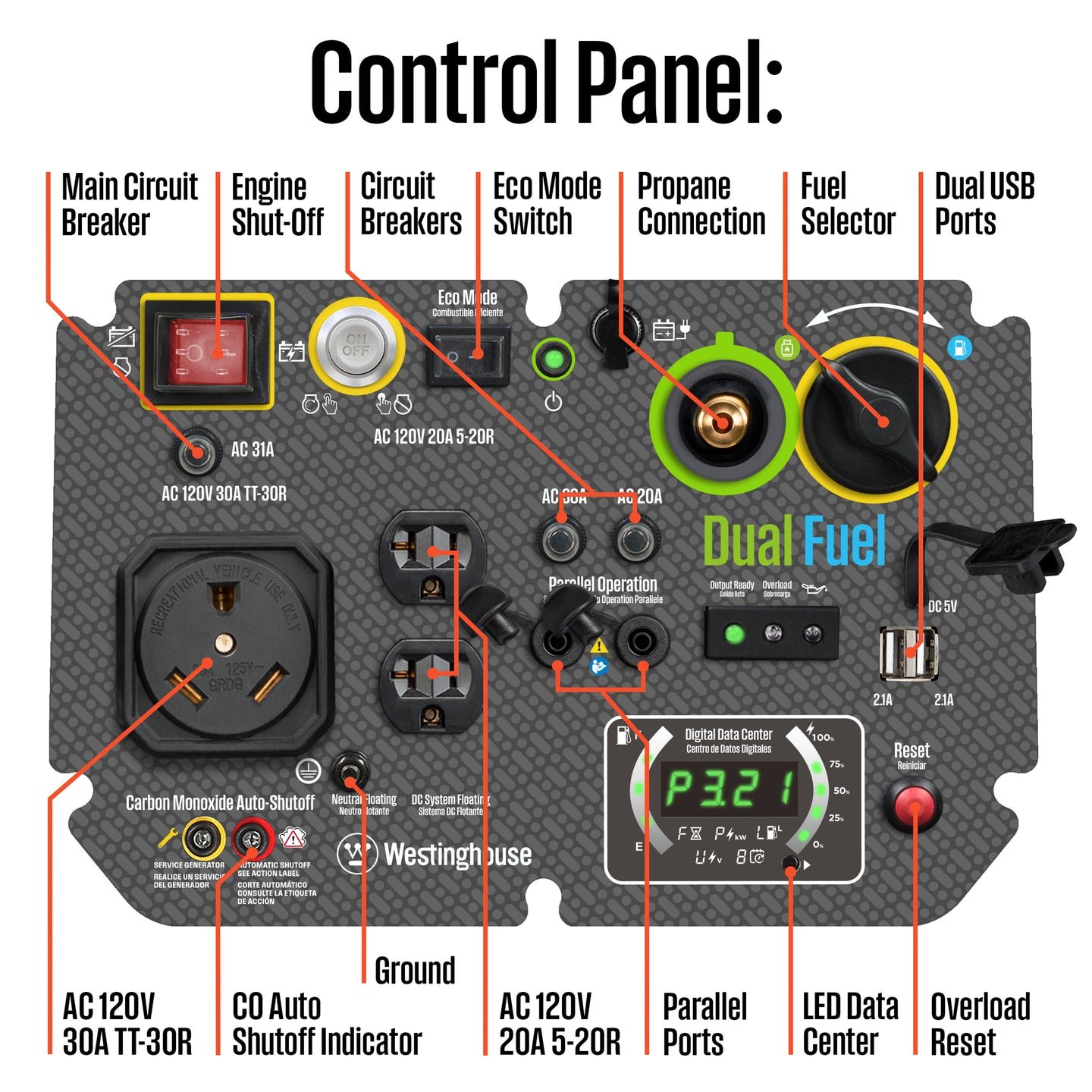
The iGen5000DFc sits above compact 2,000-watt camping generators. Its 224cc OHV four-stroke engine and larger enclosure support a meaningful jump in continuous output, yet the inverter architecture keeps the package focused on recreational and portable backup use. The official 120-volt control panel includes one duplex 5-20R household receptacle, one TT-30R RV receptacle and two USB ports. Outlet covers help protect unused connections during transport and storage.
The LED Data Center rotates through information such as voltage, load, remaining runtime, fuel level and lifetime hours. That is practical ownership information rather than decoration: load visibility helps users avoid accidental overload, while hours help anchor an actual maintenance schedule. Parallel ports also allow connection to a compatible generator with the correct Westinghouse parallel equipment, although buying and transporting two large units changes the value equation.
Included equipment covers the first setup: a propane regulator and hose, remote key fob, 12-volt battery charger, oil bottle, oil funnel and spark-plug wrench. The battery is included. Westinghouse lists a three-year limited residential warranty and a one-year limited commercial warranty; buyers should read the warranty terms and register the generator promptly.
Power output on gasoline and propane
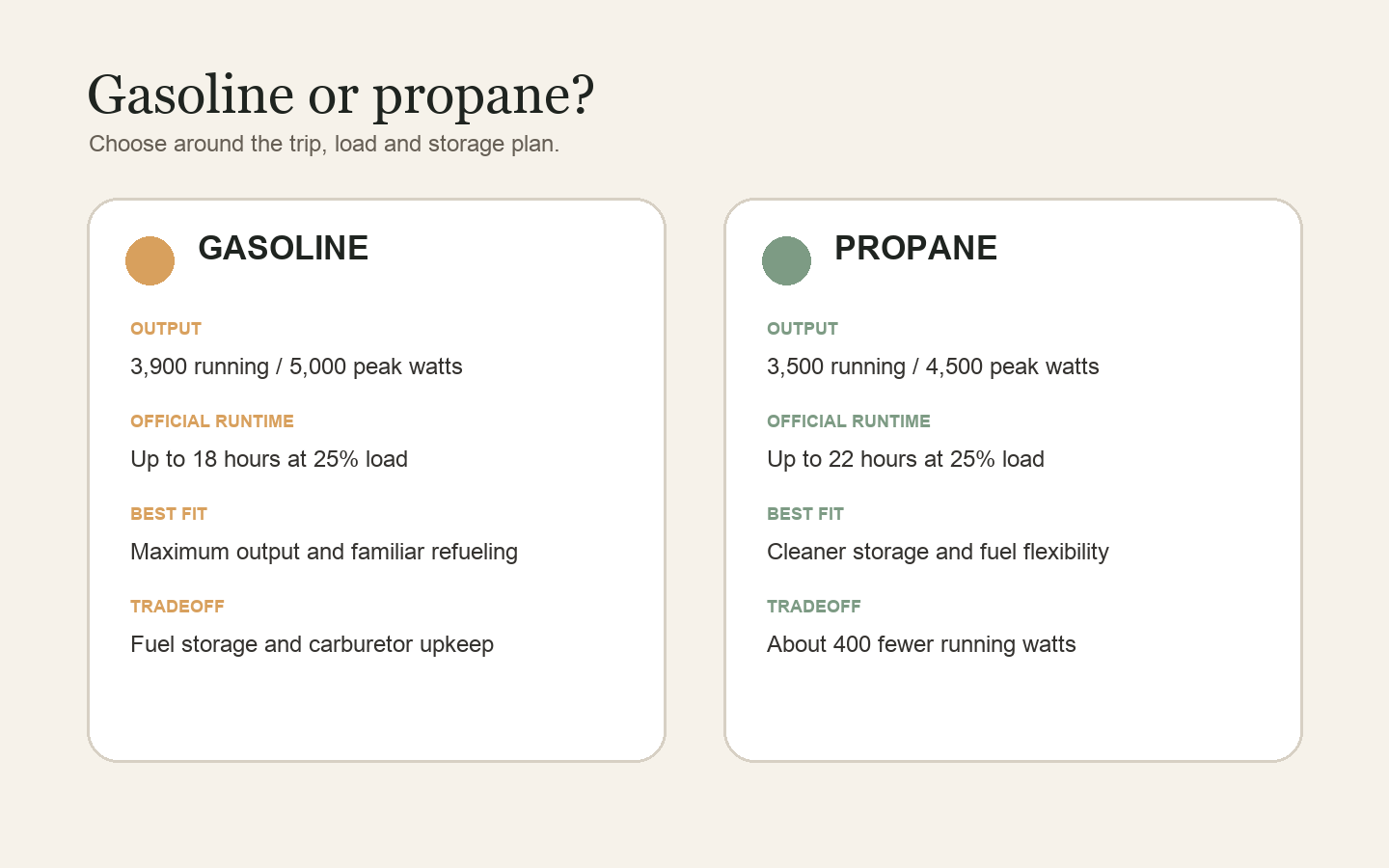
Fuel choice changes available power. On gasoline, Westinghouse rates the generator at 5,000 peak watts and 3,900 running watts. On propane, those figures fall to 4,500 peak and 3,500 running watts. Peak power is brief starting capacity; running watts are the better baseline for planning a sustained load.
That distinction matters around compressors. An RV air conditioner, refrigerator or pump may draw far more power at startup than after it settles. Add the running watts of the equipment you expect to operate at the same time, then check the starting requirement of the largest motor load. Leave margin rather than planning at the nameplate limit. Elevation, heat, fuel quality and engine condition can also reduce available output.
Can the iGen5000DFc run an RV air conditioner? It can support many single-air-conditioner 30-amp RV arrangements, but compatibility cannot be guaranteed from the generator rating alone. Air-conditioner size, startup surge, soft-start hardware and every simultaneous RV load affect the result. Turn off or sequence high-draw appliances such as an electric water heater, microwave, hair dryer or converter before starting the air conditioner, and confirm requirements in both appliance and RV documentation.
The output is 120 volts, 60Hz, single phase with a floating neutral. It is not a 120/240-volt generator and it is not advertised as transfer-switch ready. Never connect it directly to household wiring or backfeed through a receptacle. Home-circuit use requires appropriate manufacturer-approved transfer equipment and qualified installation.
Gasoline versus propane: choose for the situation
Gasoline provides the higher output, so it is the better choice when the load approaches the generator’s ceiling or a large motor needs every available starting watt. The built-in tank holds 3.4 gallons. Westinghouse claims up to 18 hours at 25% load on gasoline. That figure is a controlled rating at a light load, not a promise for hot weather, high elevation or a demanding RV.
Propane gives up 400 running watts and 500 peak watts but can be easier to store for occasional emergency use. The official specification lists up to 22 hours at 25% load on propane. Propane runtime necessarily depends on the cylinder size, fill level, ambient conditions and regulator performance; plan from the cylinder you will actually carry. Use only the supplied or manufacturer-approved regulator and hose arrangement, keep the cylinder upright where required, and inspect the connection for damage before operation.
Dual fuel is most valuable as resilience. An RV owner can use gasoline for the highest-demand day, then connect propane when storage convenience or fuel availability matters more. It does not remove the need to transport and store fuel safely. Propane combustion still produces carbon monoxide, and gasoline should never be added to a hot or running generator.
RV and camping fit
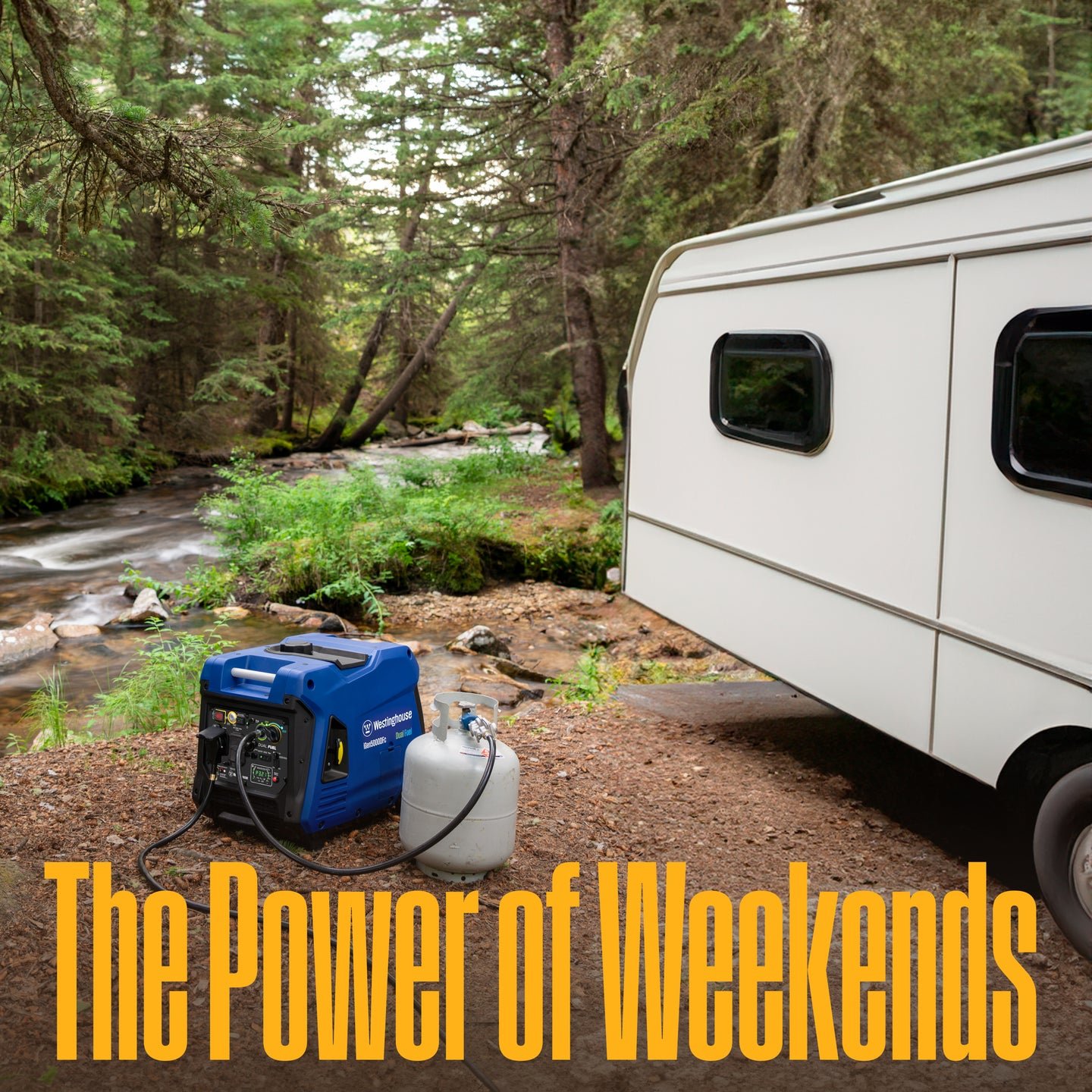
The TT-30R receptacle is the clearest reason to consider this an RV-ready inverter generator. It gives a 30-amp RV a direct 120-volt connection through a suitable cord, with the generator’s 3,900-watt gasoline rating setting the real power ceiling. A 30-amp RV pedestal may nominally represent up to 3,600 watts at 120 volts, so careful load management remains useful even though the generator’s running rating is slightly higher.
At a campsite, placement and etiquette matter as much as electrical capacity. Confirm campground rules, quiet hours and fire restrictions before arrival. Route a properly rated outdoor cord where it will not create a trip hazard or sit in water. Keep exhaust pointed away from people and occupied spaces, and do not place the generator where fumes can collect under an awning or between closely parked vehicles.
Tailgating and base-camp use are similarly plausible when local rules permit it. The household outlets can run smaller appliances while the data display helps track load. Still, “super quiet” is relative. Westinghouse lists a low figure of 52 dBA without publishing a full noise curve for every load and distance on the product page. Expect engine speed and sound to rise as electrical demand increases.
Starting, controls and daily usability
Three starting methods reduce friction. Wireless remote start is convenient when the generator is already positioned safely and the pre-start checks are complete. Push-button electric start provides an onboard option, and recoil start offers mechanical backup. An automatic choke simplifies cold starts, while the fuel selector makes the chosen fuel source explicit.
Remote start should not replace a walk-around inspection. Before starting, confirm the generator is outdoors on a stable, dry, level surface; check oil and fuel connections; disconnect or switch off loads; and verify that exhaust has a clear path away from occupied areas. Never use a remote to start a generator you cannot safely observe.
The telescoping suitcase handle and never-flat wheels make relocation easier on pavement and firm ground. They do not make 105.8 pounds disappear. Loading the unit into a truck bed or storage bay may require two people or a ramp rated for the weight. Dimensions of 24.5 by 17.5 by 20 inches should be checked against the actual RV compartment or vehicle opening before purchase. Fuel-burning generators must not operate inside those storage compartments.
Noise and power quality
Westinghouse advertises noise as low as 52 dBA and uses an enclosed body, low-tone mufflers and variable engine speed. The wording “as low as” is important because the product page does not tie that number to every operating load. Inverter generators are often most pleasant under modest demand; a heavy air-conditioner or appliance load asks the engine to work harder.
The manufacturer specifies total harmonic distortion of 3% or less. That supports use with laptops, chargers and other electronics within the generator’s outlet and load limits. Clean output does not eliminate the usual precautions: keep connections dry, use outdoor-rated cords of adequate gauge and follow device instructions. A surge protector cannot compensate for an overloaded generator or an unsafe grounding arrangement.
Carbon monoxide and electrical safety
Use portable generators outdoors only. Never run the iGen5000DFc inside a tent, RV, van, garage, shed or any enclosed or partially enclosed sleeping or living area. Do not operate it under an enclosed awning or near doors, windows, vents and other openings. Follow Westinghouse’s required distance, exhaust-direction and ventilation instructions every time.
The built-in carbon-monoxide sensor can shut the generator down when it detects a dangerous accumulation near the unit. Treat that as an additional layer of protection, not permission to reduce separation or operate indoors. Wind can shift, exhaust can travel, and a sensor on the generator does not measure every occupied space. Propane and inverter technology do not eliminate carbon-monoxide risk.
Use working battery-powered CO alarms in an RV or home according to the alarm and vehicle instructions. Keep the generator dry and do not handle plugs with wet hands. Westinghouse documents overload protection and automatic low-oil shutdown, but neither substitutes for proper load calculation, grounding decisions or maintenance. The U.S. Consumer Product Safety Commission also advises operating portable generators outside and away from structures.
Runtime claims in context
The headline runtimes—up to 18 hours on gasoline and 22 hours on propane—are both specified at 25% load. One quarter of the gasoline running rating is about 975 watts; one quarter of the propane rating is about 875 watts. An RV air conditioner plus converter and appliances can draw substantially more, so buyers should not use the maximum runtime figures as an overnight guarantee.
Runtime varies with load, economy mode, temperature, elevation, fuel energy and maintenance. The useful planning method is to identify essential loads, reduce unnecessary electrical heating loads, and keep reserve fuel within safe storage rules. For emergency use, test the power plan outdoors before a storm rather than discovering incompatible plugs, cords or startup surges during an outage.
Maintenance and long-term ownership
The engine requires SAE 10W-30 oil, with an official capacity of 20.3 ounces (0.6 quart). Check the manual for the break-in service and current maintenance intervals rather than relying on a generic generator schedule. The hour meter makes those intervals easier to track. Oil level matters because the unit has automatic low-oil shutdown, but repeated shutdowns should never become the method for deciding when to add oil.
Gasoline ownership requires extra attention during storage. Stale fuel can create starting and carburetor problems, so follow the manual’s fuel and storage procedure. Propane can reduce that particular storage burden, although the regulator, hose and cylinder still need inspection and protection. Allow the generator to cool before service, refueling or storage.
Access panels are designed to make oil and battery service reachable, and the included battery float charger can help maintain electric-start readiness. The recoil starter remains valuable after long storage, but it should not be treated as a substitute for battery care. Record the serial number, retain proof of purchase and review what the residential warranty excludes.
See the Westinghouse iGen5000DFc listing on Amazon →
The most important limitations
Weight is the first limitation. A 105.8-pound dry generator is portable on wheels but awkward over steps, gravel and truck tailgates. Add fuel, cords and a propane cylinder and the total system occupies meaningful cargo space. Measure before buying and plan how two people will load it safely.
Second, the output is 120 volts only. It cannot directly satisfy 240-volt loads and is not a whole-home solution. Third, propane operation reduces continuous output to 3,500 watts. That remains useful for many RVs, but it leaves less margin for simultaneous compressor and heating loads.
Finally, this is still a combustion engine. It needs outdoor placement, ventilation, fuel management, oil changes and periodic exercise. Buyers who primarily want quiet overnight power for phones, lights and a refrigerator may be better served by a battery power station. Buyers who need central air conditioning, well pumps or broad home circuits may need a professionally designed larger backup system.
Who should buy the Westinghouse iGen5000DFc?
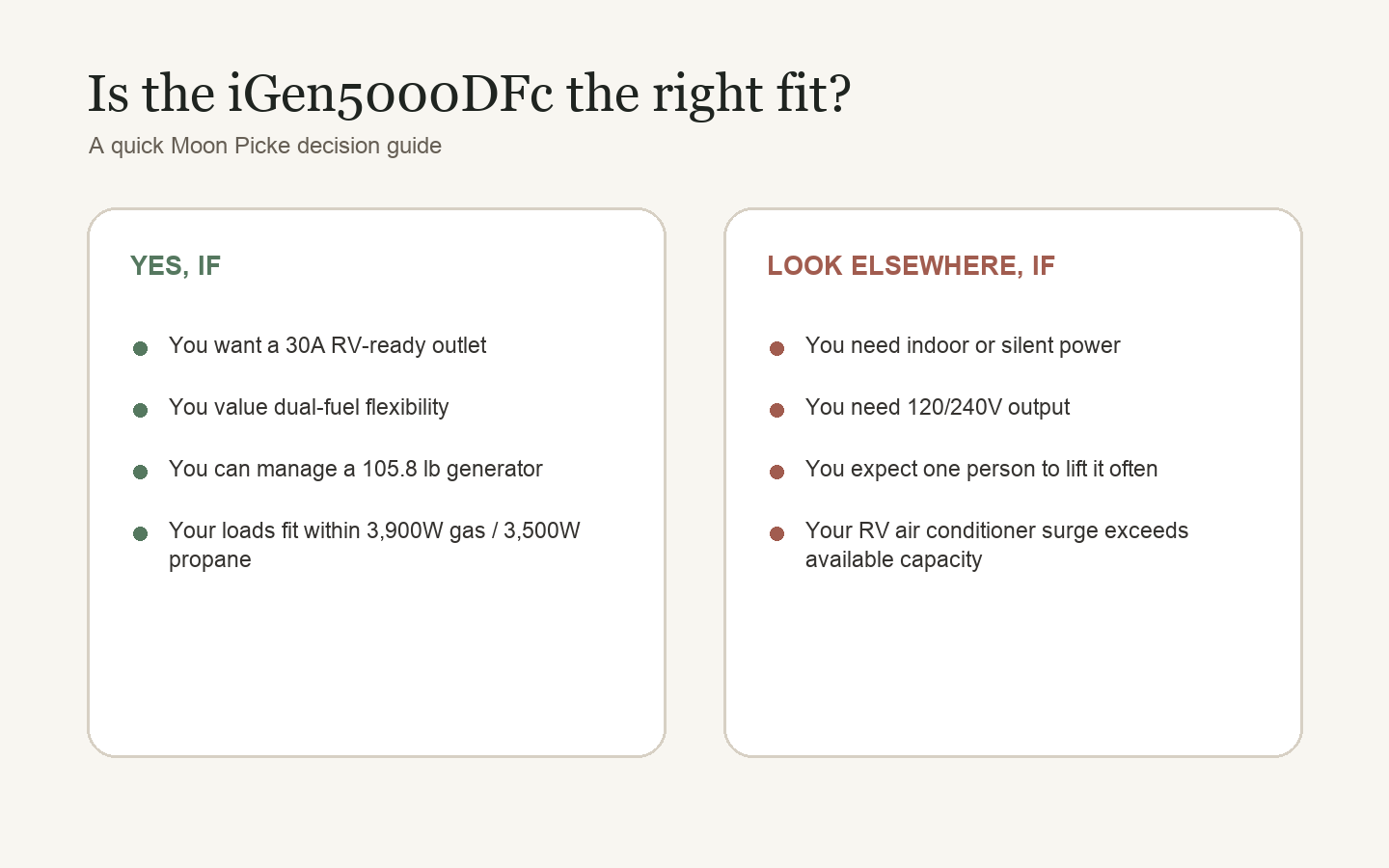
Choose it if you have a 30-amp RV, want one generator for campground-compliant daytime use and emergency essentials, and value the option to switch between gasoline and propane. It is particularly sensible when you want remote electric start, useful onboard load information and enough running capacity to manage one major RV compressor load with smaller essentials.
Skip it if portability means lifting alone, if you need 240 volts, or if your planned loads exceed its documented running and starting limits. Also skip any fuel generator if you lack a safe outdoor operating location. A battery system may be a better companion for generator-prohibited sites and quiet hours, even if it cannot match continuous fuel-based runtime.
Final verdict
The Westinghouse iGen5000DFc review comes down to a useful balance: it offers more practical RV capability than a small inverter generator while remaining easier to place and manage than an open-frame home-backup model. The 30-amp RV outlet, 3,900 gasoline running watts, dual-fuel system, three starting methods and long light-load runtime claims all support that role.
Its compromises are clear rather than hidden. The unit is heavy, limited to 120 volts and less powerful on propane. Noise rises with demand, and every fuel choice requires strict outdoor-only operation. If those limits fit your plan, the iGen5000DFc is a strong premium choice for an RV, a prepared campsite or carefully prioritized outage essentials.
Check availability and current Amazon price →
Sources and methodology
Specifications and runtime figures were checked against the official Westinghouse product page and the official owner’s manual. Purchase availability and configuration were checked against the Amazon listing. Moon Picke did not perform first-party testing for this article. Learn more about how we evaluate products.