
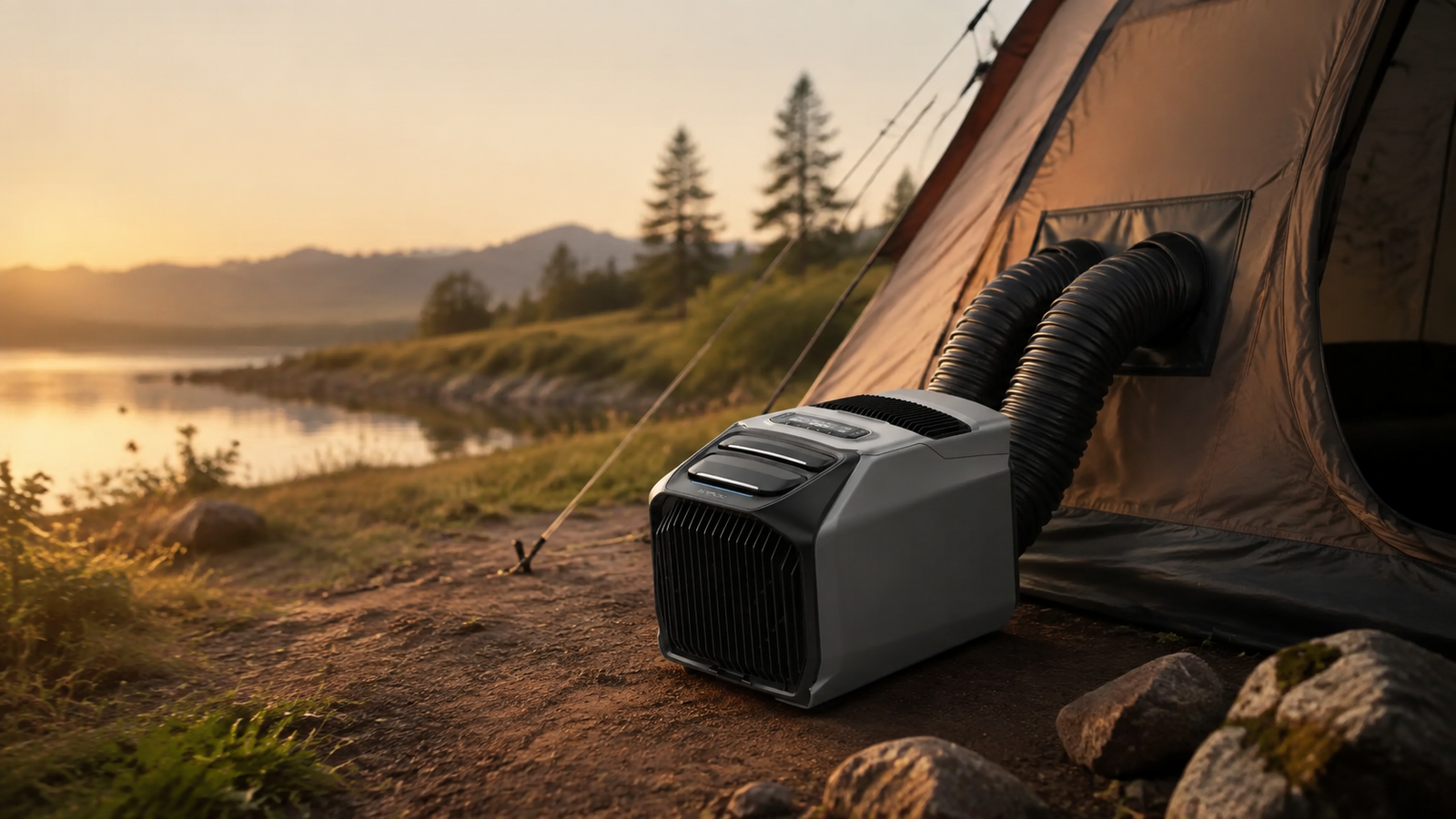
This EcoFlow WAVE 3 review examines the exact portable air conditioner bundled with its 1,024Wh Add-on Battery and drain pipe. It is designed for car campers, van users, and small RV owners who need genuine compressor cooling without a permanently installed system. Its main attraction is 6,100 BTU cooling with several power options. Its largest compromise is the setup: the unit and battery weigh about 55.1 pounds together, and effective cooling still depends on exhaust routing, insulation, space, and available energy.
As an Amazon Associate I earn from qualifying purchases.
Check the EcoFlow WAVE 3 with Add-on Battery on Amazon
EcoFlow WAVE 3 Review: Quick Verdict
The EcoFlow WAVE 3 is best for vehicle-based travelers cooling a tent, compact van, or small RV zone with a deliberate exhaust and power plan. Its strong 6,100 BTU compressor system and removable battery make it more capable than a fan or evaporative cooler. However, battery runtime is finite and the combined package is heavy. It is worth considering when targeted cooling matters more than effortless portability or whole-vehicle coverage.
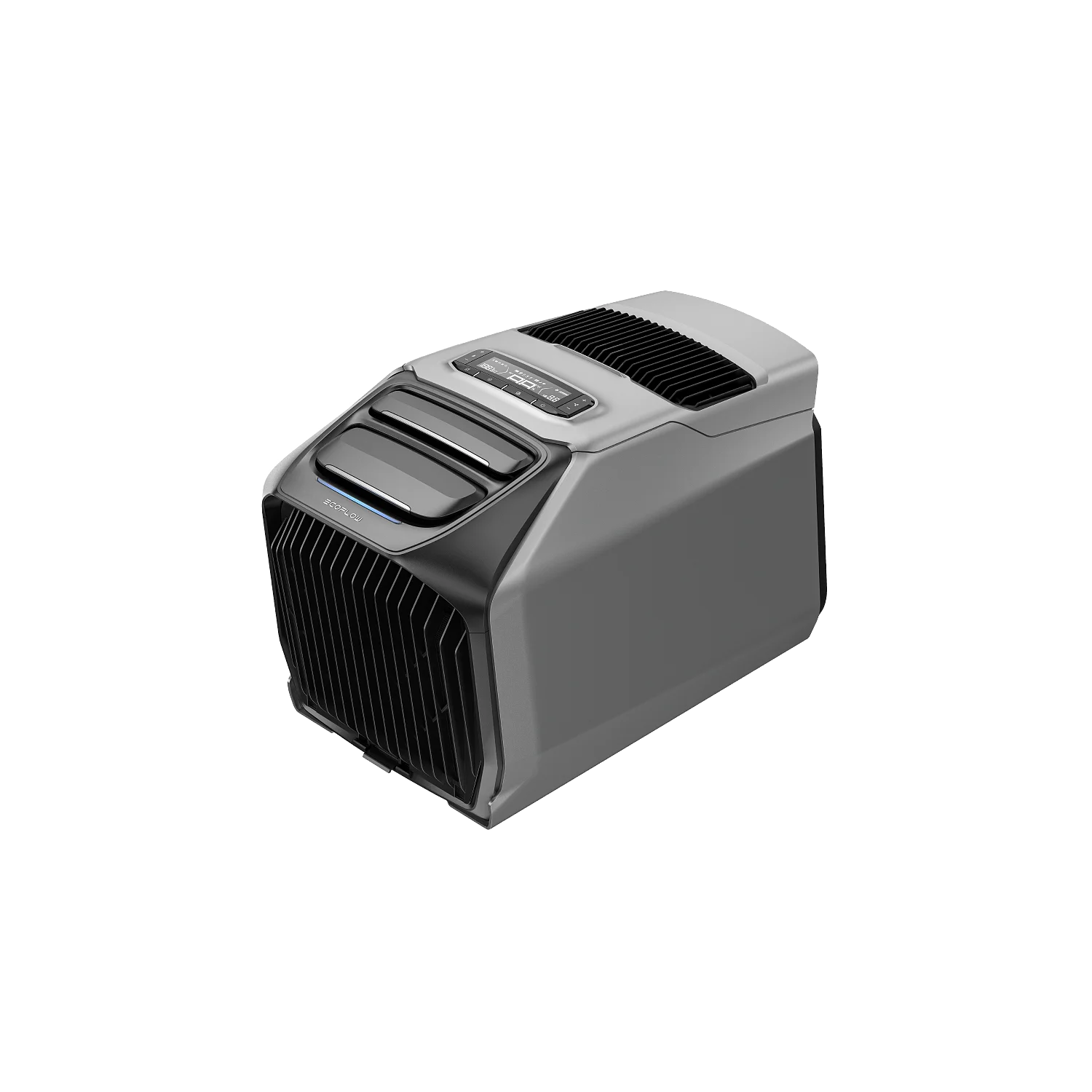
EcoFlow WAVE 3
The EcoFlow WAVE 3 is best for vehicle-based travelers cooling a tent, compact van, or small RV zone with a deliberate exhaust and power…
- Genuine compressor cooling: 6,100 BTU provides more useful heat removal than a fan or passive evaporative device.
- Cooling and heating: the same unit supports seasonal use with a documented 6,800 BTU heating capacity.
- Useful controls: physical operation and app access serve both simple and remote setups.
Affiliate link. Moon Picke may earn a commission from qualifying purchases.
What Is the EcoFlow WAVE 3?
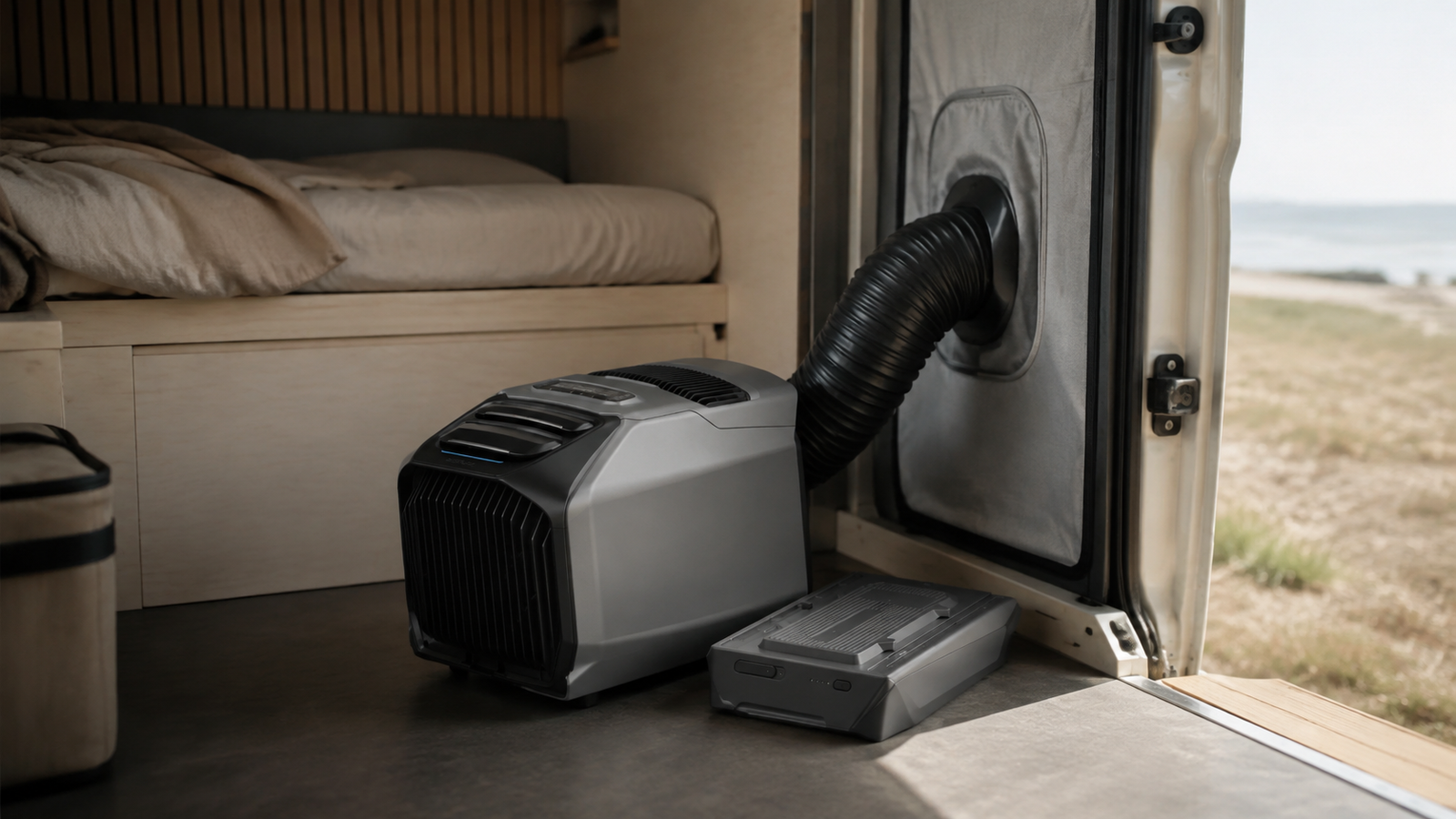
The WAVE 3 is a portable compressor air conditioner and heater. EcoFlow rates it for 6,100 BTU of cooling and 6,800 BTU of heating, with cooling, heating, automatic, fan, and dehumidification modes. The reviewed Amazon configuration includes the WAVE 3, insulated exhaust hardware, drain pipe, and the detachable 1,024Wh Add-on Battery.
It is not a battery-powered fan and should not be treated like one. Air conditioning moves heat from one place to another, so hot-side airflow must be routed away from the cooled space. The battery adds cordless operation, but the appliance still needs correctly arranged ducts, ventilation, and condensate management.
Key Specifications
| Specification | EcoFlow WAVE 3 |
|---|---|
| Cooling capacity | 6,100 BTU (1,800W) |
| Heating capacity | 6,800 BTU (2,000W) |
| Temperature setting range | 60.8–86°F (16–30°C) |
| Rated cooling input | 690W AC / 640W DC |
| AC input | 100–240V, 50/60Hz, 820W maximum |
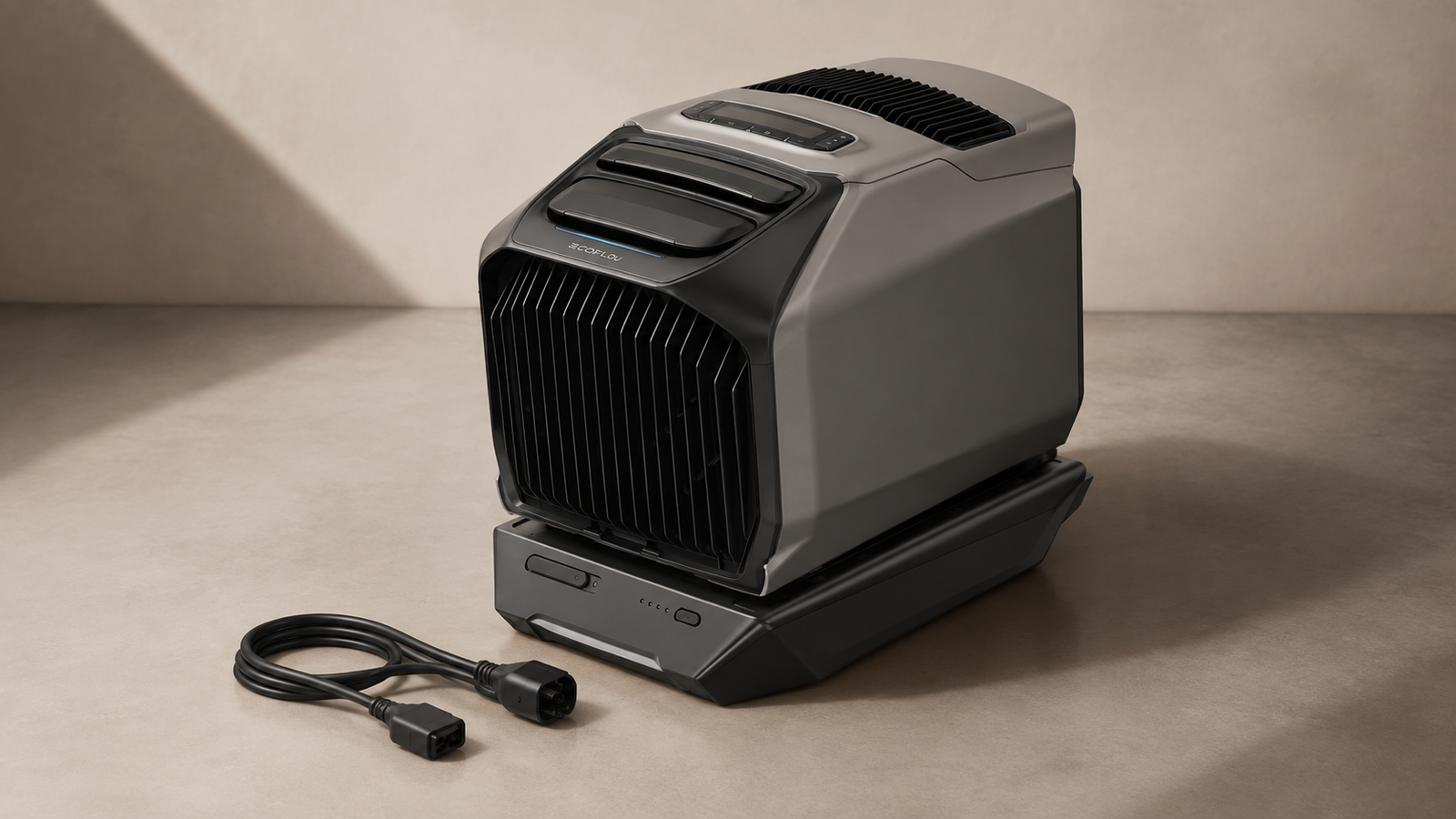
| Add-on Battery | 1,024Wh LFP; 700W maximum input to WAVE 3 |
| Official battery runtime | 2–8 hours, depending on operation |
| Unit dimensions | 20.4 × 11.7 × 13.2 inches |
| Unit net weight | Approximately 33.7 lb |
| Battery net weight | Approximately 21.4 lb |
| Noise specification | 44–58 dB |
| Connectivity | EcoFlow app via Wi-Fi and Bluetooth |
| Water-resistance ratings | WAVE 3: IPX4; Add-on Battery: IP65 |
These figures come from EcoFlow’s US specifications and manual. Ratings describe the product under defined conditions; they do not promise the same comfort or runtime in every tent, van, or RV.
Cooling Performance and Realistic Expectations
Cooling capacity and BTU
A 6,100 BTU rating gives the WAVE 3 meaningful cooling capacity for a portable unit. It can remove heat rather than merely move air across skin, making it useful when high humidity or still air makes a fan insufficient. EcoFlow also lists a 330m³/h airflow volume and a 60.8–86°F temperature-setting range.
BTU is only one part of the result. The rating cannot identify how quickly a particular shelter will cool, how evenly cold air will spread, or whether the unit can overcome direct afternoon sun. Those outcomes depend on the total heat entering the space and how efficiently exhaust heat leaves it.
Tent versus van versus RV cooling
A compact, shaded tent has little air volume but typically poor insulation and many air leaks. It may respond quickly near the cold-air outlet, yet lose that cooling rapidly through thin fabric and sun-heated surfaces. A small insulated van can retain cool air better, but metal body panels and windows still collect solar heat. A larger RV has more interior volume, partitions, appliances, and glazing, so one portable unit is better viewed as targeted or zone cooling rather than a universal replacement for installed HVAC.
Why insulation and ambient temperature matter
The larger the difference between outdoor and desired indoor temperature, the harder the compressor must work. Shade, reflective window covers, insulated curtains, closed unused areas, and properly sealed duct openings can reduce heat gain without making unsupported performance promises. Direct sun, open doors, high humidity, and a long or restricted exhaust path increase the load.
Power, Battery Runtime and Charging
Battery operation
The detachable Add-on Battery stores 1,024Wh and uses LFP chemistry. EcoFlow claims two to eight hours of runtime. That broad range is appropriate because cooling power changes with mode, fan speed, set temperature, compressor cycling, ambient heat, and enclosure conditions. Eight hours should be treated as the favorable edge of an official range, not a guaranteed overnight result.
The WAVE 3 unit weighs about 33.7 pounds and the battery another 21.4 pounds. Attaching the battery creates a self-contained package, but separating them can make loading easier. The battery’s published life is at least 80% capacity after 4,000 cycles, a useful long-term specification rather than a promise about each session.
External power options
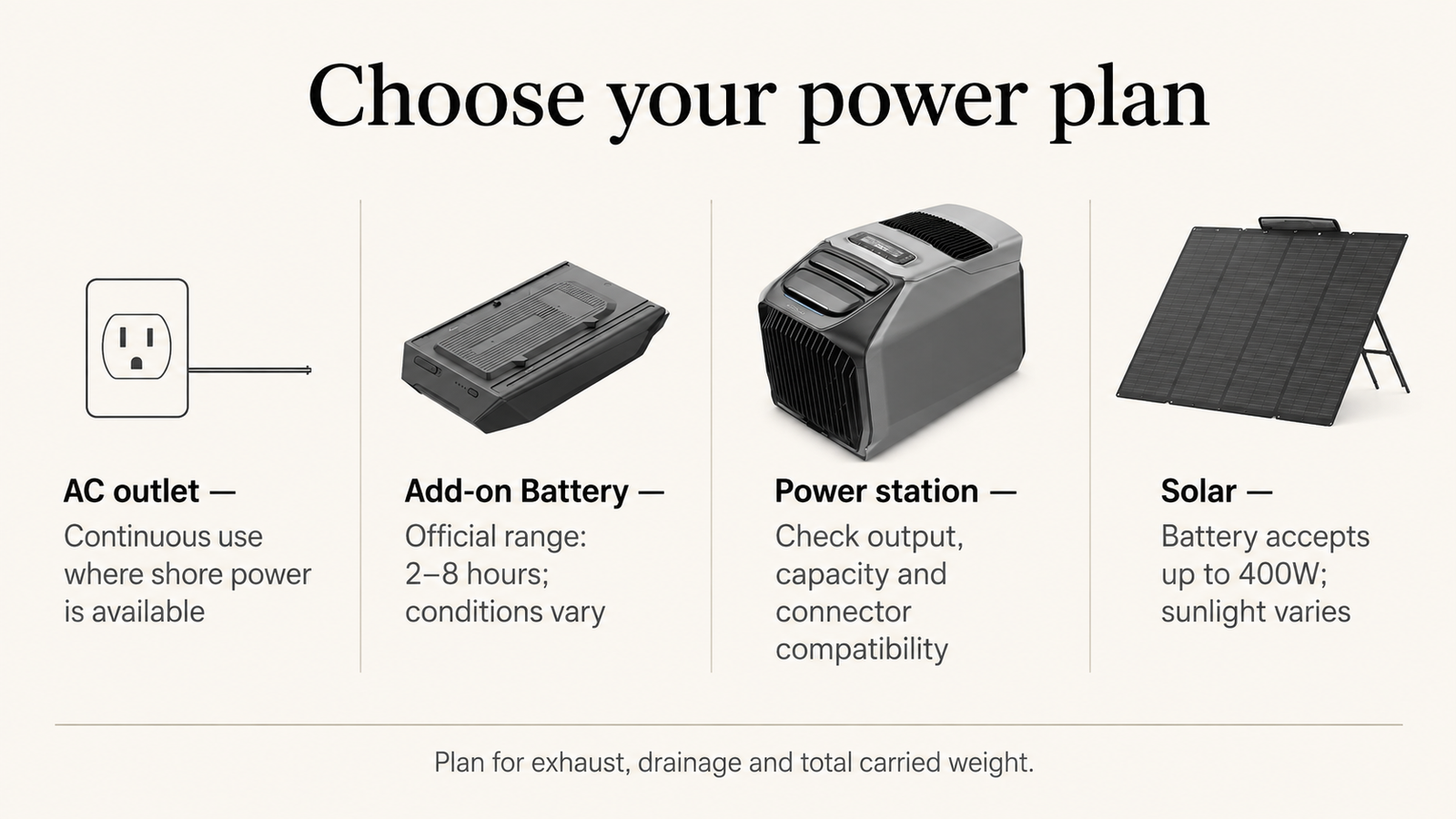
Shore power is the most straightforward option for continuous operation at home, an RV hookup, or a powered campsite. The WAVE 3 accepts 100–240V AC and is rated for up to 820W AC input. Its rated cooling demand is 690W on AC and 640W on DC, so the circuit and any extension equipment must be suitable for the load.
EcoFlow documents operation from the Add-on Battery and compatible EcoFlow portable power stations through the XT150 connection. A separate power station can extend use, but total runtime depends on usable battery energy, conversion losses, other connected loads, and the compressor duty cycle. Our Jackery Explorer 2000 v2 review explains why capacity, output, charging speed, and carried weight must be considered together.
Vehicle and solar charging
The Add-on Battery supports 12V/24V vehicle charging up to 200W and solar input from 11–60V up to 400W. EcoFlow estimates about 16.2 hours from a 12V/96W car source, 7.3 hours from 24V/192W, and approximately 3.6 hours from solar under ideal conditions. These are charging references, not guarantees. Driving time, socket behavior, panel angle, clouds, temperature, and simultaneous AC use all change the energy balance.
A vehicle socket may not replace energy as quickly as the air conditioner consumes it. Confirm how the socket behaves when the ignition is off and avoid assuming the starter battery is protected in every installation. Review the exact WAVE 3 battery bundle and included items.
Exhaust, Ventilation and Condensation
A portable air conditioner cannot simply sit inside a closed tent and cool indefinitely. The compressor produces a cold side and a hot side. If hot exhaust remains in the same enclosure, the unit recirculates its own heat and efficiency falls. EcoFlow supplies insulated ducts and adapter covers, and the manual instructs users to install the exhaust arrangement for outdoor use.
Ducts should follow the manufacturer’s diagrams and remain as direct and unrestricted as practical. A purpose-made tent port, van window panel, or RV opening is preferable to an improvised path that can collapse, leak, or pull hot air back inside. Keep required clearances and never obstruct the air inlets or outlets.
Moisture handling also matters. Cooling humid air creates condensate. The WAVE 3 includes a drain pipe and supports overflow shutdown, while the specifications do not list a blanket “no-drain” function. Drain behavior varies by humidity, operating mode, and installation. Follow EcoFlow’s placement and drainage guidance, keep the outlet path appropriate, and do not assume every climate is maintenance-free.
Portability and Real Camping Setup
The word “portable” describes a movable appliance, not a lightweight one. At 33.7 pounds, the WAVE 3 is manageable for many users but still an awkward compressor unit. Add the 21.4-pound battery, ducts, drain pipe, power cables, and protective storage, and the complete system becomes a substantial 55.1-pound load before other camping gear.
Its footprint is compact relative to room air conditioners, but allow space for ducts, drainage, cables, and ventilation. Carrying the unit and battery separately can make setup easier.
For tent use, protect the WAVE 3 from standing water and heavy weather even though the unit is rated IPX4. The battery has an IP65 rating, but that does not make the whole assembled system weatherproof. Keep electrical connections dry and use equipment only within official instructions.
Camping, Van and RV Use: Where It Fits Best
Tent camping
The best tent scenario is a vehicle-accessible, shaded campsite with a tent that can accept ducts without leaving a large opening. Directing cool air toward the sleeping zone can be more realistic than trying to hold a uniform residential temperature. Thin walls and sun exposure will limit efficiency, while the combined equipment weight rules out backpacking.
Van camping
A compact van is often the strongest fit. Insulation, window covers, and a fitted exhaust panel can create a more controllable space, while the battery enables short stops without shore power. The van must still provide safe duct routing and enough ventilation around the hot side. Do not operate it as though closing every opening automatically improves cooling.
RV and trailer use
In a small trailer or RV, the WAVE 3 can cool a sleeping area, supplement installed air conditioning, or provide a movable option when only one zone is occupied. Expecting 6,100 BTU to cool every full-size RV in direct sun is unrealistic. Shore power or a large energy reserve is generally more practical for sustained use than relying only on the Add-on Battery.
Controls, App and Everyday Usability
The physical control panel supports operation without a phone, while the EcoFlow app connects through 2.4GHz or 5GHz Wi-Fi and Bluetooth. The system offers automatic, cooling, heating, fan, and dehumidification modes, plus app functions such as a timer and Pet Mode documented in the manual.
Remote control is useful when the WAVE 3 sits near a tent wall or behind a van seat, but the basic setup should remain understandable without connectivity. EcoFlow specifies 44–58 dB, so “silent” would be inaccurate. Compressor speed, fan setting, mounting surface, and distance from the bed affect how noticeable it feels at night.
What It Does Well — and Its Main Limitations
What it does well
- Genuine compressor cooling: 6,100 BTU provides more useful heat removal than a fan or passive evaporative device.
- Flexible energy choices: shore power, the 1,024Wh battery, compatible power stations, vehicle charging, and supported solar input cover several travel patterns.
- Cooling and heating: the same unit supports seasonal use with a documented 6,800 BTU heating capacity.
- Useful controls: physical operation and app access serve both simple and remote setups.
- Detachable battery: separating the two components can make loading and storage easier.
Important limitations
- Finite battery runtime: the two-to-eight-hour official range leaves a large gap between light and demanding operation.
- Substantial combined weight: about 55.1 pounds before ducts, cables, or storage makes this vehicle-based gear.
- Exhaust is mandatory to plan: poor hot-air routing can undermine otherwise capable cooling.
- Condensate needs attention: the included drain pipe and overflow protection do not make every setup drain-free.
- Noise remains present: the 44–58 dB specification covers a meaningful range for sleeping areas.
- Premium system cost: accessories or more energy storage may be needed for ambitious off-grid use.
What Does It Really Cost to Own?
The reviewed configuration combines the WAVE 3, Add-on Battery, exhaust hardware, and drain pipe, but ownership cost depends on the intended energy plan. A fitted van panel, solar panel, compatible charging cable, larger power station, storage bag, or replacement ducts may add expense. Confirm bundle contents because similar listings may sell the air conditioner without the battery.
Rated cooling input is 690W on AC or 640W on DC, so battery capacity, charging time, and campsite electricity policies matter. Check the current Amazon configuration rather than relying on a volatile price.
Who Should Buy the EcoFlow WAVE 3?
The WAVE 3 is best for car campers, van users, small trailer owners, and RV travelers who want compressor cooling in a specific occupied zone. It is especially logical for someone who can create a proper duct opening and has shore power, regular driving time, solar capacity, or a compatible power station to supplement the battery.
Skip it if you backpack, need whole-RV cooling in severe heat, cannot route hot exhaust, or expect guaranteed all-night battery operation. A strong fan may be enough when airflow rather than lower air temperature is the actual need. A permanently installed RV system may fit better when large-volume cooling and routine shore-power use are priorities.
Is the EcoFlow WAVE 3 Worth Buying?
Yes, conditionally. It is worth considering when 6,100 BTU of targeted cooling can serve a compact enclosure and the buyer has a realistic plan for exhaust, drainage, and energy. The battery makes short off-grid use more convenient, but it does not remove the power budget. Tent fabric, van insulation, RV size, sun, and humidity determine how much comfort the same hardware can deliver.
It is less compelling when low carried weight, simple setup, or long battery-only runtime matters most. Buyers should measure the installation area and map the hot-air path before ordering. See the EcoFlow WAVE 3 with Battery and drain pipe on Amazon.
Final Verdict
This EcoFlow WAVE 3 review finds a capable premium portable AC for vehicle-based campers who understand that cooling is a system, not just a box. Its greatest strength is meaningful compressor cooling paired with a removable 1,024Wh battery and several charging paths. Its largest limitation is the combined burden of weight, ducts, drainage, and finite energy. Buy it for targeted cooling in a controlled tent, van, or small RV zone; choose another approach if you need whole-space HVAC or effortless portability.
Frequently Asked Questions
Is the EcoFlow WAVE 3 worth buying?
It can be worth buying for vehicle-based camping or a compact van/RV zone when proper exhaust and dependable charging are available. It is not ideal for ultralight travel or guaranteed whole-RV cooling.
Can the EcoFlow WAVE 3 cool a tent?
Yes, it can cool tent air, but results depend on tent size, shade, insulation, air leakage, humidity, exhaust routing, and outdoor temperature. Directing cool air toward the occupied area is often more realistic than expecting uniform residential comfort.
Can it cool an RV?
It can provide targeted cooling in a small RV or one occupied zone. Its 6,100 BTU rating should not be treated as a guarantee that it replaces installed HVAC in every RV.
How long does the Add-on Battery last?
EcoFlow specifies two to eight hours. Actual runtime varies with mode, set temperature, compressor activity, ambient heat, enclosure efficiency, and battery state.
Does the EcoFlow WAVE 3 need an exhaust hose?
Effective air conditioning requires the hot side to exhaust away from the cooled area. EcoFlow supplies insulated ducts and adapter covers and provides installation diagrams in the manual.
Does it need drainage?
The unit includes a drain pipe and supports overflow shutdown. Condensate behavior depends on humidity and operating mode, so follow EcoFlow’s drainage instructions rather than assuming it is always drain-free.
How much does the EcoFlow WAVE 3 weigh?
The US model weighs approximately 33.7 pounds. The Add-on Battery weighs about 21.4 pounds, making the combined hardware roughly 55.1 pounds.
Moon Picke separates documented facts from editorial judgment. Read How We Evaluate and our Affiliate Disclosure.