
Moon Picke independently researches products. If you buy through our links, we may earn a commission at no extra cost to you. Affiliate disclosure.
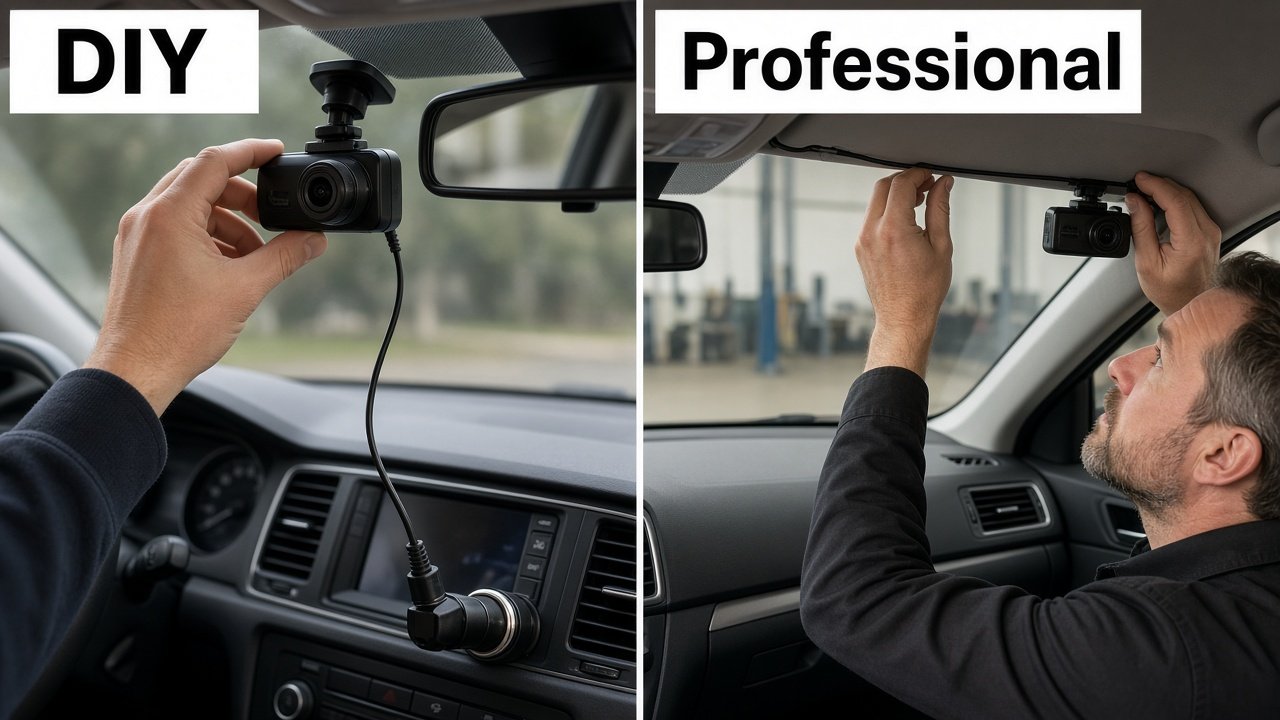
Dash cam installation cost is not one universal number. A simple front-only plug-in camera can be inexpensive to install yourself, while front/rear, hardwired, multi-channel, battery-pack, or hidden-recorder systems can justify professional labor. The total follows camera configuration, power method, vehicle, cable routing, accessories, and the local labor market. Hardware price is not the installed-system price. DIY vs professional is a complexity decision, not a morality test.
As an Amazon Associate I earn from qualifying purchases.
Dash Cam Installation Cost: Quick Answer
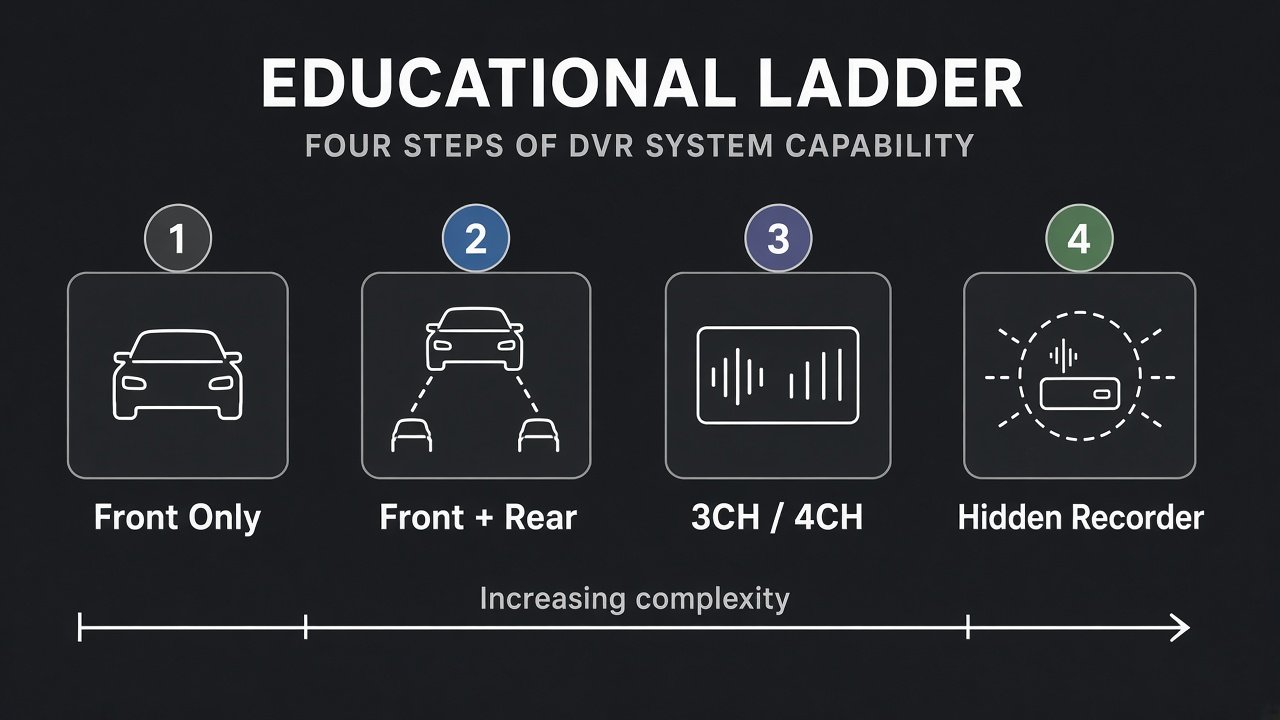
There is no honest single “always $150” figure. Quotes should name the camera, the vehicle, the power method, and whether accessories are included. Relative complexity still follows a pattern:
| Setup | Relative Complexity | DIY Suitability | Professional Value |
|---|---|---|---|
| Front-only plug-in | Low | High | Low/moderate |
| Front-only hardwire | Moderate | Moderate | Moderate |
| Front + rear | Moderate/high | Moderate | High |
| 3CH/4CH | High | Lower | High |
| Battery pack | Moderate/high | Varies | Moderate/high |
| Hidden recorder | High | Lower | High |
Do not treat this table as a price list. A hatchback rear cable can be harder than a sedan. A luxury trim panel can make a “simple” hardwire expensive.
How much does dash cam installation cost?
It depends on this camera configuration in this vehicle. Labor, power accessories, extra cameras, and storage all move the invoice. Manufacturer fitting SKUs are scoped examples, not a world average.
Is professional dash cam installation worth it?
It is more reasonable as physically separate cameras, hardwire or battery-pack parking power, hidden recorders, or complex trim increase. It is often optional for a front-only 12V plug-in mount.
Is it cheaper to install a dash cam yourself?
DIY removes a labor invoice. It does not make the install free: kits, tools, clips, time, and risk remain. Poor routing can cost more than a shop visit.
Does a rear camera cost more to install?
Usually yes in labor and parts, because of a long cable, a second mount, and hatch/trunk routing. There is no universal “+$50 everywhere.”
What Determines Dash Cam Installation Cost?
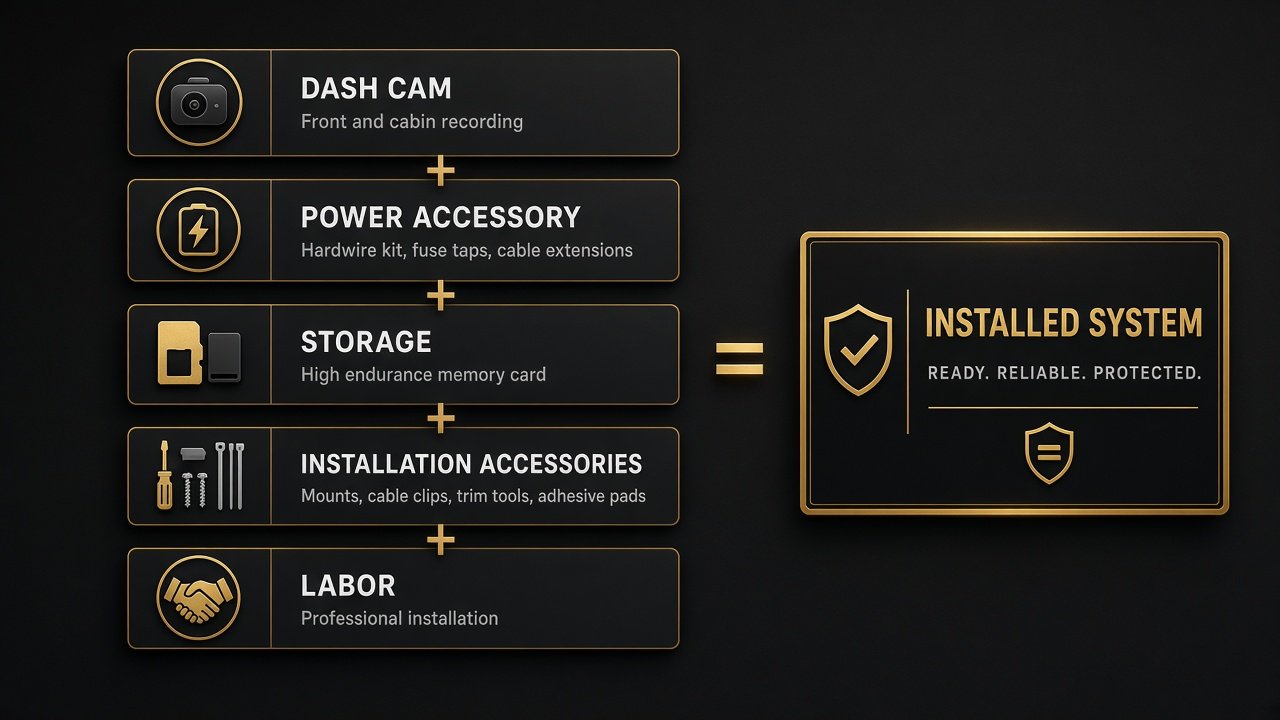
Think in a stack: dash cam hardware + power accessories + installation accessories + labor + optional battery/LTE + storage. Separate hardware from labor unless a quote explicitly bundles them.
Drivers include how many physically separate cameras; windshield vs mirror vs Box layout; 12V plug-in vs hardwire vs OBD vs battery pack; and sedan vs hatch vs SUV vs truck vs van vs convertible. Cable distance and rear-hatch wiring change more than a brochure “2CH” label. Modern vehicles can add curtain airbags, ADAS camera housings, rain sensors, factory cameras, powered tailgates, dense trim, and digital mirrors. Those features can increase complexity. They do not automatically raise every quote. A simple compact car can still be a short job; a short van can still be a long rear run.
LTE/cloud modules add hardware and sometimes an antenna. Do not assume an installer bills for app or account signup unless the quote says so. City and shop rates still sit on top of all of the above.
Front-Only Dash Cam Installation
A typical front-only job is a windshield mount, a power cable, and a 12V/USB connection, with optional hardwire later. Advantages: no rear cable, less trim, the simplest DIY path. Extra complexity starts when you hide the cable, add parking-mode power, or sit near factory cameras. A tidy headliner route still takes patience; stuffing a cable across a pillar that houses a curtain airbag is not a DIY flex. Nextbase Piqo is a compact screenless example: ClickMount on the glass, USB-C power, app aiming—not a hardwire tutorial. Professional installation is not required for every front-only camera. It is still reasonable if you do not want to route anything or you need parking power on day one.
See Nextbase Piqo (ASIN B0DD7Z338X), a simple front-only example, on Amazon →
Front and Rear Dash Cam Installation
Front + rear adds a rear mount and a long cable through a hatch or trunk. Body style matters: sedans, hatchbacks, SUVs, and trucks do not share one route. Do not invent labor hours. A Thinkware U3000 PRO-class 2CH windshield kit is still two cameras and one long run, even if both housings look small.
Example only—not a global rate. As of September 2026, Nextbase USA lists a “Front & Rear Cam Installation Standalone” SKU at $139 that includes a Nextbase hardwire kit (MSRP $29.99 on that page), for brand-new Nextbase cameras bought from Nextbase or an approved retailer, scheduled through InstallerNet at participating U.S. locations. Time “varies due to product location and/or vehicle type.” That is one vendor’s scoped service, not proof every shop charges $139.
Separately, Nextbase UK lists a “Pro Home Fitting Standalone (Includes Hardwire Kit)” at £139 for named Series models (the page cites 622GW, 522GW, 422GW or 322GW), UK mainland home/workplace fitting, Nextbase cameras only. The same UK standalone listing notes no rear-window camera cable is supplied with that SKU. Do not copy either figure onto a Vantrue, BlackVue, or WOLFBOX install in another country.
3-Channel and 4-Channel Installation
More channels can add a cabin camera, an extra exterior or rear camera, more cables, and more aim decisions. Channel count and the number of physically separate units both matter. Two cameras in one housing is not the same labor as four discrete modules. A 4CH Vantrue N5S-class kit is four mounts and four cable decisions, not “one extra hour.” Interior cameras need a legal, non-obstructive cabin position. Exterior extras need weather, angle, and another trim path. Architecture belongs on 1-channel vs 2-channel vs 3-channel dash cam. DIY suitability drops as trim panels multiply. Professional value is usually high.
See the Vantrue N5S (ASIN B0F8BWJHW4) as a multi-camera hardware example on Amazon →
How Hardwiring Changes Installation Cost
Hardwire work can include constant power, ACC/ignition, ground, low-voltage cutoff settings, and parking-mode configuration. That is extra complexity versus a cigarette-socket lead. This page does not teach fuse selection, tapping, splicing, or airbag-trim routing. Follow the camera and vehicle manuals, or pay a shop. OBD power can simplify some cameras if the vehicle and parking behavior fit, but the port may stay occupied. Power-method choice belongs on dash cam hardwire kit vs OBD cable. Hardwiring often raises professional dash cam installation cost because it is electrical work, not because the video file got better. Parking mode can turn a simple camera into a power-system job; see best dash cam for parking mode.
Battery Pack Installation Costs
A dedicated pack adds the battery itself, a mounting location, a charging feed, and camera output wiring. Some packs are themselves hardwired. Battery pack ≠ no installation. Compare power architectures on dash cam battery pack vs hardwire kit. Packs can raise hardware cost and still need professional mounting in a spare-wheel well, under a seat, or in a cargo cubby. Do not assume they are easier than a compact hardwire kit, and do not assume every pack fits every camera brand.
See the BlackVue B-130X Power Magic Ultra battery pack (ASIN B07QZ64ZK3) on Amazon →
Mirror and Hidden-Recorder Dash Cams
Mirror systems such as the WOLFBOX G900 Pro still need mirror attachment, display setup, a rear camera, a long rear cable, and sometimes a reverse-signal feature if that exact model supports it. Integrated looks do not mean low installation complexity. The rear camera is often required for the live-view benefit, so skipping it does not deliver the product you bought. Confirm the factory mirror still has room for straps or a bracket, and that HomeLink, auto-dimming, or sensors are not the reason you later pay a shop to undo the job.
Hidden-recorder systems such as the BlackVue DR970X Box add a separate recorder location, more cables, and optional LTE hardware. Less visible glass hardware can mean more hidden work behind trim: a recorder wants a dry, serviceable cavity, not a random kick panel. LTE is extra product complexity (module, SIM/eSIM, data plan), not proof that every regular dash cam is “more connected.” This page only flags the extra labor surface, not a product ranking.
DIY vs Professional: Pros and Cons
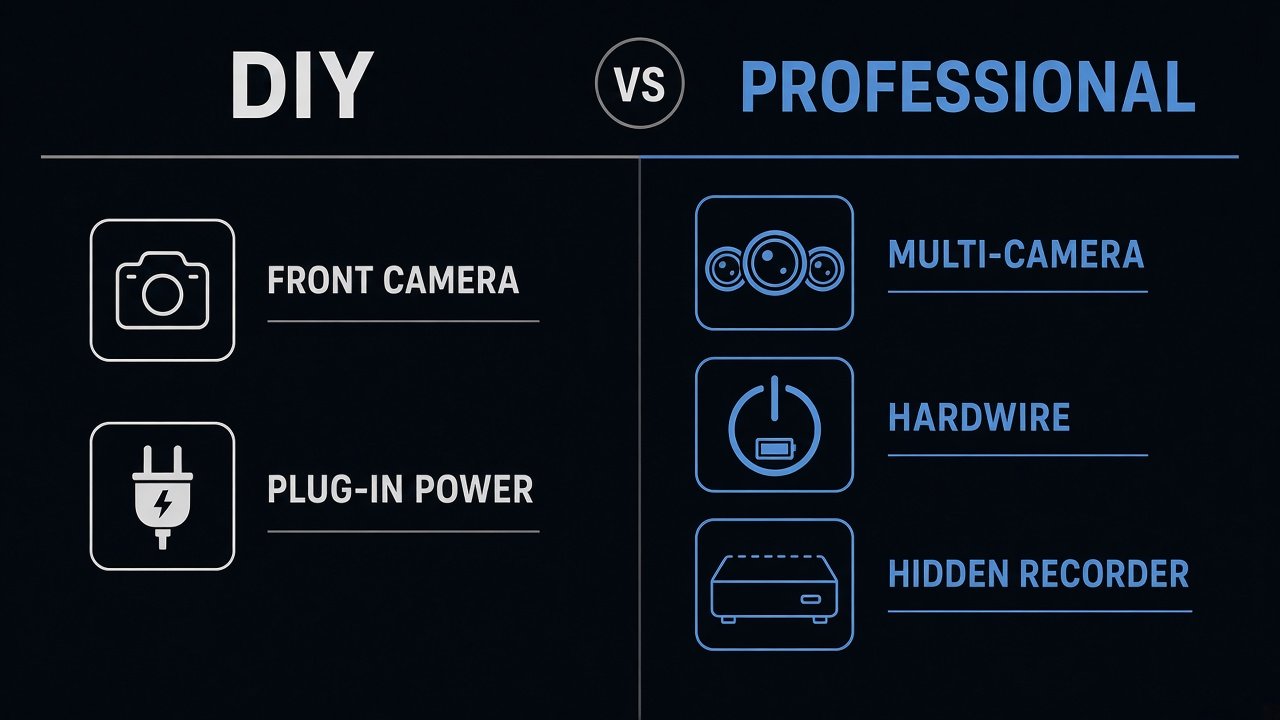
DIY dash cam installation can save the labor line, let you choose timing and camera angle, and is often practical on front-only plug-in kits if you can route cables without blocking the view or airbag paths. Downsides: time, trim-clip damage, messy cables, troubleshooting, and electrical work you should not improvise. You may still buy a hardwire kit, plastic trim tools, extra adhesive, and replacement clips. DIY removes the labor invoice, not necessarily all installation cost. Do not convert your Saturday into a fake hourly wage; just know the time is real.
Professional installation can be worth paying for on multi-camera routes, hardwire/battery parking power, Box/mirror-plus-rear jobs, and cars with dense trim. Value is cleaner routing and less owner time—not a guarantee the shop cannot make mistakes. Ask whether they have installed this exact system, whether hardwire and rear routing are included, which accessories are in the price, whether workmanship is warranted, whether later removal is quoted, and whether they know this vehicle type. Confirm if parking-mode voltage cutoffs will be set, not merely “wired.” Do not treat any shop as a directory listing here.
Warranty language stays conservative. Moon Picke does not claim DIY voids a vehicle warranty, or that a professional install protects every warranty. Implications depend on the vehicle, the product, the installer, jurisdiction, and what actually caused damage. Not legal advice.
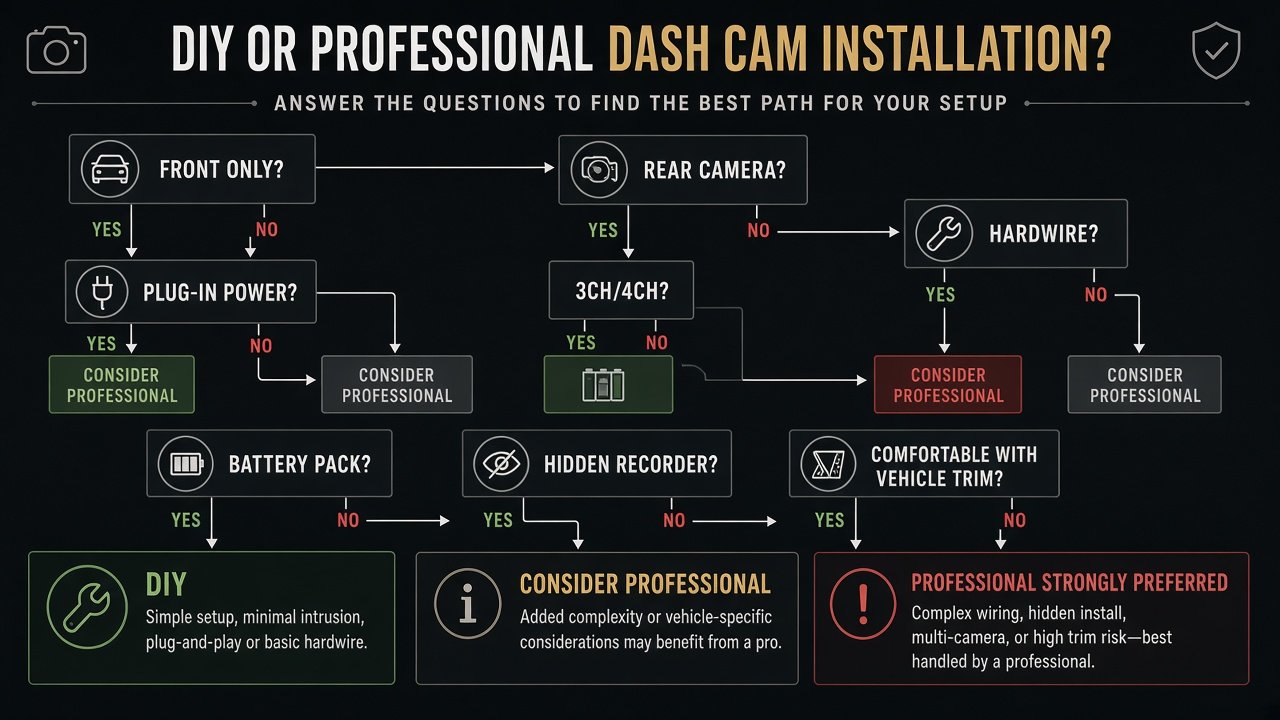
When Professional Installation Is Worth Paying For
Pay when you have 3CH/4CH, hardwire plus a battery pack, a hidden recorder, a complex or unfamiliar electrical layout, luxury trim you do not want to mark, or you are not comfortable working around airbags and factory cameras. A connected LTE camera can also add a module mount and antenna path even if the shop is not selling you a data plan. Skip the shop fee when the job is a front-only plug-in, you can mount high and safe, and you do not need parking power yet. Safety principles only: do not obstruct the driver’s view; avoid airbag paths; secure cables; follow manuals; use a qualified installer when the electrical work is beyond you. No step-by-step fuse work on this page.
Hidden Costs Buyers Often Forget
MicroSD (128GB / 256GB / 512GB) is often missing from the camera headline price; plan it with the dash cam SD card size guide, not as a labor mystery. Also budget a matching hardwire kit or OBD lead, a battery pack, LTE hardware, GPS pucks, rear extensions, spare adhesive, replacement clips, and possible professional removal when you sell the car. Parking mode is the usual reason a cheap camera becomes a power-accessory project.
How to Get an Accurate Installation Quote
Bring the exact dash cam model, number of cameras, vehicle make/model/year, plug-in vs hardwire, battery pack yes/no, LTE module yes/no, hatch vs trunk, and whether a hidden recorder must be placed. Ask the shop to split hardware vs labor if the first number mixes them. Ask what happens if a clip breaks, whether parking-mode cutoffs are configured, and whether the quote includes coming back if a rear camera needs re-aim. That is how you avoid fake universal averages and still plan dash cam installation cost for one car.
DIY vs Professional: Which Should You Choose?
DIY if the camera is simple front-only, power is plug-in, you can route cables safely, and you do not need a complex parking-power system.
Professional if you have front/rear or more cameras, hardwire, a battery pack, a hidden Box, dense trim, or any safety concern about electrical work.
The right question is not “How much does it cost to install a dash cam?” It is: what hardware and labor does this configuration require in this vehicle?
Final Verdict
Dash cam installation cost scales with system complexity, not simply the camera’s purchase price. Front-only plug-in work is often a fair DIY. Rear cables, extra channels, hardwire, battery packs, mirror-plus-rear kits, and hidden recorders are why shops exist. Use scoped vendor examples only as examples. Get a quote that names the car and the kit. No fake national average.
FAQ
How much does dash cam installation cost?
There is no universal figure. Configuration, vehicle, power method, accessories, and local labor set the number. Ask for a scoped quote.
Can I install a dash cam myself?
Often yes for a front-only plug-in mount if you follow the product manual and keep glass and airbags clear. Complexity changes the answer.
Does hardwiring cost more?
It usually adds accessory cost and more skilled labor than a 12V plug. How much depends on the vehicle and the shop—not a fixed adder.
Is professional installation worth it?
When the system is multi-camera, hardwired, battery-backed, hidden, or the trim is unforgiving. Not automatically for every puck on a windshield.
How long does professional dash cam installation take?
Vendors themselves say time varies by product location and vehicle. Do not plan your day on an invented hour count.
Does DIY installation void a vehicle warranty?
Do not assume a blanket yes or no. Warranty outcomes depend on facts, jurisdiction, and damage causation. Not legal advice.
Is a battery pack easier to install than hardwiring?
Not necessarily. Packs still need placement and charging connections; some are hardwired themselves.
Sources: Nextbase USA Front & Rear Cam Installation Standalone ($139 listing, hardwire kit included; retrieved September 2026); Nextbase UK Pro Home Fitting Standalone (£139 listing; retrieved September 2026); Nextbase Piqo product page; WOLFBOX G900 Pro / BlackVue Box installation architecture from manufacturer documentation previously cited on Moon Picke reviews; Vantrue N5S multi-channel kit documentation.