
The best ACOPOWER products are not seven copies of one kit. The US catalog covers roof kits, rigid panels, foldable panels, LiFePO4 batteries, matched systems, a high-capacity station, and portable fridge-freezers. A 200-watt rating is not 200 watts all afternoon. A charging kit is not a kit with a battery in the box. A fridge combo is not the fridge-only SKU.
These seven configurations come from ACOPOWER pages, datasheets, and the Li-Cube manual, checked on October 4, 2026. Moon Picke did not install or lab-test them. See our evaluation method and editorial standards.

Disclosure: Moon Picke may earn a commission if you purchase through links on this page, at no additional cost to you. Shop buttons use our publisher link. Manuals and policy pages are cited on their own. Details are in our affiliate disclosure.
Moon Picke readers can try code JACKYLONG for 10% off eligible ACOPOWER purchases. On October 4, 2026, the code took 10% off a US-currency cart of the configurations in this guide, including items already on sale. It did not apply to an empty cart. That is not 10% off every SKU. Check it at checkout.
Quick picks: best ACOPOWER products by job
| Product | Best for | Key specification | Price when checked |
|---|---|---|---|
| 100W PWM20A mono RV kit | Entry RV charging | One 100W panel, 20A PWM. Battery not in the description | $175.90 |
| 230W N-type panel, HY230-12MT | Fixed high-efficiency panel | 230W STC, 25.4% efficiency, IP67, MC4 | $239.80 |
| 200W lightweight foldable panel | Portable solar | 17.2 lb, folds to 42.2 × 21.5 × 2 in | $251.99 |
| Li-Cube 100Ah | 12V RV battery | 12.8V, 100Ah, 1,280Wh LiFePO4 | $498 |
| HYL200AH-M200W complete system | Matched off-grid kit | Two 100Ah batteries, two 100W panels, 1.5 kW inverter, 30A MPPT | $1,988 |
| P5000 station | High-capacity backup | 5,120Wh, 2,200W AC, 52 kg | $1,759 |
| LiONCooler Pro, fridge only | Portable cooling | 30L / 40L / 50L. Table lists −4°F to 43°F | $498 / $529 / $578 |
Prices and promotions can change. A compare-at price is the store’s displayed reference, not a past price we verified.
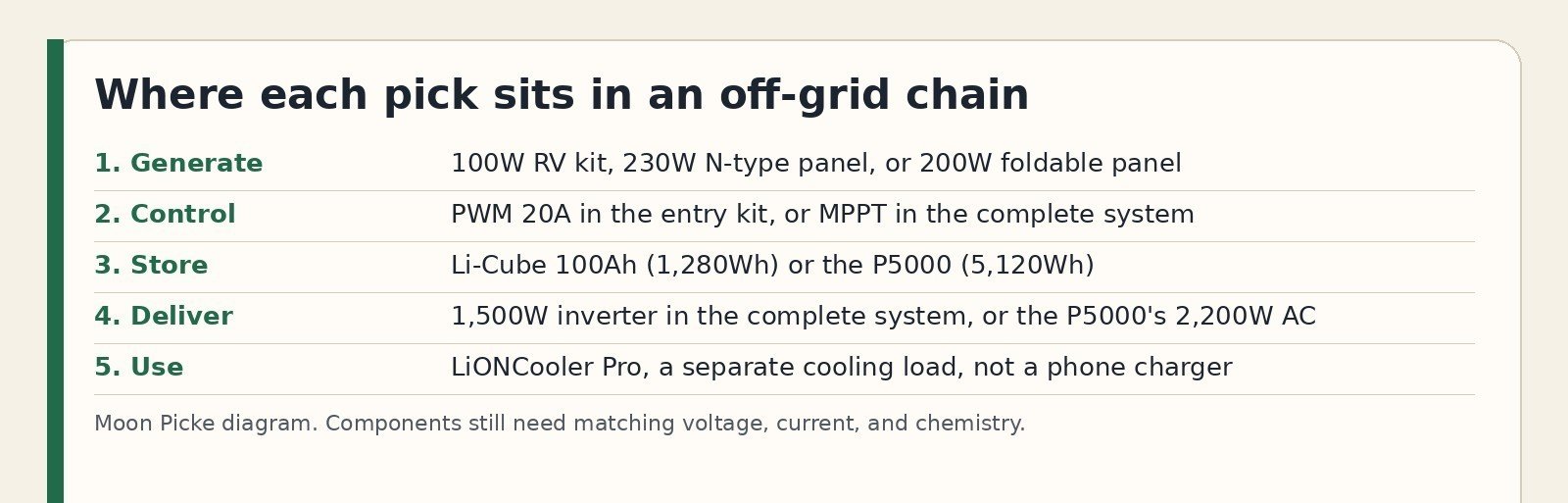
How we evaluated these ACOPOWER products
The store lists more than 150 products. We kept one configuration per job and left larger packs on the same 100W RV-kit page in the notes. Scoring used the published spec, what the box includes, portability, the warranty text for that SKU, and the price. Where a slogan and a table disagree, the table or the manual wins.
100W PWM20A RV kit — best entry RV solar kit
SKU HY-SPKM-100W20A is one 100-watt monocrystalline panel and a 20-amp PWM controller. The description says it recharges batteries and can run limited low-watt gear. It does not say a battery or an inverter is included.
On that page the 100W all-black panel is 100W, Vmp 17.48V, Imp 5.71A, Voc 22V, Isc 6.14A, 44.5 × 20.1 × 1.4 inches, and 20.9 pounds. The 20A PWM controller is 12/24V, 20A, maximum PV input 50V, IP65, 5.59 × 3.7 × 1.06 inches, and 1.1 pounds. The page gives panels a 5-year workmanship warranty and a 25-year 85% output warranty, controllers one year, and accessories one year.
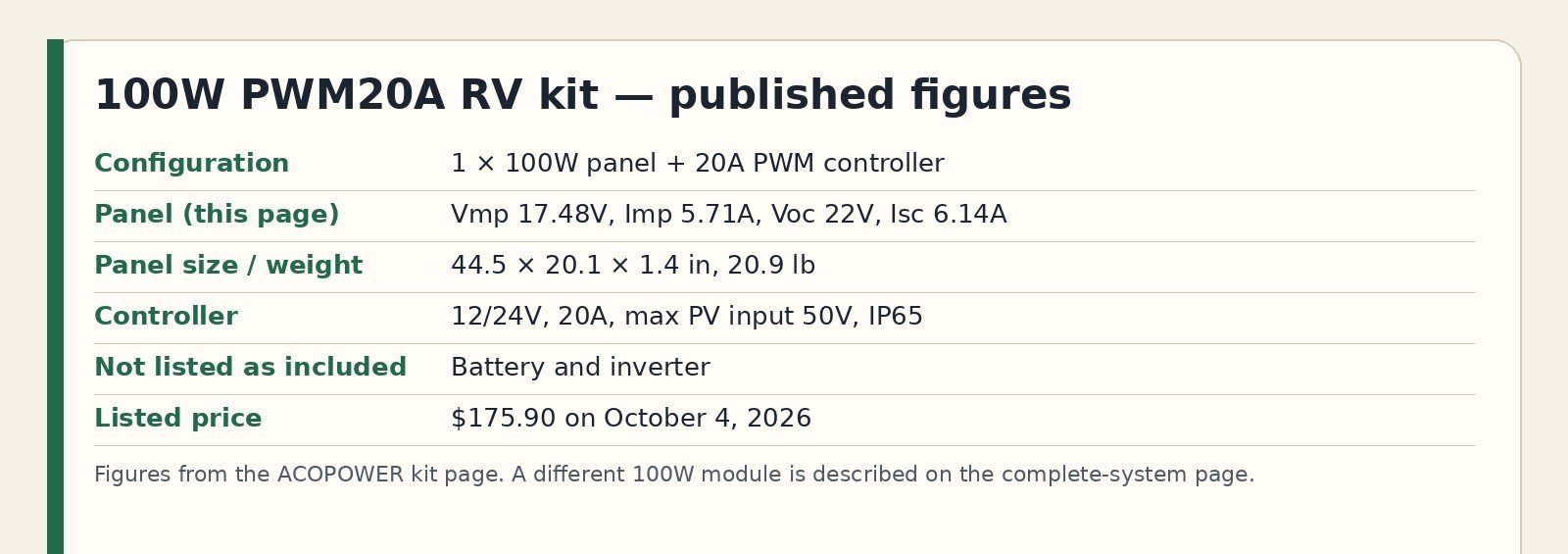
The same page scales to two through eight 100W panels with PWM or MPPT. Prices are uneven. When checked, 2×100W with MPPT 30A was $426.99 and 4×100W with MPPT 40A was $459.99. Compare the variant, not the wattage alone.
Buy it for a documented entry charge kit when you already have a compatible battery. Skip it if you need the battery, the inverter, or air-conditioning loads. Roof work belongs in the kit manual and with a qualified installer. This guide has no wiring steps. A plug that fits is not a matched system.
ACOPOWER listed this configuration at $175.90 when this guide was last checked. Prices and promotions can change.
Check ACOPOWER’s current price
230W N-type panel — best high-efficiency solar panel
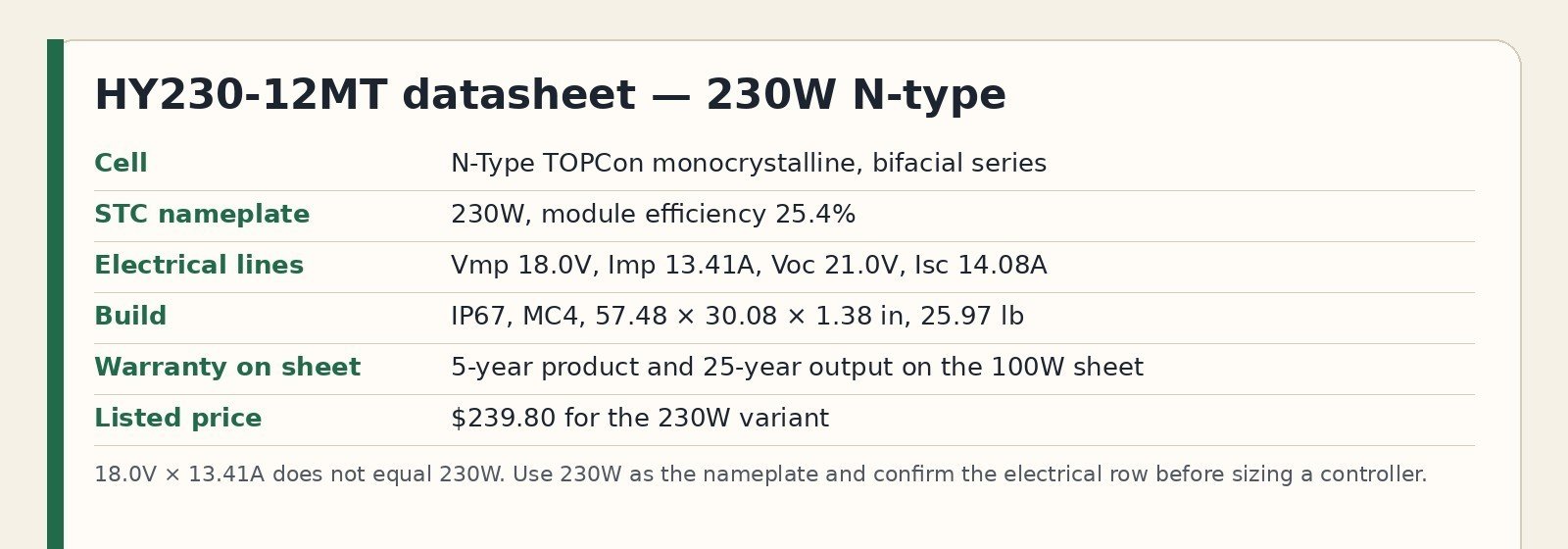
HY230-12MT is the rigid panel in this guide, listed at $239.80. The same page also lists 100W at $99.80, 125W at $129.80, and 150W at $159.80. Page copy says N-Type TOPCon cells and pre-drilled holes for Z-brackets, poles, and tilt mounts. Ignore the page’s meta description: it names a different solar brand.
The HY230-12MT datasheet lists 230W at STC, 25.4% module efficiency, IP67, MC4 connectors, 60 cells, 57.48 × 30.08 × 1.38 inches, and 25.97 pounds. Electrical lines read Vmp 18.0V, Imp 13.41A, Voc 21.0V, and Isc 14.08A. Those lines do not multiply to 230W, so keep 230W as the nameplate and confirm the row before you size a controller. The 100W datasheet in the series states a 5-year product warranty and a 25-year output guarantee. It does not print an 85% figure. Do not borrow that figure from the RV-kit page.
Buy it for a fixed array you will match to a controller. Skip it if you need a panel that folds into a car. Sun angle, shade, heat, and the controller all change real output. The module does not make 230 watts continuously.
ACOPOWER listed the 230W variant at $239.80 when this guide was last checked. Prices and promotions can change.
200W foldable panel — best portable solar panel
SKU HY-PLP-200WM is the panel you carry. The description says 17.2 pounds, a folded size of 42.2 × 21.5 × 2 inches, monocrystalline cells at up to 23% efficiency, a kickstand, and an IP68, ETFE-coated build. Those weather lines are description claims. Voc, Vmp, current, and connector type are not in the description, so they are not repeated here.
ACOPOWER says the panel can average 500 watt-hours a day depending on sunshine. That is the maker’s average, not a guarantee, and it is not 200 watts continuous.
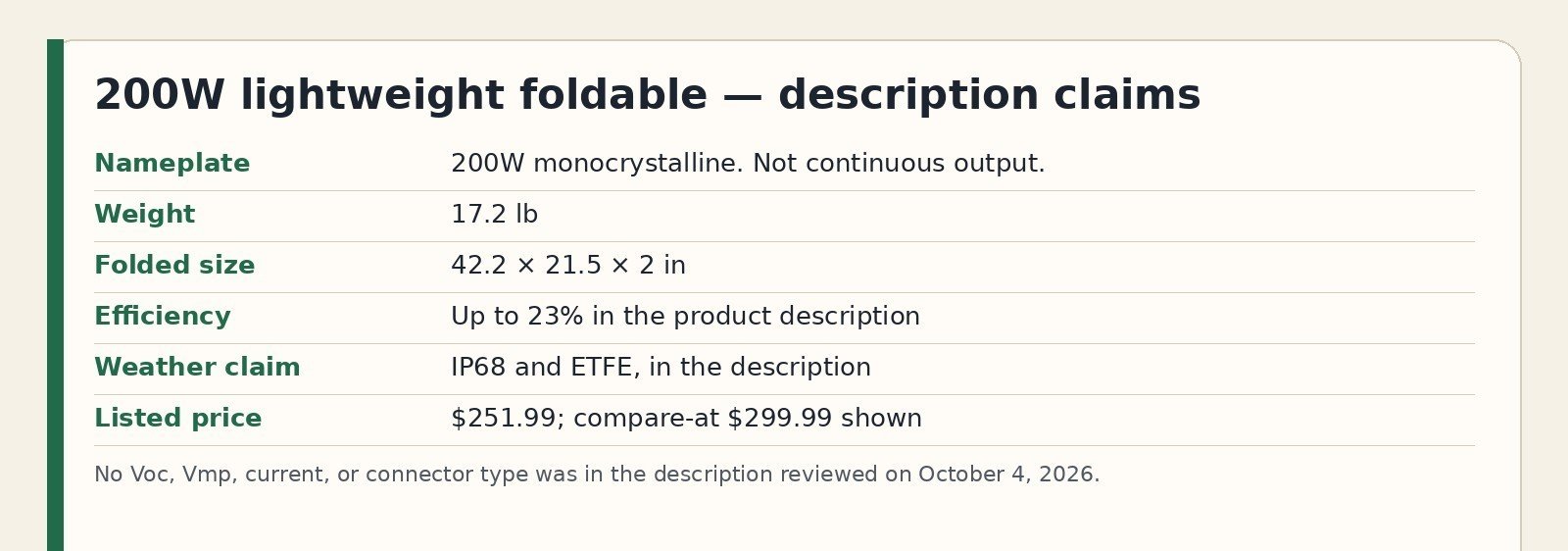
Buy it to move between camp and storage. Skip it as a roof array. Do not assume it feeds the P5000: that solar input is an XT60 at 12–120V and 15A, and this panel’s connector was not on the page we reviewed.
ACOPOWER listed it at $251.99 when this guide was last checked, with a compare-at price of $299.99. Prices and promotions can change.
Li-Cube 100Ah — best RV battery
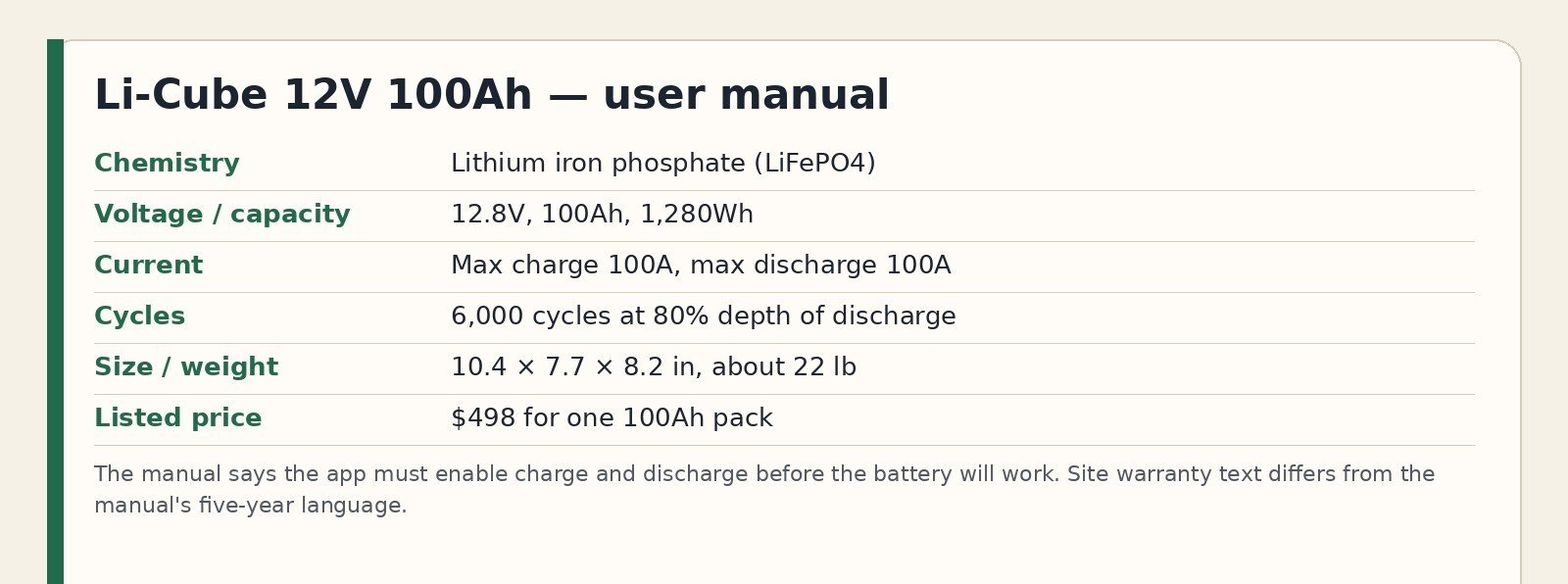
The Li-Cube is storage, not a power station. The featured buy is one 100Ah pack, SKU HYA12-Li100Ah. The manual calls it a lithium iron phosphate battery and lists 12.8V, 100Ah, 1,280Wh, 100A max charge, 100A max discharge, 6,000 cycles at 80% depth of discharge, about 22 pounds, 14.4V charge voltage, 10V cutoff, and 10.4 × 7.7 × 8.2 inches. On that spec page, charge temperature is about −4°F to 131°F and discharge about −40°F to 131°F. An earlier page prints a wider range. Use the spec page.
The manual says to install the app and turn on the charge and discharge MOS, or the battery will not charge or discharge. Terminals are M8. Series and parallel limits are in the manual, which also says not to mix chemistries. This article does not give a wiring plan.
The 230Ah page lists 12.8V, 230Ah, 2,944Wh, about 48.5 pounds, the same 6,000-cycle line, and 12.6 × 10.1 × 9.4 inches. Max discharge is printed as 200A. The charge line also shows “600A @ 0.1S,” which reads as a pulse, not a continuous charge rating. Confirm it before you buy a charger.
Warranty text conflicts. The manual and the short product description say five years for specified defects. The site warranty page covers products other than solar panels for one year, and battery cells only if you fully charge them within seven days and at least every six months. Ask which document controls the order.
Buy the 100Ah pack to replace a 12-volt battery you can charge correctly. Skip it if you wanted AC outlets. One 100Ah pack was listed at $498. The 230Ah pack was $998. A 230Ah pack plus an all-in-one unit was $1,847. Prices and promotions can change.
Complete lithium system — best matched off-grid kit
For generation, control, storage, and AC from one configuration, use a contents row. The featured row is Li200Ah 1.5kW / 200W MPPT30A, SKU HYL200AH-M200W, listed at $1,988.
That row lists two 100Ah batteries, two 100W panels, a 1.5 kW inverter, a 30A controller, a monitor, a switch, a 60A fuse, two Z-bracket sets, two pairs of battery cables, and the remaining cables marked yes. The name says Li200Ah. The table says two 100Ah batteries, not one 200Ah case. Each 12V 100Ah LiFePO4 battery on the page is 12.8V and 1,280Wh. The inverter is 1,500W continuous and 3,000W surge, pure sine. The 30A MPPT lists 8–32V battery voltage, 100V maximum PV open-circuit voltage, and 390W maximum PV input at 12V. Two 100W panels are a 200W nameplate, under that 390W line. Cold weather and series versus parallel wiring still change the design. Use the manual and a qualified installer.
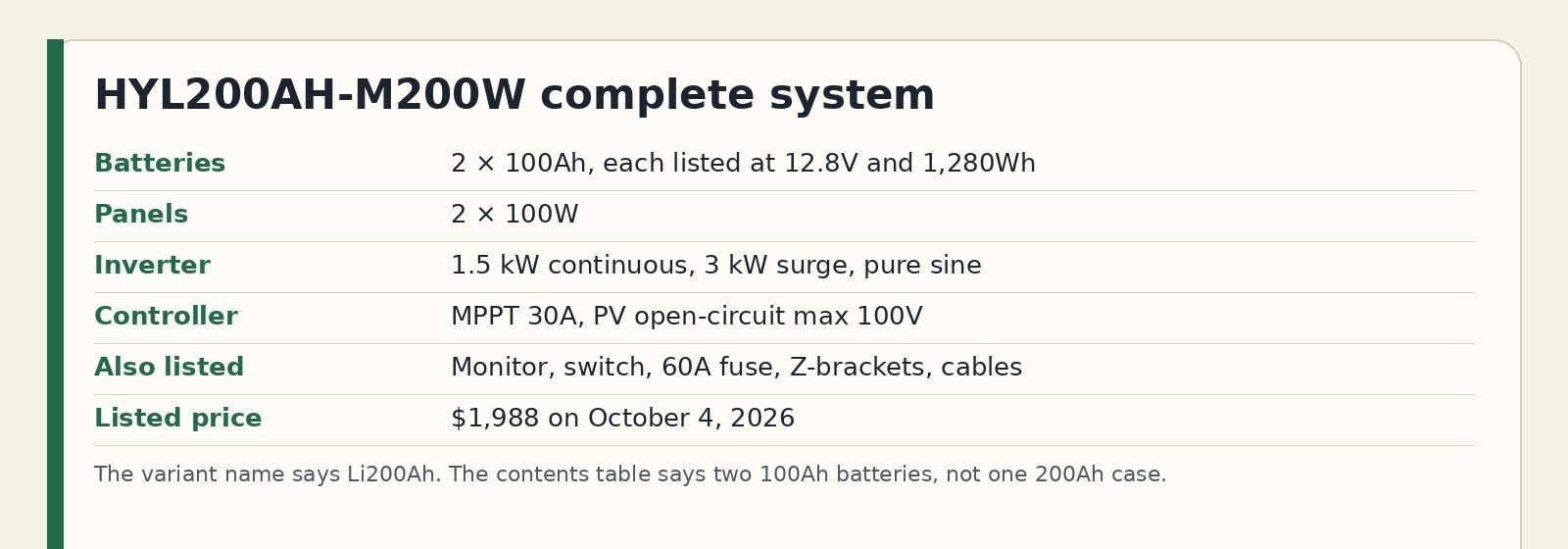
Other rows add panels, larger banks, or a 3 kW inverter. A no-panel row, HYL200AH, was $1,468. The 100W panel’s size and weight on this page do not match the 100W panel on the RV-kit page. Do not merge those descriptions. Buy the featured row for a matched starter system. Skip it for a suitcase panel, or for loads above 1,500W continuous.
ACOPOWER listed HYL200AH-M200W at $1,988 when this guide was last checked. Prices and promotions can change.
P5000 — best high-capacity portable power
The in-stock buy is the station alone, SKU HY-P5000. Bundles with one or two 200W panels were unavailable. The spec table lists LiFePO4, 5,120Wh, 5,000 cycles to 80%, operation at 32–104°F, and storage at −14–104°F. AC output is five outlets, 2,200W total, surge 4,000W. Surge is not continuous. Ports include two USB-A at 12W max, two USB-A QC at 18W max, two USB-C at 100W max, one 24V/10A, two 12V/3A, and one 12V/10A lighter socket. Solar input is one XT60, 12–120V, 15A, MPPT max 1,000W. Weight is 52 kg, about 115 pounds if that figure is exact. Size is printed L550 × W299 × H487 with no unit.
AC charging is maximum 1,800W at 200–240 Vac, maximum 15A. A standard US outlet is 120 volts. Confirm the input and the cord before you count on household charging. The description says a 1,400W uninterruptible supply. The table has no transfer time, so none is stated here. “Up to 10 years” in the description is not the warranty. The warranty cell says “1+2 Years (Subscribed).” This is high-capacity backup power, not whole-home backup.
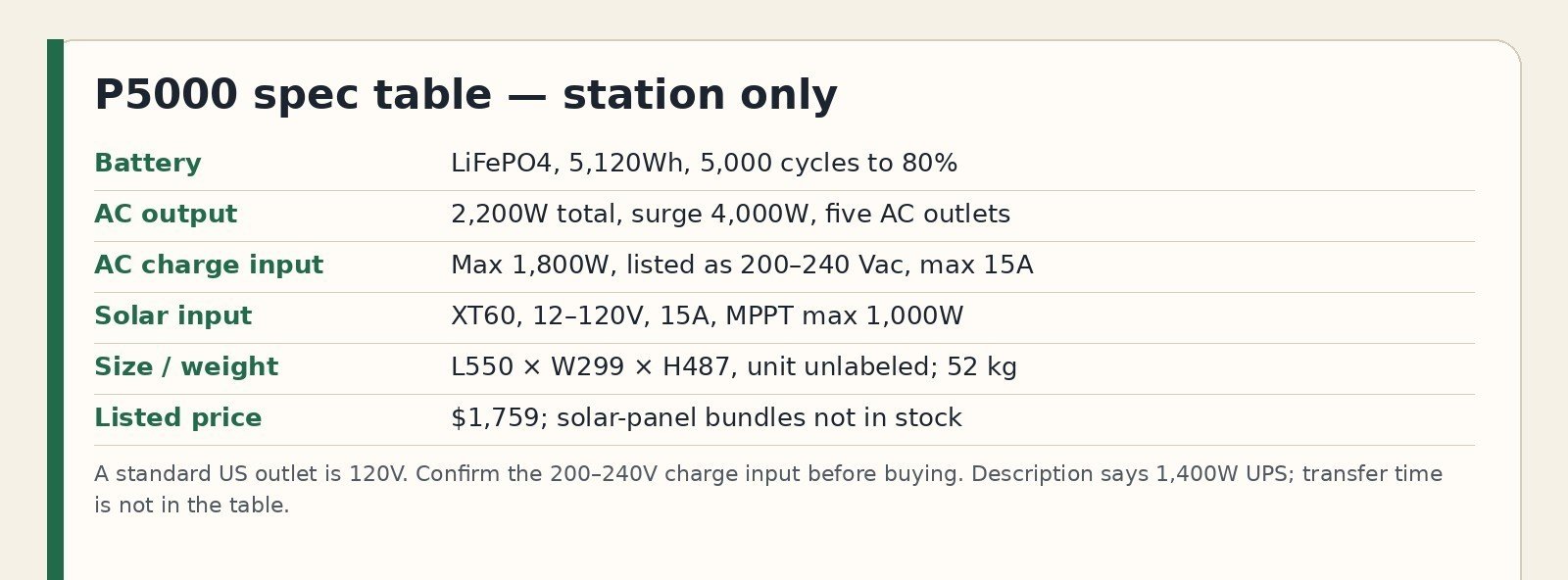

Buy it if you have confirmed the AC input and your running load stays inside 2,200W. Skip it for a light carry or a roof array. Our GEYOTO portable power guide covers a different brand. Do not mix those specs with the P5000.
ACOPOWER listed the station at $1,759 when this guide was last checked, with a compare-at price of $2,999. Prices and promotions can change.
LiONCooler Pro — best portable solar fridge
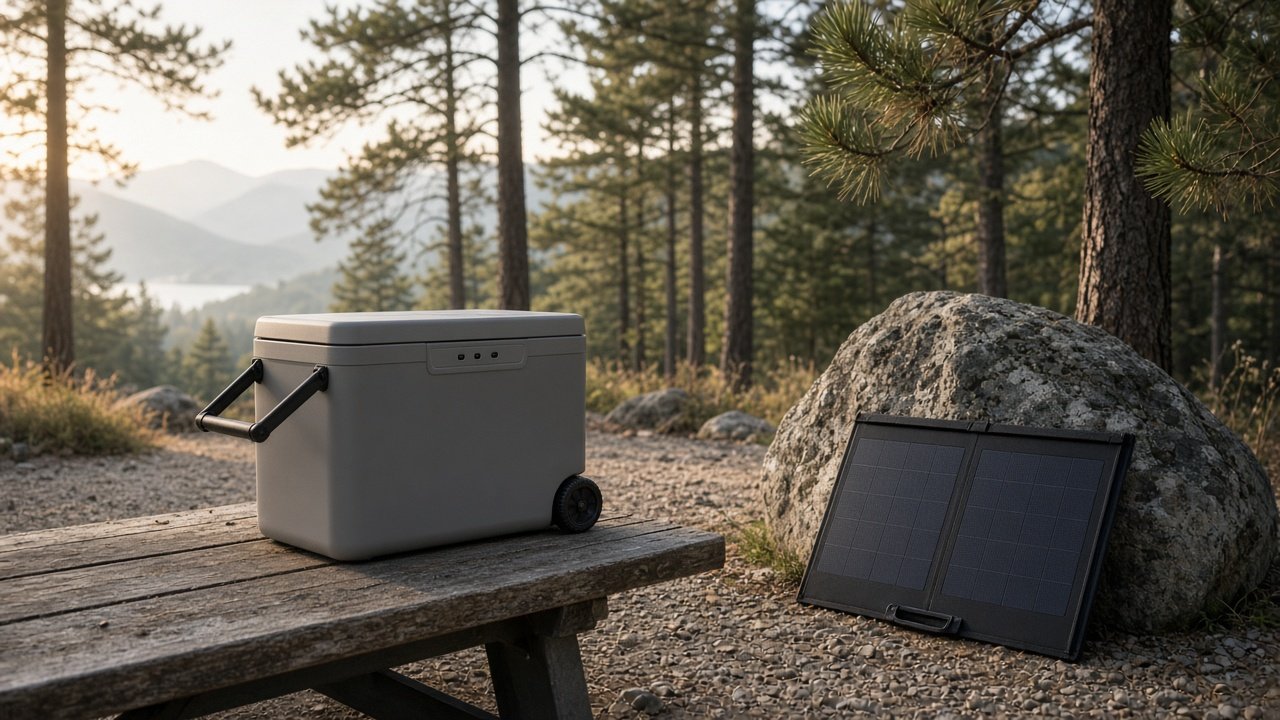
A compressor fridge is a different load from a phone charger. It runs for hours and cares about ambient heat. LiONCooler Pro comes in 30L, 40L, and 50L, each as fridge only or as a combo labeled fridge with battery.
The spec table lists 32 / 42 / 52 quarts, temperature from −4°F° to 43°F (the page doubles the degree mark), refrigerant R134a, and 50W total input power, plus DC current figures of 4.2A/2.1A and 3.75A/1.88A. Sizes are 24.72 × 16.10 inches in footprint, and 15.86, 20.19, or 22.95 inches tall. Weights are 29.54, 32.84, and 33.95 pounds. Copy mentions a DC compressor, 6-inch wheels, a pull handle, about 40 dB, and Bluetooth app control.
The description says the cooler works with a 193Wh battery sold separately and claims up to 10 hours, including a line about holding temperature at 0° with the battery and without direct sun. Those are vendor claims. Do not divide 193Wh by 50W and call it a runtime. A separate 173Wh battery listing was unavailable. Do not treat 173Wh and 193Wh as the same pack.
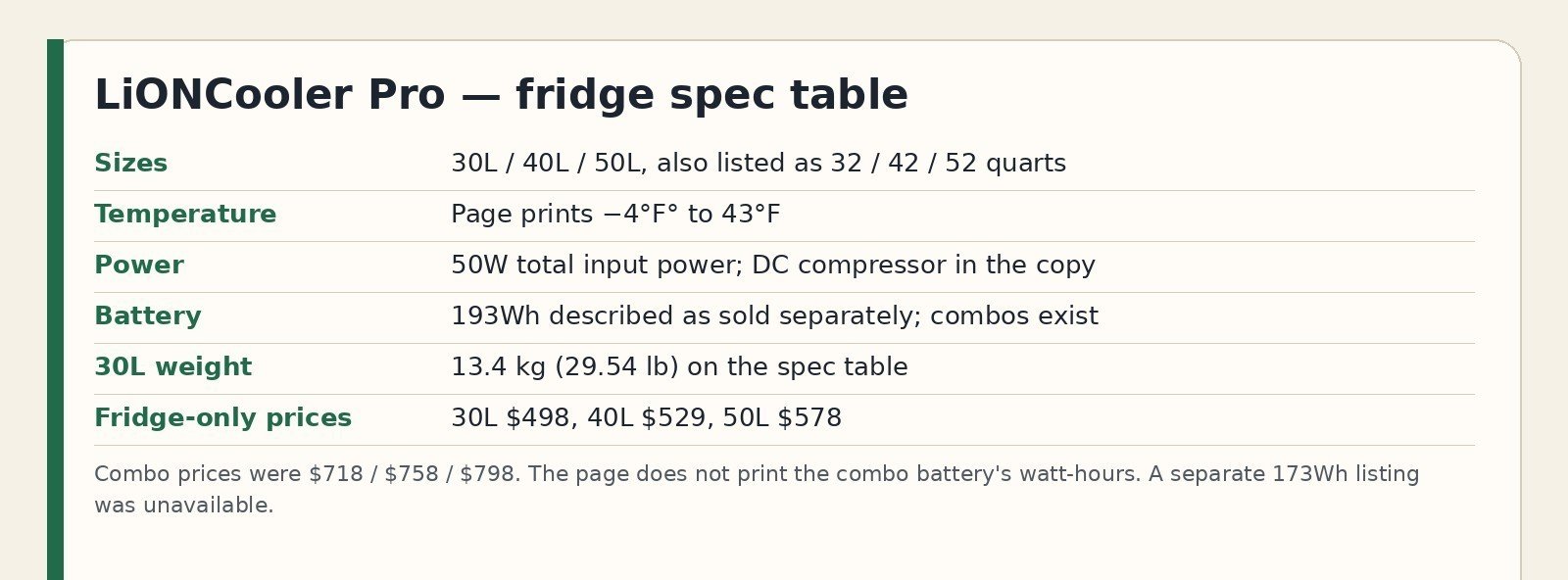
Fridge-only prices were $498, $529, and $578. Combos were $718, $758, and $798. The combo name includes a battery. The page does not print that battery’s watt-hours. AC and DC cables are separate accessories. The spec table lists no solar-port wattage, so the “solar fridge” title is not a documented panel input.
Buy fridge-only if you will power it from a source you have confirmed, or buy a combo only after you know which battery ships. Skip the $498 box if you thought a battery was inside. Other coolers, including the ICECO VL60, are a different product.
ACOPOWER listed those fridge-only prices when this guide was last checked. Prices and promotions can change.
Solar kit vs solar panel vs power station
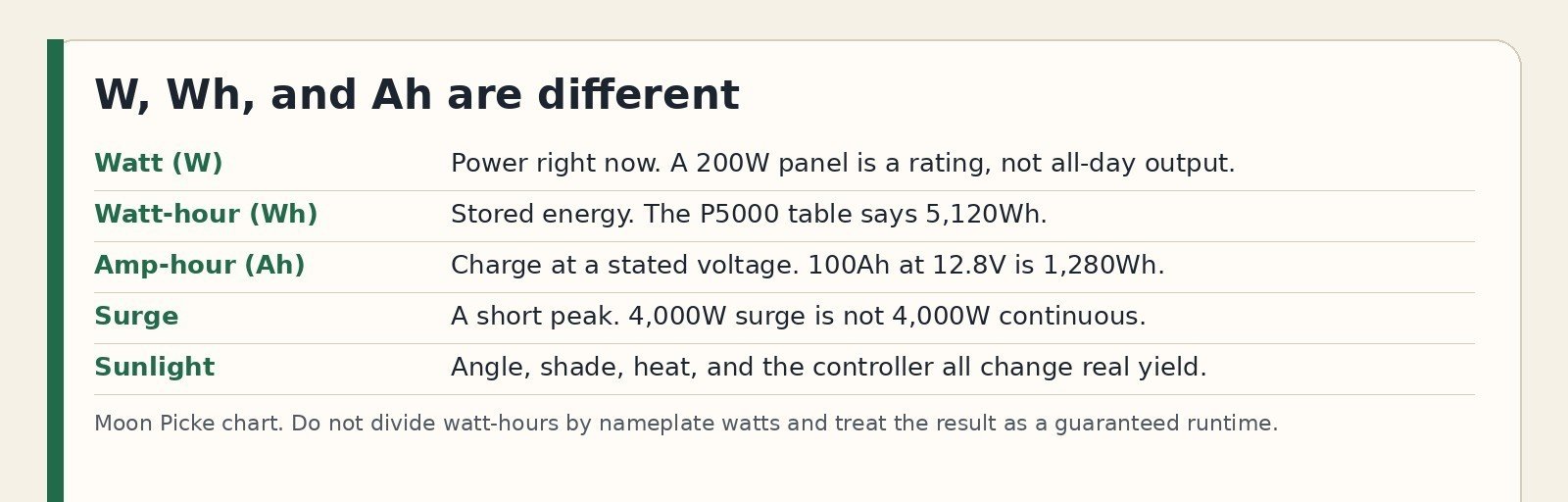
A solar panel makes electricity from sunlight. The watt rating is a lab nameplate. Shade, angle, heat, and the controller cut the yield.
A solar kit is whatever that SKU lists. The 100W PWM kit is a panel and a PWM controller. HYL200AH-M200W adds batteries, an inverter, an MPPT controller, a monitor, a switch, a fuse, brackets, and cables. “Kit” is not one box.
A battery stores energy. Watt-hours are stored energy. Amp-hours are capacity at a stated voltage. The Li-Cube’s 100Ah at 12.8V is 1,280Wh. Watts are a different unit.
An inverter turns DC into AC. On the complete system, 1,500W is continuous and 3,000W is surge. On the P5000, 2,200W is the AC total and 4,000W is surge.
A portable power station combines storage, an inverter, charging, and ports. The P5000 is that product. It does not replace a roof kit.
How to choose an ACOPOWER setup for an RV

Add daily use in watt-hours. A fridge is not a phone charger. Panel watts are a rating for some sun hours, not an all-day supply. Roof space decides if a 230W rigid module fits. If it does not, the foldable panel stays on the ground. Then compare storage: 1,280Wh in the Li-Cube, or 5,120Wh in the P5000, whose AC charge input is printed at 200–240V.
Match the controller to battery voltage and to panel voltage and current. The entry kit is PWM, 20A, 50V maximum PV input. The complete system is MPPT, 30A, 100V maximum open-circuit voltage. Do not swap them because plugs look alike. Add an inverter only for AC, inside the continuous rating. Each added panel changes controller limits. Roof weight and install belong in the manual and, where needed, with a qualified installer.
Warranty, shipping, and returns
Do not paste the homepage’s 12-month line onto every SKU. The warranty page covers solar panels for five years and other products for one year. TesFridge is named at 12 months. Coverage is for the original purchaser. Exclusions include misuse, unauthorized repair, auction purchases, and battery cells unless charged within seven days and at least every six months. The RV-kit page adds a 25-year 85% output warranty on its panels. The N-type 100W datasheet says five years of product warranty and 25 years of output guarantee, without 85%. The P5000 cell says 1+2 years subscribed. The Li-Cube manual describes five years. Those are different sentences.
The shipping page says many continental US orders ship free by ground service when the listing says so, after about 1–3 business days of processing. Orders over 150 pounds may go by freight. Alaska, Hawaii, and Puerto Rico can include a surcharge. Separate Li-Cube and suitcase pages say continental US shipping is free, with about 3–7 days in transit after 1–2 handling days. ACOPOWER.com purchases have a 30-day money-back offer. Without a quality problem, the buyer pays return shipping. Later returns need approval, a 10% restocking fee, and shipping, plus an RMA. Custom and third-party purchases are excluded. Returns text prints (626) 575-7722. Shipping text prints (626) 838-5511. Note freight damage before you sign.
ACOPOWER pros and cons
You can cover a small RV charge kit, a rigid panel, a foldable panel, a LiFePO4 battery, a matched inverter system, a high-capacity station, and a compressor cooler, and several of those publish electrical tables.
One 100W description does not match the next. Kit prices are uneven. Fridge-only and fridge-plus-battery differ. The P5000 charge input is printed at 200–240V. Warranty lines change by product. A subscribed extra term is not a flat three-year warranty. Read the variant, the contents table, and the manual.
FAQ
Is ACOPOWER a good solar brand?
The products in this guide have usable published specs, and a few documents conflict. Use the variant and the manual.
What does ACOPOWER sell?
Solar kits, rigid and portable panels, controllers, inverters, batteries, power stations, and portable fridge-freezers. This page covers seven configurations.
Does ACOPOWER make RV solar kits?
Yes. The 100W PWM20A kit is the entry pick. Larger 100W packs with PWM or MPPT are on the same page. The lithium complete system is a separate kit that includes batteries and an inverter.
Does ACOPOWER sell LiFePO4 batteries?
Yes. The Li-Cube manual describes lithium iron phosphate cells. The complete-system page also lists 12-volt LiFePO4 batteries inside named SKUs. Gel batteries exist elsewhere and are not in this shortlist.
Are ACOPOWER solar panels waterproof?
The 230W datasheet lists IP67. The foldable description says IP68. The RV-kit page does not give the 100W panel an IP rating. Its 20A PWM controller is listed at IP65.
Can an ACOPOWER panel charge a power station?
Only if voltage, current, connector, and the station limit all match. The P5000 solar input is one XT60, 12–120V, 15A, 1,000W max. The N-type panel uses MC4. The foldable connector was not in the description we reviewed.
What is LiONCooler?
It is ACOPOWER’s portable compressor fridge-freezer in 30L, 40L, and 50L. Fridge-only and fridge-with-battery are separate variants. The description ties a 193Wh battery, sold separately in that sentence, to an up-to-10-hour claim.
What warranty and discount code apply?
Site text covers panels for five years and other products for one year, with the battery-cell condition above. Product documents add output guarantees, a subscribed P5000 term, and Li-Cube language that says five years. Readers can try JACKYLONG for 10% off eligible purchases. It applied at 10% on the cart checked October 4, 2026. It is not guaranteed on every item.