
The useful question in a GEYOTO N1000 vs N300 decision is not which box has the bigger number. It is whether you will plug in something the smaller station cannot run. GEYOTO’s spec tables, checked on October 4, 2026, put the N1000 at 1,024Wh and 1,800W continuous, and the N300 at 256Wh and 300W continuous. Both are LiFePO4. One is a car-trunk backup. The other is a pack you can carry.
Moon Picke is independent, not GEYOTO’s store. This comparison uses the current product spec tables, package lists, and listed prices. We did not lab-test either station. A wider look at the lineup is in our published guide to the best GEYOTO portable power products. How we read spec sheets is on how we evaluate products.

Illustrative campsite. This is not a GEYOTO N1000 or N300.
Disclosure: Moon Picke may earn a commission if you purchase through links on this page, at no additional cost to you. See our affiliate disclosure.
If your appliances stay under 300W running and 500W startup, start with the N300. If anything you care about needs more than that, the N1000 is the one that is even in the conversation. Prices and promotions may change.
GEYOTO N1000 vs N300: specs at a glance
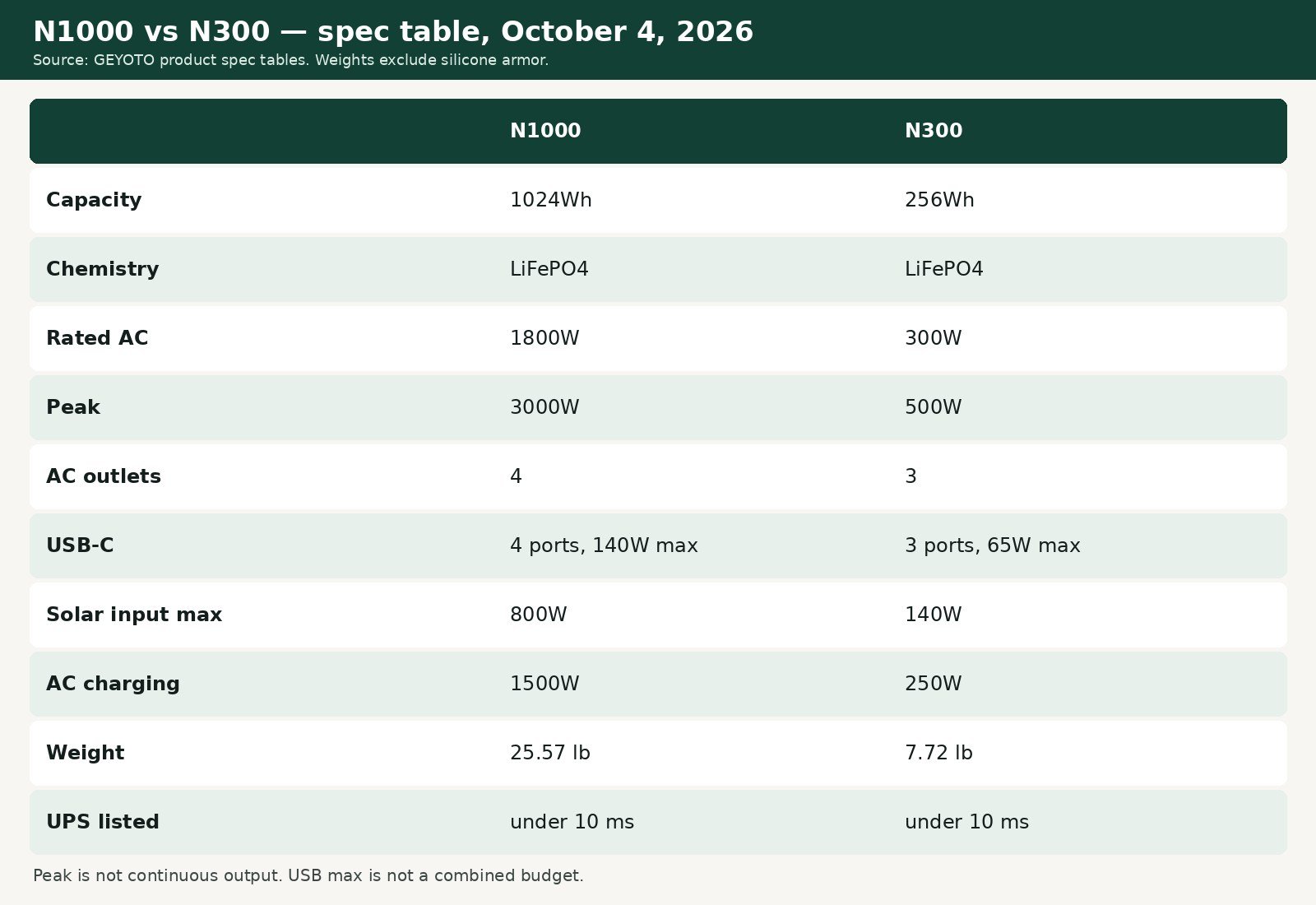
Rows below come from the two spec tables, except price, which is the amount GEYOTO displayed on each product page. “140W max” on USB-C or USB-A is the published port maximum, not a promise that every port hits that figure at the same time.
| Spec | N1000 | N300 |
|---|---|---|
| Battery capacity | 1024Wh (51.2V, 20Ah on the page highlight) | 256Wh (12.8V, 20Ah on the page highlight) |
| Battery chemistry | LiFePO4 | LiFePO4 |
| Rated AC output | 1800W, pure sine wave on the product highlight | 300W. The description calls the inverter pure sine wave |
| Peak / surge | 3000W | 500W |
| AC outlets | 4, 100–120V, 18A listed | 3, 100–120V, 3A listed |
| USB-C | 4 ports, 140W max | 3 ports, 65W max |
| USB-A | 2 ports, 12W max (5V/2.4A) | 1 port, 12W max (5V/2.4A) |
| Other outputs | XT60 378W max (12.6V/30A); car socket 126W max (12.6V/10A); wireless 25W | Car socket 126W max (12.6V/10A); wireless 25W. No XT60 output row |
| Total ports | GEYOTO markets 13. The table matches if wireless counts | Page highlight says 9 outlets |
| Solar input | 800W max | 140W max |
| AC recharge | 1500W. Description: about 0–80% in 43 minutes and 0–100% in about 68 minutes under supported fast charging | 250W. Description: about 0–100% in 1.5 hours |
| Car charging | 800W max. The connection that would reach 800W is not clearly documented | 48W max |
| UPS | Switching listed under 10 ms | Switching listed under 10 ms |
| App control | Yes, Wi-Fi and Bluetooth | Yes, Wi-Fi and Bluetooth |
| Weight | 25.57 lb / 11.6 kg, silicone armor excluded | 7.72 lb / 3.5 kg, silicone armor excluded |
| Dimensions | 13.8 x 18.8 x 10.2 in, armor excluded | 6.38 x 8.62 x 5.32 in, armor excluded |
| Cycle-life claim | 4000 cycles on the spec table | 4000 cycles on the spec table |
| Charge temperature | 32°F to 113°F | 32°F to 113°F |
| Warranty | 5-year warranty for members, on the warranty page | Same station policy. Not a separate term |
| In the box | Station, AC cable, car cable, manual. Jumper cable only on the separate listing | Station, AC cable, car cable, shoulder strap, manual |
| Current price | $449, compare-at $799 | $199, compare-at $299 |
Pricing checked October 4, 2026. Prices and promotions may change. The listed 18A beside the N1000’s 100–120V range would exceed 1,800W at 120V, and the N300’s 3A would exceed 300W at 120V. Plan around the watt ratings, not amps times 120.
What four times the watt-hours means
A watt-hour is stored energy. A watt is how fast you spend it. 1,024 is four times 256. That ratio is not a runtime. A phone might come close if nothing else changes. A compressor, a cycling heater, cold weather, or a half-empty battery will not. Inverter loss means you do not spend every watt-hour as AC, and GEYOTO does not publish a measured efficiency here.
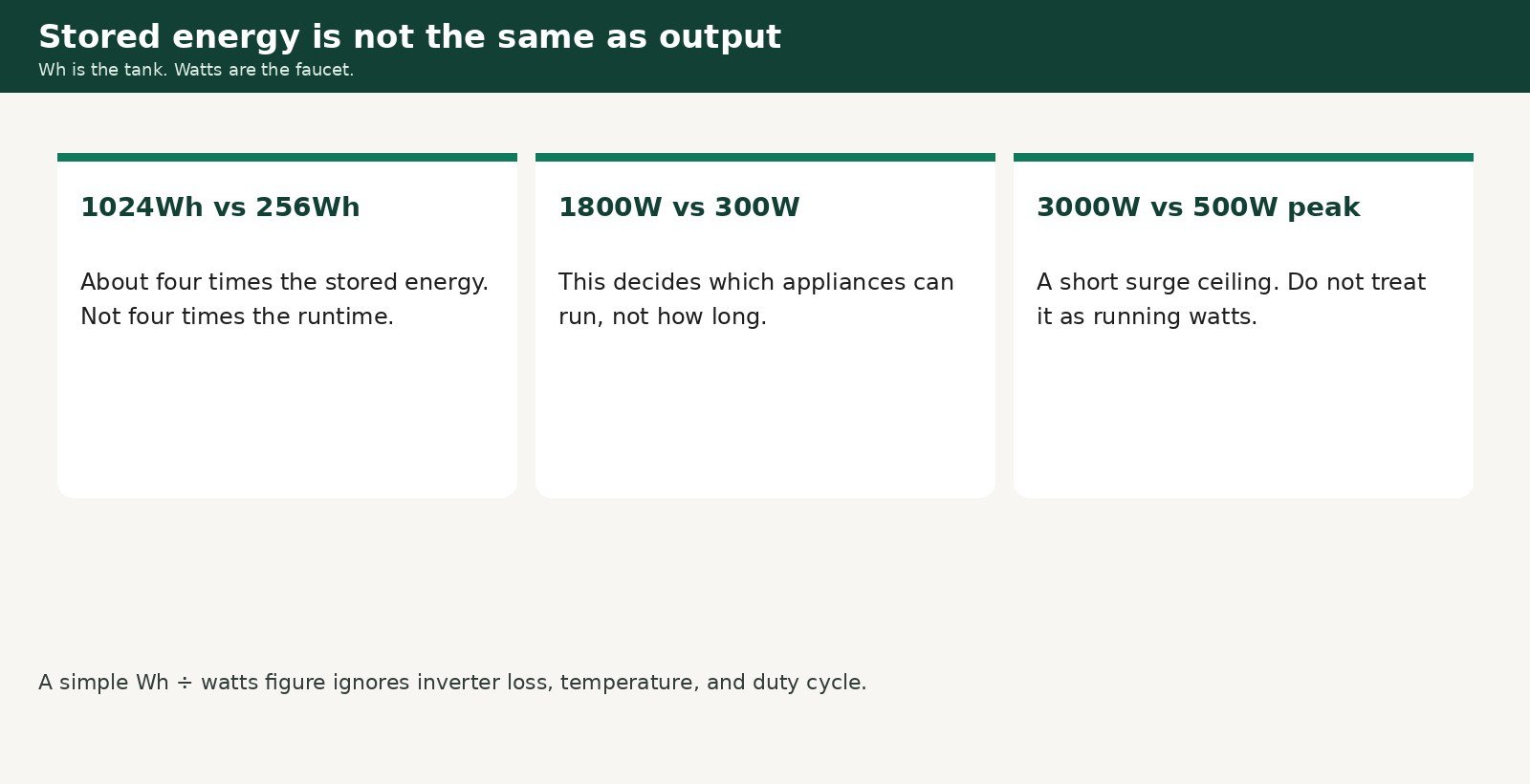
Output is the other half, and it is not a duration. The N300 stops at 300W continuous. A device that runs at 700W does not run “for less time” on the N300. It does not run. The N1000’s 1,800W rating is what puts that device in range, if its startup also fits under the 3,000W peak. Peak is a short ceiling. It is not a second continuous rating.
What can the N1000 and N300 actually power?
Match the label on your device to the station, then leave room for startup. The ranges below are typical of many U.S. products in each category. They are not a compatibility certificate.
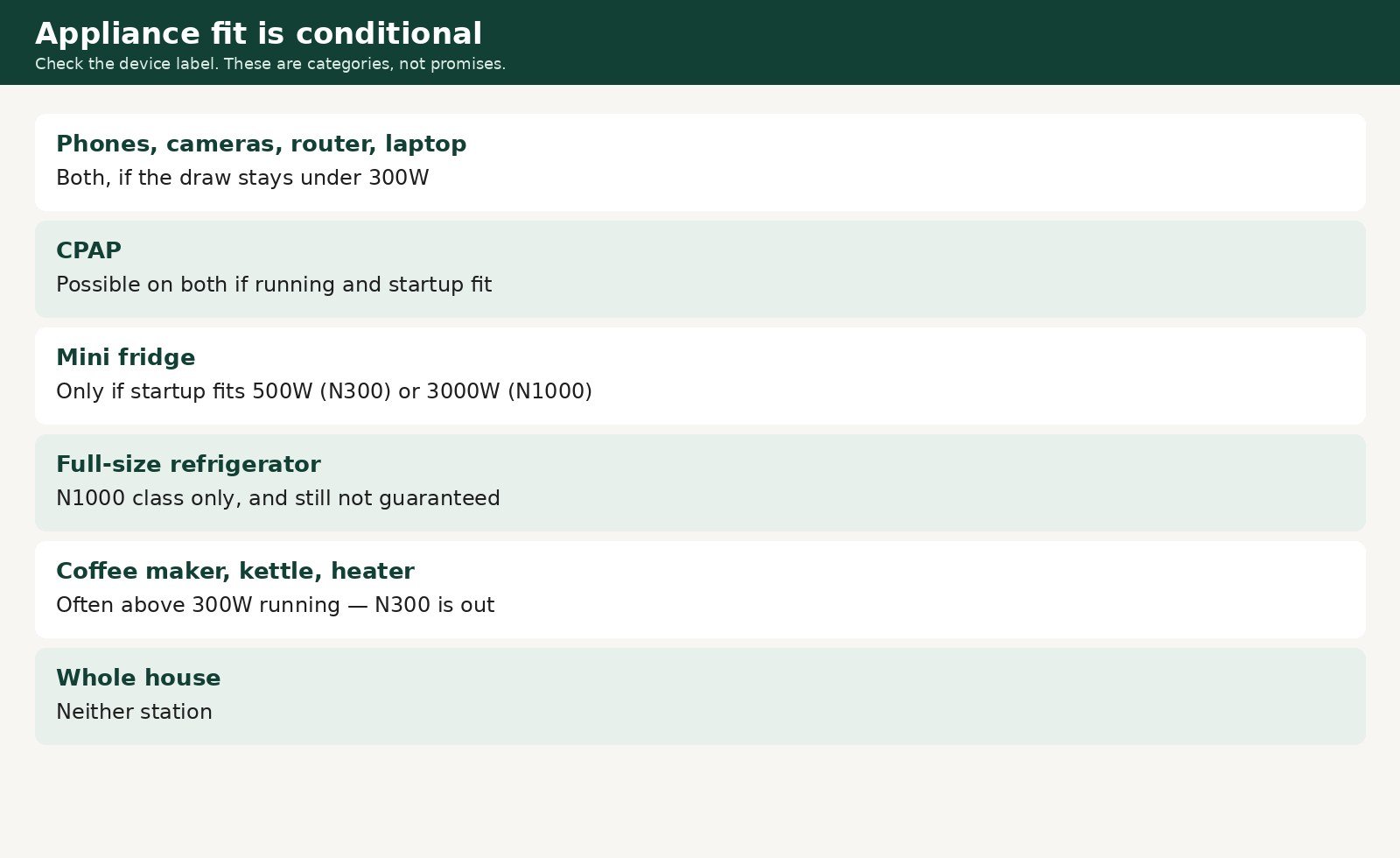
Phones, cameras, a router, and LED lights usually sit well under 30W. Both stations are in range. USB-A on both is 12W max, so a hungry laptop belongs on USB-C or AC.
Laptops often land between about 30W and 100W. The N300’s USB-C line is 65W max, so a 100W brick may need the AC outlet, and only if that brick stays under 300W. The N1000 lists USB-C at 140W max.
CPAP is a maybe on both, for the machine you own. Heat and humidity raise the draw. GEYOTO says many home units are supported and that runtime depends on settings. Confirm the label against 300W/500W or 1,800W/3,000W. That is not an overnight promise.
A television under about 150W is a candidate for both if the label agrees. Add anything that stays on with it.
A mini fridge can look fine while running and still miss on compressor startup. The N300 peak is 500W. Above that, the N300 is the wrong tool. The N1000’s 3,000W peak is more room, not a guarantee.
A full-size refrigerator is an N1000 question. Many household units run under 1,800W and start well above 500W. Runtime still follows the compressor cycle. Neither station is whole-home backup, and neither runs 240V loads such as a typical dryer, range, or central air.
Coffee makers, microwaves, kettles, and heaters often run from several hundred watts into the 1,000W–1,500W class. That already passes the N300. They are possible N1000 loads only when the nameplate is under 1,800W. Corded tools split the same way: read the tool, especially the startup surge.
Runtime estimates, and what they leave out
Estimated runtime is usable energy divided by draw, and usable energy is less than the nameplate. GEYOTO does not publish an AC efficiency. If you assume, only as an illustration, that about 85% of the watt-hours reach the device, a steady 50W load is on the order of 17 hours on the N1000 and about 4 hours on the N300. A steady 150W load falls to roughly 6 hours and 1.5 hours. A 1,000W load is an N1000-only case, on the order of under an hour, because it is above the N300’s 300W rating.
A fridge that cycles will not match a model that treats its running watts as nonstop. Cold, a partial charge, and USB versus AC all move the result. Use the sketch for scale, then read the label.
GEYOTO N1000 vs N300 for camping
For phones, cameras, a laptop, and a light, the N300 is the camping station: 7.72 lb before the armor, a strap in the box, and a 300W ceiling that covers that kit. The N1000 at 25.57 lb is a trunk lift, not a trail pack.

Illustrative night campsite. Photo: Pexels, ID 2422265. No GEYOTO equipment is shown.
The N1000 starts to make sense at camp when the site is next to the car and the load is a higher-draw cooker, a tool, or a fridge whose startup fits 3,000W, or when the trip is long enough that 256Wh will be empty before you can recharge. More ports matter if several people charge at once: four AC outlets and four USB-C ports versus three AC and three USB-C. Solar on a camp trip is a separate limit, covered below. Shorter trips, lighter packs, and a lower price all point back to the N300.
GEYOTO N1000 vs N300 for home backup
An outage plan is a device list. The N300 can cover a router, phones, a lamp, and a laptop if the total stays inside 300W running and 500W peak. That is a desk kit. It is a weak kitchen plan.

Illustrative outage scene. The lantern and laptop are not GEYOTO products, and the refrigerator is not running from either station.
The N1000 covers a wider list because 1,800W and 1,024Wh sit above 300W and 256Wh. A fridge, a CPAP, and a router are the sort of stack people mean by “essentials,” and only the N1000 has both the output headroom and the energy reserve to be a candidate for that stack. It still will not carry the rest of the house. Add the wattages. If the total running watts pass 1,800W, or any motor start passes 3,000W, this station is the wrong layer of backup.
Both list a UPS switch under 10 ms. That is a published transfer time, not a test of your computer or medical device. Try the handover before you rely on it. Indoor use is plausible because these are batteries, not gasoline engines, if you follow the manual. Charge temperature on both tables starts at 32°F.
Which is better with solar panels?
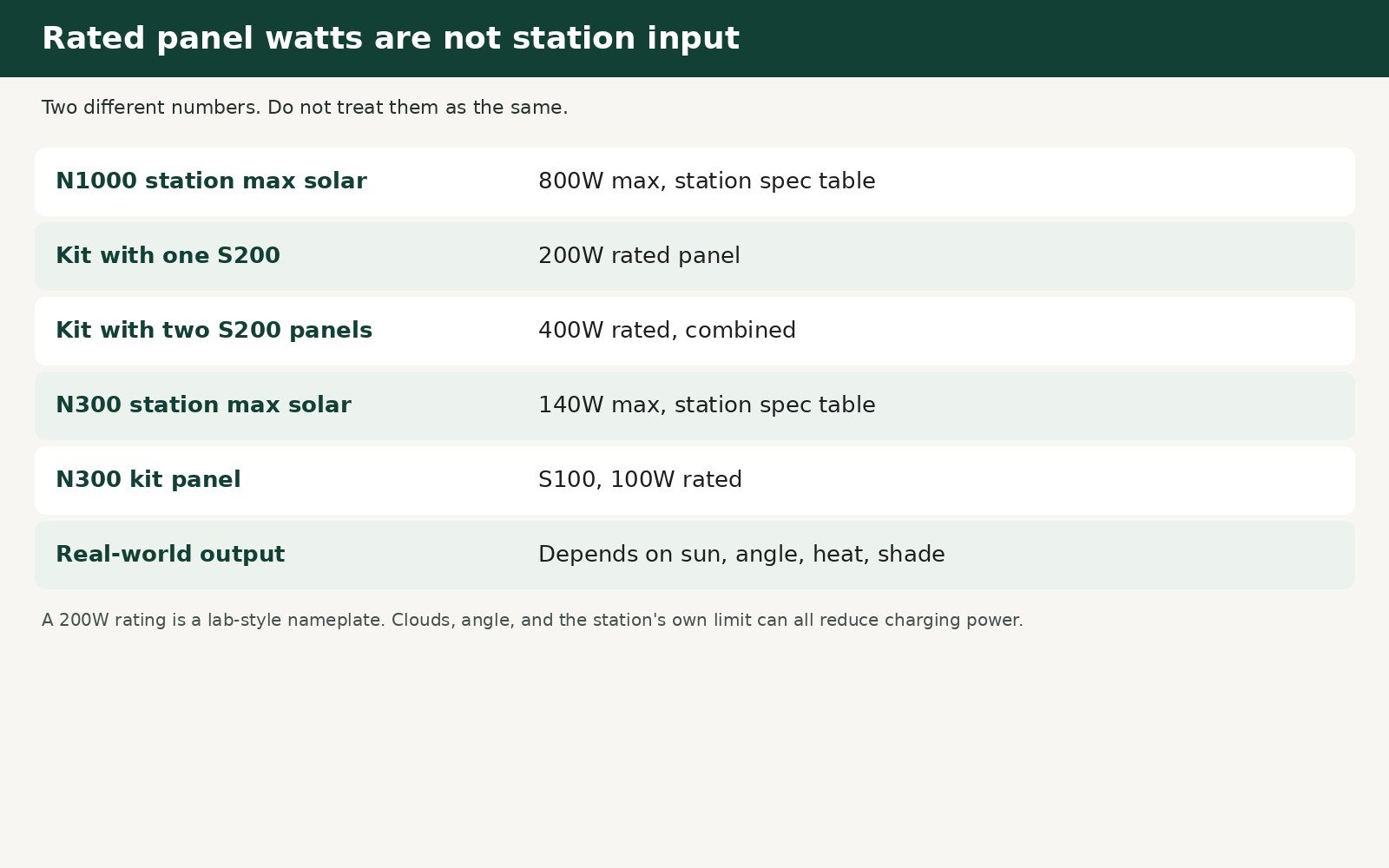
The N1000 accepts up to 800W of solar. The N300 accepts up to 140W. The S200 is 200W, 25.2V, 7.94A, 14.99 lb, and 82.2 inches unfolded. The S100 is 100W, 25.2V, 3.97A, and 8.38 lb. Both are MC4 panels with an MC4-to-XT60 cable. S35 and S45 are USB chargers, not station inputs.
Use the S100 with the N300. Its 100W nameplate fits under 140W. An S200 does not, and it is heavier. Use one or two S200 panels with the N1000. Two are 400W rated, still under 800W. Shade and angle mean you will not see that nameplate as charging power.
Listed kit prices that day were $339 for the N300 plus S100, $659 for the N1000 plus one S200, and $839 for two S200 panels. The kits are the same stations plus panels, not bigger batteries. Weather, angle, heat, and shade cut real solar watts, so this piece does not quote a full solar recharge time. The published wall-charge descriptions are about 1.5 hours on the N300 and about 68 minutes on the N1000 under its fast-charge conditions.
The N300 is easier to carry. The N1000 is not trying to be.
The gap is 7.72 lb against 25.57 lb, armor excluded, and only the N300 box lists a strap. The shells are about 6.4 by 8.6 by 5.3 inches against 13.8 by 18.8 by 10.2 inches. An S200 adds 15 lb. An S100 adds 8.4 lb.
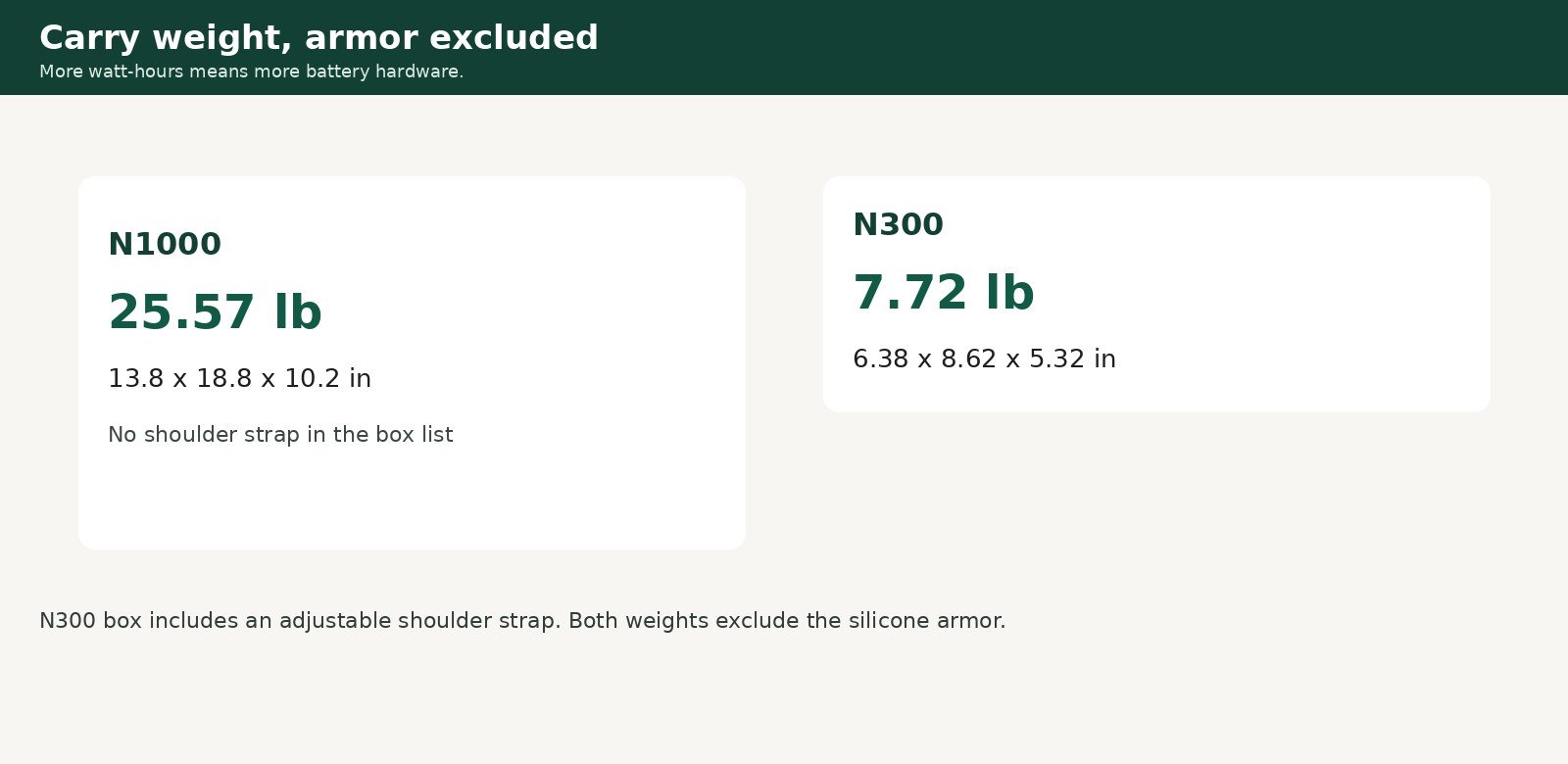
More stored energy is more cells. You do not get 1,024Wh in a 7 lb shell from this catalog. The right question is whether you will use the extra watt-hours and the extra 1,500W of continuous headroom often enough to lift the larger box. If the answer is a laptop and two phones, you will not.
Car charging is not a tie. The N300 lists 48W max, which is in the range of a modest 12V lead. The N1000 lists 800W max and does not document the vehicle socket that would deliver it. Do not assume a cigarette-lighter plug charges the N1000 at 800W.
Reasons to choose the GEYOTO N1000
Choose it when the N300’s limits are the problem. You get 1,024Wh, 1,800W continuous, a 3,000W peak, a fourth AC outlet, an XT60 output the N300 table does not list, and solar input up to 800W. App control and the sub-10 ms UPS line are on both, so they are not a reason to size up. AC input is 1,500W rather than 250W, which is why GEYOTO’s stated charge times differ.
The jumper-cable listing was $469. Compare-at was $899 on its page and $819 on the N1000 option list. The electrical table matches. Buy it only for the cable. No expansion battery is for sale, despite a diagram in the manual file.
Check current GEYOTO N1000 offers
Reasons to choose the GEYOTO N300
Choose it when 300W is enough and the carry matters. You save weight, you get a strap, and the listed price is $199 against $449. For phones, cameras, a router, and a modest laptop, the unused 1,500W of inverter in the N1000 is hardware you lift and do not use. Solar stays simpler: one 100W panel under a 140W cap, instead of managing 15 lb panels.
Lower capacity is not a feature. It is the price of the smaller box. A Stars & Stripes edition was listed at $214, compare-at $299, without a separate electrical table, so we treat it as the same 256Wh class.
Check current GEYOTO N300 offers
Choose the N1000 if. Choose the N300 if.
Choose the N1000 if a device runs above 300W, starts above 500W, or you need more than 256Wh. That is the lane for many full-size fridges and for kettles or heaters that still fit under 1,800W. Also choose it if you will use an S200.
Choose the N300 if the list is electronics, lights, and a CPAP you have checked against 300W and 500W. It is the short-trip, lower-bill station. It is not a cheap refrigerator plan.
GEYOTO N1000 vs N300: which offers better value?
The sticker favors the N300: $199 versus $449, compare-at $299 and $799. Dividing those prices by nameplate watt-hours gives about $0.78 and $0.44. Dividing by continuous watts gives about $0.66 and $0.25. The N1000 looks cheaper per unit of capacity only if you will use the extra units. If you will not, it is weight you paid for.
Bundles change the picture only if you need a panel. The N300 kit at $339 was $19.01 under the separate N300 plus S100 prices that day. The N1000 kit at $659 was under the separate station-plus-S200 total. Those gaps are a snapshot of listed prices, not a standing discount. Pricing checked October 4, 2026. Prices and promotions may change.
Warranty does not break the tie. GEYOTO’s policy gives members a 5-year term on portable power stations. Another sentence mentions a 2-year extended membership warranty and does not state a non-member baseline. Both models are stations, so the same unclear sentence applies to both. Standard service is described for the contiguous United States.
FAQ
Which is better, the GEYOTO N1000 or the N300?
Neither is better for every buyer. The N1000 is the one that can approach higher-watt appliances and a larger reserve. The N300 is the one that is light enough, and cheap enough, for electronics and short trips.
How much larger is the N1000 battery?
1,024Wh versus 256Wh, which is four times the stored energy on the spec tables. It is not a promise of four times the runtime.
Can the N300 run a refrigerator?
A full-size fridge is a poor match. Running watts may look modest, and compressor startup often exceeds a 500W peak. A mini fridge is only a candidate if its start and run figures fit 500W and 300W.
Can the N1000 run a refrigerator?
Many household fridges are in a plausible class if running watts stay under 1,800W and startup stays under 3,000W. Runtime is still the compressor’s duty cycle, not a fixed night. It will not run a 240V appliance or the whole house.
Can both charge from solar?
Yes, within 800W on the N1000 and 140W on the N300. Use the S100 with the N300 and the S200 with the N1000. Real panel output moves with the sun. A full solar charge time is not a number we will print as typical.
Which is better for camping?
The N300, unless you are camping from a vehicle and need more than 300W or more than a weekend of small electronics. Then look at the N1000.
Which is better for a power outage?
The N300 for a router, phones, and a laptop. The N1000 when the outage list includes a fridge or anything else above 300W. Write the watts down before you pick.
Are the batteries LiFePO4?
Yes. Both spec tables say LFP (LiFePO4), with 4,000 cycles listed. That cycle line is not the same thing as the member warranty term.
Verdict
Buy the N1000 when capacity and AC output are the reason you are shopping. Buy the N300 when portability, a shorter list of devices, and a lower price are the reason. The decision rule is one measurement: if any device’s running watts exceed 300, or its startup exceeds 500, the N300 is out, and the N1000 is the GEYOTO station to price. If nothing on the list crosses those lines, the larger station is extra weight.