
Moon Picke independently researches products. If you buy through our links, we may earn a commission at no extra cost to you. Affiliate disclosure.
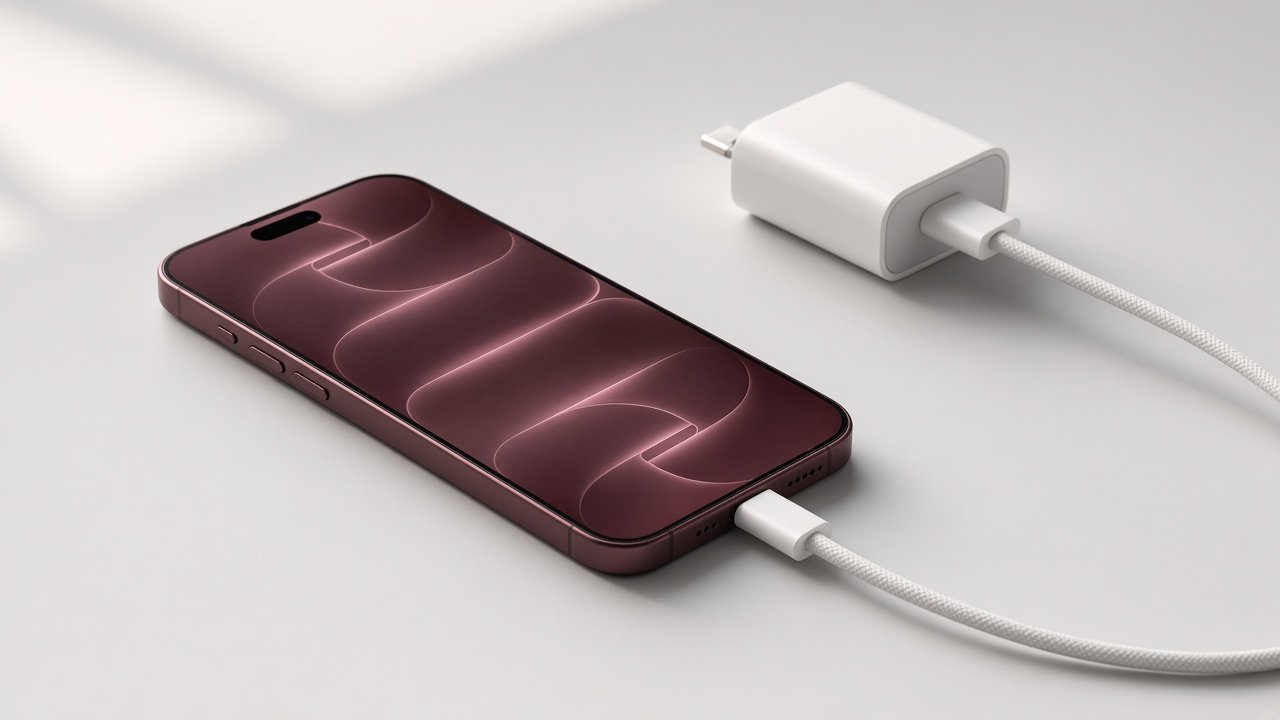
iPhone 18 Pro charging is a chain problem, not a wattage contest. Apple’s specs say the phone is USB-C, ships without a wall adapter, and reaches its advertised wired fast-charge claim with a 60W-capable adapter or higher with Adjustable Voltage Supply (AVS) plus a USB-C charging cable. That adapter rating is what the brick can provide—not what the phone continuously draws. Many owners will not need a new charger.
iPhone 18 Pro Charging: Quick Answer
Apple’s documented wired claim is up to 50% charge in around 15 minutes under July 2026 test conditions. MagSafe wireless charging is listed up to 25W, with a 50%-in-30-minutes MagSafe time claim when a 35W-or-higher adapter is paired with a MagSafe Charger. Neither claim is a constant rate or an independent lab wattage.
| Setup | Will it charge? | Apple’s maximum advertised wired/wireless claim? | Best for |
|---|---|---|---|
| Existing lower-watt USB-C PD charger | Usually yes if USB-C and USB Power Delivery | Often no for the 15-minute wired claim | Casual overnight and desk charging |
| 60W-capable or higher adapter with AVS + USB PD 3.1 (or better) + 60W-capable USB-C cable | Yes | Matches Apple’s wired fast-charge requirement | Maximum advertised wired performance |
| 100W+ USB-C charger | Yes if USB-C PD; AVS still must be verified | No automatic extra iPhone speed; wattage ≠ protocol | Laptop / multi-device |
| MagSafe Charger + 35W or higher adapter | Yes | Up to 25W MagSafe; 50% in 30 minutes in Apple’s MagSafe test | Desk, nightstand, magnetic convenience |
What charger does the iPhone 18 Pro need? For Apple’s fastest advertised wired charging: a 60W-capable or higher USB-C adapter with AVS, USB PD 3.1 or better, and a 60W-capable USB-C cable. Everyday charging can use an existing USB-C PD charger. No wall adapter ships in the box—only a USB-C Charge Cable (1 m). A 100W label does not mean 100W into the phone.
What Charger Does the iPhone 18 Pro Actually Need?
Apple’s iPhone 18 Pro specs list fast charge as up to 50% in around 15 minutes with a 60W-capable adapter or higher with Adjustable Voltage Supply (available separately) paired with a USB-C charging cable. The sheet also lists MagSafe and Qi2 wireless charging up to 25W. USB-C supports charging, DisplayPort, and USB 3 data up to 10Gb/s—data speed is not charging power.
The Newsroom footnote (July 2026, preproduction iPhone 18 Pro and 18 Pro Max) is stricter than the marketing line. Wired fast charge is supported with a 60W-capable USB-C cable and USB PD 3.1 (or better) power adapters with AVS. Apple tested the 40W Dynamic Power Adapter with 60W Max (Model A3351) plus a USB-C Charge Cable, or MagSafe Chargers (1 m A3502 / 2 m A3503) with that adapter. Times were measured from the Apple logo after drained units and vary with adapter, settings, usage, and environment. That is the advertised wired profile—not a promise every 60W USB-C brick has AVS, and not a measured peak wattage into the battery.
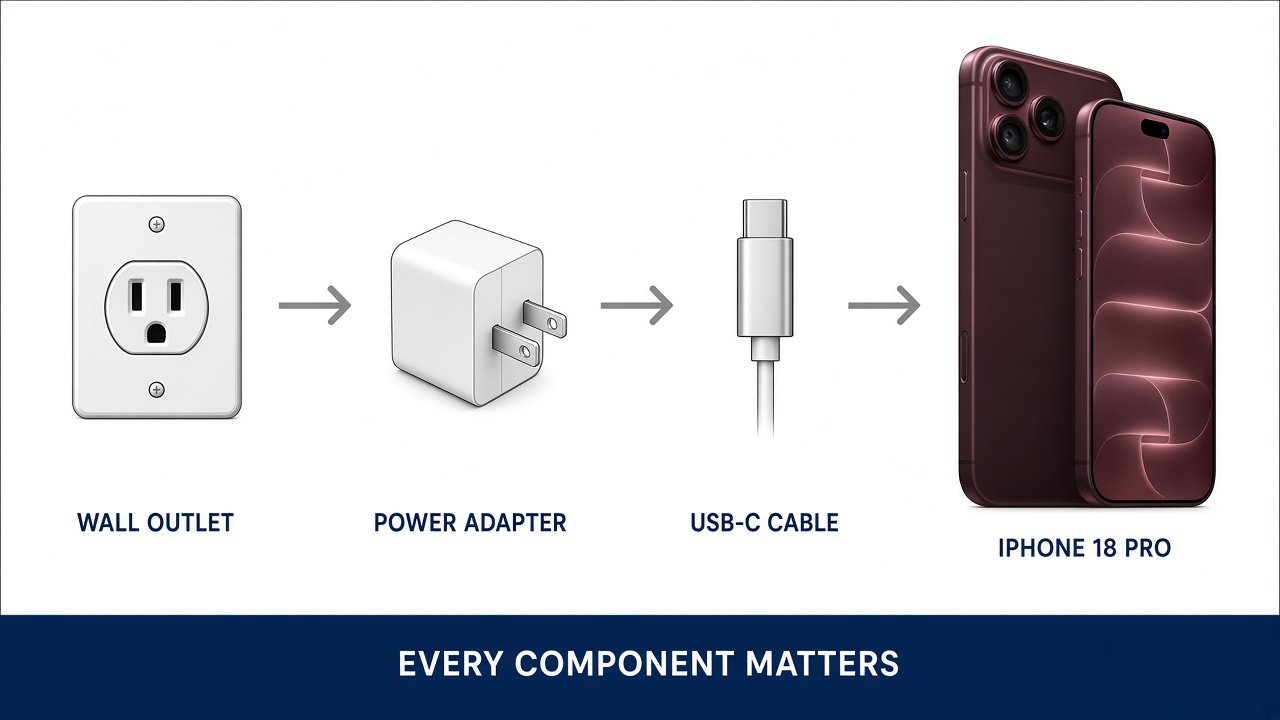
The chain is wall → USB-C adapter → USB-C cable → iPhone 18 Pro → battery management. A high-output adapter cannot fix an unsupported profile, an underspec cable, the phone’s own limit, heat-related management, or multi-port power sharing.
Does a 60W Adapter Mean 60W iPhone Charging?
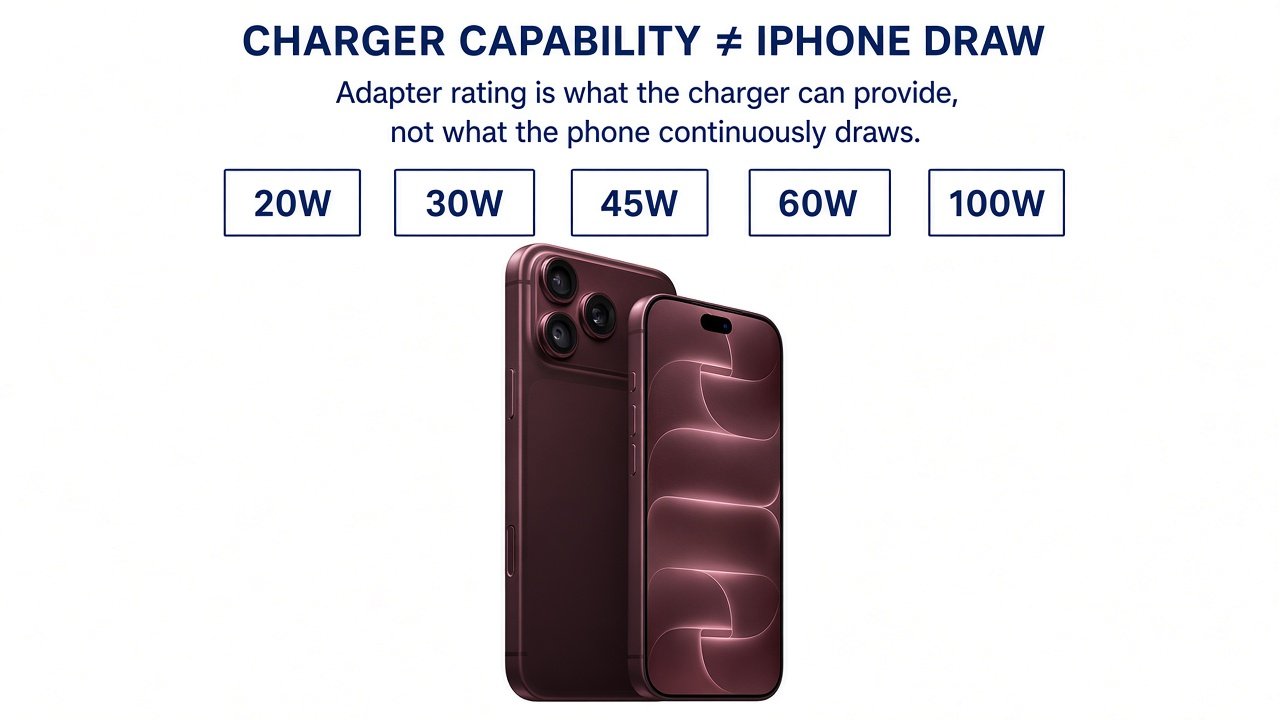
No. A 60W-capable adapter does not mean the iPhone continuously draws 60W. The rating is what the charger can provide under supported profiles. The phone negotiates and draws what it accepts. This guide does not invent an independent peak iPhone wattage.
A 100W charger is not 100W into the iPhone. “Or higher” means a 70W, 96W, or 140W-class brick can still be compatible if it supports USB PD 3.1 (or better) with AVS. Extra rated output does not automatically raise iPhone 18 Pro charging speed past Apple’s advertised profile. Apple’s test adapter is named 40W Dynamic Power Adapter with 60W Max.
20W vs 30W vs 45W vs 60W vs 100W
Do not treat these labels as measured iPhone 18 Pro charging wattage. Treat them as buyer classes against Apple’s documented requirement.
| Adapter class | What it usually means for this phone | Limitation |
|---|---|---|
| 20W USB-C PD | Can charge an iPhone over USB-C | Does not match Apple’s 60W-capable-or-higher AVS wired fast-charge requirement |
| 30W USB-C PD | Often fine for daily charging | Verify protocol; not the documented 15-minute wired setup |
| 45W USB-C PD | May work well if USB PD is real | Wattage still is not AVS; may miss the newest wired profile |
| 60W-capable + USB PD 3.1 (or better) + AVS | Matches Apple’s documented wired fast-charge adapter requirement | Needs a 60W-capable USB-C cable too |
| 100W and up | Useful if you also charge a MacBook or several devices | Does not make the iPhone charge at 100W; confirm AVS if you want the advertised 15-minute path |
A product labeled “fast charger” is marketing. It does not prove USB PD 3.1, AVS, or 60W-capable cable support. MagSafe’s 50%-in-30-minutes claim still needs a 35W adapter or higher plus the puck.
What Is AVS and Why Does It Matter?
AVS—Adjustable Voltage Supply—is part of newer USB Power Delivery behavior. Compatible chargers and devices can negotiate voltage more flexibly than older fixed USB PD steps. Apple’s footnote does not treat AVS as optional for the advertised wired path: USB PD 3.1 (or better) adapters with AVS, plus a 60W-capable USB-C cable.
Wattage alone may not identify whether a charger supports the mode Apple used. Two bricks can both say 60W; only one may support PD 3.1 with AVS. Do not assume every 60W USB-C charger supports AVS. If you want the around-15-minute wired claim, confirm AVS and PD 3.1 (or better). Apple’s test used the 40W Dynamic Power Adapter with 60W Max. Skip AVS hunting if overnight charging on a charger you already trust is enough for daily use. Protocol support is separate from the wattage printed on the brick.
Can You Use Your Existing iPhone, iPad or MacBook Charger?
Often yes for charging the phone. Not always yes for Apple’s maximum advertised wired performance. Apple’s charge-speed support pages document USB-C Power Delivery charging on iPhone 15 and later. A higher-wattage Apple USB-C MacBook or iPad adapter can be usable because the phone draws what it accepts. Charger maximum output is still not phone draw, and older laptop bricks may lack AVS even at high wattage.
Use this checklist before you buy anything:
- USB-C connector?
- Rated output on the brick and each port?
- USB Power Delivery?
- USB PD 3.1 (or better) with AVS if you want the 15-minute wired claim?
- Multi-port power shared when two devices are plugged in?
- Cable 60W-capable for that advertised wired profile?
If the answers already match your needs, the best charger purchase may be no purchase at all. Keep a 20W Apple USB-C brick for topping up. Keep a laptop adapter if it already charges the phone to your satisfaction. Replace hardware only for the documented AVS wired path, a broken cable, or ports you do not have.
As an Amazon Associate I earn from qualifying purchases.
Check current Apple 40W Dynamic Power Adapter with 60W Max listings on Amazon →
What USB-C Cable Does iPhone 18 Pro Need?
USB-C describes connector shape, not power rating, USB PD support, data speed, or certification. Apple includes a USB-C Charge Cable (1 m). The advertised wired profile needs a 60W-capable USB-C cable. The port supports USB 3 data up to 10Gb/s when the cable does—that is not a charging-speed upgrade. Some higher-power cables use e-marker identification to report capabilities. You do not automatically need a 240W cable.
Compare Apple 60W USB-C Charge Cable (1 m) listings on Amazon →
Does a Better USB-C Cable Make the iPhone Charge Faster?
Only if the current cable is the limiting part of the chain. A higher maximum power rating does not force faster charging. The cable’s job is to support negotiated power safely. Higher cable rating ≠ higher phone charging speed.
How MagSafe Charging Works on iPhone 18 Pro
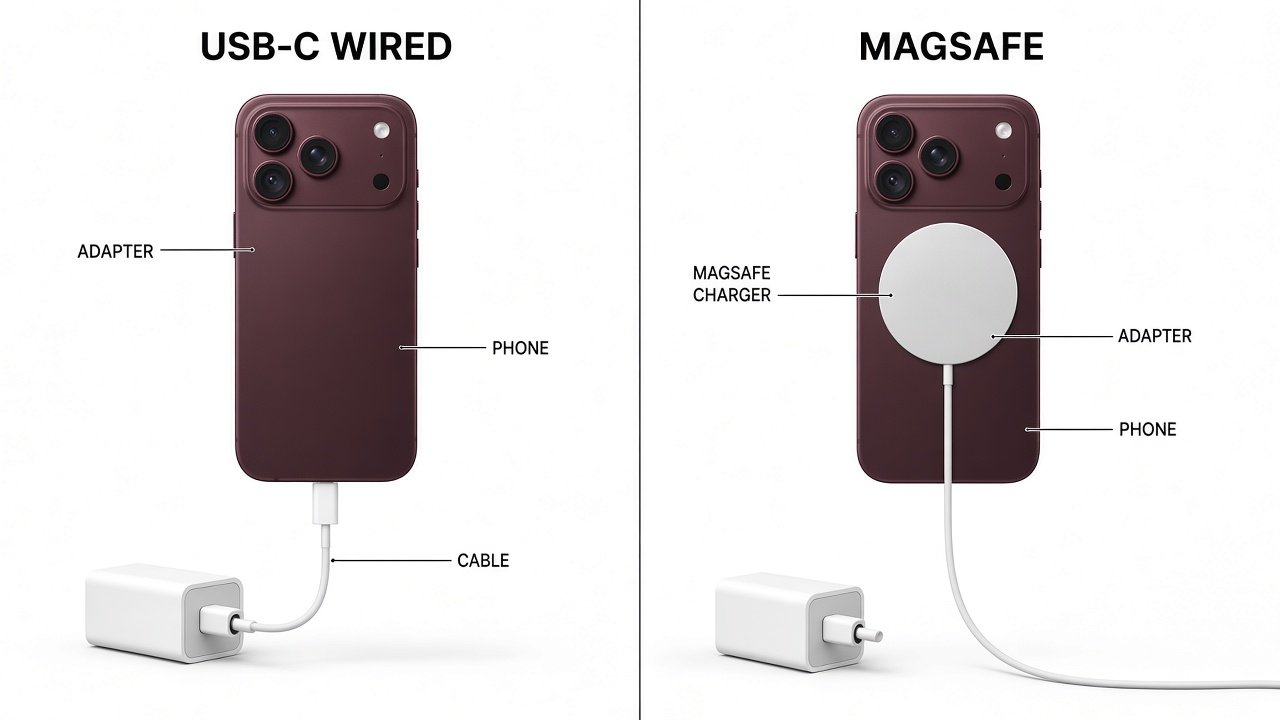
MagSafe is iPhone + MagSafe charger + power adapter. Apple lists MagSafe wireless charging up to 25W, and up to 50% in 30 minutes with a 35W adapter or higher paired with a MagSafe Charger (both sold separately). Qi2 is listed separately at up to 25W. Qi, Qi2, and MagSafe are not the same. MagSafe adds magnets and accessory identification; Qi2 is the wireless standard Apple cites for up to 25W; older Qi pads may still charge without those ceilings. Do not quote MagSafe watts without the adapter.
Do You Need a New MagSafe Charger?
Not automatically. Magnetic compatibility is not maximum MagSafe performance. An older MagSafe charger may still attach and charge. Apple’s 50%-in-30-minutes MagSafe claim uses a 35W-or-higher adapter plus MagSafe Charger; testing used A3502 and A3503. Keep your current puck if it covers desk use. Roundups belong on a later MagSafe page.
See Apple MagSafe Charger (1 m) listings on Amazon →
Wired vs MagSafe: Which Should You Use?
| Factor | USB-C wired | MagSafe |
|---|---|---|
| Apple’s documented fast-charge time claim | Up to 50% in around 15 minutes with 60W-capable+ AVS adapter and USB-C cable | Up to 50% in 30 minutes with 35W+ adapter and MagSafe Charger |
| Documented wireless power | Not wireless | MagSafe up to 25W; Qi2 up to 25W |
| Convenience | Cable required; usable while plugged in | Magnetic alignment; desk and nightstand |
| Travel / car | One USB-C cable; car adapters still need suitable PD | Puck plus adapter; MagSafe mounts are a later buying page |
Apple’s 0–50% time claim is faster on the wired AVS path than on MagSafe in the same footnotes. That is Apple’s test, not a 0–100 extrapolation. Charging changes with battery state, temperature, usage, and environment. MagSafe does not destroy battery health. Apple manages charging in software, including Optimized Battery Charging. Skip invented unplug-at-80% rituals Apple does not require.
When a 100W Charger Actually Makes Sense
A 100W-class charger makes sense for other devices—not because iPhone 18 Pro charging wattage scales to 100W. Typical cases: MacBook plus iPhone; iPad plus iPhone; travel with Watch, AirPods, phone, and laptop. Multi-port chargers often share power. Car chargers still need suitable USB-C PD. Power-bank wattage is not automatically what the iPhone receives. Car-mount and power-bank lists belong on later pages.
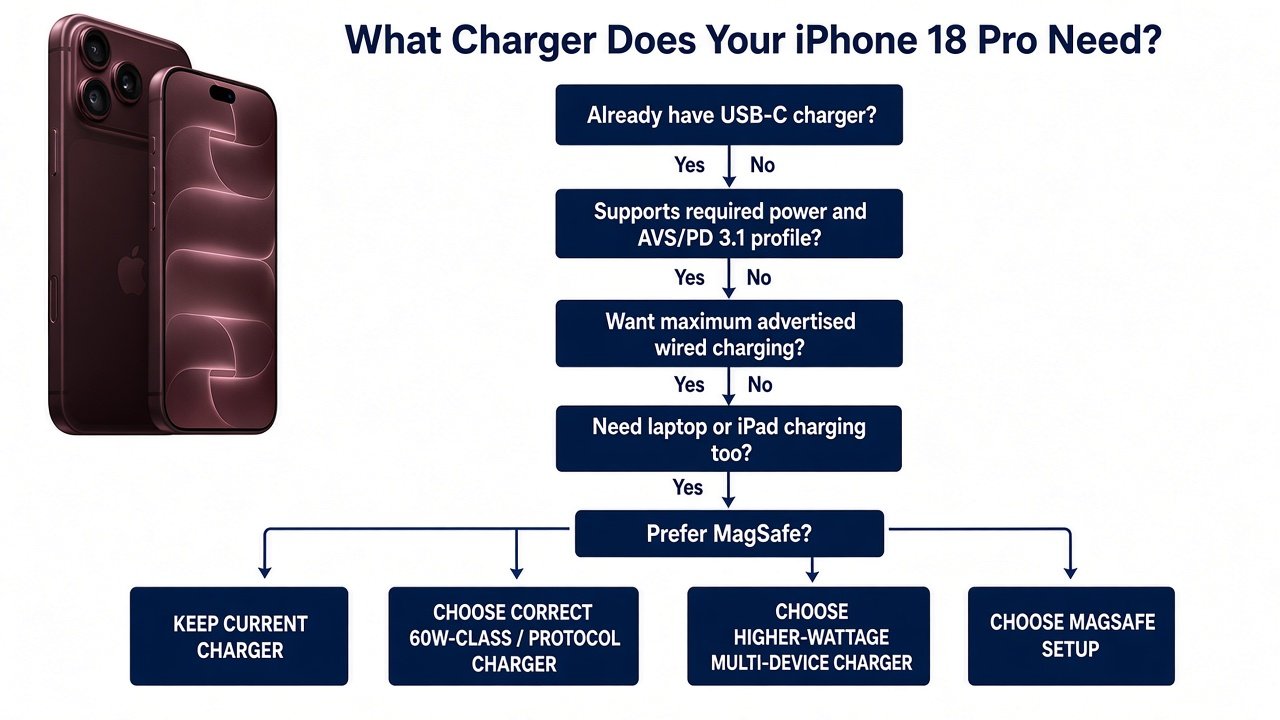
Three Charging Setups That Make Sense
Setup 1 — Use what you already own. USB-C PD charger, existing cable, overnight or desk use. Default for most people.
Setup 2 — Maximum advertised wired charging. 60W-capable or higher adapter with AVS and USB PD 3.1 or better, plus a 60W-capable USB-C cable. Apple’s test example is the 40W Dynamic Power Adapter with 60W Max (A3351). Reputable third-party bricks can be appropriate if they support that protocol. “Fast charger” labels are not automatically compliant.
Setup 3 — Multi-device / travel. Higher-wattage multi-port charger because you also charge a laptop or tablet—not because the iPhone needs 100W. Add MagSafe (puck + 35W or higher adapter) only for magnetic convenience, with the 25W MagSafe ceiling in mind.
What Should You Buy?
- Want Apple’s maximum advertised wired charging? If no, keep a working USB-C PD setup.
- Existing charger: USB-C, USB PD, and—if you want the 15-minute claim—PD 3.1 or better with AVS at 60W-capable or higher?
- Need laptop charging? Extra wattage can be rational without changing iPhone draw.
- Need multiple ports? Multi-port GaN is a travel tool with shared-power limits.
- Prefer MagSafe? Budget puck plus a 35W-or-higher adapter.
- Need a new cable? Only if the current USB-C cable cannot support a 60W-capable path, or is damaged.
Buy a new 60W-class correct-protocol charger only if you want that advertised wired capability and your brick cannot do AVS/PD 3.1. Buy higher than 60W for laptop or multi-device use. Choose MagSafe for convenience with the 25W ceiling understood. Do not buy the largest wattage number on the shelf.
Final Verdict
iPhone 18 Pro charging is decided by protocol, port, cable, and use case—not the biggest wattage print on a GaN brick. Apple requires a 60W-capable or higher adapter with AVS, USB PD 3.1 or better, and a 60W-capable USB-C cable for its around-15-minute wired 0–50% claim. MagSafe is a separate chain: up to 25W documented wireless charging, and a 35W-or-higher adapter for the 30-minute MagSafe time claim. A compatible charger you already own can be the financially correct choice. Later MagSafe, cable, and power-bank pages should link back here for requirements.
iPhone 18 Pro charging FAQ
What charger does iPhone 18 Pro need?
For Apple’s fastest advertised wired charging, a 60W-capable or higher USB-C adapter with AVS and USB PD 3.1 or better, plus a 60W-capable USB-C cable. For ordinary charging, a USB-C Power Delivery charger you already own is often enough.
Does iPhone 18 Pro need a 60W charger?
Only for the documented around-15-minute wired 0–50% claim. Lower-watt USB-C PD adapters can still charge the phone. Confirm AVS; a 60W label without AVS is not the same requirement. A 100W charger adds no automatic extra phone speed—useful when you also charge a laptop.
Can I use a 20W charger with iPhone 18 Pro?
Yes. It does not meet Apple’s 60W-capable-or-higher AVS wired fast-charge requirement.
Does iPhone 18 Pro come with a charger?
No wall adapter. The box includes the iPhone with iOS 27 and a USB-C Charge Cable (1 m).
What USB-C cable does iPhone 18 Pro use?
USB-C. Apple includes a 1 m USB-C Charge Cable. The advertised wired fast-charge path specifies a 60W-capable USB-C cable. USB 3 data (up to 10Gb/s on the port) is separate from charging.
Can I use my old MagSafe charger?
Often yes for attach and charging. Documented MagSafe wireless charging is up to 25W. Apple’s 50%-in-30-minutes MagSafe claim uses a 35W-or-higher adapter with a MagSafe Charger (A3502/A3503 in testing). Compatibility is not maximum speed. Apple’s 0–50% wired time claim is around 15 minutes on the AVS path versus 30 minutes MagSafe—Apple’s test, not a 0–100 result.
Sources: Apple iPhone 18 Pro specs; Apple iPhone 18 Pro product page; Apple Newsroom July 2026 charging footnote (A3351, MagSafe A3502/A3503); Apple 40W Dynamic Power Adapter with 60W Max; Apple Support “About iPhone charge speeds.”