
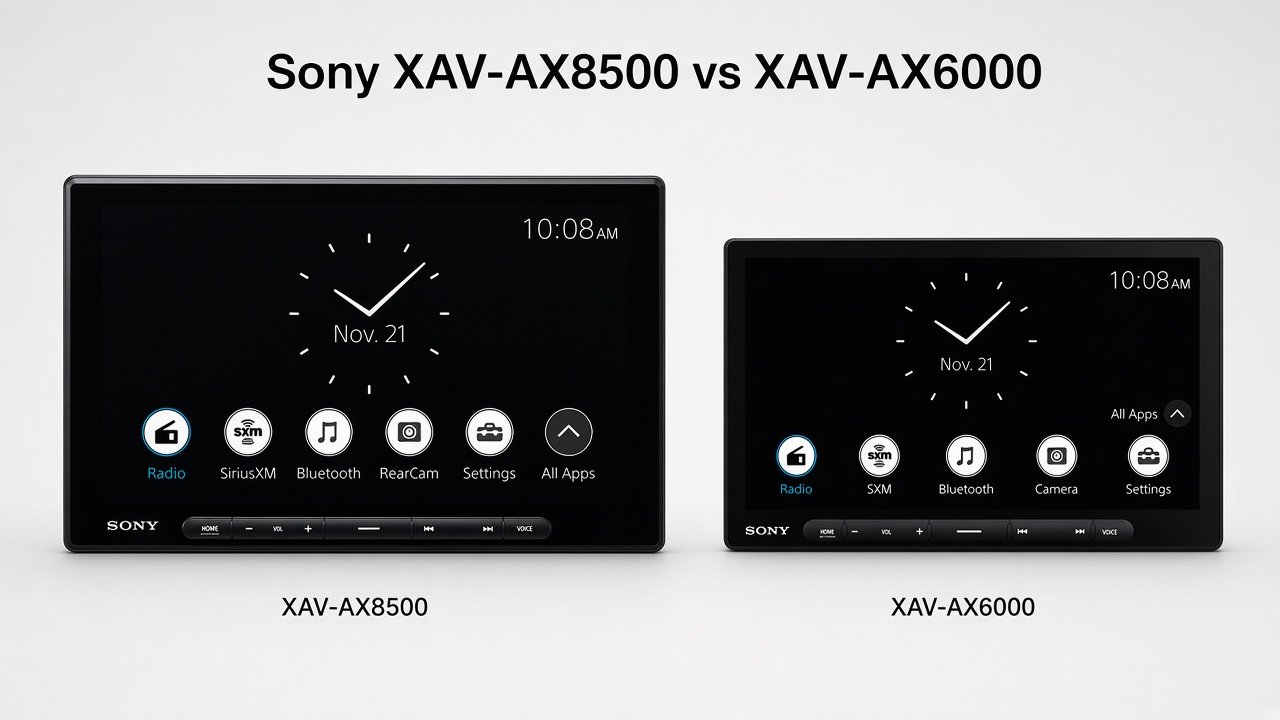
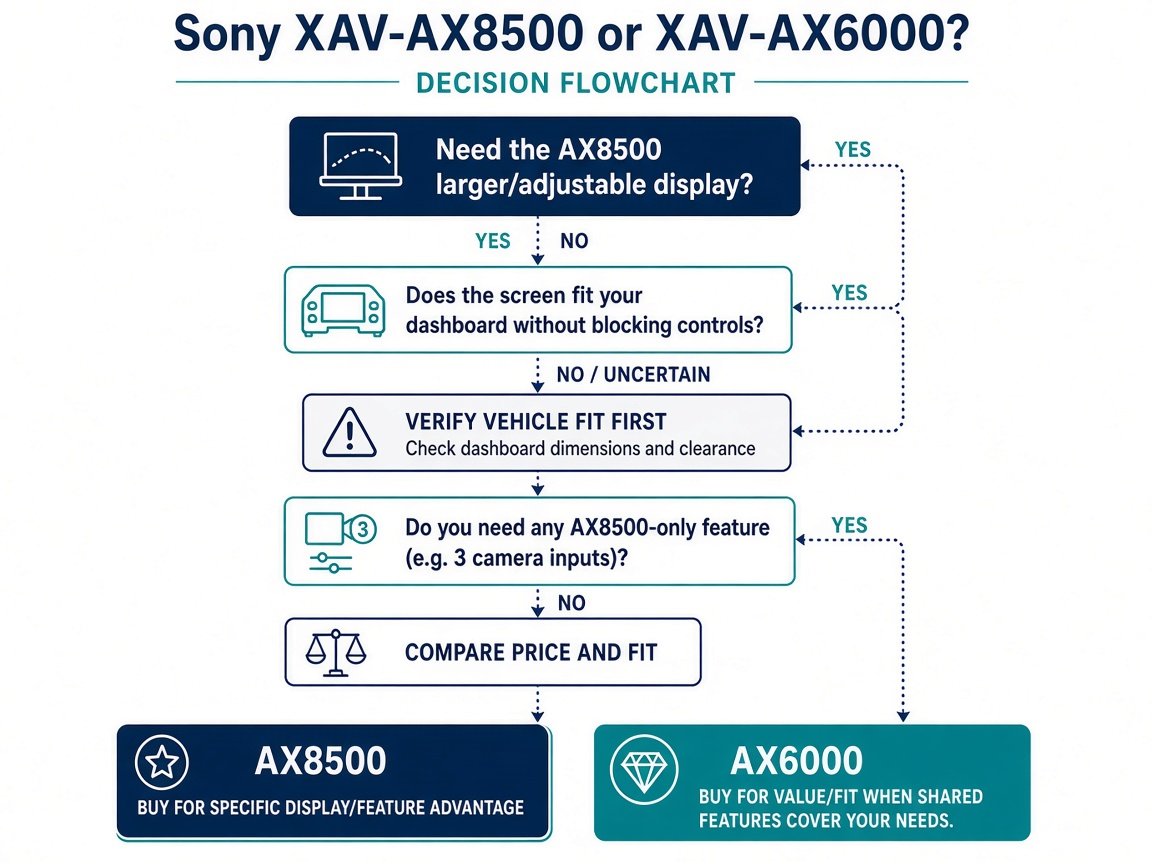
The Sony XAV-AX8500 vs XAV-AX6000 choice is not “which Sony is better.” It is whether you will pay for a 10.1-inch floating HD screen and three camera inputs, or take a 6.95-inch double-DIN-face receiver that already shares wireless CarPlay, Android Auto, 5 V preouts, and Maestro-ready integration. Quick verdict: buy the XAV-AX8500 only if the larger adjustable display (and extra camera triggers) will actually work in your dash. Buy the XAV-AX6000 if you want the same core CarPlay/audio feature set in a more conventional face. Dashboard fit can override a spec-sheet preference. This page is a buyer comparison, not a second XAV-AX8500 review — that lives on our Sony XAV-AX8500 review.
Moon Picke is independent of Sony. Specs below come from Sony Electronics product pages, Sony Help Guide specifications, and Sony support firmware listings as of September 11, 2026. See How We Evaluate, Editorial Standards, and our Affiliate Disclosure.
Sony XAV-AX8500 vs XAV-AX6000: Quick Verdict
BUY AX8500 IF: you specifically want Sony’s 10.1-inch (1280 × 720) optically gapless capacitive screen, documented tilt/swivel after install, a single-DIN chassis with a floating monitor, and three camera inputs with individual triggers — and you have confirmed the 10.1-inch panel will not block vents, shifters, or sight lines.
BUY AX6000 IF: a 6.95-inch anti-glare capacitive screen in a double-DIN-sized face with a compact single-DIN chassis covers your maps and media, you only need a single rear-camera input, and you want the lower current Sony U.S. list price for largely the same CarPlay, Android Auto, DSP, USB-C, HDMI, and Maestro architecture.
What is the main difference between Sony XAV-AX8500 and XAV-AX6000?
Display architecture and camera I/O. The XAV-AX8500 is a 10.1-inch floating HD monitor on a compact chassis. The XAV-AX6000 is a 6.95-inch bezel-less face designed to sit in a conventional double-DIN opening. Wireless CarPlay is not the differentiator.
Do both support wireless Apple CarPlay?
Yes. Sony documents wired and wireless Apple CarPlay and Android Auto on both models. Shared support is not measured wireless reliability.
Is XAV-AX8500 worth more than XAV-AX6000?
Only if you will use the larger adjustable screen and/or three camera triggers. Paying more for CarPlay you already get on the AX6000 is a weak reason.
Which is better for aftermarket audio?
Sony lists the same CTA-2006 20 W RMS × 4 internal amp class, 5 V three-channel preouts, 14-band EQ, time alignment, crossovers, and LDAC on both. There is no documented preout-voltage winner.
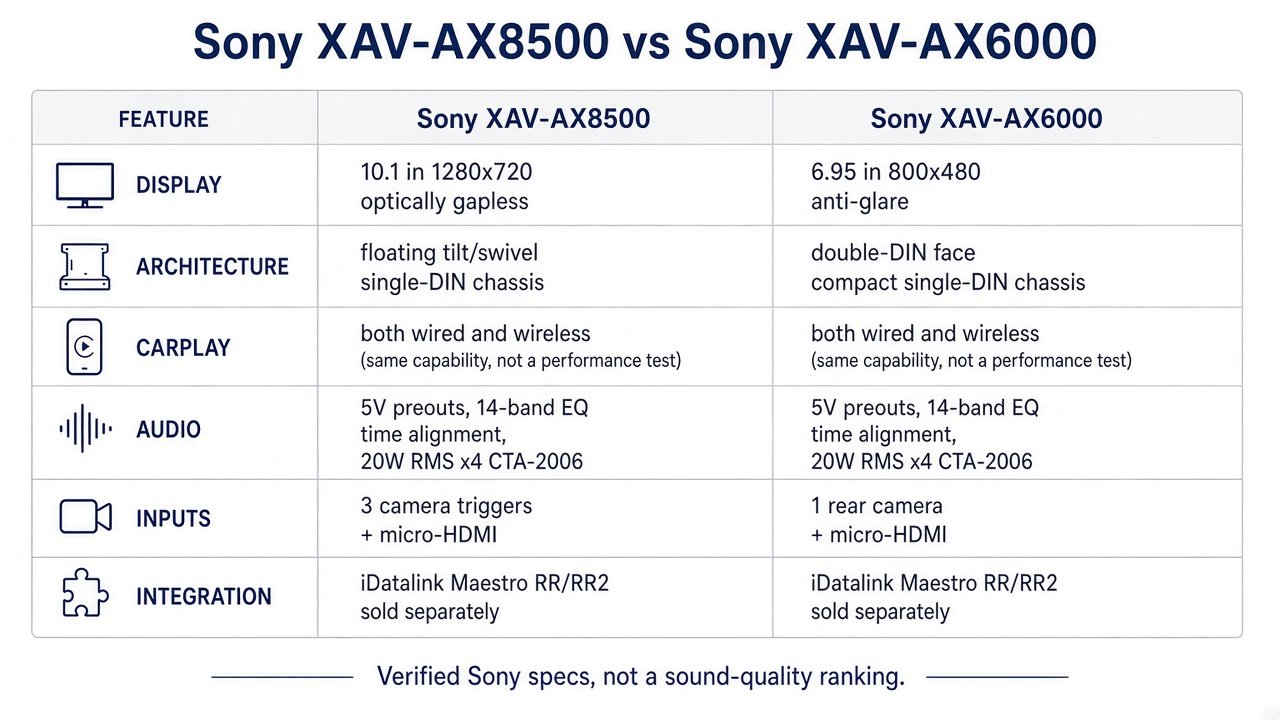
| Difference | Sony XAV-AX8500 | Sony XAV-AX6000 | Who Should Care? |
|---|---|---|---|
| Display size | 10.1 in (25.7 cm) | 6.95 in (17.6 cm) | Maps, camera view, dash space |
| Resolution | 1280 × 720 | 800 × 480 (1,152,000 pixels) | UI scale, not a lab sharpness test |
| Screen architecture | Floating monitor; tilt/swivel ±15° after install; optically gapless | Fixed bezel-less anti-glare face | Aiming the screen vs. a conventional dash look |
| Chassis / install | Compact single-DIN source + oversized floating screen | Double-DIN-sized face; compact single-DIN rear chassis | Kit choice, depth, cable space |
| Controls | Physical keys on the monitor (power/home/volume/track/voice) | Physical keys on the face (home/volume/track/voice) | Tactile input preference |
| Camera inputs | 3 inputs with individual triggers | 1 rear-view camera input | Front/side cameras vs backup only |
| HDMI | Micro-HDMI input (cable not supplied) | Micro-HDMI input (cable sold separately) | Parked external video — not a split |
| Current Sony U.S. price (Sep 11, 2026) | $799.99 (MSRP $999.99) | $549.99 (MSRP $699.99); Sony.com showed out of stock | Budget before kits and labor |
Sony XAV-AX8500 vs XAV-AX6000 — decision rows only. Sources: Sony Electronics product pages; Sony Help Guide specifications for XAV-AX6000; Sony XAV-AX8500 product FAQ.
As an Amazon Associate I earn from qualifying purchases.
See Sony XAV-AX8500 listings on Amazon (confirm New, model XAV-AX8500, ASIN B0CXF7H2Z4) →
See Sony XAV-AX6000 listings on Amazon (confirm New, model XAV-AX6000, ASIN B0B52FJ3ZG) →
The Differences That Actually Matter
Ignore equal-weight spec sheets. The purchase turns on (1) 10.1-inch floating HD versus 6.95-inch conventional face, (2) whether that floating panel physically clears your dash, (3) three camera triggers versus one rear camera input, (4) a current Sony.com gap of $250 at sale prices ($799.99 vs $549.99), and (5) vehicle-specific kits, harnesses, and interfaces that can dwarf that gap. Wireless CarPlay, Android Auto, Bluetooth 5.0 with LDAC, USB Type-C (3.0 A, rear, extension cable supplied), micro-HDMI, 5 V preouts, 14-band EQ, time alignment, SiriusXM-ready tuners sold separately, and iDatalink Maestro RR/RR2 sold separately are shared architecture — not reasons to “step up.”
Feature: larger floating screen. Use case: maps and camera images occupy more physical pixels. Limitation: bigger glass can cover vents or controls. Sony does not certify a universal vehicle list on the product page.
Display and Dashboard Fit
Sony rates the XAV-AX8500 as a 25.7 cm (10.1-inch) capacitive HD touchscreen at 1280 × 720 with optically gapless construction (Sony’s wording for reduced reflections). The XAV-AX6000 is a 17.6 cm (6.95-inch) bezel-less anti-glare capacitive TFT at 800 × 480. Those are specification deltas, not Moon Picke sunlight tests. We will not write that the AX8500 “looks better.”
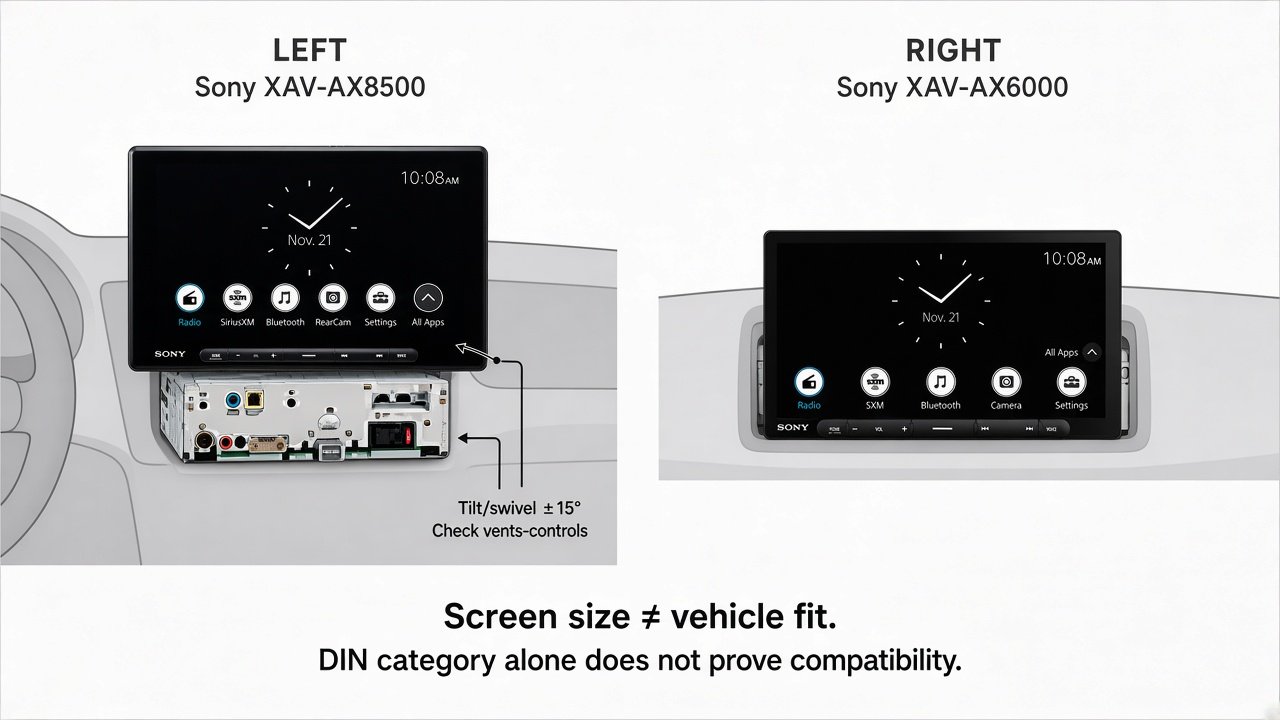
A larger screen can help maps, media, larger UI targets, and a rear-camera picture. It is not automatically the better head unit. The AX8500’s floating monitor is a physically larger object. Independent installer documentation commonly cites an approximately 10.565 × 6.575-inch monitor footprint for this chassis family — use that as a tape-measure check, not as a fit guarantee. The AX6000’s 6.95-inch diagonal is meant to occupy a typical double-DIN face area. Neither DIN label proves your vents stay clear. Head-unit screen size is not vehicle fit.
Installation: Floating Screen vs More Conventional Fit
Sony describes the XAV-AX8500 chassis as compact, with an updated display joint: after installation you can tilt and swivel the monitor ±15° horizontally and vertically without tools. That is positioning flexibility, not “fits every dash.” Sony’s AX6000 copy stresses a double-DIN display with a rear chassis smaller than conventional double-DIN boxes, leaving room for cables. Do not call either unit “just a double-DIN radio.” The AX8500 is a single-DIN-class source with a floating screen. The AX6000 pairs a double-DIN-sized face with a compact single-DIN-height rear chassis. For DIN language in general, see single DIN vs double DIN.
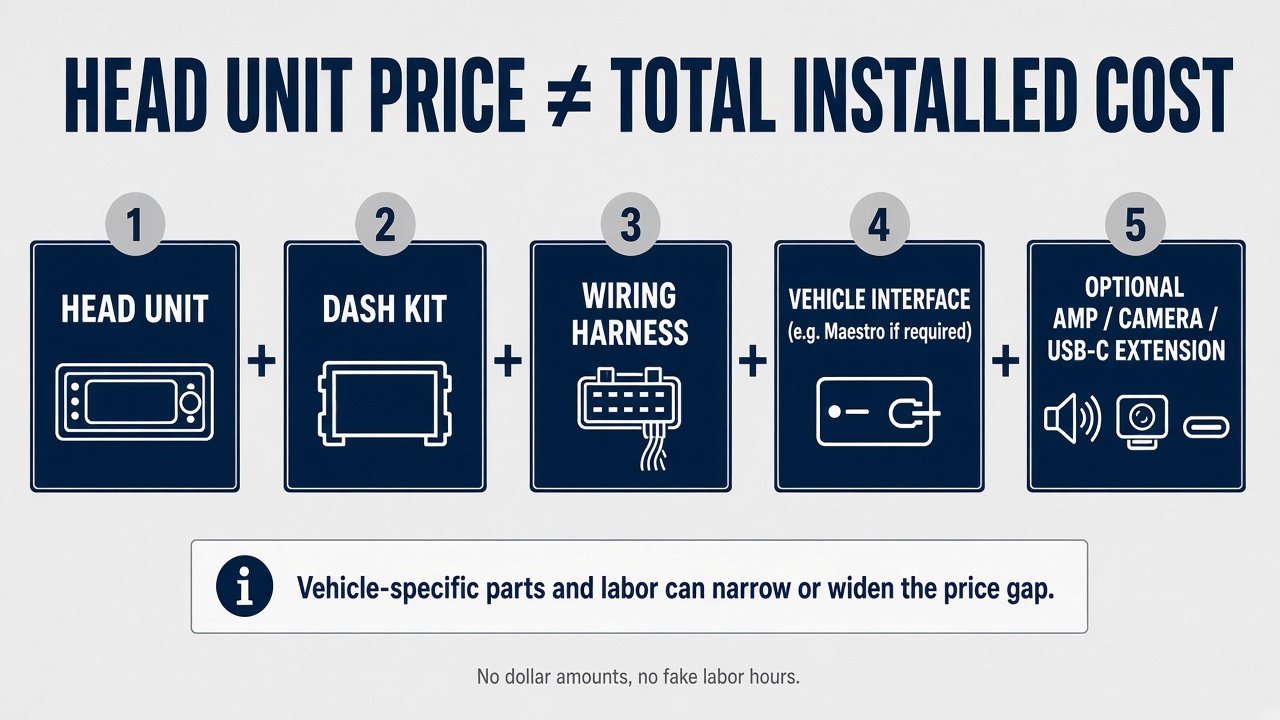
The real install system is head unit + dash kit + harness + antenna adapter + optional CAN/Maestro interface + labor + USB-C extension routing + camera/mic parts. We will not invent DIY hours, “plug-and-play,” or a universal labor bill. Factory amplifiers often need a vehicle-specific interface or bypass — Sony does not promise “works with your factory amp.”
Apple CarPlay and Android Auto
Both models document wired and wireless Apple CarPlay and Android Auto, plus Siri / Google Assistant voice paths Sony lists. Wireless CarPlay on both means the AX8500 price premium cannot be justified by “it has wireless CarPlay.” Wired versus wireless behavior, dropouts, and GPS accuracy are not measured here; a later wireless-versus-wired CarPlay article would own that topic. Sony requires the supplied GPS antenna for wireless smartphone features on this generation. USB wired CarPlay/Android Auto uses the rear USB Type-C port and the supplied Type-C extension (Sony: no regular Type-C cable in the AX8500 box; plan the cable run during install).
Audio Features: Is Either Model Better for an Amplified System?
Sony lists a built-in 4-channel amplifier at 20 W RMS × 4 (CTA-2006) and about 55 W × 4 maximum at 4 Ω on the AX8500 FAQ; the AX6000 Help Guide matches 20 W RMS × 4 CTA-2006 and 55 W × 4 maximum. Both list three 5 V preouts (front, rear, sub). Higher preout voltage is not automatically better sound — it can help some external amplifiers with gain structure. Both list 14-band EQ and time alignment. Crossover/sub control exists on this Sony generation; we are not publishing a listening winner. LDAC, AAC, and SBC are documented Bluetooth codecs on the AX6000 Help Guide; Sony also markets LDAC on the AX8500. Codec support is not a head-to-head listening test. If you are building an amplified system, treat these two as the same Sony DSP class unless a later measured difference appears. A full AX6000-only walkthrough is on our Sony XAV-AX6000 review — this comparison will not re-review it.
USB, HDMI and Camera Connectivity
USB is a wash for most buyers: rear USB Type-C, Hi-Speed, 3.0 A, extension required. HDMI is also shared: micro-HDMI input, cable not included, parked viewing / compatible external sources — not a streaming-service promise. Camera I/O is not a wash. Sony states the XAV-AX8500 has three camera inputs/triggers (rear plus two additional views such as side or front, cameras sold separately). The XAV-AX6000 Help Guide and Sony product copy document a rear-view camera input with guideline/parking-line adjustments — one backup path, not three triggers. If you want multiple aftermarket cameras on the head unit, that is an AX8500-only documented advantage. This is not a dash-cam buyer’s guide.
Vehicle Integration and iDatalink Maestro
Both Sony U.S. pages footnote iDatalink Maestro RR and RR2 sold separately; features vary by vehicle (maestro.idatalink.com). Maestro can retain steering-wheel controls, vehicle data, or climate displays in compatible cars with the correct flashed module and harness. It does not work in every vehicle. Steering-wheel control “support” on the stereo still usually needs an adapter or Maestro. Confirm your year/make/trim on iDatalink before you assume retention. Firmware: Sony support listed Firmware 3.04.00 (16 July 2026) for both XAV-AX8500 and XAV-AX6000. That is current update availability, not a promise of years of future support. SiriusXM is tuner-ready; antenna and tuner are sold separately and a subscription is separate.
Which One Is Better for Older Cars?
There is no universal older-car winner. Older dashes may have a single-DIN radio hole (AX8500 chassis language) or a double-DIN hole (AX6000 face language) and still fail because the AX8500’s 10.1-inch floating glass hits a pocket, HVAC slider, or ignition. Conversely, a tall double-DIN cavity can swallow the AX6000 face more cleanly. Verify: dash opening, kit, harness, antenna, amplifier interface, and camera trigger wire. “Easier to install” is vehicle-specific, not a model slogan.
Price and Total Installation Cost
Verified September 11, 2026 on Sony Electronics U.S.: XAV-AX8500 $799.99 (MSRP $999.99); XAV-AX6000 $549.99 (MSRP $699.99). Sale-to-sale gap: $250. MSRP-to-MSRP gap: $300. Sony.com showed the AX6000 out of stock the same day — availability is not the same as list price. Amazon product pages exist for ASIN B0CXF7H2Z4 (XAV-AX8500) and B0B52FJ3ZG (XAV-AX6000); confirm New versus Renewed, seller, and included accessories before checkout. Do not treat a stale launch price as today’s price.
Head-unit price is not total installed cost. Kits, harnesses, Maestro, antenna adapters, USB/HDMI cables, cameras, and labor can shrink or erase a $250 stereo gap — or make the AX8500 much more expensive if the floating screen needs extra brackets. We will not invent an average install bill.
Who Should Buy the Sony XAV-AX8500?
Choose the XAV-AX8500 if you have measured dash clearance for a 10.1-inch floating HD panel, you want Sony’s documented tilt/swivel, and you will use extra camera triggers or simply want the larger workspace for maps. Accept a higher stereo price and a less conventional dash object. Do not choose it because it costs more or because wireless CarPlay exists — the AX6000 already has that.
Who Should Buy the Sony XAV-AX6000?
Choose the XAV-AX6000 if a 6.95-inch conventional face fits your priority, you only need one rear-camera input, and you want the same documented CarPlay/Android Auto/DSP/USB-C/HDMI/Maestro path for less money. XAV-AX8500 or XAV-AX6000 is then a fit-and-budget call. Sony AX8500 vs AX6000 is a bad default “upgrade” if you never needed the extra glass.
Should XAV-AX6000 Owners Upgrade to AX8500?
Usually no. Core CarPlay, Android Auto, 5 V preouts, EQ/time alignment, USB-C, HDMI, and Maestro readiness match. An upgrade is mainly display form factor plus extra camera inputs. Pay that premium only if the 10.1-inch floating screen (and extra cameras) solve a daily problem your 6.95-inch unit does not. Keep the AX6000 if CarPlay already works and the smaller face fits.
Final Verdict
For Sony XAV-AX8500 vs XAV-AX6000, most buyers who only need wireless CarPlay, Android Auto, and Sony’s 5 V / 14-band tuning should start with the XAV-AX6000 — if it is in stock at a legitimate New price. The XAV-AX8500 should win only when its larger adjustable display and three-camera architecture are the actual job, and the glass clears the dash. Best spec is not best fit. Compare display + dash + integration + the few real I/O differences + total install cost, not which model sits higher in Sony’s lineup.
FAQ
What is the main difference between Sony XAV-AX8500 and XAV-AX6000?
A 10.1-inch floating HD screen and three camera triggers versus a 6.95-inch conventional face and one rear-camera input. CarPlay itself is shared.
Do both support wireless Apple CarPlay?
Yes. Sony documents wired and wireless Apple CarPlay and Android Auto on both.
Does the XAV-AX8500 have a larger screen?
Yes: 10.1 inches at 1280 × 720 versus 6.95 inches at 800 × 480.
Which Sony head unit is easier to install?
Neither, as a rule. Kits, depth, floating-glass clearance, and interfaces decide. DIN size alone is not compatibility.
Does either support iDatalink Maestro?
Both are Maestro RR/RR2 ready. Modules and vehicle firmware are sold/flashed separately; features vary by car.
Which is better for an aftermarket amplifier?
Sony lists the same 5 V three-preout class and CTA-2006 20 W × 4 internal ratings. No documented voltage winner.
Is the XAV-AX8500 worth the extra money? Should I upgrade from XAV-AX6000?
Worth it only for the display/camera architecture. Do not upgrade an AX6000 for CarPlay you already have.