
Reverse osmosis and whole-house filtration solve different water-treatment problems. The right choice depends on where you want to treat the water, what you want to reduce, your installation requirements, and whether you need drinking-water treatment, whole-home filtration, or both. The reverse osmosis vs whole house water filter decision starts with your water and your goal. Here, we compare typical point-of-use RO with sediment/carbon whole-house filtration. Whole-house describes a treatment location, not one technology; specialized whole-house RO also exists but is outside this comparison.
By Moon Picke · Fact-checked 31 August 2026 · About 11 minutes to read
Scene image: AI-generated editorial illustration, not a photograph of water or product testing.
Moon Picke has not independently laboratory-tested the SimPure systems mentioned. This guide combines official product documentation with CDC, EPA and NSF guidance, following our evaluation approach. Manufacturer specifications are not our test results.
Affiliate disclosure: Moon Picke may earn a commission from qualifying purchases through commercial links in this article. This does not determine our recommendations. Read our Affiliate Disclosure.
Reverse Osmosis vs Whole House Water Filter: The Quick Answer
Consider RO when the main objective is drinking and cooking water with a verified need for dissolved-contaminant reduction. Consider whole-house filtration when a suitable treatment needs to serve multiple fixtures. Consider both only when those are separate, justified goals.
Neither is automatically necessary. A simpler certified filter may address a taste complaint. Buying more equipment before identifying the problem can mean paying to treat water that does not need that treatment.
| Question | Typical point-of-use RO | Sediment/carbon whole-house filter |
|---|---|---|
| Treatment point | Kitchen dispenser or dedicated faucet | Incoming household line |
| Typical purpose | Targeted drinking-water treatment, including dissolved-solids reduction | Particle filtration and suitable carbon treatment across connected fixtures |
| Installation | Refillable countertop unit or under-sink plumbing | Main-line plumbing and service access |
| Wastewater | Produces a reject-water stream | Cartridge filtration does not continuously produce RO-style reject water |
| Electricity | Model-dependent; powered countertop and pumped tankless units need it | Basic cartridge housings generally do not; added equipment may |
| Maintenance | Filters, membrane, flushing and cleaning | Cartridges, housings, seals and pressure/flow checks |
| Household coverage | Selected drinking-water outlet | Downstream fixtures connected to the treated line |
Compare treatment formats in SimPure’s current range after deciding which column matches your needs.
The Biggest Difference Is Where the Water Is Treated
Point-of-use reverse osmosis
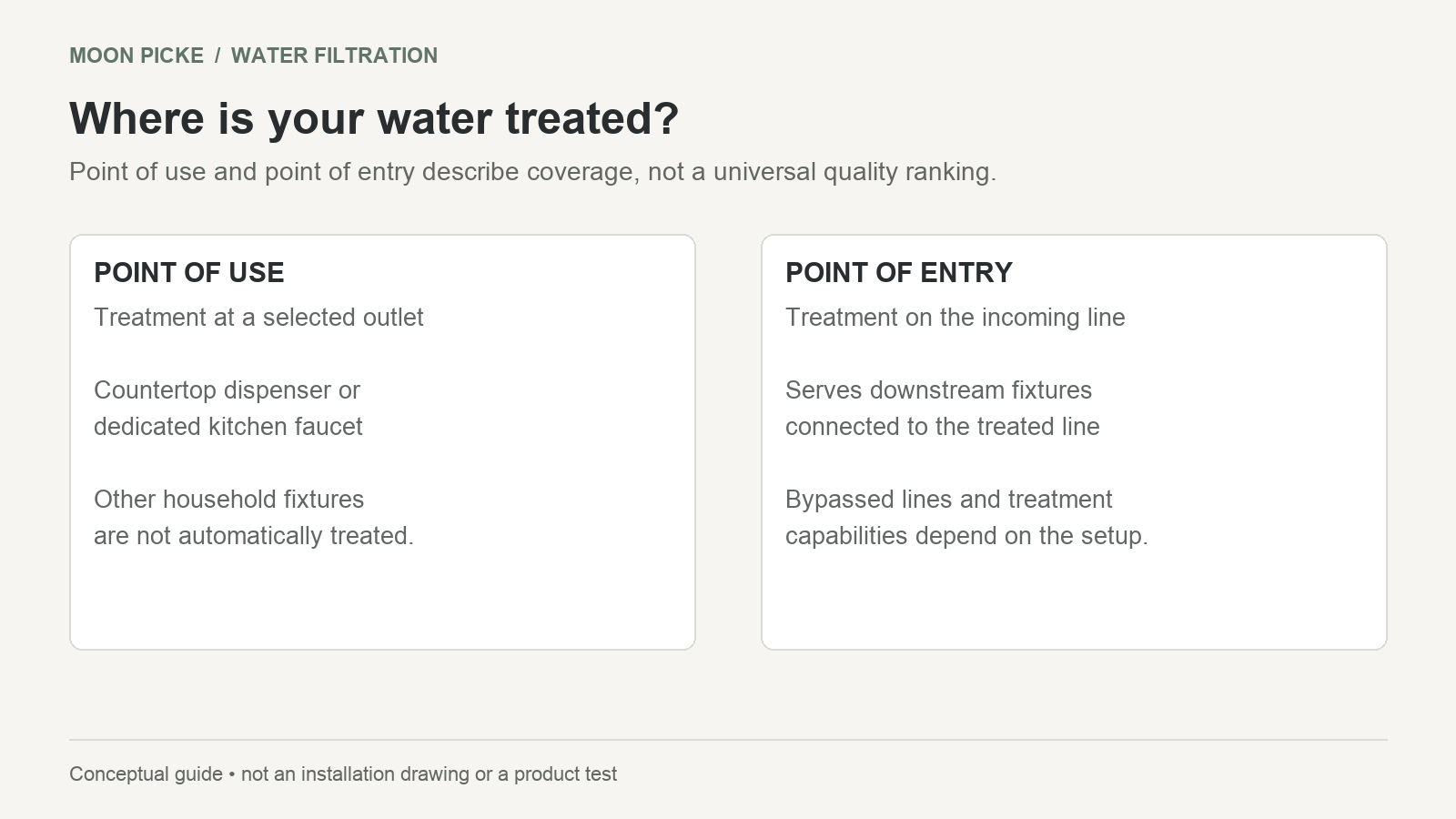
Point-of-use treatment concentrates on water you drink or use in cooking. For example, an under-sink unit supplies its connected faucet; a refillable countertop dispenser treats batches. Neither automatically filters a shower, washing machine or bathroom tap.
Point-of-entry whole-house filtration
Point-of-entry equipment treats incoming water before it branches toward household fixtures. The actual coverage depends on where it is installed and whether any lines bypass it. The CDC’s treatment overview distinguishes these two locations.
A useful planning exercise is to list the outlets you want treated. If your list says “kitchen drinking water,” whole-home installation deserves a specific reason. If it includes several bathrooms and utility fixtures, one countertop dispenser cannot meet the brief.
How Reverse Osmosis Works
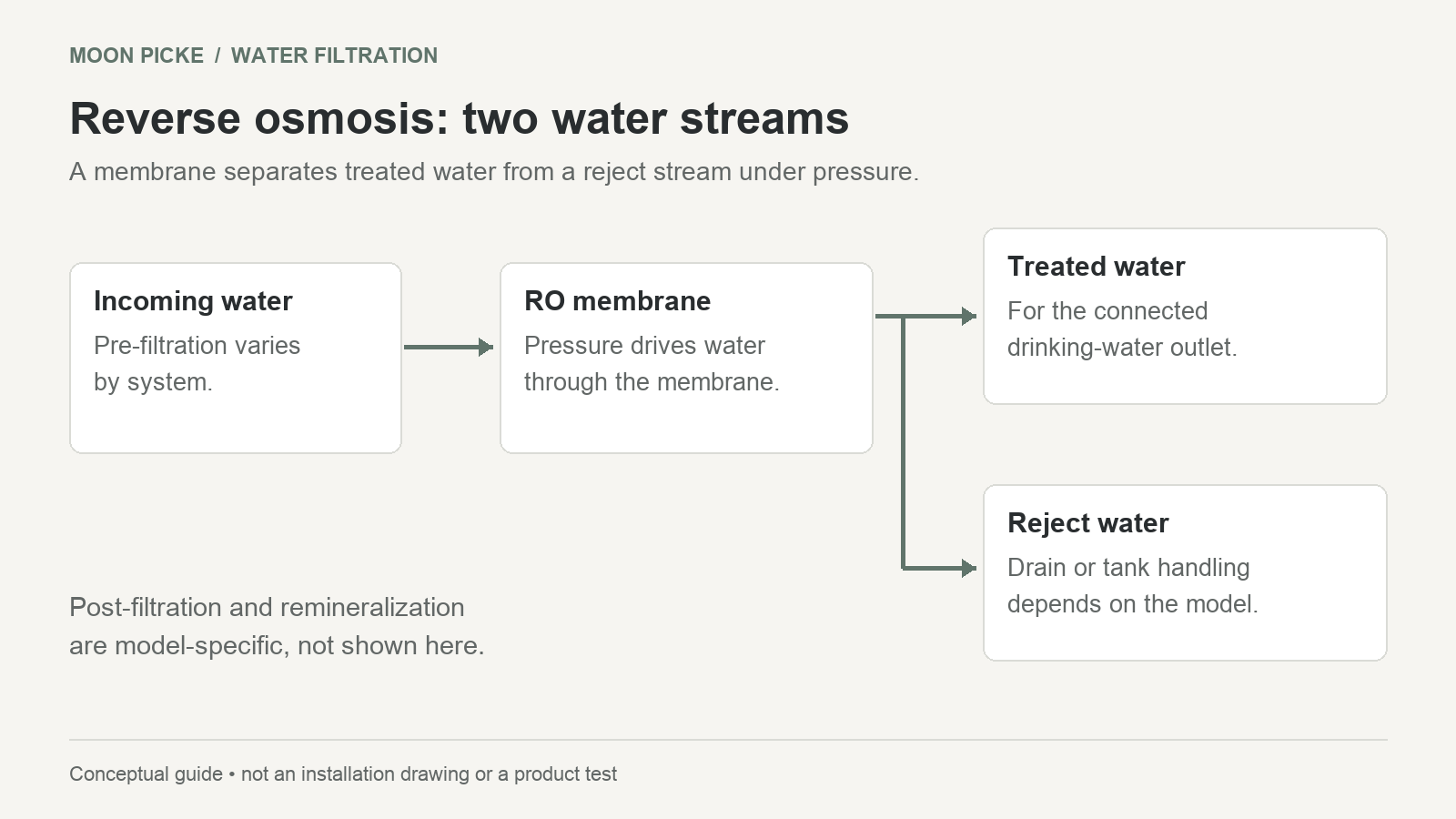
RO uses pressure to move water through a semipermeable membrane. One stream becomes treated water; another carries rejected substances away. Pre-filters and post-filters vary by system, so count the actual components and their functions rather than comparing advertised stage totals.
The EPA’s RO explanation also emphasizes water use. Reject water is part of the process, not necessarily a leak. In a plumbed system it normally goes to a drain; refillable units require the handling described in their manuals.
A stated pure-to-drain ratio needs context. Check which quantity comes first and the test conditions. Do not assume an advertised ratio predicts every household’s results, or that every RO unit uses electricity: pumps and other electrical features determine that requirement.
What a Whole House Water Filter Does
A typical sediment/carbon system combines a particle-trapping cartridge with carbon media intended for particular taste, odor or chemical-reduction tasks. It treats water before distribution, rather than creating a separate kitchen drinking-water supply.
Whole-house equipment can instead use other media, softening or disinfection technologies. Those are different treatment functions. A sediment/carbon filter is not a softener, and its presence does not establish that dissolved salts, microbes or every contaminant are addressed.
NSF explains that standards relate to different treatment claims; their numbers are not quality rankings. Check the exact model, named contaminant and applicable certification. “Tested to a standard” should not be casually rewritten as “NSF-certified.” More stages are not a substitute for this evidence.
Reverse Osmosis Is Usually Better When Drinking Water Is the Main Priority
Drinking and cooking water
When an identified dissolved-contaminant concern affects water you consume, a suitably verified RO system may be a sensible starting point. That does not establish that RO is preferable for every taste issue or necessary for already suitable tap water.
TDS and dissolved-solids reduction
RO can reduce dissolved solids. However, a total dissolved solids reading combines substances into one number; it does not identify individual contaminants or establish microbial safety. Do not use a low reading as proof that water is safe, or a higher reading as a diagnosis.
For broader brand context, see our SimPure review. The examples below illustrate different treatment formats.
Apartment and renter use cases
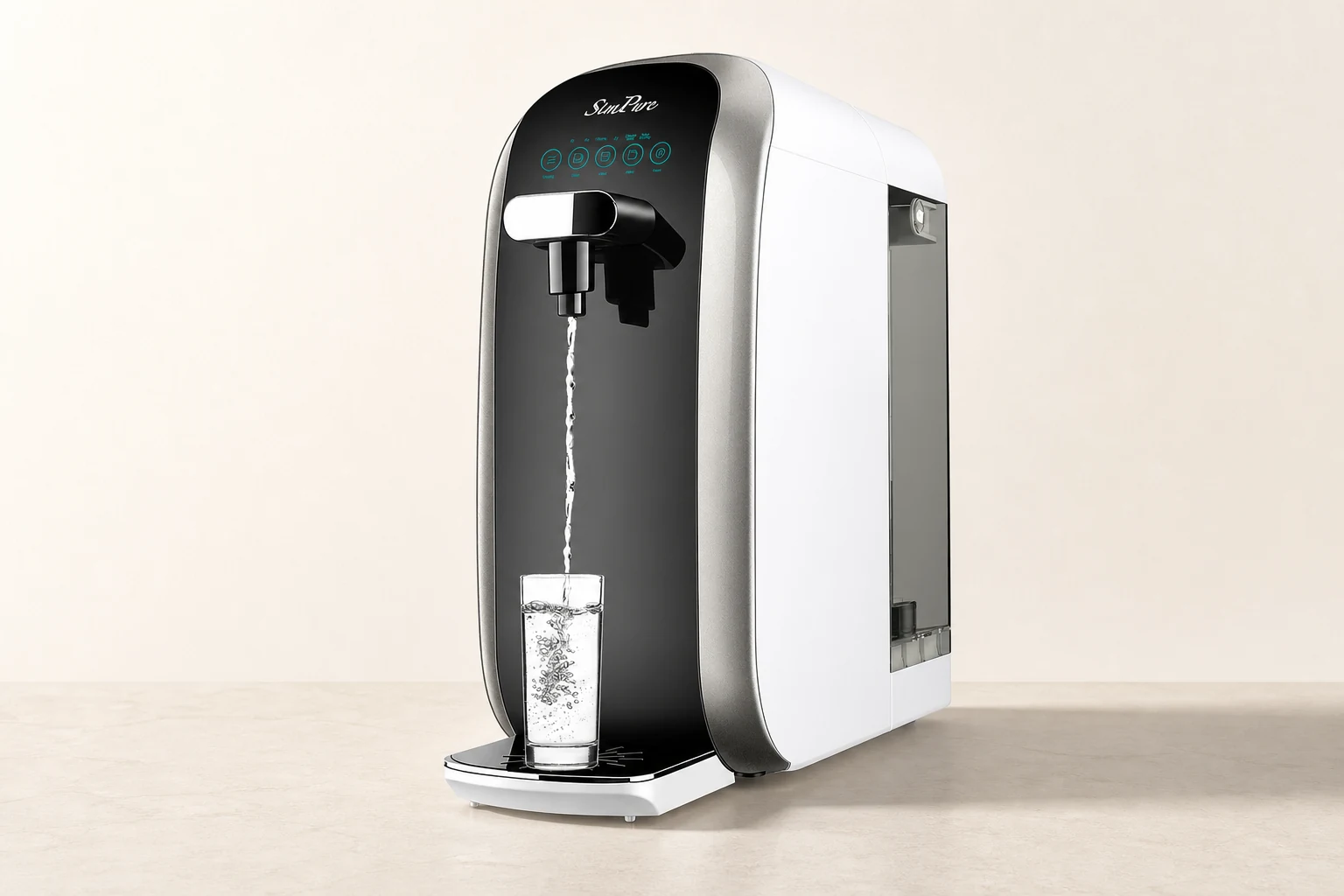
A refillable countertop unit can avoid permanent plumbing changes. SimPure presents the Y7P-BW as a plug-in dispenser with a feed-water tank. Its practical compromise is counter space plus the routine of filling, emptying and cleaning—not treatment of the apartment’s other fixtures.
Check the Y7P-BW’s current specifications and price if that routine suits your household.
Countertop vs under-sink RO
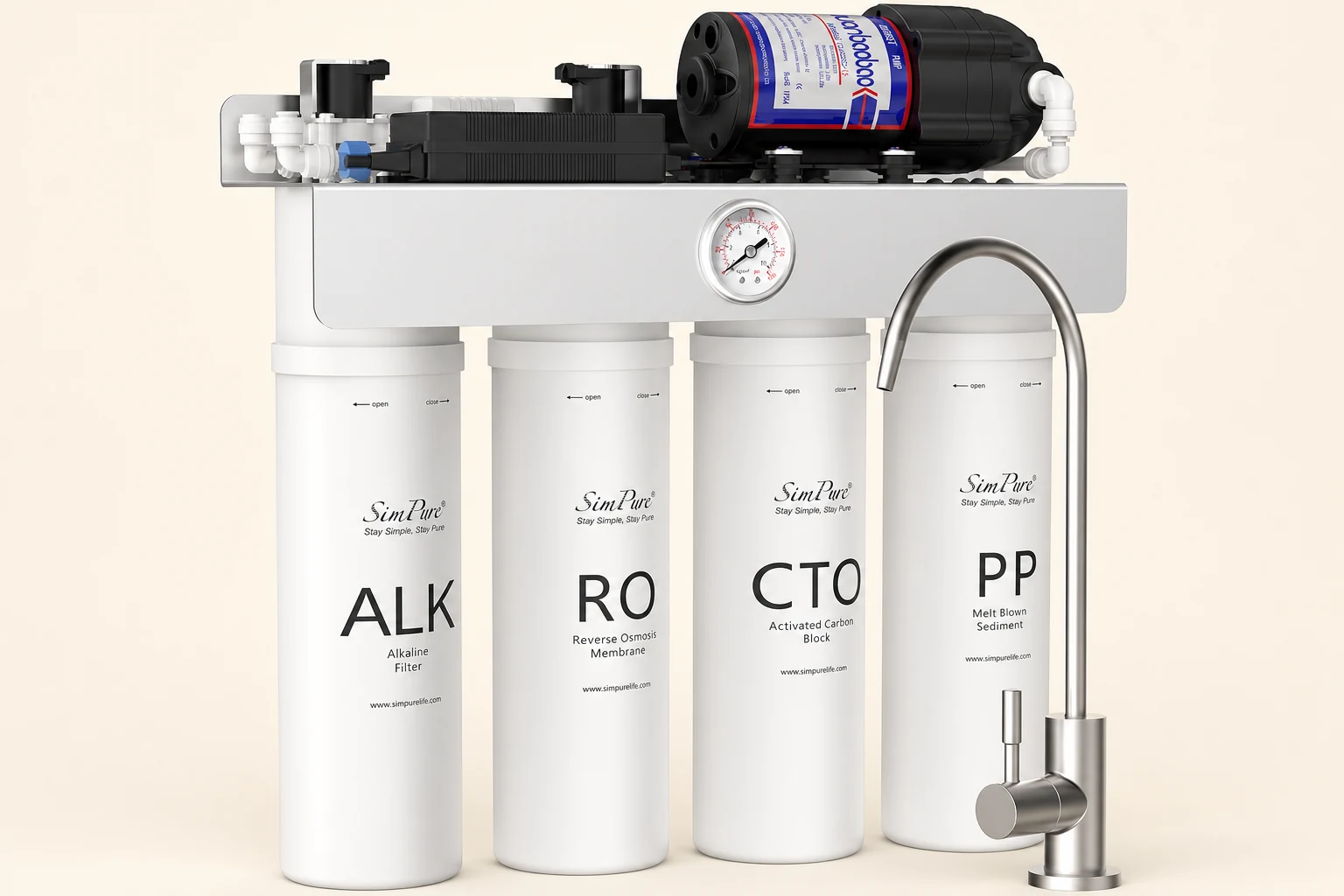
SimPure’s T1-400ALK is a tankless under-sink example with remineralization and powered operation. It offers a different ownership format: a connected drinking-water faucet rather than a countertop refill cycle. Remineralization is a product feature, not evidence of an added health benefit.
Review the T1-400ALK’s installation requirements before choosing it for a crowded cabinet or rental property.
Whole House Filtration Makes More Sense When the Problem Affects the Entire Home
Sediment entering multiple fixtures
If testing and inspection identify incoming sediment, point-of-entry particle filtration may address it before several fixtures. Choose the cartridge and service interval for the water, not merely the number of housings.
Taste or odor throughout the home
Suitable carbon treatment may help with a documented taste or odor issue. An unpleasant smell is not a diagnosis, though, and pleasant-tasting water is not proof of safety. The CDC’s filter-selection guidance recommends matching treatment to the problem.
Protecting plumbing and downstream equipment
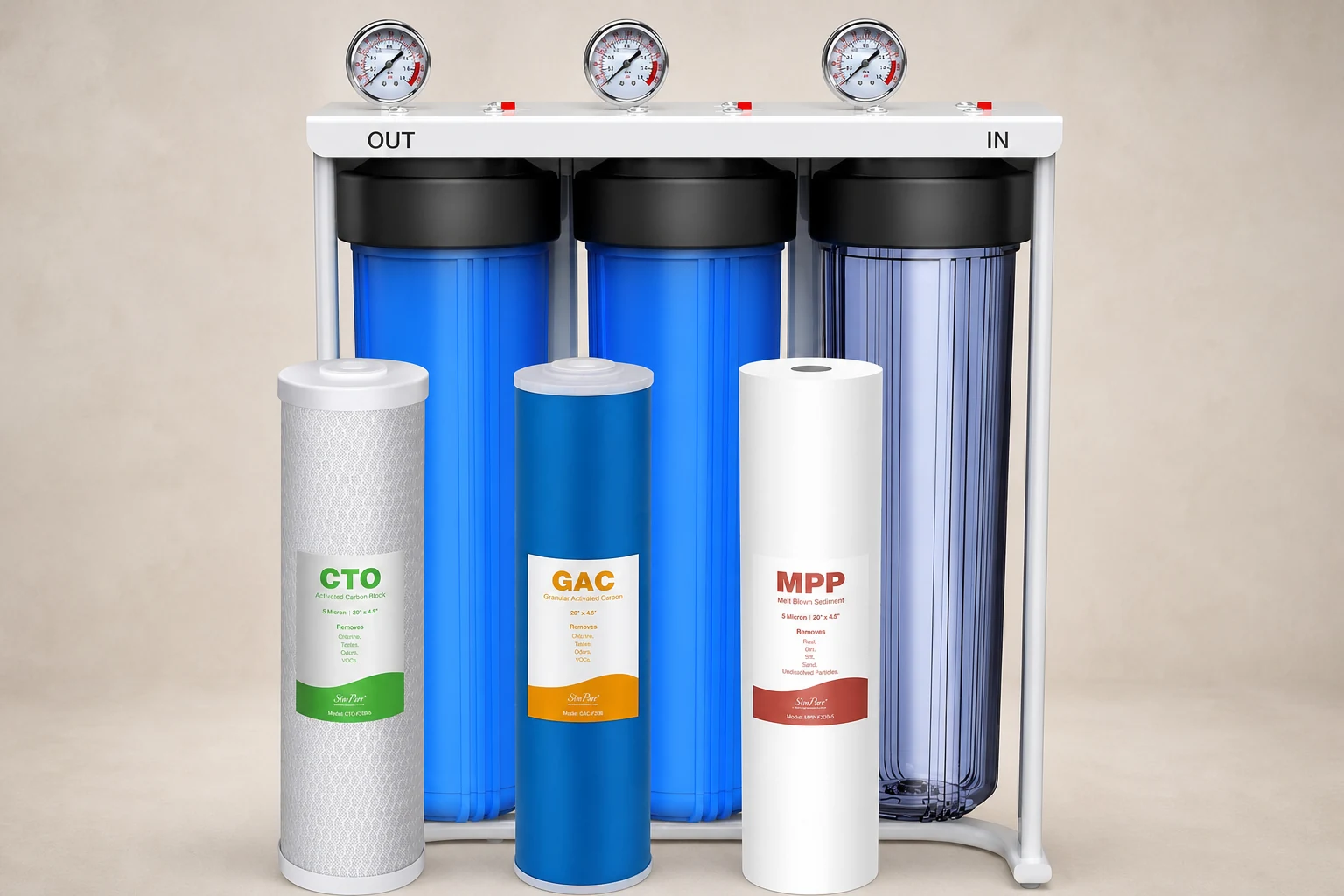
Reducing incoming particles can be a practical objective, but it does not guarantee longer appliance life or prevent hardness scale. SimPure lists the DB20P-3 with sediment, granular activated carbon and carbon-block cartridges. It specifically says this system does not reduce TDS.
Inspect the DB20P-3’s filter configuration and requirements. Do not assume it solves hardness, bacteria, iron, sulfur or every well-water problem.
City water vs well-water considerations
For city water, start with the utility’s current water-quality report and investigate any building-specific concern. For a private well, start with testing rather than a generic “city/well water” product label.
The EPA recommends annual private-well testing for total coliform bacteria, nitrate, TDS and pH, plus other locally relevant contaminants. A certified drinking-water laboratory and local health department can help interpret what treatment is appropriate.
Also consider what whole-home carbon removes: reducing disinfectant residual can allow more microbial growth in plumbing. Maintenance and system design matter; a carbon filter should not be presented as automatic disinfection.
RO vs Whole House Filter: Installation and Space
Countertop RO
Measure the counter and the clearance needed to remove or refill the tank. Check access to the outlet and how you will handle reject water. A machine fitting under a wall cabinet does not necessarily mean its tank is convenient to lift out.
Under-sink RO
Check cabinet dimensions, filter-removal clearance, the cold-water connection, a suitable drain connection, faucet space and power where required. Tankless does not mean installation-free. Ask about landlord approval and professional installation if the work exceeds your ability or local requirements.
The T1-400 manual is a better installation reference than a product photograph.
Whole-house installation
Plan for a supported mounting location, isolation for servicing and enough clearance to remove the housings. An installer should check connection size, available pressure and simultaneous household demand. Do not treat a catalog maximum flow as a promise of unchanged shower pressure with loaded cartridges.
Maintenance and Ongoing Cost
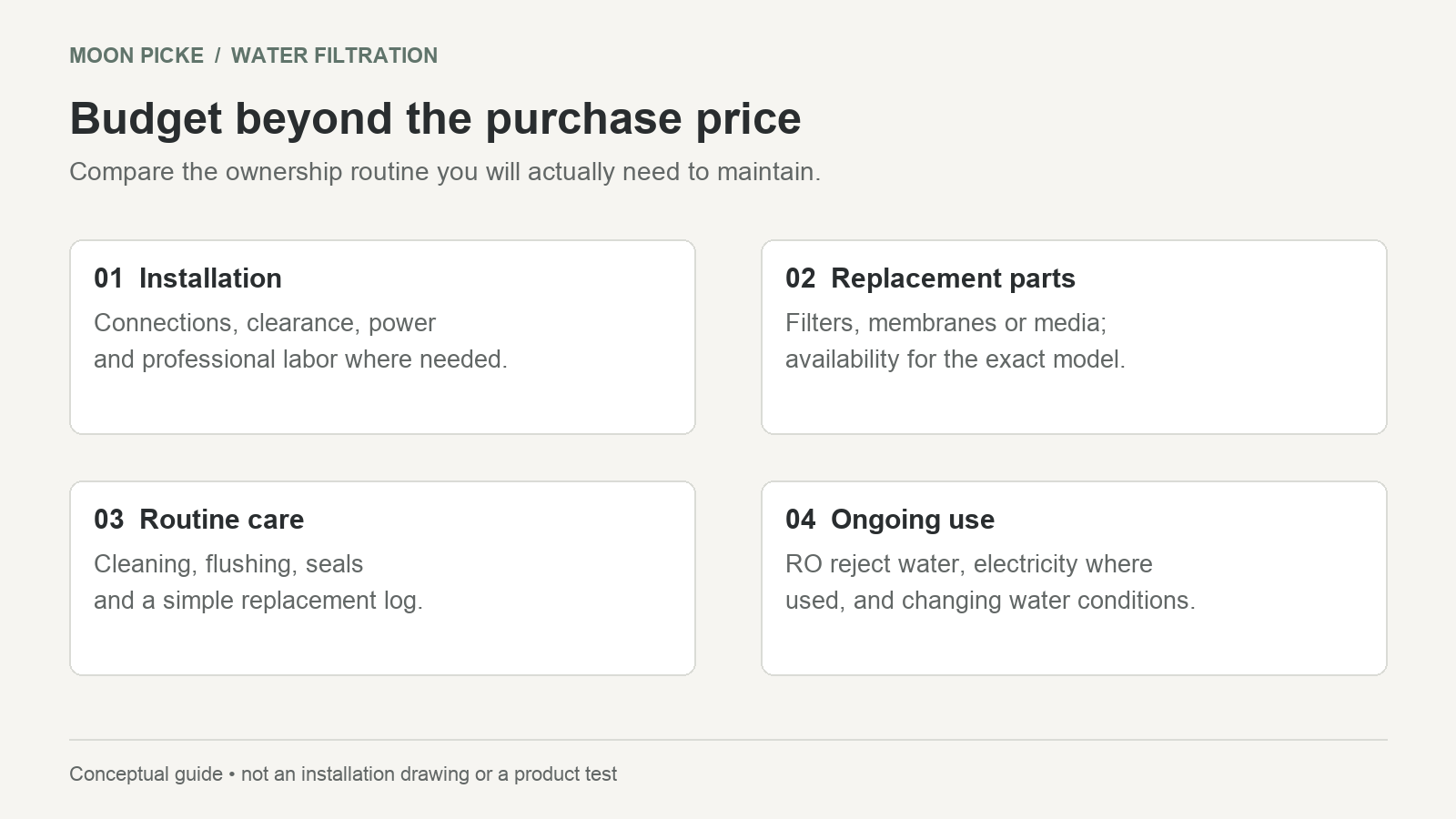
Compare a complete ownership plan, not just today’s checkout price:
- RO: replacement pre-filters and membrane, any post-filter or remineralization cartridge, flushing, tank cleaning where applicable, water use and powered operation.
- Whole-house cartridges: replacement media, housing cleaning, seal inspection, pressure changes and labor if servicing is not straightforward.
- Either format: installation, replacement-part availability and a realistic maintenance routine.
Check instructions for the exact model and water conditions. However, a manufacturer’s stated interval is not proof that a cartridge will last that long in your home. Keep a simple replacement log and investigate unexpected flow or water-quality changes.
For the countertop example, consult the Y7P manual alongside the current product listing. We have not assigned a universal annual cost because consumption, source water and replacement prices vary.
Do You Ever Need Both Reverse Osmosis and a Whole House Filter?
Yes, when there are two distinct objectives. One household might need incoming sediment/carbon filtration for multiple fixtures and separately want verified dissolved-contaminant reduction at the kitchen drinking-water outlet.
Upstream filtration does not make kitchen RO redundant merely because both use the word “filter.” Equally, the presence of two systems does not prove the water is safer. Their capabilities must match the actual concerns, and the upstream treatment must suit the downstream equipment.
Do not build a two-system setup by default. If a modest point-of-use filter meets the verified need, extra whole-home hardware may add maintenance without a clear benefit.
Which System Should You Choose?
| Your situation | Direction to investigate | Check before buying |
|---|---|---|
| Drinking and cooking water only | Point-of-use RO, if its treatment is justified | Specific reduction evidence; whether simpler filtration suffices |
| Renting or no plumbing changes allowed | Refillable countertop RO | Power, counter clearance and refill routine |
| Integrated kitchen drinking-water supply | Under-sink RO | Cabinet access, faucet, drain and installation permission |
| Incoming sediment or suitable taste/odor concern across fixtures | Appropriate whole-house filtration | Water diagnosis, media, pressure and maintenance |
| Separate whole-home and drinking-water needs | Potentially both | Compatibility and a purpose for each system |
| Complex private-well concern | Test water first | Laboratory findings and treatment advice |
Write your requirement in one sentence: “I want to reduce this identified issue at these outlets.” That is a stronger buying brief than “I want the system with the most stages.”
SimPure Options for Each Type of Buyer
SimPure Y7P-BW for countertop RO
A format to consider when you want a movable drinking-water station without permanent plumbing work. Decide whether its filling and cleaning routine is acceptable before focusing on convenience claims.
SimPure T1-400ALK for under-sink RO
A format for a dedicated kitchen faucet and an installation you can accommodate. Its tankless, remineralizing design does not eliminate cabinet, power or servicing requirements.
SimPure DB20P-3 for whole-house filtration
A three-cartridge sediment/carbon format for an appropriate incoming-water problem. It is not whole-house RO and should not be bought as a universal solution for difficult well water.
Once the format is settled, compare SimPure’s current options and replacement filters. Confirm the exact model and supplied components rather than assuming every variant has identical capabilities.
Final Verdict
There is no universal winner in reverse osmosis vs whole house water filter comparisons. The treatment objective determines the architecture: selected drinking water, the incoming household supply, or a justified combination.
Identify the problem, select evidence-backed treatment and check installation and maintenance. If you cannot yet explain what you need to reduce and where, water testing is a more useful next step than buying another filtration stage.
Frequently Asked Questions
Is reverse osmosis better than a whole house water filter?
For some dissolved-contaminant drinking-water needs, a suitable RO system is more relevant. For treatment across multiple fixtures, point-of-entry equipment may fit better. The correct comparison is capability plus coverage, not one universal ranking.
Does a whole house water filter replace reverse osmosis?
Not automatically. A sediment/carbon system does not provide the same treatment as an RO membrane. However, if it meets all your verified needs, you may have no reason to add RO.
Can you use reverse osmosis with a whole house filter?
Yes. Compatible upstream filtration and kitchen RO can serve separate purposes. Check the RO system’s feed-water requirements and maintain both systems.
Do I need RO if I already have a whole house water filter?
Only if there is an additional drinking-water objective your existing treatment does not meet. Check its documented capabilities and relevant water-test results before buying another system.
Which is better for an apartment?
A refillable countertop system can suit a renter who cannot alter plumbing, provided there is adequate space and power. A permitted under-sink installation may be preferable when you want a connected faucet and less refilling.