
SimPure Review 2026: Is It Worth Buying?
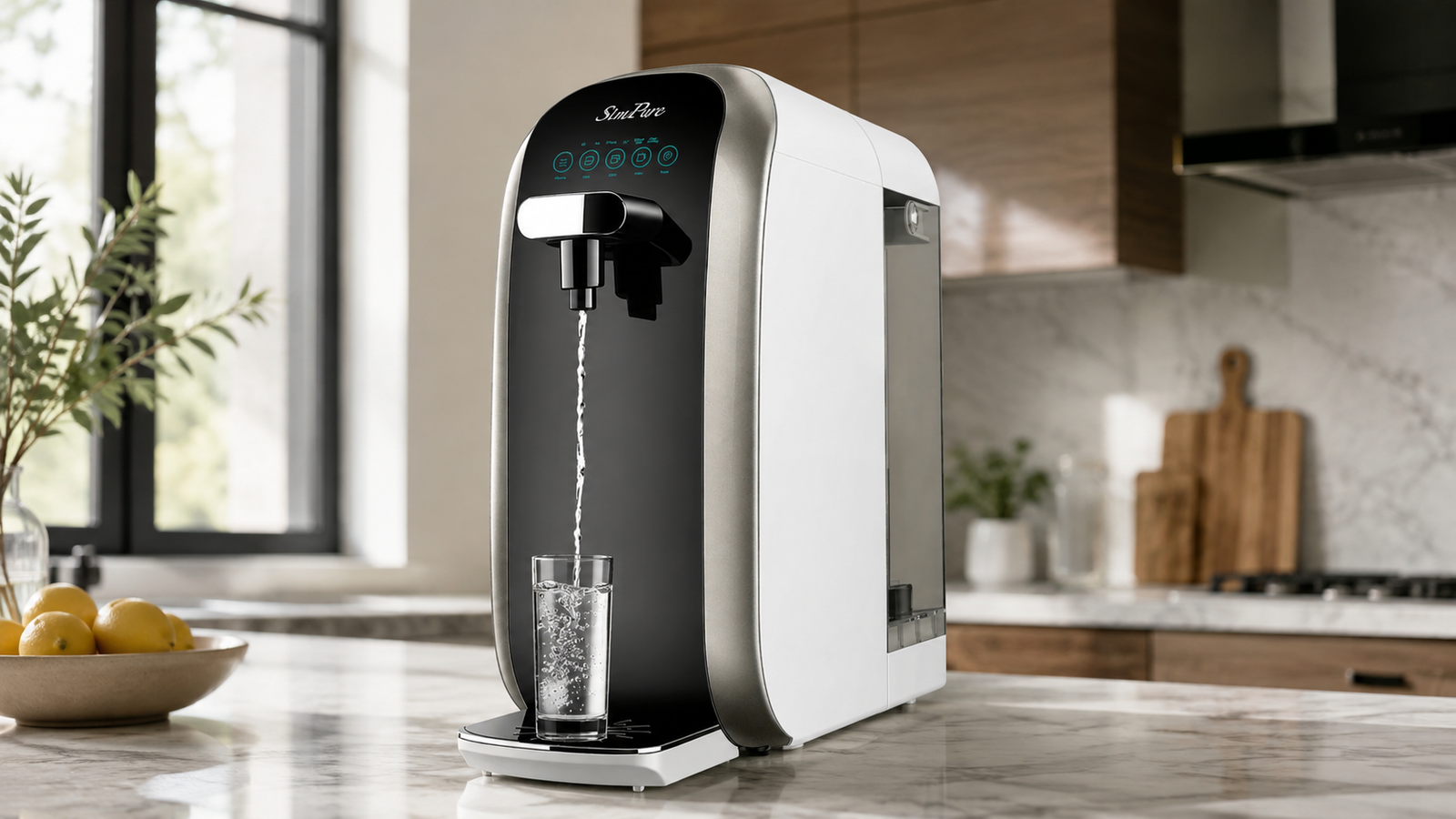
SimPure offers countertop and under-sink reverse osmosis systems, whole-house filters, and replacement cartridges. This review looks at the current lineup, pricing, maintenance, buyer trade-offs, and which types of households may benefit most.
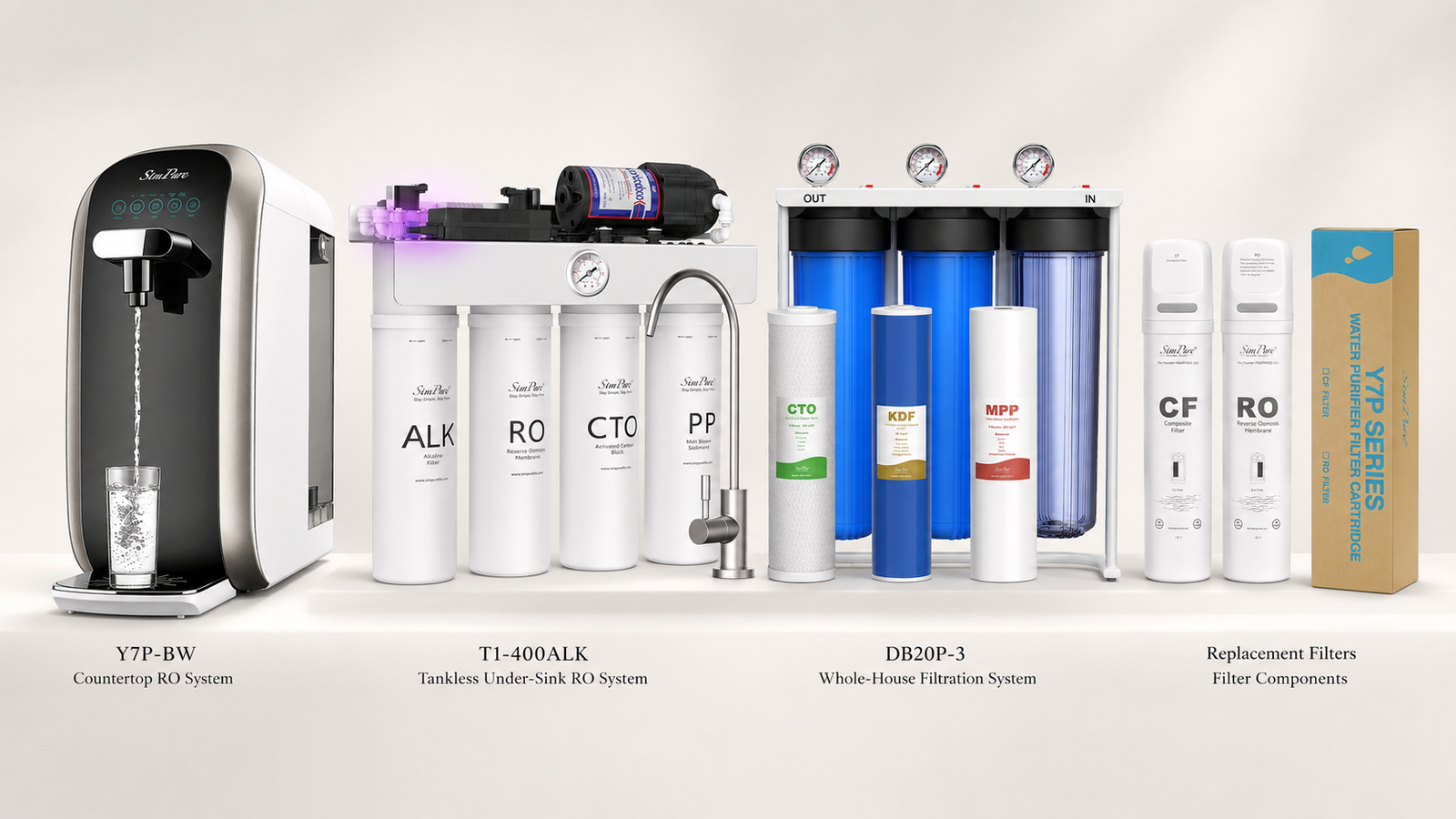
SimPure sells several very different types of home water-filtration equipment under one brand, from plug-in countertop reverse osmosis systems to tankless under-sink RO units and multi-stage whole-house filters.
That variety is useful, but it also makes a brand-level SimPure review easy to oversimplify.
A countertop RO dispenser designed for an apartment solves a different problem from a whole-house sediment and carbon filtration system installed on a home’s main water line. Even two SimPure RO systems can differ substantially in flow rate, remineralization, installation requirements, wastewater ratio, and ongoing filter costs.
So the useful question is not simply:
Is SimPure a good brand?
It is:
Does SimPure make the right type of filtration system for your water, home, installation constraints, and maintenance preferences?
This review is based on SimPure’s current product catalog, documentation, replacement-filter listings, and published customer policies. Moon Picke has not independently installed or laboratory-tested these systems, so product performance claims are identified as manufacturer information rather than presented as our own test results.
At the time of research, SimPure’s strongest product coverage appears to be in countertop RO, under-sink reverse osmosis, and entry-to-midrange whole-house filtration, with a reasonably visible replacement-filter ecosystem behind those systems.
Disclosure: Moon Picke may earn a commission if you purchase through links in this guide. This does not affect our editorial conclusions.
Quick Verdict
SimPure is worth considering if you already know what type of water-filtration system you need.
Its product range is broad enough to serve several very different buyers:
- renters who cannot modify plumbing;
- homeowners wanting countertop RO;
- buyers prepared to install an under-sink RO system;
- households looking for whole-house sediment and carbon filtration;
- users who want replacement filters available from the same brand.
The brand is particularly interesting in countertop RO. Models such as the Y7P-BW require no plumbing installation, while the higher-flow Y9A adds alkaline remineralization. SimPure also sells compact tankless under-sink systems such as the T1-400ALK and Q3-600A, plus large-format whole-house systems such as the DB20P-3.
The main qualification is that these systems are not interchangeable.
A whole-house filter does not automatically provide the same treatment as reverse osmosis at the kitchen sink. Likewise, a countertop RO machine can be convenient for drinking water while doing nothing for showers, appliances, or other fixtures.
You also need to account for:
- available counter or cabinet space;
- plumbing requirements;
- electricity requirements;
- replacement filters;
- filter-change frequency;
- wastewater from RO;
- installation complexity;
- the actual water problem you are trying to solve.
Check SimPure Y7P-BW price & availability →
Moon Picke verdict
| Area | Assessment |
|---|---|
| Countertop RO selection | Strong |
| Under-sink RO selection | Strong |
| Whole-house filtration options | Good |
| Replacement-filter visibility | Strong |
| Apartment/renter options | Strong |
| Installation simplicity | Depends heavily on product type |
| Maintenance simplicity | Moderate; filters still require scheduled replacement |
| Best fit | Buyers who first identify the filtration category they need, then choose the model |
SimPure Y7P-BW
Best starting point for countertop RO: SimPure Y7P-BW
- 100 GPD rated capacity;
- 5-stage filtration;
- 4:1 pure-to-drain ratio;
Affiliate link. Moon Picke may earn a commission from qualifying purchases.
SimPure Y9A
Best starting point for higher-flow countertop RO: SimPure Y9A
- 6-stage filtration;
- alkaline remineralization;
- 2.5:1 pure-to-drain ratio;
Affiliate link. Moon Picke may earn a commission from qualifying purchases.
SimPure T1-400ALK
Best starting point for under-sink RO: SimPure T1-400ALK
- 6-stage filtration;
- alkaline remineralization;
- 2.5:1 pure-to-drain ratio;
Affiliate link. Moon Picke may earn a commission from qualifying purchases.
SimPure DB20P-3
Best starting point for whole-house filtration: SimPure DB20P-3
- 1-inch NPT inlet/outlet connections;
- maximum rated flow of 15 GPM;
- 25–90 PSI feed-water range;
Affiliate link. Moon Picke may earn a commission from qualifying purchases.
What Is SimPure?
SimPure is a consumer filtration brand whose current catalog spans several categories rather than one single type of water purifier.
Its water-related product lineup currently includes:
- countertop reverse osmosis systems;
- under-sink RO systems;
- whole-house filtration systems;
- whole-house pre-filters;
- outdoor filtration products;
- gravity and portable filtration;
- replacement cartridges and filter kits.
Its published manuals also cover countertop models such as the Y7 and Y9 series, tankless under-sink systems such as the T1-400 and Q3-600 series, and whole-house systems including the DB10P and DB20P families.
That range is important because the phrase “water filter” can describe systems that work in very different ways.
SimPure’s reverse-osmosis products are primarily point-of-use systems intended to treat drinking water at a specific location.
Its DB-series whole-house systems are installed on the main water line to filter water before it reaches multiple fixtures.
Those are different buying decisions.
SimPure Product Range
Countertop RO systems
Countertop RO is probably one of the most distinctive parts of SimPure’s lineup.
These systems are designed for buyers who want reverse osmosis without permanently modifying under-sink plumbing.
The SimPure Y7P-BW is a 5-stage, 100 GPD countertop RO system. SimPure describes it as a zero-installation unit: the filters are pre-installed, the user fills the feed-water tank, plugs the machine in, and dispenses purified water from the countertop. Its current specifications list a 4:1 pure-to-drain ratio and electrical power as a requirement.
That format can make sense for:
- apartments;
- renters;
- offices;
- kitchens with limited under-sink access;
- people who do not want to alter existing plumbing.
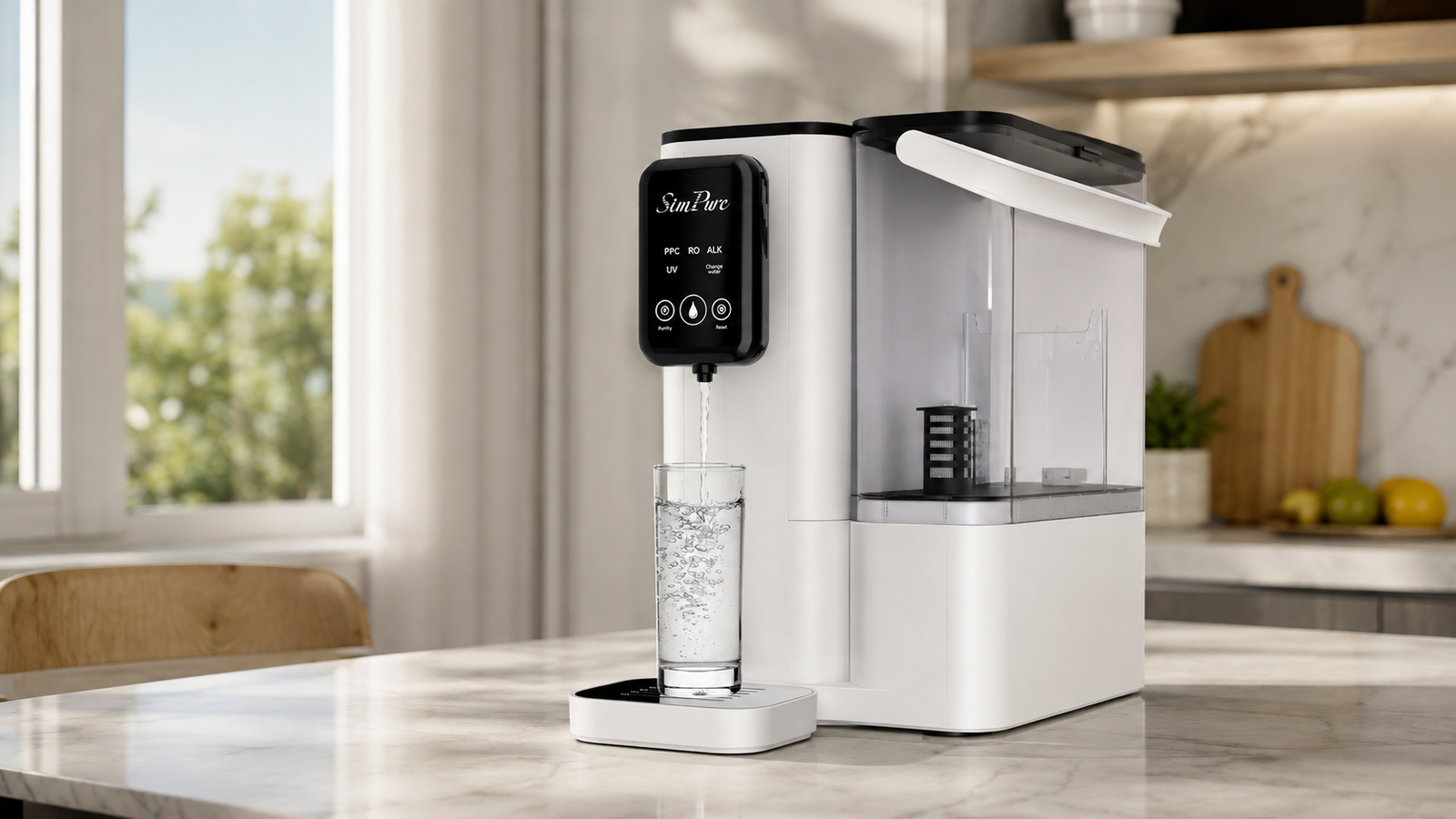
The Y9A targets a slightly different countertop buyer. It is currently listed as a 300 GPD, 6-stage countertop RO system with alkaline remineralization. SimPure’s specifications show a 2.5:1 pure-to-drain ratio, and the system also requires electricity.
So even inside the countertop category, the choice is not simply:
Y9A is more expensive, therefore it is better.
The real distinction is whether you value its higher rated capacity and remineralization enough to justify its larger price and replacement-filter requirements.
Under-sink RO systems
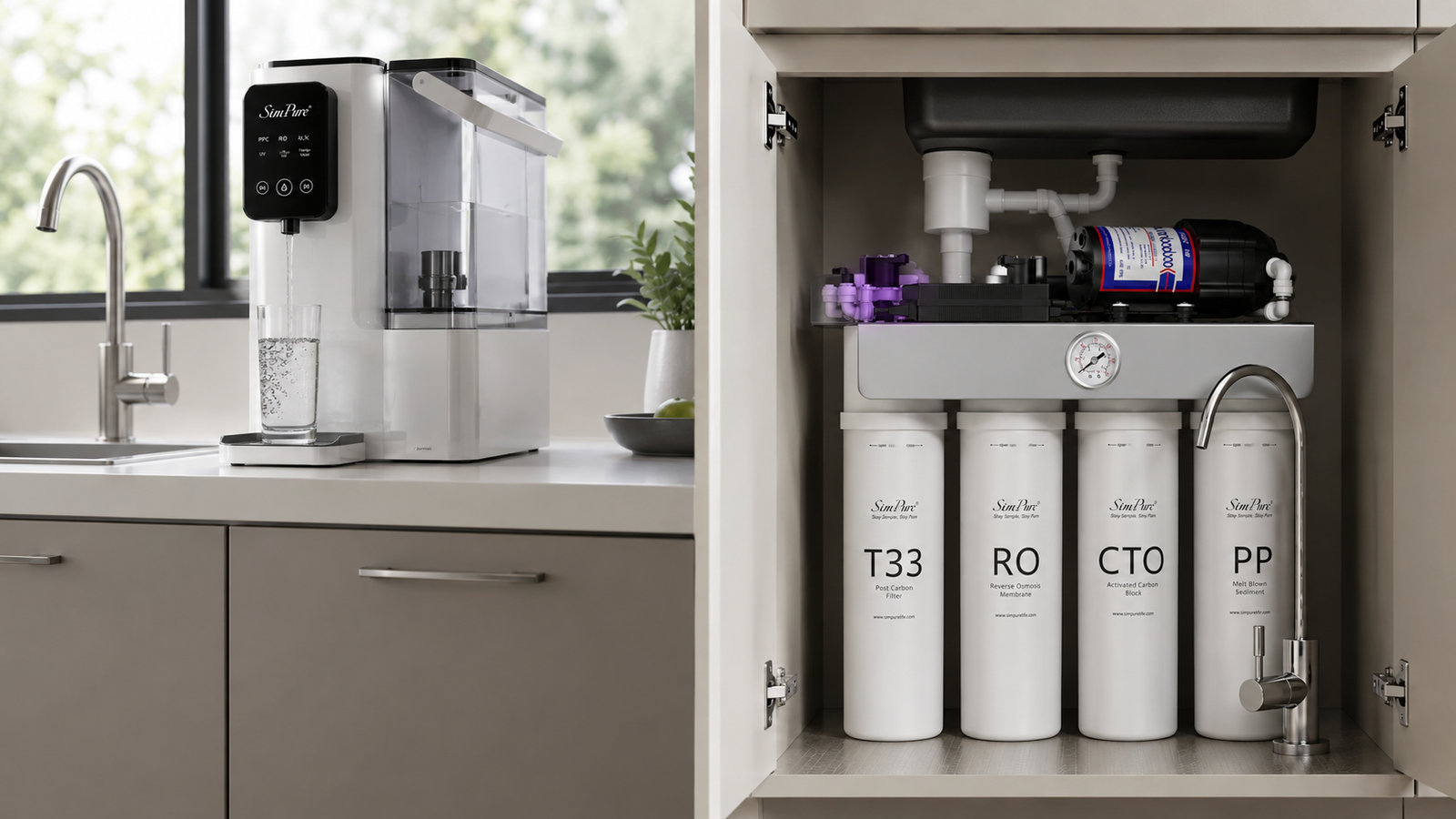
SimPure also offers several under-sink RO designs.
These require a different level of commitment from countertop systems because the filtration unit connects into the home’s plumbing and dispenses through a dedicated faucet or compatible outlet configuration.
The T1-400ALK is currently listed as an 8-stage, 400 GPD tankless RO system with alkaline remineralization. SimPure lists a 1.5:1 pure-to-drain ratio and a narrow tankless enclosure intended to reduce the space taken up under the sink.
The Q3-600A moves further toward higher-flow tankless RO. SimPure currently specifies it at 600 GPD, with eight filtration stages, alkaline remineralization, a 2:1 pure-to-drain ratio, and a footprint of roughly 13.5 × 6.5 × 12 inches.
At the time of research, however, the Q3-600A product page showed the product as sold out, which is a good example of why availability should be checked immediately before purchase.
These under-sink systems make more sense when the buyer wants filtration integrated into the kitchen rather than repeatedly refilling a countertop reservoir.
The trade-off is installation.
Whole-house water filters
Whole-house filtration serves a different purpose.
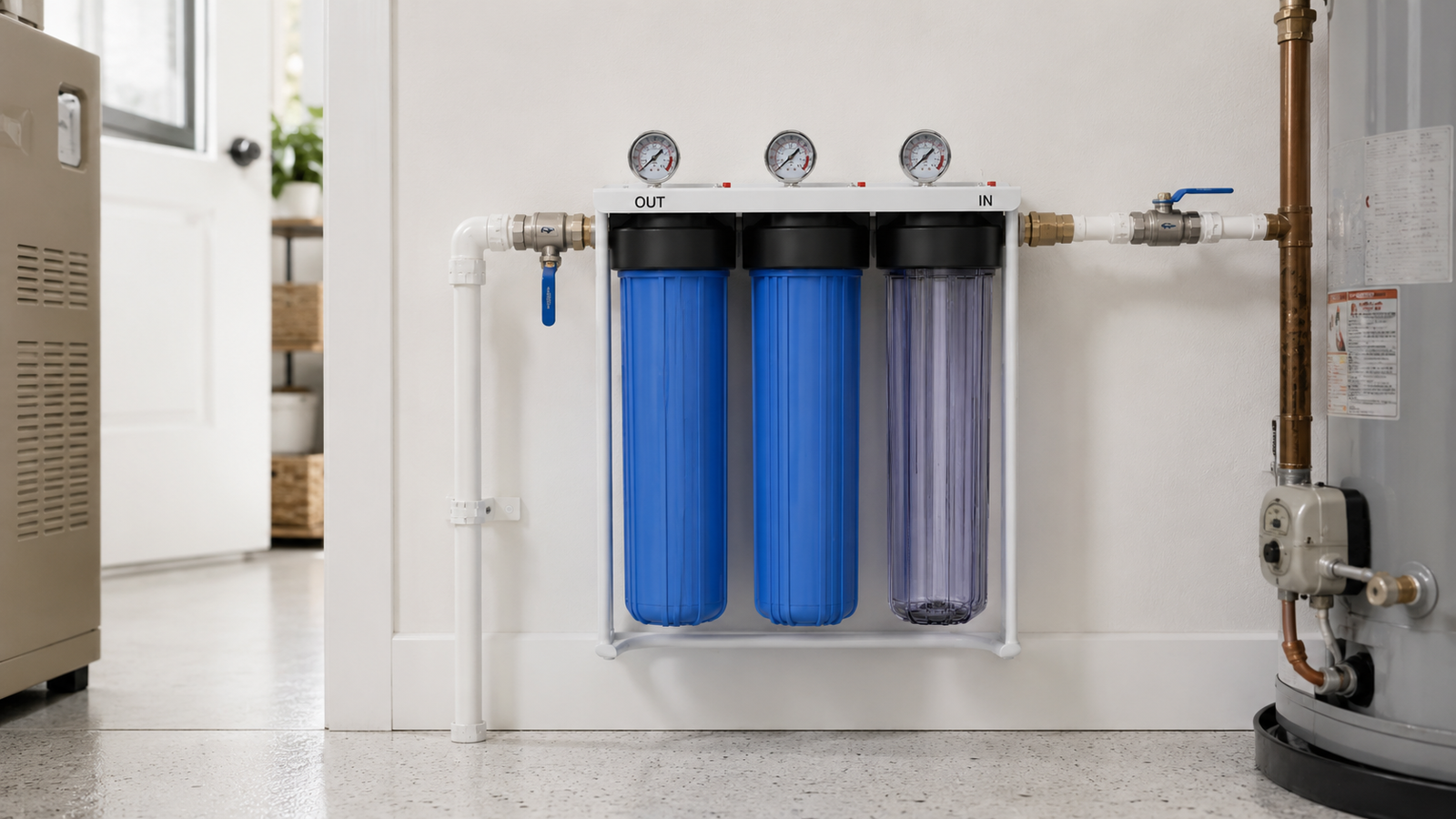
Instead of treating only drinking water at one faucet, these systems are installed upstream so water passes through filtration before being distributed throughout the home.
One current example is the SimPure DB20P-3, a three-stage system using 20 × 4.5-inch cartridges.
SimPure lists the standard configuration with sediment, granular activated carbon, and carbon-block cartridges, 1-inch NPT connections, and a maximum rated flow of 15 gallons per minute. The listed filter replacement interval is 6–12 months, depending on use and conditions.
The key point is that this is not simply a bigger version of a countertop RO system.
A whole-house sediment/carbon system and a point-of-use reverse-osmosis system have different roles.
Before buying either, identify what you actually want to change about the water.
Replacement filters and maintenance items
A filtration system creates an ongoing relationship with its replacement cartridges.
SimPure maintains replacement kits for several major product families rather than selling only the original machines.
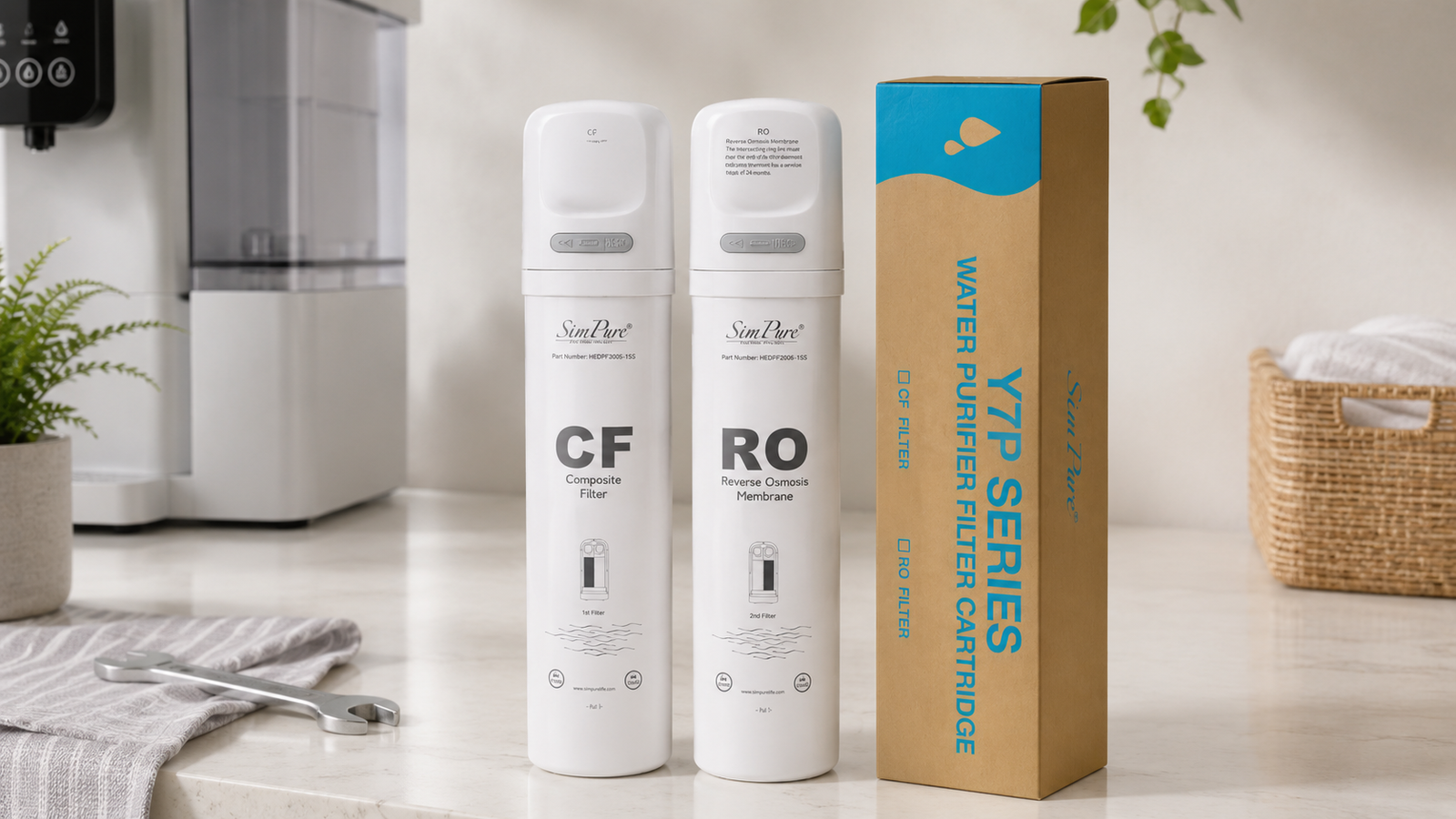
For example, the Y7P-BW product page currently lists a dedicated replacement kit, and SimPure recommends replacement of its CF and RO filters on a roughly six-month cycle. The whole-house catalog similarly lists replacement sets for the DB20P and DB20P-3 families.
This matters because the real cost of filtration is:
purchase price + replacement filters + maintenance + installation where required.
A system that looks inexpensive on day one may not remain inexpensive over several years.
SimPure Pricing: What the Current Range Looks Like
SimPure does not occupy one single price tier because its product categories are too different.
At the time of our August 2026 research, representative pricing looked roughly like this:
| Model | Type | Published price | Current checkout/offer observed |
|---|---|---|---|
| Y7P-BW | Countertop RO | $369.99 | $239.99 at checkout |
| Y9A | Countertop alkaline RO | $439.99 | $319.99 at checkout |
| T1-400ALK | Tankless under-sink RO | $349.99 | $269.99 at checkout |
| Q3-600A | 600 GPD tankless under-sink RO | $334.99 | $224.99 at checkout; sold out when checked |
| DB20P-3 | Three-stage whole-house filter | $299.99 | $299.99 |
Prices and promotions can change, so these should be treated as a research snapshot rather than permanent pricing.
Countertop RO sits in the mid-hundreds
The Y7P-BW and Y9A illustrate the range well.
At current promotional pricing, the Y7P-BW sits below the Y9A, while the Y9A adds higher rated output and alkaline remineralization.
A buyer should therefore compare:
- filtration format;
- output;
- remineralization;
- pure-to-drain ratio;
- replacement-filter cost;
- counter space.
Not simply the sale price.
Under-sink RO does not automatically cost more
An interesting aspect of SimPure’s lineup is that its tankless under-sink systems can overlap the countertop machines in price.
The T1-400ALK, for example, currently has a lower checkout price than the Y9A despite being a tankless under-sink product.
That means the buying decision is primarily about installation format and use case, not assuming countertop systems are always the budget option.
Whole-house pricing needs a different comparison
The DB20P family ranges from basic housings through complete multi-stage systems.
The DB20P housing itself is currently listed around $69.99, while the complete DB20P-3 system is around $299.99 and the DB20P-3KDF configuration around $359.99.
Those products should not be compared directly with countertop RO pricing because they treat water at a different point in the home and use a different filtration architecture.
What SimPure Seems to Do Well
Broad product coverage
The main advantage of SimPure at the brand level is selection.
A buyer can stay within the same ecosystem while comparing:
- no-plumbing countertop RO;
- countertop RO with remineralization;
- tankless under-sink RO;
- conventional under-sink designs;
- sediment pre-filtration;
- large-format whole-house filtration.
That breadth makes the brand relevant to more than one type of household.
Strong countertop and tankless RO presence
The countertop lineup is particularly easy to differentiate by use case.
The Y7P-BW prioritizes zero-plumbing installation.
The Y9A raises rated output and adds remineralization.
Under the sink, the T1-400ALK and Q3-600A provide tankless configurations in relatively narrow enclosures.
That gives buyers meaningful choices rather than minor cosmetic variations.
Visible replacement-filter ecosystem
Replacement availability should be part of any filtration purchase.
SimPure makes filter kits visible within its product ecosystem, including Y-series, T1-series, Q3-series, and DB20P-series replacements.
That does not guarantee future pricing or perpetual availability, but it is better than evaluating a machine without knowing how consumables are currently sourced.
Useful options for different installation needs
A renter may not be allowed to drill a countertop or modify a sink.
A homeowner may strongly prefer an integrated faucet.
Another homeowner may need sediment and chlorine filtration for the entire property rather than RO drinking water.
SimPure has products aimed at all three situations.
That is probably the brand’s clearest practical strength.
Potential Drawbacks and Buyer Limitations
A broad product range does not mean every buyer should choose SimPure—or even choose reverse osmosis.
Not every buyer needs reverse osmosis
RO systems provide a more intensive treatment process than many basic carbon filters.
That can be appropriate for buyers specifically seeking RO treatment.
But if your only concern is taste or chlorine odor from otherwise suitable municipal water, a simpler filtration system may be easier and cheaper to maintain.
Start by identifying the actual water problem.
If the concern is serious or source-specific—especially with private well water—water testing is far more useful than choosing a filtration technology based on marketing alone.
Whole-house and RO systems solve different problems
This distinction deserves repeating because it changes the purchase completely.
A DB20P-3 treats water entering the home using sediment and carbon stages.
A Y7P-BW treats drinking water through reverse osmosis at the countertop.
Buying a whole-house system does not automatically eliminate the need for point-of-use treatment.
Buying countertop RO does not filter the water used by:
- showers;
- washing machines;
- dishwashers;
- toilets;
- other faucets.
Choose the treatment point before choosing the model.
Filter replacement and maintenance still matter
No filtration system is maintenance-free.
SimPure publishes replacement cycles that vary by model. The Y7P-BW page, for example, recommends replacing its two filters about every six months, while the Y9A lists six-month intervals for the PPC and alkaline filters and approximately nine months for its RO membrane. SimPure lists DB20P-3 cartridge life at roughly 6–12 months.
Actual replacement timing can vary with:
- water quality;
- household consumption;
- sediment load;
- feed-water conditions.
Budget for consumables before buying the machine.
Installation and space constraints can shape the decision
Countertop RO avoids plumbing modification but consumes counter space and requires reservoir refilling.
Under-sink RO preserves counter space but uses cabinet space and requires plumbing connections.
Whole-house filtration requires considerably more installation planning and must accommodate:
- pipe size;
- mounting area;
- pressure;
- service access;
- cartridge replacement.
There is no universally most convenient format.
The easiest system is the one that fits your home.
Who SimPure Is Best For
Apartment dwellers and renters
Countertop models such as the Y7P-BW are the obvious starting point because they do not require a permanent under-sink installation.
They still require electricity and sufficient counter space, but they avoid modifying supply lines.
Buyers who specifically want countertop RO
SimPure has several distinct countertop options rather than one generic unit.
The Y7P-BW emphasizes straightforward RO purification and zero plumbing.
The Y9A adds alkaline remineralization and higher rated output.
That makes the lineup useful for buyers who already know countertop RO is the format they want.
Homeowners wanting a cleaner under-sink installation
Tankless models such as the T1-400ALK and Q3-600A reduce the need for a conventional RO storage tank and keep the system inside the cabinet.
These are better suited to buyers comfortable with plumbing installation or professional installation.
Homeowners comparing whole-house filtration
The DB10 and DB20 families provide several starting configurations for sediment and carbon filtration, including multi-stage systems.
These make more sense for buyers addressing water throughout the home rather than only drinking water.
Who May Want a Different Option
Buyers wanting the simplest possible maintenance
Reverse osmosis involves consumable filters, wastewater, periodic maintenance, and—in countertop designs—tank refilling.
Someone who only wants modest taste or odor improvement may prefer a simpler carbon-based filter.
Buyers who do not need RO
A higher level of filtration is not automatically more appropriate.
If your water-treatment objective can be met with a simpler technology, there may be little benefit to adding the cost and maintenance of reverse osmosis.
Buyers with complex well-water problems
Whole-house treatment should be selected around actual water chemistry.
Iron, manganese, hardness, sediment, sulfur odor, bacteria, and other conditions may require different technologies.
A generic sediment/carbon system should not be assumed to solve every well-water problem.
For difficult source-water conditions, test the water and size treatment around the result.
Buyers who want professional installation included
The SimPure product pages emphasize DIY installation on several systems.
That can reduce cost for capable homeowners, but buyers who want a turnkey package including professional plumbing and long-term service may prefer a locally installed treatment system.
Best SimPure Products to Start With
These are not universal “best” products. They are use-case starting points within SimPure’s current catalog.
Best starting point for countertop RO: SimPure Y7P-BW
Why consider it: No plumbing installation.
The Y7P-BW is the easiest SimPure model to understand for renters or buyers who specifically want countertop RO without modifying the sink.
Current published specifications include:
- 100 GPD rated capacity;
- 5-stage filtration;
- 4:1 pure-to-drain ratio;
- 18 × 8 × 16.1-inch dimensions;
- electricity required;
- two replaceable filters.
At the time of research, SimPure listed it at $369.99 with a $239.99 checkout price.
Best fit: Apartment, renter, office, or kitchen where plumbing modification is undesirable.
Think twice if: Counter space is scarce or you do not want to refill a feed-water tank.
Best starting point for under-sink RO: SimPure T1-400ALK
Why consider it: Tankless under-sink RO with remineralization.
The T1-400ALK is currently listed at 400 GPD with an 8-stage configuration, alkaline remineralization, and a narrow tankless design.
SimPure lists the enclosure at about 15.6 × 5.3 × 15.7 inches and a 1.5:1 pure-to-drain ratio. At the time of research, it was shown at $349.99 with a $269.99 checkout price.
Best fit: Homeowners who want an integrated RO faucet and prefer not to use a countertop reservoir.
Think twice if: You want zero plumbing work.
Best starting point for higher-flow countertop RO: SimPure Y9A
Why consider it: Higher rated output plus alkaline remineralization.
The Y9A is listed at 300 GPD compared with the Y7P-BW’s 100 GPD.
Current specifications include:
- 6-stage filtration;
- alkaline remineralization;
- 2.5:1 pure-to-drain ratio;
- 17.2 × 9.3 × 14.3-inch dimensions;
- electricity required.
The Y9A was listed at $439.99 with a $319.99 checkout price when checked.
Best fit: Countertop buyers who value higher rated throughput and remineralization.
Think twice if: The simpler, lower-cost Y7P-BW already meets your needs.
Best starting point for whole-house filtration: SimPure DB20P-3
Why consider it: Straightforward three-stage large-format whole-house filtration.
The DB20P-3 uses three 20 × 4.5-inch cartridges—sediment, GAC, and carbon block in the standard package.
SimPure currently lists:
- 1-inch NPT inlet/outlet connections;
- maximum rated flow of 15 GPM;
- 25–90 PSI feed-water range;
- 6–12 month filter-life guidance;
- $299.99 current price.
It uses standard-sized 20 × 4.5-inch cartridges, which also gives buyers more context around replacement options.
Best fit: Homeowners wanting sediment/carbon filtration before water reaches household fixtures.
Think twice if: Your objective specifically requires RO drinking-water treatment, softening, or treatment designed around a complex well-water analysis.
Shipping, Returns, and Warranty
Policies matter more for water-filtration hardware than they do for a small inexpensive purchase because systems can be bulky, installation-dependent, and expensive to return.
Shipping
The current product pages for the systems reviewed here state that SimPure ships its core products to the United States and Canada.
U.S. orders are advertised with free shipping, while some remote U.S. areas—including Alaska, Hawaii, Puerto Rico and certain military/territorial destinations—may incur additional fees. Canadian shipping costs can vary based on product size and weight.
Current pages estimate roughly 3–7 business days for standard U.S. delivery, plus 1–2 business days of handling.
Because SimPure’s broader FAQ and product pages are not perfectly identical in their international-shipping language, verify eligibility for your exact product and postal code before ordering.
Returns
SimPure’s current return policy for direct purchases provides a 30-day return period from receipt.
However, “risk-free” should not be interpreted as “use it for 30 days and return it for any reason at no cost.”
The published policy says products must be:
- unused;
- in original condition;
- returned with original packaging and accessories.
For non-quality-related returns, the customer pays return shipping. SimPure covers return shipping for qualifying quality-related issues. The policy also states that bulk orders of ten or more units are non-refundable.
That is worth considering before installing a plumbed-in system.
Warranty
SimPure currently provides a one-year warranty on eligible products purchased from its website or authorized resellers.
The company also offers an additional year through warranty registration, which is why many product pages describe coverage as a “1+1 year” warranty.
The warranty is intended for quality-related defects and requires proof of purchase.
The policy contains exclusions for misuse, unauthorized modification, products outside the warranty period, purchases from unauthorized resellers, and several other circumstances.
Do not assume every failure or return will be covered.
Read the current policy before purchase if warranty service is a major decision factor.
How SimPure Compares by Buyer Need
If you want countertop RO
Start with the Y7P-BW.
Move toward the Y9A if you specifically value:
- higher rated output;
- alkaline remineralization;
- its particular filter configuration.
Countertop RO makes particular sense when plumbing modification is inconvenient.
If you want under-sink RO
Look at tankless models such as the T1-400ALK.
The Q3-600A is another higher-rated option on paper, although it was out of stock when this review was checked.
Under-sink systems are better suited to buyers who prefer filtered water from a dedicated faucet and do not want a machine occupying counter space.
If you want whole-house filtration
Start by identifying the water problem.
For sediment and carbon filtration, the DB20P family provides several possible configurations.
If your water analysis points to a more specialized issue, do not assume the standard DB20P-3 is automatically sufficient.
The correct whole-house system depends far more on source water than the brand logo on the housing.
If you care most about maintenance simplicity
This is where the answer may not be RO at all.
Countertop RO eliminates plumbing installation but still requires:
- tank refilling;
- electricity;
- filter changes;
- cleaning.
Under-sink RO removes the refill step but adds plumbing and its own replacement schedule.
Whole-house systems generally require larger cartridge replacements and adequate space for servicing.
If your filtration requirements are modest, a simpler system may provide a better ownership experience.
Final Verdict: Is SimPure Worth Buying?
Yes—for the right buyer and the right filtration category.
SimPure’s strongest advantage is not that one individual product dominates the entire water-filtration market.
It is that the brand offers several legitimate paths into home filtration.
Renters and apartment dwellers can start with countertop RO.
Homeowners can choose tankless under-sink RO without giving up substantial cabinet space.
Households addressing sediment, chlorine, or related whole-house filtration needs can move into the DB-series systems.
Replacement filters are also clearly represented throughout the current catalog, which makes ongoing maintenance easier to evaluate before purchasing.
The biggest mistake would be buying based on the SimPure name before deciding what type of treatment you need.
A Y7P-BW, T1-400ALK, and DB20P-3 are not three versions of the same solution.
They solve different problems.
Before ordering, answer four questions:
- Do you need point-of-use or whole-house treatment?
- Do you specifically need reverse osmosis?
- Can your home accommodate the installation format?
- Are you comfortable with the replacement-filter and maintenance cycle?
If countertop or tankless RO is already the category you want, SimPure is a brand worth putting on the shortlist.
If your water-treatment needs are specialized—or you have not identified the actual problem with your water yet—test and define that problem first.
Choose the filtration method first. Choose the SimPure model second.
That produces a better buying decision than starting from whichever model happens to have the largest discount.
Frequently Asked Questions
Is SimPure a good water filtration brand?
SimPure has a broad current catalog of countertop RO, under-sink RO, whole-house filtration, outdoor systems, and replacement filters. That makes it a credible brand to compare within those categories.
Whether it is a good choice for you depends on the specific model, your water source, installation needs, maintenance preferences, and treatment goal.
Moon Picke has not independently tested SimPure’s filtration performance, so we do not treat manufacturer specifications as our own hands-on results.
Does SimPure sell reverse osmosis systems?
Yes.
SimPure currently sells both countertop and under-sink reverse osmosis systems.
Examples include the Y7P-BW and Y9A countertop systems and the T1-400ALK and Q3-600A tankless under-sink systems.
Does SimPure make whole-house water filters?
Yes.
Its current whole-house range includes housings, multi-stage sediment/carbon systems, KDF configurations, pre-filters, and replacement cartridges.
The DB20P-3 is one example of a complete three-stage 20-inch whole-house system.
Which SimPure product is best for apartments?
The Y7P-BW is one of the most logical starting points for an apartment because it is a countertop RO system that does not require plumbing installation.
It still needs electricity, counter space, and regular filter replacement, so it is not completely maintenance-free.
Which SimPure product is best for under-sink installation?
For buyers wanting a tankless under-sink RO system, the T1-400ALK is a practical starting point in the current lineup.
It combines a 400 GPD rated capacity with a narrow tankless format and alkaline remineralization. Buyers wanting higher rated output can also compare the Q3-600A when it is available.