
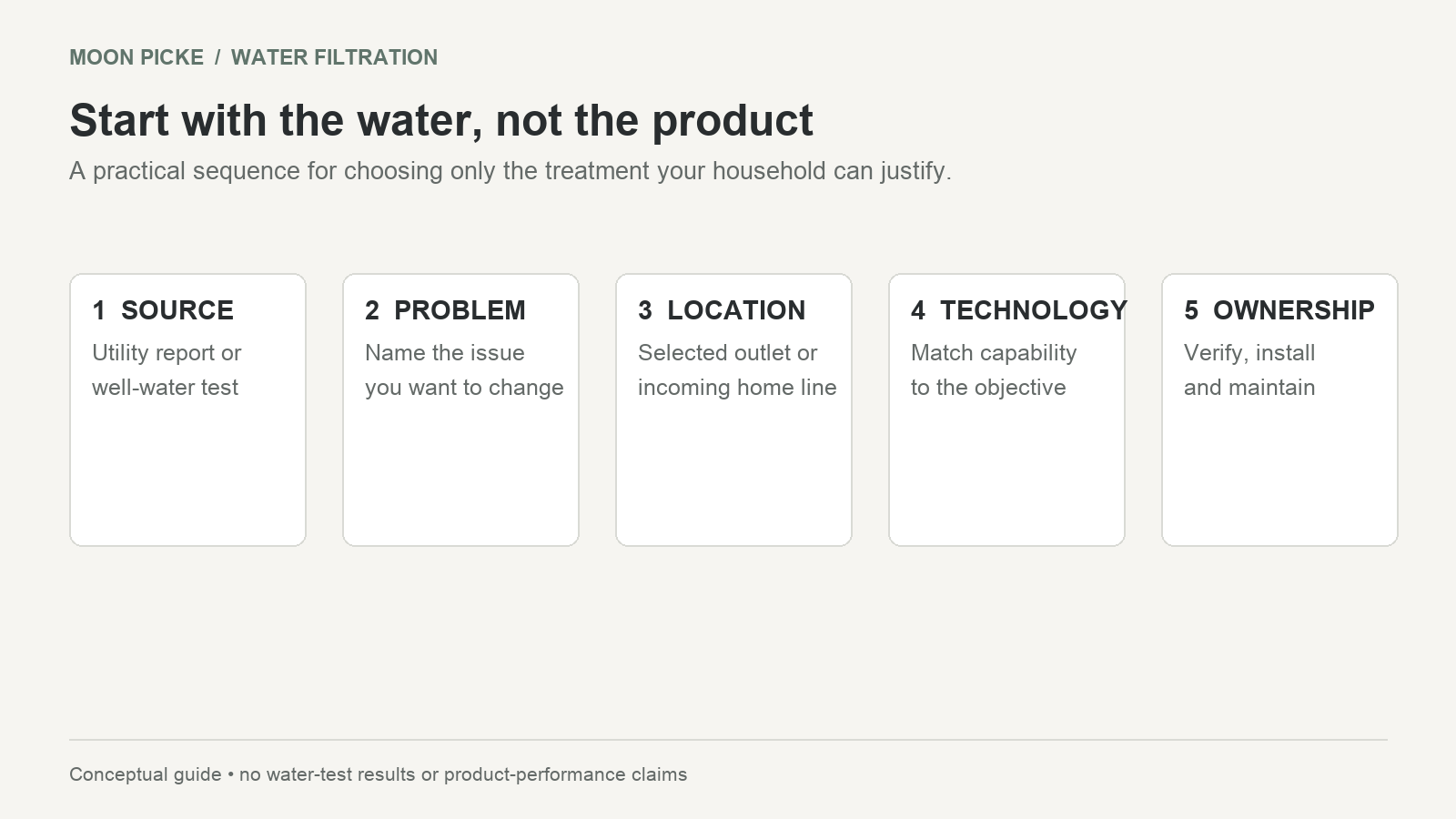
The right water filtration system depends less on the number of filter stages and more on what is actually in your water, where you want treatment to occur, how much installation you are willing to accept, and what ongoing maintenance fits your household. Learning how to choose a home water filtration system means following a sequence: water source, water problem, treatment point, technology, installation, maintenance, then product.
By Moon Picke · Fact-checked 1 September 2026 · About 11 minutes to read
Popularity and long contaminant lists are poor starting points. Therefore, a system should have evidence for the reduction you need and fit the outlets you want to serve. This guide does not assume every home needs reverse osmosis (RO), whole-house filtration, or any filter at all.
Moon Picke has not independently laboratory-tested the SimPure systems discussed here. We checked government, certification-body and manufacturer sources under our evaluation approach. Manufacturer specifications are not Moon Picke test results.
Affiliate disclosure: Moon Picke may earn a commission from qualifying purchases through commercial links in this article. This does not determine our recommendations. Read our Affiliate Disclosure.
How to Choose a Home Water Filtration System: The Quick Answer
Identify what you want to change and where you need treatment before comparing products. Review a municipal water-quality report or obtain appropriate well-water testing. Then choose the simplest system with substantiated claims for that objective.
| Situation | Likely starting category | Verify first |
|---|---|---|
| Better drinking and cooking water at one location | Point-of-use filter or RO | The specific reduction objective |
| Renting or unable to modify plumbing | Countertop filtration or countertop RO | Space, electricity and refill routine |
| Integrated kitchen treatment | Under-sink filtration or RO | Cabinet, faucet, drain and power needs |
| Sediment or suitable taste/odor issue at multiple fixtures | Whole-house filtration | Source of the problem, pressure and media |
| Hardness is the main problem | Evaluate water softening | Hardness test and local requirements |
| Complex private-well conditions | Test first | Certified-laboratory results and local advice |
This table guides investigation; it does not diagnose water or replace testing where conditions are uncertain.
Step 1: Understand Your Water Source
Municipal water
Start with the utility’s current consumer confidence or water-quality report. It describes regulated contaminants and monitoring results, while a building-specific problem can still arise in service lines or plumbing. A taste complaint alone does not prove maximum treatment is needed.
Private well water
However, private-well owners are responsible for monitoring their water. The CDC recommends annual testing for total coliform bacteria, nitrates, total dissolved solids (TDS) and pH, plus locally relevant concerns, using a state-certified laboratory. Changes in taste, color or smell are reasons to investigate, but are not a complete diagnosis.
TDS is an indicator, not a list of individual contaminants or proof of microbial safety. Use results with advice from a local health or environmental department when the issue is complex.
Step 2: Identify the Problem You Actually Want to Solve
Sediment
Visible particles may suggest a particle-filtration objective, but identify their source. Cartridge type and service frequency should reflect the water and intended flow rather than the housing count.
Taste and odor
Appropriate activated carbon can address certain aesthetic concerns. Pleasant taste does not prove safety, and an odor may require investigation before choosing media.
Dissolved substances and TDS
RO can reduce dissolved substances, but a TDS meter cannot say which substances are present. Match an RO model’s substantiated reduction claims to a verified concern rather than shopping for the lowest display number.
Hardness and scale
Hardness primarily relates to minerals such as calcium and magnesium. A water softener is designed for that objective; a standard sediment/carbon filter should not be presented as the same treatment.
Specific contaminant concerns
For lead, arsenic, nitrate, microbes or another health-related concern, use test or utility information and find evidence for that exact reduction. “Removes contaminants” is too broad to support a decision.
Step 3: Decide Where the Water Should Be Treated
Point-of-use filtration
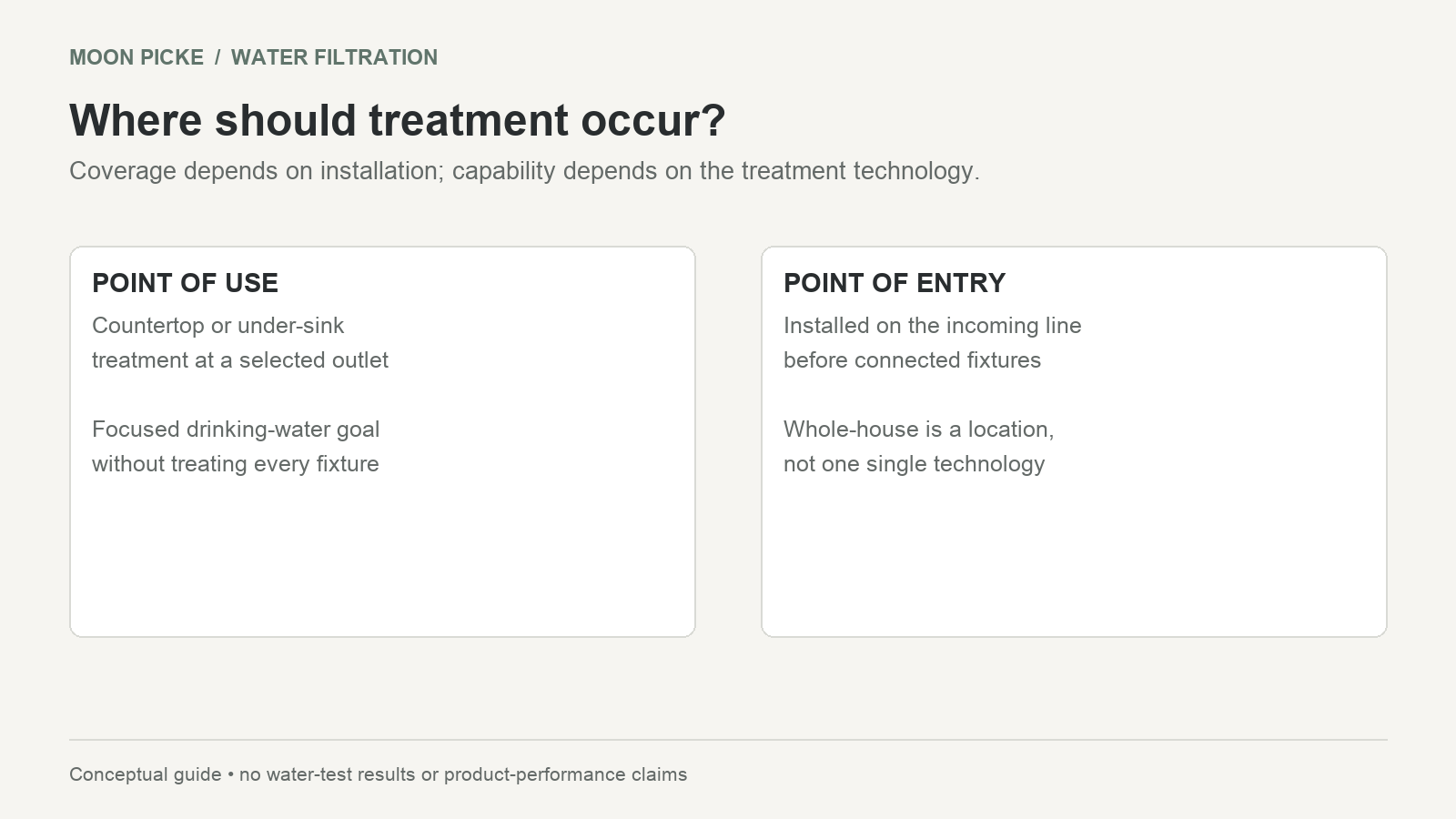
Point-of-use equipment treats water at a selected outlet. A countertop dispenser or under-sink system can focus on drinking and cooking water without treating showers, laundry or every bathroom faucet.
Point-of-entry whole-house filtration
Point-of-entry equipment is installed on the incoming line and serves downstream fixtures. Coverage depends on placement and bypasses; capability depends on its technology. Whole-house describes location, not one type of filter.
Our reverse osmosis vs whole house water filter comparison explores that distinction in more detail.
When using both can make sense
A household might address incoming sediment across several fixtures and use separate RO at the kitchen for a justified drinking-water objective. Two systems add maintenance, so each needs a distinct purpose.
Step 4: Choose the Filtration Technology
Sediment filtration
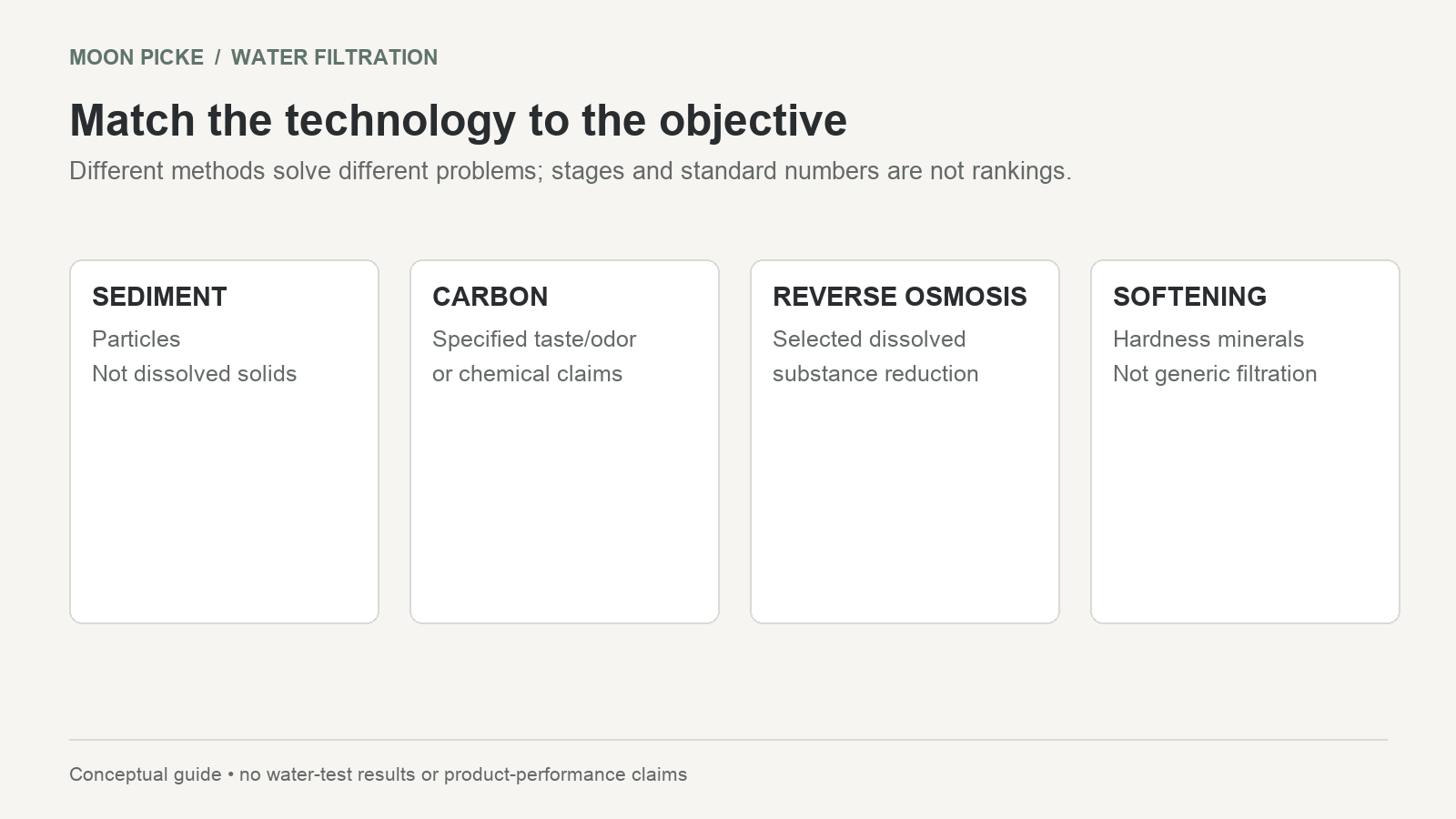
Sediment media physically traps particles within its rated design. It does not automatically reduce dissolved substances, hardness or microbes.
Activated carbon filtration
Carbon can support specified taste, odor or chemical-reduction claims. Performance depends on media, design, flow, contact time and the individual claim; “carbon” alone is not a universal capability statement.
Reverse osmosis
RO uses pressure and a semipermeable membrane, producing treated water and a reject stream. Pre- and post-filters vary. Consider wastewater handling, replacement parts and electricity where a pump or dispenser requires it.
Water softening
Ion-exchange softening primarily addresses hardness. It is not interchangeable with RO or a generic contaminant-removal filter, even when installed at the point of entry.
Other specialized treatment
Ultraviolet disinfection, oxidation, specialty media and other processes can address particular conditions. They need suitable design and validation; complex well water may require professional treatment advice.
Step 5: Check Certification and Specific Reduction Claims
NSF explains that standard numbers reflect development order, not rankings. NSF/ANSI 42 generally covers aesthetic claims, 53 health-effect claims, and 58 reverse-osmosis systems. Those labels do not mean every contaminant under a standard is reduced.
Verify the exact model in an independent certifier’s listing, the applicable standard and the named reduction claim. “Tested to” language is not automatically third-party certification. Product-family names and badges are insufficient if the exact configuration cannot be confirmed.
Step 6: Consider Installation Before Buying
Countertop systems
Measure counter and overhead clearance, check the outlet location, and consider filling, reject-water handling and cleaning. This format can suit renters because it may avoid permanent plumbing work.
Under-sink systems
Measure cabinet space and cartridge-removal clearance. Confirm cold-water, faucet and drain connections, electricity where required, landlord permission and whether installation exceeds your skills.
Whole-house systems
Plan the supported mounting location, connection size, shutoff or bypass arrangement, pressure, peak household demand, drainage where relevant and clearance for servicing. Main-line work typically deserves professional assessment.
Step 7: Calculate the Real Ownership Cost
Compare purchase and installation with replacement filters, membranes or media, cleaning, water and electricity where applicable, and professional service. Check whether replacements for the exact model are currently available before buying.
Service intervals are estimates under stated conditions, not guarantees for every home. Source water, consumption and loading change cartridge life, so keep a replacement log and investigate unexpected flow or quality changes. A speculative multi-year total is less useful than a model-specific maintenance plan.
Step 8: Check Flow Rate and Household Demand
A drinking-water outlet and an incoming household line have different flow requirements. For point-of-use systems, consider delivery speed, storage or refill behavior and simultaneous kitchen demand. For whole-house equipment, an installer should consider pressure and concurrent fixtures.
Rated capacity is meaningful only with test conditions and maintenance assumptions. The largest GPD or GPM number is not automatically the best fit, and a catalog maximum does not promise unchanged pressure when cartridges become loaded.
Common Water Filter Buying Mistakes
- Buying by stage count: stages are marketing shorthand unless each component has a clear function and evidence.
- Treating high TDS as proof of unsafe water: TDS does not identify individual contaminants or microbial risk.
- Choosing RO by default: a simpler certified filter may meet a limited taste or specific reduction goal.
- Assuming whole-house treatment replaces every point-of-use need: location and capability are separate questions.
- Ignoring replacement costs: an unavailable or burdensome cartridge can undermine ownership.
- Buying before testing complex well water: generic labels cannot diagnose local conditions.
- Treating a certification logo as universal proof: verify exact model, standard and claim.
Which Type of Water Filtration System Fits Your Home?
| Buyer | Category to investigate | Main constraint |
|---|---|---|
| Renter wanting RO drinking water | Countertop RO | Counter space, power and refill routine |
| Homeowner wanting integrated drinking-water RO | Under-sink RO | Installation and cabinet access |
| Sediment or suitable taste/odor issue across fixtures | Whole-house sediment/carbon | Diagnosis, pressure and service access |
| Household primarily concerned with hardness | Water softening | Tested hardness and regeneration requirements |
| Separate whole-home and drinking-water objectives | Potential combination | Purpose, compatibility and two maintenance plans |
| Private well with unknown conditions | Water test first | Laboratory findings and expert interpretation |
After choosing a category, compare SimPure’s current formats only if their documented capabilities fit your objective.
SimPure Options That Illustrate the Main Categories
For brand-level context and limitations, read our SimPure review.
SimPure Y7P-BW: countertop RO
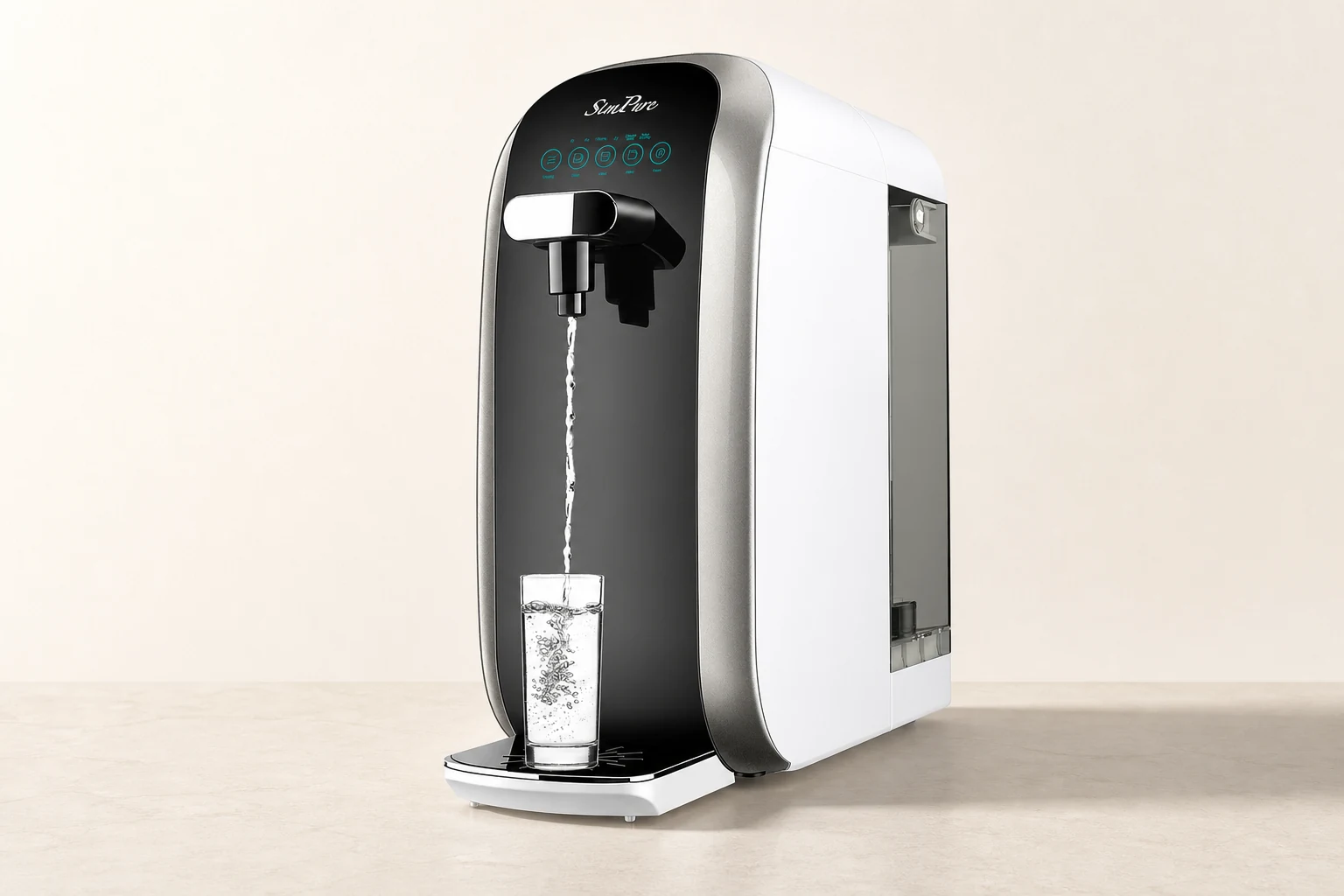
The Y7P-BW illustrates refillable point-of-use RO without permanent plumbing. It suits buyers prepared to provide counter space, power and a tank-filling and cleaning routine; it does not treat other fixtures.
Check the Y7P-BW’s current price and documentation.
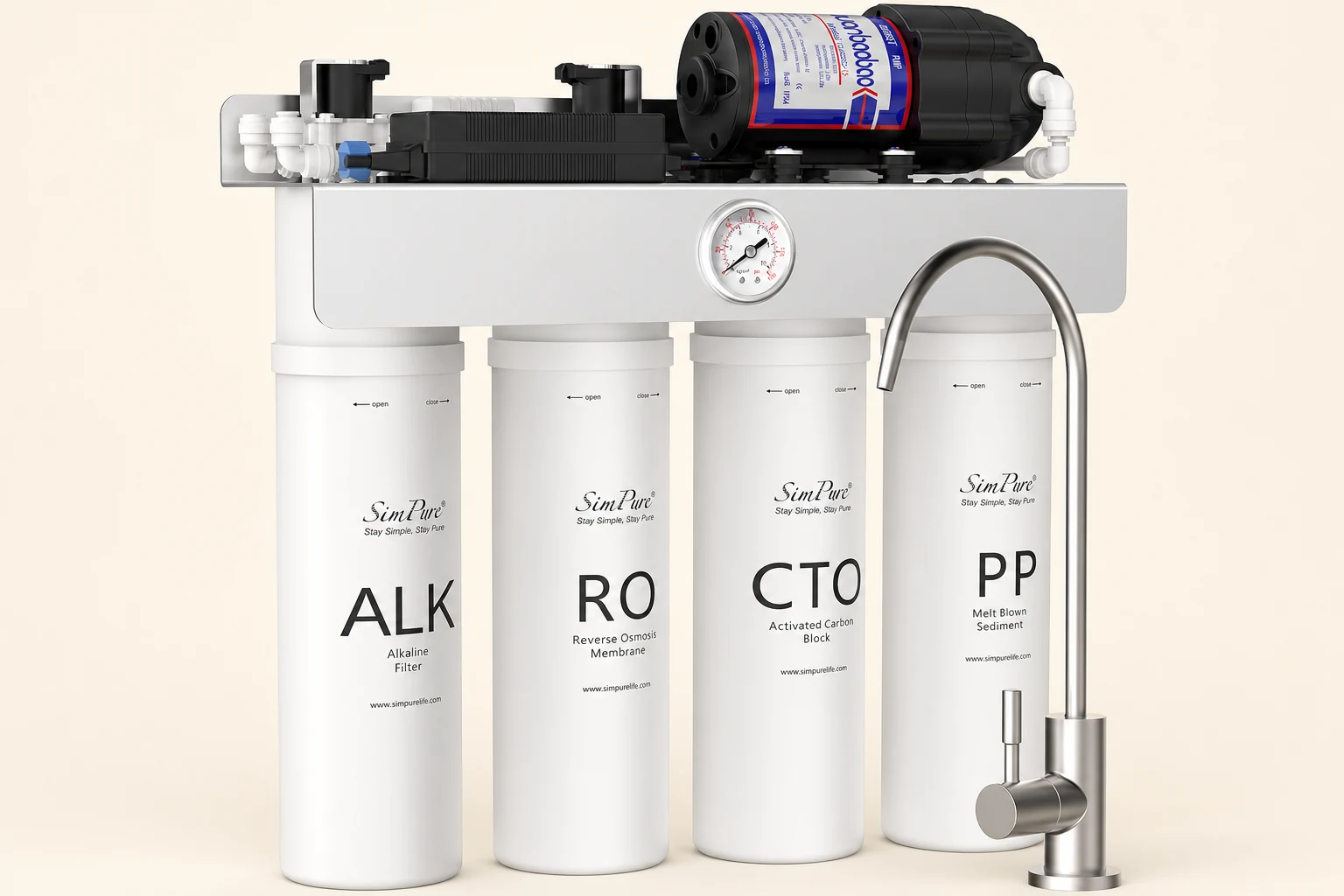
SimPure T1-400ALK: under-sink tankless RO
The T1-400ALK illustrates powered under-sink RO with a dedicated faucet and remineralization. “Tankless” does not remove its cabinet, connection, drain, power or service requirements.
Review the T1-400ALK’s installation requirements.
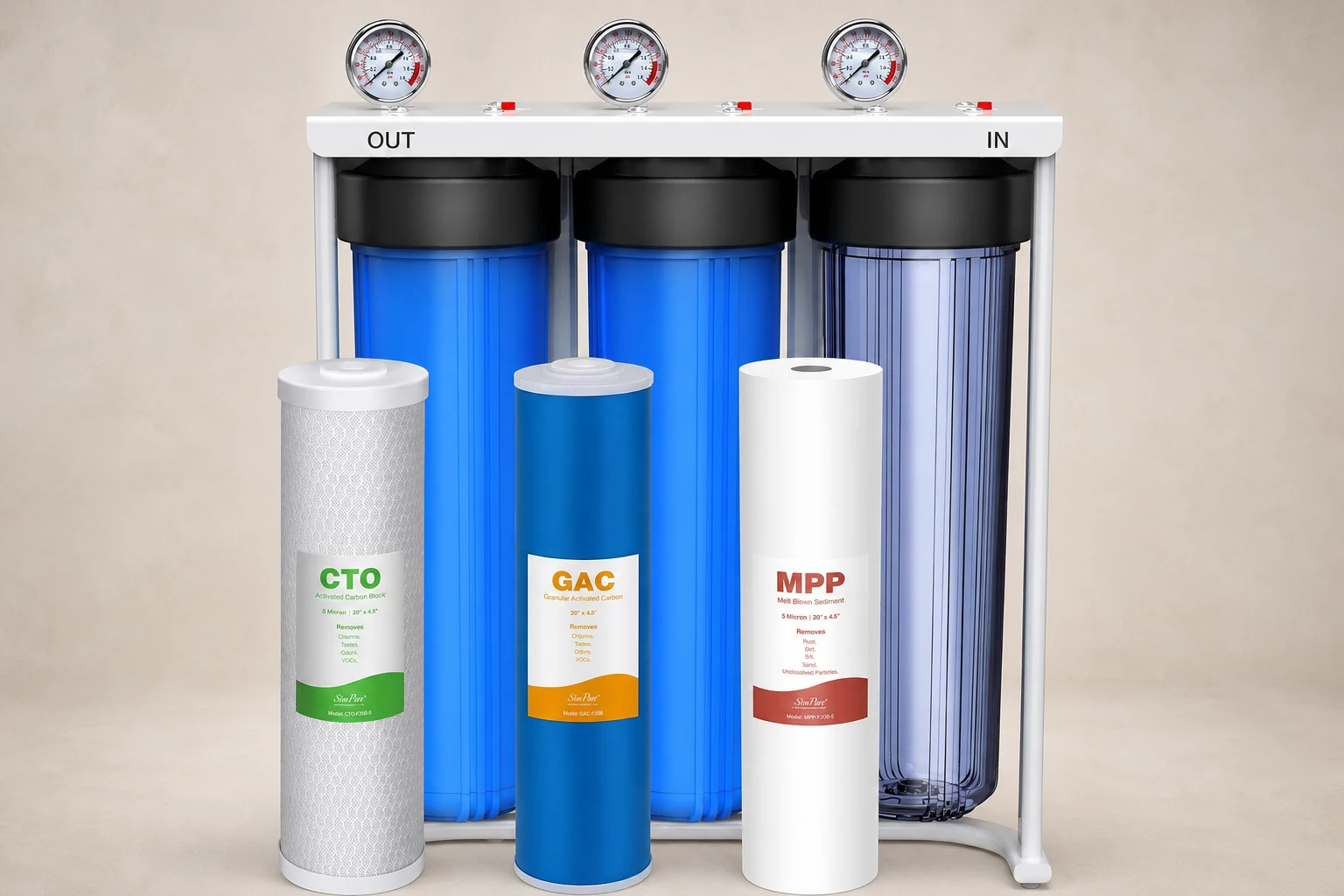
SimPure DB20P-3: whole-house filtration
The DB20P-3 illustrates a point-of-entry sediment/carbon format. SimPure’s current DB20P-3 page describes sediment, granular activated carbon and carbon-block cartridges and states that it does not reduce TDS. It is not a softener, whole-house RO or universal well-water solution.
Inspect the DB20P-3 configuration and service requirements.
Home Water Filtration Buying Checklist
- What is my water source?
- What specific problem am I trying to solve?
- Do water-test or utility data support that concern?
- Do I need point-of-use or whole-house treatment?
- Which technology addresses the problem?
- Are relevant claims independently certified or clearly substantiated?
- Does the system fit the available space and installation limits?
- What replacement parts, cleaning and professional service are required?
- Are the exact replacement filters available?
- What is the realistic ongoing ownership cost?
- Is the rated flow appropriate for the intended use?
Final Verdict
There is no universally best home water filtration system. When deciding how to choose a home water filtration system, understand the water, identify the problem, choose the treatment point, match the technology, verify the claim, then assess installation and ownership.
The simplest system that reliably meets the verified objective is usually the strongest starting point. If your needs do not match a SimPure category, do not force the recommendation; testing or another treatment format may be more appropriate.
Frequently Asked Questions
What type of water filtration system is best for a home?
The best fit is the simplest system with substantiated claims for your verified water problem and intended treatment point. No category is universally best.
How do I know what contaminants are in my water?
Review your utility’s current water-quality report or use an appropriate certified laboratory for private-well or building-specific concerns. Taste, odor, color and TDS cannot provide a complete answer.
Do I need a whole house filter or an under-sink filter?
Choose whole-house treatment for a suitable concern across connected fixtures. Choose under-sink treatment for a focused drinking-water objective. Some homes can justify both.
Is reverse osmosis necessary for every home?
No. RO may fit certain dissolved-contaminant drinking-water objectives, but a simpler filter—or no filter—may be appropriate when water data and household goals support that decision.
How often do home water filters need to be replaced?
Follow the exact model’s instructions and consider source water, consumption and observed performance. Manufacturer intervals are planning estimates, not universal guarantees.