
GEYOTO’s U.S. catalog is two LiFePO4 stations, kits that add panels, and four portable panels. The best GEYOTO portable power products depend on the load. A 1,024Wh station at 1,800W continuous is a different tool from a 7.72 lb pack at 300W. Neither number is a runtime, and neither powers a house.
Moon Picke is independent. This is not GEYOTO’s store. We compared spec tables, package lists, policy pages, and prices on geyoto.com on October 4, 2026. We did not lab-test the hardware. Peak watts are not continuous power. Prices can change.

Illustrative campsite. This photograph does not show GEYOTO equipment.
Disclosure: Moon Picke may earn a commission if you purchase through links on this page, at no additional cost to you. See our affiliate disclosure.
Quick picks
Seven products cover the distinct jobs. The jumper-cable listing and the Stars & Stripes edition share the standard electrical specs, so they are notes. Prices are what GEYOTO showed on October 4, 2026.
| Product | Best for | Capacity | Rated AC | Solar figure | Weight | Price checked |
|---|---|---|---|---|---|---|
| N1000 power station | Best overall | 1024Wh | 1800W | 800W max input | 25.57 lb | $449 |
| N300 power station | Camping, light loads | 256Wh | 300W | 140W max input | 7.72 lb | $199 |
| N1000 with one S200 | Complete solar kit | 1024Wh | 1800W | 200W panel | 25.57 + 14.99 lb | $659 |
| N1000 with two S200s | Higher solar input | 1024Wh | 1800W | 400W of panels | 25.57 + 29.98 lb | $839 |
| N300 with S100 | Compact solar kit | 256Wh | 300W | 100W panel | 7.72 + 8.38 lb | $339 |
| Panel | Best for | Rated power | Efficiency | Weight | Price checked |
|---|---|---|---|---|---|
| S200 bifacial | Charging an N1000 | 200W | 26% | 14.99 lb | $255 |
| S45 | Ultralight USB charging | 45W | 25.4% | 1.65 lb | $63.99 |
Weights exclude silicone armor. A kit’s solar column is the panels in that box, not the station maximum of 800W or 140W. Nameplate watts are not yard watts.
How we evaluated the best GEYOTO portable power products
We compared GEYOTO’s pages, following how we evaluate products and our editorial standards. Stations were judged on watt-hours, continuous and peak output, chemistry, ports, charging, the published UPS time, app support, weight, and the box list. Panels were judged on rated watts, efficiency, connectors, weight, and the IP note as written. When marketing and a spec table disagree, the table wins and the conflict stays in the copy.
Runtime is roughly watt-hours divided by device watts. A steady 100W draw on 1,024Wh is on the order of ten hours before conversion loss, cold, and duty cycle. That sketch is not a promise. Solar nameplate watts are not yard watts.
GEYOTO N1000 Portable Power Station — Best overall
The N1000 is the only higher-capacity station in the current catalog, which makes it the best overall pick when you need reserve and AC headroom. It is not whole-home backup. Output is 100–120V, so a typical 240V range, dryer, or central air conditioner is outside it.

Illustrative outage scene, not a GEYOTO product photo.
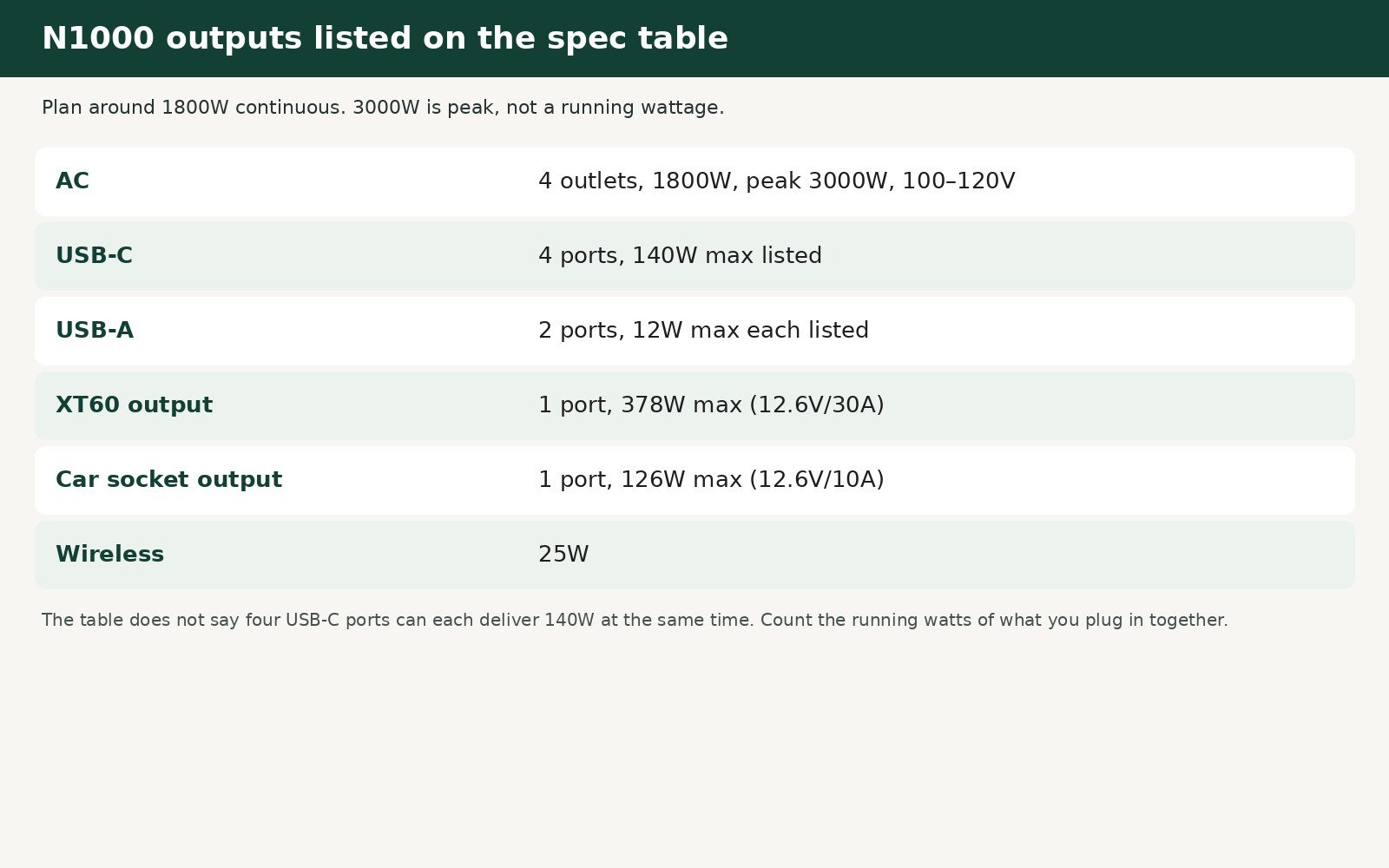
The spec table lists 1,024Wh, LiFePO4, 4,000 cycles, and four AC outlets at 1,800W with a 3,000W peak. A highlight adds 51.2V and 20Ah, which equals 1,024Wh, and calls the output pure sine wave. App control is listed for Wi-Fi and Bluetooth. UPS switching is listed as under 10 ms. That is a switch-time claim, not proof a given computer or CPAP will ride through.
The “13 output ports” line matches the table if wireless counts: four AC outlets, two USB-A at 12W max (5V/2.4A), four USB-C at 140W max, one XT60 output at 378W (12.6V/30A), one car socket at 126W (12.6V/10A), and 25W wireless. Nothing says all four USB-C ports hit 140W at once. The XT60 row is an output, not solar input. The listed 18A at 120V would exceed 1,800W, so plan on 1,800W continuous.
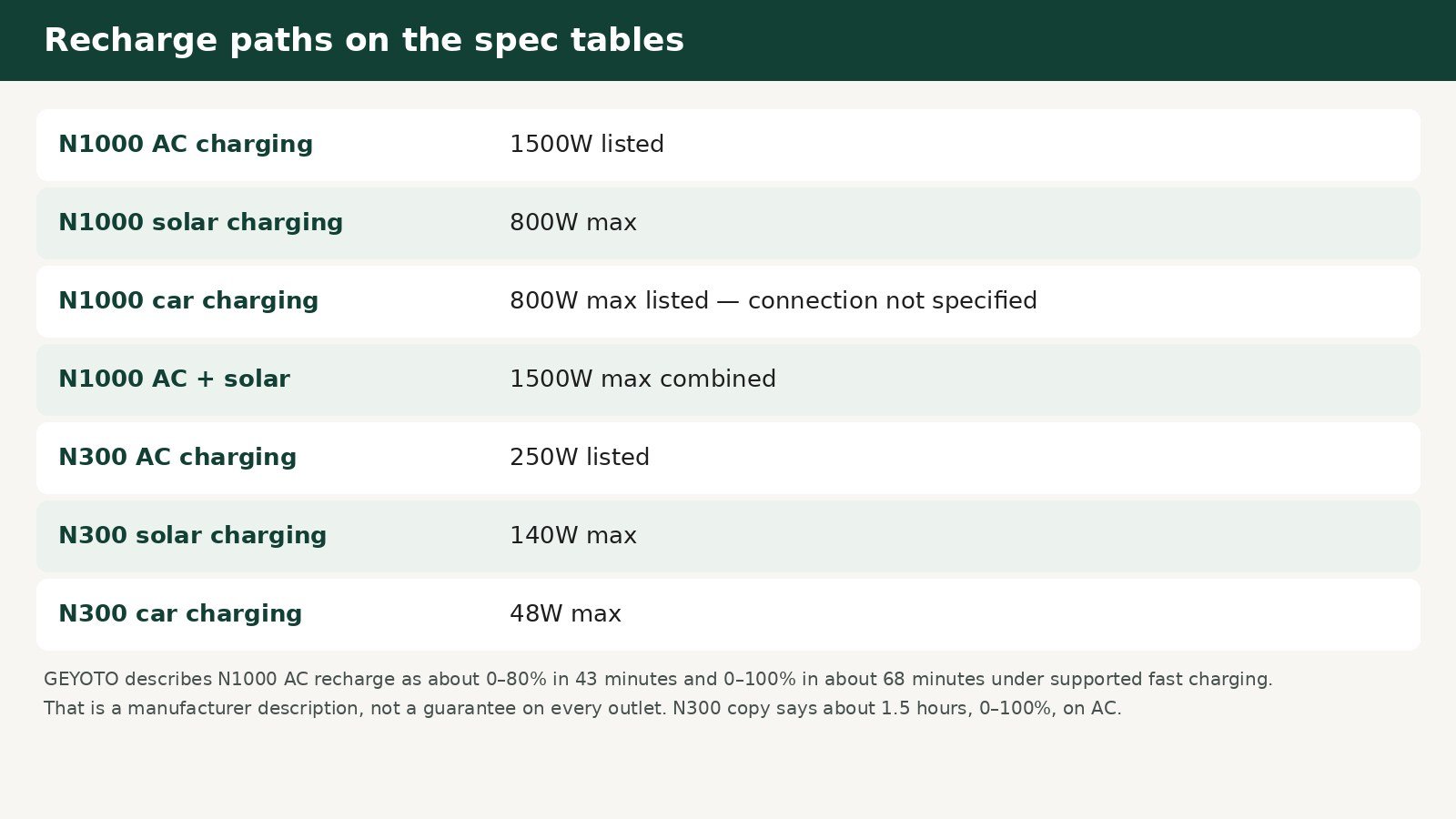
Weight is 25.57 lb and size is 13.8 x 18.8 x 10.2 in, both excluding silicone armor. Charging is listed at 32°F to 113°F. AC input is 1,500W, solar 800W max, car charging 800W max, and AC plus solar 1,500W max. Copy says about 0–80% in 43 minutes and 0–100% in 68 minutes on supported fast AC charging. An 800W car figure is far above a normal 12V socket, and the table never names the vehicle connection. The box is the station, AC and car cables, and a manual.
A jumper-cable listing of the same station showed $469 on October 4, 2026. Compare-at was $899 on the jumper page and $819 on the N1000 option list. Only the jumper package includes the cable. It is not a bigger inverter. The manual file shows an expansion-battery diagram and a California Proposition 65 warning. No expansion battery is for sale, and no expanded capacity is in the spec table. GEYOTO says the cells are UL 1973 certified. We did not audit the certificate.
Skip it when every load is under 300W, or when you need more than 1,024Wh. Other capacity classes are covered in Moon Picke’s Jackery Explorer 2000 v2 and EcoFlow DELTA 2 Max reviews. GEYOTO listed the N1000 at $449, compare-at $799. The page mentions 30-day price protection if you ask about eligibility. Prices can change. Specs: N1000 product page.
GEYOTO N300 Portable Power Station — Best for camping
The N300 is the camping station: 256Wh, 7.72 lb, and 6.38 x 8.62 x 5.32 in, armor excluded. A highlight lists 12.8V and 20Ah, which is 256Wh. Rated AC is 300W, peak 500W, on three 100–120V outlets. The table also lists 3A. At 120V that current is 360W, above the rating, so plan on 300W continuous. The description calls the inverter pure sine wave.

Illustrative campsite. Photo: Pexels ID 2422265. No GEYOTO gear is shown.
Nine outlets, if wireless counts: three AC, three USB-C at 65W max, one USB-A at 12W, one 126W car socket, and 25W wireless. The 65W line is not a combined budget. App control is Wi-Fi and Bluetooth. UPS switching is under 10 ms. Solar max is 140W, AC charging 250W, car charging 48W, AC plus solar 250W. Copy says about 1.5 hours from empty to full on AC. Chemistry is LiFePO4 with 4,000 cycles listed. The box adds a shoulder strap. A Stars & Stripes edition was listed at $214, compare-at $299, with no separate electrical table.
Phones, cameras, lights, a router, and a compatible laptop fit. A CPAP fits only under 300W running and 500W peak, heat included. Fridges, microwaves, and most heaters do not. GEYOTO listed it at $199, compare-at $299. Specs: N300 product page.
N1000 Portable Solar Generator — Best complete solar kit
Here a solar generator is a station plus a panel. The battery does not make electricity from sunlight. This kit is one N1000 and one S200.
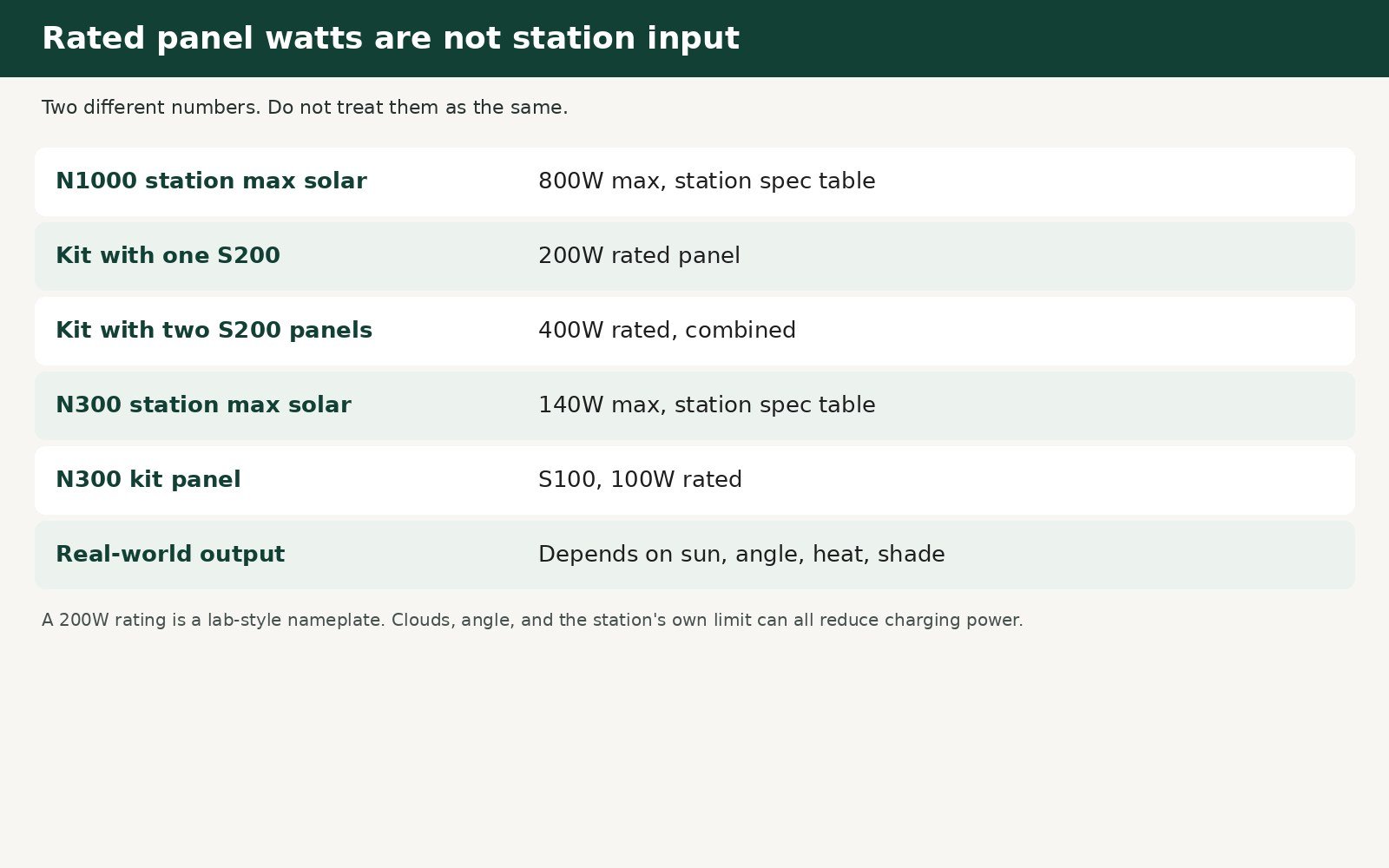
The kit row “Power Station Solar Charging: 200W” is the included panel, not a cut in the station’s 800W solar maximum. The kit FAQ still says the N1000 accepts up to 800W from compatible panels. Weight is 25.57 lb plus 14.99 lb, and the panel unfolds to 82.2 inches. The box adds AC and car cables, an EVA case with a 10 ft cable, and two manuals. The kit highlight says 5 years on the station plus 3 on the panel. The station page limits the 5-year line to members.
Listed at $659, compare-at $1,299. The station plus a separate S200 added to $704 that day, and that gap can vanish. Buy the kit for one checkout. Buy the station alone if you will not use a panel.
N1000 kit with 2 x 200W panels — Best for higher solar input
Same N1000, two S200 panels, 400W rated together. Choose it when daytime recharge matters more than pack weight. Two nameplates still do not fill 1,024Wh on a cloudy day. The 400W kit row is the array. The station maximum remains 800W. Weight is 25.57 lb plus 2 x 14.99 lb. Cables, an EVA case with a 10 ft lead, and two manuals are listed, and the pieces may ship separately.
The kit was $839, compare-at $1,499. The station plus two standalone S200 panels added to $959 that day. Skip the second panel if you charge from the wall or cannot set out two 82-inch panels. Jumper versions of the kits were $679 and $859. They add a cable, not capacity.
N300 Portable Solar Generator — Best compact solar kit
This is the N300 plus one S100. The spec table says 256Wh and 100W of panel input. Marketing on the same page says 268Wh. The title, the table, and 12.8V times 20Ah support 256Wh, so that is the figure to use. A 100W panel also fits the 140W solar ceiling better than an S200.
Weight is 7.72 lb plus 8.38 lb, with a shoulder strap and a 10 ft cable in the box. Unfolded length is 40.7 in on the S100 table and 40.75 in on the kit line. The kit was $339, compare-at $558. The two pieces alone added to $358.99 that day. A Stars & Stripes kit was $349 with no separate electrical table. Buy the kit for the panel. Buy the station alone if you only use a wall or a car.
S200 Portable Bifacial Solar Panel — Best portable solar panel
The S200 feeds a compatible station. It stores nothing and has no USB or AC outlets. The spec table lists 200W, 25.2V at 7.94A, 26% efficiency, monocrystalline cells, and IP68 on the panel surface. Weight is 14.99 lb. Folded size is 20.6 x 26.5 x 1.1 in. Unfolded length is 82.2 in. The box includes MC4 connectors, a 3 m MC4-to-XT60 cable, and a reflective case. A claimed 10% to 30% bifacial gain is for ideal sun only. Cables and the junction box are supposed to stay dry, and the panel is not a roof mount.
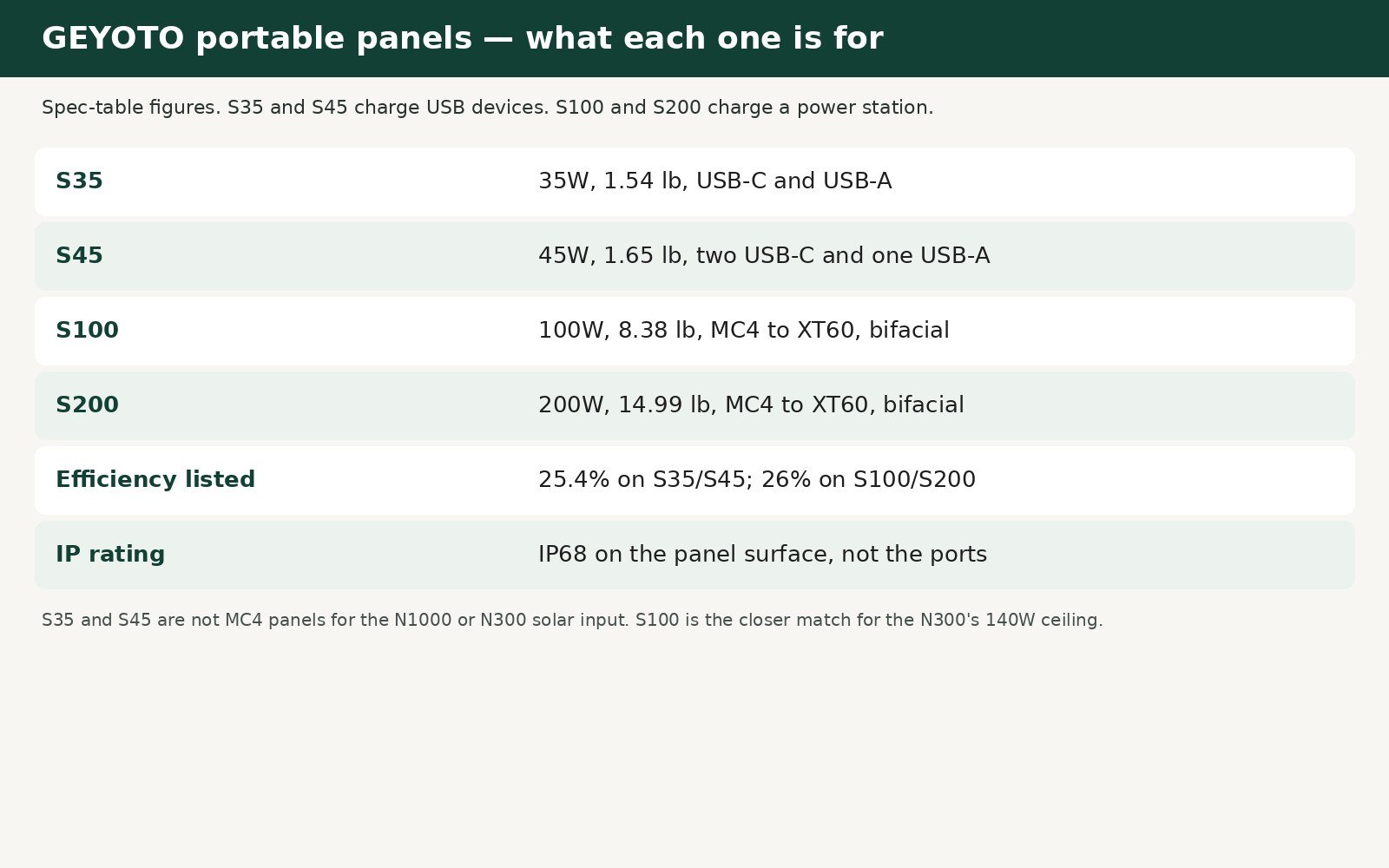
Buy it for an N1000 if you can haul 15 lb and 82 inches. Skip it on an N300. The S100 is the lighter match: 100W, 8.38 lb, 25.2V at 3.97A, 26%, IP68, and a 3-year line on its table. Listed prices were $255 for the S200, compare-at $359, and $159.99 for the S100, compare-at $259. Prices can change.
S45 Portable Solar Panel — Best ultralight USB option
The S45 charges phones and tablets from the sun. It is not a station input. Rated power is 45W, weight 1.65 lb, folded 8.5 x 12.5 x 1.3 in, unfolded 34.3 x 12.5 x 0.7 in. The spec table says 25.4% efficiency. Marketing says 25%. IP68 is the panel surface, not the ports. There is no battery and no AC outlet.

Illustrative hike. Photo: Pexels ID 1271619. No GEYOTO gear is shown.
The spec table lists USB-C1 at 5V/3A, USB-C2 up to 11V/2.25A, and USB-A up to 12V/1.5A. Marketing assigns 25W, 15W, and 18W in a different port order. Follow the table, and do not add the port maximums together. The box is a pouch, a USB-C cable, two carabiners, and a manual. GEYOTO says it is not an MC4 or XT60 panel.
The S35 is lighter: 35W, 1.54 lb, one USB-C and one USB-A, 25.4% on its table, folded about 4.8 x 8.3 x 1.6 in. Listed prices were $63.99 for the S45, compare-at $109.99, and $59.99 for the S35, compare-at $89.99. Choose the S45 for the extra port. Choose the S35 for the weight. Neither stores energy after sunset.
GEYOTO N1000 vs N300
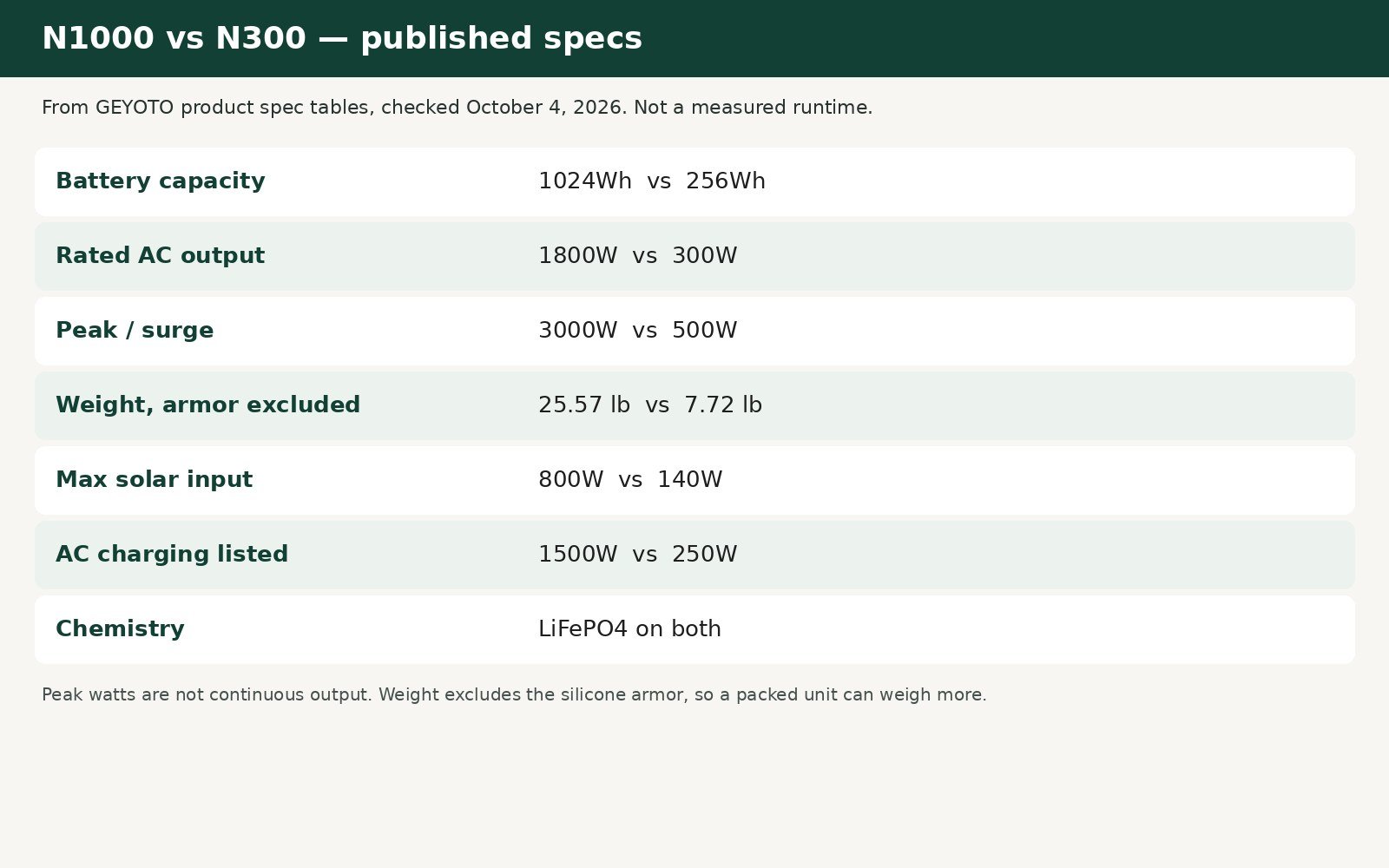
Compare the load first. The N1000 is 1,024Wh and 1,800W, peak 3,000W. The N300 is 256Wh and 300W, peak 500W. If nothing you own passes 300W running or 500W start, the N1000 mostly adds weight and price. About 8 lb with a strap is not the same object as 26 lb before the armor. Solar follows: 140W and an S100, or 800W and an S200. AC charging is 1,500W versus 250W. Car charging is listed at 800W versus 48W, and only the smaller number looks like an ordinary 12V lead. Both are LiFePO4 with app control, a sub-10 ms UPS line, and 25W wireless. Neither is a house battery.
Portable power station vs solar generator
GEYOTO uses “solar generator” for a bundle. Sunlight hits the panel. The station stores energy and supplies AC and USB. Either station runs from a wall with no panel. An S200 alone cannot run an AC appliance. One panel, two panels, or none are three ways to buy the same N1000. Compare the kit with the parts that day.
How to choose the right GEYOTO setup
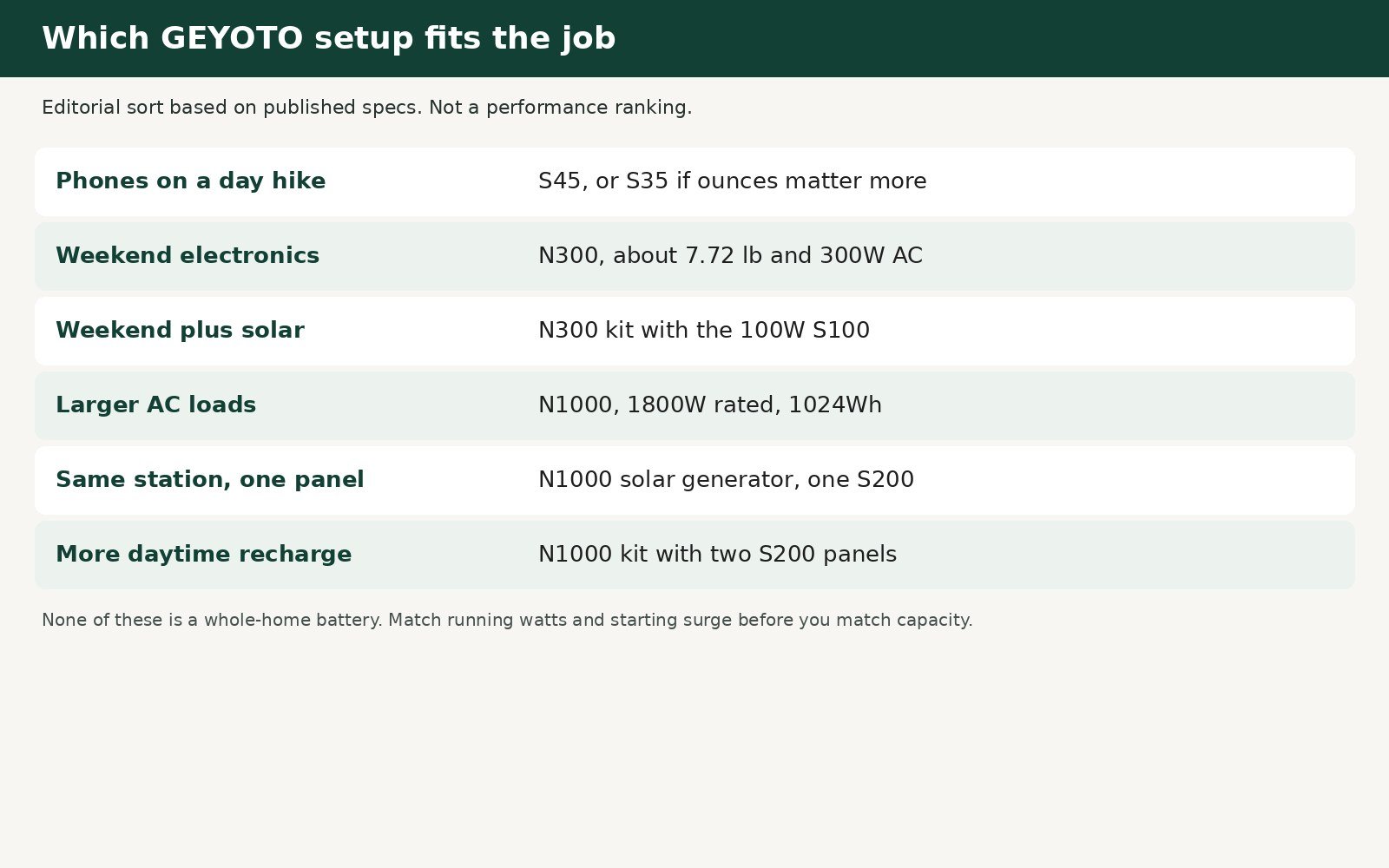
For the best GEYOTO portable power products, match running watts before you match a sale price.
- Watt-hours. 256Wh is a small-electronics reserve. 1,024Wh is deeper, and still one battery.
- Continuous watts. Stay under 300W or 1,800W, including devices that run together.
- Surge. Peak is 500W or 3,000W. It is not a running rating.
- Ports. Match AC, USB-C, USB-A, the car socket, and wireless to the device.
- Weight. The N300 is the carry. An N1000 with an S200 is a car load.
- Solar. Match volts and watts to the station limit. S35 and S45 stay on USB devices.
- Recharge. Wall charging is the path you can time. Solar hours are not fixed.
- UPS. Both list a switch under 10 ms. Test your device. Medical gear is not assumed.
- Indoors. They are batteries if you follow the manual. They do not run a house.
- Warranty. Member terms differ for stations and panels. Contiguous-U.S. service is the standard offer.
- Price. Compare the station, the panel, and the kit the same day.
Strengths and limits
Both stations are LiFePO4 with a 4,000-cycle line, the output classes are genuinely different, kits exist for each, and GEYOTO publishes U.S. warranty, shipping, and return pages plus support@geyoto.com and +1 213 292 9187 in Wilmington, Delaware.
The same pages set the limits. The N300 stops at 300W. The N1000 is heavy with panels. Solar watts move with the weather. Jumper and Stars & Stripes listings overlap the same electrical specs. Kit tables can make a panel nameplate look like the station’s input cap. Sale prices move.
Warranty, shipping, and returns
Coverage is for U.S. purchases from delivery, with proof of purchase. Standard service is the contiguous United States. Alaska, Hawaii, and territories can mean the buyer pays freight both ways. Remedies include repair or exchange, sometimes refurbished. Misuse, water, unauthorized sellers, and third-party accessories are excluded. There is no walk-in service center, per the FAQ.
Members are told they get 5 years on power stations and 3 years on panels. Another sentence offers a 2-year extended membership warranty and never states the non-member baseline. Some kit highlights drop “members” and print “5 years (power station) + 3 years (panel).” Panel spec tables say 3 years. “Up to 5 years” on the banner is not every product. Confirm the term on the order.
A site banner says free U.S. delivery in 3–5 business days. The shipping policy says standard service is typically 5–7 business days, expedited 2–3, and express 1–2, and that free standard shipping starts above an amount the page does not name. Smaller orders may pay a flat rate.
U.S. returns are allowed within 30 days of receipt in original packaging. The return page charges the customer for shipping plus a transaction fee, 2.7% on Shopify Payments or 4.4% on PayPal, and says refunds follow within 14 business days of warehouse receipt. Cancel within 24 hours for a full refund. After the parcel ships, that page adds a $25 intercept fee. The FAQ says the buyer pays shipping on a change-of-mind return and that GEYOTO pays both ways for a quality problem. The money-back banner names none of those fees.
FAQ
Is GEYOTO a good portable power station brand?
It publishes LiFePO4 specs and a real split between 256Wh and 1,024Wh. It fits when those numbers match your watts and carry limit. Moon Picke has not endurance-tested it.
What is the difference between the N300 and the N1000?
256Wh and 300W versus 1,024Wh and 1,800W, with peaks of 500W and 3,000W. Solar input max is 140W versus 800W. Buy the larger one when you need the watts.
Can a GEYOTO power station run a refrigerator?
Many fridges are plausible only on the N1000, and only if startup fits the 3,000W peak. Runtime follows the compressor. The N300 is a poor match. Nothing here runs a house.
Can these stations charge from solar?
Yes. Maximum solar input is 800W on the N1000 and 140W on the N300. S100 and S200 are the MC4 panels. S35 and S45 are USB chargers. A full solar recharge is not a fixed number of hours.
Can they be used indoors?
GEYOTO says yes if you follow the manual. They are batteries, not gasoline engines. They still make heat, and the N1000 manual includes a Proposition 65 warning.
What size is best for camping?
The N300, or that station’s 100W kit. Use the N1000 for vehicle camping when a load exceeds 300W.
What is a solar generator?
A station bundled with panels. The panel uses sunlight. The station stores the energy. The battery alone is not a solar generator.
How long is the warranty?
The policy says 5 years on stations and 3 years on panels for members, plus a separate 2-year extended line with no clear base term. “Up to 5 years” is not every product.
Match running watts, carry weight, and whether the panel should be in the same box. In this catalog that is the N1000 for larger AC loads, and the N300 or S45 when the pack has to stay light.