
ZOUPW 100W vs 200W vs 300W vs 450W is a size decision, not a trophy hunt. A 450W panel is not automatically 4.5 times more useful than a 100W panel. It can offer more charging potential. It also asks for more area, more storage, often more money, and a power station that can actually accept the voltage and wattage. Rated watts are a lab nameplate under standardized test conditions. They are not all-day output at a campsite.
This comparison uses four current, in-stock U.S. foldable panels checked on October 4, 2026: the 100W Lightweight N-Type 16BB, the 200W FoldGo Pro 10BB, the 300W N-Type 16BB, and the 450W PRO bifacial. The sold-out “200W with Solar Angle Guide” is not in this table. Rigid glass 200W and certified-pre-owned listings are out of scope. Moon Picke did not lab-test these panels. See how we evaluate and our editorial standards. For pairing a panel with a station, see the GEYOTO portable power guide and the ACOPOWER product roundup.
Disclosure: Moon Picke may earn a commission if you purchase through links on this page, at no additional cost to you. Shop buttons use our PartnerBoost tracking URL. Official ZOUPW pages were used for specs and photos, not as checkout links. See our affiliate disclosure.
Prices checked October 4, 2026. Prices and promotions may change.
ZOUPW 100W vs 200W vs 300W vs 450W
Efficiency is the cell-efficiency row on the spec table when it exists. Watts per pound and price per watt are editorial calculations from those tables and live sale prices, not manufacturer specs.
| Model | Best for | Rated power | Cell type | Efficiency | Weight | Folded size | IP rating | Connectors | Warranty | Current price |
|---|---|---|---|---|---|---|---|---|---|---|
| 100W Lightweight (ZOUPW-QB100W) | Carry-in / small stations | 100W | N-Type 16BB | 25% (table) | 7.98 lb | 23.38 × 23.22 × 1.77 in | IP67 | 4-in-1 + 10-in-1; USB-A/C | 1 year | $109.99 (was $129.99) |
| 200W FoldGo Pro (Y200W) | Car camping middle | 200W | Mono 10BB | 23.5% (table) | 19.84 lb | 25.00 × 23.1 × 1.77 in | IP67 | DC5521 / Anderson / XT60 / DC7909 / DC8020 + 10-in-1; USB-A/C | 1 year | $189.99 (was $239.99) |
| 300W Foldable (EZ300W) | High-input stations | 300W | N-Type 16BB ETFE | 25% (table) | 21.41 ± 0.5 lb | 23.23 × 31.5 × 3.44 in | IP68 | DC7909 / DC8020 / XT60 / Anderson; no USB row | 3-year panel / 1-year cables | $322.99 (was $379.99) |
| 450W PRO bifacial (ZP-DS450W) | Max portable output if voltage fits | 450W + claimed rear gain | N-Type 16BB composite | 25.6% (table) | 20.9 ± 0.5 lb | 30.4 × 34.6 × 3.5 in | IP68 | DC7909 / DC8020 / XT60 / Anderson; no USB row | 3-year panel / 1-year cables | $569.99 (was $599.99) |
Quick decision
- 100W: Best when you carry the panel. Phones, tablets, a small station, day trips.
- 200W: Best for many car campers who want more potential charging without a 32V+ Voc.
- 300W: Best when the station’s solar input is above 32.3V and over 300W.
- 450W: Best only if the station can take ~40V Vmp / 46V Voc and you can store a 10-foot sheet.
Your power station may be the real bottleneck
Every portable station publishes a maximum solar input wattage, a voltage window, a current limit, and a connector. A physically matching XT60 or DC7909 plug does not prove electrical fit. If the station caps solar at 200W, a 300W or 450W panel cannot “make” the station take 300W or 450W. If the station’s MPPT window tops out below the panel’s Voc, you should not buy that pairing.
ZOUPW’s 300W page says the station’s solar input voltage must be above 32.3V and its input limit must exceed 300W. The 450W page copy says the input should “accommodate 38V,” while the PRO table lists 40.0V Vmp and 46.0V Voc. Use the table and leave headroom for cold, higher Voc. The 100W and 200W FoldGo Pro pages list example Jackery, EcoFlow, Anker, Goal Zero, BLUETTI, and Rockpals models next to specific adapters. Those examples are not every SKU those brands have sold.
Rated watts vs real solar
100W, 200W, 300W, and 450W are rated under standardized conditions. Real production moves with sun intensity, angle, clouds, temperature, shading, orientation, cell temperature, conversion losses, and how the station’s charger behaves. Do not plan as if a 450W panel delivers 450W from sunrise to sunset.
ZOUPW 100W: best when portability matters most?
Two 100W foldables were in stock: this Lightweight N-Type 16BB (SKU ZP100W-LSV2-US, $109.99) and the 100W with Solar Angle Guide (ZOUPW-F100W, ZP100W-NSV1-US, $102.99, 9.48 lb, 23.5% cell efficiency, IP67). We use the Lightweight as the 100W class in this comparison because it is lighter (7.98 lb), lists N-Type 16BB at 25% cell efficiency, and includes the 10-in-1 adapter set. The Angle Guide model is cheaper and still current; it is not this row.
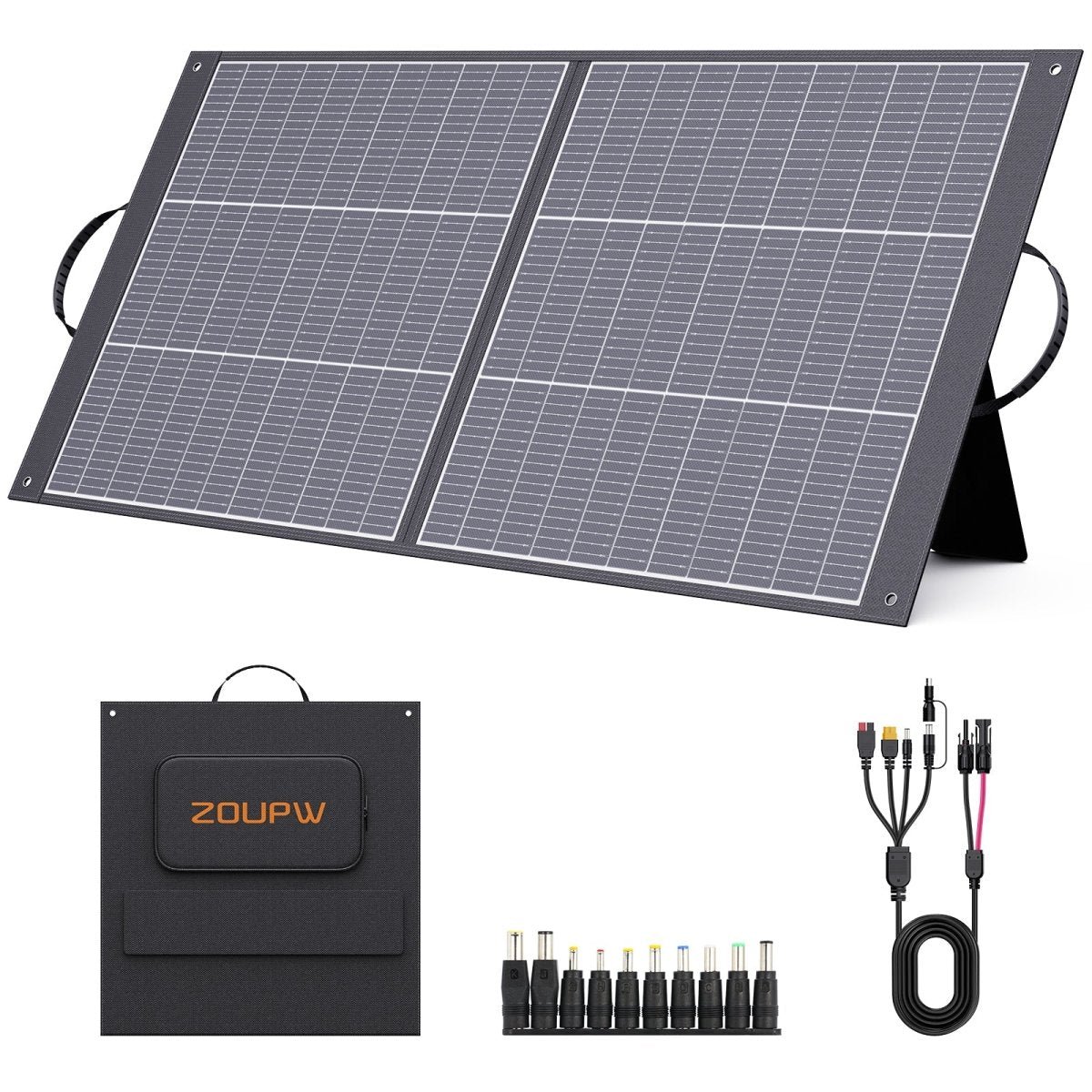
Table: 100W, Vmp 19.8V, Imp 5.05A, Voc 23.8V, Isc 5.35A. Unfolded 46.85 × 23.23 × 0.98 in. USB-A orange 5V/3A, 9V/2A, 12V/1.5A; Type-C 5V/3A, 9V/3A, 12V/3A, 15V/3A, 20V/2.25A (USB table also says 45W max PD). Kickstands. About 12.5 rated watts per pound (editorial). Box: panel, 10 ft cable, 10-in-1 connectors, manual. One-year warranty. FAQ: control box is not water-resistant and should stay dry; do not immerse the panel.
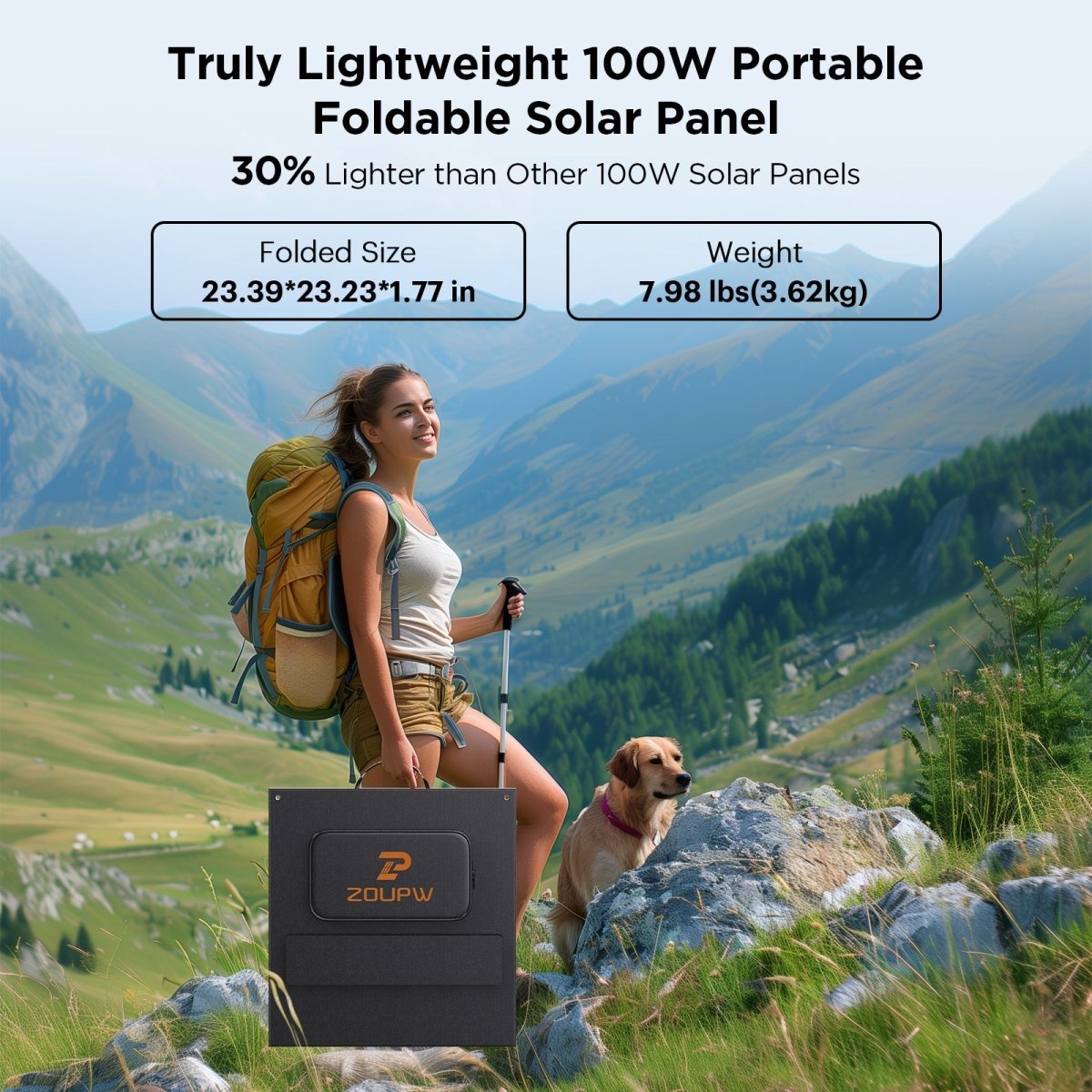
Use cases: phones, tablets, cameras, some laptops via USB-C, smaller stations, day trips, weekend kits where walking distance matters. Limitation: less rated charging potential than 200W+. For a 12V battery, ZOUPW says add a separate MPPT/PWM controller.
ZOUPW 200W: the sweet spot for many campers?
The “200W Portable Solar Panel with Solar Angle Guide” (ZP200W-NSV1-US) was unavailable. The current 200W foldable we use is FoldGo Pro 10BB (Y200W, ZP200W-PLV1-US, $189.99). A FoldGo “Square” 200W (ZP200W-NSV1-US-1) was also in stock at the same price; this article does not mix Square specs into the Pro row. FoldGo Pro is 10BB monocrystalline at 23.5% cell efficiency — not N-Type 25%.
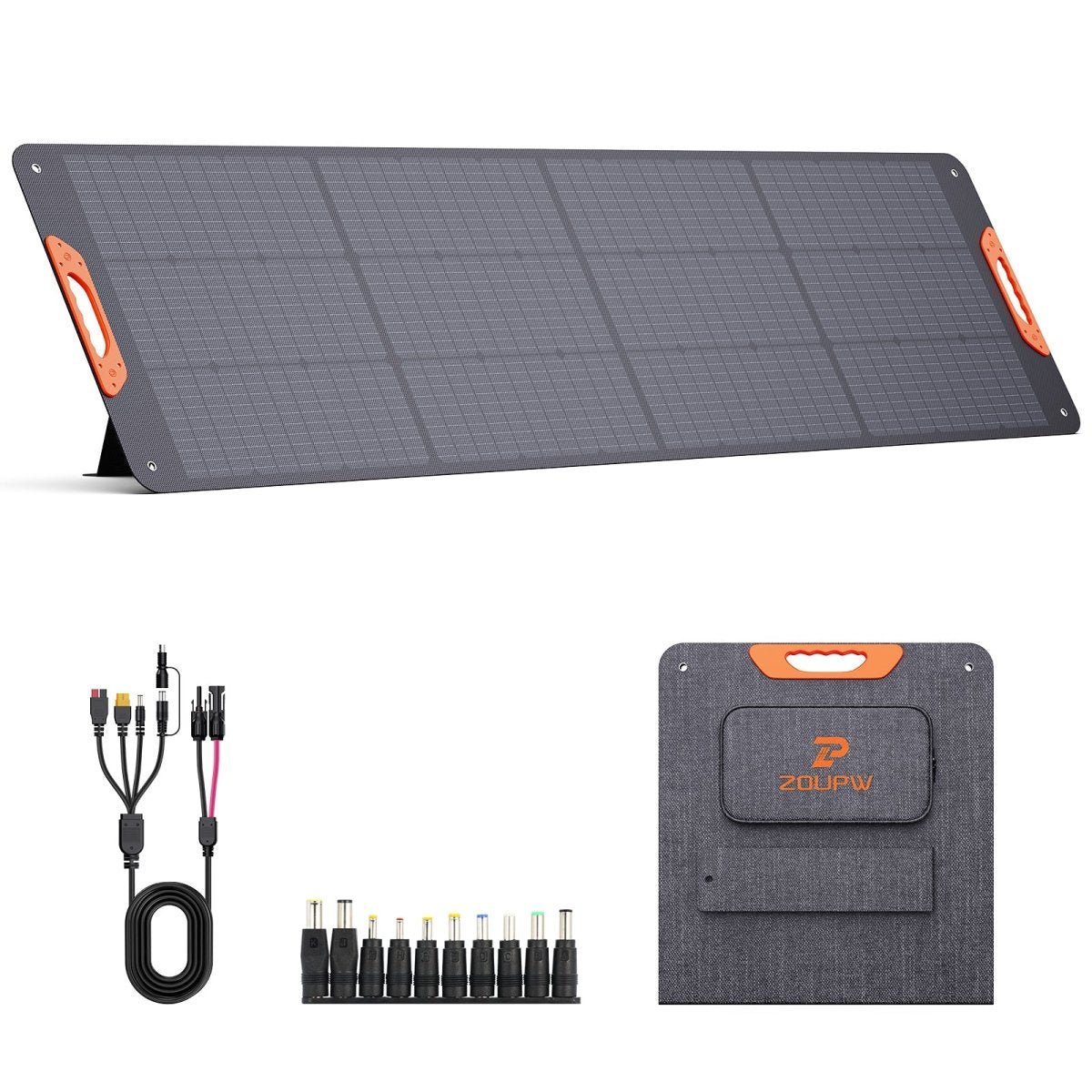
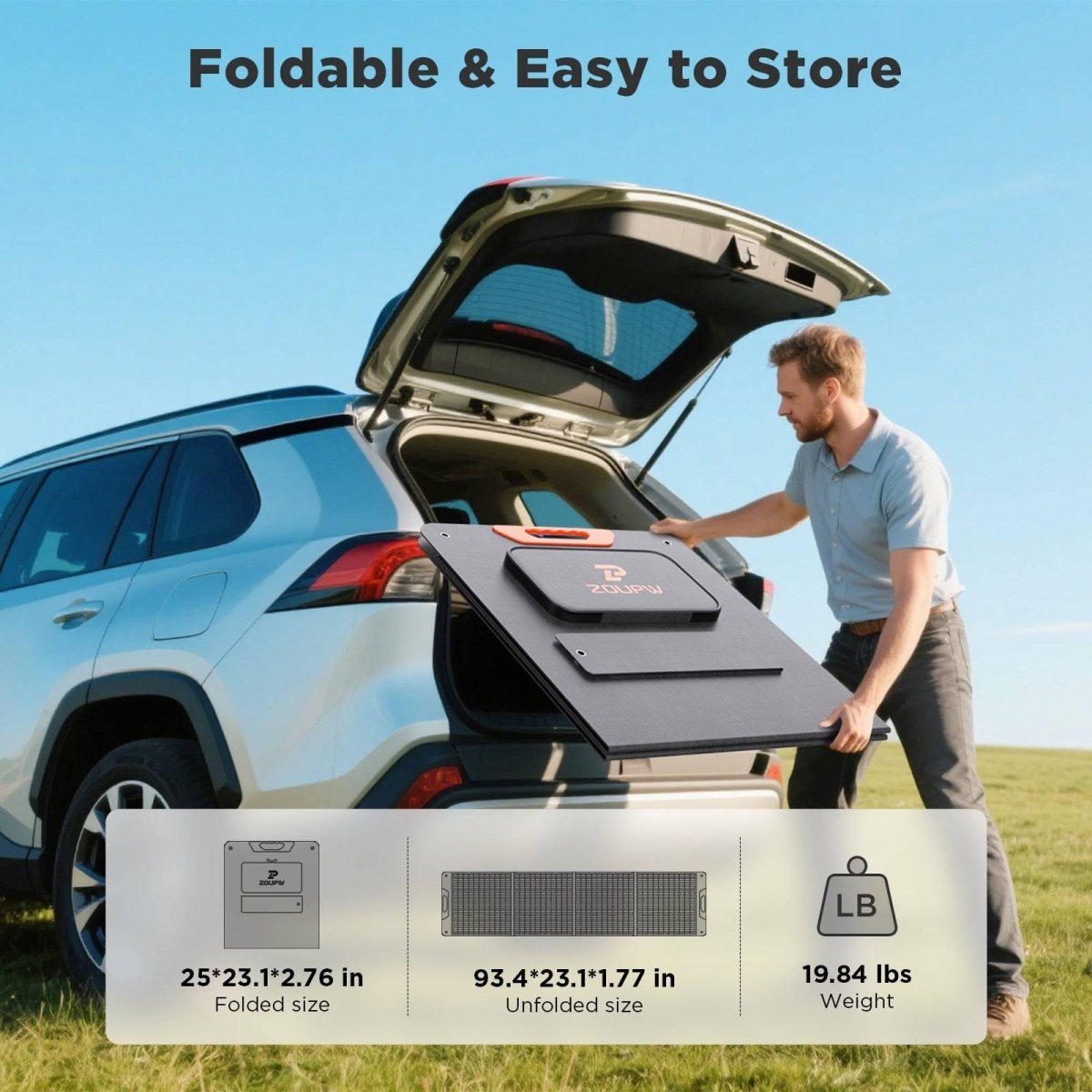
Table: 200W, Vmp 18.6V, Imp 10.75A, Voc 22.28V, Isc 11.35A, IP67, 19.84 lb. Unfolded 93.4 × 23.1 × 1.77 in — a long strip, not a square. Folded 25.00 × 23.1 × 1.77 in in the spec table (a gallery graphic on the same page prints folded thickness as 2.76 in; we treat the table as the spec). USB-A and Type-C with listed voltages. Magnetic handle. About 10.1 rated watts per pound (editorial) — the weakest density of the four. Versus 100W you roughly double nameplate and more than double weight (7.98 lb → 19.84 lb). Price step: $109.99 → $189.99.
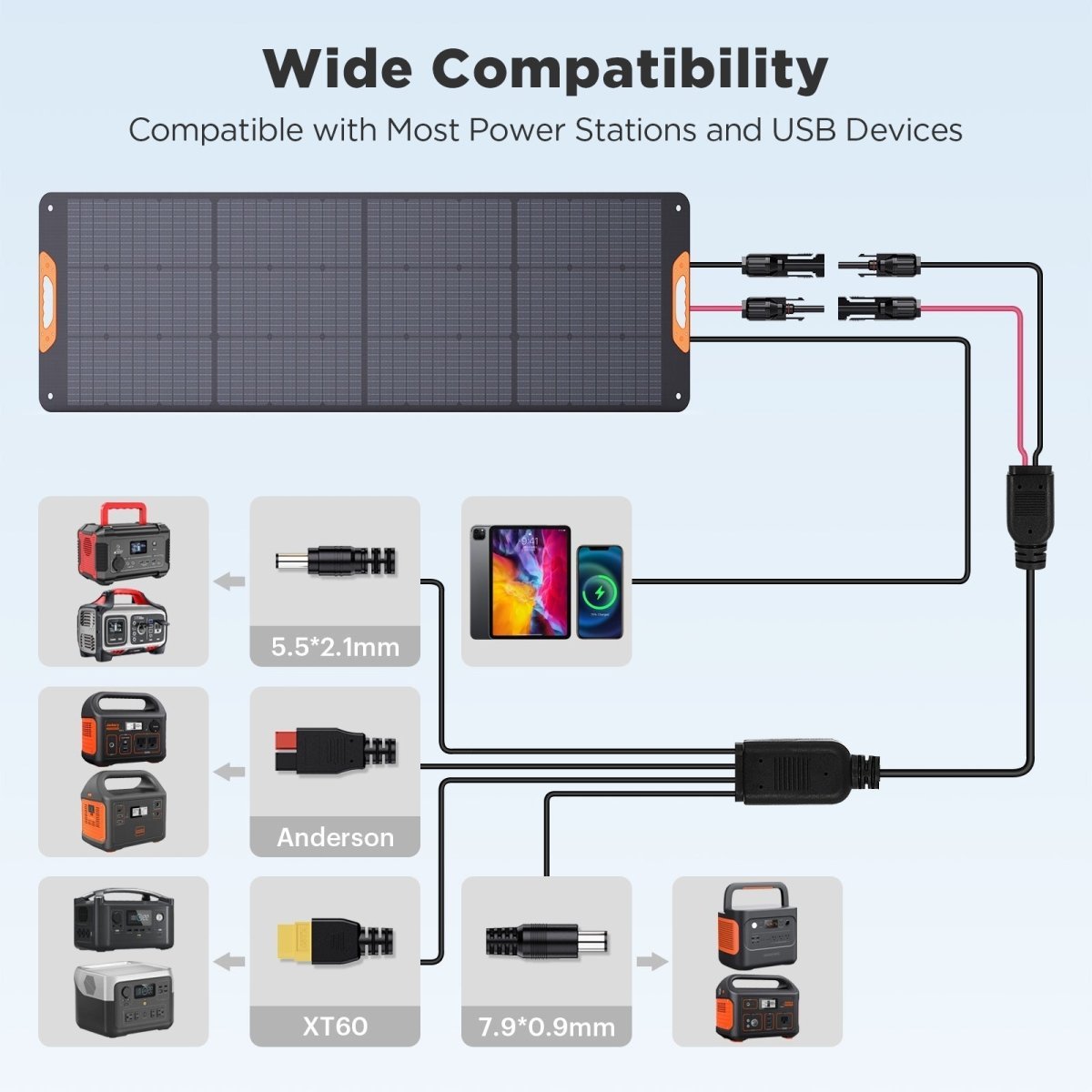
The page lists DC5521, Anderson, XT60, DC7909, and DC8020 examples, plus a 10-in-1 set, and tells you to confirm the station accepts 18.6V. An FAQ on the Pro page still describes a solar-angle scale plate; we did not confirm that hardware on every Pro unit, and we do not attach a percent gain. Box: panel, 10 ft cable, 10-in-1, manual. One-year warranty. 200W is the camping middle if your station’s solar cap is at least 200W and Voc around 22V fits. It is not “always twice as fast as 100W.”
View ZOUPW Portable Solar Panels
ZOUPW 300W: when more solar input starts to matter
Model EZ300W, SKU ZP300W-EFV1-US, $322.99. Table: 300W, Vmp 27.9V, Imp 10.75A, Voc 32.3V, Isc 11.31A, N-Type 16BB, 25% cell efficiency, IP68 ETFE, aluminum frame, 21.41 ± 0.5 lb. Unfolded 92.91 × 31.5 × 0.85 in; folded 23.23 × 31.5 × 3.44 in. No USB row. About 14 rated watts per pound (editorial). Weight is close to FoldGo Pro 200W, but Voc jumps. That is the point: 300W is compelling only if the station can take it. Do not assume every ~1 kWh station accepts 300W solar.
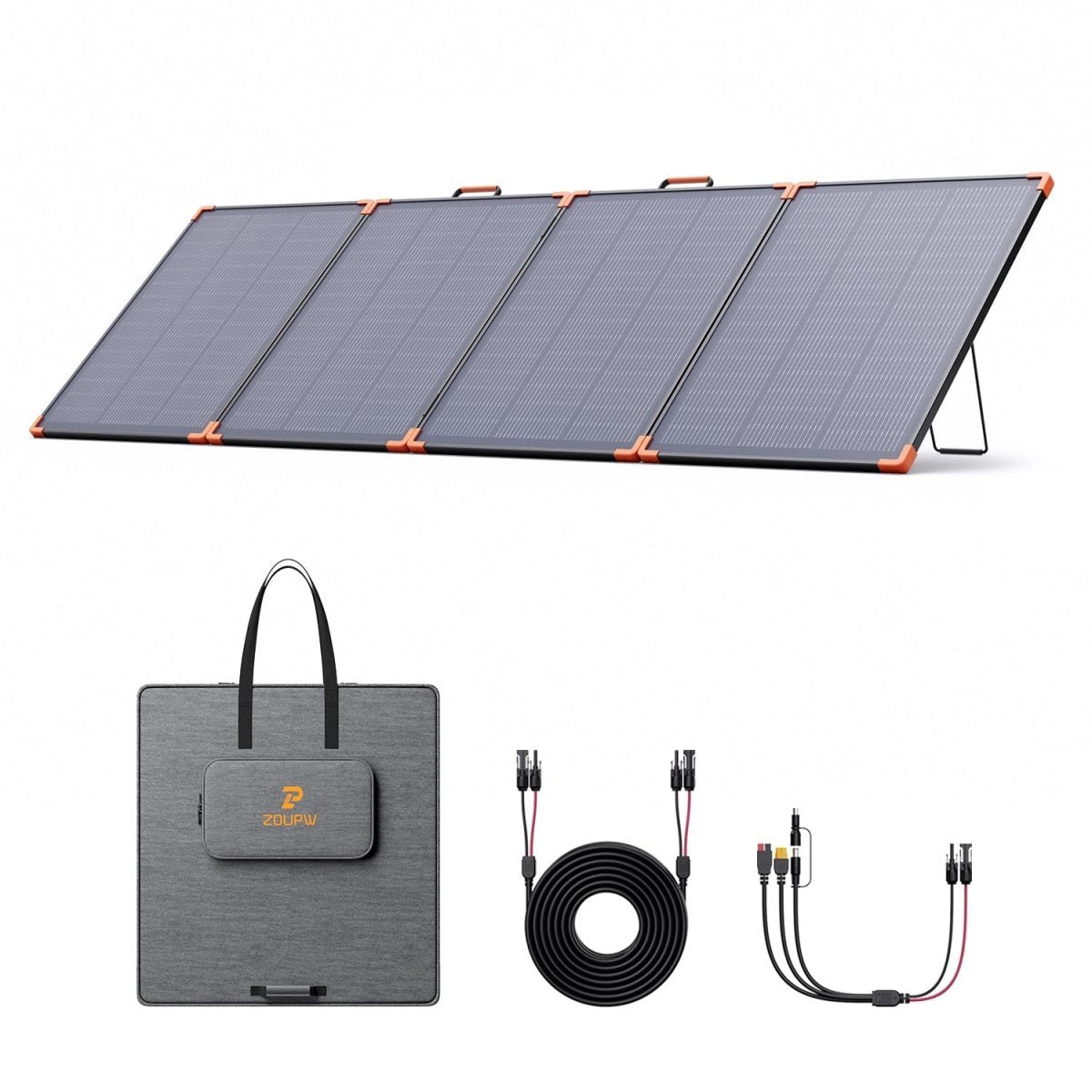
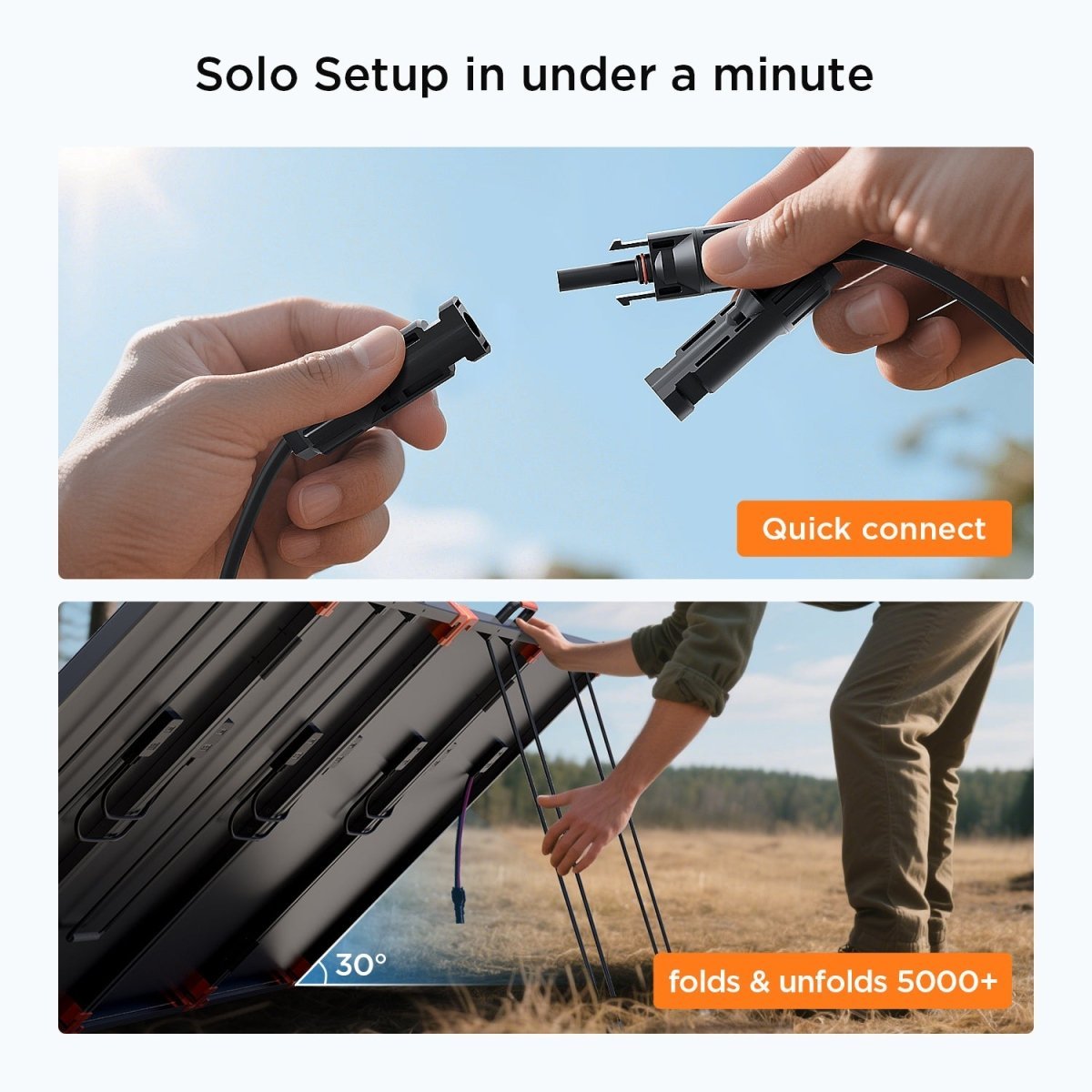
Box: panel, 13 ft cable, DC7909/DC8020/XT60/Anderson PP30, bag, manual. Kickstands; copy mentions a 30° ground angle and a bag that unzips as a ground mat. 3-year panel / 1-year cables. Page marketing that cites “95%+ of portable power stations” is not treated as fact here. $322.99 vs $189.99 for 200W is a large step for buyers whose station still caps at 200W.
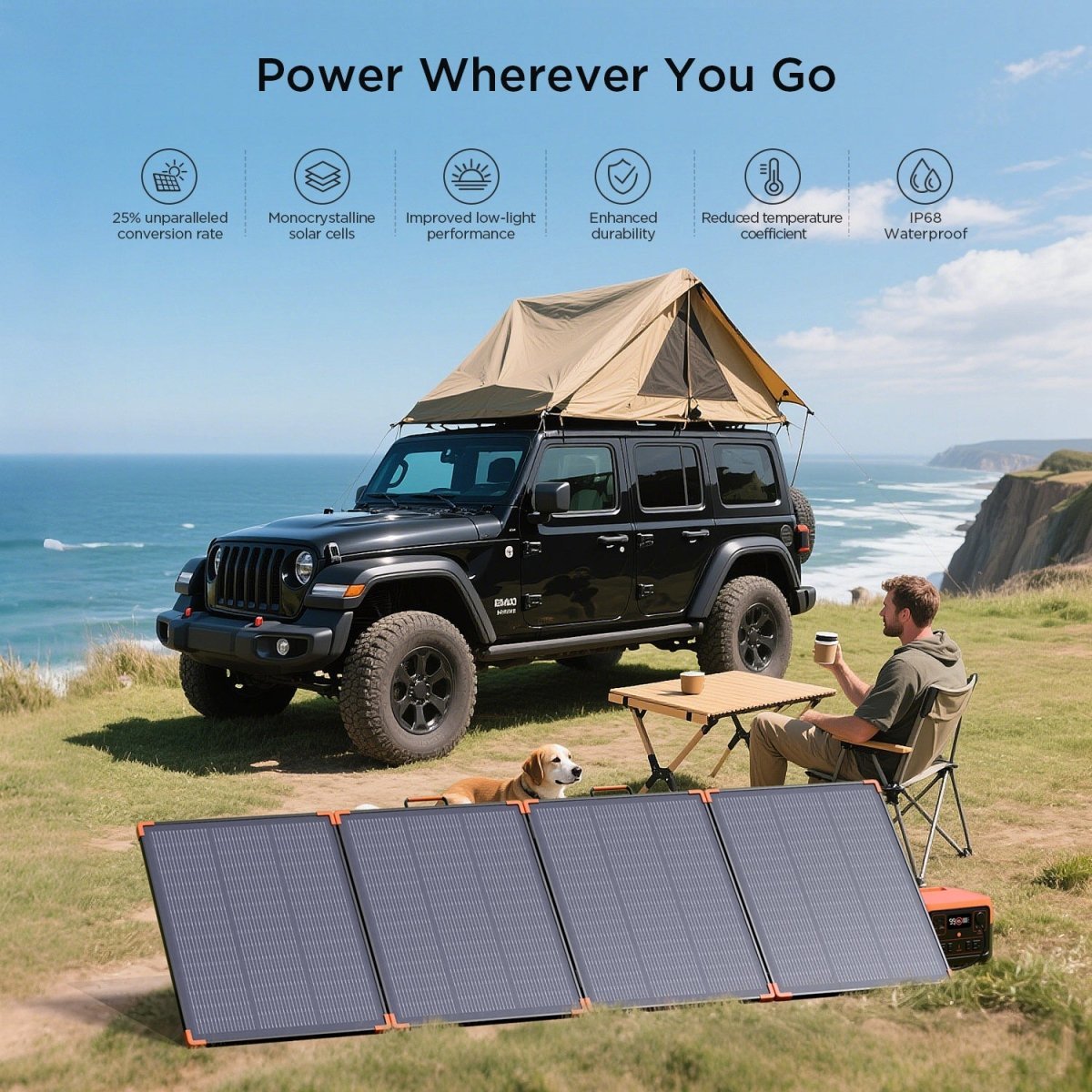
ZOUPW 450W: maximum output or too much panel?
ETFE 450W (ZP450W-EFV1-US) was unavailable. The in-stock 450W is PRO bifacial, SKU ZP450W-DSV1-US, model ZP-DS450W, $569.99. Table: N-Type 16BB, composite surface, 25.6% cell efficiency, IP68, 20.9 ± 0.5 lb. Pmax is written as 450W with “up to 30% extra power” in the same cell — ZOUPW’s bifacial claim, not a second guaranteed nameplate. Vmp 40.0V, Imp 11.7A, Voc 46.0V, Isc 12.4A. Unfolded 121.9 × 34.6 × 0.9 in; folded 30.4 × 34.6 × 3.5 in. About 21.5 rated front watts per pound (editorial) — highest density here — still a four-section sheet over 10 feet long.

Bifacial means the rear can collect reflected light. Gain depends on ground color, elevation, angle, shading, and whether the back is blocked. ZOUPW’s “up to 30%” is a manufacturer ceiling under suitable conditions, not typical grass-flat output.
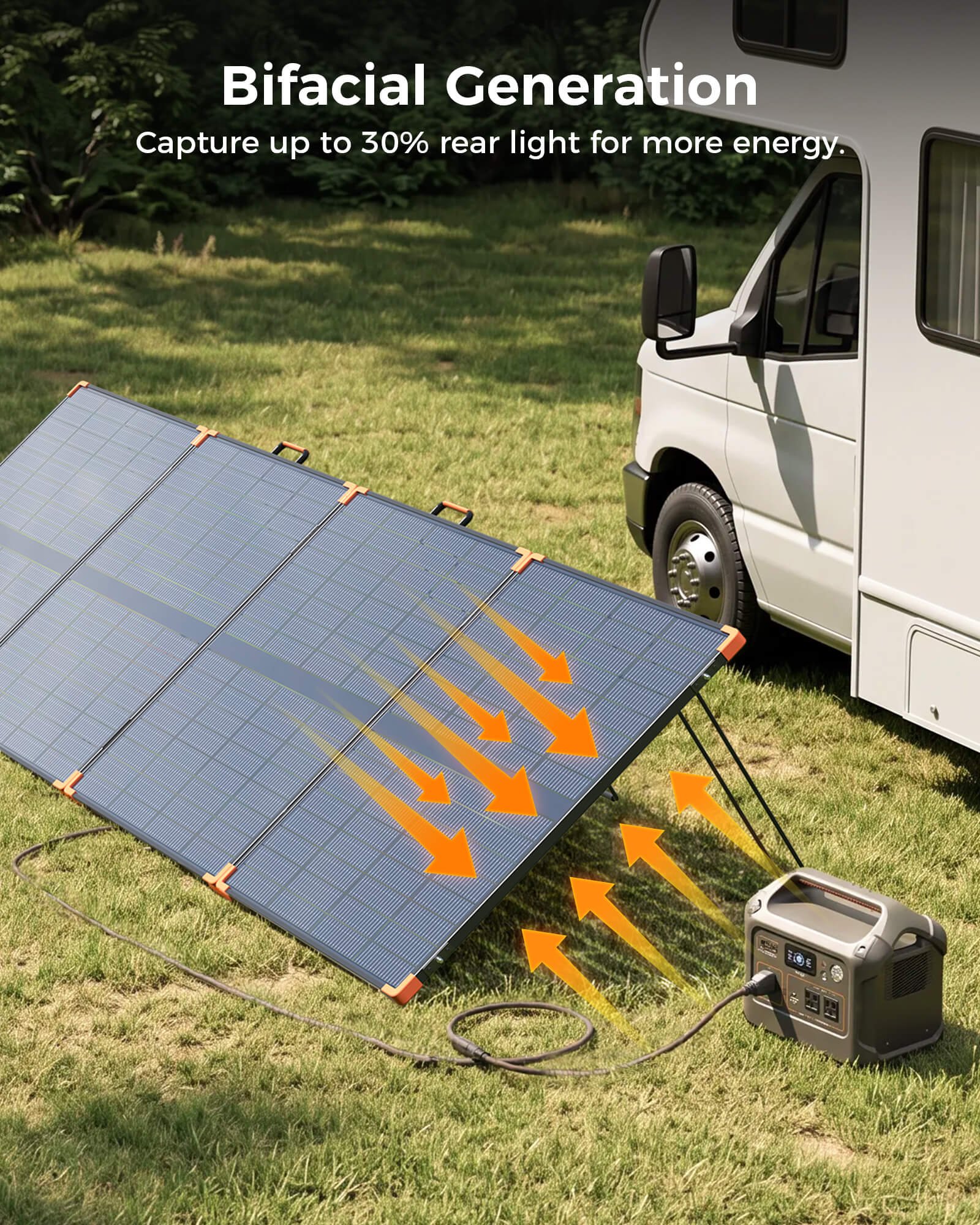
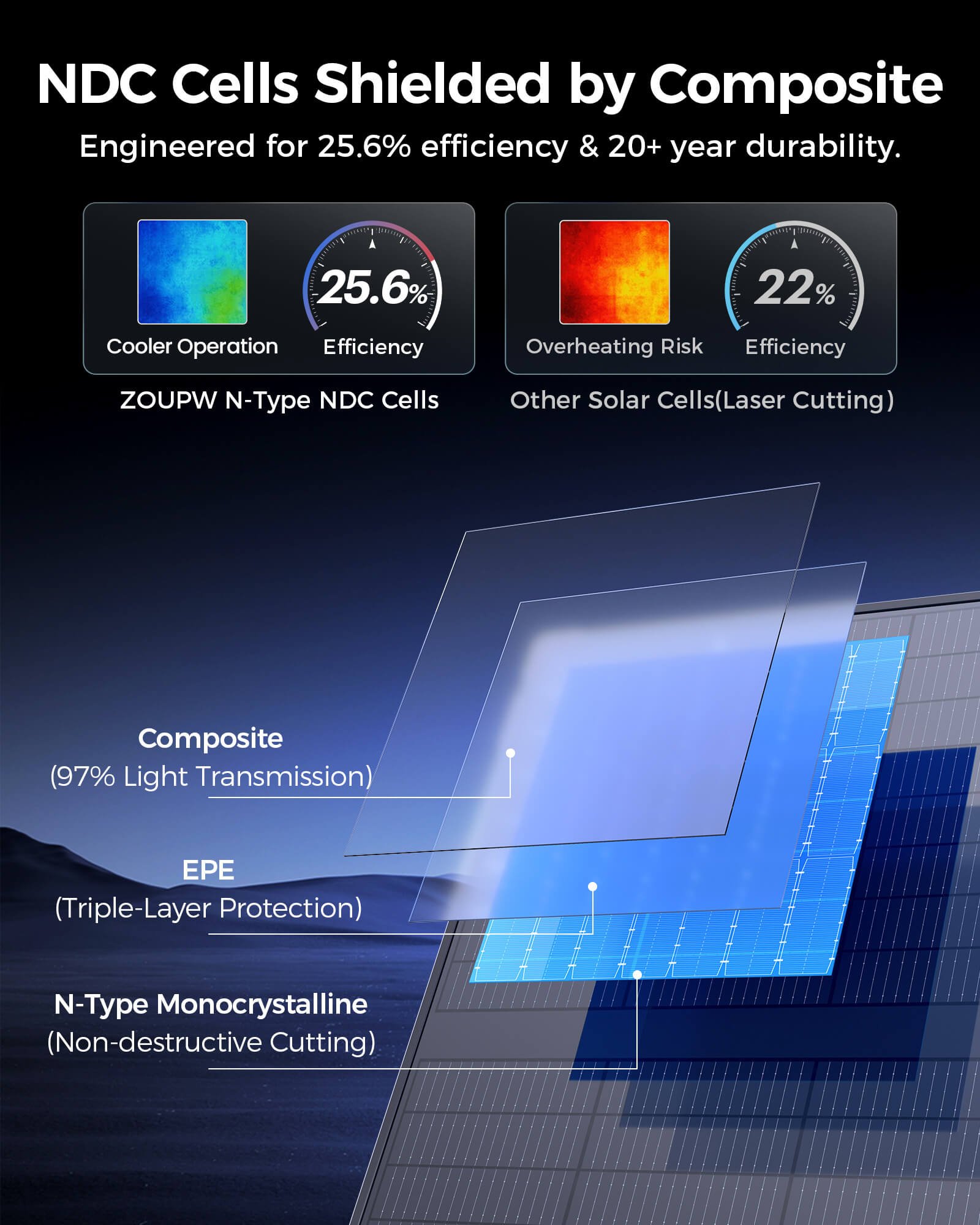
Box: panel, 13 ft cable, 4-in-1 connectors, bag, four ground stakes, manual. Copy cites a 35° kickstand and a 2400 Pa wind-load claim when staked — manufacturer language. Do not submerge. 3-year panel / 1-year cables. Skip 450W if you walk far from the vehicle or if the station’s solar window is 12–30V / 200W. It is not the default winner of ZOUPW 100W vs 200W vs 300W vs 450W.
How much faster can a larger panel charge?
Do not use 1,000Wh ÷ 200W = exactly 5 hours. Available sun, the station’s input cap, conversion losses, the charging curve, battery state, and weather all move the clock. A rough, labeled example — not a prediction: if you assume about half of nameplate reaches the battery for five favorable sun hours, and the station is not the bottleneck, you get on the order of ~250Wh (100W), ~500Wh (200W), ~750Wh (300W), ~1,125Wh (450W) before other losses. Clouds, heat, and a 200W input cap wipe that ranking.
Educational capacity classes, not specific products:
- ~300Wh station: 100W is often enough. 200W can refill faster if the input allows. 300W/450W are usually oversized and may violate voltage/watt limits.
- ~500Wh station: 200W is the common step-up if Voc ~22V fits.
- ~1,000Wh station: 200W or 300W depending on the published solar wattage and voltage window — not on the battery number alone.
- ~2,000Wh station: 300W or 450W only after you read Voc and max solar watts. A 2 kWh pack with a 200W inlet still behaves like a 200W inlet.
How much portability do you give up?
Editorial rated watts per pound: 450W PRO ~21.5, 300W ~14.0, 100W ~12.5, FoldGo Pro ~10.1. Folded: 100W is a ~23 in square; 200W is a ~25 × 23 in slab that unfolds to 93 in; 300W folds thicker (3.44 in) on a 31.5 in edge; 450W is 30.4 × 34.6 × 3.5 in and unfolds past 10 feet. 100W and 200W are fabric packs with USB; 300W and 450W are aluminum-frame briefcases with kickstands and longer 13 ft cables. Handles: 100W silicone carry, 200W magnetic handle, 300W/450W bag handles. A 450W panel that “wins” watts per pound still loses if you park 400 yards from camp.
Which ZOUPW panel is best for camping?
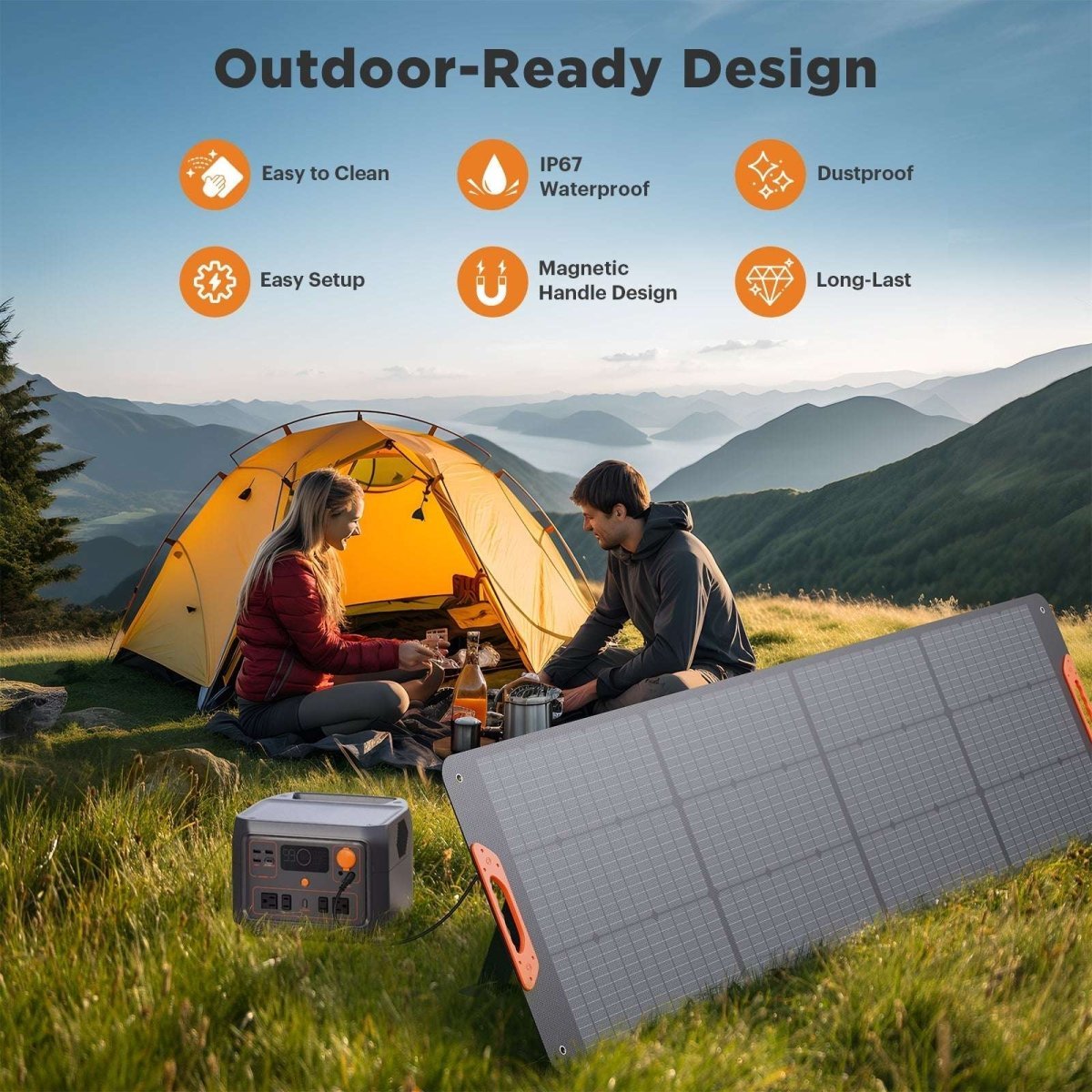
Backpack or long carry: 100W. Car camping: 200W if the station accepts ~200W / ~22V Voc; 180W-class aluminum kits exist in the catalog but are not this four-way. Multi-day camping: energy use matters more than the label — a fridge-heavy site may want 200W or 300W if input allows. Large-station camping: read the inlet first, then pick 300W or 450W. Camping is not one use case.
RVs, overlanding, and emergency backup
These are movable ground panels, not a substitute for a permanent roof array in every RV. Storage bays favor the 100W square or the 200W slab. High daily loads and a high-input station parked beside the coach can justify 300W or 450W if Voc fits. Overlanding: 200W is already 19.84 lb and 93 in unfolded; 450W needs stakes, space, and a station that will not fault on 46V Voc.
The panel does not store energy. Backup needs a compatible station or charge controller. 100W: slower top-up of phones and a small pack. 200W: middle ground. 300W+: more potential if electrically legal. 450W: highest potential in this set when compatible. None of that guarantees runtime in a storm.
Price per rated watt
Editorial price per rated watt from sale prices checked October 4, 2026: 100W $1.10/W, 200W $0.95/W, 300W $1.08/W, 450W $1.27/W. Cheapest per watt is FoldGo Pro. That does not make it best for a hiker. 450W is the most dollars per front-rated watt and the most demanding electrically.
Efficiency, N-Type, 16BB, and weather
Efficiency is not total wattage. ZOUPW rates Lightweight 100W cell efficiency at 25% (table), FoldGo Pro at 23.5% (table), 300W at 25% (table), 450W PRO at 25.6% (table). A smaller 25% panel can still be 100W. N-Type 16BB appears on the 100W Lightweight, 300W, and 450W PRO. 16BB means sixteen busbars collecting current; ZOUPW describes lower resistance versus older 9BB. FoldGo Pro is 10BB mono at 23.5%. IP67: 100W and 200W. IP68: 300W and 450W. That is not “leave it outside all season.” Keep the 100W control box dry. Do not submerge the 450W (page note). Warranties are not uniform: 1 year on 100W and 200W; 3-year panel / 1-year cables on 300W and 450W.
FAQ
Is a 100W or 200W solar panel better for camping?
Carry-in camping: 100W. Car camping with a station that accepts ~200W: FoldGo Pro. Weight jumps from 7.98 lb to 19.84 lb.
How much faster is a 200W panel than a 100W panel?
Nameplate is 2×. Real charging is not a clean 2×. Sun, losses, and the station’s cap all interfere. Treat “twice as fast” as a ceiling, not a schedule.
Is 300W solar enough for a 1000Wh power station?
Battery size and solar input are different numbers. A 1,000Wh station with a 200W / 30V inlet is not a 300W Voc 32.3V panel’s job.
Can I use a 450W solar panel with my power station?
Only if voltage, current, wattage, polarity, and connector all match. Many popular inlets will not accept 46V Voc.
Are ZOUPW solar panels compatible with EcoFlow?
The 100W and FoldGo Pro pages name EcoFlow / RIVER / DELTA examples with XT60 or Anderson. Confirm your model’s window. Do not copy those lists onto the 300W or 450W without checking Voc.
Are ZOUPW panels compatible with Jackery?
Some pages list specific Explorer models next to Anderson, DC7909, or DC8020. That is not every Jackery.
Does a higher-wattage solar panel charge faster?
It can, if the station will accept the extra power. If the inlet is the bottleneck, you paid for unused nameplate.
What happens if a solar panel exceeds a power station’s solar input rating?
The station may clip to its limit, fault, or be used outside its documentation. Read the manual. Do not size a panel by ignoring the inlet.
Is a bifacial portable solar panel worth it?
On the 450W PRO, rear gain is a ZOUPW “up to 30%” claim. Worth it if you tilt over reflective ground and the station can take the voltage. Not worth it as a magic 30% everywhere.
Which ZOUPW panel should you buy?
There is no single winner in ZOUPW 100W vs 200W vs 300W vs 450W.
100W Lightweight — choose if you carry the kit, want USB on the panel, and the station’s Voc window is in the low 20s. Skip if you already own a high-input station and want faster recovery.
200W FoldGo Pro — choose if you car-camp, want the adapter chart, and the station accepts ~200W at 18.6V. Skip if 20 lb and a 93 in strip are too much, or if you need IP68 and a 3-year panel warranty.
300W — choose if the station’s solar input is above 32.3V and over 300W. Skip if the inlet is 200W or 30V, or you need USB on the blanket.
450W PRO — choose if you have space, a high-voltage inlet, and you accept bifacial gain as conditional. Skip if you walk the panel in, or the station cannot take 46V Voc.
Match the station first. Then pick the smallest panel that meets the charging goal you can actually use.