
Moon Picke independently researches products. If you buy through our links, we may earn a commission at no extra cost to you. Read our affiliate disclosure.
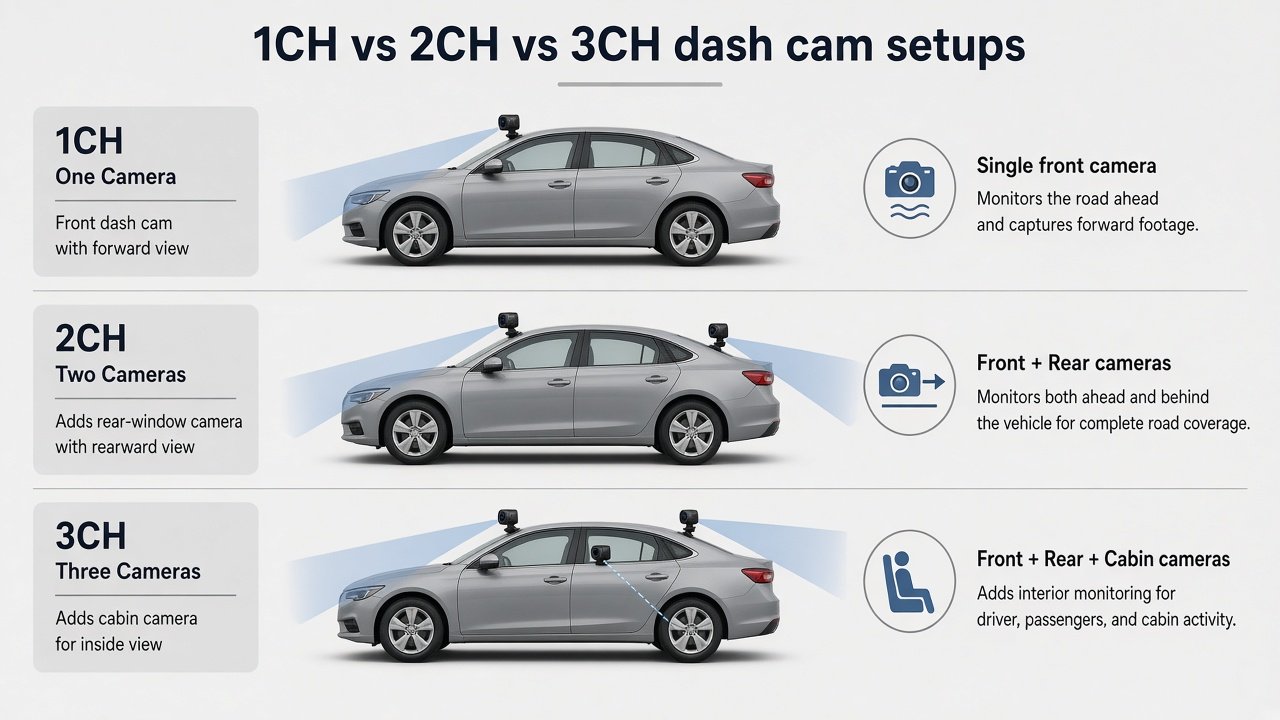
A 1 channel vs 2 channel vs 3 channel dash cam decision is about how many independent video feeds you will actually use—not a scoreboard where more cameras always win. A channel is typically one recorded camera. 1CH is usually the simplest front-only setup. 2CH is the mainstream front-plus-rear road layout. 3CH commonly adds a cabin camera for buyers who need that interior file. Exact layouts still vary by manufacturer, so count the cameras and where they point before you buy.
As an Amazon Associate I earn from qualifying purchases.
1-Channel vs 2-Channel vs 3-Channel Dash Cam: Quick Answer
How many dash-cam channels do I need? Choose 1CH for simple front-road recording. Choose 2CH if you want the usual front-plus-rear road coverage. Choose 3CH when cabin recording has a specific job (passenger, rideshare, or family interior events). There is no universal winner. The right system records the areas you need and stays practical to install, power, store, and review.
Extra lenses help only if they point at an incident type you care about: a cabin camera does not replace a rear-road camera, and a rear-road camera does not document a dispute in the back seat.
What Does “Channel” Mean on a Dash Cam?
A dash cam channel is generally one independently recorded camera or video feed. 1CH means one feed. 2CH means two. 3CH means three. Channel count is not a guaranteed camera map. A 2CH kit is often front road plus rear road, but some 2CH products pair front road with a cabin camera instead. A 3CH kit is often front + rear + cabin, yet another brand might put two lenses in one rear housing. Always verify the physical layout on the spec sheet for the exact SKU.
Shopping language is sloppy. “Dual cam” can mean two road cameras, or front plus cabin. Some systems hide two sensors in one housing, which changes cabling even when the channel count looks the same. Treat the marketing number as a feed count, then confirm where each lens points in the mode you will actually use.
Coverage is also not complete coverage. Field of view, mount height, A-pillars, tint, headrests, roof spoilers, and how you aim each camera still hide events. More channels increase recording perspectives. They do not guarantee a 360-degree sphere or a file for every collision angle.
1CH vs 2CH vs 3CH: Key Differences
Use this as a typical map for a 1 channel vs 2 channel vs 3 channel dash cam comparison, not a law of physics. Real kits can swap a rear-road camera for a cabin camera, or split two feeds into one module.
| Factor | 1-Channel | 2-Channel | 3-Channel |
|---|---|---|---|
| Typical coverage | Front road | Front + rear road | Front + rear + cabin |
| Installation | Simplest | Moderate (rear cable) | More involved |
| Storage demand | Lowest tendency | Higher | Highest tendency |
| Cabin recording | No | Uncommon / config-dependent | Common |
| Rear-road recording | No | Commonly yes | Commonly yes |
| Privacy complexity | Low | Low | Higher with cabin/audio |
| Best fit | Basic front evidence | Mainstream road coverage | Cabin-use cases |
When a 1-Channel Dash Cam Makes Sense
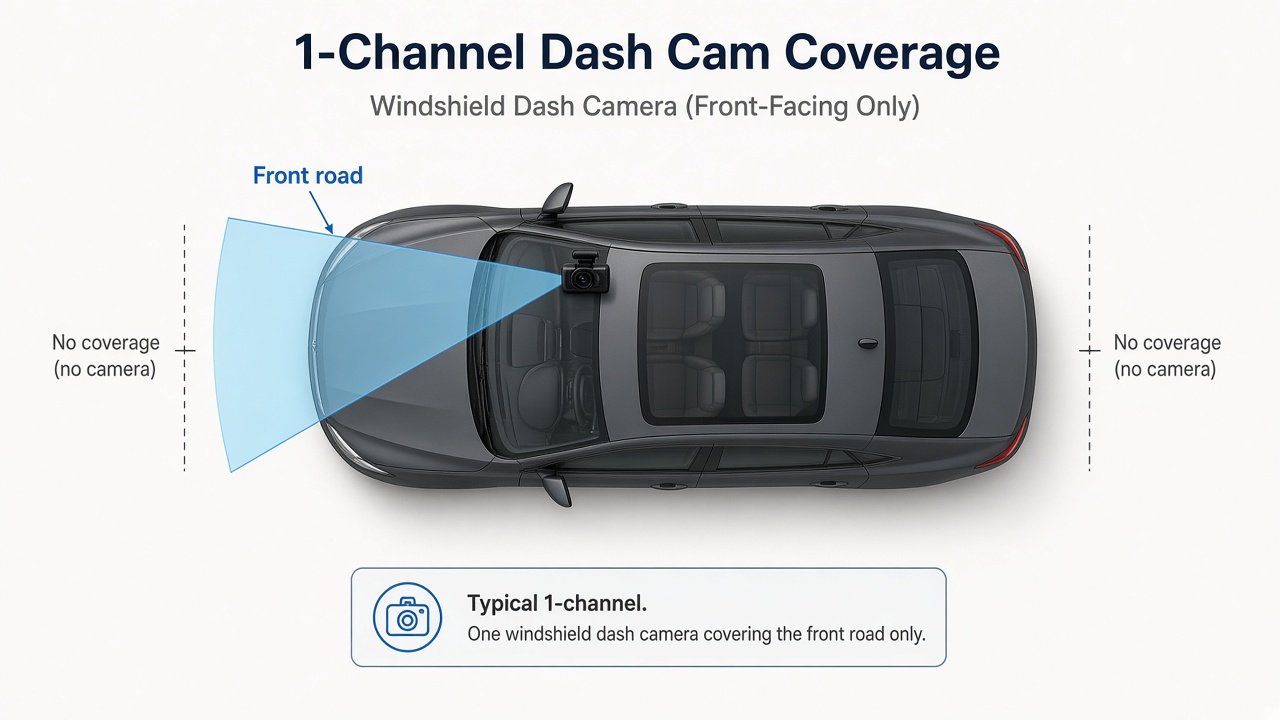
What is a 1-channel dash cam? Typically one front-road camera: windshield unit, power cable, one stream. Strengths: simplest install, least routing, lower storage tendency, easier to move between cars. Limitations: no rear-end collision file, no cabin file, fewer angles if another vehicle hits you from behind or a passenger-side event happens inside.
Not every 1CH camera is cheap or tiny. Some front-only units still include GPS, Wi-Fi, and app-only controls. Moon Picke’s Nextbase Piqo review is a current front-only example: Piqo 2K is a screenless 1440p camera with ClickMount. Compact hardware can still demand an app for settings and clips. 1CH is about missing cameras, not automatically “easy ownership.”
See the Nextbase Piqo 2K (front-only example) on Amazon →
Why 2-Channel Is the Mainstream Sweet Spot
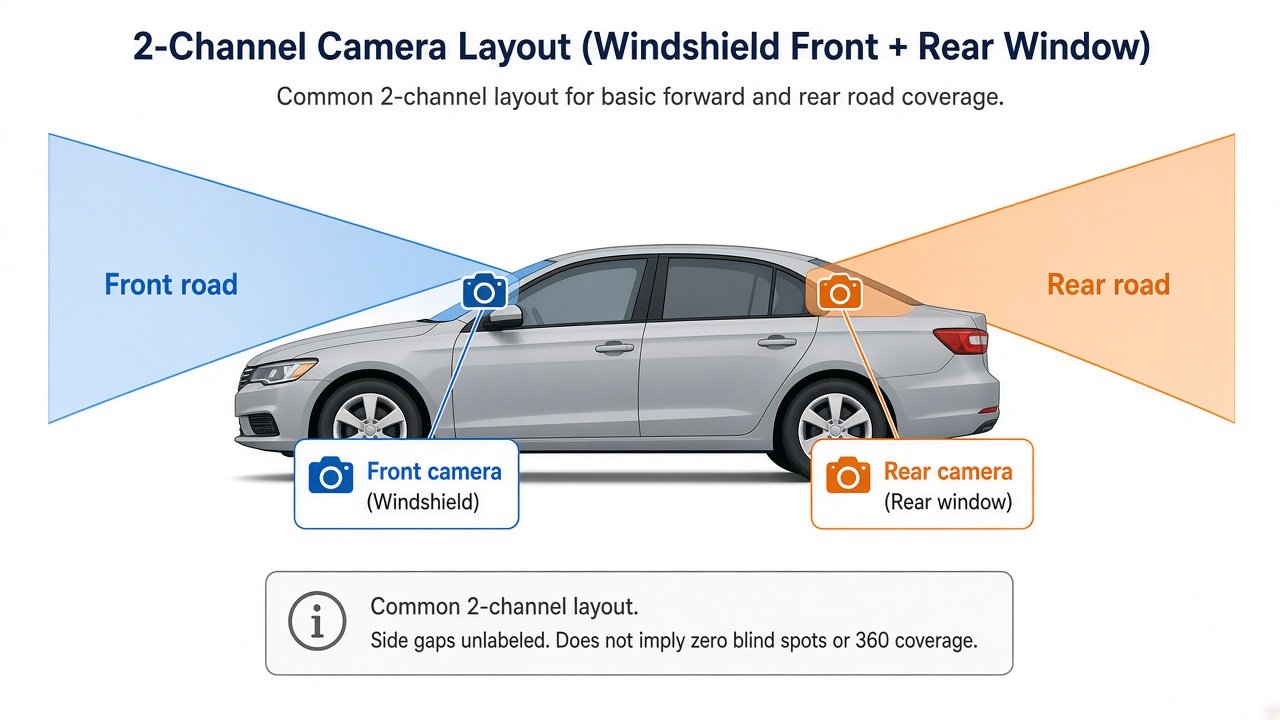
Is a 2-channel dash cam worth it? For many private cars, yes—if you mean the common front-road plus rear-road layout. The front file documents what you drove into. The rear file documents who hit you, a tailgater, or a parking-lot reverse. That two-direction road context is why 2CH is the default “serious” setup without adding cabin privacy issues.
A dual channel dash cam in that common layout does not eliminate blind spots. It adds a second cone of video. Pillars, tint, and a poorly aimed rear camera still leave gaps.
Trade-offs: a long rear cable, a second mount, more files, and usually more storage than 1CH. Installation is not determined by the number “2” alone, but a separate rear camera almost always means headliner or pillar routing. Follow the manufacturer and the vehicle; do not run cables across curtain-airbag paths or block the windshield.
Moon Picke already owns the shopping-list intent on best front and rear dash cam. Concrete 2CH examples already reviewed (named here as configuration illustrations, not a ranking): the VIOFO A329S 2CH kit, Thinkware U3000 PRO, and BlackVue ELITE 10-2CH. Those pages remain product reviews; this page is the configuration map.
See the VIOFO A329S 2CH kit on Amazon →
Who Actually Needs a 3-Channel Dash Cam?
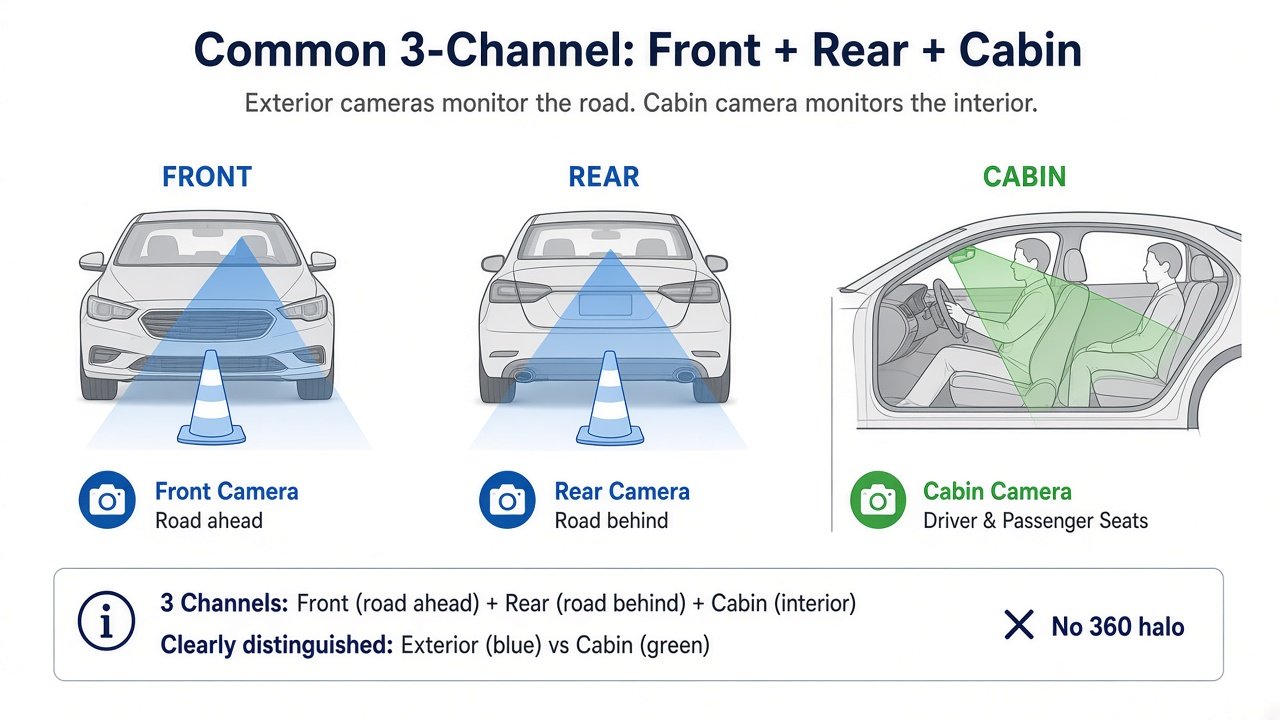
Who needs a 3-channel dash cam? Buyers with a real use for a cabin file: some rideshare or taxi work, passenger disputes, family-seat context, or documenting an event that never appears in a road camera. A common 3-channel layout is front road + rear road + cabin—a front rear cabin dash cam in marketing language. Ordinary private drivers who never want interior video often do not need that third channel.
A 1 channel vs 2 channel vs 3 channel dash cam choice should treat 3CH as a cabin decision first. If the extra lens points inside, you did not buy “more road.” You bought a people-and-interior recorder that happens to sit on the same system. That is useful when a claim, a customer interaction, or a child-seat incident is the gap in your evidence. It is unnecessary hardware if you will disable the cabin camera or cover it with tape.
Do not treat 3CH as mandatory for rideshare. Cabin coverage can help those jobs; broader “best dash cam for rideshare” recommendations belong to a later Moon Picke article. 3CH also raises storage, install, footage review, and privacy load. Audio/video recording and consent rules vary by jurisdiction. This is not legal advice—check local requirements before recording passengers or customers.
Commercial vehicles add another caution: a passenger-car 3CH kit is not automatically the right architecture for a long truck, a high cab, or a cargo box. Length, rear visibility, and operating rules can demand different camera placement than a sedan windshield-and-rear-glass kit. Use a truck-specific buying page for that vehicle class.
Does Adding More Channels Reduce Video Quality?
Does more channels mean lower video quality? Not inherently. Hardware and the selected recording mode decide. Many multi-channel kits advertise a 4K (or 2.7K) front camera while the rear runs 2K or 1080p, or cabin cameras sit at 1080p. Simultaneous modes can also drop frame rate or resolution versus a front-only mode. Check each channel, not the headline front number. That is the same lesson as 4K vs 2K dash cam, applied per feed.
Example, not a roundup: the Vantrue N5S (a 4-channel product) documents 1944P + 1080P + 1080P + 1440P together—the front is not 4K on every lens. A 2CH VIOFO A329S kit similarly should be read as front-plus-rear resolutions from that SKU, not “4K everywhere.” If a spec sheet lists a high-resolution front-only mode and a lower mixed mode, assume driving with all cameras attached uses the mixed mode unless the manufacturer says otherwise.
Frame rate belongs in the same check. A 60fps front-only listing can become 30fps when extra streams are enabled. Buyers who care about night plates still need sensor, bitrate, and lens quality, not only channel count.
How Channel Count Changes Storage Needs
More channels usually mean more total data, because you are writing extra streams. Actual card fill rate still depends on resolution, bitrate, codec, frame rate, and parking/event files. It is not true that 3CH always uses exactly three times a 1CH card. A 1CH 4K stream can outpace a 3CH kit that records mixed 1080p cabin feeds, depending on bitrate. Loop recording still overwrites old normal files; locked events and parking clips behave differently.
Ownership cost follows the same curve. Channel count can raise both upfront hardware price (extra modules) and ongoing friction: a larger microSD card, more time to download clips, and—on connected systems—more cloud or data use if you upload every camera. Buy a card the manufacturer supports, format it in-camera, and plan extra capacity as you add feeds. Moon Picke does not yet have a published SD-card size guide; do not treat generic GB-per-hour charts as universal.
Installation: One Camera vs Three Cameras
1CH: windshield camera and power. 2CH: add rear glass and a long cable. 3CH: add cabin aiming (sometimes a second lens on an existing housing, sometimes a separate camera). The number of physically separate cameras often drives install pain more than the marketing channel count. An integrated cabin lens on the front unit can be less wiring than a third puck on the rear header.
Parking-capable installs typically add a hardwire or OBD live feed. That is a power decision, not a channel-count formula. See dash cam hardwire kit vs OBD cable. Do not guess at fuse taps, unsupported headliner removal, or airbag trim. Use manufacturer instructions, vehicle documentation, and a qualified installer where the route is unclear. Cables across curtain-airbag paths and cameras that block the driver’s view of the road are not acceptable shortcuts.
Parking Mode With Multiple Channels
In parking mode, extra cameras can watch more of the car—if the firmware actually keeps those channels active. Some systems record only the front in a low-bitrate parking mode, or only collision-triggered clips, or only selected lenses. Power, voltage cutoff, battery packs, and G-sensor sensitivity still limit runtime. Channel count does not, by itself, predict how many hours you can park. Verify the exact mode on the product you buy. Category detail lives in best dash cam for parking mode.
Do not assume 3CH drains a battery three times faster. Extra sensors and processors can raise demand; wattage is product-specific and unpublished for a generic comparison. A 1CH camera left in a high-sensitivity motion mode can still empty a battery faster than a well-configured 2CH system with a high cutoff voltage. Parking duration is a power-and-firmware problem first, a channel-count problem second.
Cabin Cameras, Infrared and Privacy
Cabin channels exist to record people and interiors, not license plates down the block. IR LEDs, where a model has them, help a dark cabin; that is not the same as exterior night-road performance. Audio is often a separate toggle. Privacy and consent vary by place. Drivers should review applicable local recording and consent rules, especially when passengers or customers are being recorded. This is not legal advice and is not a claim that any one setup is lawful everywhere.
If you do not want interior video, do not pay for a cabin channel you will tape over. If you do want it, plan where the lens points (driver, rear seats, or both), whether IR glow is acceptable at night, and who can access the files. Cabin coverage is a purpose, not a default upgrade.
What About 4-Channel Dash Cams?
A 4-channel system adds another feed beyond the common 3CH map—often a second cabin angle or an extra exterior view. It is more coverage and more ownership cost (cables, card, review). That extra feed is optional; it is not a required upgrade from 3CH. Moon Picke’s product-specific discussion is the Vantrue N5S review (front road, front cabin, rear cabin, rear road on that SKU). This guide does not become a 1CH vs 2CH vs 3CH vs 4CH keyword page. If you do not have a use for the extra lens, 4CH is unused hardware.
See the Vantrue N5S 4-channel kit (beyond 3CH) on Amazon →
Which Dash Cam Channel Setup Should You Buy?
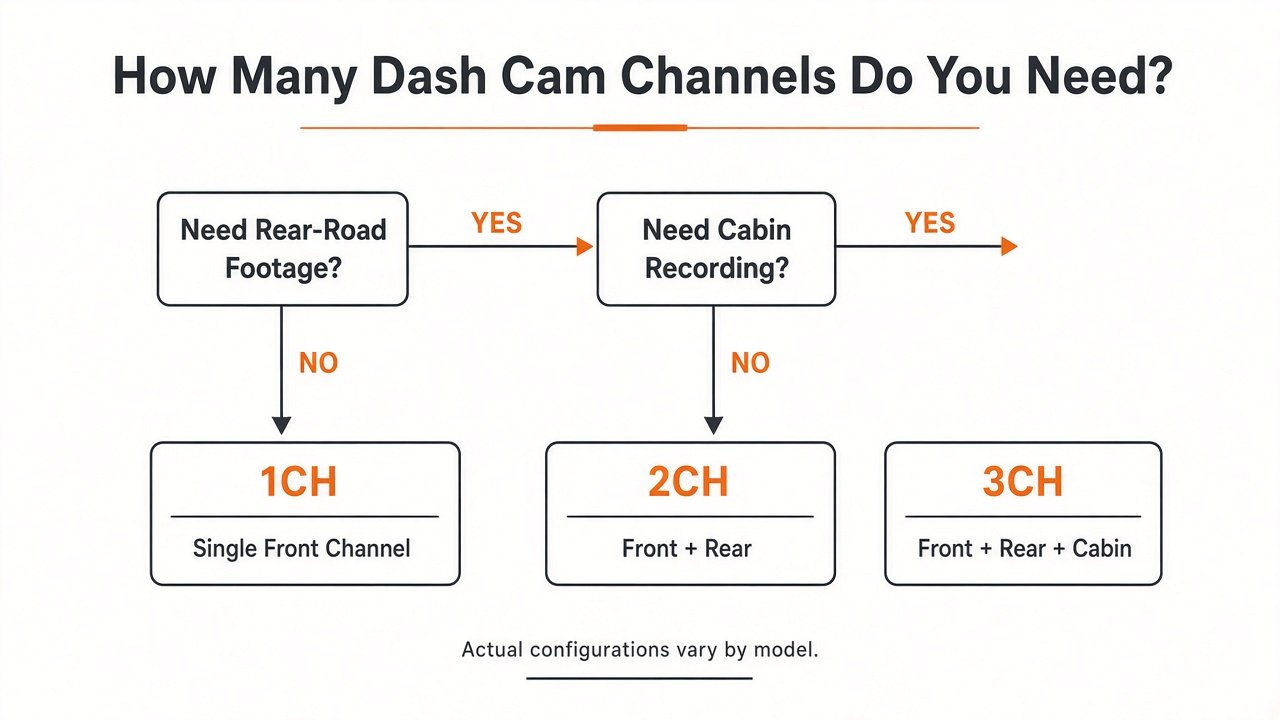
This is the practical close of a 1 channel vs 2 channel vs 3 channel dash cam buyer filter. Match cameras to the areas you need, then accept the install, storage, and privacy load that come with those feeds.
1 channel vs 2 channel dash cam: pick 2CH when rear-road evidence matters and you will route the rear cable. Stay 1CH when front-only is enough and simple install wins.
2 channel vs 3 channel dash cam: add 3CH only when the cabin file has a job. Otherwise you bought privacy complexity and more clips for no extra road coverage.
Choose 1CH if front-only evidence is enough and lowest complexity matters. Choose 2CH for mainstream private-vehicle front + rear road coverage. Choose 3CH if cabin recording is intentional and you accept storage, install, and privacy load. Do not pay for channels that will not record a useful area for your actual use case.
Final Verdict
This 1 channel vs 2 channel vs 3 channel dash cam comparison is a configuration filter. A single channel dash cam is the simplest front-road tool. A dual channel dash cam is the usual road-coverage upgrade when the second camera actually faces the rear. A 3 channel dash cam is a cabin decision first. Match cameras to the incident types you care about, then check resolution per channel, parking power, and how you will retrieve files. More channels are not automatically better.
FAQ
What is a 1-channel dash cam?
One recorded feed, typically the road ahead. No rear or cabin file unless the product is a non-typical 1CH layout—verify the SKU.
What does 2-channel mean on a dash cam?
Two feeds. Commonly front road and rear road, but some kits use front plus cabin. Check positions.
What does a 3-channel dash cam record?
Three feeds. Commonly front, rear, and cabin. Not “everything,” and not a 360-degree sphere.
Is a 2-channel dash cam worth it?
Often, for private cars that want rear-impact context and will install the rear cable.
Is 3-channel better than 2-channel?
Only if you need the cabin channel. Otherwise 3CH is extra cost and complexity.
Do 3-channel dash cams use more storage?
They tend to, because extra streams write more data. It is not a fixed 3× multiplier.
Do I need a cabin camera?
Only if interior events matter to you and local recording rules are acceptable.