

Choose InterServer if you want a short commitment and email that stays inside the hosting bill. Choose Hostinger if you will prepay 48 months and you want to pick a server location. On 7 October 2026, InterServer Standard was $2.50 for the first month and $7 a month after that. Hostinger’s Premium card showed $2.99 a month only as the monthly equivalent of $143.52 paid up front for 48 months, then a printed renewal of $10.99 a month. Those are not the same kind of price. The cheaper host to start is InterServer. The cheaper host on the long introductory prepay is Hostinger. The cheaper printed renewal rate is InterServer.
Moon Picke may earn a commission if you use the InterServer link in this article. There is no Hostinger affiliate link on this page. The official Hostinger pages below are the company’s own pages, not paid placements. The method is the one on how we evaluate products. The commission terms are on the affiliate disclosure.
See InterServer’s current plans
InterServer vs Hostinger at a glance
The plans in this table are the closest mainstream web-hosting offers for a small US site, not every product each company sells. InterServer’s offer is one Standard plan. Hostinger’s closest everyday plan is Premium. They are not a perfect pair: Standard markets unlimited websites, and Premium allows three.
| Item | InterServer Standard | Hostinger Premium |
|---|---|---|
| Best for | A short commitment and ongoing email | A 48-month prepay and a location choice |
| Price shown first | $2.50 first month | $2.99/mo equivalent |
| What you actually pay to get that rate | $2.50 for month one, then $7/mo | $143.52 up front for 48 months |
| Printed renewal | $7/mo on the monthly plan; $84 after a $30 first year | $10.99/mo on the 48-month Premium card |
| Websites | Marketed as unlimited, with resource caps | 3 |
| Storage | Marketed as unlimited; 400,000 inodes; 2 GB memory | 20 GB SSD; 400,000 inodes; 2 GB memory |
| Unlimited accounts, 200 per hour | 2 mailboxes per site, free for 1 year | |
| Domain | $7.99 with a hosting purchase | Free for 1 year on a term of 12 months or longer |
| Backups | Weekly | Weekly |
| Panel | DirectAdmin | hPanel |
| Pick a data center | Not on the Standard page | Yes, during setup, plan permitting |
| Refund | 30 days on this package | 30 days on eligible hosting |
Checked 7 October 2026 on InterServer’s Standard Web Hosting page and terms, and on Hostinger’s US web-hosting page, refund policy, and plan-limits article. A later cart can differ. Hostinger also sells an Unlimited plan and a Cloud Startup plan. Those are noted where the three-site cap on Premium would make the comparison unfair.
Which plans are actually comparable
InterServer’s public web-hosting page leads with one product: Standard Web Hosting, on DirectAdmin, for sites, stores, blogs, and email. cPanel hosting, Windows hosting, reseller hosting, and Cloud VPS are other products. This comparison uses Standard, because that is the plan a typical small-site buyer sees first. It does not use the VPS line. A VPS decision is a different purchase, with different refund rules.
Hostinger’s web-hosting page, the same day, led with three cards on a 48-month term: Premium, Unlimited, and Cloud Startup. Premium is described as the plan for creators and small brands, with three websites, 20 GB of SSD, and weekly backups. Unlimited raises the site count, storage, backup frequency, and mailbox allowance, and it costs more. Cloud Startup is a higher cloud tier, not the fair match for InterServer Standard.
Premium is the fairest primary comparison because both are the entry shared plans each company points at an ordinary website. The mismatch is real. Standard does not cap the site count at three in its marketing, and Premium does. If you need more than three sites, the Hostinger card to read is Unlimited, at $191.52 for 48 months and a printed renewal of $16.99 a month, not Premium. This article does not pretend those two Hostinger cards are the same plan.
Starting price and the commitment behind it
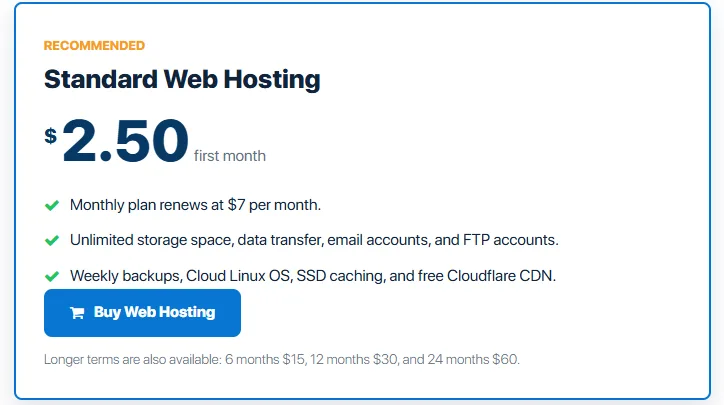
InterServer prints four terms on the Standard page. One month is $2.50, then $7 a month. Six months is $15, then $42. Twelve months is $30, then $84. Twenty-four months is $60, then $168. You can start with a single month. The $2.50 figure is the first month, not the rate you keep.
Hostinger’s Premium card does not offer $2.99 as an ordinary monthly bill. The line under the price says to get 48 months for $143.52, against a regular price of $575.52, and that the plan renews at $10.99 a month. Hostinger also says every plan is paid up front, and that the monthly rate is the total divided by the number of months. The FAQ says a monthly term exists at checkout. That page did not print the one-month, 12-month, or 24-month dollar totals. This comparison does not invent them. If you need a one-year Hostinger invoice, read the cart. The only Premium total verified here is $143.52 for 48 months.
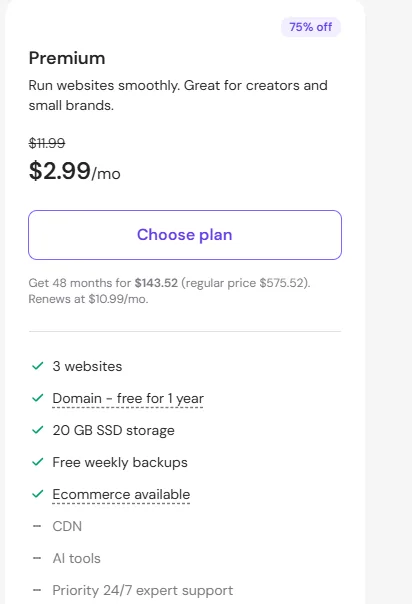
Cash due on day one, using only printed totals: InterServer can be $2.50, or $30 if you choose the 12-month term. Hostinger’s advertised Premium deal asks for $143.52. InterServer is the cheaper way to start. Hostinger’s $2.99 is a lower monthly equivalent only after you accept a four-year prepay.
A domain changes the first bill and is not inside either hosting total above. InterServer lists domain registration or transfer at $7.99 with any web-hosting package. Hostinger includes a domain free for one year on hosting plans other than Single, when the term is one year or longer. The 48-month Premium term qualifies for that first-year domain. It is not a domain you keep free after year one.
Renewal and a three-year bill
InterServer’s monthly plan renews at $7. A year of monthly billing after the opening month is 11 times $7, so the first 12 months cost $79.50 before tax and a domain. The 12-month term is cheaper if you already know you will stay: $30 in year one. Year two on that term is the printed $84 renewal. Year three is another $84. Hosting only, 36 months, on the annual path: $30 + $84 + $84 = $198. On the monthly path the same 36 months are $79.50 plus 24 months at $7, which is $247.50.
A feature table on InterServer’s details page still says “Price Lock Guarantee.” The pricing block does not lock $2.50 or $30. Budget the renewal line. Older reviews that treat the intro rate as permanent do not match the page checked on 7 October 2026.
Hostinger Premium’s card says the 48-month offer renews at $10.99 a month. Hostinger’s billing article says web-hosting renewal periods can be 1, 12, 24, or 48 months, and that the quote in Billing is the one that applies. Multiplying $10.99 by 36 and calling it your invoice would invent a term the card does not lock. What is safe to say: the printed renewal equivalent is $10.99 a month, which is higher than InterServer’s $7. If a later 48-month renewal were billed at that printed rate, 48 times $10.99 is $527.52. Treat that as arithmetic on the printed rate, not as a quote Hostinger issued for your account.
Put the long intro next to that renewal. Hostinger Premium’s first 48 months cost $143.52 at the published promo. InterServer does not sell a 48-month Standard term. The longest printed term is 24 months at $60, renewing at $168. Two of those cycles, intro then renewal, are $228 for 48 months. On that comparison the Hostinger intro is the smaller check, and it still has to be paid at once. After the intro, InterServer’s $7 monthly renewal is the lower printed rate.
A strict 36-month stay is awkward because Hostinger’s verified promo is 48 months. If you buy that promo, you pay $143.52 even if you only wanted three years, and the 30-day refund will have closed long before month 36. InterServer’s annual path for exactly 36 months is $198, paid as $30 and then two $84 renewals. Hostinger costs less cash up front for a longer term. InterServer costs less if you might leave after a year, and its renewal rate is the lower of the two printed monthly renewals.
Email is the cost most comparisons skip. InterServer includes mailbox creation on Standard, with a 200-email-per-hour cap. Hostinger Premium includes two mailboxes per website for a one-year Business Email trial. Hostinger’s trial article says that if a payment method is on file, those mailboxes renew as a paid Business Starter plan. Starter, on Hostinger’s email page the same day, is $0.39 per mailbox per month on a 48-month term, $18.72 per mailbox up front, renewing at $1.59 per mailbox per month for 48 months. Two mailboxes at the intro rate are about $37.44 for that email term. That email bill is not inside the $143.52 hosting total. Do not add it to year one of a 48-month hosting plan, because the trial covers the first year. Do add it, or an unknown cart price, after the trial if you want the mailboxes to continue.
Check InterServer’s current pricing
Hostinger’s own prices are on Hostinger’s web hosting page. That link is not an affiliate link.
Resources, including the word unlimited
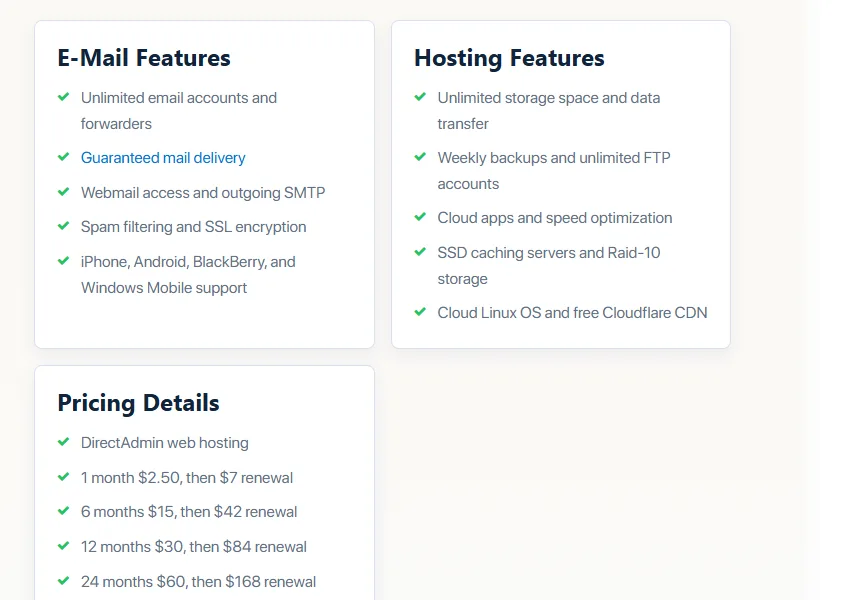
InterServer’s Standard marketing says unlimited storage, transfer, email, FTP, and websites. The terms limit a shared account to 20 percent of the server’s resources and to 400,000 inodes, and they allow a $0.15 per GB storage fee when InterServer decides usage is unreasonable. The Boost comparison page lists the Standard baseline as 1 CPU core, 2 GB of memory, 1,024 IOPS, 100 processes, 30 entry processes, and 200 emails per hour. The same terms bar some uses on shared hosting, including file archives, mirrors, and upload sites. “Unlimited” here means the meter is not a fixed gigabyte cap for a normal site. It does not mean infinite hardware.
Hostinger Premium, on the plan-limits article, is 3 websites, 1 CPU core, 2 GB of memory, 20 GB of disk, and 400,000 inodes. The marketing card calls the disk 20 GB SSD and lists weekly backups. The Unlimited card is the one that drops the three-site cap: the limits article lists 2 CPU cores, 3 GB of memory, 50 GB of disk, and 600,000 inodes, and the card calls that disk 50 GB NVMe with daily backups. Hostinger says unlimited features are subject to a fair-use policy. The web-hosting FAQ also describes bandwidth on these plans as unmetered. Unmetered is a policy word, not a promise of unlimited network hardware.
On CPU and memory, Standard and Premium are the same published shape: one core and 2 GB. Premium states a 20 GB disk. Standard does not state a gigabyte cap and does state an inode cap and a possible per-gigabyte fee. A small WordPress site fits either description. A media library that will pass 20 GB fits the Standard wording better, until it hits inodes or the unreasonable-use fee. More than three sites fits Standard’s marketing or Hostinger Unlimited, not Premium.
Neither company is offering you a private server at these prices. If the site needs isolated resources, that is a VPS or cloud plan, and the prices in this table stop applying. A general look at that choice is in dedicated server versus VPS.
WordPress
Both plans can run WordPress. InterServer’s details table lists an easy WordPress installer, automatic updates, weekly backups, and the use of any plugin, on DirectAdmin, with phpMyAdmin and SSL. Staging is not documented on that Standard table. LiteSpeed, CloudLinux, and SSD caching are platform claims, not a speed score.
Hostinger’s web-hosting FAQ says the plans include a one-click WordPress install, and it points WordPress buyers at managed WordPress hosting for LiteSpeed, object cache, and automated updates. The shared Premium card itself lists WordPress, a CDN, and weekly backups. hPanel is also described as including WP-CLI, PHP version control, and Git. This article did not find a staging feature printed on the Premium card. Do not assume Premium includes every tool on a separate managed-WordPress product.
There is no performance winner. Moon Picke did not measure TTFB, uptime, or a WordPress benchmark on either host. InterServer states a 99.9 percent uptime guarantee. Hostinger’s page argues for faster pages from NVMe, LiteSpeed, a CDN, and object cache, while the Premium card specifies SSD rather than NVMe. Those are the companies’ claims. They are not a test.
Data centers
Hostinger’s FAQ says you choose a server location during setup, and that the list can vary by plan. The same help center lists web, cloud, and managed WordPress locations as the United States, the United Kingdom, Brazil, France, Germany, Lithuania, the Netherlands, India, and Indonesia. A US option is on that list. So are regions outside the United States. Choosing a city is not proof that the site will be faster. It is proof you can place the account nearer the audience.
InterServer’s homepage names US locations in the New York City area, Dallas, and Los Angeles. Its VPS pages describe a choice between Los Angeles and Secaucus, New Jersey. The Standard web-hosting page does not offer that picker. A US-focused site can live on either company. A site with visitors in several countries has a documented location list on Hostinger that Standard does not publish. That is a location advantage for Hostinger. It is not a measured speed advantage.
Panel and day-to-day work
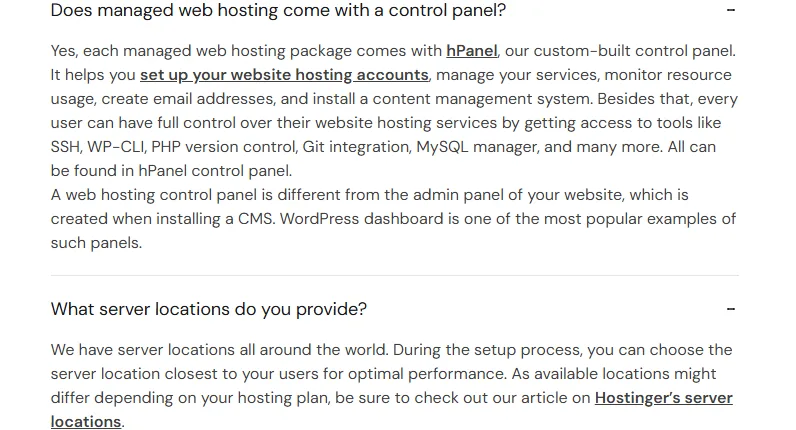
InterServer Standard uses DirectAdmin for sites, mail, databases, DNS, FTP, and SSL. Hostinger uses hPanel, which its FAQ describes as the place to install a CMS, create email, watch resource use, and reach SSH, WP-CLI, PHP versions, and Git. Hostinger also sells a website builder and an AI agent on these plans. InterServer lists a website builder elsewhere in its menu and one-click apps on the hosting page. Moon Picke did not operate either dashboard for this article, so this is not a design review. The documented difference is the panel name and the fact that Hostinger’s own pages frame hPanel as a beginner tool, while DirectAdmin is a traditional hosting panel many WordPress tutorials do not use.
InterServer includes unlimited email accounts and forwarders on Standard, webmail, spam filtering, and outgoing SMTP, with the 200-per-hour limit from the resource table. That inclusion is part of the hosting plan, not a one-year trial.
Hostinger Premium includes two mailboxes per website, free for one year. The trial limits article caps that free year at 1 GB per mailbox and 100 messages a day. When the trial ends, mail continues only if you move to a paid email plan. With a card on file, Hostinger says the mailboxes renew as Business Starter. Starter’s published 48-month price is $0.39 per mailbox per month, renewing at $1.59. The Unlimited hosting card says unlimited mailboxes free for one year. The limits article’s mailbox row for that plan says five per website. Those two Hostinger pages disagree. If mailbox count matters, confirm it in the cart. Either way, the free period is a trial, not a permanent bundle.
For a site that will send ordinary mail for more than a year, InterServer’s included mail is the clearer offer. For a site that only needs two mailboxes during year one, Hostinger’s trial covers that window and then becomes a separate bill.
Domains
Hostinger’s free domain lasts one year and applies when the hosting term is at least one year, except on the Single plan. The FAQ says a refund of a plan that included a free domain may deduct the domain’s cost. New .com and .net registrations are described as refundable within 96 hours. Many country-code extensions are excluded from refunds. Domain privacy is listed on the hosting page. The renewal price of the domain after the free year was not on the hosting card.
InterServer’s $7.99 domain price is a promotional registration or transfer with hosting. The terms say that promotional domain price can change at the annual renewal, and that leaving InterServer means paying the yearly fee listed on the site. The domain is not free, and it is not guaranteed at $7.99 in year two.
A first-year domain is cheaper at Hostinger, at $0, if you take a term of 12 months or more. It is not cheaper forever. InterServer is the one that prints a dollar figure for the first year, $7.99, with a warning that renewal can move.
Backups and security
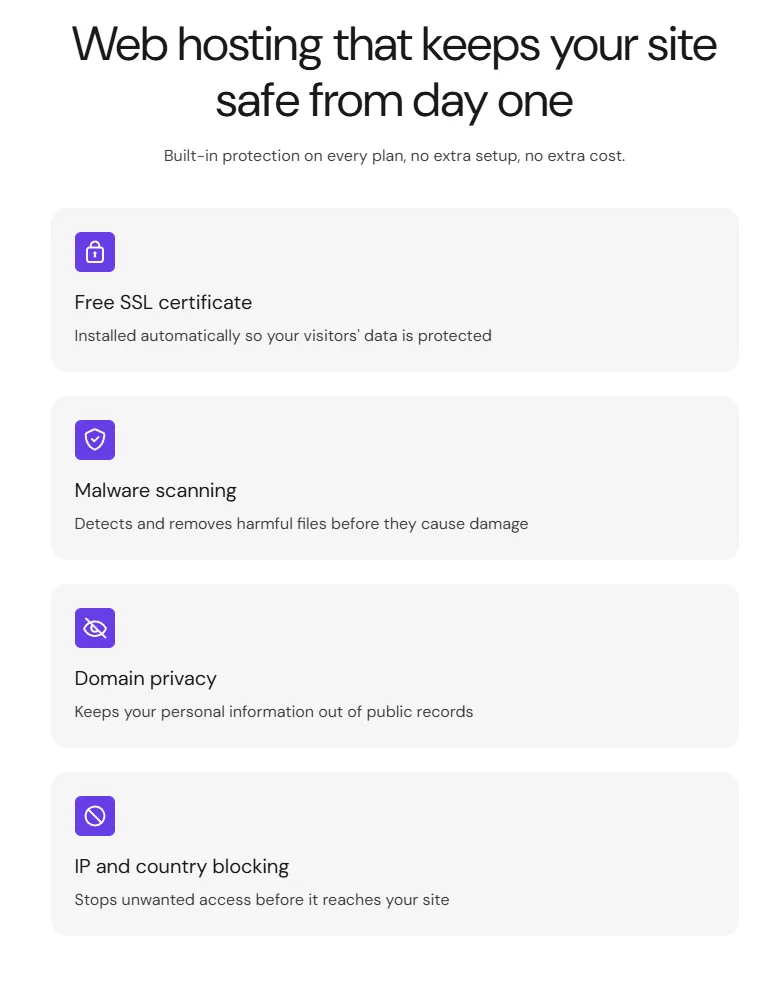
Both Standard and Premium list weekly backups. Hostinger Unlimited and Cloud Startup list daily backups, and Cloud Startup adds on-demand backups. Weekly is not a retention promise and not a substitute for your own copy. InterServer’s terms say the customer is responsible for backups and that InterServer is not responsible for deleted files. Hostinger’s marketing describes malware scanning that detects and removes harmful files, a free SSL, domain privacy, and IP and country blocking. InterServer lists free SSL, InterShield, spam filtering, a Cloudflare CDN, and a cleanup offer it calls Inter-Insurance. Neither description is a disaster-recovery guarantee. DDoS protection is mentioned on InterServer’s homepage as a network path and is not given a shared-hosting specification here. No security winner is awarded beyond those documented lists.
Migration
InterServer’s migration page says a move is free and can include the site, databases, email, and custom setup, requested by chat, phone, or ticket. Hostinger’s hosting page says unlimited free migrations with the site staying online, started from hPanel after you buy a plan, and the FAQ says a non-WordPress site can still be guided by support. Hostinger’s help center says a migration often takes up to 48 hours. Both companies call the move free. Neither claim is a timed result from Moon Picke. On documented scope, this category is a tie.
Support
InterServer offers a 24/7 technical support department, with a stated goal of a reply in one to three hours and an explicit note that the speed is not guaranteed. Billing, sales, and development do not run 24/7. The details page prints the phone number (877) NJ-COLO-1, and the migration page also lists chat and tickets.
Hostinger’s web-hosting FAQ says support is multilingual and 24/7, and it tells you to use live chat, plus tutorials. The Premium card says “priority 24/7 expert support.” This research did not find a Hostinger phone line for shared hosting on those pages. Availability is documented on both sides. Quality is not. There is no support-quality winner, because no ticket was opened and no reply was timed.
Refunds
InterServer’s terms refund web hosting in the packages Standard, Windows, Boost2/4/X, and WordPress if you ask within 30 days of signup, for the full amount paid. After that you can cancel future charges and you forfeit what you already paid. VPS is outside that window.
Hostinger’s refund policy allows a refund of hosting plans within 30 days of the transaction, with stated exceptions that include the first payment after a free trial, and a separate narrower rule for VPS. The policy also says some products are not refundable, including many domain registrations and domain renewals. The FAQ adds that a free domain’s cost may be deducted. Paying Hostinger $143.52 does not mean that sum is refundable on day 45. The window is 30 days from the transaction, including, under the policy’s definition, a renewal transaction for eligible products.
The refund length is the same. The risk is not. A 48-month Hostinger prepay puts much more money inside that 30-day window than InterServer’s $2.50 or $30.
Which host fits which buyer
For a US-focused site, InterServer is a US company with US facilities and no Standard location picker. Hostinger lists a US location and lets you choose among a longer list. If the audience is entirely in the United States and you do not care which US city, either plan is a reasonable home. If you want the account in a named region, Hostinger is the one that documents the choice.
For a global audience, Hostinger’s location list is the practical difference. That does not prove lower latency. It does give you a control Standard’s page does not.
For a beginner, Hostinger’s pages are written around hPanel, a builder, and chat. InterServer expects DirectAdmin. If your tutorials are cPanel screenshots, neither panel is cPanel. Hostinger is the clearer beginner path on the documentation each company publishes. That is not a claim that Moon Picke clicked through both interfaces.
For a small business that needs mailboxes next year, InterServer is the simpler bill. For a small business that will prepay four years, wants three sites or fewer, and will pay for email after the trial, Hostinger Premium’s $143.52 intro is the smaller hosting check than staying on InterServer for 48 months at the rates above.
Choose InterServer
- You want to pay monthly, or $30 for the first year, instead of $143.52.
- You want the lower printed renewal, $7 a month or $84 a year.
- You want mailboxes included after year one.
- You may have more than three sites and you accept the inode and resource caps.
- You want a phone number on the support page.
Choose Hostinger
- You will use the 48-month Premium term and you have compared $143.52 with InterServer’s longer-term totals.
- You want to choose a server location, including a US location or a location outside the United States.
- Three websites, 20 GB, and weekly backups are enough, or you step up to Unlimited on purpose.
- A one-year email trial is enough, and you have priced Business Starter for year two.
FAQ
Is InterServer better than Hostinger?
InterServer is the better fit when the decision is a short commitment, a $7 renewal, and email that stays in the hosting plan. Hostinger is the better fit when you will prepay $143.52 for 48 months of Premium and you want a data-center choice. Neither is better on measured speed, because this article does not contain a speed test.
Is Hostinger cheaper than InterServer?
Hostinger’s $2.99 Premium price is cheaper per month only as the equivalent of a 48-month prepay of $143.52. InterServer is cheaper to start, at $2.50 for one month or $30 for 12 months. After the intro, InterServer’s printed monthly renewal is $7 and Hostinger Premium’s printed renewal is $10.99.
Which renewal is lower?
InterServer Standard. The monthly plan renews at $7, and the 12-month plan renews at $84. Hostinger Premium’s 48-month card says it renews at $10.99 a month. Confirm the renewal term in the Hostinger billing screen, because 1, 12, 24, and 48 months are all described as possible cycles.
Which is better for WordPress?
Both install WordPress. Hostinger documents hPanel, a one-click install, and points to LiteSpeed and object cache on its WordPress hosting. InterServer documents an installer, automatic updates, and DirectAdmin. No staging feature was verified on either shared card. No speed winner is awarded.
Which is better for a US website?
Both can host a US audience. Hostinger lets you choose a location and lists the United States. InterServer runs US facilities and does not show a location picker on Standard. Choose Hostinger if the city matters. Either is reasonable if it does not.
Which asks for the longer commitment?
Hostinger’s advertised Premium price requires 48 months paid up front. InterServer publishes a one-month term. A monthly Hostinger term exists, according to Hostinger, and its price was not printed on the page checked here.
Which has better email?
InterServer includes mailboxes with the hosting plan, capped at 200 messages an hour. Hostinger Premium includes two mailboxes per site for one year, at 1 GB and 100 messages a day during the trial, then a paid Business Starter plan if you keep them. Included ongoing mail favors InterServer.
Which should I choose?
Choose InterServer for a small US site you might keep month to month, with email included and a $7 renewal. Choose Hostinger Premium if you are ready to pay $143.52 now, you want a server-location list, and three sites are enough. Move to Hostinger Unlimited only if you need more than three sites and you accept $191.52 for 48 months and a $16.99 renewal.
Final verdict
InterServer Standard is the better default for a US buyer who wants ordinary web hosting without a four-year prepay. The first month is $2.50, the monthly renewal is $7, a first year paid annually is $30, and email stays on the plan. Hostinger Premium is the better buy when the 48-month promo is the term you actually want: $143.52 up front, a free domain for the first year, a location picker, and a printed renewal of $10.99 a month that you should read in the billing screen before you assume the next invoice. Do not choose Hostinger because $2.99 looks lower than $7. That $2.99 is not a monthly bill.
There is no technical winner on speed. The product edge splits. Hostinger has the broader location list and the beginner-oriented panel. InterServer has the lower commitment, the lower printed renewal, and the mailboxes that are not a one-year trial.