
The best SalesCrunch CRM alternatives are not “seven CRMs that beat SalesCrunch.” They are tools that close a specific gap: a free CRM entry point, a larger app marketplace, a visual multi-pipeline board, a Zoho-style business suite, or built-in calling. SalesCrunchCRM remains a valid $30-per-user sales CRM with a 14-day trial and no free plan. Moon Picke did not migrate live pipelines into these products. Facts below are from current official pages on 19 September 2026.

Best SalesCrunch CRM Alternatives: Quick Picks
Moon Picke may earn a commission if you purchase through some links on this page, at no additional cost to you. Read the affiliate disclosure.
If you still want one published seat price, an ACT!-style contact card, and included Crunchy AI (150 messages/month), stay with SalesCrunch. If you need a lasting free CRM, start with HubSpot’s documented two-user free tier. If you need a deal board with marketplace apps, look at Pipedrive. If you want CRM plus a wider Zoho stack, look at Zoho CRM. If reps live on the phone, look at Close. If you want a lighter SMB CRM with a real free plan, look at Capsule. See how we evaluate software.
| CRM | Best For | Starting Price | Free Plan | Automation | Integrations | Main Trade-Off |
|---|---|---|---|---|---|---|
| SalesCrunchCRM | Focused ACT!-style sales CRM | $30/user/month after trial | No | Alarms, recurring tasks, Crunchy drafts | Gmail; import; no public Zapier directory found | Narrow ecosystem; mobile apps not listed |
| HubSpot CRM | Free CRM ecosystem | $0 Free (2 users); Sales Hub Starter $7/seat/mo billed annually or $20 monthly | Yes | Limited on Free; sequences need Sales Hub Pro/Ent + Sales Seat | App marketplace (2,000+ apps documented) | Needed sales depth often means paid seats |
| Pipedrive | Visual pipeline | Lite US$14/seat/mo billed annually | No (14-day trial) | Plan-gated; sequences on Premium in current plan docs | Marketplace 500+ tools; API/webhooks on higher plans | Add-ons and higher tiers change cost |
| Zoho CRM | Business suite | Free for 3 users; Standard US$14/user/mo billed annually | Yes (3 users) | Workflows on paid editions; Zia AI is edition-gated | Zoho apps + marketplace; API credits by edition | Edition choice is the real cost |
| Close | Calling / engagement | Solo $9/user/mo billed annually or $19 monthly | No (14-day trial) | Workflows from Growth; calling/SMS usage extra | Native calling/SMS/email; other apps via documented integrations | Seat + usage + AI credits |
| Capsule CRM | Simple SMB CRM | Free (2 users); Starter US$18/user/mo billed annually | Yes (250 contacts) | Workflow automations from Growth (US$36 billed annually) | 60+ listed; Zapier for more | Contact ceilings force upgrades |
Why Look for a SalesCrunch CRM Alternative?
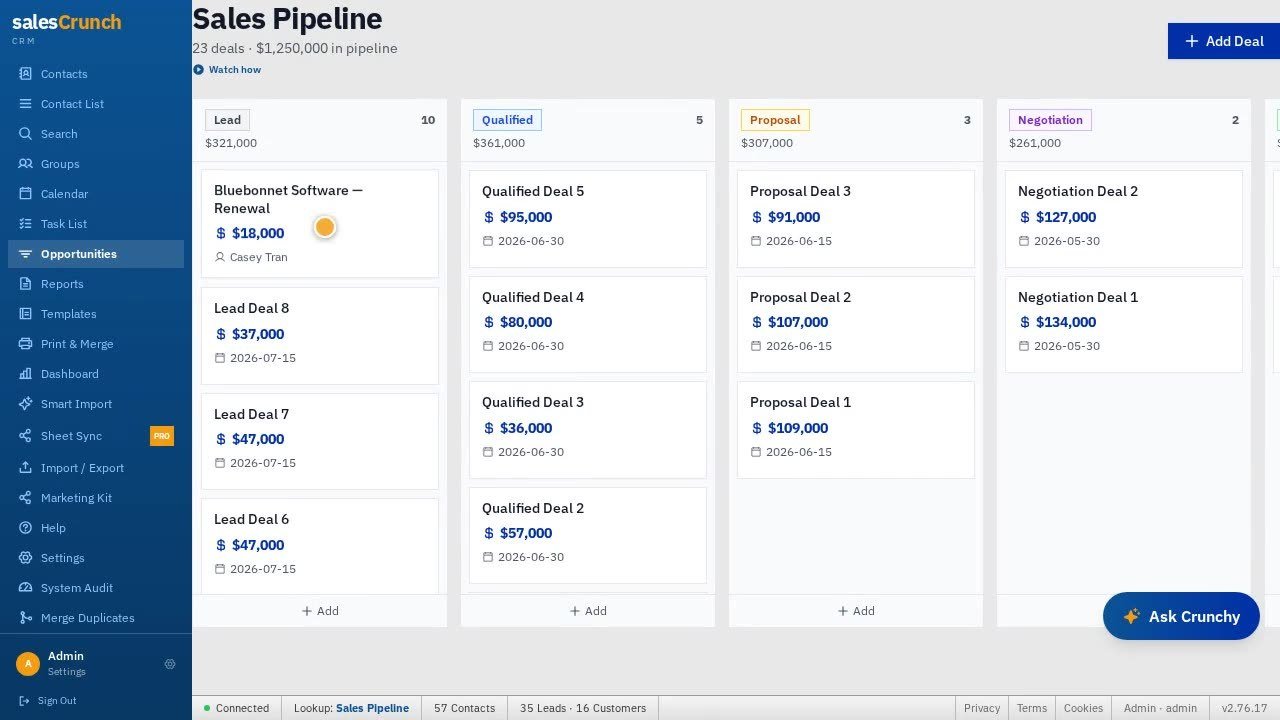
Current SalesCrunch pages support a few honest switch reasons — not invented “missing essentials.” The product is one plan at $30/user/month after a 14-day trial, with opportunities on a Kanban pipeline, Gmail and mail-merge, Crunchy on Claude Sonnet 4.5 (150 messages/month), and up to 250,000 contacts. Public marketing does not list native iOS/Android stores, a Zapier directory, HubSpot-style sequences, or a forever-free CRM. Buyers who need those published capabilities are shopping SalesCrunch CRM alternatives for a gap, not because SalesCrunch failed a lab test.
Moon Picke’s SalesCrunch CRM review owns the single-product walkthrough. This page owns multi-product fit. HubSpot is summarized only as a free-CRM ecosystem option; plan gates belong on HubSpot’s CRM and Sales Hub pricing pages, not a second full HubSpot essay.
Should You Actually Replace SalesCrunch?
Keep SalesCrunch if you want one seat price, cancel-anytime monthly billing, an ACT!-familiar contact card, Boolean lookup, and an included assistant cap. Leave only when a documented need is unmet: a free two- or three-user CRM, extra pipelines as a published cap, sequences, a marketplace of native apps, phone/SMS inside the CRM, or a mobile store listing. CSV export is not a full-fidelity move — associations, automation, and activity history often do not travel cleanly. See editorial standards.
Should I switch away from SalesCrunch? Only if a current published capability you need is missing. A focused CRM is not automatically weaker. A larger ecosystem is not automatically a better sales desk.
How We Chose These SalesCrunch CRM Alternatives
These SalesCrunch CRM alternatives were chosen from official product, pricing, and help pages — not a bake-off. Each finalist has a distinct buyer role. We checked pipelines, automation versus sequences, email versus marketing, reporting versus forecasting, native vs marketplace vs Zapier vs API, mobile listings, and free plan versus trial. Affiliate availability did not pick the list. More on process: about Moon Picke.
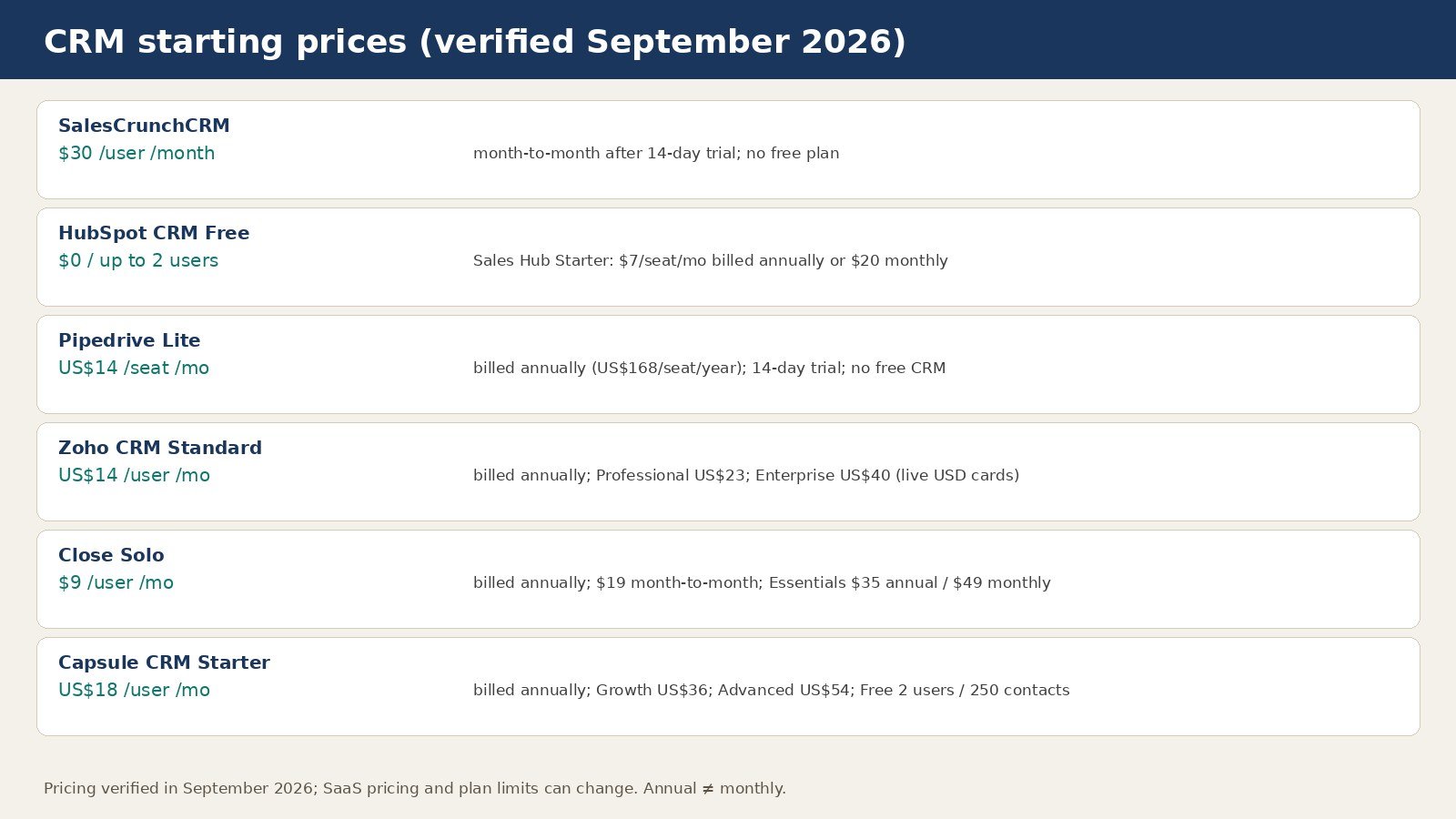
Pricing verified in September 2026; SaaS pricing and plan limits can change.
HubSpot CRM — Best for a Free CRM Ecosystem
HubSpot is a SalesCrunch alternative when you want a lasting free CRM and a path into Sales Hub — not when you only need one ACT! card. Free Tools document up to two users and 1,000 contacts on HubSpot’s CRM FAQ. Deals exist on Free; extra pipelines are catalog-capped at 2 / 15 / 100 on Sales Hub Starter / Professional / Enterprise. Sequences require Professional or Enterprise plus a Sales Seat. Custom reports and Forecasting sit on higher editions. Breeze Assistant appears on Free; paid credits are usage-limited (extra catalog credits at $0.010). iOS and Android are documented. $0 is the start; seats are the later bill. SalesCrunch may still be simpler at one $30 seat. Skip HubSpot Free if you assume Professional sequences are included. Explore HubSpot CRM
Pipedrive — Best for Visual Pipeline Management
Pipedrive’s current plans are Lite, Growth, Premium, and Ultimate. The official U.S. pricing page (pipedrive.com/en/pricing, 19 September 2026) lists Lite at US$14 per seat per month billed annually (US$168 per seat/year), then Growth US$39, Premium US$59, Ultimate US$79, also billed annually. A headless capture of that URL was Cloudflare-blocked; prices below follow the live page text, not a blocked screenshot. Monthly billing costs more; do not compare Lite’s annual rate to SalesCrunch’s month-to-month $30 unlabeled. There is a 14-day trial and no forever-free CRM. Customizable pipelines appear across new plans. Automations and sequences are plan-gated (sequences listed on Premium in Pipedrive’s September 2026 plan mapping). Campaigns is a separate add-on. Marketplace copy cites 500+ tools; iOS and Android apps are documented. SalesCrunch may still fit if you want one price without add-on shopping. Skip Pipedrive if you need a $0 CRM. See current Pipedrive plans
Zoho CRM — Best for an Integrated Business Suite
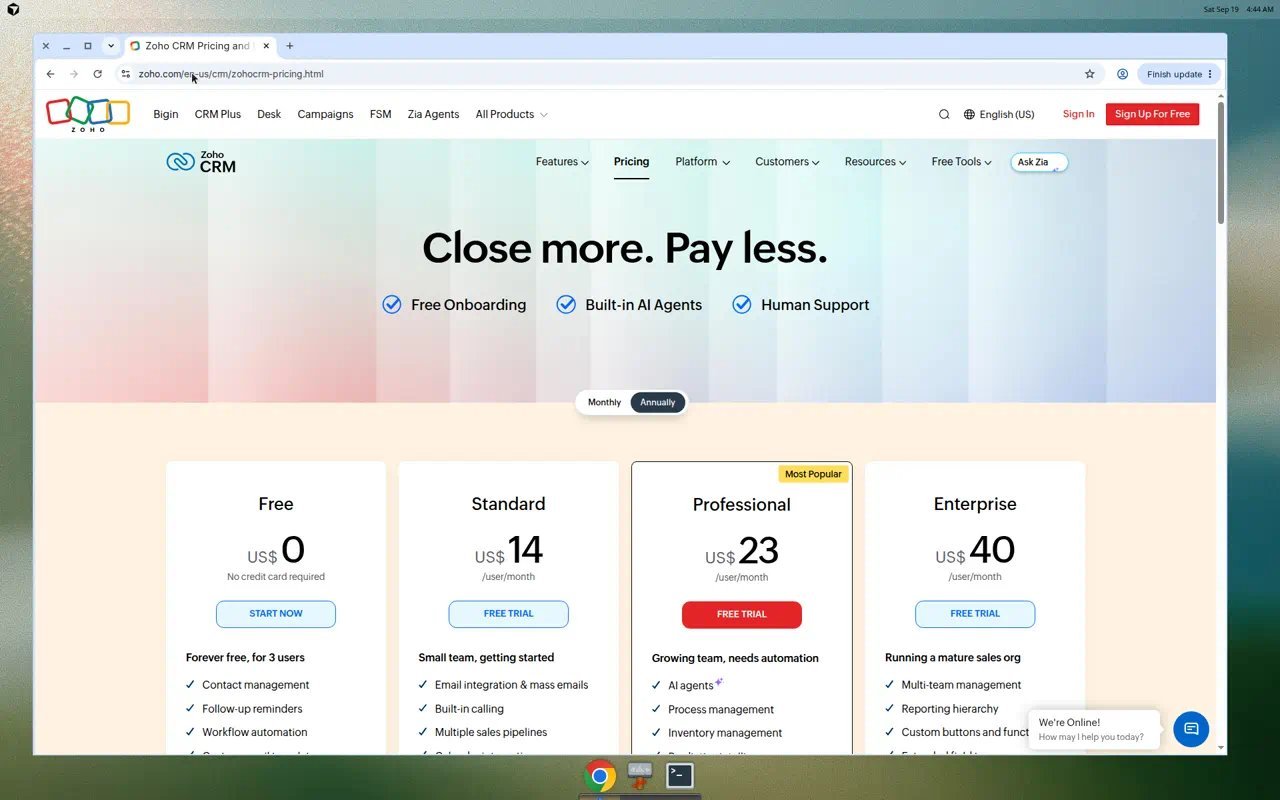
Zoho CRM is the alternative when the goal is CRM inside a broader Zoho stack, not a clone of SalesCrunch’s contact card. The official U.S. pricing page documents Free for three users, then Standard, Professional, Enterprise, and Ultimate, with monthly versus annual toggles. Current USD cards on 19 September 2026 show Standard at US$14, Professional at US$23, Enterprise at US$40 per user per month with the Annually toggle selected. Free includes contacts, limited workflows, 10 email templates, standard reports, API credits, and mobile apps — not the full paid edition. Multiple pipelines, mass email, forecasting, and inventory arrive by edition. Zia is edition-gated, not a Free entitlement. HIPAA language on paid copy is vendor documentation, not a Moon Picke audit. SalesCrunch may still be simpler on day one. Skip Zoho if you only wanted HubSpot’s marketplace shape.
Close — Best for Calling and Sales Engagement
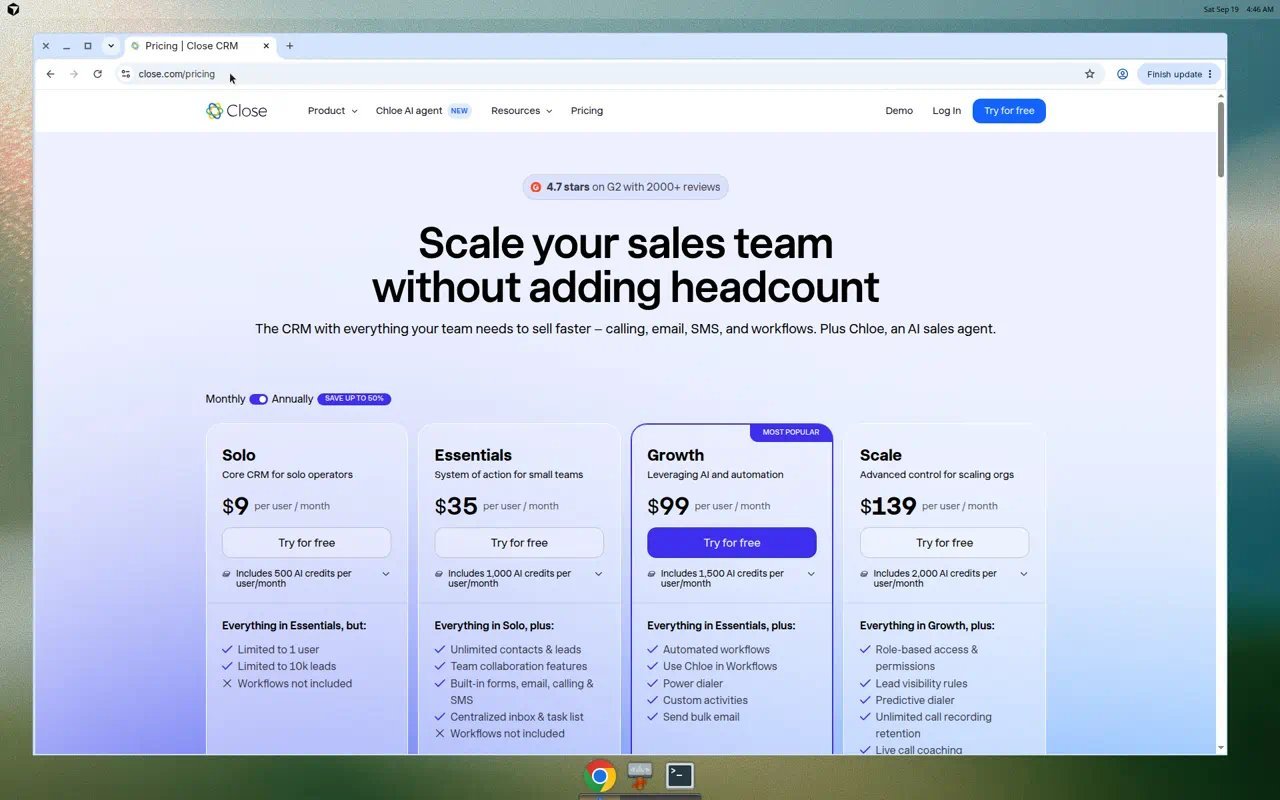
Close is the alternative when calling, SMS, and a shared inbox should sit inside the CRM. Official pricing (19 September 2026): Solo $9 per user/month billed annually or $19 month-to-month (1 user, 10k leads, no workflows); Essentials $35 annual / $49 monthly (calling, email, SMS; workflows still not included); Growth $99 / $109 (workflows, power dialer, bulk email); Scale $139 / $149. Chloe AI credits are included by plan (500–2,000/user/month; no rollover). Calling and SMS are usage-based. No free plan; 14-day trial. iOS and Android are documented. SalesCrunch may still cost less if you do not need a dialer. Skip Close if you only needed a contact database. See current Close plans
Capsule CRM — Best for a Simple Small-Business CRM
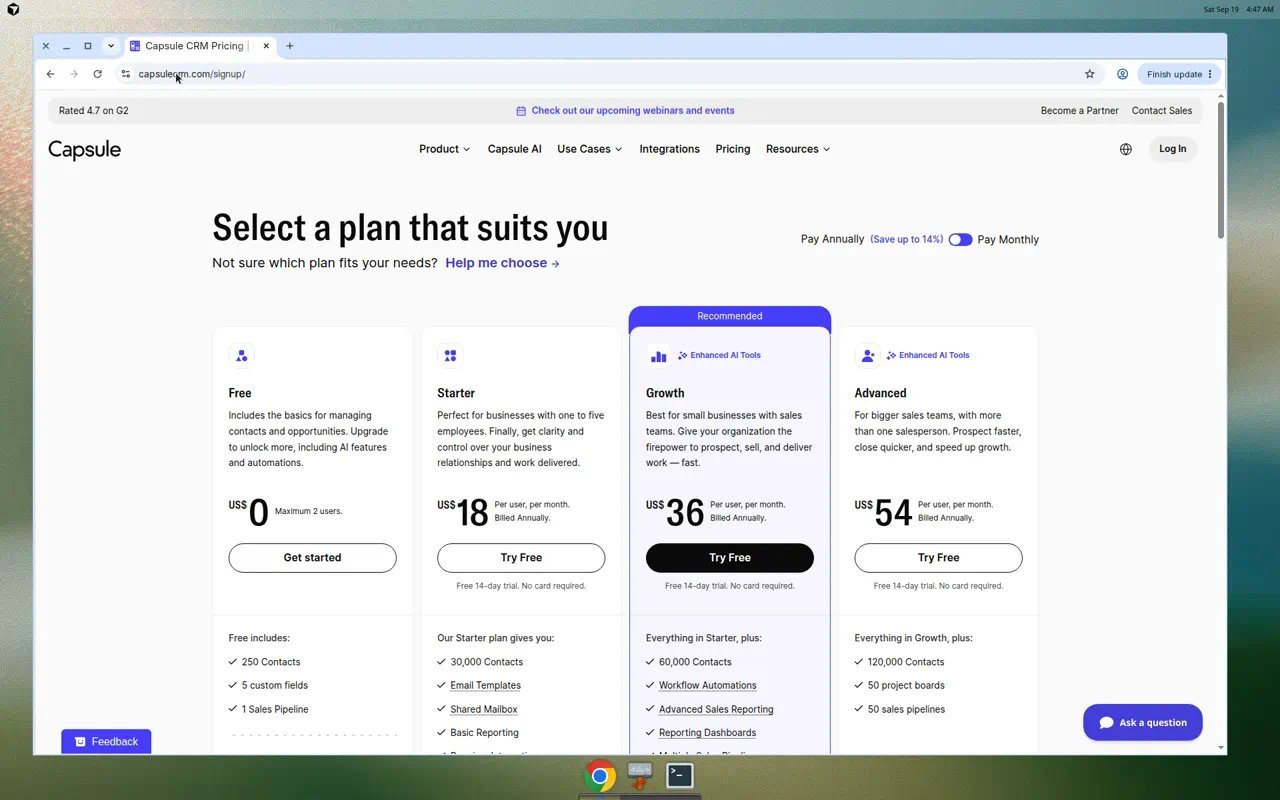
Capsule is the alternative when you want a lighter SMB CRM and a real free plan. Free: two users, 250 contacts, five custom fields, one pipeline. Starter is US$18 per user per month billed annually, with 30,000 contacts, email templates, basic reporting, and listed premium integrations (Xero, Zendesk, Import2). Growth (US$36 billed annually) adds workflow automations, multiple pipelines, email sync, advanced reporting, and documented AI enrichment/summaries. Advanced (US$54 billed annually) raises caps (120,000 contacts; 50 pipelines). Paid plans have a 14-day trial and no setup fee; monthly or annual billing. Transpond marketing from $11/month is not Capsule CRM email. Integrations: 60+ plus Zapier. SalesCrunch may still fit ACT! refugees who want 250,000 contacts on one $30 seat. Skip Capsule Free if 250 contacts is already too small. Explore Capsule CRM
What is a good free alternative to SalesCrunch CRM? HubSpot documents a two-user free CRM. Zoho CRM documents a three-user Free edition. Capsule documents a two-user free plan with 250 contacts. None of those free tiers is the full paid product. Pipedrive and Close use trials, not free CRMs. SalesCrunch has a trial, not a free plan.
SalesCrunch vs Broader CRM Ecosystems
A marketplace is not a native feature. HubSpot’s and Pipedrive’s catalogs are app ecosystems; Zapier is glue; an API is developer work. SalesCrunch’s public site emphasizes Gmail, imports, and Crunchy — not 500 connectors. Buyers who already live in digital tools stacks (email, invoicing, ads) often outgrow a focused CRM first. Buyers who only needed contacts, alarms, and a pipeline may pay for complexity they will not configure. monday CRM exists as another board-style path (Basic from $12/seat/month billed annually on monday’s CRM pricing page, three-seat minimum) — it is not expanded here so this page does not become a 10-CRM roundup.
Free CRM vs Paid CRM: What Changes?
Free is not cheapest long-term. HubSpot Free omits Professional sequences. Zoho Free is three users with tight automation/email caps. Capsule Free caps contacts at 250. SalesCrunch’s 14-day trial is not a free plan. Close and Pipedrive trials end; then seats (and, for Close, usage) bill. Starting price is not deployment cost: multiply seats, then add the tier that actually includes automation, extra pipelines, or calling minutes. Annual billed-monthly rates are not month-to-month. There is no universal “right” CRM invoice in 2026. For adjacent ops software, see the SparkReceipt review and receipt management software guides — those are not CRMs.
Is HubSpot a SalesCrunch alternative? Yes, as a free-CRM-plus-Hubs path. It is not a one-price ACT! replacement. Sequences, extra pipelines, and Forecasting follow Sales Hub edition rules, not the Free FAQ.
Which Alternative Fits a Small Sales Team?
Solo founder who likes one number: SalesCrunch $30/month or Close Solo if calling is the job. Two people who will not pay yet: HubSpot Free or Capsule Free (watch HubSpot’s 1,000-contact FAQ and Capsule’s 250-contact cap). Spreadsheet team that thinks in Kanban: Pipedrive Lite as a starting published annual rate — confirm whether Growth is required for the automations you need. Team that will buy Books and Desk anyway: Zoho CRM edition that matches forecasting and workflows, not Free by default. Outbound callers: Close Essentials for native voice/SMS; Growth if workflows and power dialer are documented needs. Growing headcount: seat math beats sticker price on every per-user CRM including SalesCrunch.
What is the best SalesCrunch CRM alternative? There isn’t one. Match the gap: free ecosystem (HubSpot), pipeline marketplace (Pipedrive), suite (Zoho), dialer (Close), simple free-to-paid SMB CRM (Capsule), or stay on SalesCrunch.
Final Verdict: Which SalesCrunch Alternative Should You Choose?
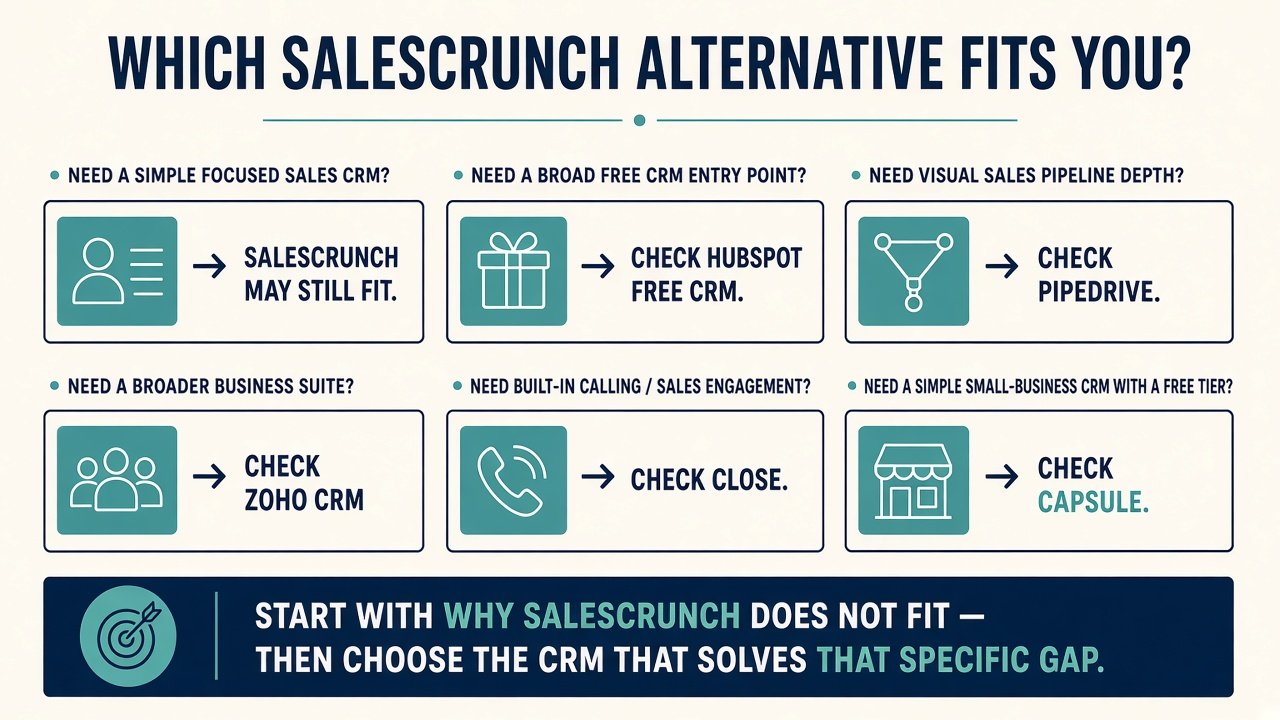
Choose from these SalesCrunch CRM alternatives only after you can name the missing piece. Need a focused sales CRM with one seat price? SalesCrunch may still fit. Need free CRM plus a huge marketplace? Check HubSpot’s current Free limits. Need a visual pipeline and 500+ marketplace apps? Check Pipedrive’s Lite-versus-Growth gates. Need CRM inside a business suite? Check Zoho editions. Need calling/SMS in-product? Check Close’s seat plus usage. Need a simple SMB CRM with a real free tier? Check Capsule’s contact caps. None of these is universally better. Affiliate links did not rank them.
Check current SalesCrunch plans
FAQ
What are the best SalesCrunch CRM alternatives? For distinct jobs: HubSpot (free ecosystem), Pipedrive (pipeline + marketplace), Zoho CRM (suite), Close (calling), Capsule (simple SMB free/paid). SalesCrunch remains a fit for ACT!-style desks.
Is HubSpot a good alternative to SalesCrunch? It can be if you want Free CRM and Hubs. It is a poor clone of a $30 one-plan contact card.
Does SalesCrunch have a free alternative? HubSpot, Zoho, and Capsule publish free editions with user/contact limits. Pipedrive and Close publish trials. SalesCrunch publishes a trial, not a free plan.
Which CRM is best for pipeline management? Pipedrive markets customizable pipelines across plans. HubSpot extra pipelines are Sales Hub–gated. Capsule multiple pipelines start at Growth. SalesCrunch documents an Opportunities Kanban.
Which SalesCrunch competitor has more integrations? HubSpot and Pipedrive publish large marketplaces. That is not automatically better fit. Native ≠ Zapier ≠ API.
Which CRM is better for sales automation? Confirm the tier: HubSpot sequences are not Free; Pipedrive sequences are not assumed on Lite; Close workflows start at Growth; Capsule automations start at Growth; Zoho workflows scale by edition.
Is SalesCrunch still good for small businesses? Yes, when the published one-plan CRM matches the workflow. Alternatives help when that scope is the problem.
What should I check before moving CRM platforms? Contacts, companies, deals, notes, fields, pipeline stages, integrations, and historical activity. A CSV is not a full migration.