
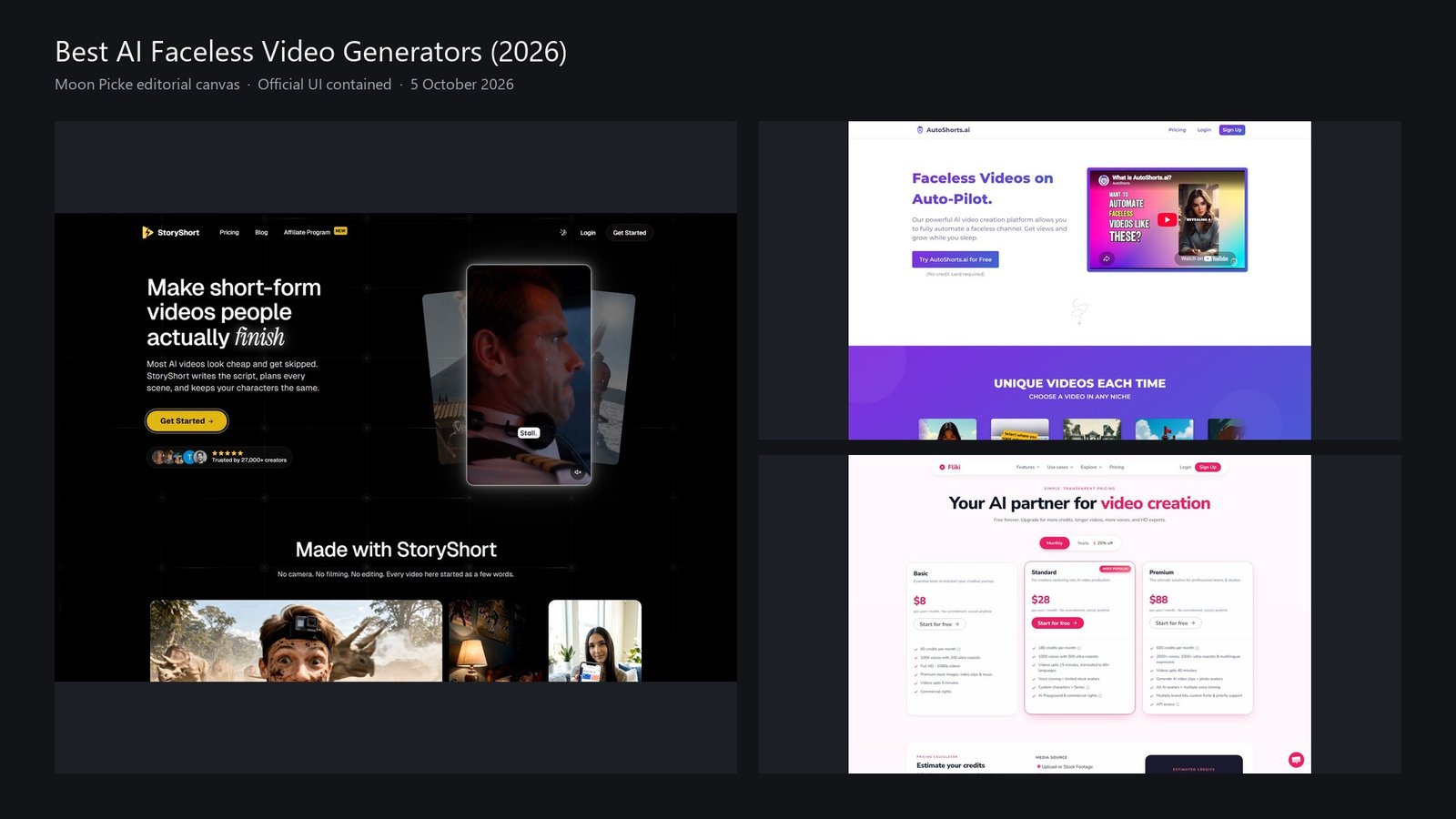
If you already know the topic and refuse to film yourself, you are shopping for an AI faceless video generator: a product that can turn a script or idea into a finished clip with voice, visuals, captions, and an export you can post. That is a different job from a raw text-to-video model, a talking-avatar studio, or a clipper that only slices existing footage.
This comparison is Moon Picke’s faceless-content pillar for the United States in 2026. It is not a rewrite of our published best AI video generators roundup, which maps many video jobs at once. Here the ranking question is narrower: which current web products actually assemble faceless YouTube, TikTok, and Shorts workflows, how much they automate, and where stock footage, generative clips, series, and auto-posting really live.
Quick picks
Best overall: StoryShort — script, scene plan, AI visuals, voice, captions, series, and auto-post on one documented stack.
Best for automation / recurring series: AutoShorts.ai — Series cadence with paid auto-post to TikTok, YouTube, and Instagram.
Best for YouTube long-form: Fliki — minute-metered text-to-video, large voice library, blog/URL inputs, 15–40 minute export caps on paid plans.
Best for Shorts volume: AutoShorts.ai on frequency-priced plans (90-second class, still-first visuals).
Best for TikTok + IG publishing from a studio: Revid — Growth includes publish to TikTok, Instagram, and YouTube plus Auto-Mode workers.
Best for AI-generated visuals: StoryShort (native scene generation) and Revid (named models such as Seedance 2.5 on pricing).
Best for stock-based video: Pictory — Getty/Storyblocks libraries plus script/URL/blog assembly.
Best for editing control: InVideo — timeline editor plus generative models; not a set-and-forget channel bot.
Best budget creation plan: Fliki Basic at $8/month (1080p, commercial rights, 5-minute cap).
Best simple faceless templates: Short.ai — story/Reddit/fake-text pipelines plus scheduler.
Moon Picke did not generate matching test videos across these products. Rankings follow official current workflows, publishing claims, plan cards, and documented limits checked on 5 October 2026.
Comparison table
| Tool | Best for | Script | Voice | Visuals | Long-form | Auto-post | Starting price |
|---|---|---|---|---|---|---|---|
| StoryShort | End-to-end faceless stack | Yes | Yes + clone | AI images/clips | Credit-gated | TikTok, YouTube, Instagram | $39/month Starter |
| AutoShorts | Recurring Shorts series | Yes | Clone on paid | Stills + motion credits | No (FAQ) | TikTok, YouTube, Instagram | $19/month Starter |
| Revid | Editable short films + publish | Yes | 70+ languages | Stock + generative models | Multi-minute shorts | TikTok, IG, YouTube | Hobby $39/month |
| Fliki | YouTube explainers | Yes | 2,000+ voices | Stock + AI image/video | Yes (plan caps) | One-click publish claimed | Free; paid from $8/month |
| InVideo | Timeline + models | Yes | Editor/agent | Stock + Seedance/Nano Banana | Editor-length | Export-first (not a Series bot) | $9/seat/mo billed annually |
| Pictory | URL/blog to stock video | Yes | ElevenLabs minutes | Getty/Storyblocks + AI Studio | Yes (max length by plan) | Export/resize; Zapier/Make | $25/month billed annually |
| Short.ai | Template faceless Shorts | Yes | Basic/Pro by plan | Template + clip maker | No (short-first) | Schedule: TikTok, YouTube, IG, Facebook, more | $19/month Basic |
| ReelsBuilder | Stock shorts autopilot | Yes | ElevenLabs-powered | 18K stock clips | Clip extraction exists | TikTok, IG, YT/Shorts claimed | $24.99 or $14.99/month Starter |
Automation depth
| Tool | Topic to script | Script to video | Recurring series | Scheduling | Direct publishing | Automation level |
|---|---|---|---|---|---|---|
| StoryShort | Yes | Yes | Yes (1-4 series by plan) | Yes | Yes (three platforms named) | High automation |
| AutoShorts | Yes | Yes | Yes (1 series per plan) | Yes | Yes on paid | High automation |
| Revid | Yes | Yes | Auto-Mode workers | Publish workflow | Yes on Growth+ | High / creation-focused |
| Fliki | Yes | Yes | Series on Standard+ | Publish claimed | Claimed TikTok/IG/YouTube | Moderate-high |
| InVideo | Script tools | Agent + timeline | Not a faceless Series product | Not listed as social autopilot | Not equivalent to AutoShorts | Editor-heavy |
| Pictory | Yes | Yes (stock match) | Not Series autopilot | Make/Zapier | Not native social auto-post | Creation-focused |
| Short.ai | Yes | Yes (templates) | Channel-oriented | Yes | Scheduler to listed networks | Moderate automation |
| ReelsBuilder | Yes | Yes | Autopilot queue | Yes | Claimed multi-network | High automation (stock) |
How we chose the best AI faceless video generators
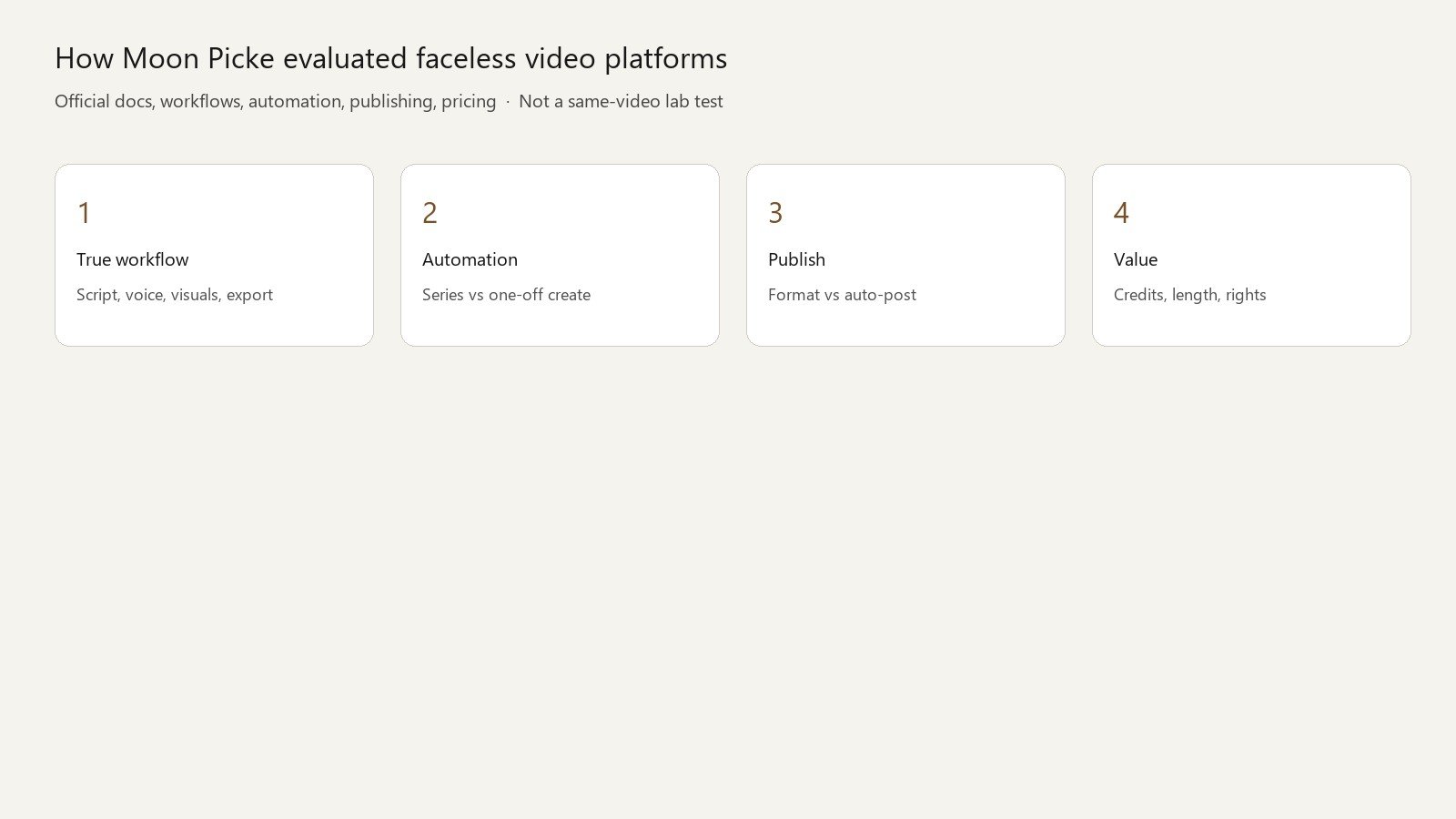
We compared current faceless-video workflows using official product sites, pricing pages, and (where the dedicated review is already published) Moon Picke’s live-captured notes. Dimensions: true faceless assembly (script + voice + visuals + captions/export), automation depth, recurring series, short vs long form, stock vs generative media, editing control, platform-by-platform publishing, credit economics, and commercial language. Affiliate relationships did not set rank. InVideo and Pictory sit in the middle because they are strong faceless-capable products even though they are not Moon Picke affiliates.
Process notes: How we evaluate. Pricing, credits, generation limits, and publishing features were checked on 5 October 2026 and may change. Check each provider’s current pricing before purchasing.
Affiliate disclosure
Disclosure: Moon Picke may earn a commission if you purchase through links on this page, at no additional cost to you. Read the affiliate disclosure.
What is an AI faceless video generator?
Faceless video means the creator does not need to appear on camera. Typical outputs are narrated B-roll, stock assemblies, AI-illustrated stories, listicles, explainers, and Shorts. It does not mean “AI people with no faces,” and it does not mean the software is fully automated.
A useful faceless platform usually covers several of: idea or URL in to script to voiceover to visual sourcing or generation to scene assembly to captions to music to export to optional schedule/publish. A model that only emits a five-second clip is a component, not the factory.
Faceless vs fully automated: what’s the difference?
Faceless-capable tools let you skip the camera. Semi-automated tools still want you in the editor. Highly automated tools generate on a series schedule. End-to-end automated would mean idea-to-live-post with little review. Even AutoShorts and StoryShort document preview, credits, and channel-connection steps. We do not call any product “set-and-forget income.” YouTube’s own monetization language (updated 15 July 2025) treats mass-produced, generic, or template-like AI content as a policy risk under inauthentic/repetitious rules. Automation is a production choice, not a quality or monetization guarantee.
1. StoryShort: Best overall faceless stack
StoryShort is a consumer web app sold as an AI faceless video generator for TikTok and YouTube Shorts. Official copy: it writes the script, plans scenes, generates images and clips, adds voice, and can post on a schedule. Characters can be locked across scenes; voice cloning from a short recording is listed. That is a true generation workflow, not Ken Burns on a JPG.
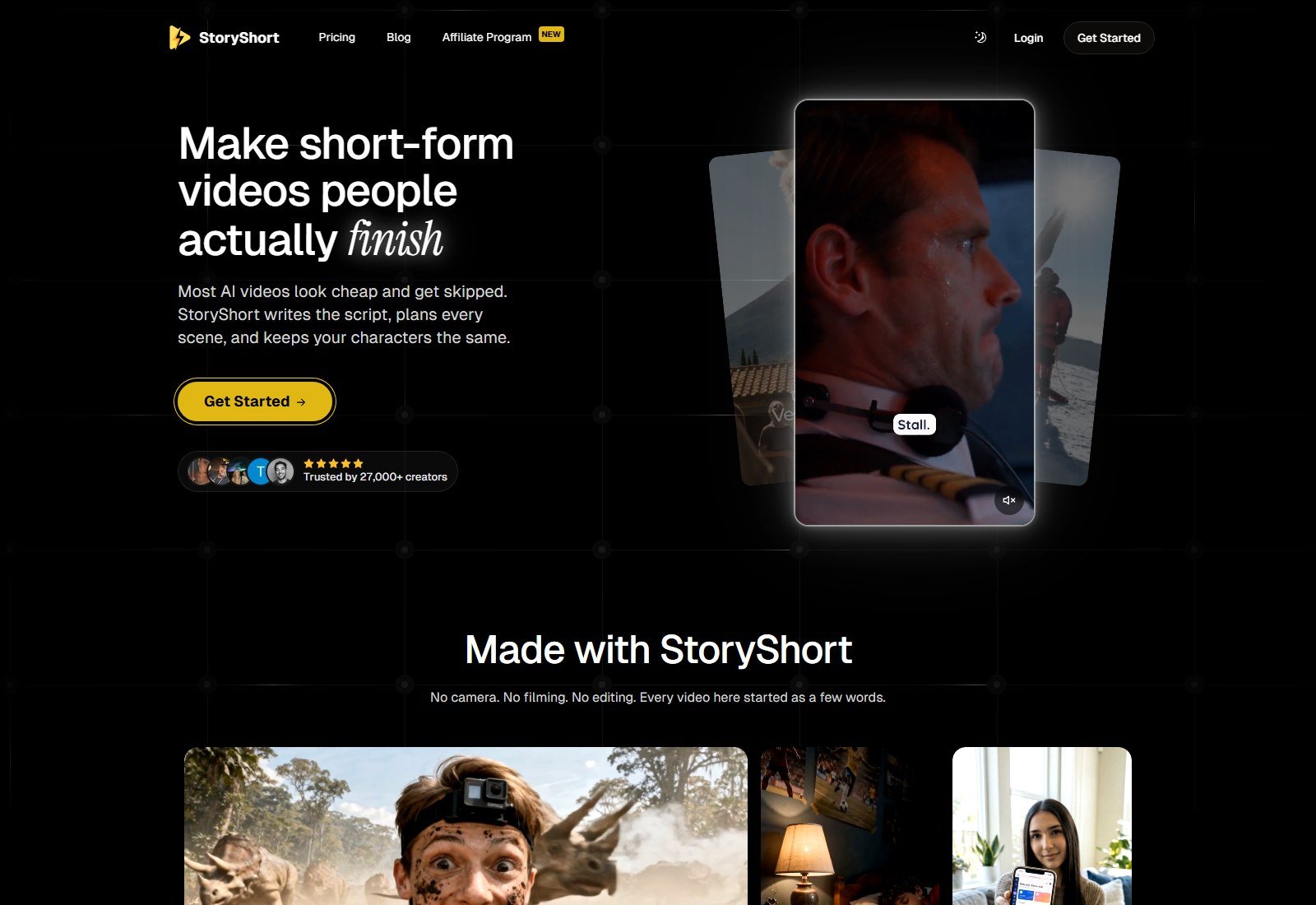
Workflow: topic or prompt → script + scene plan → AI visuals (homepage names Ultra and Wan 3.0 Prime as visual options) → voice/clone → word-level captions → generate → optional series auto-post to TikTok, YouTube, and Instagram. Users can also paste a performing video and “Repurpose” the topic in their style. Editing after generate is documented (shot-level redo).
Automation: High. Series “picks the next topic in your niche, writes it, makes it and posts it.” That still needs a connected account, credits, and human review of facts and brand marks. Scripted news, health, or finance copy is not automatically accurate.
Short vs long: Core product is short-form. Pricing bullets list long-form and UGC on every card, but the credit table on the same page marks long-form (85–150 credits) and UGC ads as “Not in plan” on Starter and Growth. Treat long-form as Influencer/Ultra until the live table says otherwise.
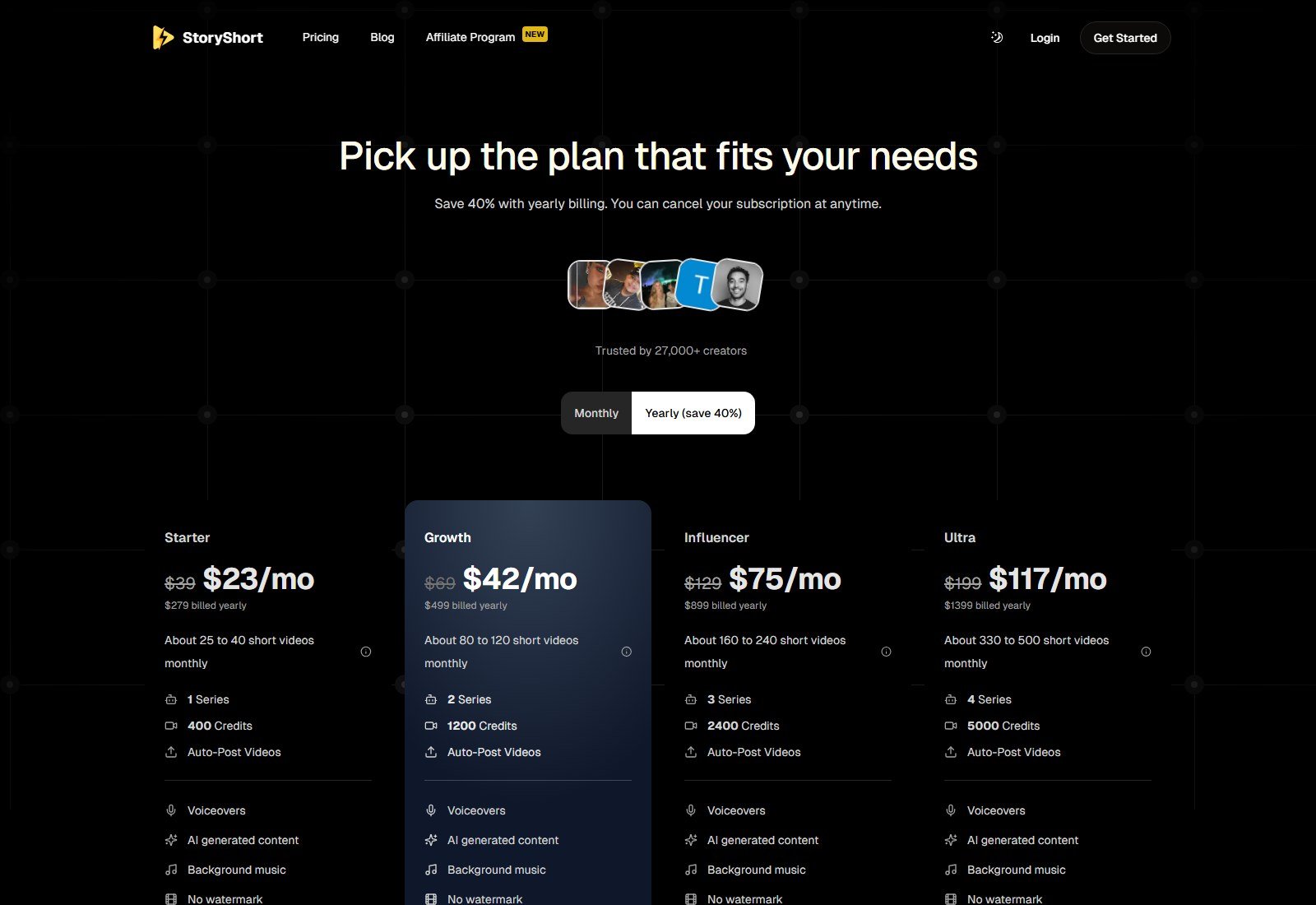
Pricing (5 October 2026): Starter $39/month, 1 series, 400 credits, auto-post, no watermark. Growth $69 (2 series, 1,200 credits). Influencer $129 (3 series, 2,400). Ultra $199 (4 series, 5,000). Yearly: Starter $279 billed yearly ($23/month equivalent). Typical short video 8–20 credits. Biggest advantage: complete faceless pipeline plus multi-series. Biggest limitation: credit cost spikes on “AI movie,” ASMR, and UGC; long-form is not the cheap path. Best for operators who want AI-illustrated episodes and posting in one vendor. Skip if you only need stock B-roll or a Premiere-class timeline. Dedicated walkthrough: StoryShort AI review.
2. AutoShorts.ai: Best for recurring Shorts automation
AutoShorts is a web app whose homepage and footer sell faceless videos on auto-pilot: create, schedule, and post unique shorts customized to a topic. Official /pricing returned 404 in this session; plan cards sit on the homepage.
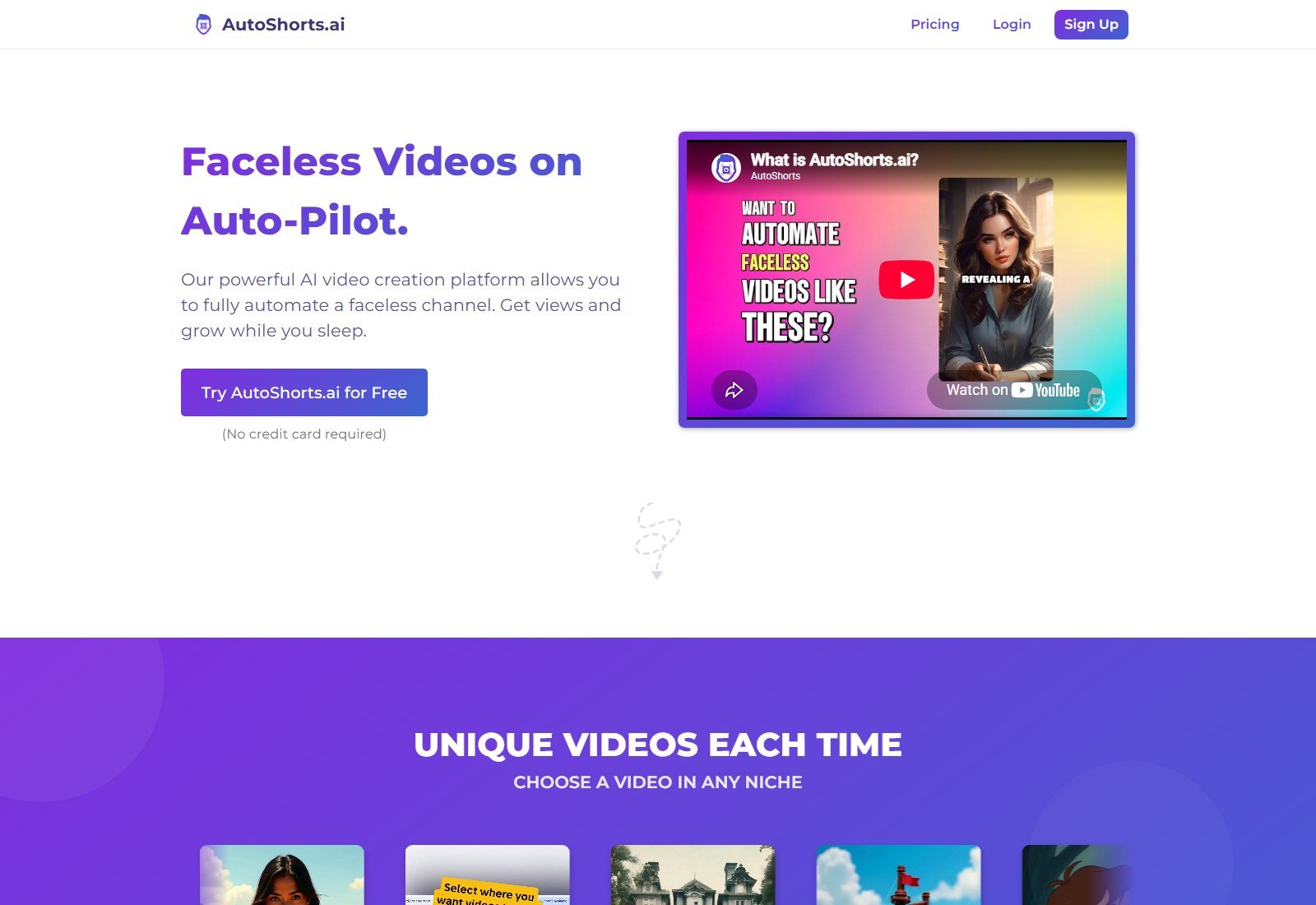
Workflow: create a Series (preset niche or custom prompt) → AI crafts the first unique video → preview/edit script, title, images, music → connect TikTok, YouTube, Instagram → scheduled auto-post. This is not a one-off editor. Visual default is still images; motion credits animate stills. That is generative illustration plus motion, not a named cinematic T2V model like Veo. Captions are not a named settings row on the public cards; sample videos on the homepage show on-screen text.
Automation: High for short-form cadence. Paid cards include auto-post. Every paid plan is still 1 Series. FAQ (public headings) includes long-form as a question; the published AutoShorts review records a 90-second cap and “not designed for single-video creation.” Treat long-form as unsupported. Voice cloning is listed on paid cards; provider NOT LISTED on the public homepage dump.
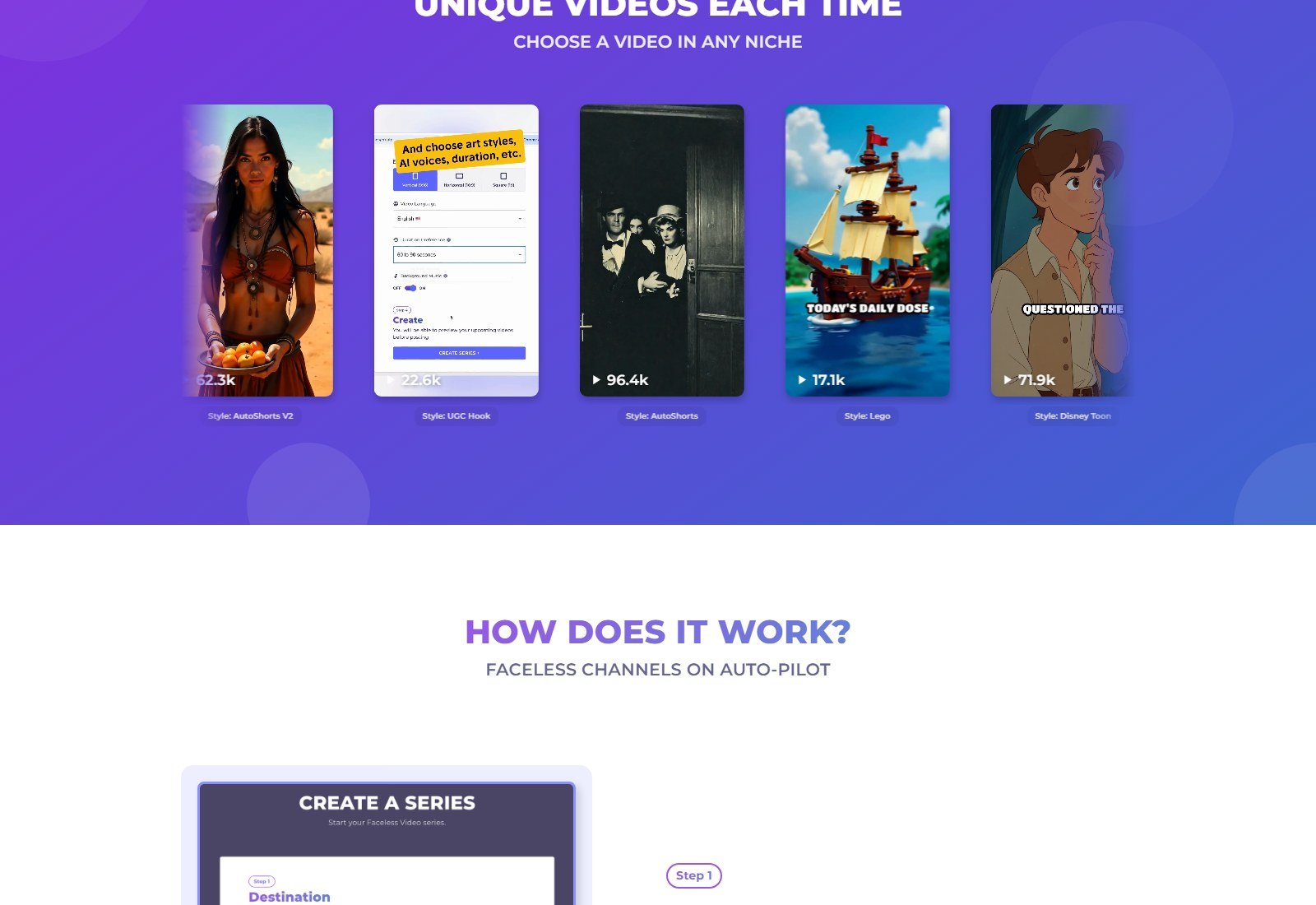
Pricing: Free $0 (1 video, 0 motion credits) marked Temporarily paused. Starter $19/month, posts 3×/week, 27 motion credits, HD, no watermark, auto-post, voice cloning. Daily $39 (once a day, 62 motion). Hardcore $69 (twice a day, 124 motion). Yearly toggle on the same homepage: Starter $16/month billed yearly; Daily $33/month billed yearly; Hardcore $58/month billed yearly. Those are not month-to-month rates. Biggest advantage: cheapest verified auto-posting Series among finalists. Biggest limitation: one Series, still-first look, paused free path. Best for a single niche Shorts/Reels/TikTok cadence. Skip for long YouTube or multi-niche on one seat. Details: AutoShorts.ai review.
3. Revid: Best editable short-form studio with publishing
Revid is a web app for short-form creators: write, render, publish, and (on paid Growth) run Auto-Mode workers. Homepage: prompt, topic, or URL → script → voiceover, visuals, subtitles, editing in one workflow → publish to TikTok, YouTube, Instagram. FAQ: you own generated content; Growth starts at $39/month with 2,000 credits. That is a faceless and mixed-format studio (music videos, avatars, podcasts exist as tools). Rank here is for the script-to-published-short path, not avatars.
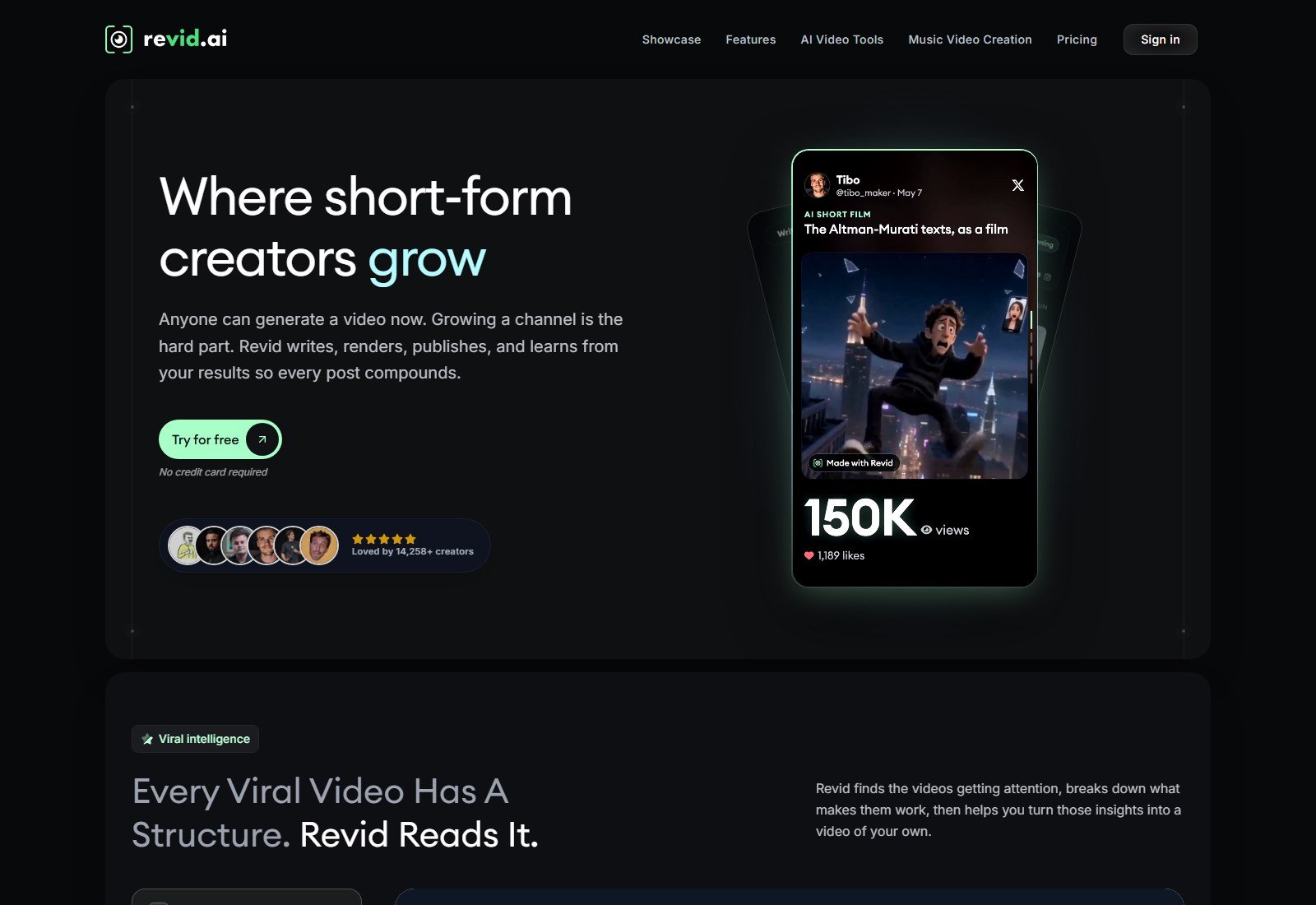
Visuals: mixed. Pricing names Seedance 2.5 and “more, up to 4K.” Do not call every moving frame a Revid-native model; Revid is a platform over named engines plus editing. Stock vs generative depends on the tool you pick. Voice: 70+ languages on Growth. Voice cloning is listed on Ultra, not Hobby/Growth. Captions/subtitles are part of the finished-video claim. Auto-Mode: 3 workers on Growth, 10 on Ultra. Credits do not roll over; boost packs exist.
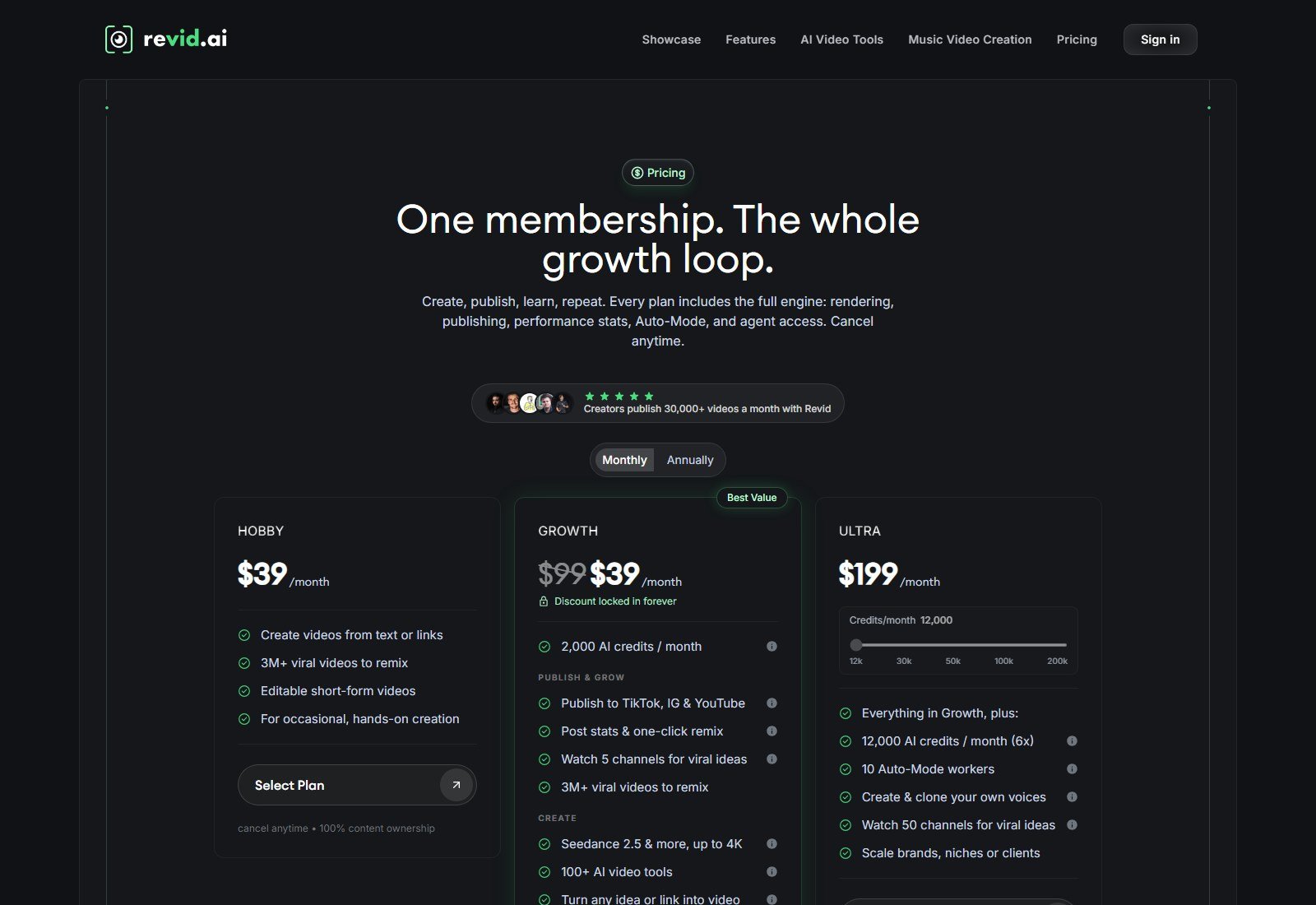
Pricing: Hobby $39/month (occasional creation). Growth displayed as $99 → $39/month with 2,000 credits, publish, Auto-Mode 3, API/MCP/CLI. Ultra $199/month, 12,000 credits (scalable SKUs in FAQ). Yearly: Growth $32/month billed yearly; Ultra $166/month billed yearly. Free: signup without card, free credits, not a full free plan. Biggest advantage: editor plus named generative models plus publishing. Biggest limitation: credit cost of frontier video models vs stock-like modes; not a cheap daily Series at AutoShorts prices. Best for creators who will actually edit. Skip if you refuse a credit wallet. Revid AI review.
4. Fliki: Best for long-form YouTube and voice-led explainers
Fliki is a browser text-to-video and text-to-speech suite. Homepage: paste a script, blog, or prompt; it writes (or uses) the script, picks visuals, adds AI voice, music, and subtitles. Faceless Shorts are an explicit use case, but the product is also built for longer training, explainers, blog-to-video, PPT, and dubbing. That is why it ranks above template Shorts tools for YouTube—not because it is the most automated poster.
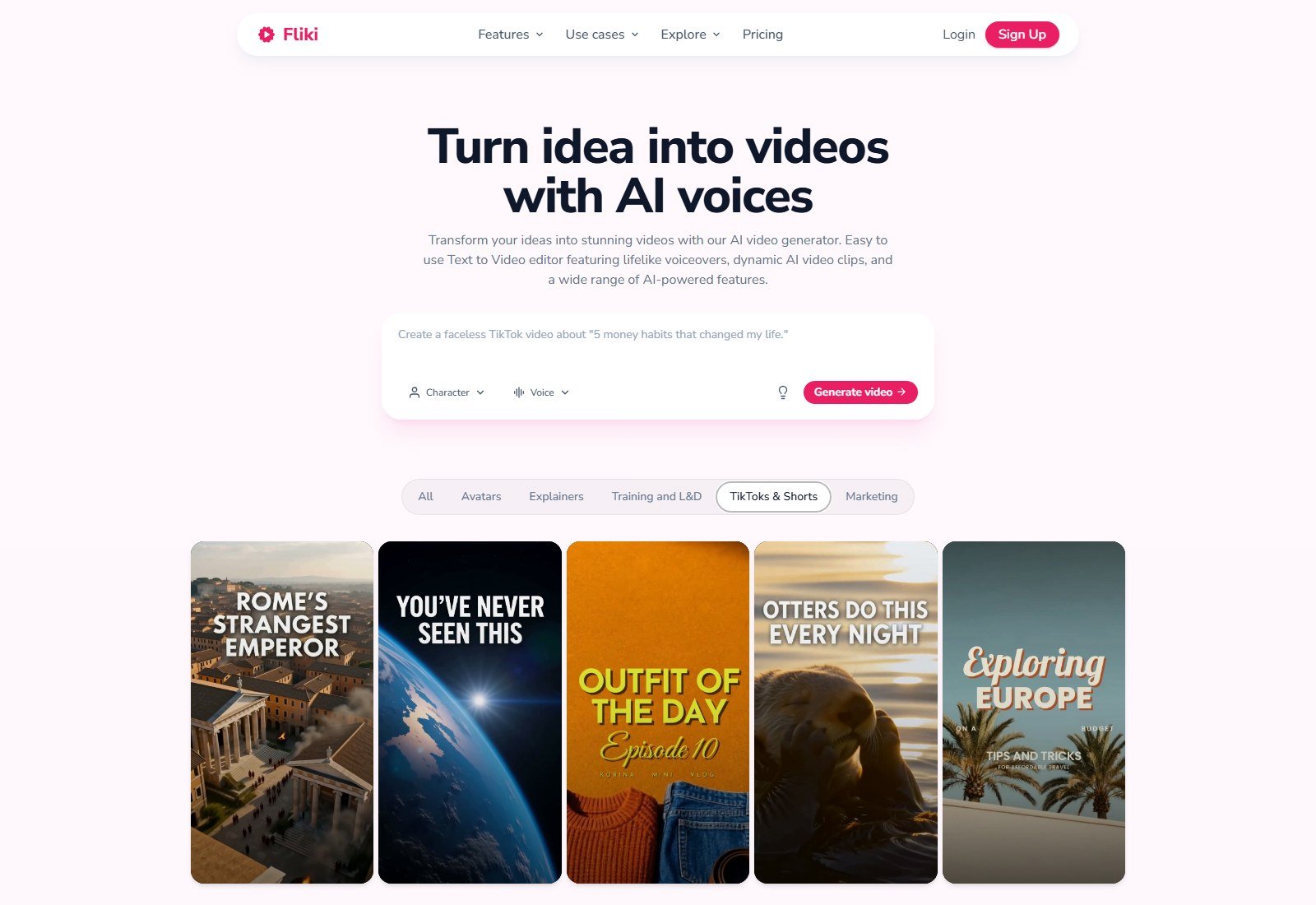
Workflow: idea/script/blog URL/PPT → scenes → stock or AI media → 2,000+ voices (80+ languages) → captions → export. Series appear on Standard+. Voice cloning: Standard (limited) / Premium (multiple). Digital twin/avatar is a separate talking-head path—faceless buyers can ignore it. AI video clips and photo avatars sit on Premium. Stock images, clips, and music are on paid Basic. Models page names MiniMax H3 and others as available inside Fliki; those are hosted models, not Fliki-owned engines.
Publishing: homepage claims one-click publish to TikTok, Instagram, and YouTube. That is direct publishing language, not proof of AutoShorts-style unattended Series. Resolution: Free 720p watermark; paid 1080p. Commercial rights: paid plans. Music: Fliki says paid plans include YouTube-licensed music—do not call it “copyright-free.”

Pricing: Free forever, 3 credits/month, 300 voices, 720p, watermark, no card. Basic $8/month, 60 credits, 1080p, videos up to 5 minutes, commercial rights. Standard $28/month, 180 credits, 15 minutes, voice cloning, series. Premium $88/month, 600 credits, 40 minutes, AI video clips. Yearly 25% off: Basic $6/month equivalent billed at $72; Standard $21/month equivalent billed at $252; Premium $66/month equivalent billed at $792. Credits track generated audio/export minutes; estimator example 0.5 credits/min for stock+voice (AI video/avatar extra). Biggest advantage: voices + long-form caps. Biggest limitation: not the deepest unattended series bot. Best for explainers. Skip if you only want daily TikTok autopilot. Fliki AI review.
5. InVideo: Best for editing control (non-affiliate)
InVideo’s current homepage is an agentic timeline editor, not a faceless Series autopilot. It still qualifies as faceless-capable: you can start from a script or idea, generate or pull visuals, and finish without filming. Stock footage, Seedance 2 / 2.5, and Nano Banana Pro are metered in credits. That is a professional creative suite, not “fully automated YouTube.”
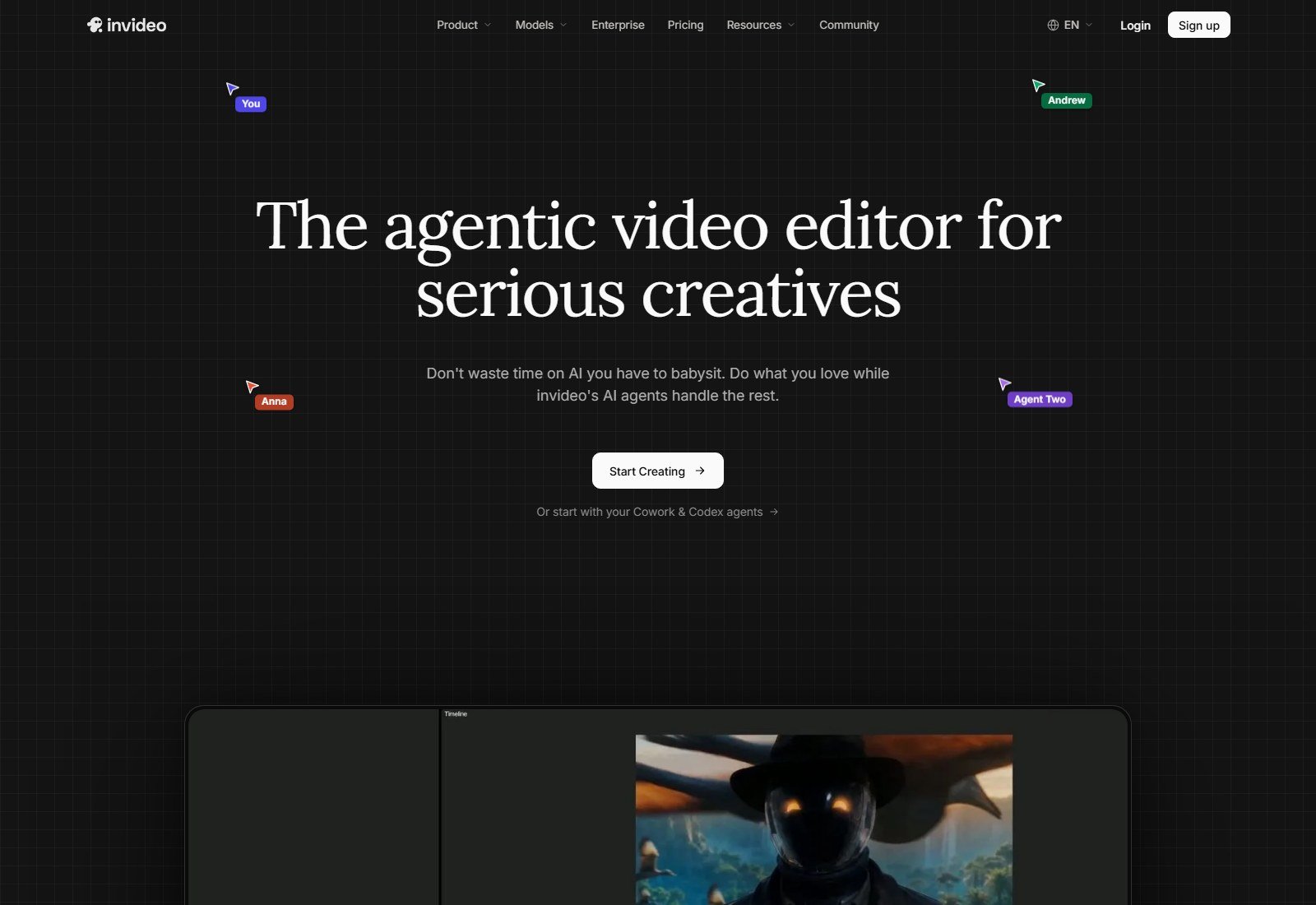
Workflow: script/storyboard inside the product → agent or manual timeline → stock and/or generative shots → color/audio/3D tools on every plan in the pricing dump → export. Direct social auto-posting as a Series product is not the homepage pitch. Do not label format support as auto-posting. Seedance 2.5 is not on Basic; Fast/Mini access is. 4K language on Seedance 2.0 is plan-gated. Unused credits do not roll over.
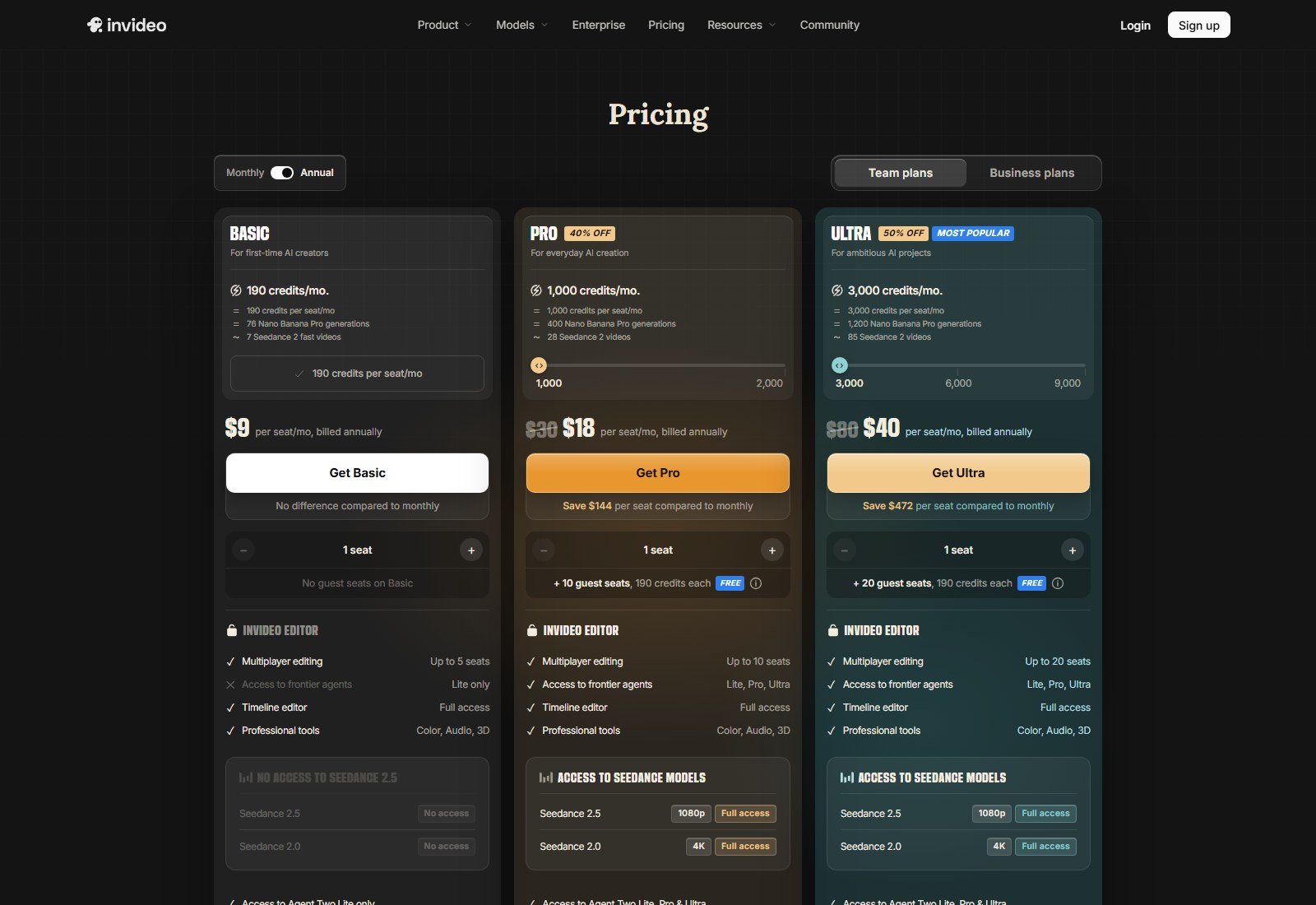
Pricing: Basic $9/seat/month billed annually, 190 credits/seat, “no difference compared to monthly” on that card. Plus $18/seat/month billed annually (from $30 monthly). Max $40/seat/month billed annually (from $80). Example credit notes: Seedance 2.0 Fast ~30 credits/5s; Seedance 2.5 ~72 credits/5s; Nano Banana Pro ~2.5 credits/image. Biggest advantage: real timeline plus current generative models. Biggest limitation: you still edit and you still post. Best for branded faceless films you will finish by hand. Skip for unattended daily Shorts. No Moon Picke affiliate link.
6. Pictory: Best stock-and-URL workflow for explainers
Pictory is a text/URL/script/PPT/audio-to-video web app aimed at business and creator explainers. It auto-builds scenes, matches stock (Getty Images and Storyblocks are named), adds captions and ElevenLabs voices, and exports 1080p in multiple aspect ratios. AI Studio can generate images/video; named I2V models on the homepage include Pixverse 5.5 and Veo 3.1 / Veo 3.1 Fast. Those are optional generative add-ons on top of a stock-first assembler. Avatars exist as a presenter layer—optional, not the faceless definition.
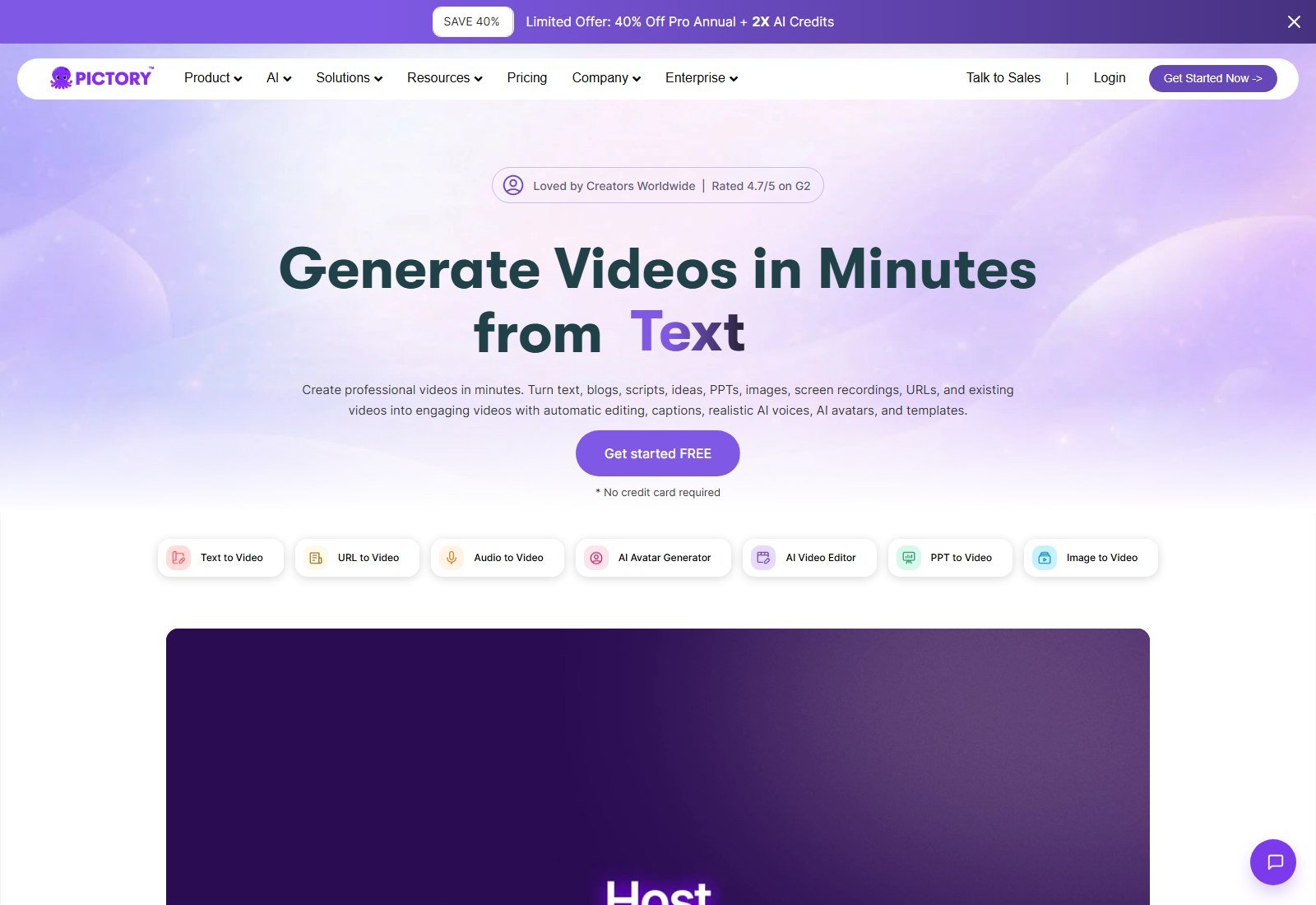
Automation: Creation-focused. Make and Zapier are listed for downstream distribution. That is not native TikTok auto-post. Native article input is HTML blogs/news URLs—not PDF/Word/Google Docs, per pricing FAQ. Text-to-video language support on the FAQ still flags English-first for some modes; voice languages differ by plan (Starter 7 vs Professional 29 in the comparison copy). Do not treat Pictory as a clipping-only tool; it also summarizes long recordings, which is repurposing when the input is already a video.

Pricing: 14-day free trial (3 projects in FAQ), not a forever free plan. Starter $25/month billed annually ($29 monthly), 2,400 minutes/year on annual, 5 GB, 1 brand kit, 720 ElevenLabs minutes/year on annual, no watermark. Professional $35/month billed annually ($59 monthly). Team $119/month billed annually. Annual minutes are granted upfront; monthly minutes do not roll. Max generated video length: 5 minutes Starter vs 30 minutes higher plans in the comparison grid. Biggest advantage: licensed stock + URL-to-video. Biggest limitation: no native social Series. Best for blog-to-YouTube. Skip for daily TikTok autopilot. No affiliate link.
7. Short.ai: Best simple faceless templates plus scheduler
Short.ai is a short-video web app that mixes original faceless generation (AI story, Reddit story, fake texts, superhero, dialogue) with a clip maker (long video → many shorts) and an auto-caption/scheduler. Only the generation side ranks here. Clipping is repurposing; it is secondary, not the reason for inclusion.

Workflow: script or template → faceless video → captions (14+ styles, 32+ languages claimed) → schedule to TikTok, YouTube, Twitter, Facebook pages, Instagram, LinkedIn, and Pinterest. URL-to-script and 50+ templates are listed. Audio generation: 32 languages. Duration: no hard public cap; FAQ says most creators 0–2 minutes, length follows script. Voice: Basic vs Pro voices by plan. This is template-heavy. Do not confuse it with StoryShort’s character-consistent scene planner.
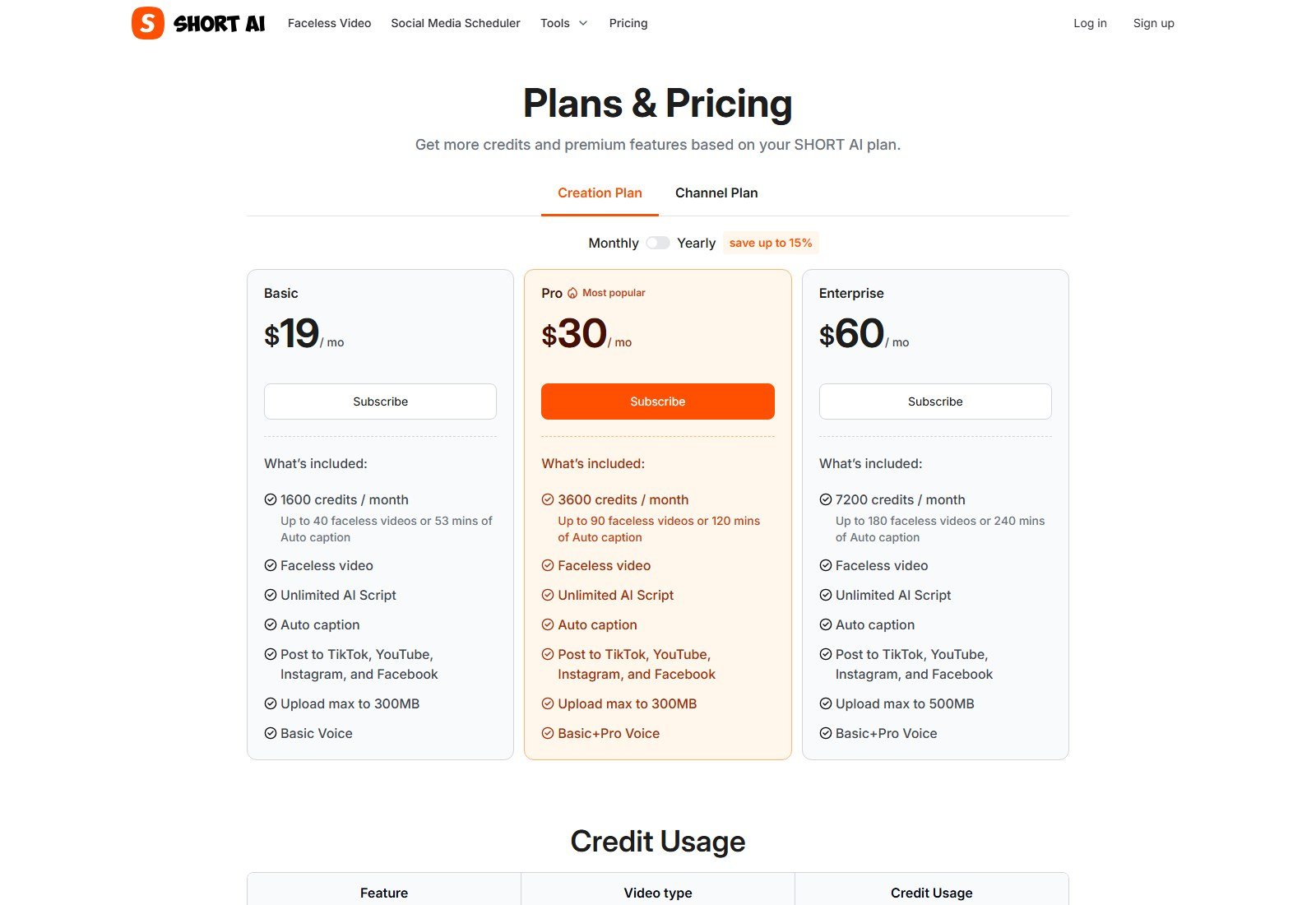
Pricing: Basic $19/month, 1,600 credits (up to 40 faceless videos or 53 minutes auto caption), posting to TikTok/YouTube/Instagram/Facebook, Basic voice. Pro $30/month, 3,600 credits. Enterprise 7,200 credits (price NOT LISTED on the public cards dump). Credit examples: AI story video 30s / 20 credits; superhero 20 credits/video excluding image; auto captions 1 min / 30 credits; auto clip 1 min / 20 credits. Biggest advantage: cheap template Shorts plus a real scheduler. Biggest limitation: clipping and generation share a credit pool; marketing still uses “viral” language we do not endorse. Best for Reddit/story formats. Skip for long-form education. Short.ai review.
8. ReelsBuilder: Best stock-based shorts autopilot (with noisy marketing)
ReelsBuilder.ai is a browser studio for faceless Reels/Shorts/TikTok-style videos: AI scripts, stock or generative visuals, voiceover, karaoke-style captions, and autopilot posting. Homepage: 18K stock clips, ElevenLabs-powered voices (20+), 63+ styles, five networks. That is a qualifying faceless workflow. The same homepage uses aggressive income and “while you sleep” copy. Moon Picke treats that as advertising, not evidence. Rank is for the documented pipeline, not revenue claims.
Workflow: niche/product/URL → script → stock clip matching → voice → captions → queue/auto-post (TikTok, Instagram, YouTube/Shorts claimed). Clip extraction from YouTube/podcasts is a repurposing module, not the generation rank. Visual default is stock, not Veo-class T2V. 7-day trial and 14-day money-back language appear on-page; confirm in checkout.
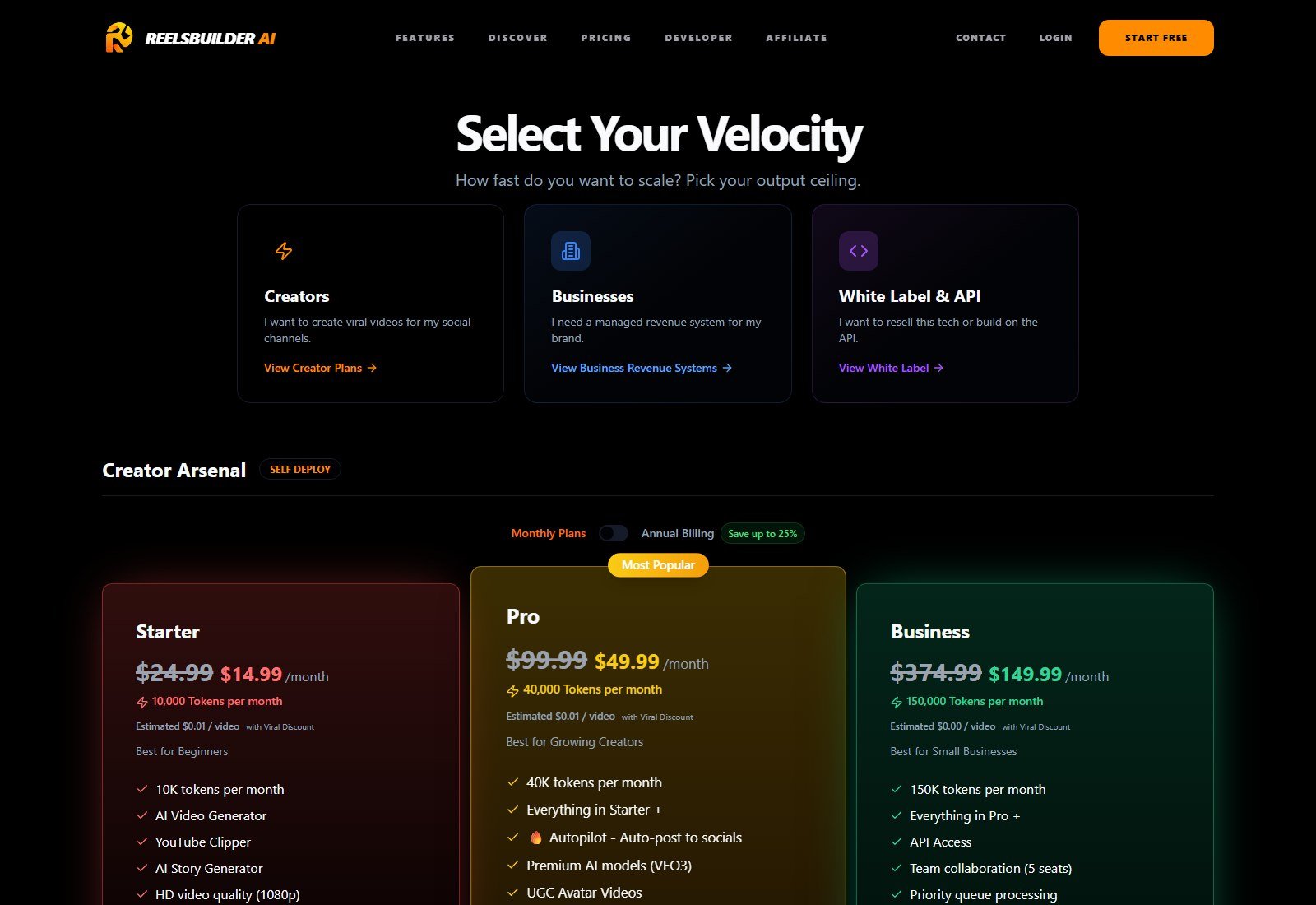
Pricing: Starter $24.99 / $14.99 per month (toggle), 10,000 tokens. Mid tier $99.99 / $49.99, 40,000 tokens. Business $374.99 / $149.99, 150,000 tokens. Do not treat $14.99 as month-to-month unless the monthly toggle shows it. Token examples on-page include YouTube clips ~1K tokens each. Estimated “$0.01 / video” is vendor math, not a Moon Picke calculation. Biggest advantage: stock autopilot with a trial. Biggest limitation: hype density and token opacity vs Fliki’s minute credits. Best for operators who want stock faceless volume. Skip if you need character-consistent AI films (use StoryShort) or a timeline (use InVideo). ReelsBuilder.ai review.
What we researched but did not rank
Vidofy: multi-model T2V/I2V studio. Faceless clips are possible; it is not a script-to-captions-to-auto-post channel. Excluded as a raw-model platform. Review is still a draft, so it is not linked.
Crayo: homepage positions it as a clipping editor (upload or YouTube/TikTok link → subtitles → clips). Repurposing-first. Excluded from generation rank.
HeyGen: avatar/presenter studio. You can avoid filming yourself, but the product centers a talking face. Overlap only.
Canva, VEED, Kapwing: editors with AI assists, not dedicated faceless factories.
MakeUGC, UGCVideo.ai, UGCReal, TheInfluencer.ai: AI UGC ads, a different series pillar.
Kling, Runway, Veo, Luma: clip engines. Useful inside a faceless workflow; they are not faceless platforms.
Faceless.video / Faceless.so: considered as AutoShorts-class competitors; weaker public plan evidence in this pass than AutoShorts’ homepage cards, so they stay out rather than as filler.
Best for full automation
AutoShorts and StoryShort are the only finalists whose public product is a recurring Series that can post without opening an NLE. AutoShorts is narrower (one Series, frequency-priced, still-first). StoryShort is broader (multiple series on paid plans, AI scene generation). Neither is “fully automated” in the sense of zero review. Revid Auto-Mode and ReelsBuilder Autopilot are close cousins with more editor/stock flavor.
Best for recurring series
AutoShorts if you want one niche on a posting cadence. StoryShort if you want more than one series and AI-illustrated episodes. Fliki Series on Standard+ is a content calendar for explainers, not the same as AutoShorts’ 3×/week paid floor. Revid Auto-Mode workers (3 on Growth) automate creation jobs you define.
Best for YouTube
Split the platform. For YouTube Shorts volume, AutoShorts and StoryShort match the vertical, captioned, narrated format and name YouTube as a publish target. For long-form YouTube (explainers, blog narration, lessons), Fliki’s 15- and 40-minute caps and Pictory’s 30-minute Professional length are the relevant products. Do not call AutoShorts “best for YouTube” if you meant 10-minute videos. InVideo can make long edits but you assemble them.
Best for Shorts and TikTok
Shorts and TikTok want 9:16, captions, and a hook in the first seconds. AutoShorts, StoryShort, Revid, Short.ai, and ReelsBuilder all document that shape. TikTok auto-post is independently named by AutoShorts (FAQ), StoryShort, Revid Growth, Short.ai scheduler, and ReelsBuilder. Format export alone (Pictory/InVideo) is not auto-posting.
Best for long-form
Fliki (paid length 5 / 15 / 40 minutes) and Pictory (5 vs 30 minutes by plan). StoryShort long-form is credit-expensive and marked off Starter/Growth in the usage table. Revid sells “multi-minute” shorts and films, not hour-long courses.
Best for AI-generated visuals vs stock
AI-illustrated episodes: StoryShort; Revid when you spend credits on Seedance-class tools. Stock B-roll: Pictory (Getty/Storyblocks), ReelsBuilder (18K clips), Fliki Basic stock library. Mixing both: Fliki Premium (AI video clips) and Pictory AI Studio. Never call stock matching “AI-generated video.”
Best for editing control
InVideo’s timeline is the outlier. Revid’s rebuilt editor is the short-form middle. Pictory’s storyboard is scene-level, not Premiere. AutoShorts edits are script/title/images/music before post. Highly automated tools trade control for cadence.
Pricing and value comparison
Pricing, credits, generation limits, and publishing features were checked on 5 October 2026 and may change. Check each provider’s current pricing before purchasing. Raw credit counts are not comparable across vendors.
| Tool | Entry paid | Annual note | Free access | Usage basis |
|---|---|---|---|---|
| StoryShort | $39/month Starter | $23/mo equiv., $279 billed yearly | Get Started / credits (confirm in-app) | Credits; shorts ~8–20 |
| AutoShorts | $19/month Starter | $16/month billed yearly | Free card paused | Posting frequency + motion credits |
| Revid | Hobby $39/month | Growth $32/month billed yearly (FAQ) | Free credits, no card | Credits; 30s Pro ~40–80 |
| Fliki | Basic $8/month | $6/month equiv., $72 billed yearly | Free plan, watermark | Credits ≈ minutes |
| InVideo | $9/seat/mo billed annually | Card says same as monthly | Not verified as free plan on dump | Credits / model |
| Pictory | $25/month billed annually | $29 month-to-month | 14-day trial | Export minutes + AI credits |
| Short.ai | $19/month Basic | Up to 15% yearly | Homepage “free” generator language; paid credits for volume | Credits / 30s story |
| ReelsBuilder | $24.99 or $14.99/month | Toggle; confirm billed total | 7-day trial copy | Tokens |
We did not publish a cost-per-30-second table. Model mix, regeneration, and motion vs stills swing the real number. Moon Picke would only calculate a scenario with a frozen settings list; that list is not stable enough across eight vendors today.
How to choose a faceless video generator
If you want maximum unattended Shorts posting, start with AutoShorts, then StoryShort if you need better scene generation or extra series. If you want a recurring AI-illustrated channel with character lock, StoryShort. If you want YouTube explainers from blogs and a serious voice library, Fliki. If you want URL-to-stock corporate video, Pictory. If you will sit on a timeline and buy Seedance seconds, InVideo. If you want Reddit/story templates and a multi-network scheduler, Short.ai. If you want stock Reels volume with a trial, ReelsBuilder—read past the hype. If you only need cinematic clips, you are in the wrong aisle; use a model host, then edit elsewhere.
Can faceless AI videos be monetized?
No tool guarantees YouTube Partner Program access, Shorts revenue, or TikTok Creator Rewards. YouTube’s channel monetization policies (Help article, including the 15 July 2025 update that renamed “repetitious content” to inauthentic content) say monetized content should be original and authentic: not mass-produced, generic, repetitive, or made only to harvest views. Explicit examples of what is not allowed to monetize include templated storylines with minimal variation, image slideshows with little narrative, and “AI-generated content made with generic or unoriginal templates giving the impression of mass production without adding the creator’s original, authentic insights or perspective.” Reused content (scraping or lightly wrapping other people’s videos) is a separate policy.
Practical implication: a Series that emits interchangeable factoids or cloned Reddit plots is a policy risk even if the software worked perfectly. Human fact-check, transformation, and commentary matter more than the generator logo. You remain responsible for product photos, trademarks, music licenses, cloned voices (only clone a voice you have rights to), and platform rules. Paid-plan “commercial use” or “you own the output” clauses do not override YouTube or copyright law.
FAQ
What is the best AI faceless video generator? For a complete short-form stack (script, AI scenes, voice, captions, series, auto-post), StoryShort is the overall pick on 5 October 2026 evidence. The “best” tool still depends on long-form vs Shorts and stock vs generative visuals.
What is the best AI faceless video generator for YouTube? Shorts: AutoShorts or StoryShort. Long-form: Fliki, then Pictory.
What is the best AI faceless video generator for Shorts and TikTok? AutoShorts for cadence; StoryShort for generated scenes; Revid if you will edit.
Can AI create an entire faceless video automatically? Several products generate script, voice, visuals, and captions in one pass. “Entirely automatically” including unattended posting is only documented on Series/Autopilot products, and even those expect preview, credits, and connected accounts.
Can AI create faceless YouTube videos from a script? Yes on Fliki, Pictory, StoryShort, Revid, Short.ai, InVideo, and others in this list. Quality and length caps differ.
Can AI generate scripts, voices, and visuals together? That is the default pitch of StoryShort, AutoShorts, Revid, Fliki, Short.ai, and ReelsBuilder. InVideo and Pictory also script, but they expect more assembly.
Can AI faceless videos be monetized on YouTube? Only if the channel meets current YPP and inauthentic-content rules. Using a generator does not qualify you. Mass-produced template AI is called out in YouTube’s own examples of content that is not allowed to monetize.
Can faceless AI tools auto-post videos? AutoShorts, StoryShort, Revid (Growth publish), Short.ai scheduler, and ReelsBuilder document platform posting. Pictory and InVideo are export-first. Always verify which networks are connected—not “all social media.”
Are AI-generated voices allowed on YouTube? YouTube does not ban TTS as a category in the monetization overview we cited; inauthentic, reused, or policy-violating content is the issue. Clone only authorized voices.
How much do faceless AI video generators cost? Verified paid floors in this research: Fliki Basic $8/month, InVideo Basic $9/seat/month billed annually, AutoShorts and Short.ai $19/month, Pictory $25/month billed annually, StoryShort $39/month, Revid Hobby $39/month. Credits and tokens sit on top.
Which faceless video generator has a free plan? Fliki Free forever (watermarked). Revid free credits. AutoShorts Free card is paused. Pictory is a 14-day trial. ReelsBuilder advertises a 7-day trial. Confirm at signup.
Final verdict
The 2026 faceless market split is clear. Channel autopilots (AutoShorts, StoryShort, ReelsBuilder, Revid Auto-Mode) optimize for cadence. Creation suites (Fliki, Pictory, InVideo) optimize for length, stock rights, or editorial control. StoryShort is the best overall match for someone who wants generated scenes and posting without pretending a raw Veo tab is a faceless platform. AutoShorts is the best match for a single short-form Series on a budget. Fliki is the best match for voice-led YouTube that actually needs minutes, not 30 seconds. InVideo and Pictory earn their places without affiliate help because US buyers still need a timeline and a stock explainer tool.
Buy the workflow you will operate every week. Review every script for facts. Review every frame for logos and nonsense motion. Do not confuse automation with original value. Recheck live pricing the day you subscribe.