
For a US buyer replacing a factory stereo because of sound, tuning, and the option to add amplifiers, the Sony XAV-9000ES is the strongest documented choice that was actually in stock on 6 October 2026. Sony’s help guide gives it three 5-volt preouts, a 14-band graphic equalizer, an 8-band parametric equalizer with frequency, gain, and Q on each channel, crossovers, a front two-way speaker mode, and time alignment in 0.1-inch or 1 cm steps. That is a tuning toolkit. It is not a listening-test win. Moon Picke did not measure noise, distortion, or frequency response, and a higher price does not prove a radio sounds better.
If the dash needs a 10.1-inch floating screen with the same Mobile ES feature list on the box, the Sony XAV-9500ES was in stock new at $1,198.00. If the next piece of the system is an external digital signal processor, the Kenwood Excelon Reference DMX1058XR adds a digital optical output that the Sonys do not list. The Kenwood DMX958XR is the fixed 6.8-inch Reference radio. The Alpine iLX-F511 Halo11 has per-channel parametric EQ on an 11-inch screen, with 4-volt preouts rather than 5-volt.
Prices and stock were checked on Amazon.com on 6 October 2026. Specifications come from the manufacturer pages named below, except where a sentence is marked as Amazon listing copy. This is not a bench comparison.
Affiliate disclosure. As an Amazon Associate I earn from qualifying purchases. Amazon links on this page are paid links. Read the affiliate disclosure and how we evaluate products. Buttons go only to the head-unit listing named in that section, not to a camera bundle, a SiriusXM bundle, or a renewed unit.
Quick picks
- Best documented tuning: Sony XAV-9000ES. 5-volt front, rear, and subwoofer preouts, graphic plus parametric EQ, time alignment, and a two-way front mode. Amazon showed $998.00 and “In Stock.”
- Same Mobile ES tools, floating 10.1-inch screen: Sony XAV-9500ES. Amazon’s new-condition price was $1,198.00, with 17 left. A separate $949.99 line on that page was a used offer. Do not treat it as the new price.
- Best path to an external DSP: Kenwood Excelon Reference DMX1058XR. Three 5-volt preouts plus a digital optical output. $1,449.00, five left.
- Best fixed Reference screen: Kenwood DMX958XR. 6.8-inch 1280×720 panel, 5-volt preouts, 13-band EQ, and digital time alignment. $999.00, three left.
- Per-channel parametric EQ on an 11-inch screen: Alpine iLX-F511. Alpine lists three 4-volt preouts and a 13-band parametric EQ per channel. Amazon showed $1,660.00 with one left. Alpine’s own page showed $1,899.95 the same day.
Wireless Apple CarPlay is on all five, but it is not the ranking. If phone connection is the reason you are shopping, use the published wireless Apple CarPlay head unit guide. That article answers a different question. The 10.1-inch Sony XAV-AX8500 also stays out of this table. Its published XAV-AX8500 review already covers that floating screen. It is not the Mobile ES tuning radio.
Comparison
| Model | Role | Preouts | Tuning Sony, Kenwood, or Alpine actually lists | Chassis | Amazon on 6 Oct 2026 |
|---|---|---|---|---|---|
| Sony XAV-9000ES | Best documented tuning | 3 × 5 V (front / rear / sub) | 14-band graphic EQ, 8-band parametric with frequency, gain, and Q, crossover, front two-way mode, time alignment | About 7 × 4 in face, mounting depth about 4.75 in | In stock at $998.00. ASIN B0CCPN68V3 |
| Sony XAV-9500ES | Floating Mobile ES | 5 V front, rear, and sub, gold-plated, per the listing | Listing copy: 14-band EQ, 8-band parametric EQ, time alignment, ESS DAC | Single-DIN chassis, 10.1 in floating screen | New $1,198.00, 17 left. ASIN B09TBMGT33 |
| Kenwood DMX1058XR | Optical output | 3 × 5 V, plus optical PCM at 48 or 96 kHz / 24-bit | 13-band EQ and time alignment on the Amazon listing; Kenwood lists the optical output | Floating 10.1 in, 1280×720 | $1,449.00, 5 left. ASIN B0F83TY2LJ |
| Kenwood DMX958XR | Fixed Reference | 5 V / 10 kΩ, impedance at or below 300 Ω | 13-band EQ, digital time alignment; Kenwood also publishes a 1 kHz THD figure and an SNR | Fixed 6.8 in, 1280×720 | $999.00, 3 left. ASIN B0B4WZTQLT |
| Alpine iLX-F511 | 11-inch parametric | 3 × 4 V | 13-band parametric EQ per channel, 6-channel time correction, high-pass and low-pass | Single-DIN body, 11 in floating screen | $1,660.00, 1 left. ASIN B09WWSMMNM |
What actually changes the sound
A head unit is the source, the volume control, and sometimes a small amplifier. It is not the speaker, and it is not the cabin. Door speakers, a subwoofer, and where those speakers point will move the sound more than the difference between a 13-band and a 14-band equalizer. This article still compares head units, because the radio decides the preamp voltage, the crossover points, and whether you can delay one speaker so the sound arrives with the rest.
Preout voltage is a line-level number, not a loudness number. Five volts gives an external amplifier a larger signal before its gain knob. Four volts can be set up cleanly. Higher voltage does nothing if you never leave the radio’s built-in amplifier, and it does not fix a small speaker. Sony rates the XAV-9000ES at 20 watts RMS × 4 under CTA-2006, at 4 ohms and no more than 1 percent THD+N, with a maximum of 55 watts × 4. Kenwood’s DMX958XR page lists 22 watts × 4 at less than 1 percent THD, and 50 watts × 4 maximum. Those figures are not a reason to skip an external amplifier.
Equalizer band count is control, not quality. A graphic EQ moves fixed frequencies. A parametric band lets you pick the frequency, the boost or cut, and how wide it is. Kenwood’s published 0.010 percent THD and 98.5 dB signal-to-noise figures on the DMX958XR are Kenwood’s numbers for that model. They are not a Moon Picke measurement, and the DMX1058XR page used here did not publish them in the same form.
A high-resolution badge means the radio lists a high sample rate or a codec such as LDAC. It does not mean a phone stream in a moving car will sound different. This article does not claim that it will.
How these five were chosen
US results for “best car stereos” mix speaker roundups, cheap multimedia radios, and guides that say a writer listened in a car. Those listening claims were not reused. The filter here was a current name-brand receiver with documented tools for an amplified system: at least three preout pairs, an equalizer, time alignment or time correction, and a crossover. Wireless CarPlay was noted because these radios include it. It was not the reason a radio made the list.
The wireless CarPlay shortlist was left out on purpose: Sony XAV-AX6000, Pioneer DMH-W3050NEX, Kenwood DMX908S, Alpine iLX-507, and JVC KW-M785BW. Pioneer was not forced in. Kenwood’s DMX809S and Alpine’s iLX-W670-M were dropped because a new head-unit-only ASIN was not confirmed apart from bundles.
Each finalist was checked on 6 October 2026 for the exact model, a new head-unit listing, a price, and a manufacturer specification. Renewed offers and bundles were ignored even when they were cheaper.
Sony XAV-9000ES
Sony’s help guide for the XAV-9000ES is the most specific tuning document in this group. The graphic equalizer is 14 bands, adjustable from −12 to +12, with two custom curves. The parametric equalizer is eight points. With the speaker configuration set to front and rear, those points apply to front left, front right, rear left, rear right, and the subwoofer, each with frequency, gain, and Q. Set the configuration to front two-way and the same eight points apply to high left, high right, mid left, mid right, and the subwoofer. You can mute a speaker output while you adjust. Sony also says that if you are using a factory amplifier through an iDataLink Maestro module, the UC version should stay on front and rear, not the two-way mode.
Time alignment is in the same guide. Choose Custom and the control appears. Distance from each speaker to the listening position is adjustable in 0.1 inch or 1 centimeter steps. Crossover settings sit in the advanced menu with subwoofer output. Canada’s Sony specification page lists the preouts as 5 volts, three pairs: front, rear, and subwoofer. The help guide’s CTA-2006 line is 20 watts RMS × 4 at 4 ohms and no more than 1 percent THD+N, with a signal-to-noise figure of 86 dBA referenced to 1 watt RMS. Maximum power is 55 watts × 4 at 4 ohms. Speaker impedance is 4 to 8 ohms. Maximum dimensions are about 178 × 100 × 137 mm. Mounting dimensions are about 182 × 111 × 120 mm. That is a double-DIN face, not a short chassis and not a floating screen.
The help guide lists DSD files (.dsf and .dff) at 2.8, 5.6, 11.2, and 22.4 MHz, two channels. Amazon’s product description says DSD plays back through a 192 kHz / 24-bit PCM conversion, and it also lists native 192 kHz / 24-bit WAV, FLAC, and ALAC, plus LDAC. Use both statements together: the file types are in Sony’s guide, and the PCM-conversion wording is on the Amazon description, not a claim that a DSD stream stays DSD all the way to the preouts. Wireless and wired Apple CarPlay and Android Auto are in that product description, along with three camera inputs, Maestro compatibility, and SiriusXM readiness. The tuner is not included.
On 6 October 2026, ASIN B0CCPN68V3 was the XAV-9000ES, manufacturer part XAV9000ES, UPC 027242920200. The one-time price was $998.00 and the page said in stock. The warranty description on the listing is 3 years. Amazon’s generic specification table also says “5.1” surround. That table is not Sony’s preout description. The radio has three preout pairs, not a documented 5.1 processor.
Check the Sony XAV-9000ES on Amazon
Sony XAV-9500ES
The XAV-9500ES is the floating-screen Mobile ES radio, not a second copy of the XAV-9000ES and not the XAV-AX8500. Amazon’s listing, model XAV-9500ES, UPC 027242918191, describes a 10.1-inch 1280×720 anti-glare capacitive screen on a four-way mount and a single-DIN chassis. The about-this-item text lists 5-volt front, rear, and subwoofer preouts, three camera inputs with separate triggers, LDAC, an ESS digital-to-analog converter, 192 kHz / 24-bit WAV, FLAC, and ALAC, and DSD playback via 192 kHz / 24-bit PCM. The product description adds time alignment, an 8-band parametric EQ, a 14-band EQ, wired and wireless CarPlay and Android Auto, Maestro, SiriusXM readiness, and a 3-year warranty.
Those EQ and time-alignment lines are Amazon’s product description for this model. The step size, the Q control, and the two-way speaker mode were read in the XAV-9000ES help guide, and they are not repeated here as if the same page had been opened for the 9500ES. The ESS converter is also listing copy. It is a parts claim, not a measured noise-floor result.
The install difference is the one that matters next to the 9000ES. A single-DIN chassis with a 10.1-inch floating screen needs dash clearance the fixed 6.75-inch face does not. Airbag zones, vents, and the driver’s sight line decide it. On 6 October 2026 the new-condition price on ASIN B09TBMGT33 was $1,198.00, sold with 17 left in stock. The same page also showed $949.99 on an offer described as perfect cosmetic condition. That lower figure is not the new unit. The button below is the ASIN page. Confirm the offer says new before you pay.
Check the Sony XAV-9500ES on Amazon
Kenwood Excelon Reference DMX1058XR
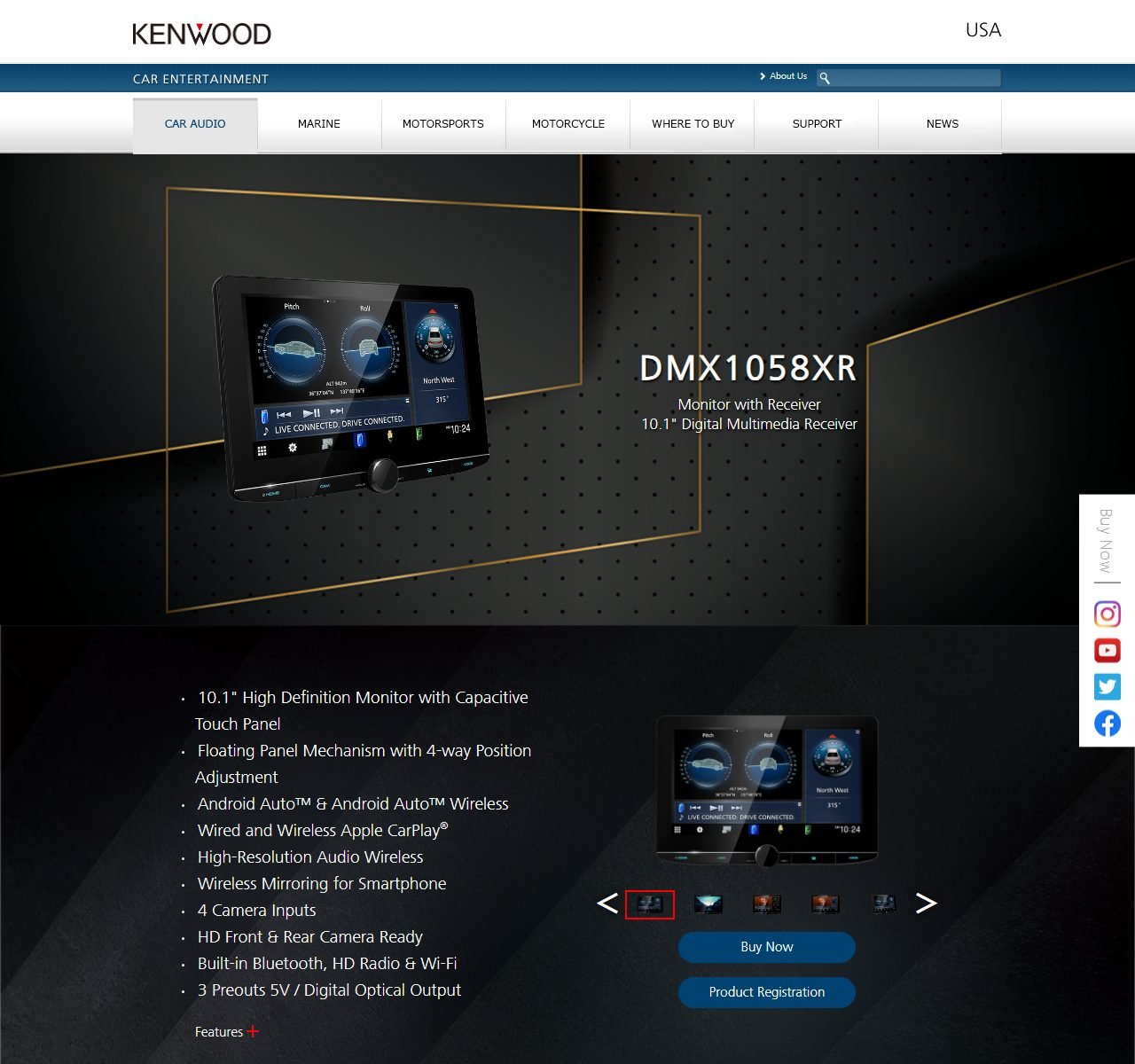
Kenwood’s US page lists a 10.1-inch high-definition capacitive panel, 1280 × 720 × RGB, on a floating mechanism with four-way adjustment. Wireless and wired Apple CarPlay, wireless Android Auto, wireless high-resolution audio, and wireless mirroring are on that page, along with four camera inputs, HD front and rear camera readiness, Bluetooth, HD Radio, and Wi-Fi. The audio line that separates it from the Sony pair is “3 Preouts 5V / Digital Optical Output.” The specification table lists preout level at 5 volts into 10 kΩ, preout impedance at or below 300 ohms, and a digital optical output at 48 kHz or 96 kHz, 24-bit linear PCM. USB-C is rated DC 5 V at 3.0 A. The decoder list includes FLAC, WAV, and Vorbis. Output frequency band is listed to 88 kHz.
Typical power on that Kenwood table is 29 watts × 4 at 4 ohms, 1 kHz, and 10 percent THD. Maximum is 50 watts × 4. Do not read the 29-watt figure as cleaner or louder than the DMX958XR’s 22 watts at under 1 percent THD. The test conditions are different. Ten percent THD is a high-distortion rating. Quote it as Kenwood wrote it.
Amazon’s head-unit listing is ASIN B0F83TY2LJ, model DMX1058XR, manufacturer part DMX1058XR, UPC 019048240842. On 6 October 2026 the price was $1,449.00, against a $1,699.00 list price, with five left, sold by Freeman’s Car Stereo as an authorized dealer. The warranty description on the listing says 1 year. Do not buy the SiriusXM bundle or the CMOS-230LP camera bundle if you only want the radio. Those are different ASINs. An optical output is useful when the next component is a digital signal processor that accepts PCM. It does not replace the processor, and it does not set the processor’s crossovers for you.
Check the Kenwood DMX1058XR on Amazon
Kenwood DMX958XR
The DMX958XR is the fixed-screen Excelon Reference. Kenwood lists a 6.8-inch high-definition capacitive monitor, 1280 × 720, wired and wireless Apple CarPlay, wireless Android Auto, wireless high-resolution audio, USB-C at 5 V / 3.0 A, a 13-band equalizer with digital time alignment, four camera inputs, and three 5.0-volt preouts. Preout level is 5 volts into 10 kΩ, impedance at or below 300 ohms. The same table lists total harmonic distortion of 0.010 percent at 1 kHz, a signal-to-noise ratio of 98.5 dB, and dynamic range of 89 dB. Frequency response at 192 kHz sampling is 20 Hz to 88 kHz. Full-bandwidth power is 22 watts × 4 at less than 1 percent THD. Maximum is 50 watts × 4. Those are Kenwood’s published figures for this model.
A Moon Picke review of this radio is already published: Kenwood DMX958XR review. That page is the model history and support check. This section only places the radio against the other tuning tools. It does not have the optical output Kenwood lists on the DMX1058XR, and it does not have Sony’s per-channel parametric Q controls. It does have a fixed 1280×720 screen, 5-volt preouts, and a USB-C port at 3 amps, in a conventional double-DIN face.
ASIN B0B4WZTQLT matched the DMX958XR on 6 October 2026 at $999.00, with three left in stock. Use that head-unit listing, not a camera kit.
Check the Kenwood DMX958XR on Amazon
Alpine iLX-F511 Halo11
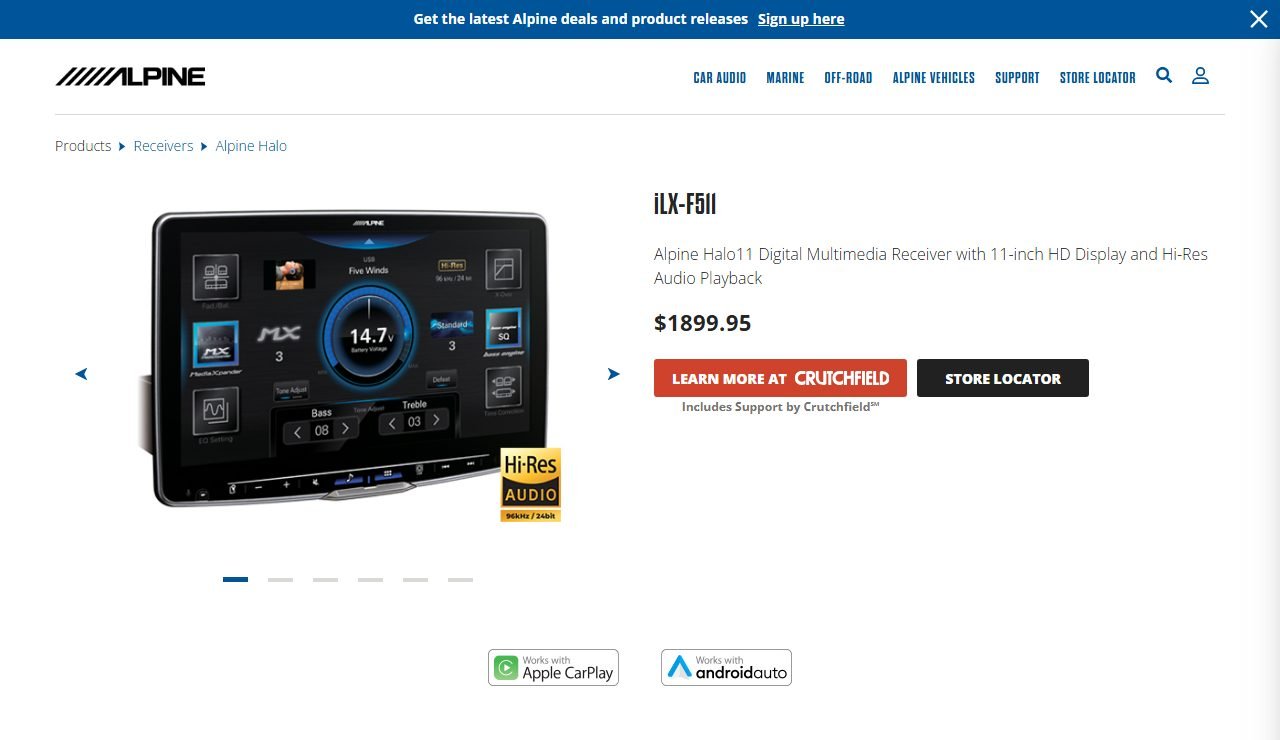
Alpine’s US page titles the iLX-F511 as the Halo11, an 11-inch receiver with high-resolution playback. Alpine lists three 4-volt preouts, a 13-band parametric equalizer per channel, and 6-channel time correction, plus high-pass and low-pass crossovers. The screen is WXGA, 1280×720, on an adjustable mount attached to a single-DIN chassis. Wireless and wired Apple CarPlay and Android Auto are part of the product. HDMI input and HDMI output are both on the Amazon specification block for this model, along with two RCA camera inputs and a separate dash-cam input for the DVR-C320R, sold separately. Audio formats listed there include FLAC, WAV, and APE. The built-in amplifier is the messy number: Alpine’s product summary in search of the US page has been stated as 18 watts RMS × 4, while the Amazon A+ table on 6 October 2026 said 16 watts RMS × 4. Treat the amplifier rating as unresolved between those two published lines, and do not use either figure as a sound-quality score. The preouts are the part that matters if an external amplifier is the plan, and they are 4 volts, not 5.
On 6 October 2026, ASIN B09WWSMMNM was the iLX-F511, manufacturer part iLX-F511, UPC 793276084361, at $1,660.00 with one left in stock. Alpine’s own page showed $1,899.95. The listing warranty description says 1 year. One Amazon marketing block on that page mentions the iLX-F509 in a CarPlay sentence. The model number and the manufacturer part on the listing are iLX-F511. Buy the F511, and ignore the stray F509 line.
Screen size versus the Sony XAV-AX8500 is already covered in XAV-AX8500 vs Alpine Halo11. The audio point here is narrower. The Halo11’s parametric EQ is per channel, which is a real tuning feature. The preout voltage is a step below the Sony Mobile ES and Kenwood Reference radios. Paying Alpine’s or Amazon’s price for the 11-inch screen is a display decision. It is not automatically a better signal to an amplifier.
Check the Alpine iLX-F511 on Amazon
What the tuning controls do
Time alignment, which Alpine calls time correction, delays the closer speaker so it arrives with the farther one. Sony’s XAV-9000ES guide sets that delay as a distance, in 0.1 inch or 1 cm steps. A driver setting is wrong for the passenger.
A crossover sends lows to a subwoofer and keeps them out of a small speaker. Sony exposes a front two-way split on the XAV-9000ES. Alpine lists high-pass and low-pass on the Halo11. A tweeter left full-range can be damaged. The control only helps if it is set for the speakers in the car.
A graphic EQ is a row of fixed frequencies. A parametric band is the frequency, the amount, and the width. Cut is safer than boost. Sony’s custom curves save a result. They do not measure the car.
Kenwood’s optical output on the DMX1058XR sends linear PCM at 48 or 96 kHz, 24-bit, to a processor that accepts optical. The processor then owns the crossovers. The jack does not include the processor.
Head unit, amplifier, and a separate processor
Three builds get confused in the same shopping cart. The first uses the radio’s internal amplifier and the factory or replaced speakers. In that build, 5-volt preouts are unused. Time alignment and the EQ still matter. Preout voltage does not. The second build adds an amplifier and a subwoofer, and uses the radio’s preouts and crossovers. That is the build the XAV-9000ES and the DMX958XR are documented for. The third build puts a separate digital signal processor between the radio and the amplifiers. Then the radio’s EQ should usually be left flat, because two equalizers in a row fight each other. The DMX1058XR’s optical output is the documented reason to pick that Kenwood when the processor is already in the plan.
An amplifier does not make a harsh tweeter polite. It makes the speaker louder until the speaker or the gain structure runs out. Set amplifier gain to the preout voltage you actually have. A 5-volt radio into an amplifier whose gain is still parked at a 2-volt setting will clip. A 4-volt Alpine into a gain structure set for 5 volts will be quieter and noisier than it needs to be. The voltage on the spec sheet is a setup number.
Hi-res file support belongs in this decision only if you will play those files. LDAC needs a phone that sends LDAC. A CarPlay session does not automatically use the radio’s USB DAC path. If the music comes from Apple Music or Spotify inside CarPlay, the phone app and Apple’s or Google’s pipeline decide the stream. The radio’s FLAC decoder never sees it. Buy the decoder for USB listening. Do not buy it as a promise about CarPlay.
Installation
The XAV-9000ES and the DMX958XR are fixed faces in a double-DIN opening. The XAV-9500ES, the DMX1058XR, and the iLX-F511 put a large screen on a smaller chassis and need open dash in front of the opening. Depth still matters on the fixed radios. Sony’s mounting depth for the 9000ES is about 120 mm, with a maximum depth of about 137 mm. A floating screen adds a different problem: the glass must not block a vent, a hazard switch, or an airbag lid. Single-DIN versus double-DIN is the opening-size explanation. It does not measure your dash.
Budget for a dash kit, a harness, and usually an antenna adapter. Steering-wheel controls and a factory amplifier need an interface. Sony, Kenwood, and Alpine all point at iDataLink Maestro, sold separately, and the features depend on the vehicle. Sony’s own note on the XAV-9000ES says the two-way speaker mode is the wrong configuration when Maestro is feeding a factory amplifier. Read that before you copy a two-way preset from a forum.
Cameras are extra. The Kenwood Reference radios list four inputs, the Sony listings list three, and the Halo11 lists two RCA cameras plus a separate dash-cam input. None of those cameras are in the head-unit price.
How to choose
Choose the Sony XAV-9000ES when a fixed screen fits and you want the tuning steps written down: 5-volt preouts, parametric Q, a two-way front mode, and distance-based time alignment. At $998.00 on 6 October 2026 it was also the least expensive new radio in this shortlist. That is a value fact. It is not a sound measurement.
Choose the XAV-9500ES when you want that Mobile ES description on a 10.1-inch floating screen and a single-DIN chassis, and you have confirmed the offer is new at $1,198.00 rather than the used $949.99 line. Choose the DMX958XR when you want Kenwood’s fixed 1280×720 Reference radio, 5-volt preouts, and the published distortion and noise figures, and you do not need an optical output. Choose the DMX1058XR when an external processor with an optical input is part of the build. Choose the iLX-F511 when the 11-inch screen and per-channel parametric EQ are worth 4-volt preouts and a price that was $1,660.00 on Amazon and $1,899.95 on Alpine’s page.
Skip this list if the factory speakers are staying and you only want wireless CarPlay. The other guide is the right one, and a radio with fewer preouts can be the better buy. Skip it if a shop has already specified a processor and only needs a clean digital source. Then the optical output matters more than another EQ band.
FAQ
Which head unit has the most useful sound controls on paper?
The Sony XAV-9000ES, because the help guide documents 5-volt preouts, a 14-band graphic EQ, an 8-band parametric EQ with Q, crossovers, a two-way mode, and time alignment in small distance steps. That is documentation, not a blind listening result.
Does a 5-volt preout sound better than a 4-volt preout?
Not by itself. Five volts gives an external amplifier more signal before the gain knob. Four volts can be set up cleanly. Neither voltage improves a speaker that is off-axis or underpowered by the radio’s own amplifier.
Does high-resolution audio mean I will hear more detail?
It means the radio lists a high sample rate, a codec such as LDAC, or a file type such as FLAC. CarPlay streams do not automatically use that USB decoder. No listening test in this article claims a difference.
Should I buy a separate DSP instead of a fancier head unit?
Buy the processor when you need more channels or finer crossovers than the radio lists. Then leave the radio’s EQ flat. The Kenwood DMX1058XR is the radio in this group with a documented optical PCM output for that job.
Is the Sony XAV-AX8500 the sound-quality Sony?
No. Use the XAV-AX8500 review for that 10.1-inch receiver. The sound-tool Sonys in this article are the XAV-9000ES and the XAV-9500ES.
Why is the Alpine more expensive if the preouts are 4 volts?
You are paying for the 11-inch Halo screen and Alpine’s per-channel parametric EQ, not for a higher preout voltage. Amazon was $1,660.00 with one left. Alpine’s page was $1,899.95.
Can I add steering-wheel controls?
Often, with a Maestro module sold separately. Features depend on the year and trim. Sony warns that a factory-amplifier Maestro setup on the XAV-9000ES should use the front-and-rear speaker configuration.
Final recommendation
Buy the Sony XAV-9000ES if a fixed double-DIN screen fits and you want the tuning controls Sony actually documents. Recheck the $998.00 price. It was in stock on 6 October 2026.
Buy the XAV-9500ES if you need the floating 10.1-inch Mobile ES and you select the new offer at $1,198.00. Buy the Kenwood DMX958XR if you want the fixed Reference radio at $999.00 and you have read the existing review. Buy the DMX1058XR, ASIN B0F83TY2LJ only, if the optical output is the feature you came for. Buy the Alpine iLX-F511 if the 11-inch screen is the point and you accept 4-volt preouts.
Whichever radio you pick, the speakers, the amplifier gain, and the time-alignment distances will decide more of what you hear than the badge on the face. The head-unit price is not the installed price.