
For a US buyer choosing specifically between the Sony XAV-AX8500 and the Kenwood Excelon Reference DMX958XR, the Sony is the better overall buy on 6 October 2026. It was in stock new at $798.00, against $999.00 for the Kenwood, and its 10.1-inch 1280×720 screen is the documented difference most of that money is actually buying. Both radios list three 5-volt preouts, wired and wireless Apple CarPlay, and wireless Android Auto. Five volts does not make one of them sound better. A larger screen does not either. Moon Picke did not listen to these units, measure them, or time a CarPlay connection.
Best overall: Sony XAV-AX8500, for the buyer who can fit a floating 10.1-inch screen and wants the lower new price.
Choose Sony if the dash has room for that floating panel, three camera inputs are enough, and you do not need built-in HD Radio. The tuning tools are real, and they are spelled out below. They are not a listening score.
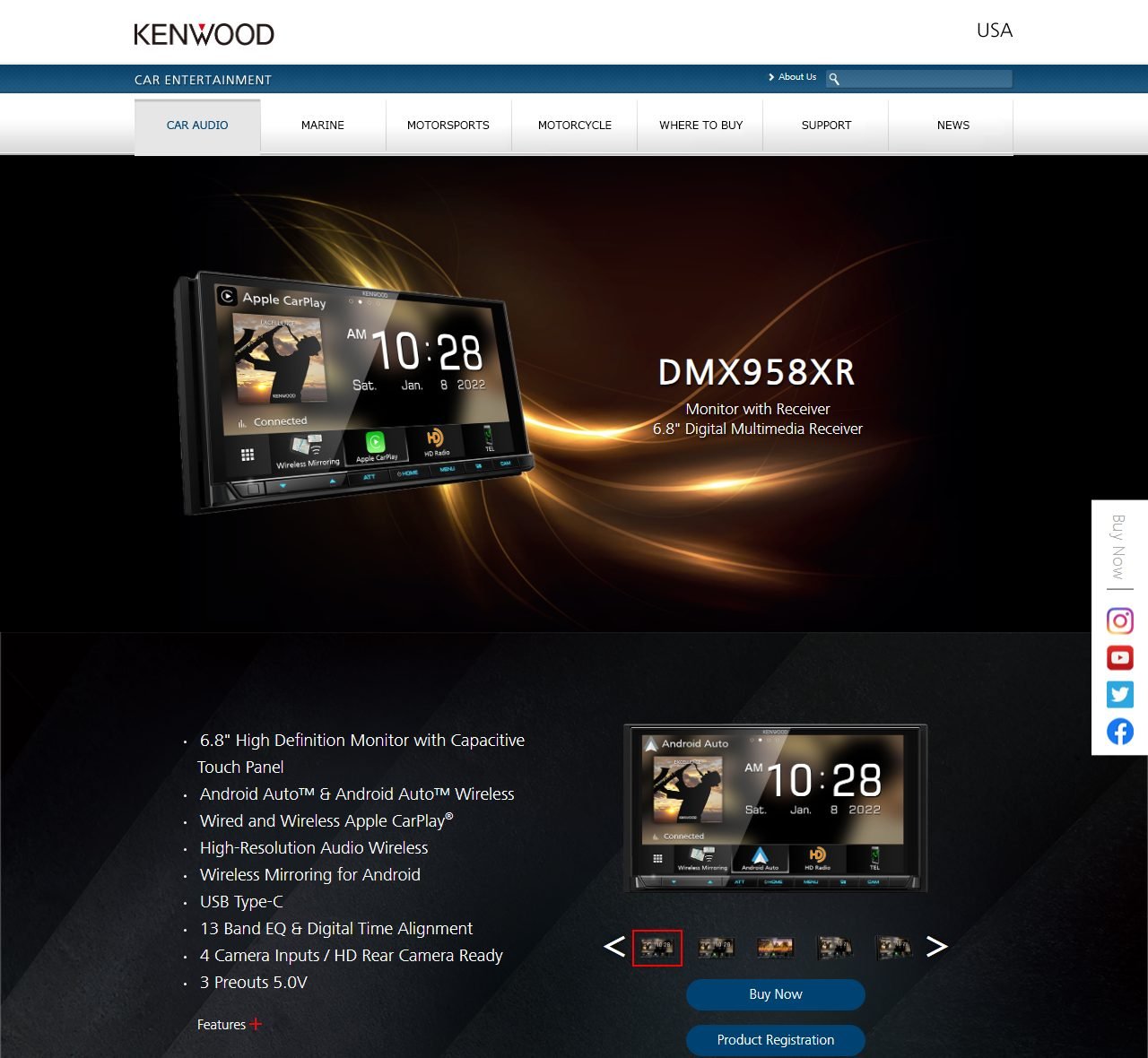
Choose Kenwood if you want a fixed double-DIN face, four camera inputs, built-in HD Radio, and Kenwood’s published 13-band EQ plus a 2-way and 3-way crossover. Accept a 6.75-inch panel (the marketing line says 6.8 inches) and the higher price.
Prices and stock were checked on Amazon.com on 6 October 2026. Both new offers were thin: two Sonys left, three Kenwoods left. Specifications below come from Sony’s US help guide, Sony Canada’s specification table, and Kenwood USA’s DMX958XR page. Prices, stock, seller names, and warranty lines are Amazon listing copy from that date.
Affiliate disclosure. As an Amazon Associate I earn from qualifying purchases. Amazon links on this page are paid links. Read the affiliate disclosure and how we evaluate products. Each button goes only to the head-unit listing named in that section.
Sony vs Kenwood at a glance
This page answers one decision: AX8500 or DMX958XR. The published Sony XAV-AX8500 review stays the place for a Sony-only read. The published Kenwood DMX958XR review stays the place for a Kenwood-only read. If the job is “which wireless CarPlay radio,” use the wireless Apple CarPlay head unit guide. That guide does not pick between these two.
| Decision | Sony XAV-AX8500 | Kenwood DMX958XR |
|---|---|---|
| Best overall on 6 Oct 2026 | Yes, if the floating screen fits | When a fixed face and the extra integration matter more than glass |
| Screen | 10.1 in, 1280×720, floating, capacitive | Spec table 6.75 in; marketing 6.8 in. Same 1280×720 grid, fixed |
| Chassis | Single-DIN height. Mounting about 178 × 50 × 158 mm | Double-DIN. Main unit about 178 × 100 × 85 mm |
| CarPlay / Android Auto | Wired and wireless for both | Wired and wireless CarPlay. Android Auto and Android Auto Wireless |
| Preouts | 5 V, three: front, rear, sub | 5 V / 10 kΩ, three. Preout impedance listed as 300 ohms or less |
| EQ Kenwood or Sony actually publishes | Custom curve –12 to +12. Sony Canada says 14-band. No center frequencies in the help guide | 13 bands with listed centers, gain –9 to +9 dB |
| Crossover | High-pass, low-pass, slope, subwoofer phase. Frequencies not listed in the help guide | 2-way and 3-way tables with frequencies and slopes |
| Time alignment | 0.1 inch or 1 cm steps | 0 to 20.01 ft, in 0.03 or 0.04 ft steps |
| Cameras | Three: rear, input 1, input 2 | Four, including an HD rear-camera input |
| HD Radio | Not listed. FM/AM, plus optional SiriusXM tuner | Built in. SiriusXM still needs a separate tuner |
| Amazon, new, 6 Oct 2026 | $798.00, list $899.99, 2 left. ASIN B0CXF7H2Z4 | $999.00, 3 left. ASIN B0B4WZTQLT |
Current price and availability
The exact DMX958XR is still sold new. Kenwood USA still publishes the model page, and Amazon still had a head-unit-only offer, with three left. It is an older fixed Reference radio beside newer floating Kenwoods. A buyer can still set it against the AX8500, because the jobs differ by about $200, not because either radio is easy to find.
Sony’s new listing, ASIN B0CXF7H2Z4, showed $798.00 against a list price of $899.99, with “only 2 left” and an In Stock line. The item-details model and manufacturer part were both XAV-AX8500. The UPC was 027242927674. The seller on that offer was Quality Industries, labeled an authorized dealer. Amazon’s warranty description read “3 Year Manufacturer.” Do not use a camera bundle, a SiriusXM bundle, or a renewed unit as the Sony you are pricing.
Check the Sony XAV-AX8500 on Amazon
Kenwood’s new listing, ASIN B0B4WZTQLT, showed $999.00 as a one-time price, with three left. The item-details model and manufacturer part were both DMX958XR. The UPC was 019048233912. The box contents on the listing were the receiver, sleeve, trim ring, harness, two 39-inch USB extension cables, a GPS antenna, and an external microphone. That is the head unit, not a camera kit. Amazon’s warranty description read two years. The seller shown was Santa Clarita AutoSound, and the page did not label that seller as an authorized Kenwood dealer.
Kenwood’s own page tells buyers to purchase from authorized Kenwood retailers, and it says Kenwood does not offer the manufacturer’s limited warranty for car audio bought from a dealer Kenwood has not authorized. The Amazon warranty line and Kenwood’s dealer rule are both on the record. This article does not resolve which one would apply to that specific order.
Check the Kenwood DMX958XR on Amazon
The Kenwood premium is about $201 for a smaller screen. It makes sense if you are paying for the fixed face, a fourth camera, HD Radio, and the fuller crossover table. It does not make sense if you only want a larger CarPlay display.
Display and physical design
Sony’s monitor section lists a 10.1-inch / 25.7 cm TFT LCD and 2,764,800 pixels, arranged as 1280 × 3 (RGB) × 720. Sony Canada lists the same diagonal, a capacitive panel, and 425 cd/m². The screen floats on a short-height chassis. The US help guide’s maximum size is about 269 × 167 × 263 mm. Sony Canada lists 269 × 167 × 258 mm. Those two depths disagree. Use the mounting size in the installation section for the dash opening.
Kenwood’s specification table lists a 6.75-inch diagonal, a viewable area of 152.1 × 79.5 mm, and the same 2,764,800-pixel count as 1280 × 720 × RGB. The headline on that page says 6.8 inches. Both numbers are Kenwood’s. The pixel grids match, so the Kenwood is smaller glass, not a sharper panel. Kenwood does not publish a brightness number to set next to Sony’s 425 cd/m².
Display winner: Sony. 10.1 inches against 6.75 inches is what the driver sees. The matching pixel count makes the Kenwood denser, not sharper, and the flush face is an installation advantage rather than a picture-quality claim. Sony’s help guide also documents a custom hardware button (mute, display off, source, sound, or subwoofer/EQ) plus previous and next. Kenwood documents four home-screen widgets and an optional remote, the KCA-RCDV340. Neither note is a touch test.
Wireless CarPlay, Android Auto, and connectivity
Sony supports wired and wireless Apple CarPlay and wired and wireless Android Auto. Kenwood’s feature list says the same thing in Kenwood’s wording: wired and wireless Apple CarPlay, plus Android Auto and Android Auto Wireless. A compatible phone is required on both. This article did not pair a phone with either radio.
Bluetooth is version 5.0 on both, with SBC, AAC, and LDAC. Kenwood’s “High-Resolution Audio Wireless” line is that LDAC path, used under the Japan Audio Society logo. The logo is a certification mark, not a measurement of what you hear. Sony lists LDAC as well. Kenwood also lists Android wireless mirroring (HDCP 2.2, touch via UIBC) and Music Mix for up to five Bluetooth devices. Sony’s help guide does not list mirroring or a five-device mix.
For the US XAV-AX8500(UC), Sony’s help guide lists 802.11 a/n/ac on 5.725–5.850 GHz. Kenwood lists 802.11 a/b/g/n/ac on 2.4 GHz and 5 GHz. Those are radio specifications, not a CarPlay speed test.
USB is Type-C on both, at up to 3.0 A. Sony’s port is rear. Kenwood also lists USB 2.0 High Speed and includes a USB-C cable plus a USB-A adapter. HDMI input exists on both. Sony accepts 480p, 576p, and 720p, and the help guide says HDMI output is not available. Kenwood uses an HDMI Type-D connector, accepts VGA, 480p, and 720p, and lists linear PCM up to 192 kHz / 24-bit. The optional cable Kenwood names is the KCA-HD200.
Radio is the clearer split. Kenwood has a built-in HD Radio tuner, with digital FM and digital AM ranges in the spec table, plus analog FM/AM. Sony’s US help guide lists FM and AM ranges and does not list HD Radio. Both are SiriusXM-ready only in the sense that a tuner is sold separately. Connectivity winner: Kenwood, on HD Radio, Android screen mirroring, and the dual-band Wi-Fi table. CarPlay itself is a tie on paper.
Audio architecture and tuning
Treat this section as a document comparison. A 13-band EQ is not automatically better than a 14-band EQ. A wider gain range is not automatically audible. A Hi-Res badge is not a road test.
Kenwood’s DSP section lists a 13-band graphic equalizer. The centers are 62.5, 100, 160, 250, 400, 630, 1 kHz, 1.6 kHz, 2.5 kHz, 4 kHz, 6.3 kHz, 10 kHz, and 16 kHz. Gain runs from –9 dB to +9 dB in 1 dB steps. Time alignment, under Position, runs from 0 to 20.01 feet in steps of 0.03 or 0.04 foot, with a gain trim from –8 dB to 0 dB and a subwoofer level from –50 dB to +10 dB. The 2-way crossover lists high-pass and low-pass frequencies and slopes of –6, –12, –18, and –24 dB/octave. The 3-way table adds a band-pass filter and drops the –6 dB/octave slope. That is a complete published tuning map.
Sony’s US presets include R&B, Rock, Pop, Dance, Hip-Hop, EDM, Jazz, Soul, Country, and two custom slots. The custom curve runs from –12 to +12 and saves to Custom 1 or Custom 2. The help guide does not count the bands or list center frequencies. Sony Canada’s table does say “14-band Equalizer,” so that is the published count, without those frequencies. Time alignment is 0.1 inch or 1 cm. Crossover is front/rear high-pass, subwoofer low-pass, slope, and phase. The cutoff list is not printed.
Sony’s 0.1-inch step is finer arithmetic than Kenwood’s 0.03-foot step (about 0.36 inch). That is not a claim that one alignment sounds more precise. Neither setting was used on a bench for this article.
Kenwood’s USB music table lists FLAC and WAV up to 192 kHz / 24-bit, plus MP3, WMA, AAC, and Vorbis. In that same USB section, not in the amplifier lines, Kenwood prints 0.010% total harmonic distortion at 1 kHz, a 98.5 dB signal-to-noise ratio, and 89 dB dynamic range, with a 20–88,000 Hz response at 192 kHz sampling. Sony’s USB section lists MP3, WMA, AAC, FLAC, ALAC, WAV, and DSD, with WAV listed up to 768 kHz, FLAC up to 384 kHz, and DSD at 2.8 to 22.4 MHz. A higher file ceiling is not a quieter car, and Sony does not print a matching USB distortion figure.
Keep the amplifier lines in their own boxes. Sony’s US CTA-2006 rating is 20 W RMS × 4 at 4 ohms and ≤ 1% THD+N, signal-to-noise 85 dBA at 1 watt, maximum 55 W × 4. Kenwood lists 22 W × 4 at less than 1% THD and a 50 W × 4 maximum, into 4–8 ohms. Different methods. Do not treat 22 as louder than 20, or 55 as clean power.
Audio-tuning winner, on documentation only: Kenwood, because the centers, the ±9 dB steps, the crossover tables, and the USB-section noise figures are printed. Sony’s –12 to +12 curve, the Canada 14-band label, and the CTA-2006 line are also printed. The extra Sony band does not overturn Kenwood’s map, and the map does not prove better sound.
Preouts, DSP, and system expansion
Both radios are in the same preout class. Sony Canada lists “5V 3-Pre (Front LR / Rear LR / Sub x 1).” Kenwood lists a preout level of 5 V / 10 kΩ and a preout impedance of 300 ohms or less. The Sony subwoofer output is one sub channel, not a stereo sub pair. Higher voltage is not available here as a tie-breaker, because neither sheet shows a higher voltage.
The expansion difference is the crossover, not the voltage. Kenwood publishes a 3-way network with slopes. Sony’s crossover is front, rear, and sub, with slope and phase: a normal 2-way-plus-sub layout, not that 3-way table. Either trio can feed an external amplifier. Kenwood states the preout load and impedance; Sony Canada states the 5-volt outputs. If you need a digital optical output into a separate DSP, neither of these two models is the radio that lists one.
Expansion winner: Kenwood, on the 3-way table and the printed preout impedance. Voltage is a tie. Buying the Kenwood to chase a louder preout would miss the point.
Cameras and vehicle integration
Sony Canada lists three camera inputs: Rear, Input 1, and Input 2. Kenwood lists four, including an HD rear input for the optional CMOS-740HD, which Kenwood says can show 1280×720. Kenwood’s layouts can include a front camera, the optional DRV-N520 dash camera, and side cameras. Side-camera automation needs an optional iDatalink Maestro RR on a supported vehicle. Camera winner: Kenwood, on the count. No camera was connected for this article.
Factory integration is optional on both, through an iDatalink Maestro RR or RR2 sold separately, and it depends on the vehicle. Kenwood also mentions climate data and optional radar-detector display on compatible setups. Check the Maestro vehicle list before you count on retained steering-wheel controls. HD Radio, built into the Kenwood only, is the other integration difference.
Installation considerations
Sony’s mounting size is about 178 × 50 × 158 mm (7 × 2 × 6 1/4 inches), so the sleeve is single-DIN height and about 6.25 inches deep, with a 10.1-inch panel standing off the dash. Mass is about 2.6 kg. Fit details for that screen are in the XAV-AX8500 installation notes.
Kenwood’s main unit is 178 × 100 × 85 mm (7 × 3-15/16 × 3-3/8 inches), or 182 × 112 × 85 mm with the sleeve. Weight is about 1.5 kg with the sleeve. The page says “less than 3.5 inches” of depth, and 85 mm is 3.35 inches. The face fills a fixed double-DIN opening. The single-DIN versus double-DIN explainer covers the opening itself.
A shallow double-DIN cavity favors the Kenwood. A deeper opening with room above it can take the Sony. Neither dimension replaces a vehicle-specific dash kit.
Installation winner: Kenwood, for a standard double-DIN opening and the shorter published depth. Sony wins the install only when the owner has already decided the floating screen fits and wants that screen more than an easy sleeve depth.
Which one should you buy?
Buy the Sony XAV-AX8500 if the screen and the price are the decision. On 6 October 2026 it was $201 less than the Kenwood, with a panel about three inches larger on the diagonal, the same 5-volt preout class, wireless CarPlay, wireless Android Auto, LDAC, and a documented custom EQ and time alignment. Three camera inputs and FM/AM, rather than HD Radio, have to be acceptable. Stock was two units at the checked offer, so the price can move.
Buy the Kenwood DMX958XR if the dash wants a flush double-DIN radio and you will use the parts Sony does not match on paper: a fourth camera input, built-in HD Radio, Android wireless mirroring, a 13-band EQ with printed centers, and a 3-way crossover. Pay $999.00 only with your eyes open about the seller. The checked offer did not show an authorized-dealer label, and Kenwood’s warranty statement is aimed at that situation. Stock was three units.
The Excelon name and Sony Canada’s 14-band label are not sound tests. The decision evidence is the screen, the chassis, the camera count, HD Radio, and two tuning sheets that are not interchangeable.
- Overall: Sony XAV-AX8500.
- Display: Sony.
- CarPlay: tie on the feature list. Broader connectivity: Kenwood.
- Audio tuning, as documented: Kenwood.
- System expansion: Kenwood, on the 3-way table. Preout voltage is a tie.
- Cameras: Kenwood.
- Installation: Kenwood for a shallow double-DIN dash. Sony if the floating screen is the point.
- Usability: no hands-on winner. Kenwood publishes widgets and five-device Bluetooth mixing. Sony publishes a custom hardware button.
- Value: Sony, at $798.00 against $999.00 for less glass.
- Availability: both new, both low. Three Kenwoods and two Sonys at the checked offers. Not a comfortable winner either way.
Current alternatives, only where they change the decision
The AX8500 review and the DMX958XR review cover each radio alone. They do not replace this choice. Two other Kenwoods are easy to mix up with this one, and neither gets a buy button here. The DMX908S shares a manual with the DMX958XR and is a different receiver. The DMX1058XR is a later floating 10.1-inch Reference model, priced well above $999.00, and it is the one that adds a digital optical output. Do not buy it under the DMX958XR name. If wireless CarPlay is the whole list, use the wireless CarPlay guide instead of this page.
FAQ
Is the Kenwood DMX958XR still sold new in the US?
Yes, on 6 October 2026. Kenwood USA still hosts the page, and Amazon had a new unit at $999.00 with three left, ASIN B0B4WZTQLT. It is an older fixed design with thin stock. This article does not swap in a newer Kenwood.
Which is better, the Sony XAV-AX8500 or the Kenwood DMX958XR?
The Sony, for most buyers who can fit the screen: it costs less and the display is larger, with the same 5-volt preout class. The Kenwood fits a fixed dash that needs four cameras, HD Radio, and the published 13-band and 3-way tables. That is not a listening test.
Do both have wireless Apple CarPlay and wireless Android Auto?
Yes. Both document wired and wireless CarPlay and wireless Android Auto. A compatible phone is required. No connection was timed here.
Does the Sony have more EQ bands?
Sony Canada says 14-band. Kenwood says 13-band and prints the center frequencies and a –9 to +9 dB range. Sony’s help guide prints a –12 to +12 curve and does not print the centers. Band count is not a sound-quality result.
Are the 5-volt preouts a reason to prefer one radio?
No. Both list three 5-volt preouts. The documented expansion difference is Kenwood’s 3-way crossover, not the voltage.
Which one has more camera inputs?
Kenwood, with four, including an HD rear input. Sony Canada lists three.
Will the Sony’s floating screen fit a double-DIN dash?
The Sony sleeve is about 50 mm tall and 158 mm deep, and the 10.1-inch panel needs space above the opening. The Kenwood fills a double-DIN hole and is about 85 mm deep. Measure the cavity first.
Is HD Radio included?
On the Kenwood, yes. Sony’s tuner section lists FM and AM only. SiriusXM needs a separate tuner on both.
Final verdict
The Sony XAV-AX8500 is the one to buy if you are deciding between these two exact models and the dash can take the floating screen. It was the cheaper new unit on 6 October 2026, the screen is the larger 1280×720 panel, and it does not give up the 5-volt preouts, wireless CarPlay, or wireless Android Auto to get there.
The DMX958XR is still a rational US alternative when the dash is a shallow double-DIN opening and you will use four cameras, HD Radio, and the fuller EQ and crossover tables. It is not the better-sounding radio by default, and it costs more. Check the seller against Kenwood’s authorized-dealer rule before paying $999.00, and do not let thin stock push you into a bundle or a renewed unit.