
For a US buyer choosing between the Sony XAV-AX8500 and the Pioneer DMH-WT8600NEX, the Sony is the better overall buy on 6 October 2026. Both are current 10.1-inch floating receivers on a 1-DIN chassis, with wired and wireless Apple CarPlay and wired and wireless Android Auto. The Sony was $798.00 new on Amazon. Pioneer’s own US store listed the exact new DMH-WT8600NEX at $1,500.00, and Amazon showed the same model at $1,499.99. That is about $700 for HD Radio, built-in Alexa, a remote in the box, and a 6-channel 4-volt preout section. It is not $700 of proven better sound. Moon Picke did not listen to either radio, measure a screen, or time a CarPlay connection.
Best overall: Sony XAV-AX8500, if the dash can take a floating 10.1-inch screen and you do not need built-in HD Radio.
Choose Sony if the lower new price, three camera inputs, and three 5-volt preouts matter more than Alexa or HD Radio. Sony Canada lists a 14-band equalizer. The US help guide documents a custom curve from –12 to +12 and time alignment in 0.1-inch or 1 cm steps, without printing the band frequencies.
Choose Pioneer if you want HD Radio, Amazon Alexa built in, an included remote, and Pioneer’s published 13-band EQ, built-in DSP label, and network crossover with a band-pass mode. Accept 4-volt preouts rather than 5-volt, and a camera layout with one dedicated backup input plus a second input that can be a camera or A/V.
Prices and stock were checked on 6 October 2026. Specifications come from Sony’s US help guide, Sony’s US product page, Sony Canada’s specification table, and Pioneer USA’s DMH-WT8600NEX page, except where a sentence is marked as Amazon or Crutchfield copy.
Affiliate disclosure. As an Amazon Associate I earn from qualifying purchases. Amazon links on this page are paid links. Read the affiliate disclosure and how we evaluate products. Each Amazon button goes only to the head-unit listing named in that section.
Sony vs Pioneer at a glance
This page answers one decision: AX8500 or WT8600NEX. The published Sony XAV-AX8500 review stays the Sony-only read. A wider screen-size shopping list is the large-screen CarPlay guide. Wireless phone connection, on its own, is the wireless Apple CarPlay guide. Neither of those pages picks between these two.
| Decision | Sony XAV-AX8500 | Pioneer DMH-WT8600NEX |
|---|---|---|
| Best overall on 6 Oct 2026 | Yes, for the lower new price in the same screen class | When HD Radio, Alexa, and the Pioneer tuning sheet are the point |
| Screen | 10.1 in, 1280×720, capacitive, floating. Sony Canada lists 425 cd/m² | 10.1 in / 16:9, HD-720 capacitive, floating, 1-DIN chassis |
| CarPlay / Android Auto | Wired and wireless for both | Wired and wireless for both |
| Preouts | 5 V, three: front, rear, one sub | 4 V, listed as 6-channel RCA |
| EQ and crossover Pioneer or Sony publishes | Canada: 14-band. Help guide: custom curve –12 to +12, no center frequencies. High-pass, low-pass, slope, phase | 13-band graphic EQ. Network mode HPF / band-pass / LPF. Standard mode HPF / LPF. DSP listed as built in |
| Time alignment | 0.1 inch or 1 cm | Manual, plus a listening-position selector. Distances are not printed on the store page |
| Cameras | Three: rear, input 1, input 2 | Dedicated backup, plus input 3 as A/V or a second camera |
| Radio extras | FM/AM. No HD Radio in the tuner section. SiriusXM tuner sold separately | HD Radio built in. SiriusXM-ready, tuner sold separately. Alexa built in |
| Checked price | Amazon $798.00, list $899.99, 2 left | Pioneer USA $1,500.00, 5 left. Amazon $1,499.99 |
Price and current availability
Both exact models were still sold new in the US on 6 October 2026. This is a real premium-screen comparison, not a hunt for a discontinued Pioneer.
Sony’s Amazon listing, ASIN B0CXF7H2Z4, showed a one-time price of $798.00 against a list price of $899.99, with only 2 left. The item-details model and manufacturer part were XAV-AX8500. The UPC was 027242927674. The seller was Quality Industries, labeled an authorized dealer. Amazon’s warranty description read “3 Year Manufacturer.” Sony’s US product page lists an MSRP of $999.99. Do not price a camera bundle or a renewed unit as this Sony.
Check the Sony XAV-AX8500 on Amazon
Pioneer USA’s product page for the DMH-WT8600NEX showed a regular price of $1,500.00, with “Only 5 left” and an estimated delivery window of 12 October to 17 October. The page title is the 10.1-inch 1-DIN floating receiver. That is the new model on Pioneer’s own store.
Amazon ASIN B084ZYMHSH is the head-unit listing checked for this article. Item details showed model DMH-WT8600NEX, UPC 884938445702, and a one-time price of $1,499.99. The offer next to that price was sold by Crutchfield and marked In Stock, with free delivery dated 14 October. The listing title does not say Renewed or refurbished, and the page text did not use the word Renewed. A separate Amazon.com offer on the same page showed 4 left, with a Prime delivery date of 8 October. That second offer did not print a different price in the text fetched here. Amazon’s warranty description on the listing was 1 year. The page did not label Crutchfield, or Amazon.com, as a Pioneer-authorized dealer.
Do not use the renewed listing, a camera bundle, or a Maestro bundle as the Pioneer in this comparison. Pioneer also sells a reconditioned receiver under a different model number. That is not the new DMH-WT8600NEX, and it is not the Amazon button below.
Check the Pioneer DMH-WT8600NEX on Amazon
The Pioneer costs about $700 more. That premium makes sense for HD Radio, Alexa, and the extra preout channels. It does not make sense if you only want a 10.1-inch wireless CarPlay screen.
Display and design
Sony’s monitor section lists a 10.1-inch / 25.7 cm TFT LCD and 2,764,800 pixels, arranged as 1280 × 3 (RGB) × 720. Sony’s US product page calls it a capacitive HD touchscreen with optically gapless construction. Sony Canada lists 425 cd/m². The panel floats on a short-height chassis. The US help guide’s maximum size is about 269 × 167 × 263 mm. Sony Canada lists 269 × 167 × 258 mm. Those depths disagree. Use the mounting size in the installation section for the dash opening.
Pioneer’s store page lists a 10.1-inch, 16:9, HD-720 capacitive floating screen on a 1-DIN chassis. It does not print a candela figure or the 1280×720 pixel math. HD-720 is the same resolution class as Sony’s 1280×720 grid. It is not a claim that one panel is sharper. Pioneer does not publish a brightness number to set next to 425 cd/m².
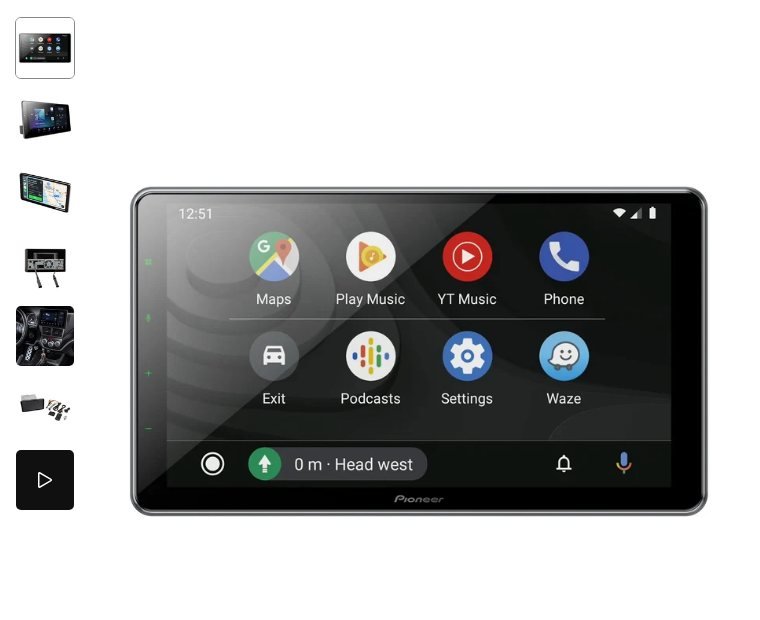
Display winner: a tie on size class. Both are 10.1-inch capacitive floating panels in the HD-720 class. Sony publishes the pixel count and a brightness figure. Pioneer publishes the floating 1-DIN layout and does not publish nits. No touch-response test was run.
Sony’s help guide documents a customizable hardware button, with jobs such as mute, display off, source, sound settings, or subwoofer/EQ, plus previous and next. Pioneer’s spec table says the remote control is included. Neither note is a usability test.
CarPlay, Android Auto, and connectivity
Sony supports wired and wireless Apple CarPlay and wired and wireless Android Auto. Pioneer’s feature list says the same thing: wireless or wired USB for both. A compatible phone is required. This article did not pair a phone with either radio.
Bluetooth is where the sheets diverge. Sony’s help guide lists Bluetooth 5.0, with SBC, AAC, and LDAC. Pioneer’s store page lists built-in Bluetooth, A2DP, AVRCP 1.6, a dual-phone connection, five-phone registration, and an included microphone. It does not name SBC, AAC, or LDAC. Do not read that silence as proof that a codec is missing, and do not treat LDAC as a listening result. Sony also does not list a five-phone registry.
Pioneer adds Amazon Alexa as a built-in feature, plus Wi-Fi described as tethering and a hotspot. Sony’s US help guide, for the UC model, lists 802.11 a/n/ac on 5.725–5.850 GHz. Those are different Wi-Fi descriptions, not a speed test. Pioneer’s CarAVAssist app is the published path for home-screen customization and over-the-air firmware. Sony’s help guide does not list Alexa or that app.
USB is Type-C at the rear on both, at up to 3.0 A. HDMI input exists on both. Sony accepts 480p, 576p, and 720p, and the help guide says HDMI output is not available. Pioneer’s fourth input is HDMI Micro, Type D. Pioneer also lists an RCA video output. Sony does not.
Radio is the clean split. Pioneer has built-in HD Radio, with the store page also listing artist experience, multicasting, and hybrid radio, plus analog presets of 18 FM and 6 AM. Sony’s US tuner section lists FM and AM and does not list HD Radio. Both are SiriusXM-ready only with a tuner sold separately. Connectivity winner: Pioneer, on HD Radio, Alexa, and the dual-phone Bluetooth tools. CarPlay itself is a tie on the feature list.
Pioneer’s US support page offers a DMH-WT8600NEX firmware package labeled v3.09. A Pioneer notice dated 25 August 2026 includes this model in a minor bug-fix and security update, and it warns that the file is model-specific. That is a support fact. It is not a reliability test, and this article does not walk through an update.
Audio, DSP, and system expansion
A 5-volt preout is not automatically better sound than a 4-volt preout. A “DSP” label is not a listening test. A 13-band EQ is not automatically better than a 14-band label, and the reverse is also true.
Sony Canada lists “5V 3-Pre (Front LR / Rear LR / Sub x 1).” The sub output is one channel, not a stereo pair. The US help guide’s CTA-2006 line, marked as the US audio-power specification, is 20 W RMS × 4 at 4 ohms and ≤ 1% THD+N, with signal-to-noise of 85 dBA referenced to 1 watt. Maximum power is 55 W × 4. Speaker impedance is 4–8 ohms. The custom EQ runs from –12 to +12 and saves to Custom 1 or Custom 2. The help guide does not count the bands. Sony Canada’s table says 14-band and does not list the center frequencies. Time alignment is 0.1 inch or 1 cm. Crossover is front/rear high-pass, subwoofer low-pass, slope, and subwoofer phase. The cutoff list is not printed.
Pioneer lists RCA preout voltage of 4 V and RCA preamp outputs of 6 channels. Built-in amplifier lines on the same page are a continuous 22 W × 4, a CTA-2006 rating of 14 W RMS × 4 at 4 ohms, and a maximum of 50 W × 4 at 4 ohms. The maximum line also includes a 70 W × 1 subwoofer figure at 2 ohms. Load impedance is given as 4 ohms, with 4 to 8 ohms allowable. The graphic EQ is 13-band. The page says the digital signal processor is built in, time alignment is manual, and a listening-position selector is included. It does not print the EQ center frequencies or the time-alignment distances. Crossover network mode is high-pass, band-pass, and low-pass. Standard mode is high-pass and low-pass. That band-pass network mode is the clearest tuning difference versus Sony’s front/rear/sub crossover.
Do not subtract 14 from 20 and call the Sony louder. Both CTA-2006 lines are published ratings under that standard’s wording. They are not a road test. Do not treat 55 W or 50 W maximum as clean power. Do not treat Pioneer’s 22 W continuous line as the same sentence as Sony’s 20 W CTA line.
Pioneer’s USB list includes MP3, WMA, WAV, AAC, FLAC, and DSD, with WAV, FLAC, and DSD marked hi-res. Sony’s help guide lists those families plus ALAC, at higher sample-rate ceilings, while Sony’s US product page describes DSD as 96 kHz / 24-bit PCM conversion. The two Sony documents do not match. A higher file number is not a quieter car.
Expansion is a split, not a trophy. Sony’s 5-volt outputs are the higher published voltage, into front, rear, and a mono sub. Pioneer’s 4-volt section is listed as six channels, with a named band-pass network mode. Either set can feed external amplifiers. Voltage changes the gain you set on the amp. It does not, by itself, decide which radio sounds better. If the job is a separate processor with an optical input, neither of these two pages is the radio that advertises one. A wider tuning shortlist lives in the published sound-quality stereo guide. That article is a different question.
Cameras and vehicle integration
Sony Canada lists three camera inputs: Rear, Input 1, and Input 2. Pioneer’s expandability table lists input 1 as a dedicated backup camera, input 2 as AUX on a minijack, input 3 as A/V or a second camera, and input 4 as HDMI Micro. Parking-assist lines are listed as yes. Camera winner: Sony, on dedicated camera count. Pioneer’s second camera shares an input that can also be A/V. No camera was connected for this article.
Factory integration is optional on both. Sony’s US help guide has an iDatalink Maestro section for the UC model. Maestro RR and RR2 are sold separately, and the features depend on the vehicle. Pioneer lists iDatalink Maestro RR and RR2, and also Metra Axxess. Steering-wheel control readiness is listed, with the adapter sold separately. Check the interface brand’s vehicle list before you count on retained factory features.
Installation
Both radios use a 1-DIN-height chassis and then put a 10.1-inch panel in front of the dash. Sony’s mounting dimensions are about 178 × 50 × 158 mm (7 × 2 × 6 1/4 inches). Mass is about 2.6 kg. The floating panel still needs clear space above the opening. Fit notes for that screen are in the XAV-AX8500 installation guide. The single-DIN versus double-DIN explainer covers the opening itself.
Pioneer’s store page confirms the 1-DIN floating chassis and tells the buyer to check depth. It does not print a chassis depth in the specification block fetched on 6 October 2026. Crutchfield’s listing, which is retailer research rather than a Pioneer factory drawing, lists chassis depth 7.455 inches, width 7.025 inches, and height 1.975 inches. If that retailer depth is the one in the box, the Pioneer chassis is deeper than Sony’s published 158 mm mounting depth. Confirm it against the unit or Pioneer’s fitment guide before you treat 7.455 inches as factory metal.
Installation winner: no hands-on winner. Both need floating-screen clearance. Sony is the one with a published mounting depth. Pioneer is the one whose own store page leaves depth to a fitment check.
Sony advantages
The Sony costs about $700 less at the checked new prices and still brings a 10.1-inch HD-class floating screen, wireless CarPlay, and wireless Android Auto. The preouts are 5 volts, not 4. Three camera inputs are dedicated. The US listing’s warranty description is three years, against one year on the Pioneer Amazon listing. LDAC is named. The CTA-2006 amplifier line is 20 W RMS × 4, against Pioneer’s published 14 W RMS × 4. None of that is a sound demo. It is why the Sony is the default when the buyer does not have a specific Pioneer feature to pay for.
Pioneer advantages
HD Radio is built in. Alexa is built in. The remote is included. The preout section is listed as six channels, and the crossover table includes a band-pass network mode plus a standard high-pass/low-pass mode. Bluetooth registration is listed for five phones, with a dual-phone connection. Wi-Fi is described as tethering and a hotspot. An RCA video output is listed. CarAVAssist and a current v3.09 firmware package are part of the support picture. Pioneer’s own store still had five new units. Those are the reasons to spend $1,500.
Which should you buy?
Buy the Sony XAV-AX8500 if the screen and the price are the decision. On 6 October 2026 it was the much cheaper new 10.1-inch floating receiver of this pair, with higher published preout voltage, three camera inputs, and named LDAC. You give up built-in HD Radio and Alexa. Stock on the checked offer was two units.
Buy the Pioneer DMH-WT8600NEX if you will use HD Radio, Alexa, the included remote, and the 6-channel 4-volt section with the named network crossover. Pay $1,499.99 or Pioneer’s $1,500 only for those tools. The Amazon offer checked here was a new head unit sold by Crutchfield, not a renewed radio and not a camera bundle. The page did not print an authorized-dealer badge, so the one-year warranty line on Amazon and Pioneer’s own $1,500 store are both part of the buying record.
- Overall: Sony XAV-AX8500.
- Display: tie on the 10.1-inch HD-720 class. Sony publishes pixels and brightness.
- CarPlay and Android Auto: tie on the feature list.
- Broader connectivity: Pioneer.
- Audio tuning, as documented: Pioneer, for the named 13-band EQ, DSP label, and band-pass network mode. Not a listening win.
- System expansion: split. Sony for 5-volt preouts. Pioneer for six listed preout channels.
- Cameras: Sony.
- Installation: no tested winner. Sony publishes mounting depth. Both need screen clearance.
- Usability: no hands-on winner. Pioneer includes a remote. Sony documents a custom hardware button.
- Value: Sony, at $798.00 against about $1,500.
- Availability: both new. Pioneer’s store had 5 left, and the Amazon head-unit offer was in stock. Sony had 2 left.
FAQ
Is the Pioneer DMH-WT8600NEX still sold new?
Yes. On 6 October 2026 Pioneer USA listed the exact model at $1,500.00 with five left. Amazon ASIN B084ZYMHSH showed the same model at $1,499.99, sold by Crutchfield, and the listing was not marked Renewed.
Which is better, the Sony XAV-AX8500 or the Pioneer DMH-WT8600NEX?
The Sony, for most buyers who want this screen class: it costs far less and keeps 5-volt preouts and three camera inputs. The Pioneer is the one to buy for HD Radio, built-in Alexa, and the published 13-band and network-crossover sheet. That is not a listening test.
Do both have wireless CarPlay and wireless Android Auto?
Yes. Both document wired and wireless modes for Apple CarPlay and Android Auto. No connection was timed here.
Does the 5-volt preout make the Sony sound better?
No. Sony lists 5 volts and Pioneer lists 4 volts. That changes amplifier gain setup. It does not prove a sound-quality winner. Pioneer lists more preout channels.
Which has more camera inputs?
Sony, with three. Pioneer has a dedicated backup input and a second input that can be a camera or A/V, plus HDMI and an AUX minijack.
Does the Pioneer include HD Radio and Alexa?
Yes. Both are built in on Pioneer’s spec table. SiriusXM still needs a separate tuner. Sony’s tuner section does not list HD Radio, and the Sony pages checked here do not list built-in Alexa.
Will either radio sit flush in a double-DIN dash?
No. Both are 1-DIN chassis radios with a floating 10.1-inch panel. The panel needs space in front of the dash. Sony’s published mounting depth is about 158 mm. Measure the cavity either way.
Final verdict
The Sony XAV-AX8500 is the one to buy if you are deciding between these two exact 10.1-inch floating receivers and you do not need HD Radio or Alexa. It was the much cheaper new unit on 6 October 2026, the screen is the same size class, and the published preouts are 5 volts rather than 4.
The Pioneer DMH-WT8600NEX is the rational upgrade only when those Pioneer-only tools are the reason for the extra $700: HD Radio, Alexa, the included remote, six listed preout channels, and the named network crossover. It is not the better-sounding radio by default, and a higher price does not make the 4-volt outputs better than Sony’s 5-volt outputs. Buy the new head unit, not a renewed listing and not a camera bundle.